
 English
 Українська
 Български
 Hrvatski
 Čeština
 Dansk
Dansk Nederlands
 Eesti
Eesti Suomi
Suomi Français
 Deutsch
 Ελληνικα
 Magyar
 Íslenska
 Italiano
 Latviešu
 Lietuvos
 Polski
 Português
 Română
 Русский
 Српски
 Slovenčina
 Slovenščina
 Español
 Svenska
 Türkçe
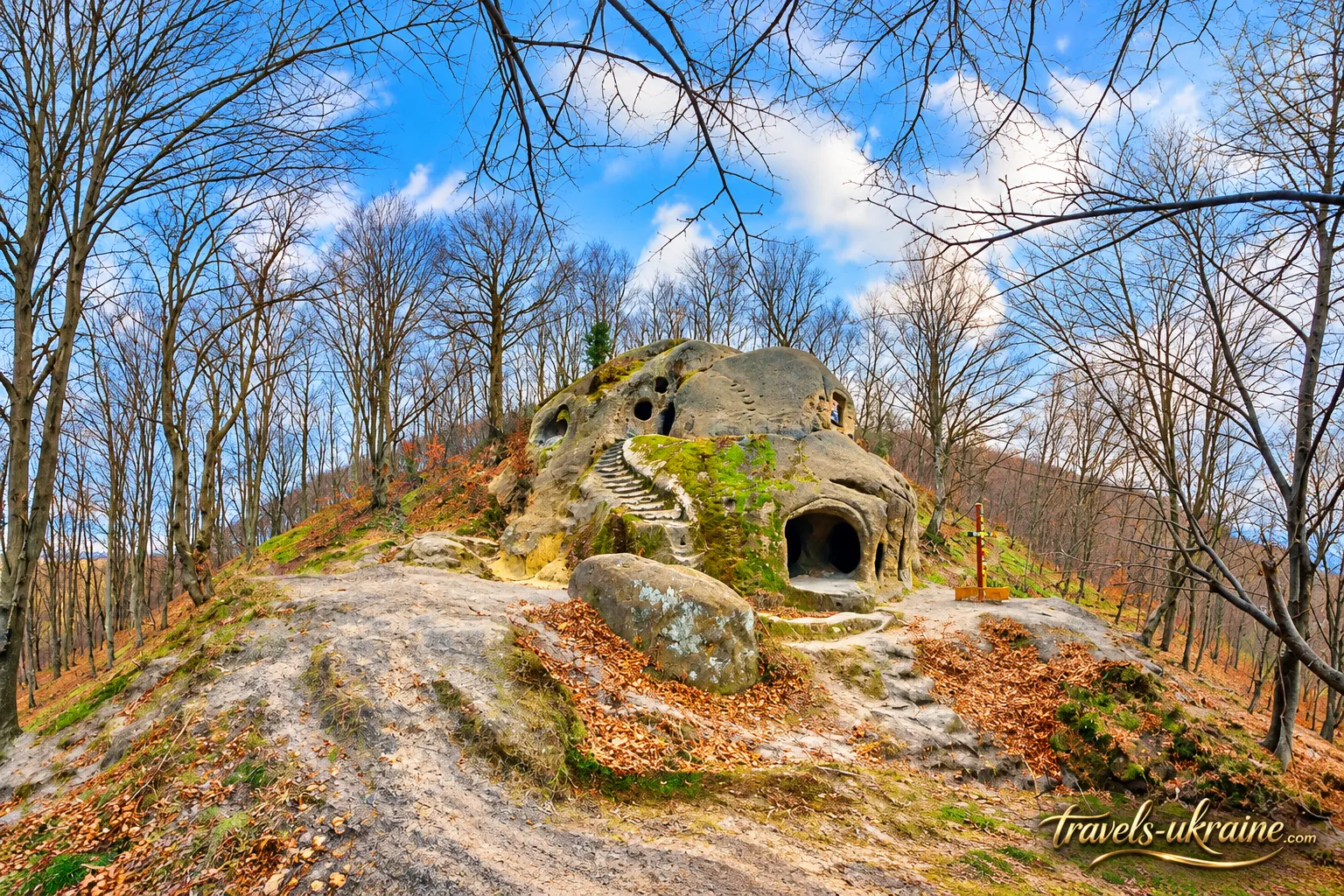
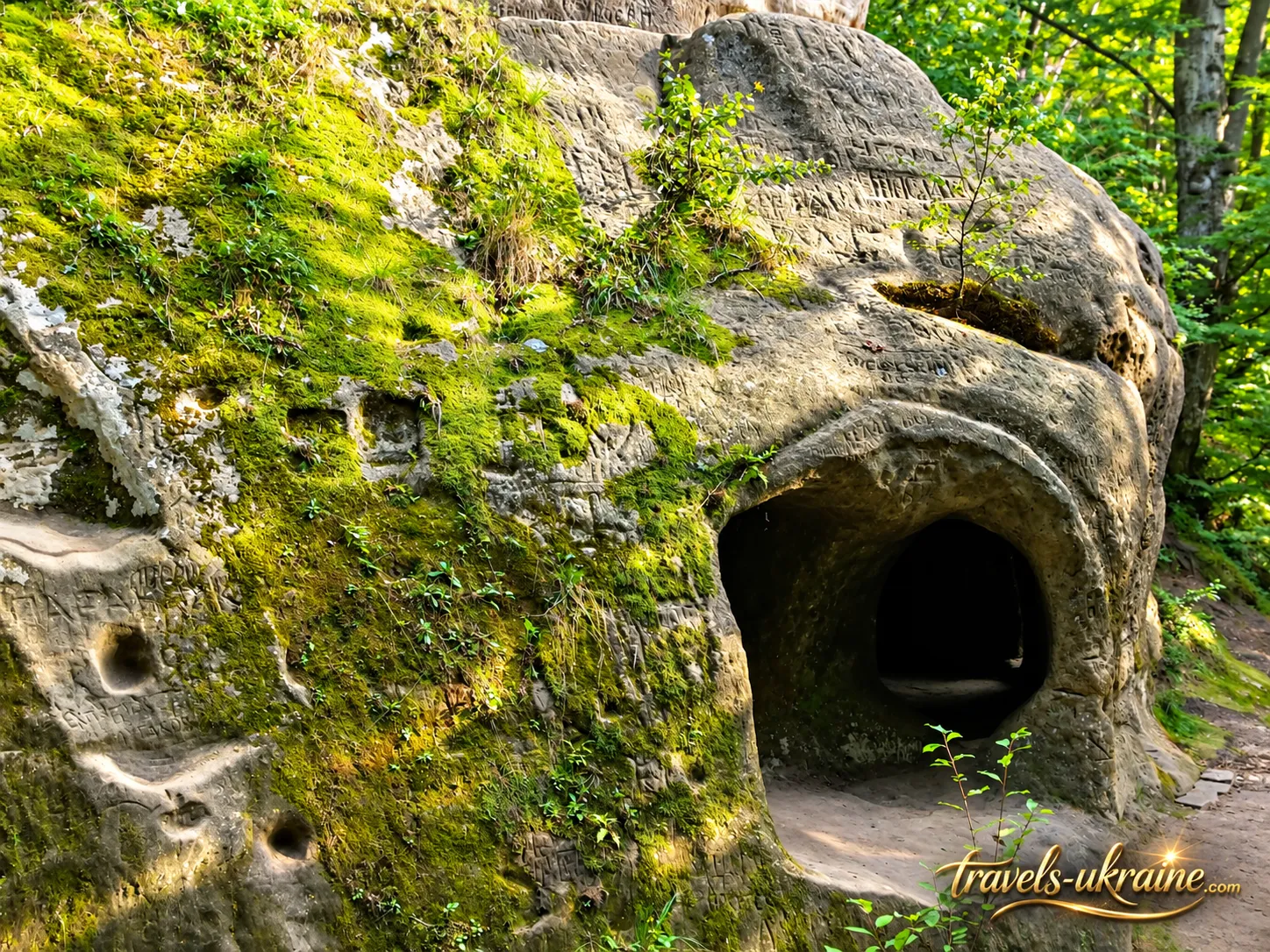
Amid the Carpathian forest near the village of Rozhirche lies a place that is easy to miss if you do not know what to look for. Behind the trees, large sandstone rocks gradually come into view, with entrances to rooms carved directly into the stone. There are no high walls, domes, or grand gates here; everything looks much more restrained, yet it is precisely this simplicity that creates a sense of genuine antiquity.
The cave monastery in Rozhirche is unlike ordinary monastic complexes. Its rooms are arranged within the rock massif on several levels, while the stone walls preserve niches, steps, crosses, inscriptions, and traces of workmanship left by people from different eras.
The most interesting part begins when questions arise. Who first used these caves? Were they a Christian monastic retreat? Which inscriptions are truly ancient, and which were left by much later visitors? And why were these particular rocks chosen for the shrine?
Some answers are known from historical and archaeological research, while others remain matters of conjecture. That is why the Rozhirche Rocks are interesting not only as a tourist destination, but also as a place where history must literally be read in stone—by carefully examining every niche, carved symbol, and old inscription.
Although the complex itself can be explored fairly quickly, there is no urge to hurry here. In the quiet of the forest, amid cold stone and dark cave entrances, it is easy to sense that this place existed long before modern tourist routes appeared—and that it has not yet told all its stories. This is the best way to begin discovering the Rozhirche cave monastery: an ancient shrine carved directly into the stone.
A brief history of the cave monastery in Rozhirche
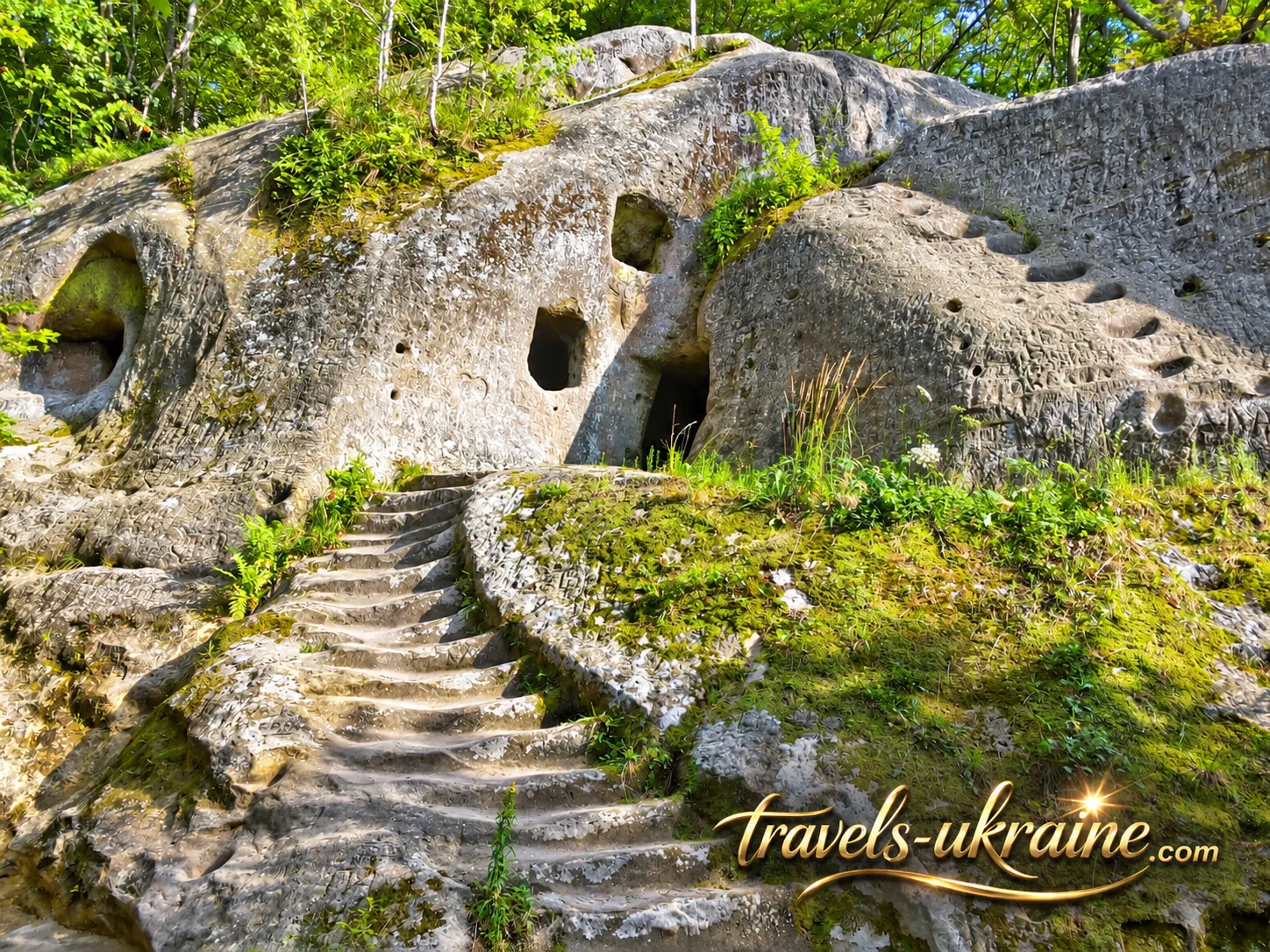
The history of the cave monastery in Rozhirche has one distinctive feature: here, it is much easier to see traces of the past with your own eyes than to name the exact year when the first monks appeared in the rocks. Few written sources survive from the early period, so researchers must reconstruct the history of the complex from the architecture of the caves, traces of stonework, archaeological finds, and old descriptions.
Today, the best-supported theory is that the monastic center at Rozhirche took shape around the XII–XIV centuries, and was rebuilt and expanded over the centuries that followed. At the same time, the rocks themselves were used by people much earlier—and this is what makes Rozhirche’s history considerably older than the history of the monastery.
What existed in Rozhirche before the monastery
Archaeological research has shown that people appeared near the rocks long before the Middle Ages. During work in 1990, traces of an agricultural settlement dating from the VIII–VII centuries BC were discovered near the complex. This does not mean that a temple or cave shrine already existed here at that time, but it does prove that the area was known and used by people nearly two thousand years before the medieval monastery took shape.
This discovery became one of the reasons for speculation about possible pre-Christian use of the rocks. Some researchers allowed for the existence of an earlier cult site or refuge here, but there is currently insufficient direct archaeological evidence of a pagan shrine. It is therefore more accurate to leave this version as a hypothesis rather than present it as an established fact.
When the monks appeared in the rocks
The exact date when the Rozhirche rock monastery was founded is unknown. Architectural analysis of the caves and research findings place the formation of the monastic complex approximately in the XII–XIV centuries. Some researchers narrow this period to the XIII–XV centuries.
The monastery’s purpose is indicated not only by the location of the caves, but also by their internal structure. In the upper chamber, researchers identify a space characteristic of a small Christian shrine: an altar area, niches, and other elements that are difficult to explain solely in terms of practical use.
The lower rooms probably served residential and хозяйственные functions. Traces of alterations show that the complex did not emerge fully formed all at once—the caves were enlarged, individual rooms were joined together, and wooden structures may have adjoined the rock section.
The monastery’s period of greatest development
Judging by the architectural features of the complex and historical reconstructions, its active development took place approximately during the XIV–XVI centuries. The monastery was probably much larger than the three caves visible to today’s tourist. Wooden cells, utility buildings, enclosures, and small sacred structures may have stood on the surface, leaving almost no surviving traces. Grooves and cuttings remain in the rocks where wooden elements were once attached. For this reason, the modern complex should be understood only as the stone core of a much larger monastic community.
The first written references linking Rozhirche with the medieval period date from the second half of the XV century. However, they appear at a time when, according to researchers, the rock complex may already have existed for many generations.
How researchers uncovered Rozhirche’s secrets
Scientific interest in the rocks intensified in the XIX century. One of the first to describe them was Ivan Vahylevych, a researcher, writer, and one of the members of the «Ruthenian Triad.» He was particularly interested in the signs and inscriptions on the stone, some of which he considered very ancient. In 1878, the first known archaeological excavations were carried out beneath the caves. Later, historians and architects studied the monument in detail, including Vasyl Karpovych, who analyzed the layout of the caves and attempted to determine the function of individual rooms.
A new stage of research began at the end of the XX century. Architectural and archaeological work made it possible to better understand the structure of the complex and simultaneously showed that a much older settlement had existed around the rocks. It was after this research that it became clear how cautiously one must treat appealing legends about the «exact date» when the caves were created.
Why the monastery’s history still has gaps
Unlike large monasteries, where archives, documents, and records of abbots have survived, Rozhirche has left very little written evidence. The wooden structures disappeared long ago, some caves were rebuilt, and the inscriptions on the walls were created in different eras—from old crosses to much later graffiti. As a result, many claims about the lives of the local monks, their origins, or specific events in the monastery’s history remain conjectural. This is precisely why it is important not to turn a beautiful tourist story into an invented chronicle.
What the monument itself confirms, however, is already fascinating enough: medieval monks really did adapt the sandstone rocks for living and prayer, create a cave shrine here, and leave behind a complex that survived for several centuries. To understand how this unusual place was organized, it is worth moving from historical dates to the rocks themselves—climbing the stone steps, looking into the cave church, and examining the cells, niches, and numerous signs left on their walls.
What to see in Rozhirche: caves, a church, cells, and rock inscriptions
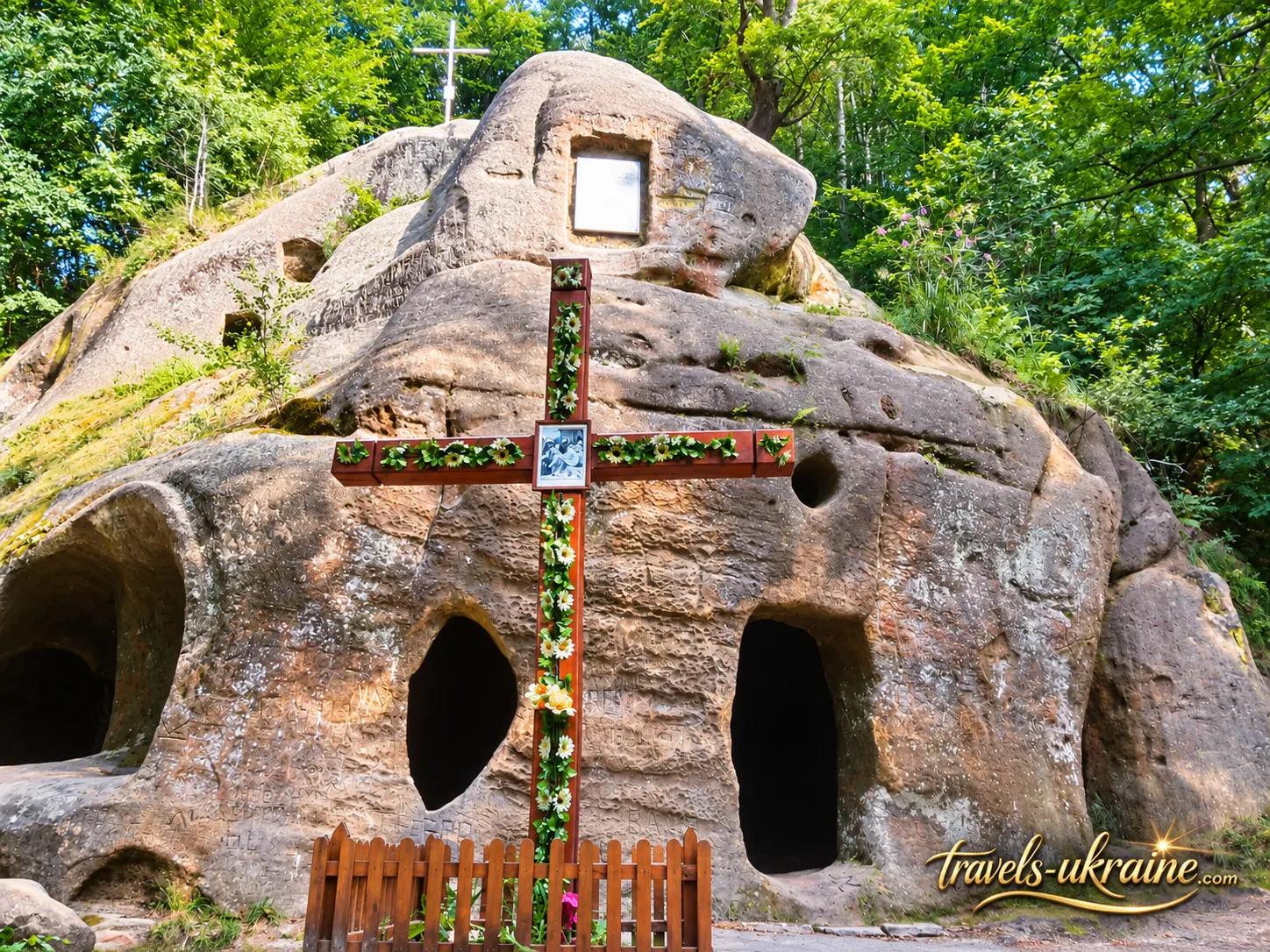
The rock-and-cave complex in Rozhirche is small but rich in detail. There is no lengthy route or dozens of separate attractions—the main value lies in the rocks themselves, their internal structure, and the traces left by people across different eras. That is why the Rozhirche cave monastery is best explored without rushing: every niche, step, or symbol carved into the stone may tell a separate part of its story.
The main two-tiered rock-and-cave complex consists of three rooms, while other rock formations bearing traces of human activity have survived nearby. The lower rooms were probably used for residential and хозяйственные needs, while the monastery church occupied the upper level. Steps carved directly into the rock lead to it.
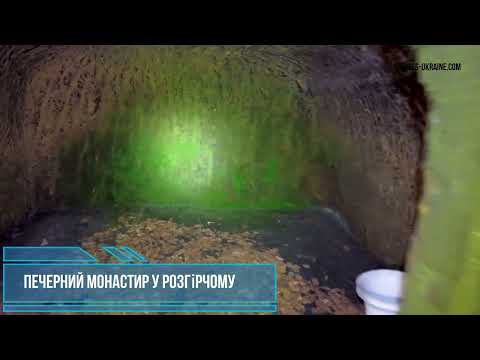
The lower level contained rooms used for the monks’ daily life. Researchers believe there was a living room and a pantry here, while the complex was rebuilt and expanded at various times. Cuttings and recesses in the rocks testify to former doors, partitions, and wooden structures.
The most interesting part of the complex is the cave church on the second level. Narrow stone steps carved directly into the sandstone lead to it. Inside, researchers identify an altar area, side niches for church furnishings, and a space used for worship. A brotherhood burial vault is also described in the right-hand part of the church. The layout of the upper cave became one of the main arguments supporting the complex’s monastic purpose. Yaroslav Isaievych called the small two-bay church in Rozhirche a unique surviving example of this type of cave architecture in Galicia.
Rock inscriptions, symbols, and traces of wooden structures
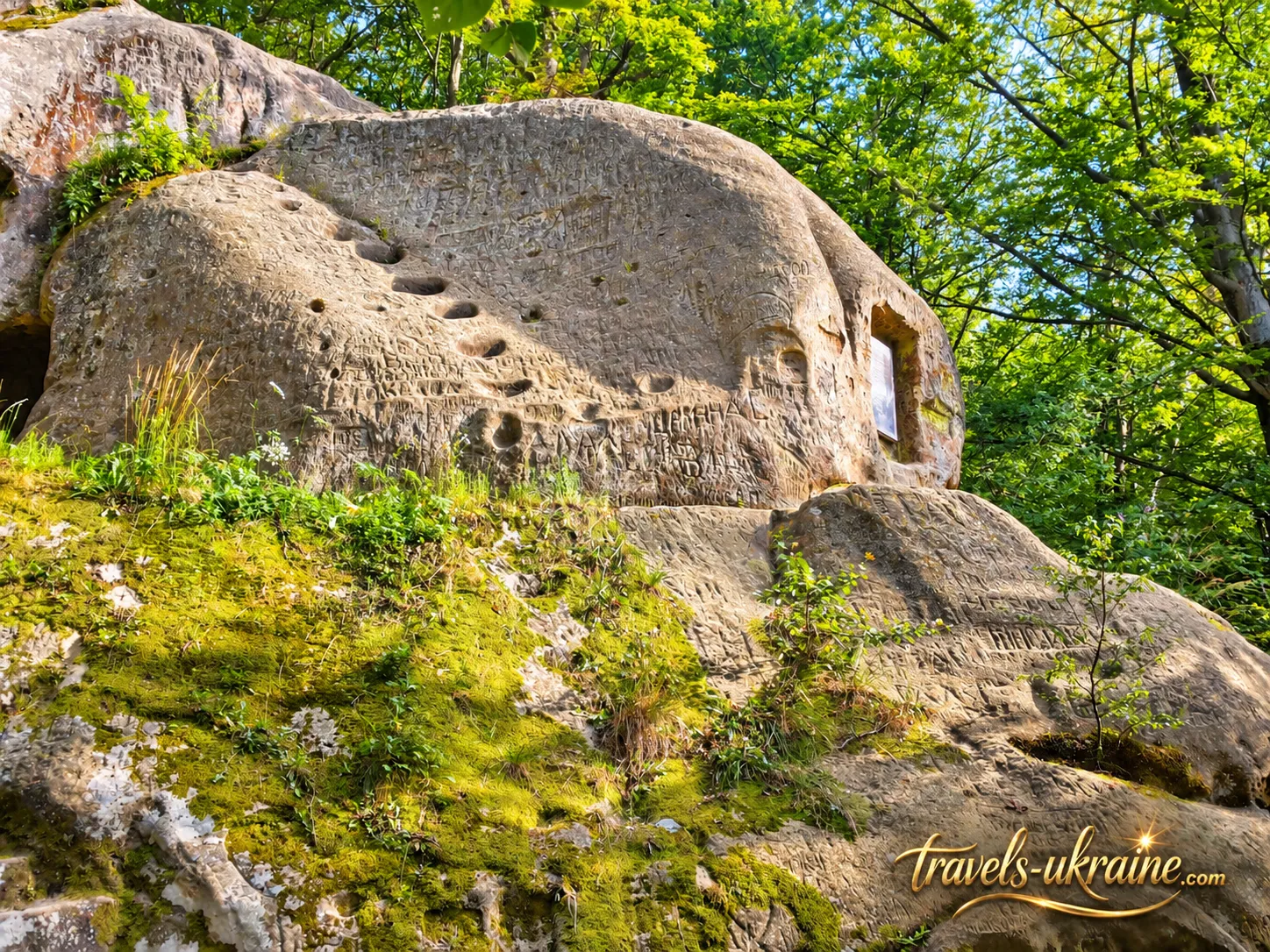
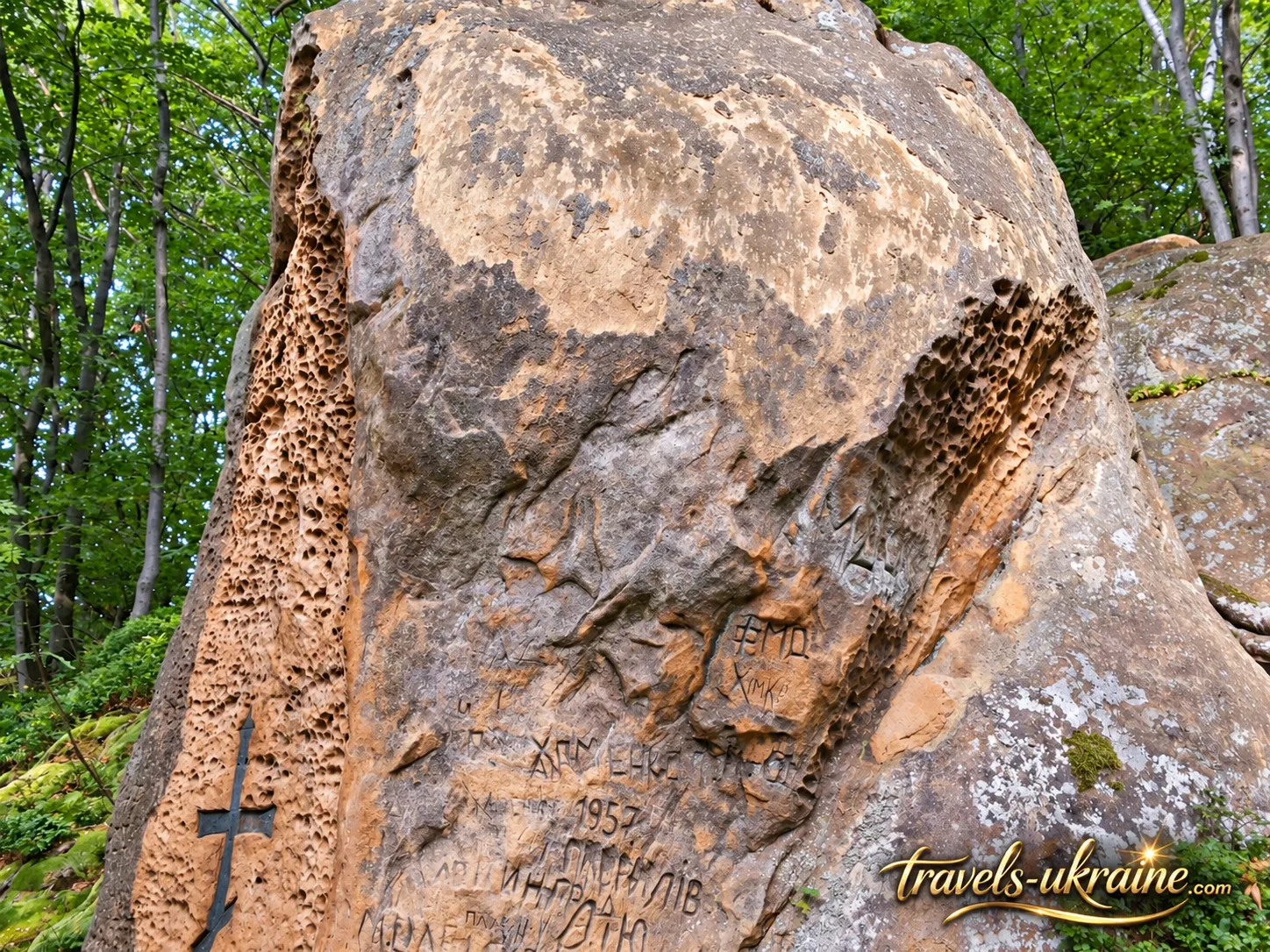
The rock inscriptions and symbols of Rozhirche deserve particular attention. Carved crosses, symbols, individual letters, and later inscriptions can be seen on the cave walls. Some are connected with the complex’s Christian use, others appeared much later, and the origins of certain symbols remain debated. It is important not to treat every scratch as a «mysterious sign of ancient priests.» People visited the rocks for centuries, so modern graffiti appears alongside older symbols. Any interpretation of a particular inscription should therefore be presented cautiously unless supported by archaeological or epigraphic research.
Another noteworthy detail is the abundance of grooves and recesses in the stone. They show that the cave section was once supplemented by wooden structures. Additional cells, shelters, or utility rooms that have not survived may have adjoined the rocks. This changes how the complex is perceived: today’s visitor sees only the stone core, while at the height of its development the monastery may have been considerably larger and more structurally complex.
Gateway rocks and outlying caves
Several dozen meters from the main complex are smaller rock formations that researchers associate with the monastery grounds. Some rocks may have served as a kind of entrance or natural «gateway,» while rock images of crosses have been found in a remote cave. During a walk, it is therefore worth looking beyond the main two-tiered massif. Part of Rozhirche’s history is scattered among the surrounding rocks and forest.
When visiting the rock-and-cave complex, it is especially worth paying attention to several details:
- steps carved into the stone leading to the upper church;
- the altar area and niches of the cave church;
- the lower residential rooms and traces of their alterations;
- rock-carved crosses, symbols, inscriptions, and grooves from wooden structures;
- the neighboring rocks, which may have formed part of a larger monastic complex.
These details make the Rozhirche Rocks more than an ordinary walk to a cave. Here, you can do more than step inside the rock: you can literally trace how a natural sandstone massif was gradually transformed into a place for living, prayer, and solitude. After exploring it, the central question emerges: were the monks the first to give these rocks sacred significance, or did they merely continue a much older tradition of using this place?
What is known about the caves’ purpose: a monastery or an earlier shrine?
The original purpose of the caves in Rozhirche raises the greatest number of questions. There is little doubt about the Christian use of the complex: the layout of the upper cave, the altar area, niches, crosses, and the structure of the lower rooms all fit well with monastic life. It is much harder to answer another question—were medieval monks the first to consider these rocks a special place?
Tourist descriptions often claim that the monastery was established on the site of an ancient pagan sanctuary. For example, Lviv’s official tourism portal explicitly states that in the 13th–14th centuries the monastery was founded on the site of a pagan shrine. At the same time, archaeological evidence calls for a much more cautious conclusion: it confirms a very ancient human presence near the rocks, but by itself does not yet prove that a pre-Christian temple existed here.
What the Archaeology Confirms
The most important argument for the area’s ancient use was the discovery of a settlement dating to the 8th–7th centuries BC near the rock complex. It shows that people lived or worked here long before the Christian monastery appeared.
However, there is a major difference between the existence of a settlement and a claim that a pagan sanctuary stood here. To confidently identify a place as cultic, archaeologists need specific finds: altars, ritual objects, distinctive burials, or other clear traces of ritual activity. For Rozhirche, there is not yet enough evidence of this kind.
Therefore, the most accurate wording is: people used the rocks as early as the pre-Christian period, while their possible sacred purpose remains a hypothesis.
Why the Pagan Sanctuary Theory Emerged in the First Place
This assumption did not arise out of nowhere. Unusual rock formations, caves, remoteness from settlements, water, forests, and natural elevations often acquired sacred significance even before the arrival of Christianity. Such places could be used for rituals, solitude, or as symbolic boundaries between «ordinary» and «sacred» space.
Rock carvings and symbols, some of which have no definitive explanation, add further intrigue. Yet this is where it is easy to fall into a trap: not every puzzling mark is ancient, let alone pagan. People visited the rocks for hundreds of years, so a medieval cross, a later inscription, and entirely modern graffiti may stand side by side on the same surface.
That is why modern researchers emphasize the need for further study of the rock complexes in the Lviv region. In 2026, the Lviv Regional Military Administration also specifically noted that some symbols in Rozhirche remain undeciphered and that the complex requires further research.
The Christian Monastery—The Best-Documented Function
By contrast, there is considerably more evidence for the caves’ monastic purpose. The complex consists of three rooms on two levels: the lower rooms were used as living quarters, while the upper one served as a monastic church. The upper level reveals a sacred layout, while the lower rooms show signs of domestic use. Carved steps, niches, slots for wooden structures, and the system of interior spaces form an entirely logical model of a small monastic retreat adapted to the natural rock formation.
Therefore, the medieval cave monastery should be regarded as Rozhirche’s primary and best-supported historical function.
Perhaps the Monks Did Not Create the Shrine from Scratch but Inherited It
The most interesting version lies somewhere between the two extremes. There is no need to imagine that a large pagan temple already existed here before Christianity. It is entirely possible that the rocks simply held special significance for the local population before the monastery appeared, and that Christian monks later adapted this natural site to their own spiritual tradition.
This scenario is well known from history: old sacred sites often acquired new religious significance without losing their symbolic status. But in Rozhirche, this remains a working hypothesis rather than a proven fact. That very uncertainty makes the complex especially interesting. There is no need to invent «mysteries» here—it is enough to honestly say that we still do not know everything about the earliest period of the rocks’ existence. Archaeology confirms a very ancient human presence, architecture points to medieval monastic use, and everything between these two eras still awaits a more precise answer.
How to Visit the Cave Monastery in Rozhirche
The cave monastery in the village of Rozhirche is not a fully equipped museum with a ticket office, lighting, and smooth tourist paths. The complex lies in a forest on a hillside near the village, and the final part of the route must be covered on foot. That is why a trip here feels more like a short nature-and-history outing than a conventional visit to a museum monument.
For travelers driving from Lviv, the most convenient approach is to head first toward Stryi and then continue along local roads to the village of Rozhirche. The distance from Stryi to the village is approximately 20–25 km, and the main road is paved. In dry weather, you can drive fairly close to the start of the walking route.
In this area, it is best to use the navigator only as a guide. The map may show several shorter dirt roads, but they are not always suitable for an ordinary passenger car. It is therefore safer to follow the main approach through the village, even if the navigator suggests «cutting off» a few kilometers.
Firsthand Experience: The Walk to the Cave Monastery in Rozhirche
So let me answer one of the most practical questions for tourists who, like us, prefer independent travel: how do you walk to the rock-and-cave complex?
Our family’s starting point was the bus stop near the village of «Nyzhnya Stynava» on the M-06 Kyiv–Chop highway. We left the car on the roadside here and continued on foot. I repeatedly saw local residents selling berries and mushrooms at this spot, and there is a food establishment across the road where you can have a decent snack after the walk.
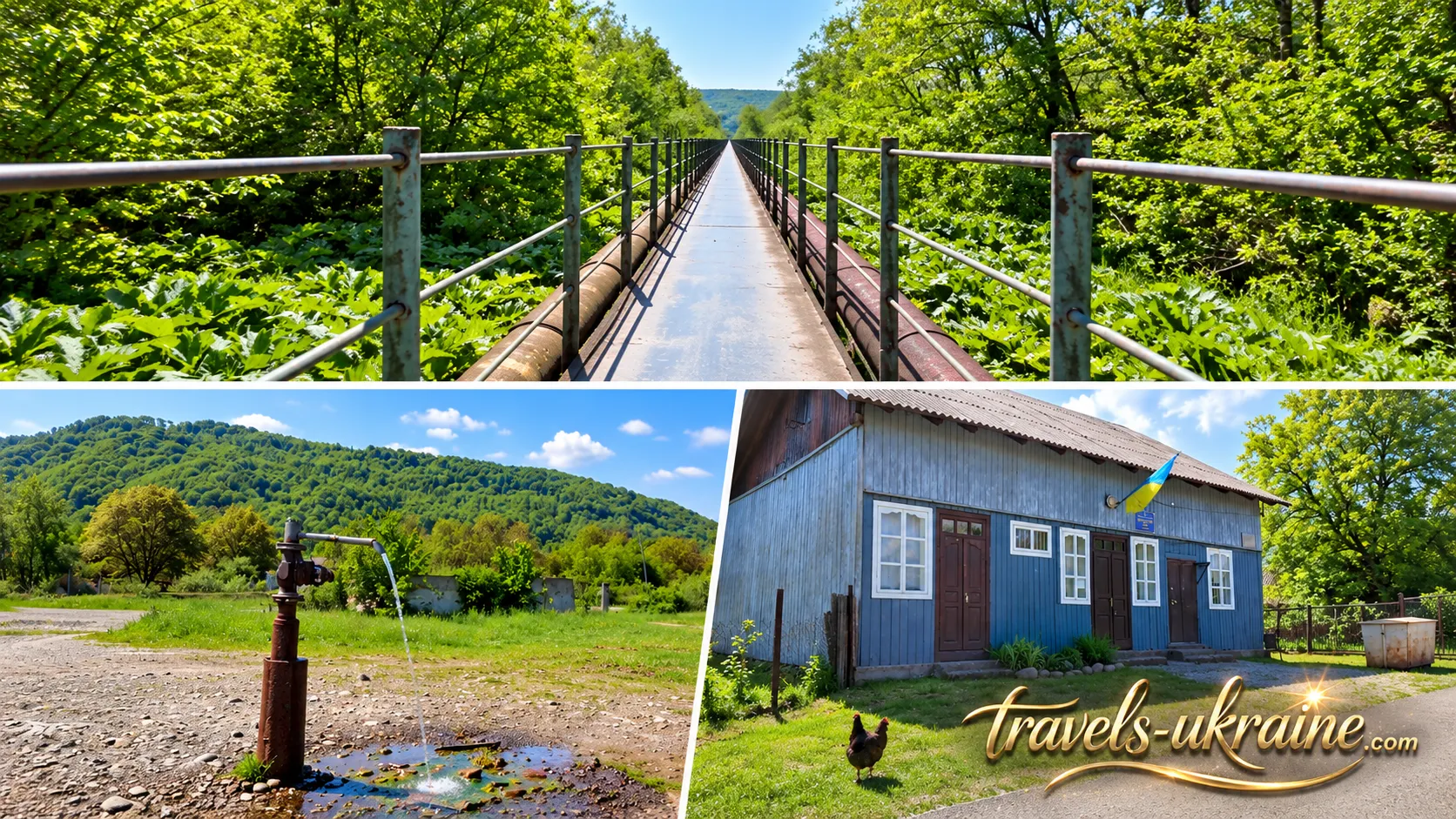
From the stop, you can clearly see a well-trodden path leading to a fairly long bridge over the Stryi River. The crossing itself already adds a little atmosphere to the walk: the wide river, open space, and village ahead gradually leave the noise of the main highway behind. After crossing the bridge, we continued toward the village. Along the way, we came across a mineral water well that anyone can use—there are no queues, ticket offices, or special restrictions. It is certainly interesting to try. Personally, I was not won over by the water: the smell of hydrogen sulfide was so pronounced that my body decided to skip a second tasting.
A little farther on, you reach the beginning of the village, where a bus stop marked «Rozhirche» stands along the road. From there, continue only a short distance along the village road and turn right at the first noticeable bend. If a blue administrative building appears ahead, you are going in the right direction. In any case, it is quite difficult to get lost here. If necessary, you can always ask local residents for directions—Rozhirche is small, and everyone here knows about the cave monastery. The main landmark is the wooded hillside beyond the village. That is where, slightly away from the homes, the rock complex hides like a true hermit.
A well-trodden path leads from the edge of the village to the caves. First, you need to climb the hill slightly, after which the route continues through the forest. The trail is fairly clear, so in normal visibility it is difficult to lose your way. The total length of our walk from the highway to the rocks was approximately 3 km each way. When we visited Rozhirche, there were no tourist signs leading directly to the cave. I cannot say what the situation will be during your trip, so it is still best to keep a map on your phone.
In brief, our route was as follows: Kyiv–Chop highway → bridge over the Stryi → village of Rozhirche → right turn → administrative building along the way → forest trail → rock-and-cave complex. Nothing extreme—just an ordinary, pleasant walk that becomes part of the journey in its own right.
Firsthand Impressions of Rozhirche
As for my personal impressions, I will be honest: I did not experience that unconditional «wow» that makes you want to return the next time. But that certainly does not mean the place is not worth visiting. Rozhirche works well as an additional tourist stop to add variety to an itinerary: take a short walk through the forest, see unusual caves, enter rooms carved into the rock, examine old inscriptions, and simply spend a few hours outside the city.
I probably would not make a special second trip here—unless it were to show friends the way or combine Rozhirche with other interesting places in the Stryi area. But as a first introduction, the location is definitely worthwhile, especially if you enjoy small, quiet, and not overly «polished» tourist destinations. One particular advantage of the complex is free access. There are no ticket offices, turnstiles, fixed tour hours, or need to fit your trip around a museum schedule. You can arrive at a convenient time, calmly explore the rocks, and stay as long as you like.
And perhaps that is what is most pleasant about Rozhirche: it does not try to sell you anything or prove anything to you. Just forest, stone, a few old caves, and the chance to briefly turn off the main road into a place where time moves a little more slowly.
What to See Near Rozhirche
The cave monastery in Rozhirche can certainly be visited as a standalone destination, but it will most likely not be enough for a full day of travel. It is much more interesting to make it one of the stops on a route through the Stryi area: after the rocks, you can take a walk through old Stryi. The town lies close to Rozhirche and has enough sights to keep you there for several more hours. Its central area retains buildings from the 19th and early 20th centuries, old townhouses, religious architecture, and small palace buildings.
Among the tourist attractions, it is worth visiting the «Verkhovyna» local history museum, the Bandera family museum, the People’s House, the old synagogue, the Marysia Palace, and other architectural landmarks. After a forest walk to the caves, you can therefore make a sharp change of atmosphere and finish the day with an urban itinerary.
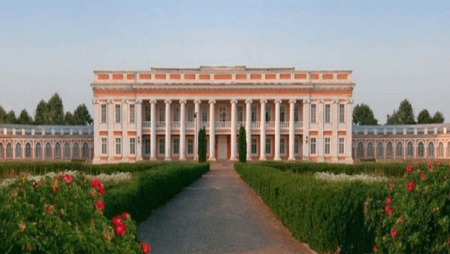
For lovers of historic architecture, the Brunytskyi Palace in the village of Pidhirtsi may be an interesting stop. Do not confuse this village with the famous Pidhirtsi near the Pidhirtsi Castle—this is an entirely different landmark not far from Stryi. The history of this residence dates back to the 18th century, while the palace acquired its present appearance at the end of the 19th century. It once had a library, a portrait gallery, and a large park. Today, the palace is listed as a locally significant architectural monument, and an arboretum has survived nearby. This is not a heavily promoted tourist site with museum infrastructure, but rather an interesting stop for those who enjoy discovering lesser-known historic places.
Tustan—If You Want to Continue Your Journey into the World of Rocks
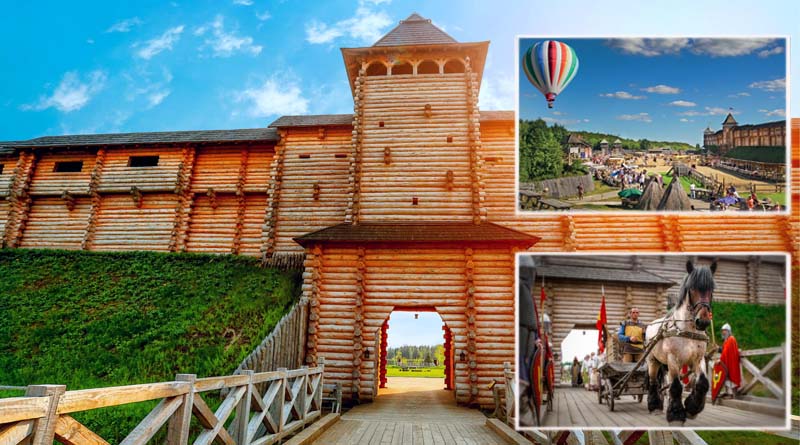
For a full one- or two-day trip, the most interesting continuation of the theme may be the «Tustan» reserve in the village of Urych. This is a much larger site: a medieval wooden rock fortress once stood among enormous rocks, and traces of its structures can still be clearly seen in the stone.
Rozhirche and Tustan are very different, but that is precisely why they complement each other so well. In the first case, people adapted the rocks for prayer and monastic life; in the second, they used the rock massif as the foundation for a complex defensive fortress. Both sites show how resourcefully medieval people could work with the natural landscape.
Tustan is worth planning as a full-fledged tourist stop rather than a brief roadside visit. The reserve has its own museum and guided-tour experience, so it is best to allow several hours for it.
Frequently asked questions about the cave monastery in Rozhirche
Where is the Rozhirche cave monastery located?
The Rozhirche rock-and-cave complex is located near the village of Rozhirche in Stryi District, Lviv Region, in a wooded area not far from the Stryi River. From the central part of the village, you need to walk along a forest trail to reach the rocks.
Were the Rozhirche caves really a monastery?
Yes. The most well-founded theory is that they were a medieval cave monastery. The layout of the upper chamber shows features of a small church with an altar area and niches, while the lower caves were probably used by the monks for living and domestic purposes.
When was the cave monastery in Rozhirche established?
The monastery’s exact date of foundation has not been established. The complex’s monastic use is most often associated with the 13th–14th centuries, although some researchers suggest a broader dating range extending into the 15th century.
How many caves are there in the Rozhirche rock complex?
The main complex consists of three caves arranged on two levels. The lower chambers are associated with residential and domestic functions, while the upper one is associated with the monastery church. There are also other small rock formations nearby bearing traces of human activity.
What do the rock inscriptions and symbols in Rozhirche mean?
Crosses, individual signs, letters, and inscriptions from different periods can be seen on the rocks. Some are connected with the complex’s Christian use, but not all the symbols have an unambiguous date or interpretation. Alongside the older signs, there are much later inscriptions and modern graffiti.
Was there a pagan sanctuary in Rozhirche?
Such a theory exists, but there is insufficient archaeological evidence of a pagan sanctuary. Traces of an 8th–7th-century BCE settlement have indeed been found near the rocks, confirming a very ancient human presence in the area, but not proving that it had a ritual purpose.
Do you need to buy a ticket to visit the Rozhirche caves?
No. Admission to the rock-and-cave complex is free; there is no permanent ticket office, turnstile, or museum schedule here. You can explore the caves independently, taking care not to damage the rocks or historic inscriptions.
How far do you have to walk to reach the cave monastery?
The route from the village to the rocks is short—approximately 10–15 minutes, depending on the starting point. If you start from the Kyiv–Chop highway and cross the bridge over the Stryi River, the walking route is approximately about 3 km one way.
Can you visit Rozhirche with children?
Yes, especially with school-age children. However, you should take into account uneven forest trails, natural stone steps, and the lack of railings in some places. The route is unsuitable for a stroller, and the rocks may be slippery after rain.
How much time is needed to see the rock-and-cave complex?
The caves themselves can be explored in about an hour. Including the walk, photography, viewing the inscriptions, and a stroll among the surrounding rocks, it is best to allow 1.5–2 hours.
Rozhirche—a place where history remains in the stone
The cave complex in Rozhirche is not one of those tourist destinations that impress with their scale or large number of exhibits. There are no restored halls, museum displays, or spectacular attractions here. Its value lies elsewhere—in the opportunity to see a place where natural rock was adapted over the centuries for living, prayer, and solitude. What leaves the strongest impression is not the size of the caves themselves but the details: steps carved into the sandstone, niches, traces of wooden structures, crosses, and inscriptions on the stone. Some of them have already been explained historically; others still raise questions to which researchers have no definitive answers.
It is precisely this uncertainty that makes Rozhirche more interesting. There is no need to invent mystical legends here—it is enough to realize that people lived near these rocks long before the medieval monastery appeared, while the area’s earliest purpose has still not been definitively established. At the same time, it is worth having realistic expectations. The cave monastery in Rozhirche is more of an interesting stop during a journey through the Stryi area than a destination for which most tourists should plan a separate, hours-long trip. The complex is compact, and the main pleasure here comes from the walk through the forest, searching for details in the rocks, and the chance to see something entirely unlike an ordinary museum or castle.
Rozhirche has another advantage: it remains a fairly natural and not overly commercialized place. There are no queues, strict schedules, or need to follow a prescribed route. You can arrive, calmly explore the caves, sit by the rocks, and leave whenever you feel like it. And perhaps that is exactly the role this place fulfills best: it does not try to be the main tourist sensation, but simply gives you a reason to turn off the main road, walk a few kilometers, and spend a short time among stone, forest, and very ancient history.

No Comment
You can post first response comment.