
 English
 Українська
 Русский
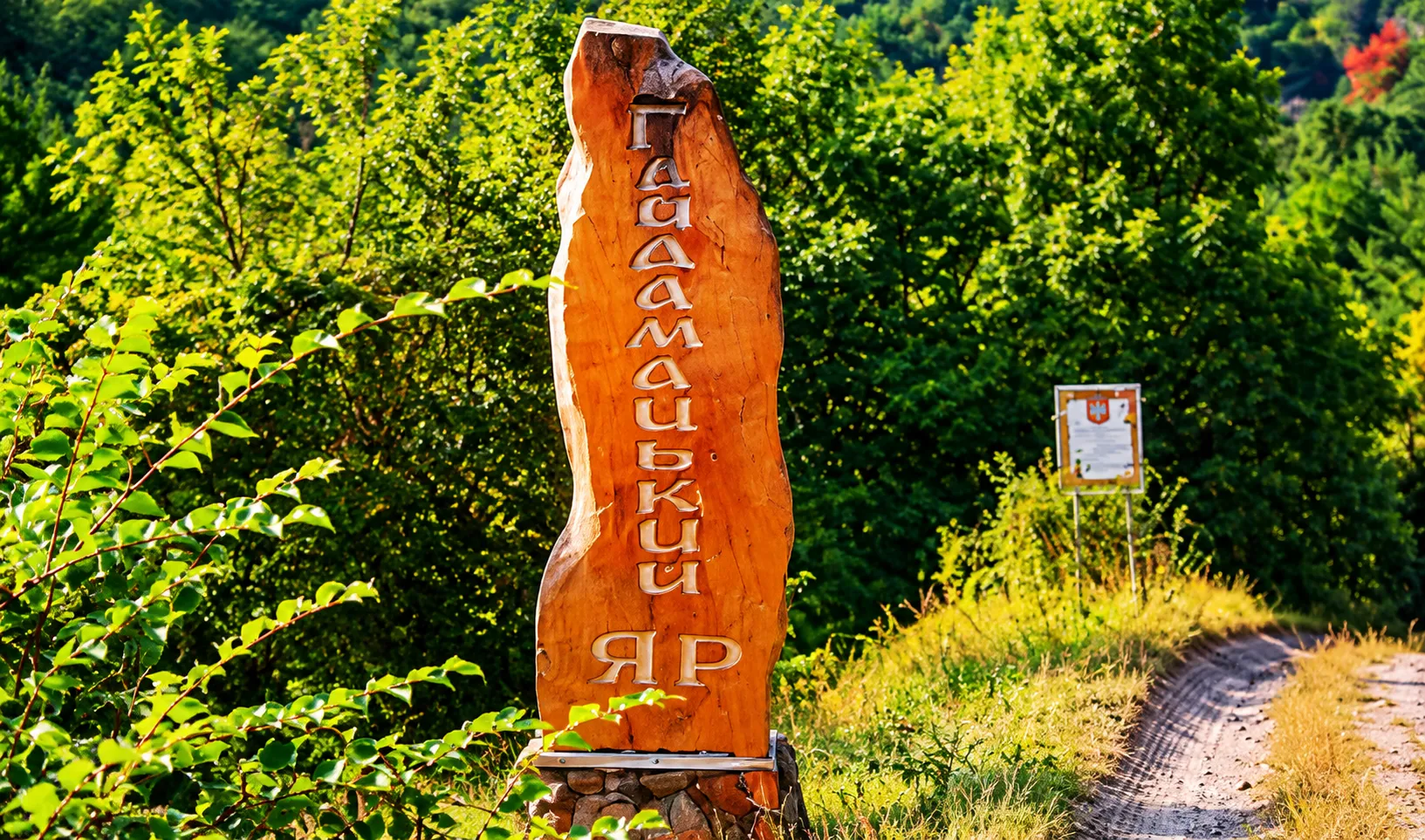
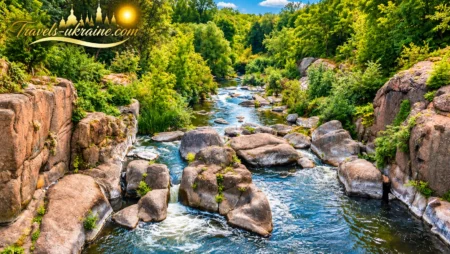
There are places where nature has created landscapes so unusual that they look more like sets from an adventure film than an ordinary Ukrainian forest. Huge stone blocks, narrow passages between rocks, moss-covered slopes, and trees whose roots cling firmly to the stone. This is how Haidamatskyi Yar appears to travelers — a picturesque tract near the village of Busha in Vinnytsia Oblast.
At first glance, it seems as though someone deliberately scattered giant stones throughout the forest, leaving a maze of winding corridors between them. Some rocks resemble fantastic creatures, others form natural overhangs, while certain stone passages are so narrow that after just a few steps, the surrounding forest almost disappears from view. And none of this is the ruins of an ancient fortress or the remains of a lost city. The rocky labyrinth of Haidamatskyi Yar was created by nature itself. Over long periods of geological time, weathering and erosion gradually reshaped the sandstone, forming the unusual rock formations that have become the main attraction of this area today.
But natural beauty is only part of the story. The name of the tract is associated with the Haidamaks, who remain in popular memory as participants in the insurgent movement in Right-Bank Ukraine. According to local legends, the hard-to-reach rocks, dense forest, and hidden passages may have served as shelters for them. How closely these stories correspond to documented historical events, and which details gradually became legend, is a separate question that we will return to later.
Today, Haidamatskyi Yar has the status of a geological natural monument of national importance. It is not merely a picturesque corner of Podillia, but a valuable protected natural area where distinctive rock formations, forest vegetation, and unusual landforms have been preserved. One of the special features of this place is that it cannot be fully appreciated from a single viewpoint. You need to walk the trails, examine the rocks, pass between massive stone blocks, and occasionally stop to notice details that are easy to miss during a hurried walk.
For visitors, this is an excellent opportunity to combine a walk in nature with an introduction to the history of Podillia. Especially since the State Historical and Cultural Reserve “Busha” is located nearby, making it easy to include the ravine in a broader tourist route through this part of Vinnytsia Oblast.
But before heading between the rocks, it is worth finding out a few interesting things. How did this stone labyrinth form? Why is the tract called Haidamatskyi Yar? Did insurgents really hide among its rocks? And where does documented history end and folk legend begin? That is where we will start — with the natural origins of Haidamatskyi Yar, its history, and the legends that have accompanied this unusual place for generations.
Haidamatskyi Yar: Natural Origins, History, and Legends
Looking at the enormous stone blocks of Haidamatskyi Yar, it is difficult to believe that nature itself created this unusual rocky labyrinth. Some formations resemble giant mushrooms, others look like pillars, walls, or frozen animals. Trees grow between them, narrow trails wind through the rocks, and the small Bushanka River flows below. Yet the history of this place began long before the appearance of humans and even before the formation of the modern Podillian landscape. Haidamatskyi Yar is the result of long geological processes that gradually transformed ancient rock formations into a complex natural labyrinth. Only much later did people connect its rocks, caves, and difficult-to-reach passages with the history of the Haidamak movement.
How Haidamatskyi Yar Was Formed
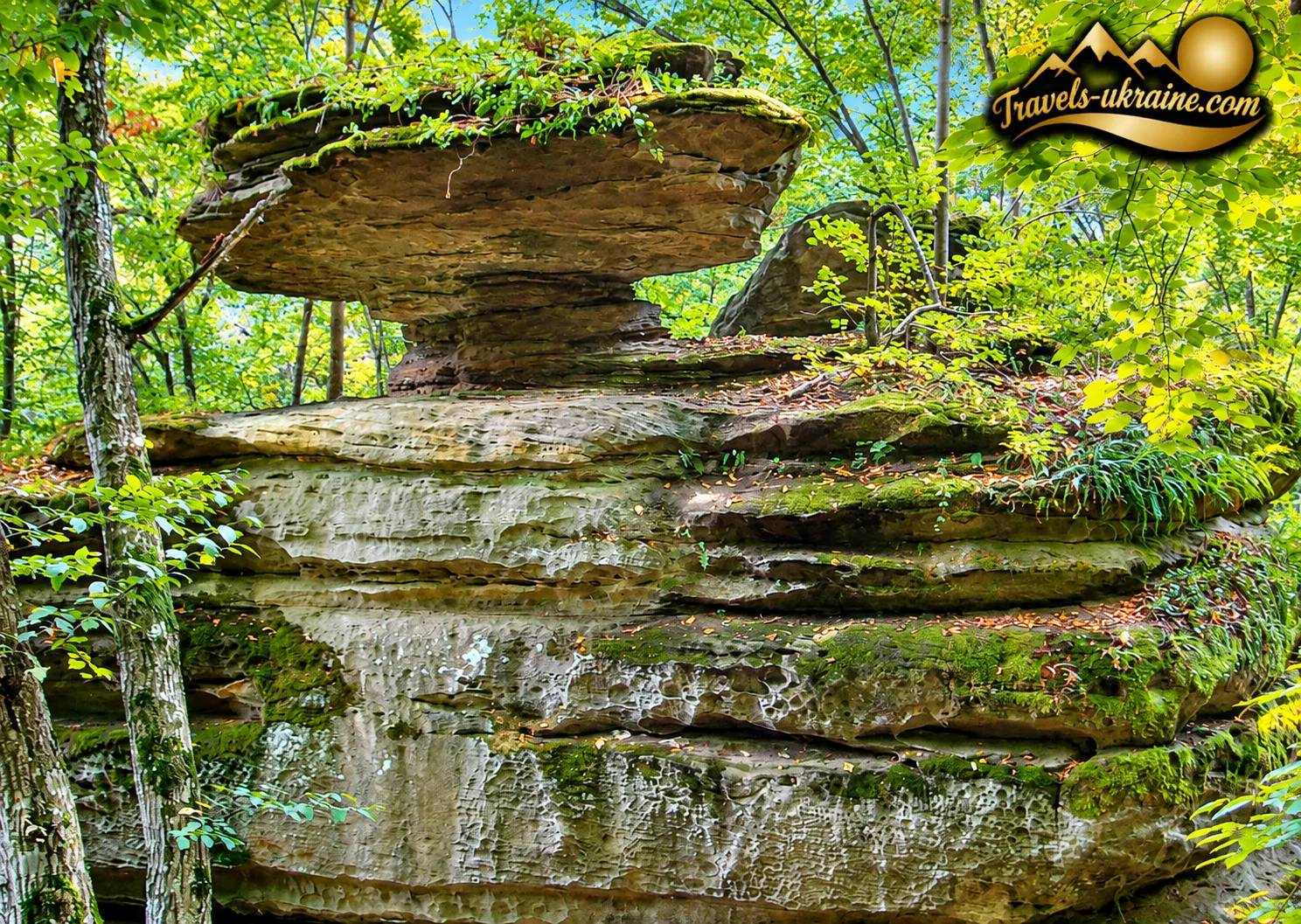
The main role in shaping the tract was played by ancient rocks, flowing water, and weathering processes. Over enormous periods of time, the river cut into layers of sandstone, limestone, and other rocks, gradually forming a deep canyon-like valley. Of particular interest are the local sandstones — sedimentary rocks formed from sandy material that became compacted and cemented over time. Different parts of the sandstone massifs resisted erosion to different degrees. Less resistant sections gradually weathered away, while stronger sections survived as rocky outcrops, pillars, and isolated stone remnants.
This is how the unusual formations visible in the forest today were created. Nature seems to have worked like a sculptor: water eroded the rocks, wind and temperature fluctuations affected their surfaces, and cracks gradually widened, dividing large rock masses into separate blocks. Interestingly, geologists have studied Haidamatskyi Yar not only as a picturesque gorge. The scientific work “Haidamatskyi Yar — a Monument of Arid Epochs” describes ancient aeolian landforms preserved in the local sandstone. They indicate that the history of this area included periods of significantly drier natural conditions. In other words, some of the rock formations preserve information not only about the work of the river but also about ancient climatic conditions that once influenced the formation of the Podillian landscape.
Today, this geological history is hidden among the trees. Oaks, hornbeams, maples, and other species grow on the slopes, while their roots intertwine with rocky outcrops in some places. As a result, stone and vegetation form an unusual natural ensemble in which it is difficult to draw a clear boundary between forest and gorge.
Haidamak Hideouts: Historical Facts and Folk Legends
Among the best-known local legends are stories about the Haidamak Rock and Cave, which were supposedly used by insurgents. Some accounts even mention the year 1768, when the Koliivshchyna uprising swept across Right-Bank Ukraine. The terrain itself is certainly well suited to the emergence of such stories. Massive stone blocks create hidden passages, the forest limits visibility, and rocky overhangs and recesses could have been used by people as temporary shelters.
However, the fact that the landscape was naturally suitable for hiding does not prove that detachments led by Zalizniak, Gonta, or other famous participants in the uprising were actually present here. Such claims should be treated as part of local historical tradition unless they are supported by independent documentary evidence.
Equally popular are legends about hidden treasure and secret passages among the rocks. Stories like these often arise around places associated with uprisings, wars, and persecution. In Haidamatskyi Yar, they fit especially naturally into the landscape: one glimpse of a narrow dark passage between stone blocks is enough for the imagination to begin adding an underground continuation.
However, there is no convincing evidence that a confirmed system of secret Haidamak tunnels or treasure caches exists here. Natural cavities and rocky passages should not automatically be interpreted as man-made underground structures. And perhaps this is the most interesting way to understand the local legends: not as established historical facts, but as part of the cultural memory that formed around an unusual natural place.
How Haidamatskyi Yar Became a Protected Natural Monument
The scientific and conservation value of the tract is not limited to historical legends. The area preserves a distinctive geological section, unusually shaped rock remnants, and valuable forest stands. On October 14, 1975, Haidamatskyi Yar received the status of a geological natural monument of national importance. The protected area covers 96 hectares.
This status emphasizes that the tract’s main value lies not only in its picturesque scenery, but also in preserving its geological heritage. Rocks that formed over enormous periods of time cannot simply be restored after damage in the same way as ordinary tourist infrastructure. Visitors should therefore avoid damaging the formations, leaving inscriptions on the rocks, or attempting to widen natural passages or caves.
Today, Haidamatskyi Yar combines three different stories: a geological one about the formation of the rocky landscape; a natural one about the forest ecosystem of the Bushanka canyon; and a human one about the Haidamak legends that gave the tract its name. But the most interesting part for visitors begins when these stories can be seen with their own eyes. Which rocks are known as the Mushroom, Ram, and Hanging Rock? Where are the Haidamak Rock and Cave? And which natural formations should you be sure to see during your walk? That is what we will explore next — in an introduction to the most interesting places in Haidamatskyi Yar.
What to See in Haidamatskyi Yar: Rocks, Caves, and Natural Formations
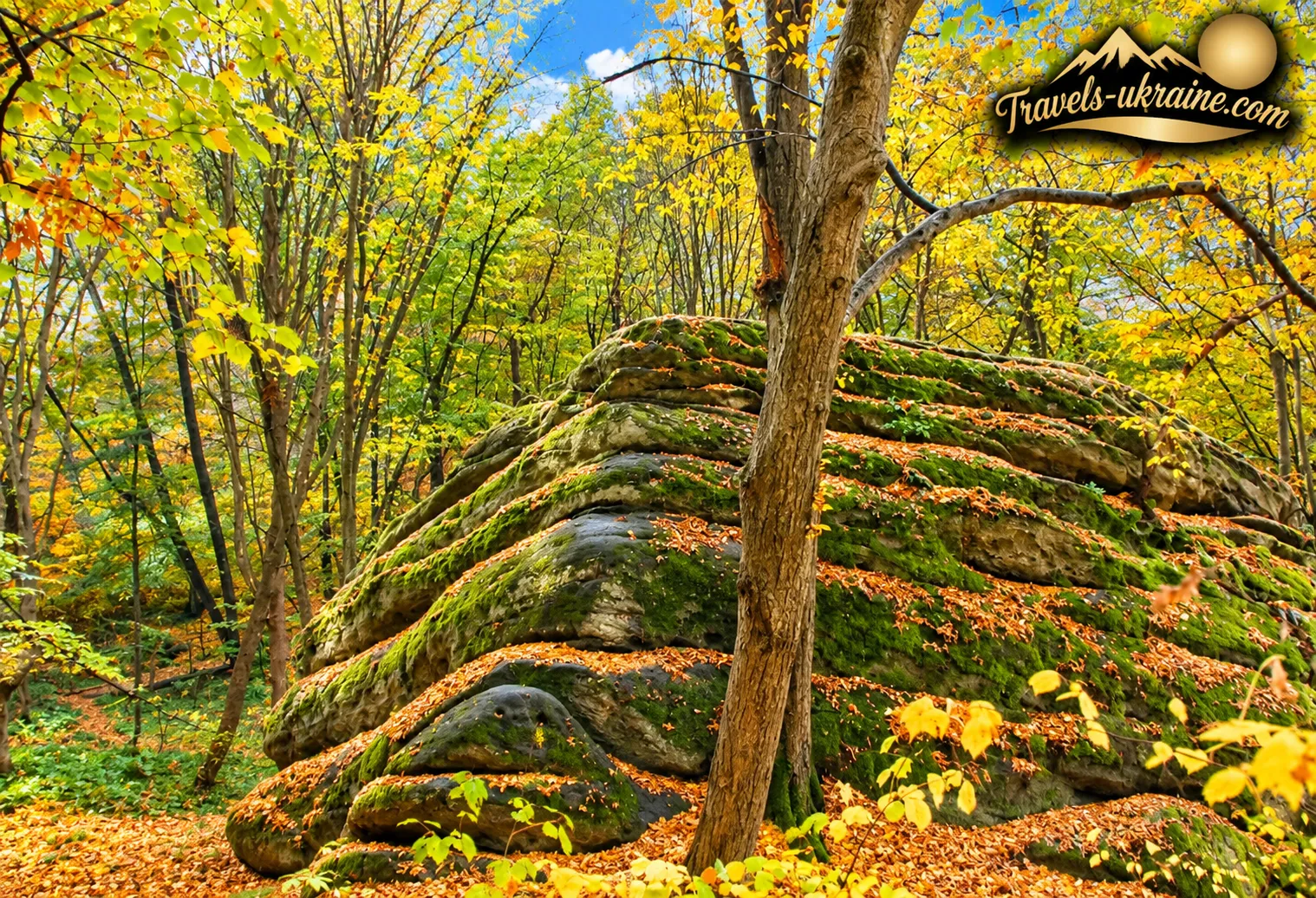
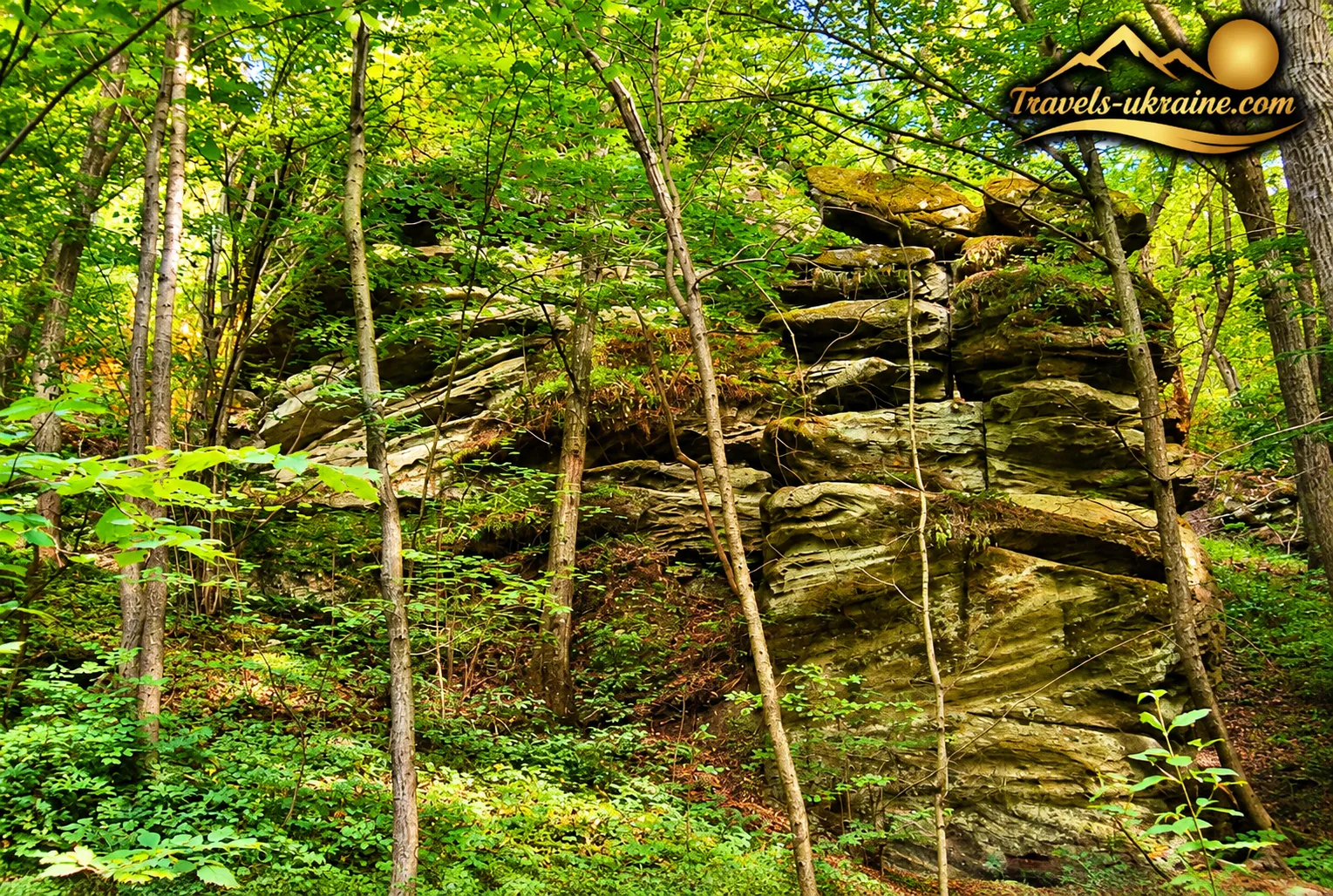
The main attraction of Haidamatskyi Yar is not a single famous rock or viewpoint, but an entire natural labyrinth in which every turn of the trail reveals new stone formations. Huge sandstone blocks, narrow passages, rocky overhangs, and old trees create an atmosphere that makes you want to explore the place slowly. The most interesting thing here is to look at the rocks from different angles. What appears from one side to be an ordinary stone outcrop may, a few steps later, resemble an animal’s head or a fantastic creature. It is precisely because of such natural shapes that some formations have received their own names.
Rocks in Haidamatskyi Yar: Mushroom, Ram, and Hanging Rock
One of the most interesting rock remnants in the tract is called the Mushroom. The origin of the name becomes obvious when you look closely at its shape: the more massive upper section resembles a cap resting on a narrower base. Formations like this develop through uneven weathering of rock. Different sandstone layers have varying resistance to erosion, so some sections gradually wear away faster while others preserve their unusual shapes. For visitors, this rock is especially interesting because of its silhouette. It is worth viewing from several sides, as a change in perspective makes its resemblance to a natural mushroom much more noticeable.
Another well-known natural formation is the Ram Rock. It received its name because the human imagination can recognize animal-like features in its outline. Such rock forms are especially interesting because every visitor may see something different in them. One angle emphasizes the massiveness of the rock, while another reveals unusual protrusions and hollows that resemble parts of a head or body. And this is one of the charms of Haidamatskyi Yar: nature did not deliberately create sculptures here, yet the result of its centuries-long work often looks as though the stone had been shaped by a master.
Among the characteristic formations of the tract is also the Hanging Rock, sometimes known as Vysiachka. Its name reflects the impression created by the massive stone projection hanging above the surrounding space. Such formations are especially striking when viewed from below, where their scale and unusual position relative to nearby stone blocks can best be appreciated. At the same time, it is important to remember that natural rock formations are not specially constructed tourist facilities. Visitors should not climb unstable projections, stand beneath dangerous overhangs, or attempt to scramble between blocks outside accessible trails.
Haidamak Rock and Cave
The Haidamak Rock, associated with some of the best-known historical legends of the tract, deserves special attention. Local descriptions also mention the Haidamak Cave — a natural recess or shelter among the rock formations. Places like these help explain why stories about insurgent hideouts emerged around the ravine. Large stone blocks, rocky overhangs, and concealed passages really do create the feeling of a secluded space that would be difficult to notice from a distance.
However, visitors should not treat every dark crevice between the rocks as an entrance to an underground passage. Some cavities are entirely natural, and their depth, stability, and accessibility may be unknown. It is best to view such places from the outside rather than attempting to enter narrow or potentially dangerous openings.
Stone Labyrinths and Forest Trails
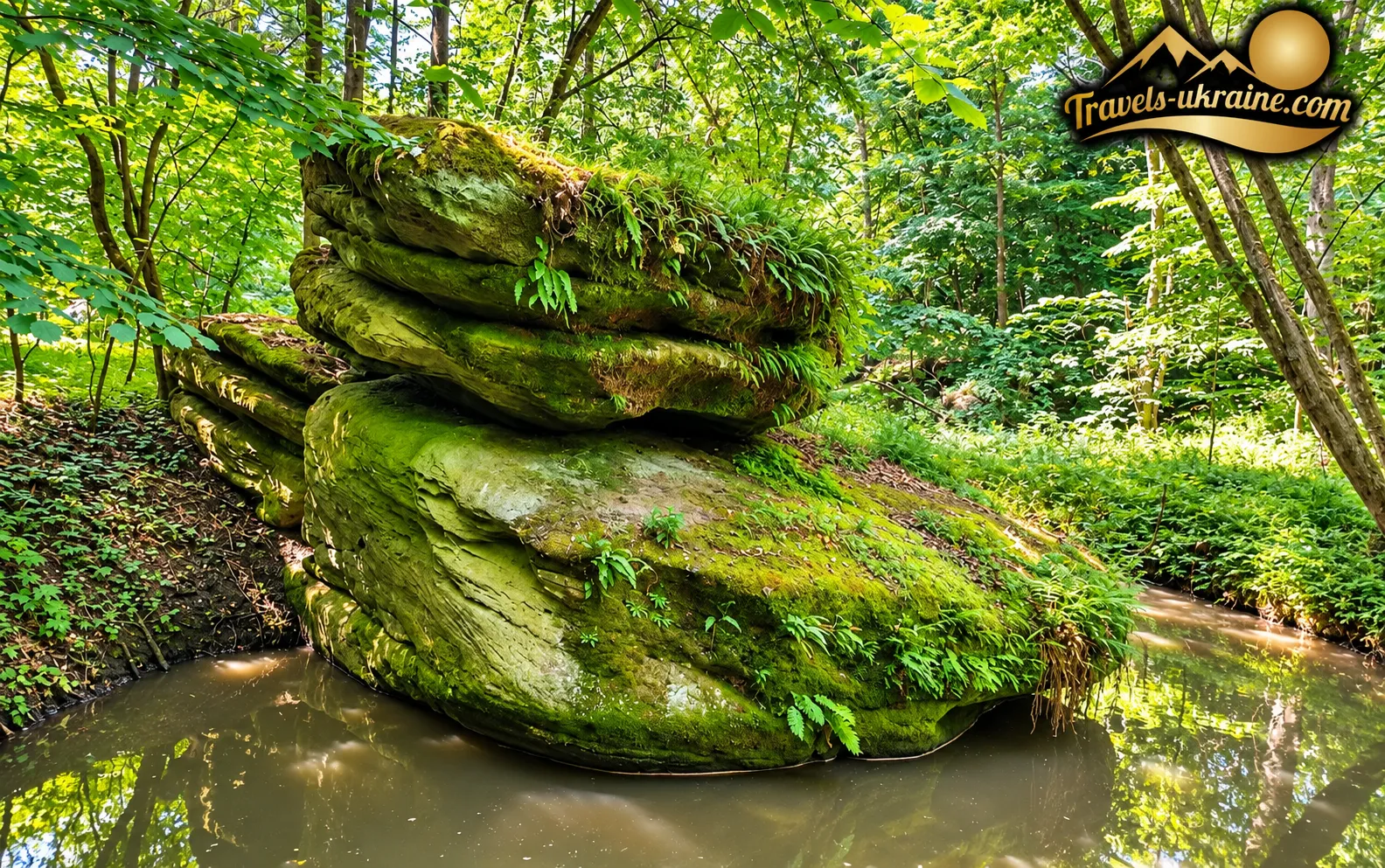
Even if you do not try to locate every named rock formation, a walk through Haidamatskyi Yar leaves plenty of impressions. The passages between sandstone massifs are attractions in themselves, with stone walls rising beside the trail in some places while trees form a natural green canopy overhead. In certain areas, tree roots wrap around large stone blocks, moss covers shaded surfaces, and sunlight filters through the leaves in narrow beams. All of this creates a distinctive atmosphere that makes it worth stopping for a moment simply to take in the surrounding landscape.
After rain, the stones and dirt trails can become slippery, so comfortable footwear with good traction is recommended. Extra caution is needed in narrow passages, on slopes, and in areas with exposed tree roots.
The Bushanka Valley — the Natural Setting of the Rocky Ravine
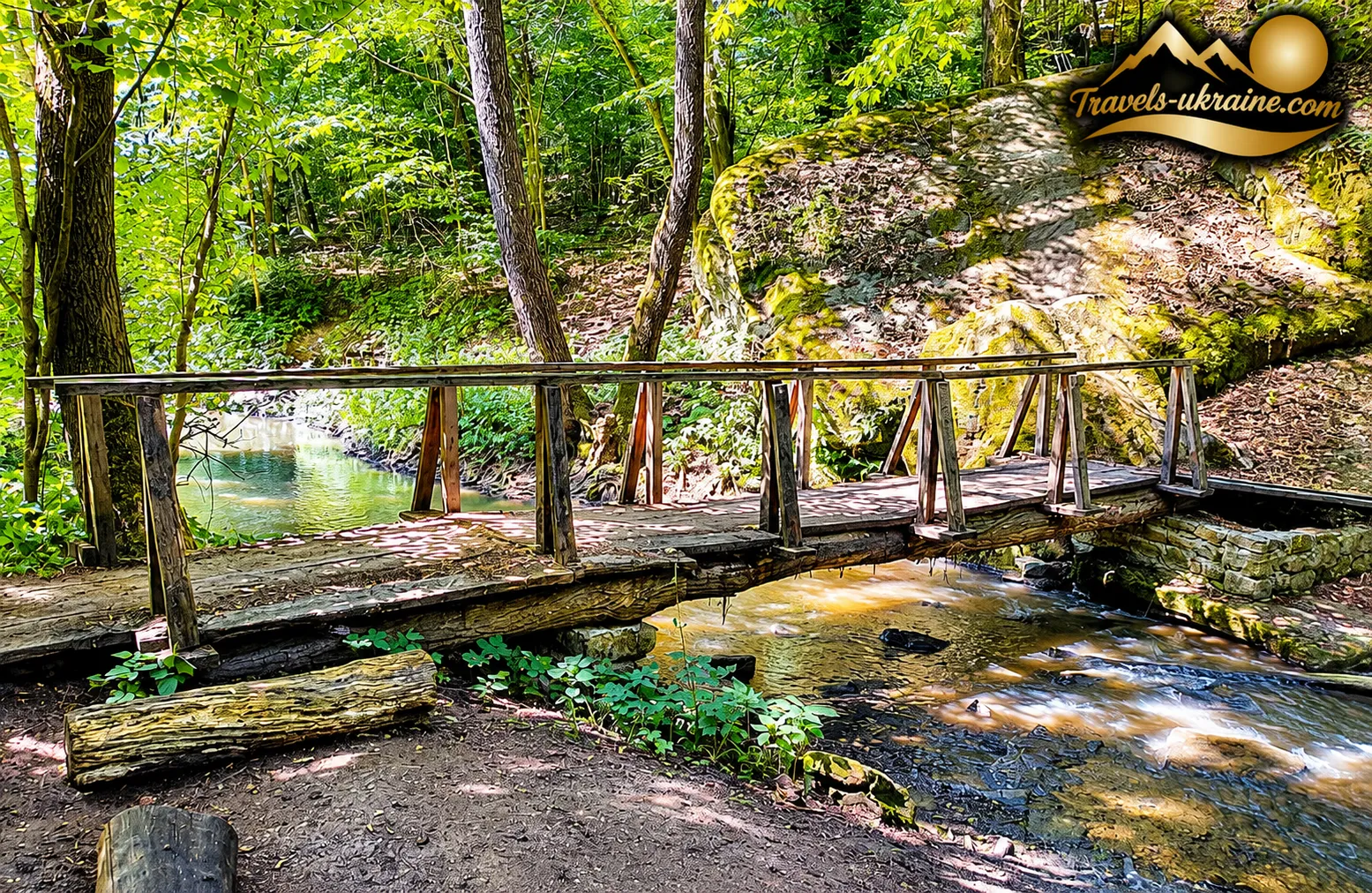
An important part of the natural complex is the valley of the Bushanka River. Water and erosion processes played a major role in shaping the local relief over long periods of time. For visitors, the valley is interesting because of the combination of rocky slopes, forest vegetation, and the small stream. The contrast between massive stone formations and living vegetation that has gradually reclaimed the spaces between them is especially noticeable here. The landscape can change significantly depending on the season. In spring and summer, the tract is immersed in greenery; in autumn, the forest takes on golden shades; and during periods without dense foliage, individual rock massifs become easier to see.
How Best to Explore the Natural Attractions
Haidamatskyi Yar reveals itself best during a slow walk. There is no need to try to see every named rock within a few minutes or turn the route into a search for social-media photos. It is much more rewarding to focus on the natural forms themselves: examine the sandstone layers, notice unusual projections, walk between large blocks, and feel how the landscape changes in different parts of the ravine.
Since the names of individual rocks are not always marked by obvious signs, it is useful to study a map before your visit or use the services of a local guide. This is especially helpful if you want to find specific natural formations rather than simply walk along the forest trails. Haidamatskyi Yar is a place where the landscape itself is the main attraction. You do not need to find one famous rock to understand the value of the tract. The experience comes from the combination of stone labyrinths, forest, natural passages, and a sense of quiet that is difficult to find in an urban environment.
Haidamatskyi Yar: Answers to the Most Frequently Asked Questions
Where is Haidamatskyi Yar located?
Haidamatskyi Yar is located near the village of Busha in Mohyliv-Podilskyi District, Vinnytsia Oblast. The tract is one of Podillia’s natural monuments and is associated with the tourist area of the State Historical and Cultural Reserve “Busha.”
How do you get to Haidamatskyi Yar?
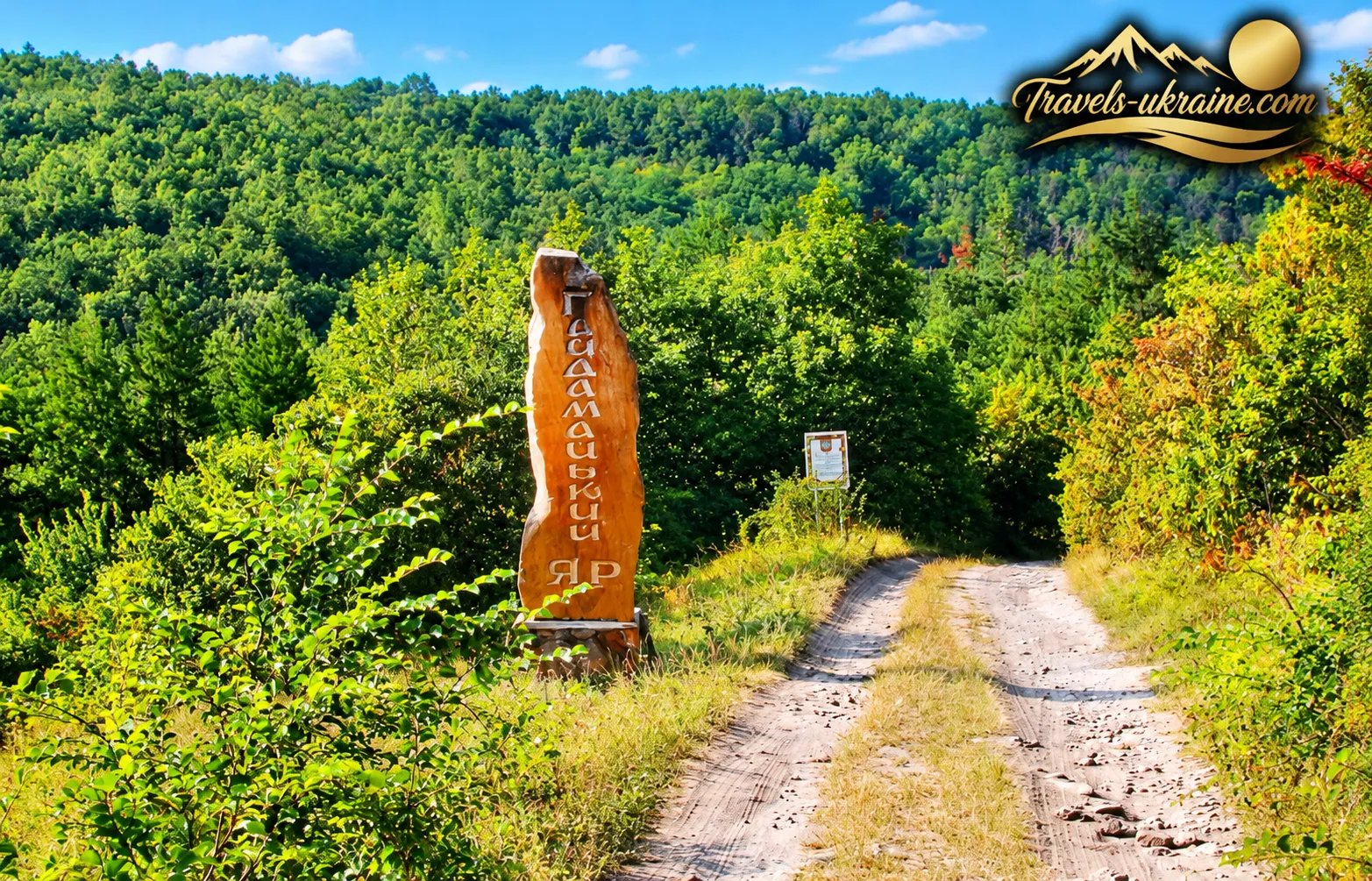
The most convenient option is to travel by car toward the village of Busha. After arriving, follow local tourist signs and confirm the starting point of the walking route with the reserve administration. Part of the route must be covered on foot along forest trails. Before traveling, it is recommended to check the current condition of the access roads.
How much does it cost to visit Haidamatskyi Yar?
Visiting tourist sites within the “Busha” reserve may require a fee. The cost of guided tours and the specific conditions for visiting Haidamatskyi Yar should be checked before your trip, as prices and access rules may change.
How much time is needed to explore Haidamatskyi Yar?
For a relaxed walk along the main accessible trails, it is worth allowing approximately 1–2 hours. If you plan to photograph the rock formations, visit several natural sites, or take a guided tour, you may need more time.
Can you visit Haidamatskyi Yar independently?
An independent walk should be planned only along accessible tourist trails and in accordance with the current rules of the reserve. Since some individual rocks may not be marked by signs, a guided tour or a route prepared in advance can be useful for a first visit.
Is Haidamatskyi Yar suitable for visiting with children?
The walk can be interesting for families with school-age children, but the terrain includes natural uneven surfaces, rocky passages, slopes, and sections that become slippery after rain. Children should be supervised and should not be allowed to climb rocks independently or enter unknown cavities.
When is the best time to visit Haidamatskyi Yar?
The most comfortable seasons for walking are spring, summer, and early autumn in dry weather. In autumn, the rocks are especially picturesque among colorful foliage, while in spring some of the stone formations are easier to see. After heavy rain and during winter, the trails may be slippery.
What can you see near Haidamatskyi Yar?
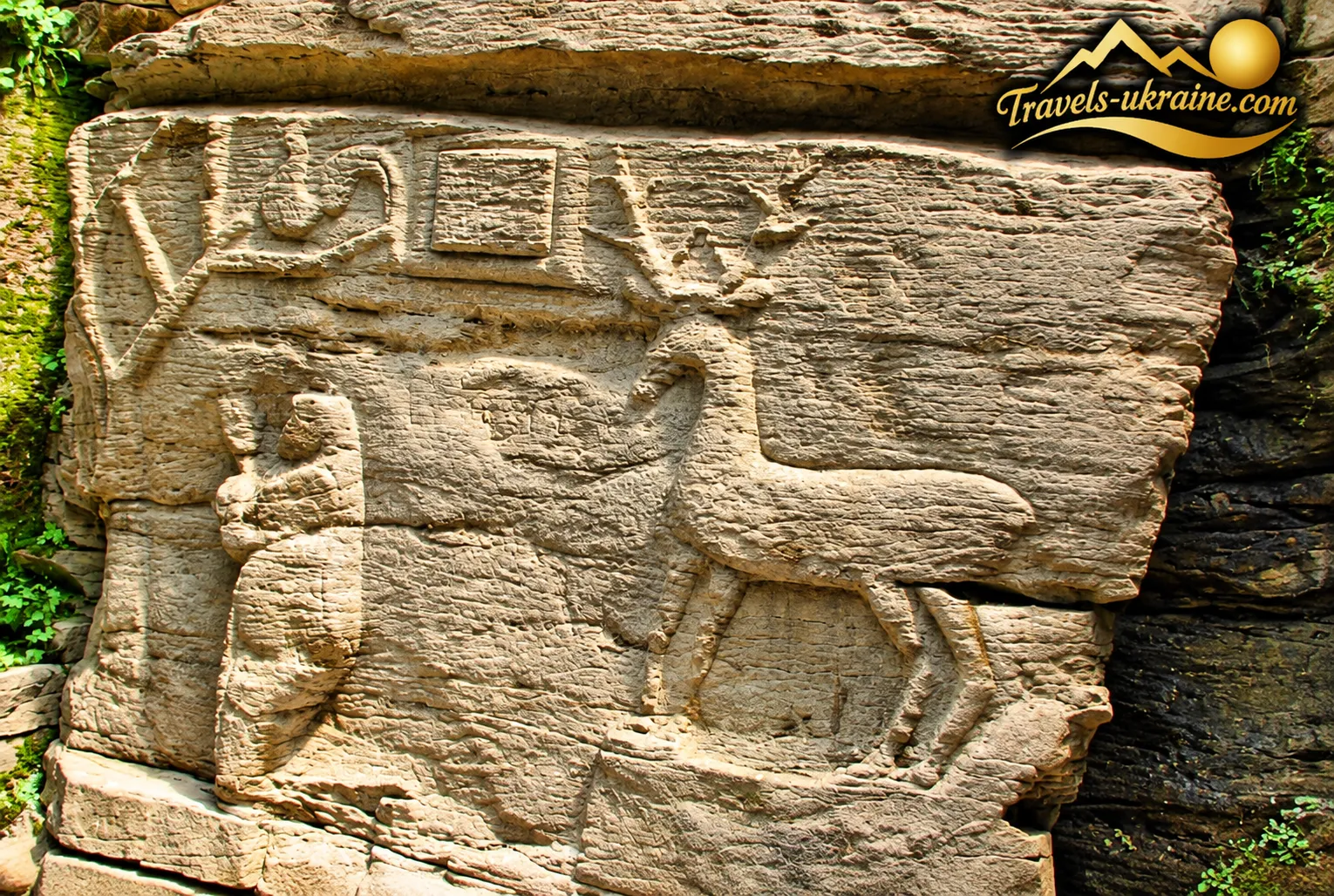
First of all, it is worth visiting the State Historical and Cultural Reserve “Busha”. Its best-known attractions include the remains of Busha’s defensive structures, historical exhibitions, and the famous Busha rock relief. Combining the natural tract with the historical landmarks of the village makes it possible to create a rich route lasting several hours.
Haidamatskyi Yar — a Place Where Nature Preserves History
Haidamatskyi Yar is one of those natural landmarks of Vinnytsia Oblast that needs no monumental buildings, observation towers, or artificial scenery to make an impression. Nature itself was the main creator here. Among the forests of Podillia, it left enormous sandstone cliffs, unusual stone formations, narrow passages, and secluded corners where time seems to slow down.
But the true character of the tract lies not only in its picturesque landscape. Every rock here has two stories: one created by nature, the other by human memory. Geological processes explain the origins of the stone labyrinths, while legends about the Haidamaks add historical meaning to them. And although not every legend is supported by documentary evidence, they remain part of the cultural heritage of this place. That is why the tract is best explored without rushing. Walk along the forest trails, examine the unusual shapes of the rocks, stop among the massive stone blocks, and try to imagine what this landscape looked like long before modern roads and settlements appeared. This is a place where it is rewarding not only to take photographs, but also to notice the details that are easy to miss during a quick walk.
The trip combines especially well with a visit to the State Historical and Cultural Reserve “Busha”. In a single day, you can see natural rock formations, discover the history of a Podillian village, and explore very different chapters of Vinnytsia Oblast’s past. Haidamatskyi Yar is a place where nature created a stone labyrinth and people filled it with stories. And perhaps that is why, after a walk here, you remember not only the enormous rocks or forest scenery, but also the special feeling that another untold story may be hiding around every bend in the trail.




No Comment
You can post first response comment.