
 English
 Українська
 Русский
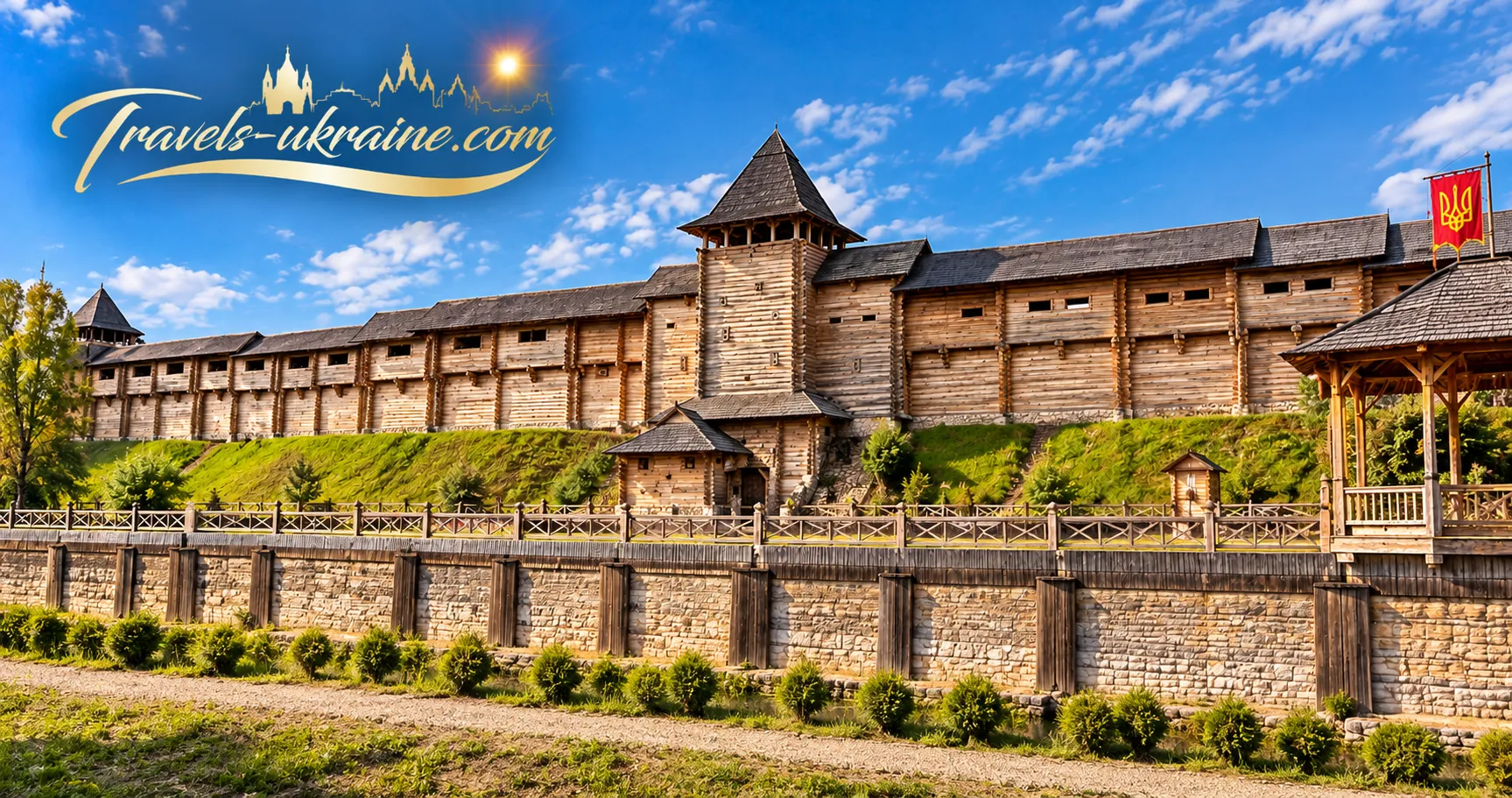
Imagine a place where the familiar modern world disappears behind towering wooden walls, replaced by imposing defensive towers, princely courtyards, and ancient gates. A place where you can hear the sound of horses' hooves, see warriors dressed in medieval armor, and, for a moment, feel like a traveler from the distant past. It may seem that such an adventure would require a time machine. In reality, all you need to do is venture beyond Ukraine's capital, where, amid the picturesque landscapes of Kyiv Oblast, you will find Kyivan Rus Park — an extraordinary historical and cultural complex dedicated to recreating the atmosphere of ancient Kyiv.
Near the village of Kopachiv in Obukhiv District, Kyiv Oblast, there is a large-scale reconstruction of the historic appearance of the princely city from the 5th to the 13th centuries. The project, known as "Ancient Kyiv", aims to illustrate what the capital of medieval Rus might have looked like during its formation and flourishing. Here, history extends beyond museum displays and textbook pages, taking the form of wooden fortifications, watchtowers, and reconstructed elements of everyday life in ancient times. However, this is not an authentic medieval settlement but a modern reconstruction complex where historical knowledge is combined with architectural recreations and themed entertainment.
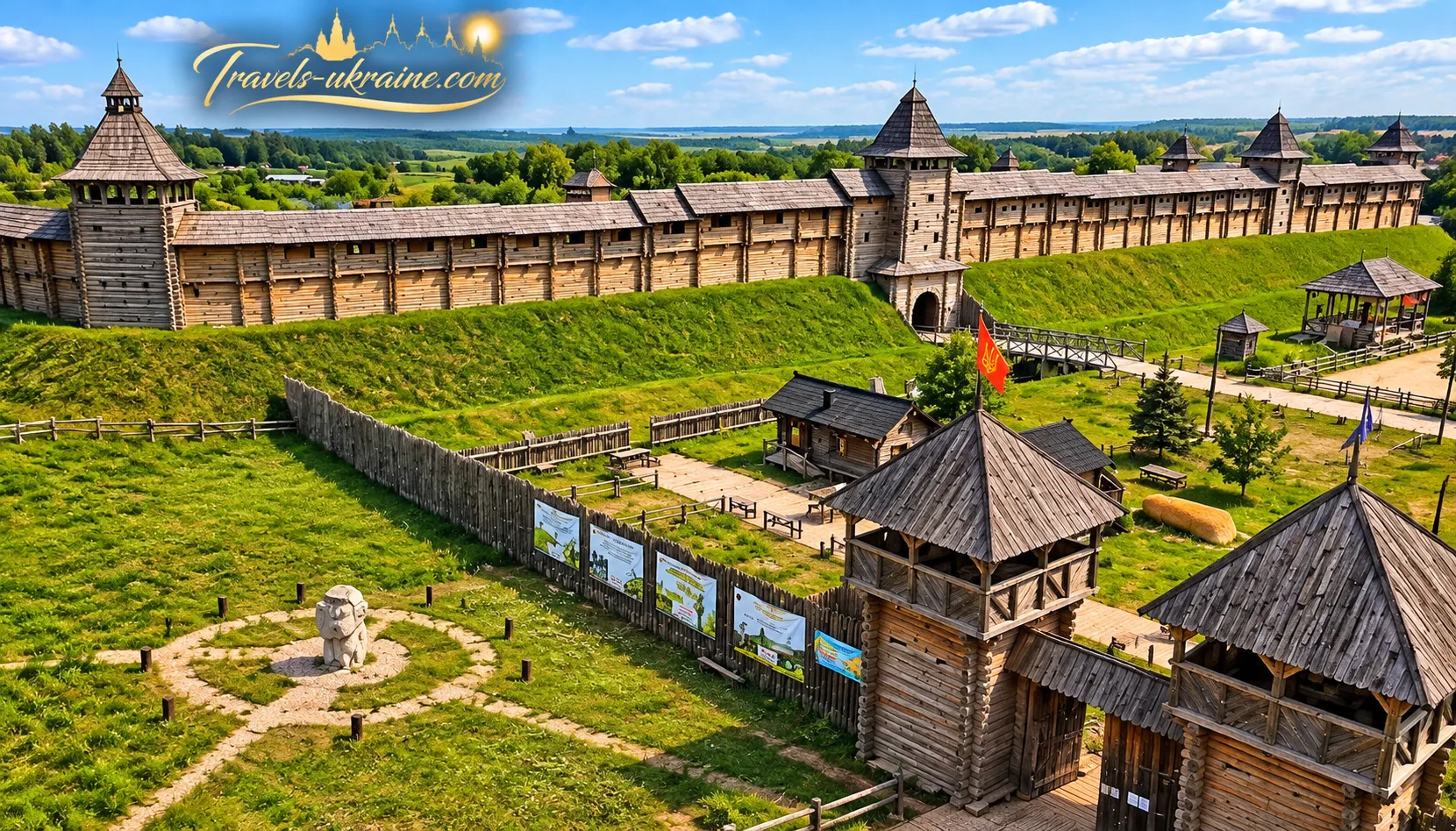
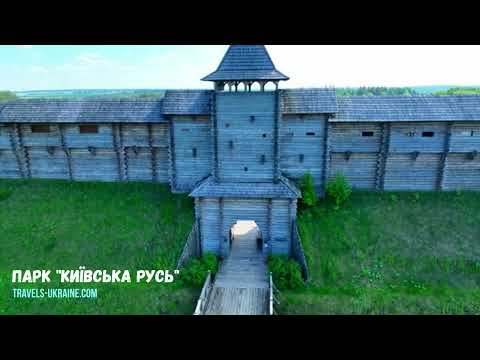
Particularly impressive are the majestic wooden fortifications of Ancient Kyiv. The massive defensive wall, stretching for hundreds of meters, and the towering St. Michael's Gate create an extraordinary architectural landscape. Standing before them, you cannot help but wonder: what was life like behind these walls a thousand years ago? Who guarded the city gates? How did people live, how did they welcome princely messengers, and what happened along the streets of medieval Kyiv? These are the very questions that transform an ordinary walk into a fascinating journey through history.
For families with children, history enthusiasts, and travelers looking for unusual places to visit near Kyiv, the park can offer an exciting alternative to traditional sightseeing tours. Here, visitors can combine an outdoor walk with educational activities, take photographs against the backdrop of medieval fortifications, and discover the culture of the princely era.
In this article, we will explore the history of Kyivan Rus Park, its architectural concept, the reconstructed buildings of Ancient Kyiv, and the most interesting experiences available to visitors. You will discover what can already be seen within the complex, which reconstructions remain part of the project's future plans, what makes the princely stables, historical performances, and themed events so fascinating, as well as how to plan your visit and which tourist attractions are located nearby. And perhaps, after exploring this extraordinary corner of Kyiv Oblast, medieval history will no longer seem quite so distant — because sometimes, all it takes is stepping through an ancient gate to feel the spirit of an entire era.
History of Kyivan Rus Park — How Ancient Kyiv Was Brought Back to Life
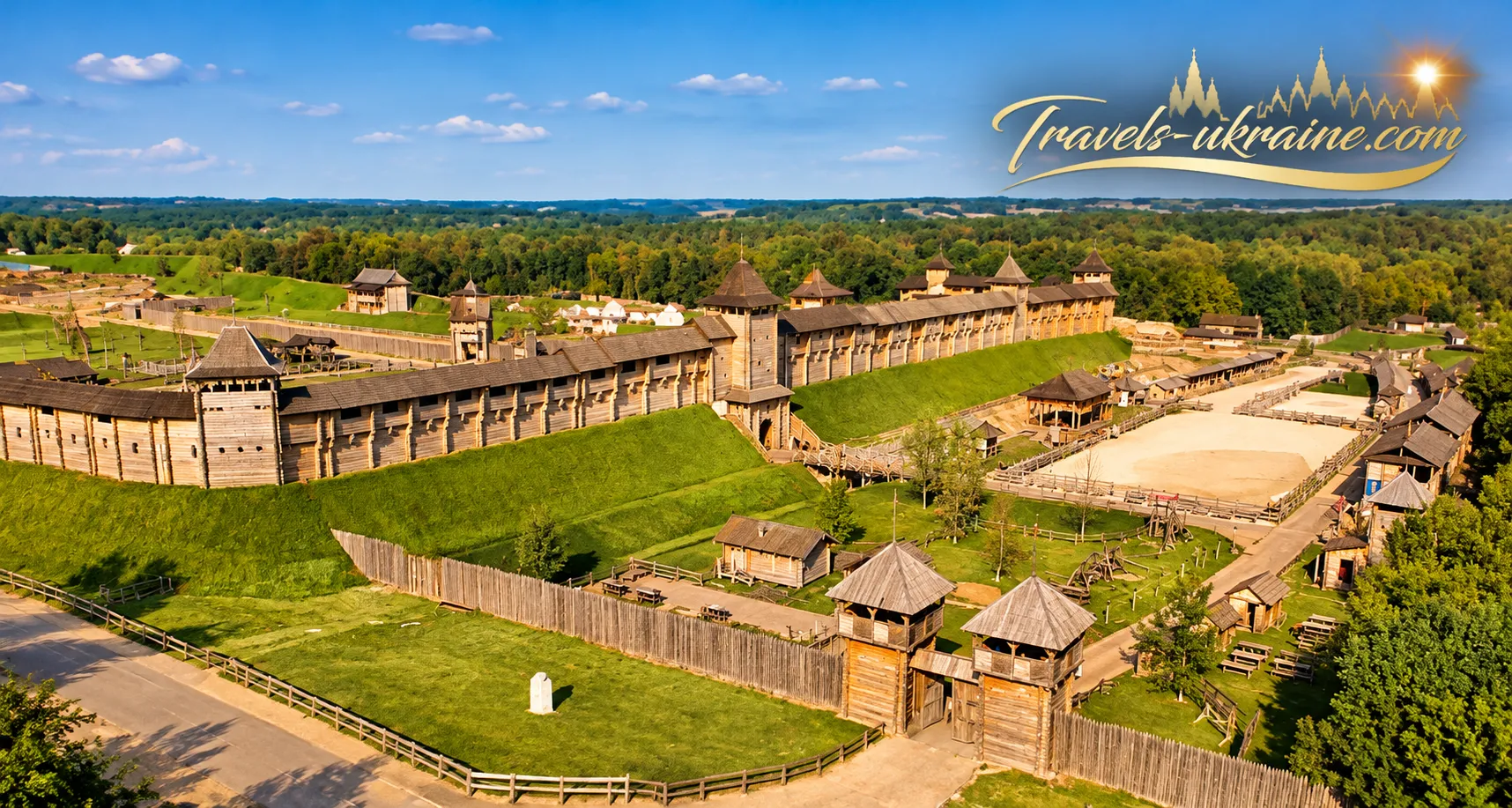
The creation of Kyivan Rus Park began with an ambitious idea — to recreate the architectural appearance of medieval Kyiv not as a small-scale model or museum exhibition, but at full size. The city, of which only individual buildings, archaeological remains, and written records have survived to the present day, was to rise once again before visitors in the form of wooden defensive walls, city gates, princely courtyards, and ancient buildings. The concept seemed extraordinarily challenging: it essentially involved creating a modern historical complex capable of conveying the atmosphere of the capital of Rus more than a thousand years ago.
However, the main idea was not simply to construct picturesque scenery. The project's creators wanted to establish a space where history could not only be studied but also experienced through architecture, everyday life, traditional crafts, and cultural customs. This vision gave rise to the Ancient Kyiv project, which gradually developed into one of the best-known historical and cultural complexes in Kyiv Oblast.
The history of Kyivan Rus Park began in late 2005, when a large-scale project to recreate the architectural appearance of ancient Kyiv was launched. Over the following years, construction of the first buildings continued, and the park gradually developed into a historical and cultural complex that opened to tourists in 2008.
At the heart of this ambitious vision was Kyiv's fortified citadel, known as the Dytynets or the City of Volodymyr — the fortified heart of the medieval capital, where political life flourished, important decisions were made, and the history of Rus was shaped. The architectural appearance of the city is being recreated at a 1:1 scale, drawing on archaeological research, historical sources, and modern scientific knowledge. Although time machines remain the stuff of science fiction, the park's creators decided to take a different approach: if people cannot travel back in time, why not try to recreate the past around them?
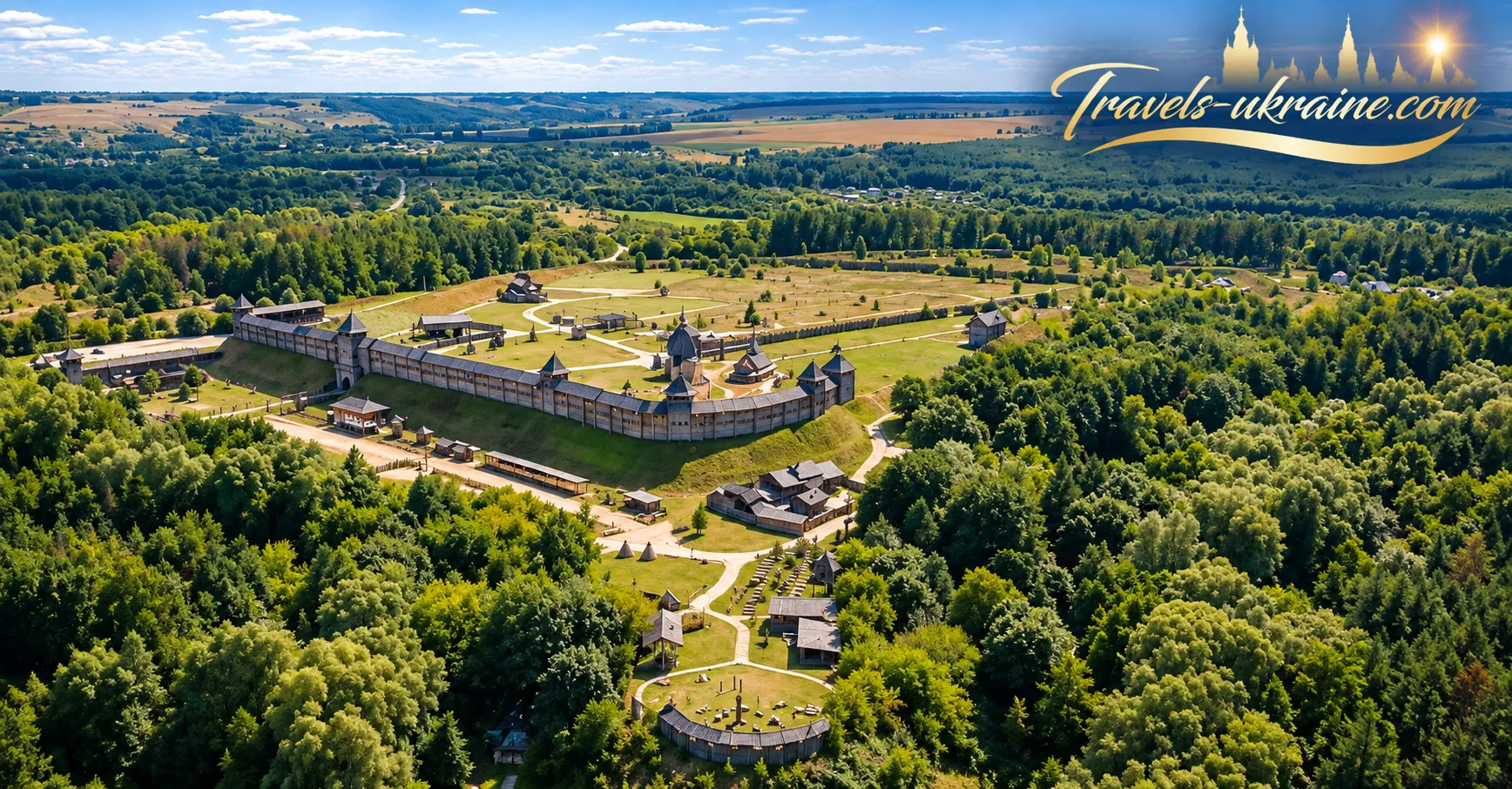
The scale of the project is truly impressive: the entire complex covers more than 50 hectares, with approximately 10 hectares allocated to the reconstruction of Kyiv's historic citadel. There would be enough space here not only for a princely court but also for an entire military retinue, complete with horses, weapons, and hearty appetites after a campaign. Of course, recreating an ancient capital is not a task that can be completed in a single year, so some architectural plans have already been realized, while others remain in development. Nevertheless, even the completed fortifications allow visitors to appreciate the scale of a medieval city and imagine, if only for a moment, that they are guests in princely Kyiv — with the pleasant advantage that today, entering the city does not require the prince's personal permission.
Why the Village of Kopachiv Was Chosen for Ancient Kyiv
The location selected for this ambitious project was not just a random point on the map, but a historically significant area near the village of Kopachiv in Obukhiv District, Kyiv Oblast, connected with the region's ancient past. The surrounding hills, spacious valleys, and natural landscapes are remarkably well suited to recreating the atmosphere of medieval Kyiv. During the project's development, particular attention was paid not only to the terrain but also to the vegetation, with the aim of recreating the natural environment characteristic of the Kyiv region a thousand years ago.
Indeed, among green hills and wooden fortifications, it is much easier to imagine princely warriors, merchants, and craftsmen than in the middle of modern apartment blocks and traffic jams. Here, even nature seems to have agreed to play along with the historians — all that remains is to await a horseman carrying a message from the prince. Fortunately, modern tourists have a considerable advantage over travelers of the 11th century: today, the road to Ancient Kyiv can be found using a navigation app, without risking getting lost in the forest or accidentally encountering bandits.
Scientific Research and the Historical Accuracy of the Reconstruction
Developing such a large-scale project required cooperation with specialists from various disciplines. Researchers in archaeology, history, architecture, ethnography, and cultural studies were involved in discussions about the historical concept and master plan. The results of many years of research into ancient Kyiv were particularly important. Among the scholars associated with the project, a prominent role was played by Hlib Yuriiovych Ivakin — a Ukrainian archaeologist, researcher of medieval Kyiv, and corresponding member of the National Academy of Sciences of Ukraine. His scientific work focused, among other subjects, on the archaeological heritage of the capital and the development of the city during the princely era.
The reconstructions were based on information about the defensive structures of Kyivan Rus, the characteristics of wooden architecture, archaeological excavation findings, and historical descriptions. Researchers sought to establish not only the possible appearance of the buildings but also their arrangement within the urban landscape. However, historical reconstruction always has certain limitations in terms of accuracy. Archaeological research often makes it possible to determine the dimensions of foundations, the location of walls, or the layout of buildings, but it does not always provide sufficient evidence to establish the exact shape of roofs, building heights, decorative details, and other architectural features. Therefore, some elements of Ancient Kyiv are reconstructed using historical comparisons and scholarly hypotheses. This is standard practice for historical reconstruction complexes, but it requires clear explanations for visitors: an archaeologically confirmed fact and a plausible architectural interpretation are not the same thing.
It is precisely this combination of scientific foundations and full-scale architectural reconstruction that makes the project so interesting from an educational perspective. It offers visitors an opportunity to see one possible representation of a city whose complete medieval environment can no longer be recreated in modern Kyiv.
Kyivan Rus Park Today — History, Education, and Tourist Experiences
Over the years, Kyivan Rus Park in Kopachiv has become a well-known tourist destination in Kyiv Oblast, combining architectural reconstruction, historical and cultural events, and family recreation. Its main distinguishing feature is the attempt to present history not only through museum exhibits but also through physical surroundings, sounds, movement, and direct visitor participation.
Historical performances, themed festivals, equestrian programs, and workshops have become an important part of the Ancient Kyiv experience. Such activities help tourists imagine different aspects of medieval life, from warfare and traditional crafts to festive customs. However, the modern park should not be regarded as a fully reconstructed capital of Rus. Its grounds combine completed architectural structures, historical exhibitions, tourist facilities, and elements whose development is included in the project's long-term concept. Certain programs and attractions are available only during special events.
It is important to distinguish historical education from theatrical interpretations of the past. Costumed performances, knightly tournaments, and equestrian shows help create a medieval atmosphere, but they are not always literal recreations of events or customs from a particular century. Their main value lies in their ability to spark visitors' interest in history and encourage a deeper exploration of cultural heritage. The history of the Ancient Kyiv project demonstrates just how challenging it can be to bring architecture that disappeared many centuries ago back into the visible world. From an idea that emerged in 2005, the project has developed into a large historical and cultural complex where medieval themes provide the foundation for educational excursions and tourist recreation.
Although no modern reconstruction can fully restore the lost world of the princely era, this park complex offers an unusual opportunity to see one possible interpretation of its architectural appearance. This is the central idea behind the project: to make distant history more accessible, understandable, and fascinating for modern generations, as the architectural image of Ancient Kyiv from the 5th to the 13th centuries gradually comes to life among wooden fortifications — a city that became the heart of the powerful medieval state of Kyivan Rus, witnessed princely victories, fierce conflicts, and events that forever changed the course of Eastern European history.

Architecture of Ancient Kyiv — Behind the Walls of a Mighty Medieval Capital
What did a traveler feel a thousand years ago when, after a long journey, the mighty fortifications of princely Kyiv finally appeared before them? Admiration, anxiety, or relief that the dangerous journey was finally over? Perhaps all of these emotions at once. Today, visitors can experience a glimpse of those feelings at a historical reconstruction complex, where wooden fortress walls, watchtowers, and city gates inspired by medieval architecture rise among the picturesque hills of Kyiv Oblast.
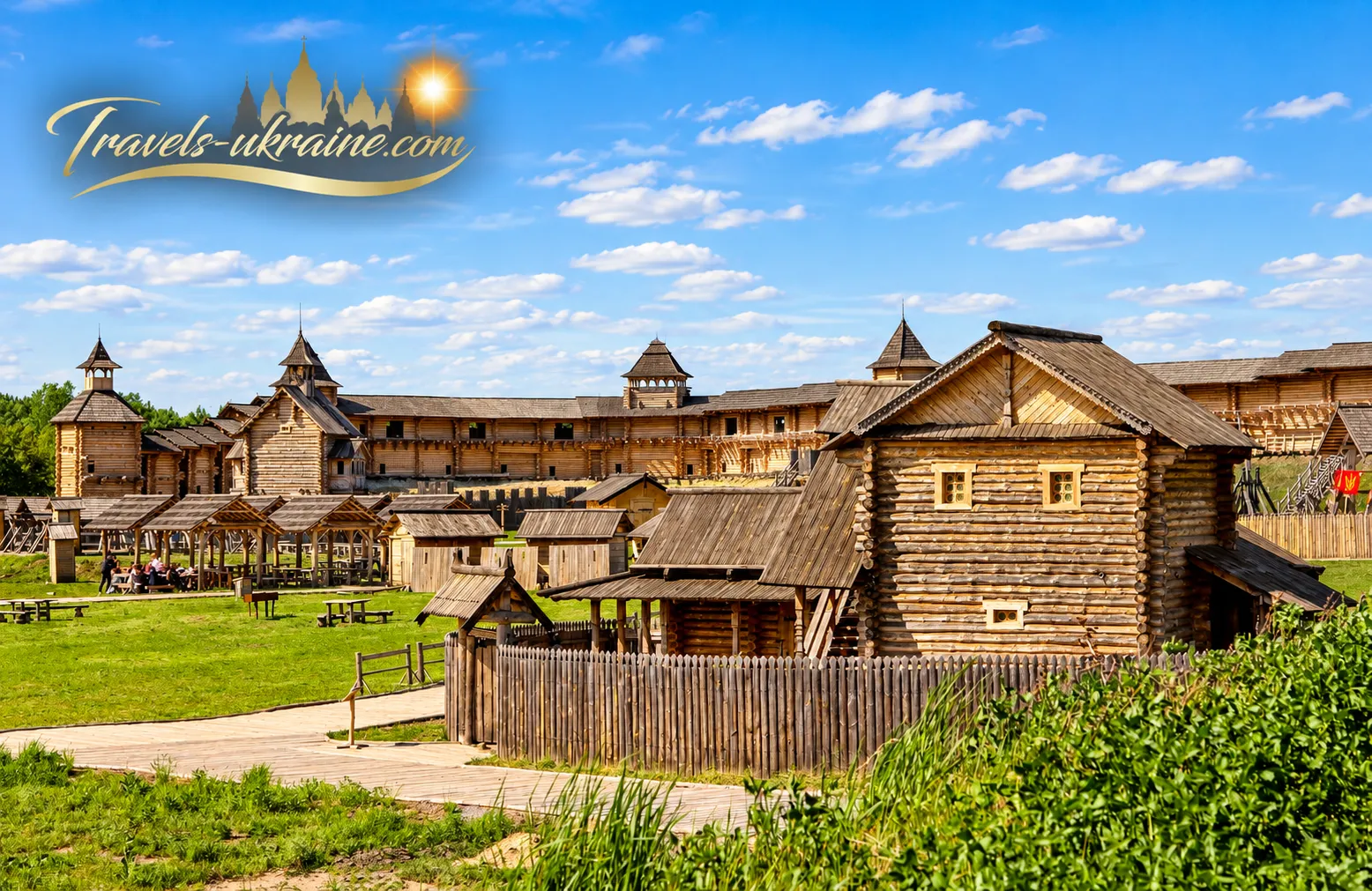
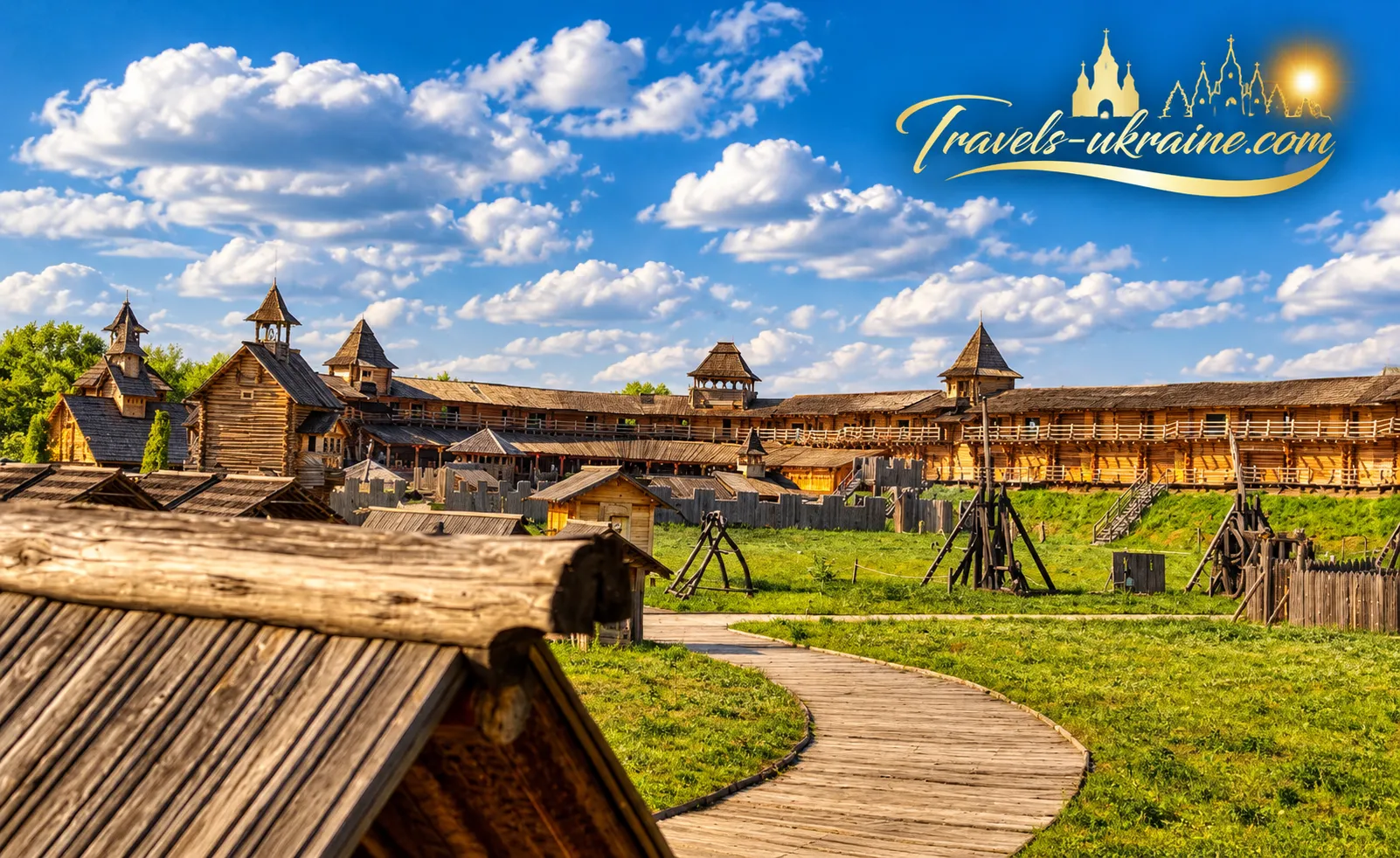
The park's architecture is one of the main reasons to visit this historical and cultural complex. Here, visitors can discover what the defensive structures, townspeople's homes, princely courtyards, and public spaces of the capital of Rus might have looked like. While in modern Kyiv, the ancient wooden fortifications are mostly remembered through archaeological discoveries and historical reconstructions, the park brings their appearance to life at full scale. Of course, instead of a stern medieval city guard, visitors are welcomed by modern tourist facilities — progress does have its advantages.
However, it is important to understand one essential feature of the complex: Ancient Kyiv in Kopachiv is not an authentic medieval city. It is a modern reconstruction created using archaeological research, historical sources, and architectural comparisons. Some structures have been recreated, others are represented in exhibitions, and some remain part of the project's ambitious long-term vision. This is why visiting the park is interesting not only as a walk among unusual buildings but also as an opportunity to discover how historians and architects attempt to bring the visible image of a long-lost world back to life.
Defensive Fortifications of Ancient Kyiv — The Power of the Princely Capital
The first thing that impresses visitors to the park is the scale of its wooden defensive structures. Tall walls, earthen ramparts, and watchtowers create the image of a city that would have been difficult to approach unnoticed in medieval times. And for good reason: fortifications were among the most important requirements for the existence of a major political and trading center. During the era of Kyivan Rus, the defensive system consisted of several fortified sections that developed and expanded over the centuries. Particularly important was the Dytynets of Kyiv — the central fortified area where princely authority, important buildings, and the city's treasures were concentrated. Defensive structures protected residents from attacks, while their height and strength were intended to intimidate enemies even before a siege began.
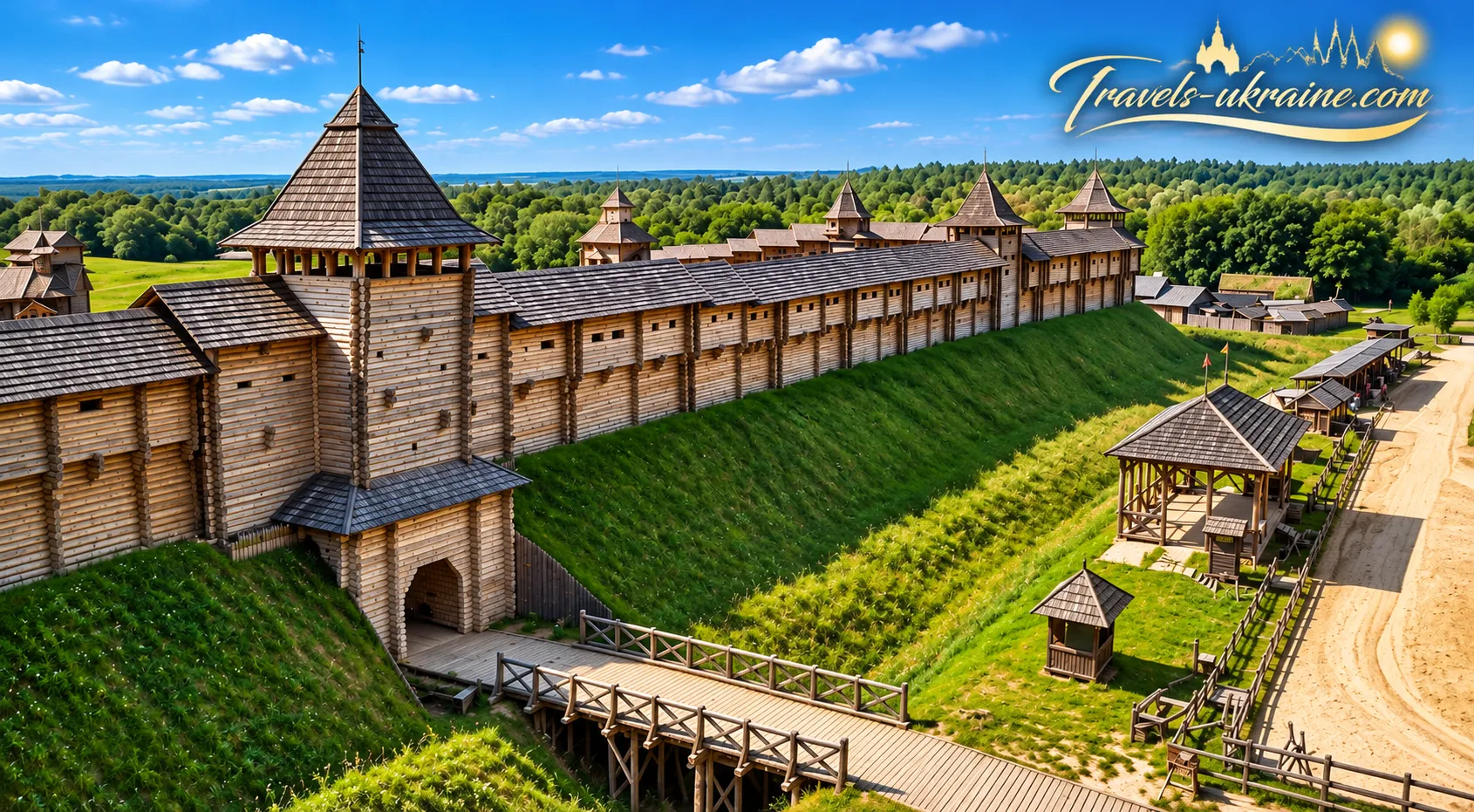
The park's reconstruction is based on the principles of wooden and earthen fortification construction typical of the Middle Ages. Earthen ramparts were reinforced with wooden structures, while defensive walls and fighting platforms were built along their upper sections. This system allowed defenders to observe the surrounding territory, maintain defensive positions, and make assaults more difficult for attackers. According to the organizers, the complex includes a reconstructed earthen rampart system with a planned total length of approximately 1.5 kilometers, while some embankments reach heights of up to nine meters. The defensive system also includes sections of a moat, wooden walls, and fortress structures. The combined height of certain defensive elements, including the rampart and wooden constructions, may reach approximately 15 meters.
Of particular interest is the reconstruction of the upper defensive wooden structures known as zaborola. Approximately 300 meters of wooden fortress walls have been constructed in the park, which the organizers describe as a record-setting reconstruction project in Ukraine. Massive logs and tightly arranged wooden elements help visitors imagine how complicated and labor-intensive the construction of such fortifications must have been in ancient times. Medieval fortresses, of course, were built without modern heavy machinery. Every log had to be prepared, transported, lifted, and securely positioned. Such structures required enormous human effort, skilled carpenters, and well-organized labor. Therefore, the defensive walls of Ancient Kyiv are fascinating not only for their impressive appearance but also for the opportunity they provide to understand the construction techniques of our ancestors.
St. Michael's Gate — The Majestic Entrance to Princely Kyiv
One of the most striking landmarks of the reconstructed city is St. Michael's Gate of Ancient Kyiv. This wooden structure rises to a height of approximately 21 meters and makes a particularly powerful impression thanks to its monumental proportions, massive walls, and architectural details characteristic of medieval defensive construction. The reconstructed gate recalls the ancient fortifications of Kyiv, through which residents and visitors once entered the central part of the capital. The historic St. Michael's Gate is associated with the southeastern section of princely Kyiv's fortifications, near the area where St. Michael's Monastery was later established.
In a medieval city, gates were much more than simple passages through fortress walls. They served as important defensive checkpoints through which the movement of people, animals, and goods was controlled. In times of danger, the gates were closed, and defenders took up their prepared positions. For this reason, the construction of city gates received just as much attention as the defensive walls themselves.
The reconstructed St. Michael's Gate features double wooden doors decorated with wrought-iron elements. Particularly interesting are the door handles shaped like lions' heads — a symbolic artistic motif emphasizing the power and ceremonial character of the structure. The massive wooden constructions create the atmosphere of a genuine fortress. It is easy to imagine a merchant caravan entering the city, envoys arriving from a neighboring principality, or a princely military retinue returning from a long campaign. Although modern visitors are not required to explain the purpose of their arrival to an armed guard, the architecture of the gate reminds us that crossing a city's boundaries in medieval times was a far more serious matter than an ordinary stroll.
Watchtowers and Entrance Gates of the Outer Settlement
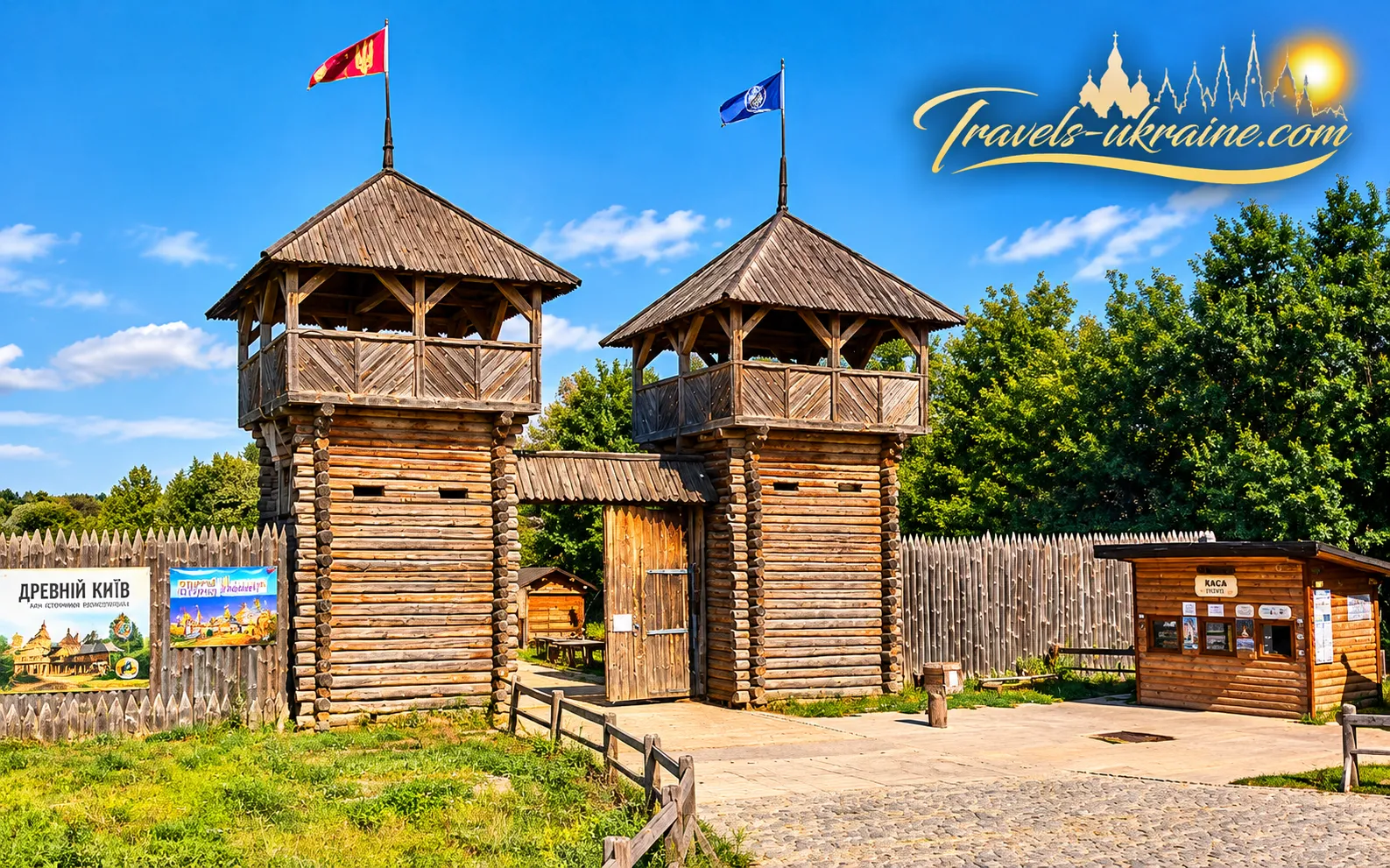
In addition to the main fortress gate, Ancient Kyiv features reconstructed entrance gates with two watchtowers, offering visitors an insight into the defensive system of the city's outskirts. These structures belong to the reconstructed outer settlement, representing the areas beyond the central fortifications of the princely city. The watchtowers were constructed using the traditional wooden log-building technique known as "v oblo", in which logs are joined using specially carved notches. This method allowed builders to create sturdy structures without modern metal fasteners. In ancient times, gaps between logs could be sealed with natural materials, including moss.
Each tower has a base measuring approximately three by three meters and reaches a height of around 11 meters. Their upper sections are crowned with hipped roofs, beneath which observation platforms and reconstructed defensive positions are arranged. In medieval cities, such towers served an important practical purpose. From their elevated positions, guards could detect approaching unfamiliar groups, monitor roads, and warn residents of potential danger. In this way, watchtowers functioned as an early warning system. While today sending a message requires only a few taps on a smartphone, a thousand years ago everything depended on the watchman's vigilance. If he happened to fall asleep, the city's news might arrive in a considerably less pleasant manner.
The watchtowers are also fascinating examples of medieval wooden architecture. Examining the log walls, massive timbers, and roof structures provides a better understanding of how architecture combined defensive requirements with the construction technologies available at the time.
Kyiv's Dytynets and Outer Settlement — How a Medieval City Was Organized
To understand the architectural concept of Kyivan Rus Park, it is important to recognize that medieval Kyiv was not a uniform settlement filled with randomly arranged buildings. Its urban environment developed gradually, and different districts served different purposes. The Dytynets formed the fortified heart of the city. This was where important administrative, princely, and religious buildings were concentrated. During different historical periods, the boundaries of Kyiv's fortified districts changed, while the city's development was accompanied by the construction of new defensive lines and neighborhoods.
Beyond the central fortifications were residential and agricultural districts, trading areas, and centers of craftsmanship. Such territories were often known as posads or outer settlements. They were home to craftsmen, merchants, and other members of the urban population whose everyday activities supported the economic development of the great medieval city. In modern Ancient Kyiv in Kopachiv, elements of both types of urban environments are being recreated. Defensive walls and gates help visitors imagine the fortified city center, while residential estates, market stalls, roads, and utility buildings provide insights into the daily lives of its inhabitants.
This combination allows visitors to explore history beyond the stories of princes and major political events. After all, a medieval city existed thanks to the work of thousands of people: carpenters, blacksmiths, potters, merchants, farmers, and countless other residents. Without them, even the most powerful prince would hardly have been able to boast of a well-developed capital.
Townspeople's Homes, Craft Workshops, and the Wooden Architecture of Kyivan Rus
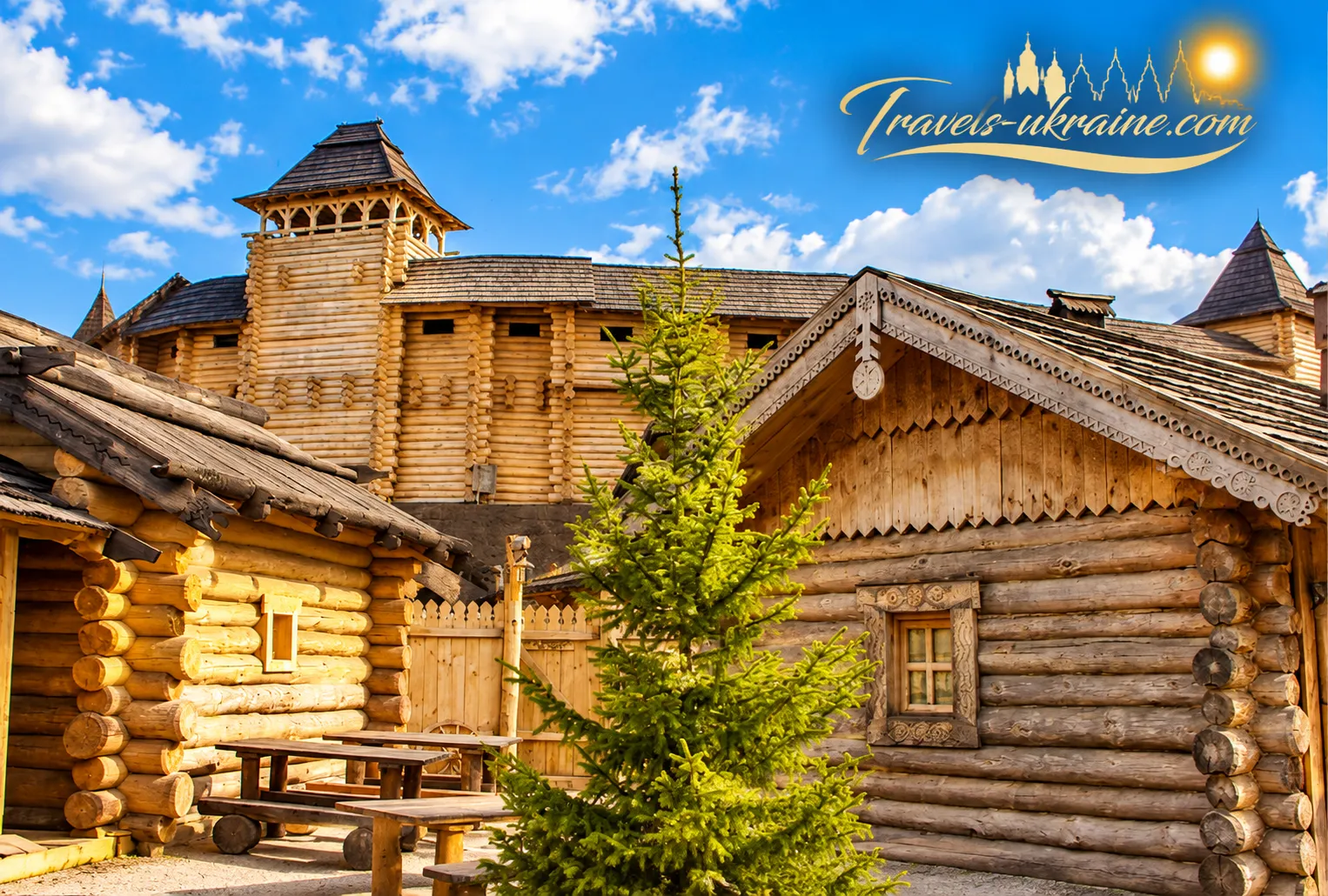
Another fascinating aspect of the complex is the reconstruction of residential and utility buildings from medieval Kyiv. These structures offer a glimpse into the everyday lives of ordinary people, an aspect of history often overshadowed by accounts of princes, battles, and political treaties. The park features reconstructions of 11th–13th-century Kyiv residents' homes, market stalls, and buildings associated with traditional crafts. Their architecture draws on the traditions of wooden construction, which played an essential role in the urban life of Kyivan Rus.
Wood was an accessible material and relatively easy to work with. It was used to construct houses, storage buildings, workshops, fences, utility structures, and numerous other buildings. Wooden construction required considerable skill, as carpenters had to account for the properties of the material, soil conditions, climate, and the intended purpose of each structure.
In traditional homes, a stove or another type of hearth occupied an important place. It provided warmth, allowed food to be prepared, and served as the center of domestic life. At the same time, living conditions varied significantly depending on a family's wealth: the homes of prosperous townspeople could differ considerably from the modest dwellings of craftsmen. The reconstructed craft workshops and market stalls of Ancient Kyiv also highlight the medieval capital's importance as a trading center. Kyiv was a major hub for the exchange of goods, where important trade routes intersected and both local and foreign merchants gathered in the city's markets.
It is easy to imagine a bustling marketplace here: a blacksmith offering his handmade goods, a potter displaying pottery, a craftsman presenting jewelry, and a merchant trying to convince customers that his products are the finest in all of Rus. Although medieval traders were unfamiliar with modern advertising technologies, the art of persuading customers has probably changed very little over the past thousand years. When exploring these reconstructed buildings, pay attention to construction techniques, roof shapes, wall structures, and the overall arrangement of the residential plots. These details help explain how a city functioned when most buildings were made of wood and everyday life was closely connected with craftsmanship and trade.
The Princely Court, Yaroslav the Wise's Palace, and Ceremonial Buildings
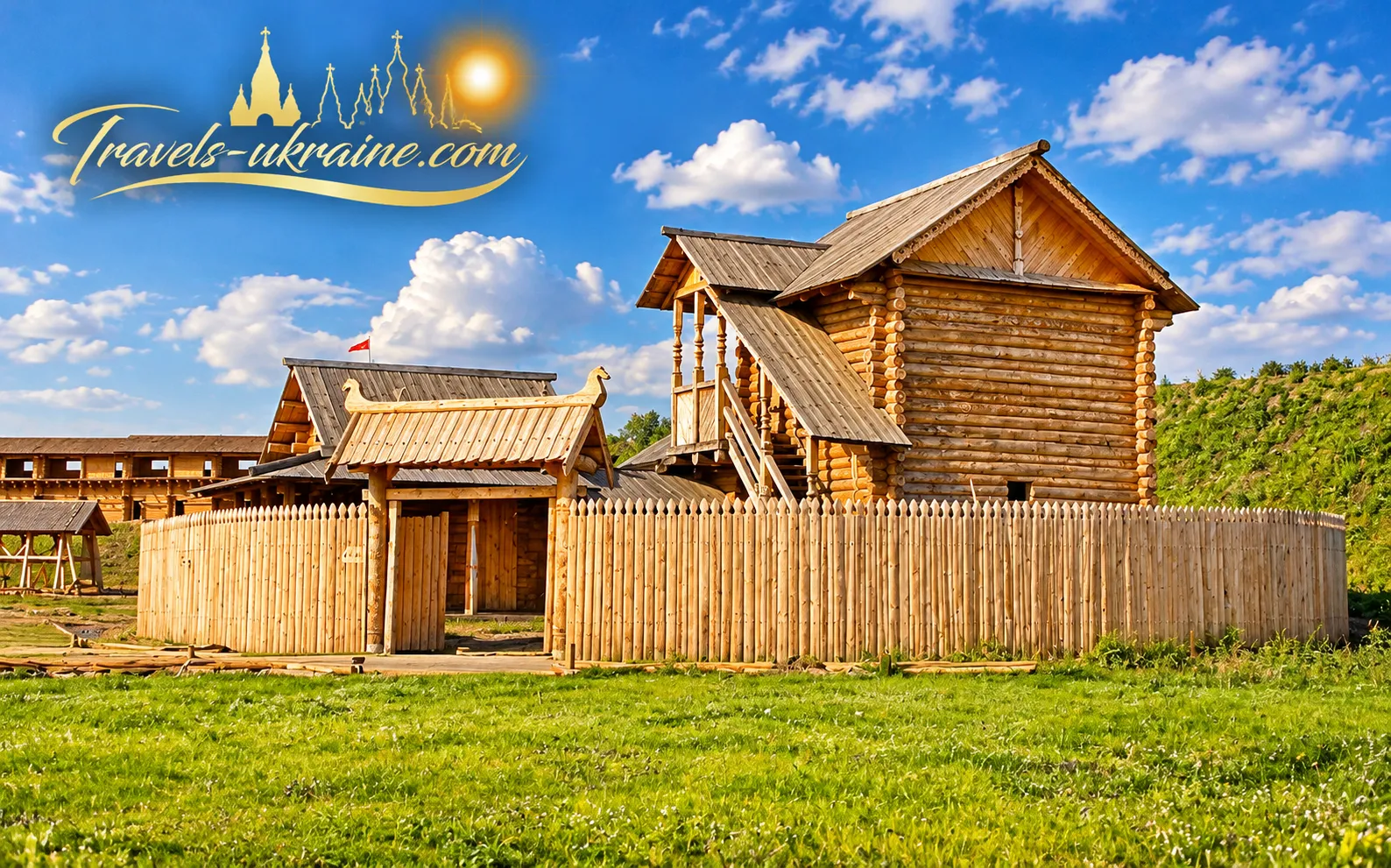
A separate aspect of the architectural reconstruction focuses on buildings associated with princely authority and the lives of the ruling elite of Rus. These structures help visitors imagine the setting in which receptions, military councils, and other important political events might have taken place. The complex features a princely courtyard, viewing stands, and a reconstruction of the residence traditionally associated with Yaroslav the Wise. These structures are intended to convey the character of architecture associated with princely residences and ceremonial buildings of the Middle Ages. Yaroslav the Wise was one of the most famous rulers of Kyivan Rus. During his reign in the first half of the 11th century, Kyiv experienced a period of political and cultural flourishing, expanded its territory, and gained new monumental buildings. This is why the prince's name occupies an important place in the historical concept of Ancient Kyiv.
The term "terem" is traditionally associated with residential and ceremonial buildings belonging to wealthy members of society. In reconstructions of the princely era, such buildings help demonstrate how the architecture of the ruling elite might have differed from ordinary urban housing. However, the reconstructed residence of Yaroslav the Wise should not be considered an exact replica of a particular 11th-century building. It is a modern historical and architectural interpretation designed to help visitors imagine the possible appearance of princely residences. And although visitors today do not need to belong to a royal family to enter such a place, the architecture reminds us just how different the lives of ordinary medieval townspeople were from those of their rulers. The princely court was not merely a home but also a symbol of authority, prestige, and political influence.
St. Basil's Church and the Sacred Architecture of Ancient Kyiv
The history of medieval Kyiv cannot be imagined without its spiritual life. The adoption of Christianity in the late 10th century was one of the most important events in the development of Kyivan Rus and significantly influenced its architecture, art, and urban environment. With the spread of Christianity, new traditions of church construction developed in Kyiv. Alongside wooden structures, monumental stone churches gradually appeared, serving not only religious purposes but also important cultural and ceremonial functions.
Among the buildings mentioned in the architectural concept of Kyivan Rus Park is the 10th-century St. Basil's Church. Its historical prototype is associated with the early spread of Christianity in Kyiv and Prince Volodymyr the Great. Such reconstructions help visitors understand how the architectural appearance of the capital changed following the adoption of Christianity. From pagan sanctuaries and ancient religious traditions, the city gradually transitioned toward a new religious environment in which churches became important symbols of princely authority and social transformation.
However, to maintain historical accuracy, it is important to understand that archaeological evidence and written records do not always allow researchers to establish the exact appearance of Kyiv's earliest churches. As a result, modern reconstructions of religious buildings may combine confirmed historical information with architectural hypotheses. Furthermore, not all churches included in the broader development plan for Ancient Kyiv have been constructed. Some remain part of the project's future vision, so visitors should confirm whether a particular structure is currently available to see before planning their trip.
Tournament Grounds, Princely Stands, and Medieval Competition Areas
Not all architectural spaces in a medieval city were intended for housing or defense. Open areas where people gathered, celebrations took place, military skills were demonstrated, and public events were held also played an important role. Ancient Kyiv features reconstructed large and small tournament grounds — specially designed arenas now used for historical performances, equestrian programs, and themed competitions. Nearby, princely and guest stands provide a distinctive setting for public spectacles.
The historical term "rystalyshche" refers to a place where competitions or military exercises were held. In the modern park, these arenas have become part of the reconstructed historical environment, allowing themed events to take place against the backdrop of wooden fortifications. Architecturally, tournament grounds differ from ordinary urban buildings. They are open spaces designed for horse riding, historical reenactments, and spectators. Such areas help combine static architecture with live performances. After all, even the most impressive wooden fortress creates a completely different atmosphere when horsemen appear before its walls, the sound of clashing armor fills the air, and a theatrical spectacle unfolds.
However, modern knightly shows should not be confused with historically accurate reconstructions of every military tradition of Kyivan Rus. Programs may combine historical elements, sporting competitions, and theatrical performances. We will explore these activities in greater detail in a separate section dedicated to festivals and themed events.
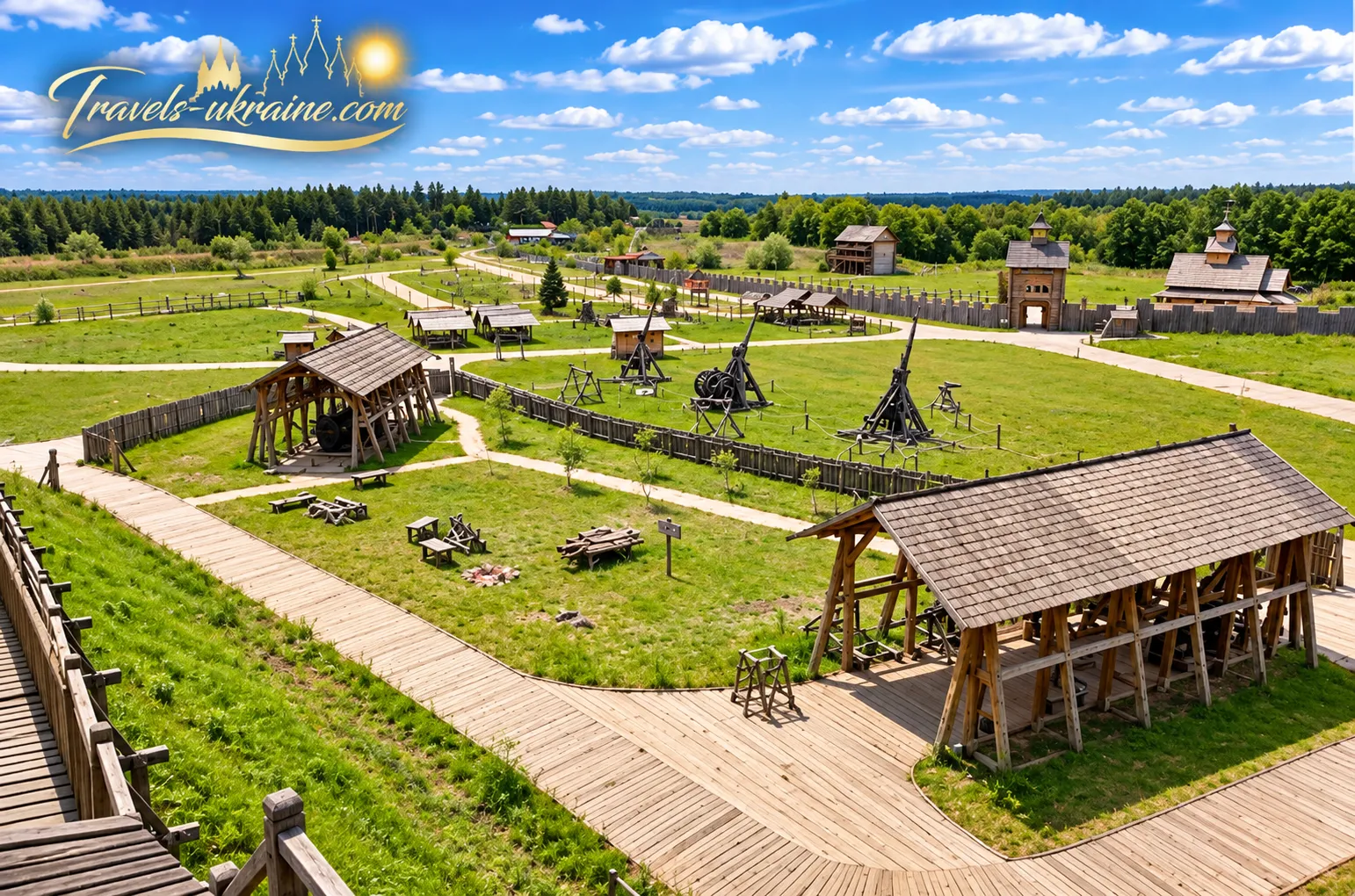
Historical Exhibitions — Siege Engines, Shipbuilding, and Everyday Life in the Princely Era
The park's architectural landscape is complemented by themed exhibitions dedicated to different aspects of medieval life. Particularly interesting are reconstructions of siege equipment, examples of ancient shipbuilding, historical weapons, and everyday household objects. Siege equipment of Kyivan Rus is a fascinating subject that helps visitors understand the complexity of medieval warfare. Tall fortifications required not only courageous defenders but also specialized equipment for attacks and defense. Studying historical military mechanisms therefore provides a deeper appreciation of the role fortifications played in the development of medieval cities.
The exhibition of medieval shipbuilding is equally interesting. Kyiv was connected to major river trade routes, and boats and river vessels played an important role in commerce, transportation, and military campaigns. Among the park's exhibits is a reconstruction of a medieval river vessel called "Prince Volodymyr", inspired by ships from the 9th–11th centuries. It recalls a time when great rivers were not merely natural obstacles but also essential transportation routes. Although modern travelers are more accustomed to using cars, during the princely era a reliable boat could sometimes be just as important as a good horse.
The historical atmosphere is further enhanced by exhibitions of costumes, armor, musical instruments, and traditional wooden architecture. These displays help visitors appreciate the diversity of medieval society, from military traditions to art, craftsmanship, and everyday activities.
What Else Is Planned for Reconstruction in Ancient Kyiv?
The ambitious vision of the Ancient Kyiv project extends far beyond the wooden fortifications, gates, and historical buildings already constructed. The master plan envisages a much broader reconstruction of the medieval capital's architectural appearance. Proposed future attractions include an ancient fortified settlement from the 5th–9th centuries, the dwelling of the legendary Prince Kyi, a pagan sanctuary, palaces of Kyiv's rulers, princely residences, monasteries, churches, and craft districts.
Of particular interest are the planned reconstructions of the palaces of Princes Oleh, Ihor, Sviatoslav, Princess Olha, and Volodymyr the Great. Their construction would significantly expand visitors' understanding of how princely architecture developed throughout different periods of Kyivan Rus history. The long-term concept also includes the Church of the Tithes, several monastery complexes, the princely court of Yaroslav the Wise, boyar estates, and other buildings associated with the historical environment of ancient Kyiv.
However, the inclusion of these names does not mean that all the listed attractions can already be seen during a visit. Some remain architectural concepts, while the timing of future construction depends on the complex's development opportunities. Therefore, Kyivan Rus Park should be viewed as a project being developed in stages rather than as a fully completed reconstruction of the ancient capital. Understanding this distinction helps visitors avoid unrealistic expectations while appreciating the historical reconstructions that have already been completed.
What to See and Do at Kyivan Rus Park — Princely Entertainment and Medieval Adventures
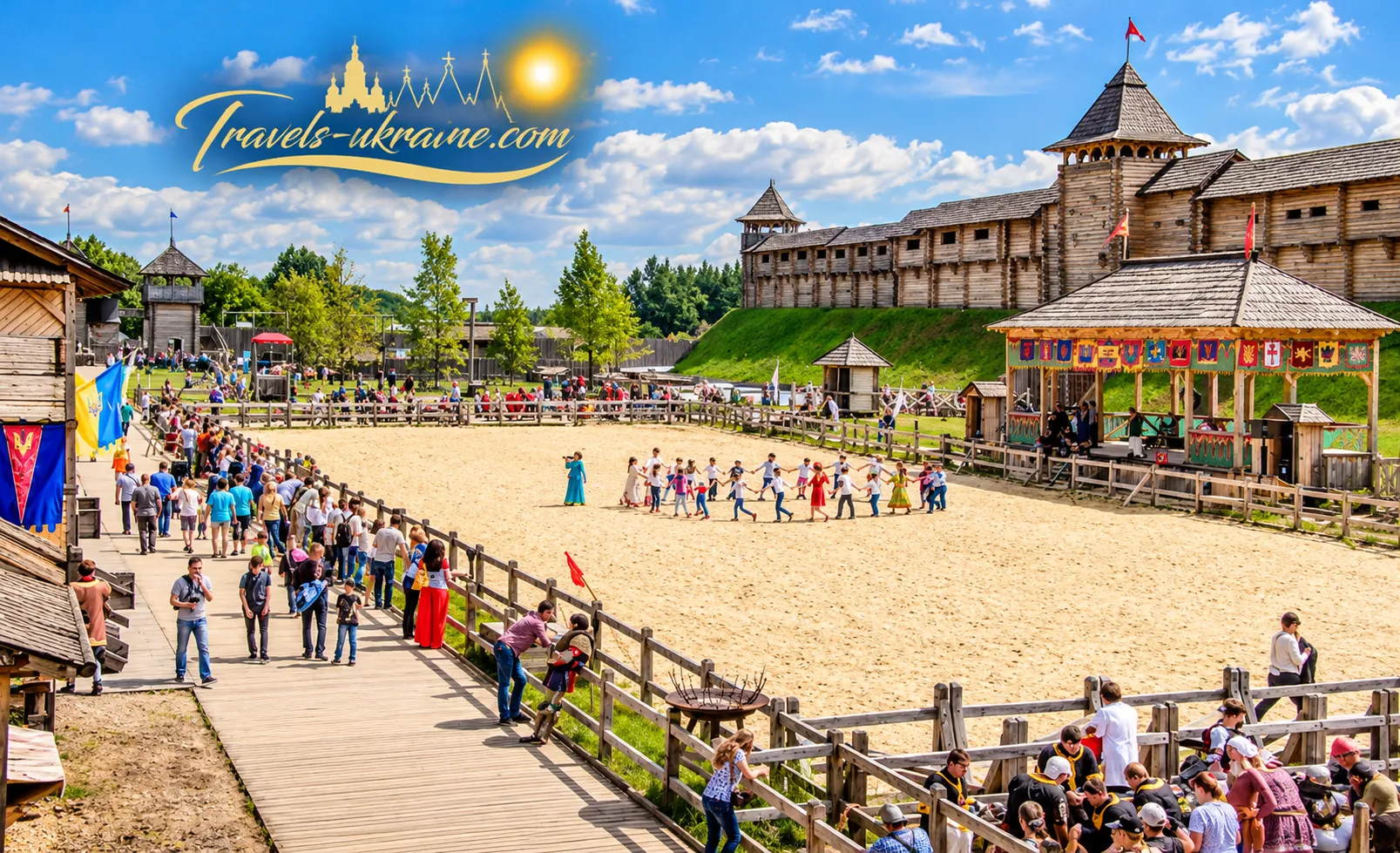
Who says exploring history has to be limited to museum displays, ancient documents, and endless dates? At Kyivan Rus Park, visitors are invited not only to see the past but also to experience it through unusual activities, workshops, and entertainment inspired by life in a medieval city. Here, you can try your hand at archery, put on a suit of armor, meet the horses of the princely stables, or even mint your own commemorative coin. All of this takes place among wooden fortifications that recreate the atmosphere of an ancient capital.
What makes this destination special is its combination of educational tourism and active recreation. Adults can discover a new perspective on the history of the princely era, while children can explore a world where wooden toys replaced smartphones, horses took the place of cars, and the ability to shoot a bow accurately was sometimes valued far more highly than typing messages quickly.
However, it is worth remembering that not all activities at Kyivan Rus Park are available every day. Some workshops are offered mainly on weekends, certain services require advance booking, and other activities take place only when instructors are available or during special programs. Therefore, before your trip, it is best to decide which experiences interest you most and confirm whether participation is possible.
The Princely Stables — Discovering Horses and Medieval Traditions
One of the most fascinating attractions of the historical complex is the Princely Stables at Kyivan Rus Park. This is hardly surprising, as the medieval world would have been very different without horses. They helped people travel long distances, transport goods, cultivate land, and participate in military campaigns. For a prince's military retinue, a well-trained horse was not merely a means of transportation but a true companion in battle. Today, visitors can meet the horses, learn about their care, and, by prior arrangement, try horseback riding. Unlike a conventional guided tour, interacting with the animals can become an adventure in itself, especially for those who have previously seen horses mainly in photographs or films.
The princely stables are home to horses of various breeds, and the organizers also pay attention to the history of equestrian traditions. Visitors can take part in horseback rides, instructor-led lessons, guided equestrian tours, and special programs introducing them to the stables. For beginners, a short ride supervised by an experienced instructor may be the most appealing option. It provides an opportunity to become accustomed to a horse's movements, learn how to sit correctly in the saddle, and discover that horseback riding involves much more than striking an impressive pose for a photograph.
Another particularly interesting activity is horseback archery, which the park also offers as part of specialized training programs. This discipline requires remarkable coordination, as riders must control their horses, maintain their balance, and aim at a target simultaneously. Even imagining all these actions happening at once is enough to inspire greater respect for the military skills of ancient mounted warriors.
Archery — Testing the Accuracy of a Medieval Warrior
If meeting the horses at the princely stables inspires you to test your own combat skills, consider trying archery at Kyivan Rus Park. This themed activity offers an opportunity not only to experience the atmosphere of the Middle Ages but also to practice a skill requiring concentration, patience, and precise movements. In ancient times, the bow was an important weapon for hunting and warfare. Accurate shooting required extensive training, physical strength, and a good eye. A medieval archer had to draw the bowstring correctly, choose the direction of the shot, and judge the distance to the target.
Today, visitors to the historical park can try archery at a specially designated range. Under an instructor's guidance, participants learn the rules of handling a bow, practice holding it correctly, and take their first shots at a target. This is where many people make an unexpected discovery: hitting a stationary target is considerably more difficult than adventure films make it appear. Especially when the arrow stubbornly chooses an entirely different direction, while the target seems completely unaware that anyone is trying to hit it.
Historical Swordsmanship — Experience Life as a Princely Warrior
Another way to immerse yourself in the world of medieval warriors is through historical swordsmanship. Among the themed activities at Kyivan Rus Park are programs dedicated to the handling of bladed weapons, along with sporting exercises using safe training swords. During the princely era, a sword was not only a weapon but also a symbol of military status and personal honor. However, genuine swordsmanship required much more than the ability to swing a blade dramatically. A warrior needed to master attack and defense techniques, react quickly to an opponent's movements, and maintain balance.
During themed sessions, participants can learn the basic principles of swordsmanship, discover the characteristics of medieval weapons, and test their agility through controlled exercises. For someone who has never held a sword before, even a few simple movements can prove unexpectedly challenging. After all, wearing knightly armor does not automatically make you stronger, and looking heroic certainly does not guarantee victory. Sometimes the greatest challenge is not your opponent but your own lack of coordination. Modern historical swordsmanship sessions are primarily educational and sporting activities. They are not genuine medieval duels and are conducted using appropriate protective equipment under the supervision of instructors.
Coin Minting — Create Your Own Souvenir at the Princely Mint
One of the most original activities offered at Ancient Kyiv is the minting of commemorative coins. This workshop introduces visitors to traditional craftsmanship and allows them to create a souvenir that will remind them of their journey into the princely era. The history of currency circulation in Kyivan Rus was complex. During different periods, foreign silver coins, locally minted currency, and other forms of payment were used. Particularly noteworthy were the gold zlatnyks and silver sriblyanyks, whose minting is associated with Princes Volodymyr the Great and Sviatopolk.
At the park, visitors are invited to try making a decorative coin using specialized equipment. This activity helps demonstrate that producing even a small metal object requires skill and precision. Of course, your handmade souvenir coin will not become legal tender, so using it to pay for something in a modern shop is unlikely to work. However, as a keepsake from a visit to a medieval city, it holds far greater sentimental value. The workshop is particularly appealing to children, as it allows them not only to hear stories about ancient money but also to take part in creating a small souvenir with their own hands.
Medieval Costumes and Photo Sessions — Dress Like a Prince or Princess
Exploring the wooden fortifications of Ancient Kyiv is fascinating in itself. But doing so while wearing clothing inspired by the inhabitants of the princely era can make the experience even more memorable. For this purpose, the complex offers a medieval costume experience. Visitors may be able to try on themed outfits styled after the historical clothing of different social groups in medieval society. These may include princely costumes, garments inspired by the nobility, warrior attire, or simpler traditional clothing.
The combination of historical costumes and reconstructed architecture creates a particularly memorable atmosphere. Against the backdrop of wooden gates, defensive walls, and princely buildings, visitors can take unusual photographs that stand out from ordinary travel pictures. And this is where everyone gets the chance to enjoy a temporary rise in social status. Just a few minutes ago, you were an ordinary tourist with a smartphone in your pocket; now you are standing before a fortress in princely attire, looking as though the fate of several lands depends on your decisions. Unfortunately, once the photo session is over, your princely authority must be returned along with the costume.
Guided Tours of Ancient Kyiv — History Worth Listening To
For those who want to do more than simply walk around the grounds and would like to understand the complex's historical concept, guided tours of Kyivan Rus Park are well worth considering. These tours connect individual buildings, historical exhibitions, and reconstructions into a coherent story about a medieval city. During a guided tour, visitors can learn how ancient Kyiv's defensive system developed, how the lives of princes differed from those of craftsmen, how trade and military practices evolved, and why wooden construction was so widespread.
Guided tours are particularly valuable when the guide goes beyond listing dates and explains historical events through clear, relatable examples. After all, it is much easier to remember why high defensive ramparts were built when you can see their reconstruction in front of you than when trying to imagine such a structure from a small illustration in a textbook.
The Princely Tavern — What to Eat in Ancient Kyiv
After a long walk, historical excursions, and active adventures, there inevitably comes a moment when even the most fascinating story about the princely era gives way to a much simpler desire — enjoying a delicious meal. In this respect, Kyivan Rus Park also has themed dining options. Visitors can stop by the Princely Tavern, where outdoor gazebos and food outlets offer Ukrainian and themed dishes. The dining concept introduces guests to traditional cooking methods, including meat and vegetable dishes prepared over an open fire.
However, it is important to understand that the modern menu of a historical park is not an exact recreation of what the inhabitants of 10th-century Kyiv ate. Rather, it is a culinary interpretation of ancient traditions adapted to the tastes and habits of modern visitors. And although nobody in the Middle Ages left reviews about the quality of service, good food has always been an essential part of hospitality. Especially after exploring a fortress, missing a few archery targets, and making a heroic attempt to master horseback riding.
Knightly Tournaments and Historical Festivals — When Ancient Kyiv Comes to Life
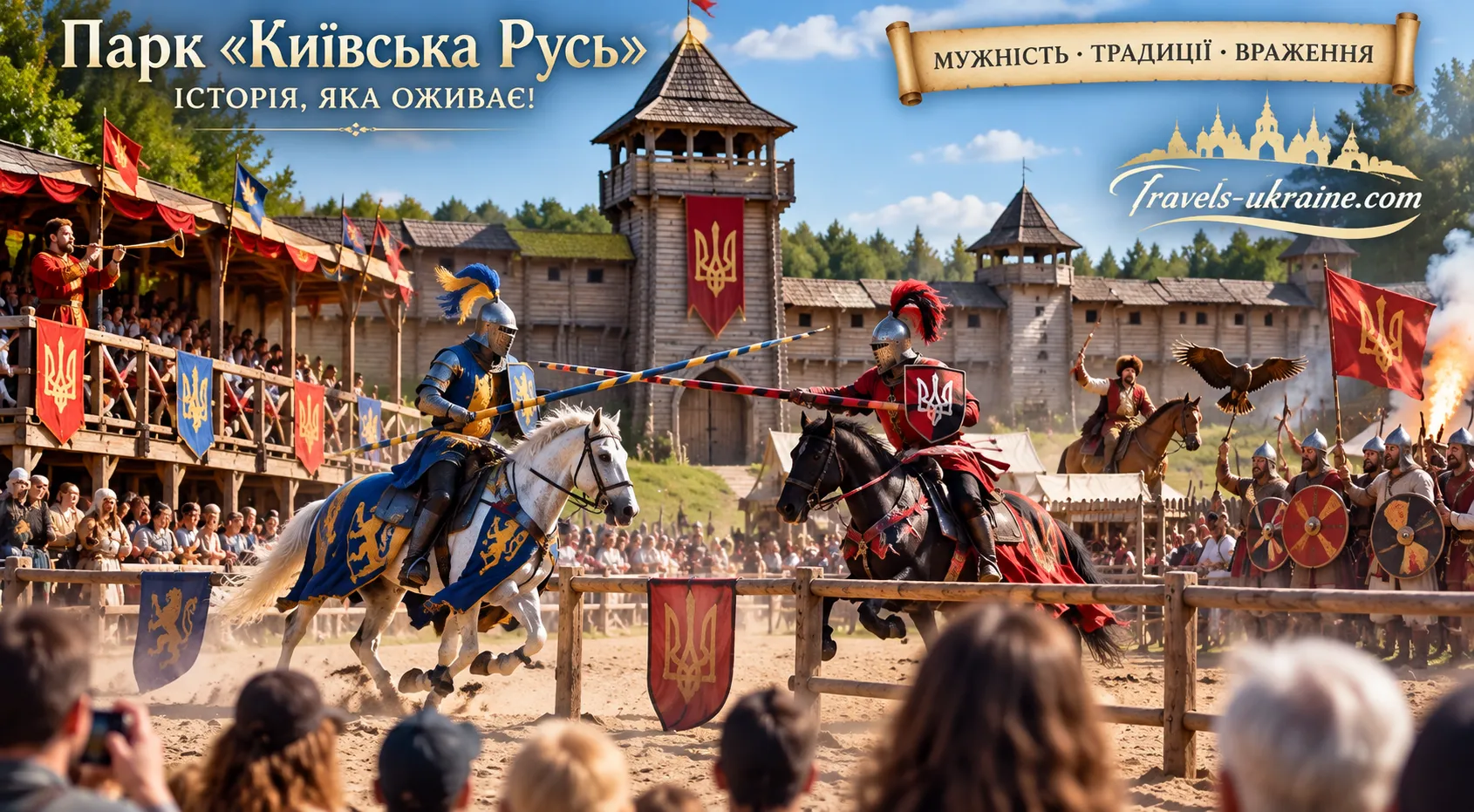
Imagine the sound of a battle horn echoing above the wooden walls of a medieval city, horsemen entering the tournament arena, and armored warriors preparing for combat. A moment later, the air fills with the thunder of hooves, the clash of metal, and the cheers of spectators. This is the atmosphere once created by historical reenactments and knightly tournaments at Kyivan Rus Park, transforming the wooden fortifications of Ancient Kyiv into a spectacular setting for medieval performances.
For many years, the Principality of Kyivan Rus was known for its large-scale festivals, equestrian performances, staged battles, and themed celebrations. Specially designed tournament grounds welcomed members of historical reenactment clubs, who demonstrated martial arts, traditional weaponry, and aspects of medieval society. These events allowed visitors not only to admire the architecture of the princely city but also to witness how it became part of a living historical spectacle.
However, visitors should be aware of an important detail: historical festivals in Ancient Kyiv are temporarily no longer held in their former regular format. At certain times, the complex operates as a landscape park, while individual events may be organized by partners. Therefore, the tournaments, festivals, and performances described below primarily reflect the complex's cultural traditions and past activities. Whether any particular event is taking place on a specific date should be checked against the current program.
Knightly Tournaments and Equestrian Stunt Shows
Among the most spectacular events previously held at Kyivan Rus Park were knightly tournaments and historical medieval combat competitions. Participants entered specially prepared arenas wearing armor and carrying shields and training or sporting weapons, demonstrating various techniques of historical martial arts. Unlike theatrical duels, where the outcome is predetermined by a script, competitive historical combat can involve genuine sporting rivalry. Participants demonstrate physical endurance, quick reactions, technical skills, and the ability to fight while their movements are restricted by armor.
A particular highlight of Ancient Kyiv's historical programs was its equestrian stunt theater. Its performances combined advanced horseback riding techniques, theatrical storytelling, and impressive demonstrations of riders performing extraordinary stunts while their horses were in motion. Equestrian culture played an important role in medieval society. For a prince's military retinue, a well-trained horse was indispensable during military campaigns, reconnaissance missions, and battles. The ability to remain confident and balanced in the saddle was considered an essential skill, while training a warhorse could require just as much time as preparing the rider himself.
Historical Battles — Experience the Middle Ages Without a Time Machine
Another memorable part of Kyivan Rus Park's activities was its theatrical reenactments of historical battles. Against the backdrop of wooden fortifications, staged performances featured participants portraying medieval warriors, using historically inspired equipment, and demonstrating tactical techniques from past centuries. What made these performances particularly impressive was the combination of architecture and action. Seeing a wooden fortress wall during an ordinary guided tour is one thing. Imagining it under siege, with armed troops gathering near the gates and defenders preparing to repel an attack, is an entirely different experience.
These performances incorporated elements of military history, costumed scenes, weapons demonstrations, and carefully prepared stunts. Depending on the program, the action could feature princely warriors, nomadic fighters, knights, or other figures from medieval history. However, historical reenactment and theatrical performance are not exactly the same thing. Historical reenactment aims to reproduce a particular period as accurately as possible, including its clothing, weapons, and everyday customs. Theatrical performances, on the other hand, may use historical themes to create an entertaining storyline, combining authentic elements with artistic interpretation. Such shows are therefore best appreciated as an engaging introduction to the past rather than an exact reconstruction of every historical event. Real history was far more complicated than any performance: the outcome of a battle was not always predictable, and its main participants certainly did not always leave the battlefield to the applause of spectators.
Medieval Festivals and Themed Celebrations
Historical festivals in Ancient Kyiv were not limited to knightly duels or battle reenactments. Over the years, the complex organized celebrations dedicated to medieval crafts, equestrian culture, folk traditions, music, and historical games. Musical performances, theatrical scenes, traditional dances, and themed entertainment were important parts of these events. The organizers aimed to recreate the atmosphere of a grand medieval celebration where visitors could not only watch performers but also participate in shared activities.
One example was a series of programs dedicated to the history of horse breeds. During the "World of Horses" exhibition show, the main attractions were not princes or warriors but the inhabitants of the princely stables. Spectators were introduced to horses of different breeds, learned about their distinctive characteristics, and watched demonstrations of equestrian skills.
Nighttime Spectacles — Fire, Music, and the Atmosphere of an Ancient City
Evening and nighttime programs were among the most memorable highlights of Kyivan Rus Park's festival history. As twilight descended, the wooden fortress walls took on an entirely different appearance, while torchlight and theatrical effects created an extraordinary atmosphere. Programs from previous years included fire performances, themed theatrical productions, musical acts, and demonstrations of historical siege equipment. Such events were often organized as the grand finale of special festival days, attracting visitors eager to experience Ancient Kyiv in a completely different light.
Particularly fascinating were demonstrations of the trebuchet — a medieval siege engine that operates using a counterweight. Similar mechanisms were employed during sieges of fortified cities, although their designs and prevalence varied depending on the historical period and region.
Theatrical programs used specially designed stage effects to recreate the atmosphere of ancient sieges. Of course, modern spectators experience such scenes very differently from the inhabitants of a medieval fortress: for one, it is an exciting spectacle, while for the other, the appearance of a siege engine outside the city walls would hardly have been a reason to celebrate. Nevertheless, these nighttime programs belong to the history of the park's festival activities. They should not be regarded as permanent attractions or guaranteed features of a present-day visit.
What to See Near Kyivan Rus Park — Scenic Places in Kyiv Oblast
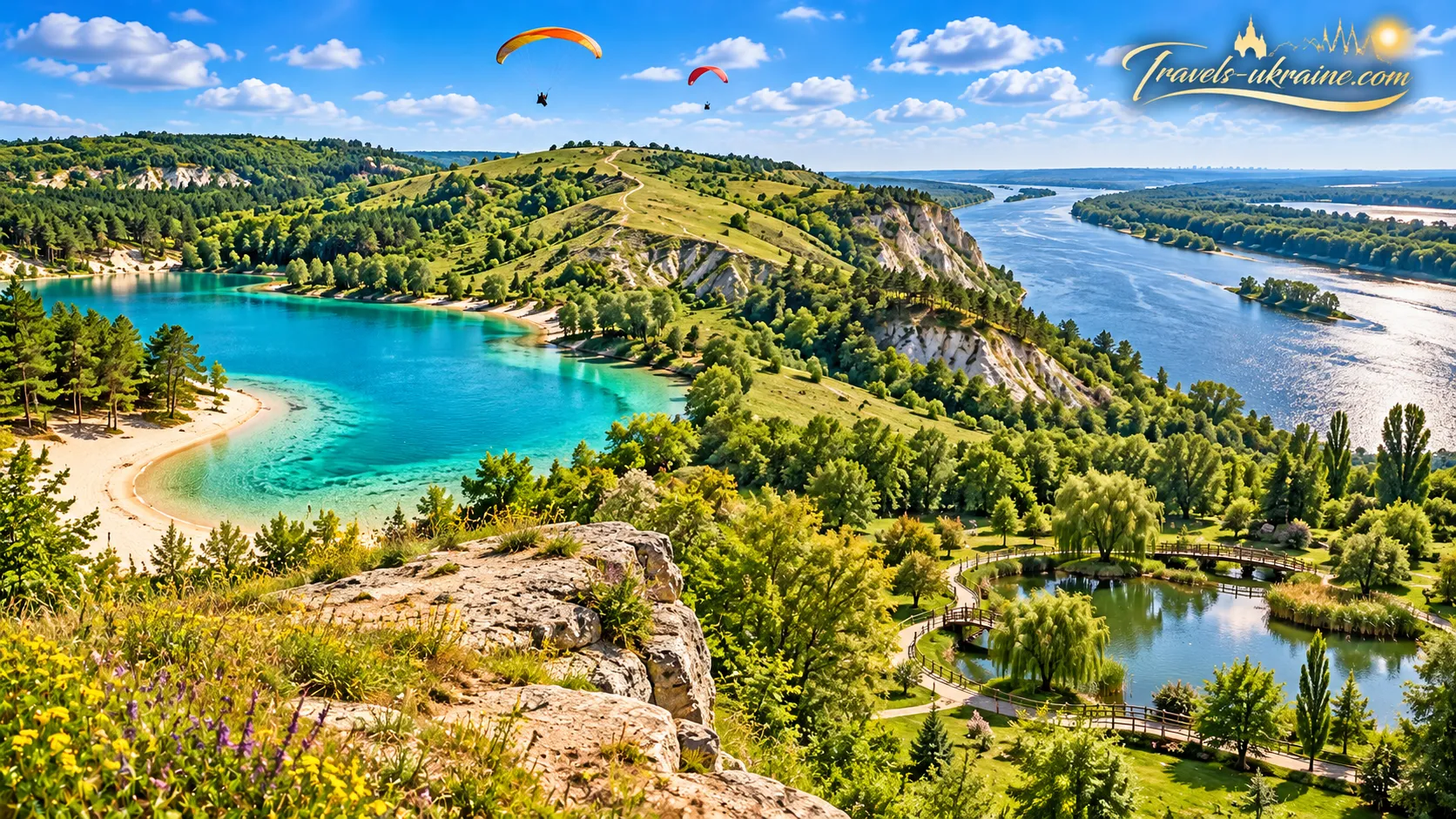
A trip to Kyivan Rus Park can turn into a much bigger adventure if, after exploring the princely fortresses, you set out to discover the natural beauty of Kyiv Oblast. Not far from the capital, there are extraordinary places where turquoise lakes resemble seaside resorts, rolling hills create the illusion of mountain valleys, and high cliffs above the Dnipro River offer breathtaking panoramic views.
What makes these destinations special is that each offers an entirely different experience. Some are perfect for spending a few hours by the water, others invite you to walk among picturesque green slopes, while certain locations are ideal for simply stopping to enjoy the silence and seemingly endless landscapes. And all of this is possible without embarking on a multi-day expedition or traveling to the other side of Ukraine.
Blue Lake — Turquoise Water and Sandy Beaches
Blue Lake in Kyiv Oblast (Pidhirtsi village) is one of the most attractive destinations for summer recreation near the capital. Its main feature is the unusual color of the water, which changes from pale blue to vibrant turquoise on sunny days. Combined with light-colored sand and green shores, the scenery truly resembles a small seaside resort. The lake formed in a former sand quarry. Thanks to its light-colored bottom and the way sunlight interacts with the water, it takes on the distinctive color that inspired its name. Sandy beach areas, green spaces, and recreational spots can be found around the lake.
During the warmer months, visitors come here to enjoy walking, sunbathing, and relaxing by the water. Some developed sections offer paid beach facilities. Swimming availability and current visiting regulations should be checked before traveling. After exploring the medieval fortifications of Ancient Kyiv, this stop offers a refreshing change of atmosphere: instead of towering wooden walls, an open expanse of water; instead of princely adventures, a relaxing break on a sandy shore.
Vasylkiv Carpathians — The Remarkable Green Hills of Kyiv Oblast
You do not have to travel hundreds of kilometers to discover landscapes resembling mountain valleys. Kyiv Oblast has its own Vasylkiv Carpathians, located near Vasylkiv — a protected landscape reserve known for its rolling hills, deep ravines, and green slopes. Despite the impressive name, these are not the actual Carpathian Mountains. Instead, nature has created such extraordinary terrain that the area is often compared to mountain scenery. Tourist publications also refer to it as "Ukrainian Iceland" or "Fairytale Ravine."
The reserve covers approximately 226.8 hectares. Its distinctive landscape was shaped by a network of ravines and gullies within the basin of the Stuhna River and its tributary, the Buhaivka. Here, visitors can discover open meadows, steep slopes, small wooded areas, and natural depressions that form a picturesque mosaic. The scenery is particularly impressive in spring and early summer, when the hills are covered in fresh greenery. From elevated viewpoints, sweeping panoramas unfold, resembling waves of a green sea frozen across the surrounding countryside.
The Vasylkiv Carpathians are primarily a protected natural area rather than a developed amusement park. The destination should be treated with the same care and respect as other nature reserves and national parks. Visitors should not expect conventional tourist facilities, so comfortable walking shoes, a supply of drinking water, and caution on steep slopes are essential.
Planerna Hora — Panoramic Views, Wind, and Flights Above the Hills
If you would like to see Kyiv Oblast from an unusual perspective, consider visiting Planerna Hora (Glider Hill), located near the village of Khodosivka (along the Obukhiv Highway, approximately 26 km from Kyiv). This picturesque hill is well known among paragliding and hang-gliding enthusiasts, as well as visitors seeking beautiful panoramic views. Its open terrain and favorable air currents under certain weather conditions have made the area popular with enthusiasts of unpowered flight. When the weather is suitable, you may see paragliders slowly soaring above the green hills.
However, Planerna Hora is worth visiting even without taking to the skies. Its open slopes offer sweeping views of the surrounding countryside, while the absence of dense development creates a wonderful sense of space and freedom. The location is particularly beautiful around sunset, when soft evening light highlights the contours of the hills. For photographers, it offers an excellent opportunity to capture atmospheric landscape images.
Feofaniya Park — Green Alleys, Lakes, and Beautiful Landscapes
A wonderful way to end an eventful journey is with a visit to Feofaniya Park, located in the southern part of Kyiv. It is one of the capital's best-known landscape attractions, where natural hills, ornamental ponds, and well-maintained pathways create a picturesque setting for leisurely walks. Feofaniya is especially appealing for its peaceful atmosphere. Visitors can stroll beside the lakes, relax among the greenery, admire ornamental plants, and take beautiful photographs.
The park is particularly beautiful in spring, when nature awakens after winter, and in autumn, when the trees turn brilliant shades of gold and crimson. Thanks to its varied terrain, even an ordinary walk reveals new perspectives and scenic views. It is an excellent option for travelers who, after exploring the wooden fortifications of Ancient Kyiv, would like to spend a few more hours surrounded by nature without planning a complicated sightseeing itinerary.
Kyivan Rus Park — Frequently Asked Questions
Where is Kyivan Rus Park located?
Kyivan Rus Park, also known as "Ancient Kyiv," is located in Obukhiv District, Kyiv Oblast, near the village of Kopachiv, in the Zastuhna area. The historical and cultural complex lies south of Kyiv, approximately 45 minutes away by car under favorable road conditions. The exact GPS coordinates published by the park administration are 50.145642, 30.474139. For navigation, it is best to enter "Kyivan Rus Park" or these coordinates, as searching only for the village name may not lead directly to the entrance of the complex.
How can I get to Kyivan Rus Park from Kyiv?
You can reach Ancient Kyiv in Kopachiv by car or suburban bus. For those traveling by car, the park administration recommends taking the route through Obukhiv, from where the road continues toward Kopachiv and the park. For public transportation, the suggested route is minibus No. 311 from the Vydubychi Bus Station to the Pishchana stop in Obukhiv, followed by a transfer to a bus heading toward Kopachiv or Stepok. Since schedules and routes may change, it is advisable to check current transport connections and the departure time of the last return service before your trip.
What are the opening hours of Kyivan Rus Park?
The opening hours of Kyivan Rus Park may vary depending on the season, visiting arrangements, and special events. The official website lists opening hours of 10:00–18:00 for certain periods, but this schedule should not be considered valid throughout the entire year. At certain times, the complex operates as a landscape park without a full festival program. Before traveling, visitors are advised to check the latest opening hours on the official website or contact the administrator on duty at +38 (050) 385-20-35.
How much does admission to Kyivan Rus Park cost?
Ticket prices for Kyivan Rus Park depend on the visiting period and the type of events being held. For certain seasonal programs, the administration has published adult admission prices starting from UAH 200, although tickets for special events may cost considerably more. Children's tickets, discounted admission, and individual activities may be subject to different pricing conditions. Current admission prices should always be checked directly before visiting. Visitors should not rely on prices published in old festival advertisements or travel articles.
Do I need to buy tickets to Ancient Kyiv in advance?
The conditions for purchasing tickets to Ancient Kyiv depend on the type of visit. During certain periods, tickets for ordinary visits to the architectural complex have been available at the park's ticket office. However, special festivals, partner-organized events, and guided tour programs may have their own ticketing or advance booking requirements. Therefore, before traveling, it is important to confirm whether tickets can be purchased directly at the entrance or must be booked in advance. This is particularly important for large groups and visits during themed events.
Is Kyivan Rus Park worth visiting with children?
Kyivan Rus Park is suitable for educational family outings, especially for children interested in history, medieval fortresses, horses, and unusual adventures. Visitors can explore wooden defensive fortifications, city gates, historical exhibitions, and the grounds of the reconstructed medieval city. During selected programs, guided tours, workshops, and interactive activities may be available. Families should consider the large size of the complex, weather conditions, and the possibility that some attractions may not operate on ordinary visiting days. For younger children, comfortable footwear, drinking water, and sufficient time for breaks are recommended.
How much time should I allow to explore Kyivan Rus Park?
For a leisurely exploration of the architecture of Ancient Kyiv, it is worth allowing approximately 2–3 hours. This is generally enough time to see the main accessible wooden fortifications, city gates, historical buildings, and take photographs. If you are planning a guided tour, a visit to the princely stables, participation in workshops, or relaxation near Forest Lake, it is better to set aside half a day. During special themed events, a visit may last considerably longer. The exact amount of time required depends on which attractions are accessible and the complex's current program.
Are food and dining facilities available at Kyivan Rus Park?
During certain seasons, Kyivan Rus Park offers food outlets and designated areas where visitors can relax. According to the administration, a food stand beneath the spectator stands may operate on weekends in spring and autumn, except in November. The complex also provides tables where visitors can take a break and enjoy a snack. However, full restaurant service is not guaranteed every day, so it is advisable to confirm food availability before traveling. Families with children may find it particularly useful to bring drinking water and a small supply of food.
When is the best time to visit Kyivan Rus Park to see knightly tournaments and shows?
Historically, the most elaborate knightly tournaments, equestrian performances, and themed festivals at Kyivan Rus Park were held on weekends and public holidays. However, the administration currently reports that regular historical festivals have been temporarily suspended. Therefore, there is no guarantee that visitors will see a knightly duel or equestrian stunt show during an ordinary visit. Special events may be organized separately, including by the park's partners. If the main purpose of your trip is to attend a historical performance, you should first check the current event calendar, program, and ticketing arrangements on the complex's official website.
Kyivan Rus Park — A Place Where History Comes to Life
Is it possible to travel back a thousand years, even for a moment, without inventing a time machine? Kyivan Rus Park offers its own answer to this question. Here, among towering wooden fortifications, princely gates, and watchtowers, history becomes more than just the pages of ancient chronicles. It takes on a visible form, allowing visitors to imagine the world in which our distant ancestors lived, cities developed, traditions of statehood emerged, and events unfolded that would shape the future of entire generations.
The greatest value of Ancient Kyiv in Kopachiv lies not only in its large-scale architectural reconstructions but also in the very idea of making medieval history more accessible and understandable. Stories about the princely era take on a completely different meaning when massive fortress walls rise before you and the city gates remind you how important defense, craftsmanship, and the daily work of ordinary inhabitants were to the ancient capital. Although modern reconstructions cannot reproduce every detail of a lost world, they can inspire curiosity about history far more effectively than even the most demanding school textbook.
So, is Kyivan Rus Park worth visiting? If you are interested in Ukrainian history, enjoy unusual architecture, and would like to experience the atmosphere of the princely era, even for a short time, the answer is definitely yes. There is no need to search for imaginary treasures or wait for a real prince to appear on a white horse. Simply walk through the wooden gates, look up at the towering defensive walls, and let your imagination recreate a world that existed many centuries ago. After all, the most fascinating journeys are not always those that take us far from home. Sometimes they transport us far into the past, leaving behind not only beautiful photographs but also a desire to learn more about our own history.


No Comment
You can post first response comment.