
 English
 Українська
 Latviešu
 Lietuvos
 Русский
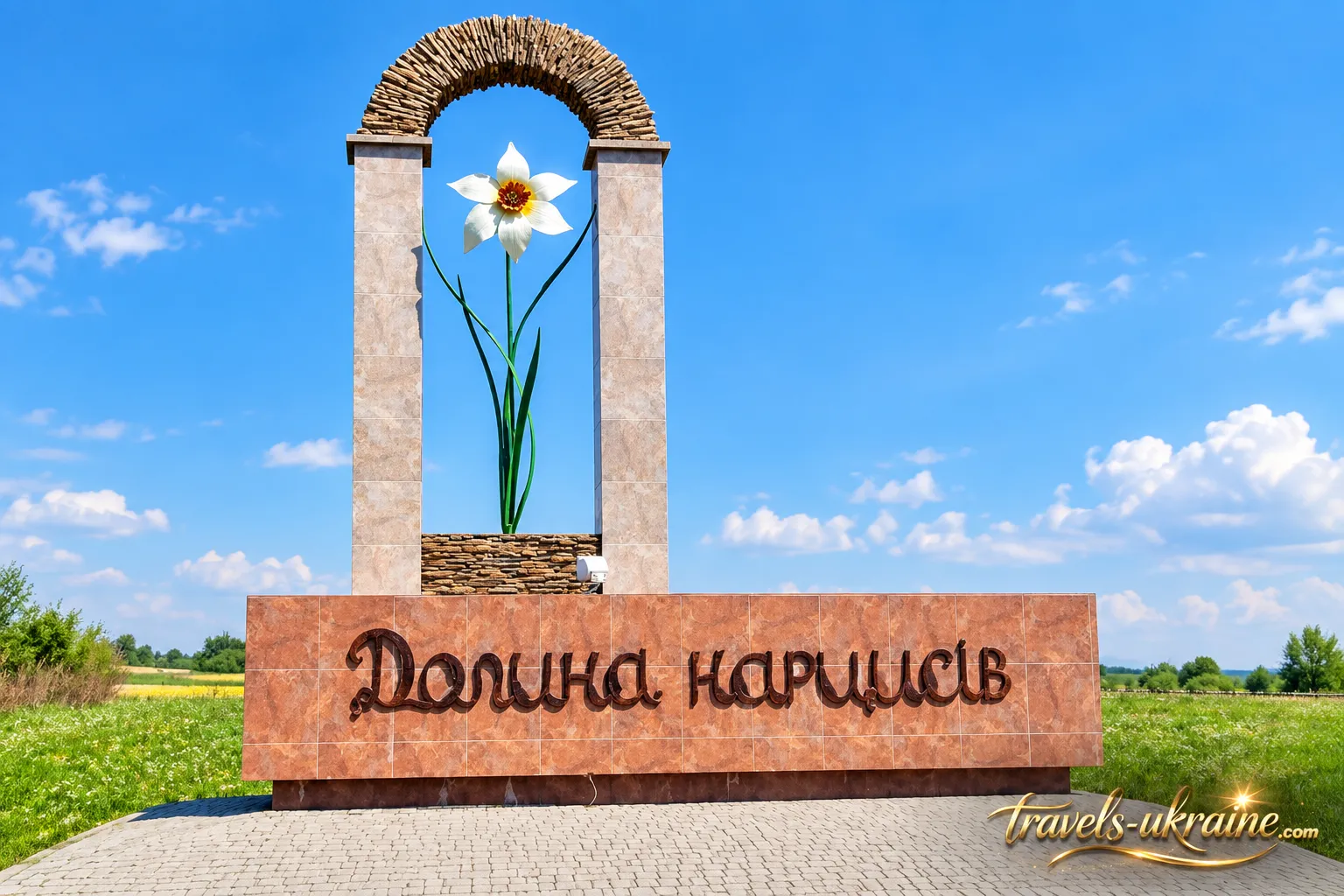
In spring, the Narcissus Valley near Khust looks as if someone deliberately sowed thousands of white flowers across immense meadows. In reality, tourists are not looking at a decorative field or a specially created park. This is a natural population of narrow-leaved narcissus that has survived in the floodplain of the Khustets River near the Kireshi tract. That is what makes this place special.
According to the Carpathian Biosphere Reserve, the Narcissus Valley is the only site in Europe where narrow-leaved narcissus grows in such abundance. During the flowering season, some parts of the meadows really are covered with white flowers, creating the famous landscape that draws thousands of people to Khust every spring. And the most interesting thing begins when you look not only at the flowers themselves, but also at where they grow. Narrow-leaved narcissus is considered a mountain species, found in the Carpathians and other mountainous areas of Central and Southern Europe. Yet the Narcissus Valley lies almost on a plain—at an altitude of only approximately 180–200 metres above sea level.
That is precisely why this population is so interesting to scientists. One explanation for its origin dates back to the Ice Age: during colder periods, mountain plants spread to lower elevations, and after the climate changed, some narcissi managed to survive in the cool, damp conditions of the Khustets floodplain. As a result, what is usually associated with mountain meadows has continued to live literally next to modern-day Khust.
The Narcissus Valley is about much more than narcissi
It would be a mistake to view this area merely as a vast flower field. The protected area covers about 256 hectares and safeguards an entire meadow-and-wetland ecosystem. Around 500 plant species grow here, 18 of which are listed in the Red Data Book of Ukraine. Alongside narrow-leaved narcissus, visitors can encounter spring snowflake and Heuffel’s crocus, among other species.
Since 1979, the area has formed part of the Carpathian Biosphere Reserve, and in 2019 the Narcissus Valley also received the status of a wetland of international importance under the Ramsar Convention. In other words, this is not simply a popular tourist photo spot, but a natural area of international importance protected to preserve its ecosystem.
And this is where the Narcissus Valley’s main paradox emerges: its popularity depends directly on mass flowering, yet the large number of visitors simultaneously places additional pressure on highly vulnerable meadows. So seeing the famous white carpet is only half the story. It is equally important to choose the right time for your trip and know how to behave in a protected area, so that these narcissi can continue blooming here for decades to come.
Narrow-leaved narcissus: how it differs from garden varieties and why it interests scientists
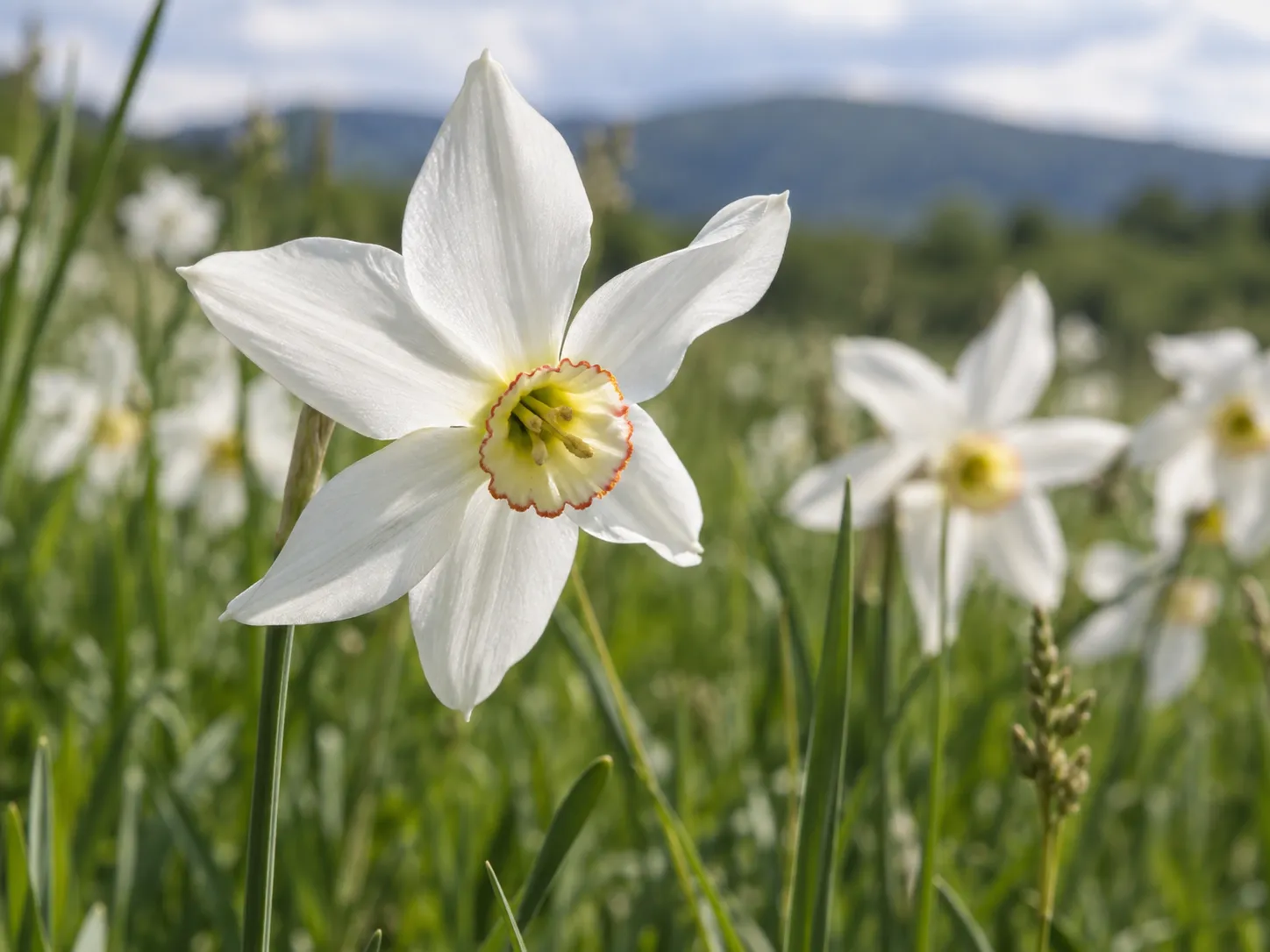
At first glance, narrow-leaved narcissus growing in the Narcissus Valley may seem little different from the familiar spring flowers found in garden beds. The difference, however, is fundamental: the valley is home to a wild species in its natural environment, whereas most garden narcissi are numerous ornamental varieties selected and crossbred over many years for large flowers, unusual forms and diverse colours.
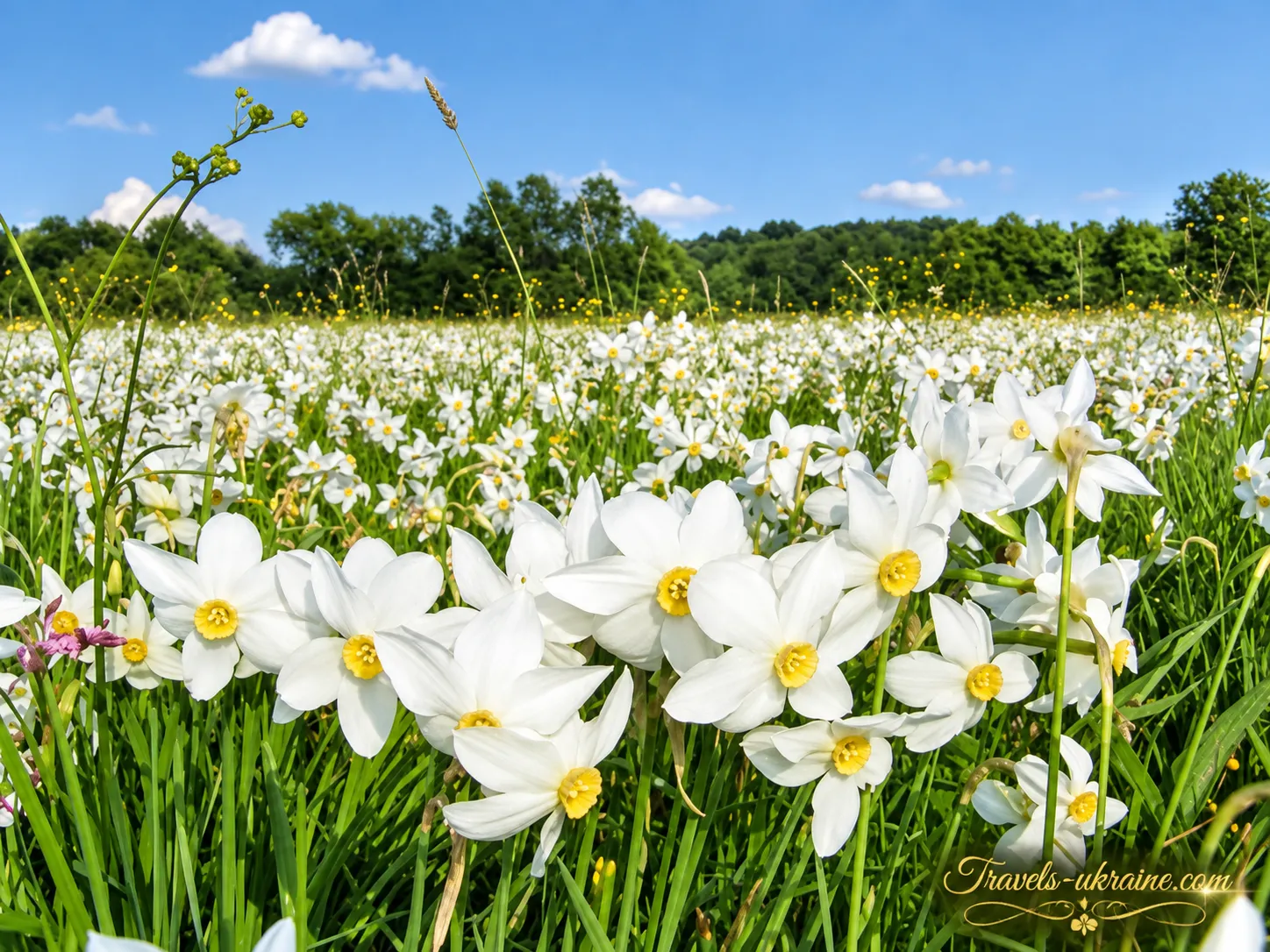
The Carpathian Biosphere Reserve specifically emphasises that narcissi in ordinary flowerbeds and the stands in the Kireshi tract are not the same thing. People did not plant the narrow-leaved narcissus here: this is a natural population that developed independently. Its flower looks considerably more restrained than many modern ornamental varieties—white predominates, while the central corona has pale tones with a distinct coloured edge.
It is this naturalness that sets it apart. Garden narcissi are created primarily for decorative purposes—breeders select plants with larger flowers, unusual colours, double petals or longer flowering periods. No one has «improved» the narrow-leaved narcissus in the Narcissus Valley for garden beds: it is part of a complex meadow ecosystem and lives according to its natural laws.
Here it competes with other plants for light and nutrients, depends on soil conditions and the water regime, interacts with insects and completes its entire natural cycle without human intervention. That is why wild narcissi may look more modest than brightly coloured ornamental varieties, but their value lies elsewhere: they are not decorations planted for tourists, but part of a natural system formed over many generations.
Why narcissi interest pharmacologists
Narcissi have another side that tourists are usually unaware of. Plants of the genus Narcissus contain so-called Amaryllidaceae alkaloids—natural chemical compounds with pronounced biological activity. For this reason, narcissi have been studied by pharmacologists and natural-products chemists for many years. Scientists have also been interested specifically in the Transcarpathian narcissus. In the bulbs of Narcissus angustifolius subsp. transcarpathicus, researchers identified seven different alkaloids, including pankracine, nangustine and other compounds. Some of them have been studied under laboratory conditions for activity against parasitic protozoa. These are interesting findings for fundamental pharmacology, but they do not mean that the plant itself is a ready-made medicine.
In general, members of the genus Narcissus are an important source of various alkaloids, which is why researchers study their effects on the nervous system, enzymes, microorganisms and other biological processes. Scientific studies show that different species—and even ornamental narcissus varieties—may differ substantially in the composition of these substances.
A medicinal plant does not mean it is safe for self-medication
It is important not to draw the wrong conclusion here: the presence of pharmacologically interesting substances does not mean that narcissi can be used at home as tea, a tincture or another «folk remedy». On the contrary, plants of the genus Narcissus can be toxic if ingested, and the highest concentration of toxic substances is usually found in the bulbs. Ingesting parts of the plant may cause nausea, vomiting, abdominal pain and other symptoms of poisoning.
Therefore, the pharmacological value of narcissus does not lie in picking flowers and experimenting with them yourself, but in the fact that certain substances from the plant can be studied under controlled scientific conditions. For tourists, the best purpose of a wild narcissus is much simpler: admire it where it grows naturally and leave the flower where it is.
When the Narcissus Valley blooms and how not to miss the best moment
The timing of your trip determines what the Narcissus Valley will look like when you see it. Arrive a few weeks too early and you will find mostly green meadows. Arrive too late and the famous white carpet will already be beginning to disappear. That is why, for this destination, the question of «when the Narcissus Valley blooms» matters much more than simply choosing a sunny weekend.
The Carpathian Biosphere Reserve gives the approximate flowering period as 1 to 15 May. At the same time, peak flowering most often falls approximately between 8 and 15 May. This is the brief window when you are most likely to see the meadows in the form that has made the Narcissus Valley one of the best-known spring destinations in Transcarpathia.
Narcissi do not follow a calendar, so it is unwise to tie your trip to one «correct» date. The beginning of flowering depends on the kind of spring it has been: air temperatures, the number of sunny days, precipitation and how quickly the soil warms up. If late April is warm and the average daily temperature rises rapidly, the first mass blooms may appear as early as the beginning of May. After a cold, prolonged spring, the process shifts to later dates instead. That is why last year’s photographs captioned «10 May» are no guarantee that the landscape will look the same on that date the following year.

How to catch peak flowering
The most reliable approach is not to plan your trip solely around general calendar forecasts. A few days before setting out, check the latest updates from the Carpathian Biosphere Reserve. During the season, reserve staff publish information about the state of flowering, and it is far more useful than old social-media photographs or articles with a fixed date. If your main goal is to see the greatest number of flowers blooming at once, it makes sense to aim for the middle of the first half of May, while remaining open to shifting the date slightly after checking the current condition of the meadows.
Many people come here during peak flowering, especially at weekends. For a more peaceful walk, it is therefore better to choose morning hours on a weekday. There are fewer tourist groups then, the light is softer for photography, and the valley feels entirely different from during the busiest hours. The second half of the day can also be beautiful, especially in clear weather, when the low sun highlights the contours of the meadows and the white flowers stand out clearly against the green background. In very hot midday weather, however, walking is less comfortable, and harsh sunlight rarely helps photographs.
Is it worth going if the narcissi have not yet bloomed or are already fading?
The valley remains a protected natural area outside the peak flowering period, but the experience will be quite different. If you are coming specifically for the famous white meadows, it is still best to arrive during the short period of mass flowering. At the same time, even within the valley itself, the flowers do not open completely simultaneously: different areas may look different depending on soil moisture and microrelief. So the beginning or end of the season does not necessarily mean that the narcissi have disappeared altogether—it simply means that the continuous white landscape may no longer be there.
There is another important detail here: the period of mass flowering is very short. That is precisely what makes the Narcissus Valley so appealing. You do not have the whole summer to «drop by sometime later»—a few weeks pass quickly, and the green valley becomes simply green again until the following spring.
What tourists will see in the Narcissus Valley
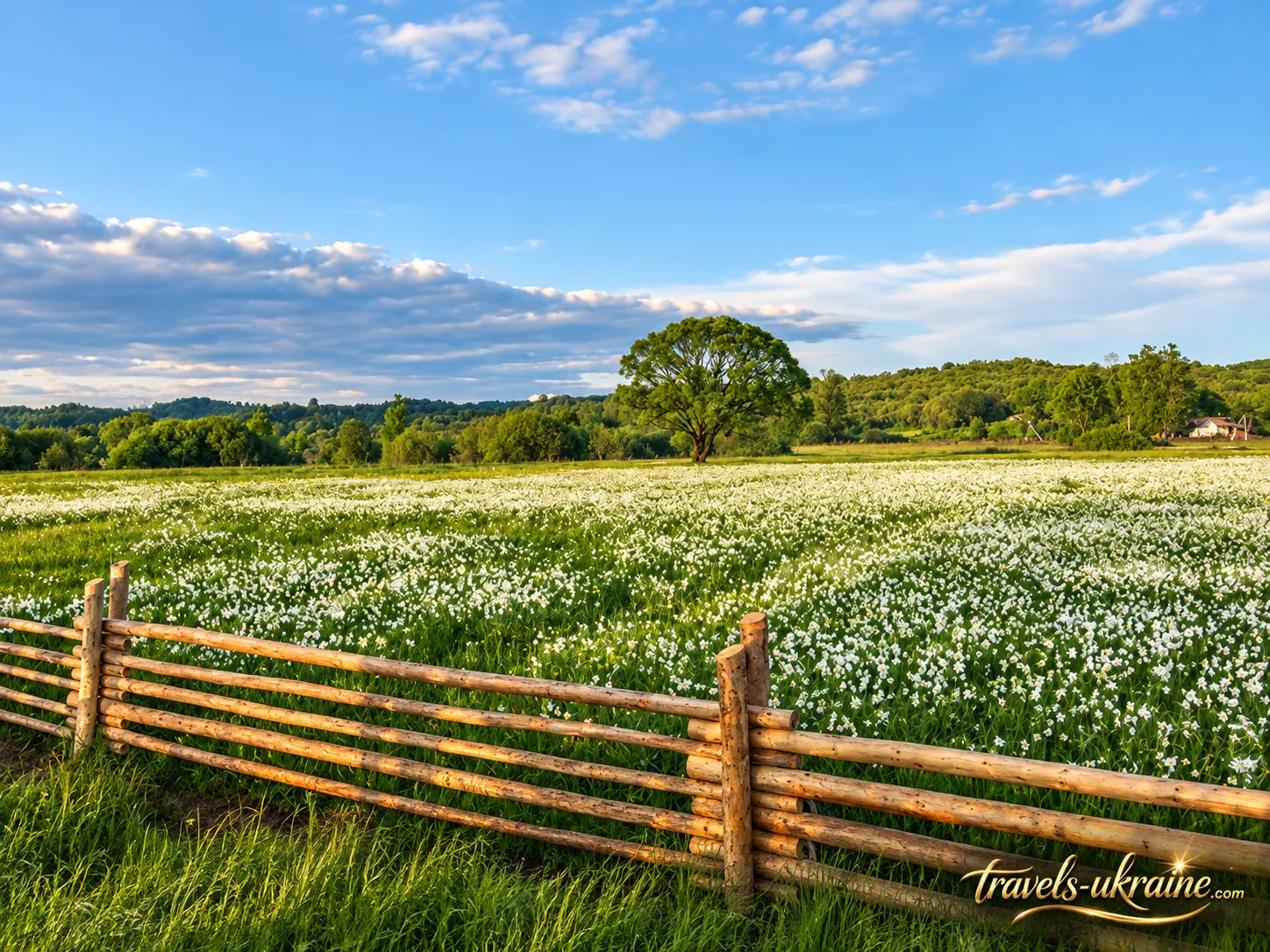
The first impression of the Narcissus Valley is often quite different from what photographs online may suggest. It is not one enormous, continuous field where flowers grow equally densely from horizon to horizon. Visitors encounter a large natural area with meadows, wet patches, bushes and islands of vegetation, among which are numerous concentrations of narrow-leaved narcissus.
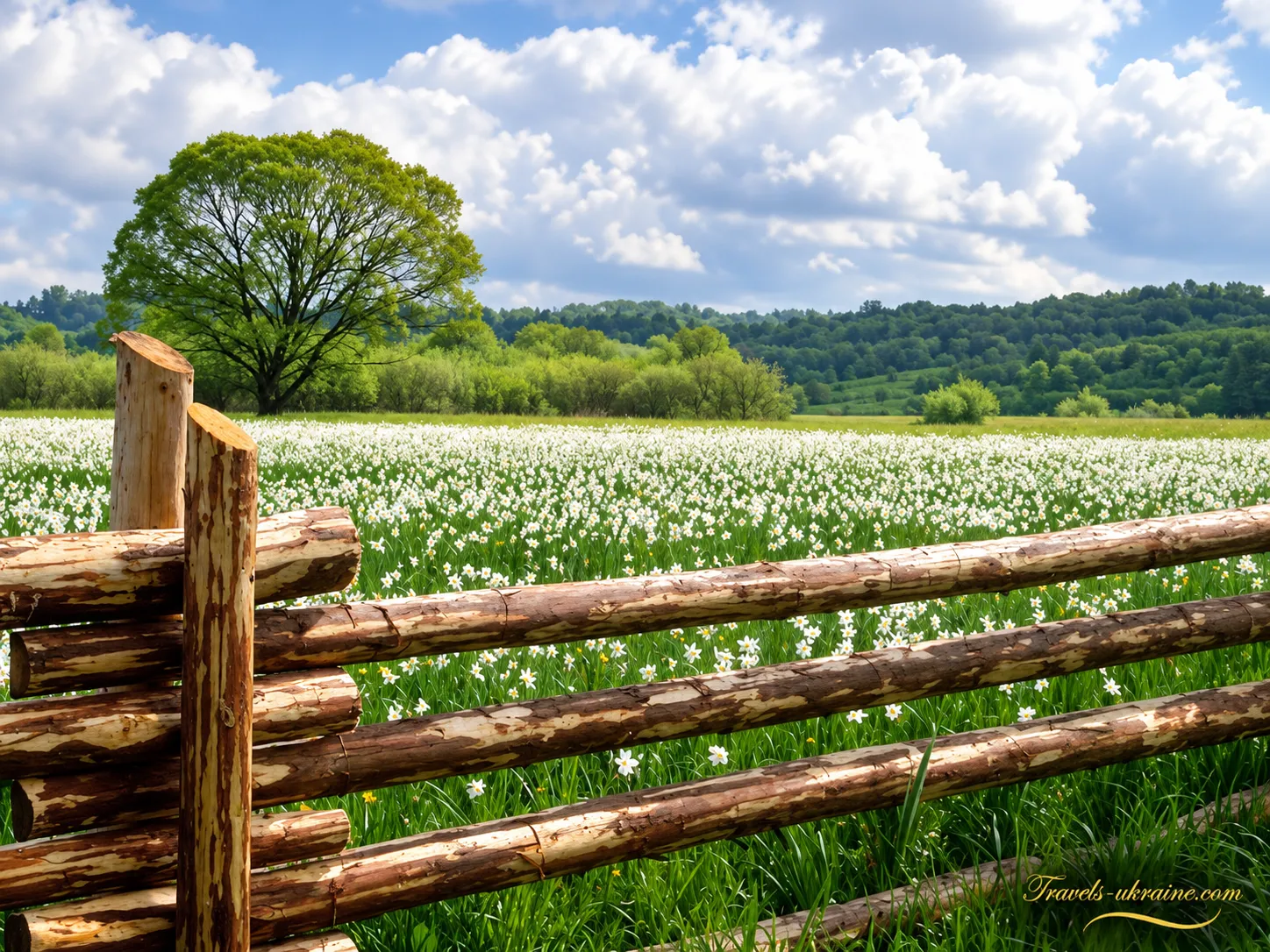
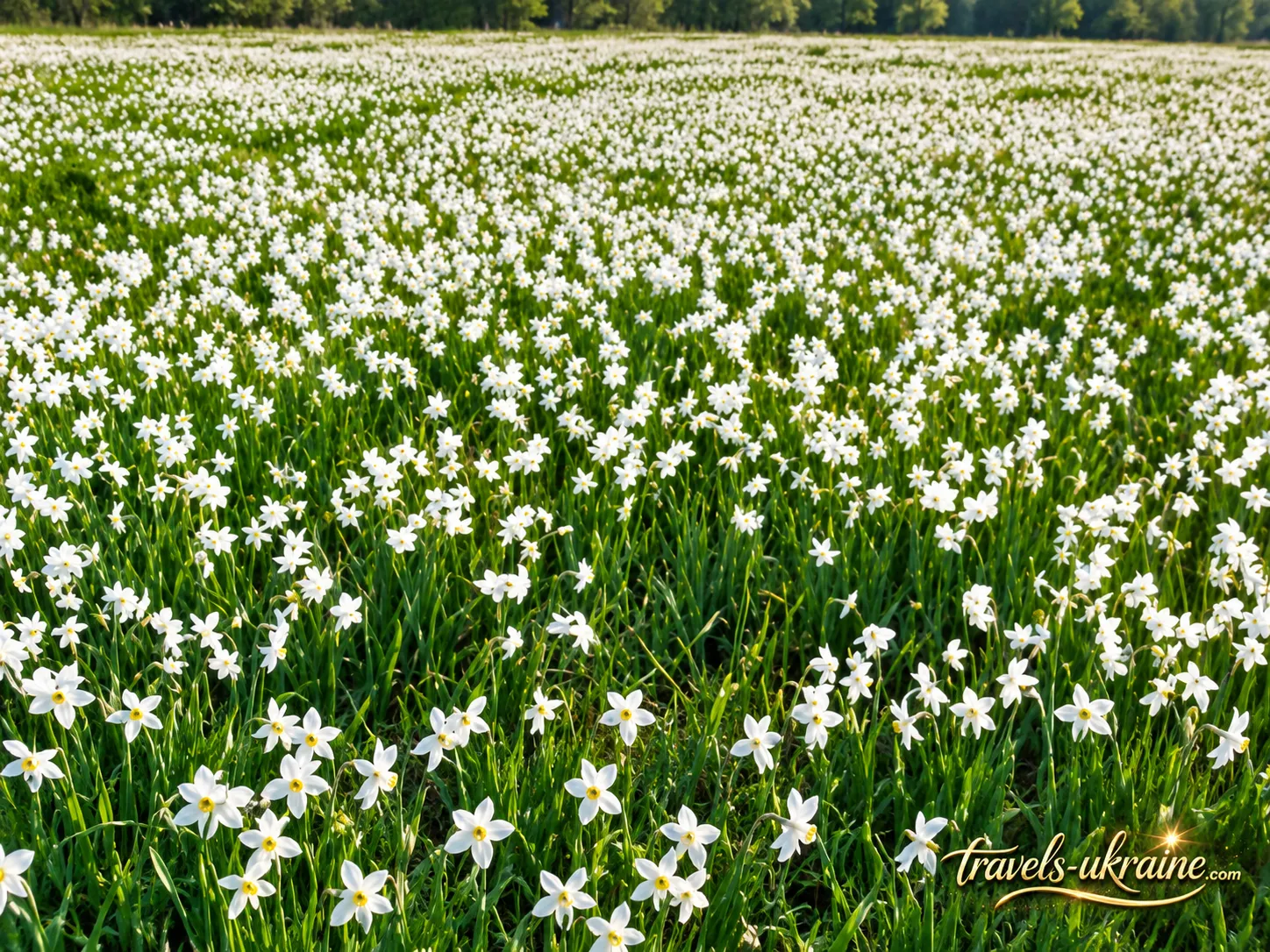
At peak flowering, there are so many flowers in some areas that from a distance they really do resemble a white carpet. Elsewhere, narcissi grow in small groups among tall grass. That is why walking here is more rewarding than making a quick stop at a single viewpoint: the landscape gradually changes, and the most flower-filled areas can be seen in different parts of the route.
The «Narcissus Valley» nature trail
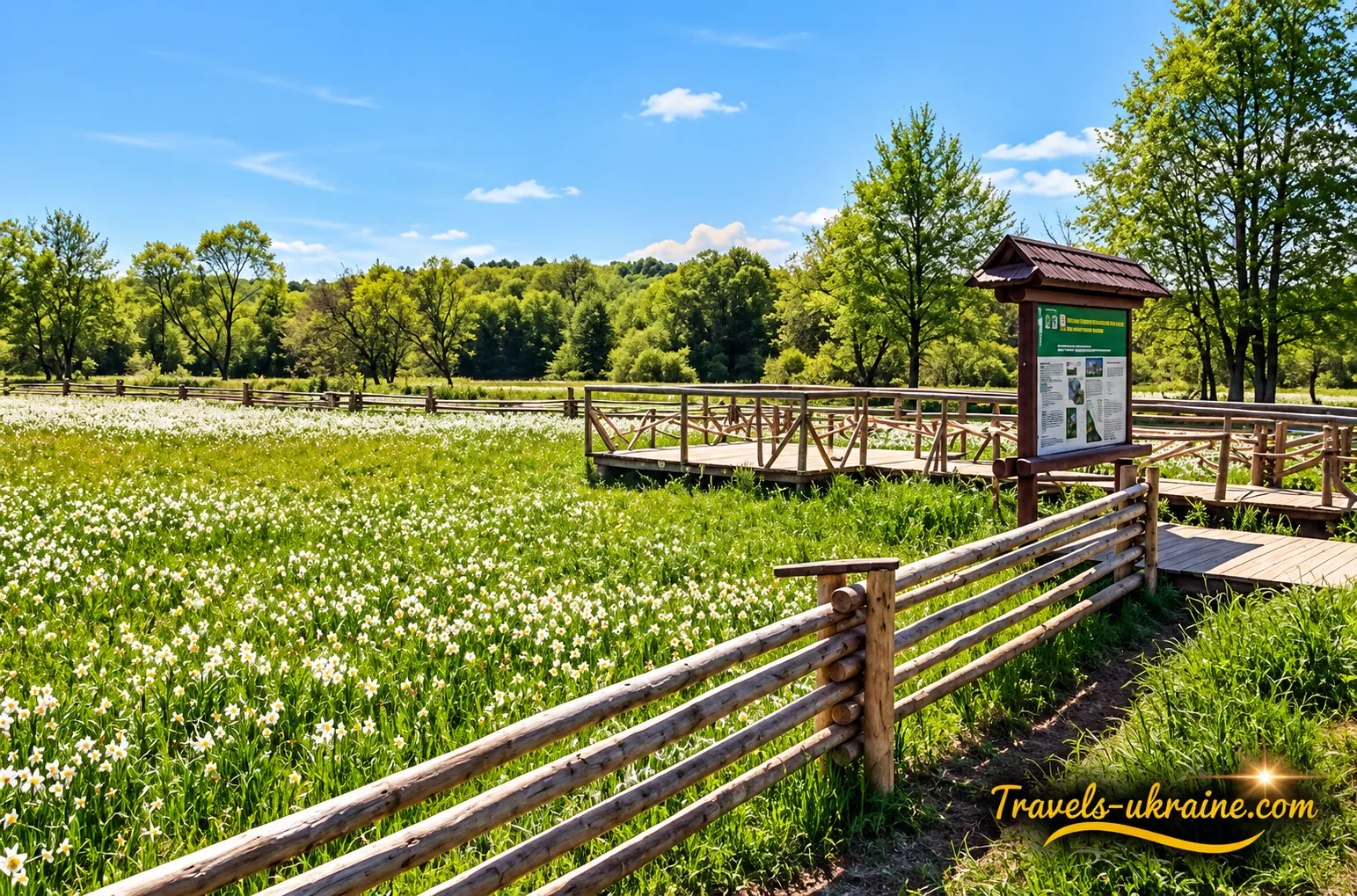
For visitors, the Carpathian Biosphere Reserve has established a dedicated «Narcissus Valley» nature trail. It is approximately 1.9 km long, the route is considered easy, and the reserve recommends allowing about 1.5 hours for the full walk.
The trail begins near the «Narcissus Museum» environmental education centre. Here you can learn not only about the flower itself, but also about the history of research into the Narcissus Valley, the local flora and fauna, and why this area requires special protection. There is also a photo spot by the entrance showing the valley at peak flowering. Further on, the route leads through protected meadows to several information points and viewpoints. This is a good format even for those who are not usually keen on botany: instead of lengthy scientific explanations, visitors gradually get to know the valley as they walk.
Three Viewing Platforms Among the Narcissus Meadows
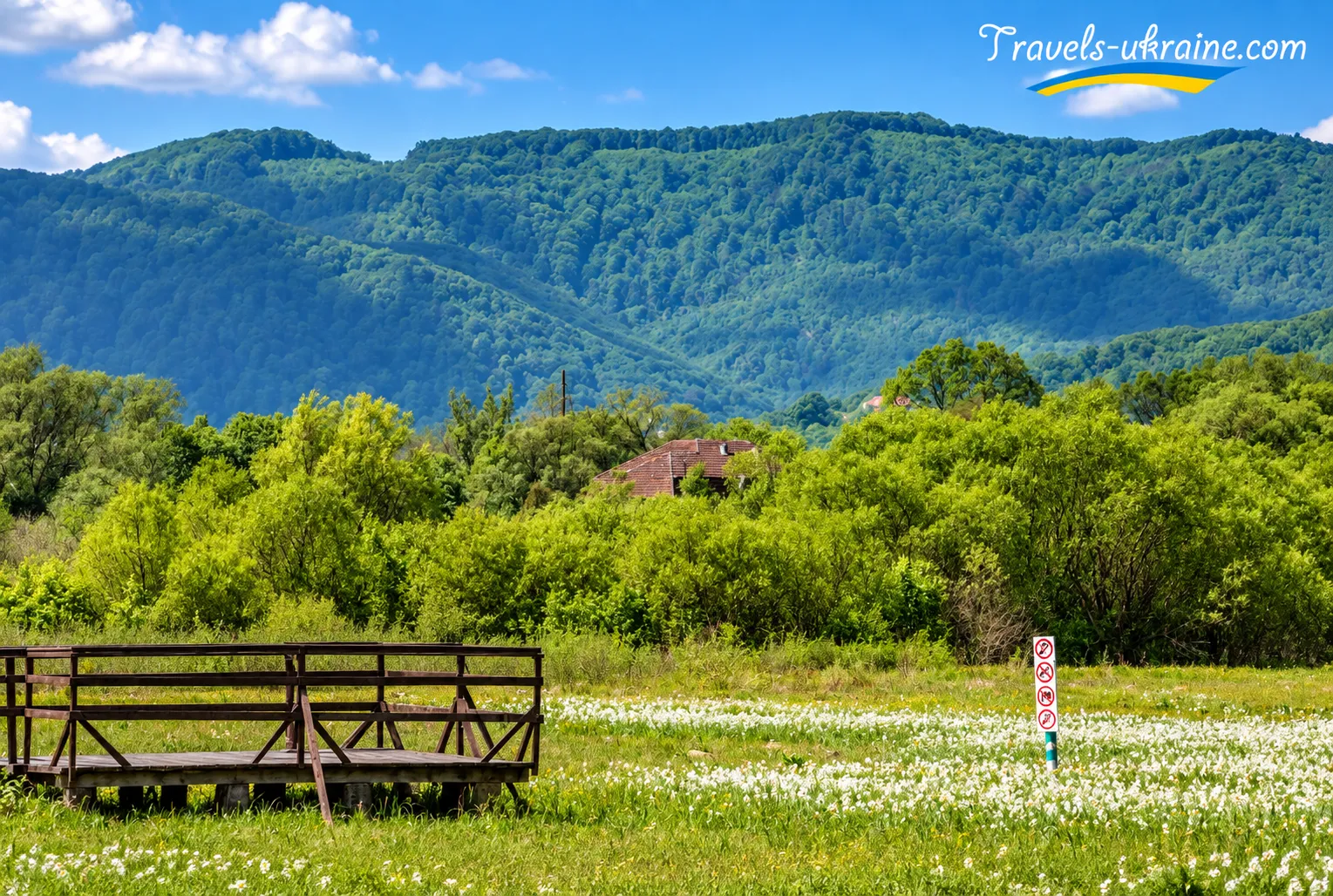
The route features three viewing platforms. The first is located right beside stands of narrow-leaved narcissus. During the flowering season, this is an excellent place to view the flowers up close without stepping onto the meadows themselves.
The second platform is near a route junction where the narcissus stands come almost right up to the road in places. An information panel and photo area are located nearby. This is one of the spots where, during a good season, it becomes clear where the famous photographs of the white meadows near Khust came from.
The third viewing platform reveals a different character of the Valley of Narcissi. From here, you can see not only the flowering areas but also the surrounding meadows, mountain spurs, and outskirts of the village of Kireshi. This change in scenery is a good reminder that what lies before us is not an ornamental flowerbed but a large, living ecosystem.
The Hydrological Sluice: Why the Valley of Narcissi Needs Water
One of the most unexpected stops along the route is the hydrological sluice. At first glance, it seems to have little to do with beautiful white flowers, but in fact it explains one of the protected area's main challenges. The groundwater level is critically important for preserving the narcissus meadows. Draining the area and altering its water regime can gradually change the composition of the vegetation, causing other species to overtake the meadows. The sluice is part of conservation measures designed to maintain the necessary water regime. An information board explaining its purpose stands nearby.
This small detail shows just how much more complicated it is to preserve the Valley of Narcissi than simply banning people from picking the flowers. The entire ecosystem in which the population developed must be maintained for it to survive.
Why the Narcissi Are Protected Here and What Tourists Must Not Do
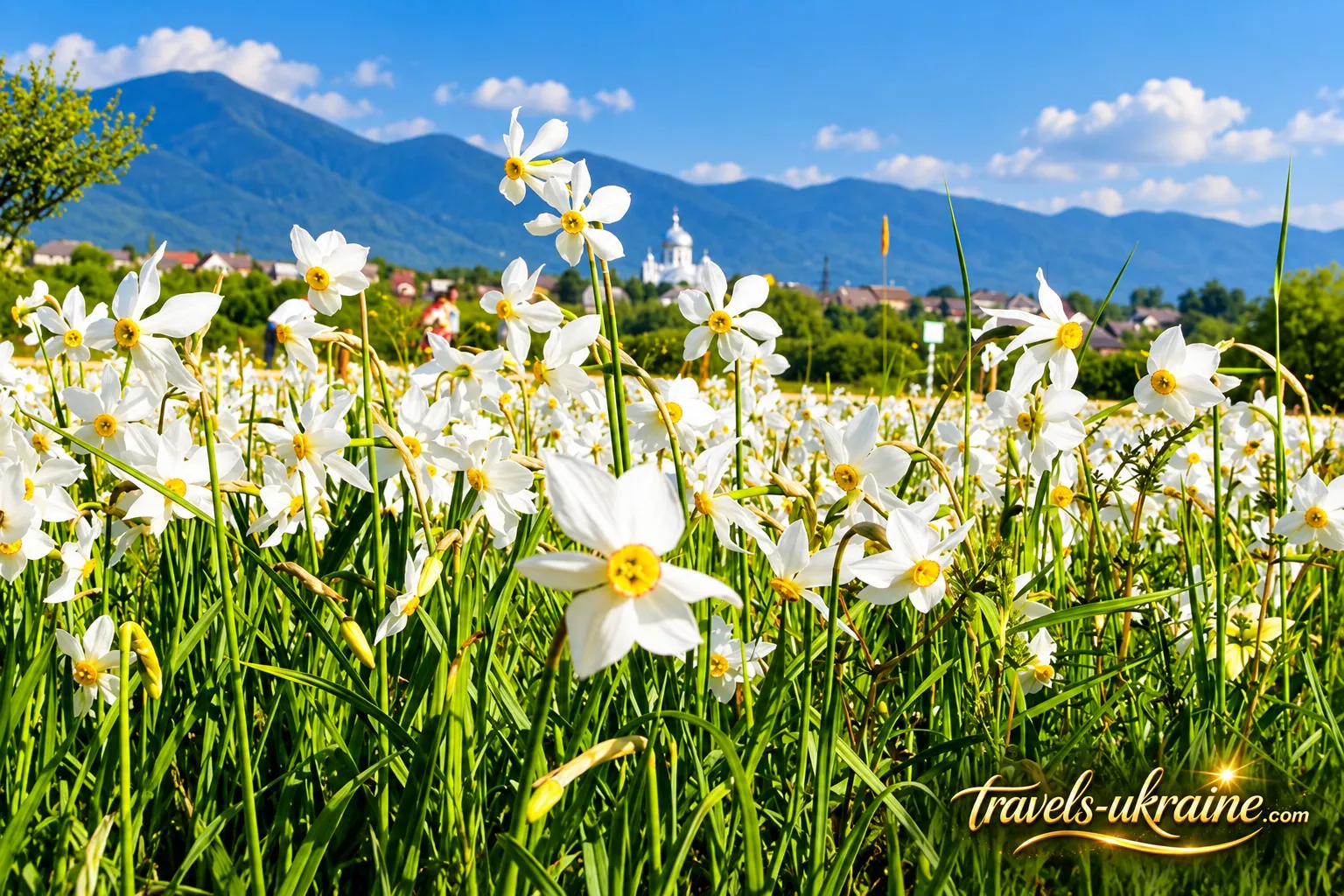
The Valley of Narcissi may seem like a vast and resilient natural system: hundreds of hectares of meadows, thousands of flowers, and new blooms every spring. In reality, however, this ecosystem is quite vulnerable. The Carpathian Biosphere Reserve explicitly states that the area covered by narcissus stands is shrinking, so protection here concerns not only the flowers themselves but also the entire environment in which they grow.
Narrow-leaved narcissus is listed in the Red Data Book of Ukraine and protected under the Bern Convention. Soil moisture, the condition of the meadows, and the absence of excessive trampling are all important to it. That is why even ordinary tourist behavior, such as «walking a few metres into the field for a better shot,» can have far greater consequences here than it might seem.
One person who takes a few steps among the flowers is unlikely to notice any immediate harm. The problem begins when hundreds or thousands of visitors do the same during the short flowering season. Plants and soil cover become compacted and damaged, trampled paths appear, and individual areas gradually lose their natural vegetation. That is why the biosphere reserve emphasizes separately that visitors must not leave the tourist route, enter stands of narrow-leaved narcissus, or take photographs directly among the flowers. Viewing platforms and designated photo areas are provided for photography, allowing visitors to take a good shot without damaging the meadows.
Why You Must Not Pick the Narcissi
Picking flowers within the reserve is prohibited. The issue is not only that a bouquet of wild narcissi will quickly wilt. Every plant that is picked loses the opportunity to complete its flowering and reproductive cycle properly, while mass flower gathering places additional pressure on a population that already needs protection.
So the rule here is very simple: the only narcissi you should take home are those in your photographs. A beautiful image will last for a long time, while the flower can continue to play its far more important role in the natural ecosystem.
What Else Is Prohibited in the Protected Area
The official visitor rules apply to more than just the narcissi. In the protected area, it is prohibited to damage plants or other natural features, light fires in unauthorized places, litter, or create excessive noise. Visitors do not need to memorize a long list of prohibitions here—just behave in a way that leaves the valley exactly as you found it after your walk.
It is especially important to explain this to children before setting out. A child’s natural impulse may be to run toward the largest group of flowers or pick one «for Mom.» But places like this can offer an important lesson in nature appreciation: sometimes the best way to treat a rare flower is not to touch it at all.
The Valley Is Protected from More Than Just Tourists
Trampling is only one of the problems. To preserve the narcissus meadows, reserve staff must monitor the area’s water regime, prevent the meadows from becoming overgrown with shrubs and trees, and maintain open meadow ecosystems. This is precisely why visitors can see the hydrological sluice mentioned above along the route.
In other words, the white spring carpet does not exist by itself. It depends on ongoing conservation work; without it, the landscape would gradually change and the area covered by narcissus stands could shrink even faster. This is probably worth remembering when visiting the Valley of Narcissi near Khust: a tourist comes here for only an hour or an hour and a half, while the plants remain here all year. A few simple rules—stay on the path, do not enter the flowers, do not pick them, and do not leave litter—are a small price to pay for the chance to see the same bloom next spring.
What to See Near the Valley of Narcissi
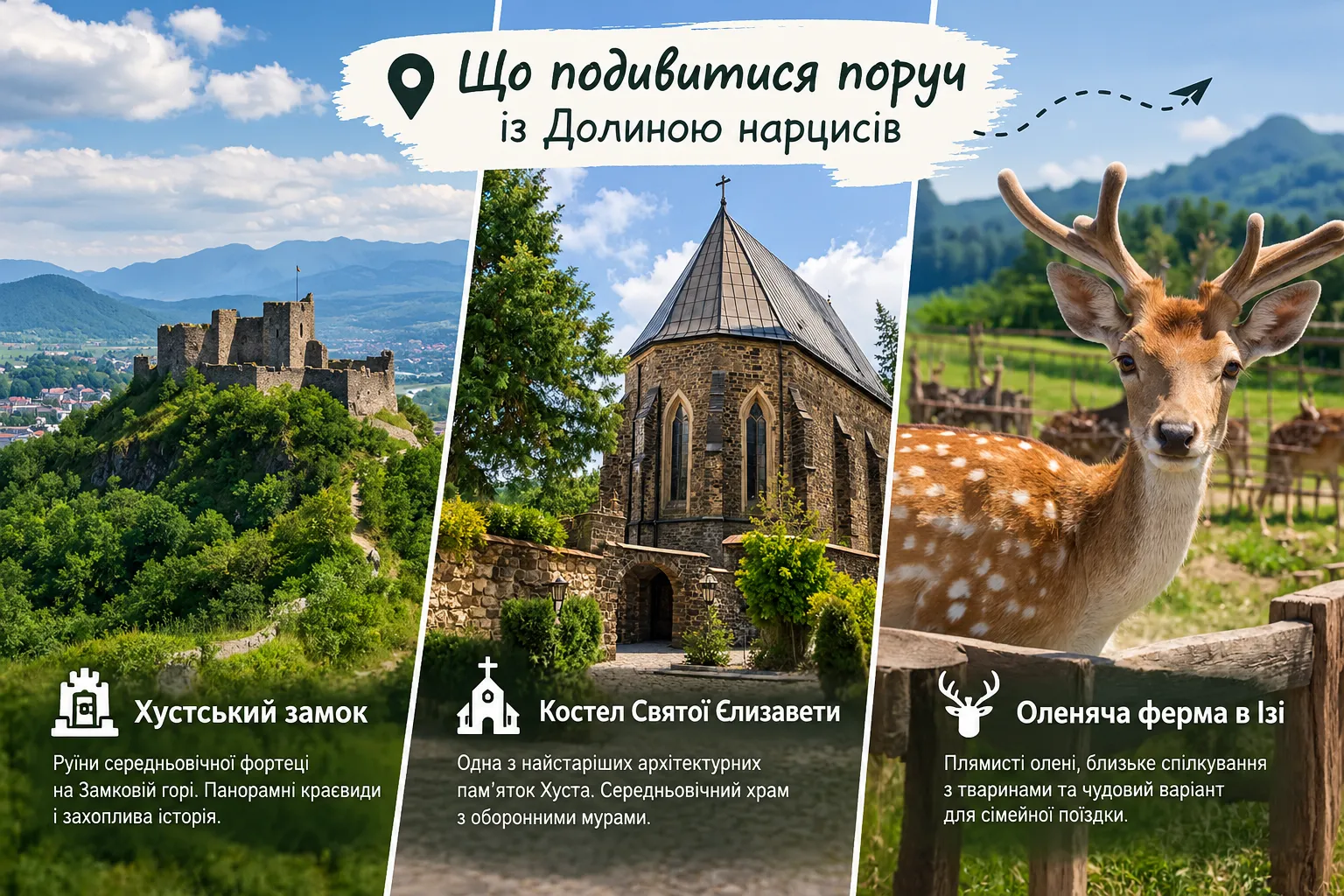
The Valley of Narcissi is so close to Khust that there is no need to come here solely for the flowering meadows. Even if you spend an hour and a half to two hours walking the nature trail, it is easy to turn the rest of the day into a short trip around the Khust area. Nearby you will find medieval ruins, historic architecture, and one of Zakarpattia’s best-known animal farms.
Khust Castle—Fortress Ruins Above the City
The most logical continuation of the route is Khust Castle. Its ruins rise above the city on Castle Hill and are clearly visible from a distance. The fortress once controlled an important salt route from Solotvyno and was one of the key fortifications in this part of Zakarpattia. Today, only fragments of its walls, towers, and defensive structures remain, but the climb is worth the effort for the wide panorama of Khust as well.
It is especially rewarding to combine these two locations in one day: start at the Valley of Narcissi, then climb to the summit and look down on the city from above. This makes Khust’s geography unfold before your eyes in an entirely different way.
St. Elizabeth’s Church—Medieval Khust That Has Survived
After descending from Castle Hill, it is worth visiting St. Elizabeth’s Church on Karpatskoi Sichi Street. It is one of Khust’s oldest architectural landmarks, dated by the city council to the 14th century. The stone church has a distinctly defensive character: it is surrounded by sturdy walls with gateways, its walls are reinforced with buttresses, and its narrow Gothic windows resemble loopholes. That is why it makes such an interesting follow-up to the castle ruins—you can see authentic medieval architecture in Khust that, unlike the fortress, has survived the centuries.
The Deer Farm in Iza—Spotted Deer Near Khust
If you would like to end the day with something completely different, head to nearby Iza and visit the Deer Farm. A herd of spotted deer lives here on a large enclosed site, and the farm has long been one of the best-known family attractions in the Khust area.
The chance to see the animals up close and feed them approved food is usually the biggest highlight. Children especially enjoy this stop, so combining the Valley of Narcissi with the Deer Farm in Iza works well for a family trip. In a single day, you can enjoy three entirely different experiences: walk through protected meadows, climb to a medieval fortress, and see spotted deer. Add a short stroll through central Khust, and the route becomes full without requiring exhausting drives across half of Zakarpattia.
Frequently Asked Questions About the Valley of Narcissi
When does the Valley of Narcissi bloom?
Mass flowering most often occurs in the first half of May, but the exact timing varies each year depending on temperatures and spring weather. The Carpathian Biosphere Reserve warns that peak bloom sometimes lasts only a few days, so it is best to check the latest information or call the staff of the Valley of Narcissi before your trip.
Where is the Valley of Narcissi located?
The Valley of Narcissi is located near the village of Kireshi, approximately 2 km from Khust in Zakarpattia Oblast. The area belongs to the Carpathian Biosphere Reserve. The most convenient way to get there from Khust is by car, heading toward Kireshi and following signs for the environmental education centre, the «Narcissus Museum.»
How much does admission to the Valley of Narcissi cost?
Admission fees charged by the Carpathian Biosphere Reserve for the «Valley of Narcissi» nature trail and the «Narcissus Museum» during the peak flowering period may change. Discounted rates are available for school pupils, students, postgraduate students, and pensioners. Guide services are paid for separately.
How much time is needed to visit the Valley of Narcissi?
The official nature trail is approximately 1.9 km long, and visitors are advised to allow about 1.5 hours to complete it. If you plan to spend longer taking photographs, visit the «Narcissus Museum,» or arrive on a very busy day during peak bloom, allow a little more time.
Is the Valley of Narcissi suitable for visiting with children?
Yes. The route is considered easy and is well suited to a family walk. The Carpathian Biosphere Reserve also notes that the «Valley of Narcissi» nature trail is accessible for people with disabilities. When visiting with children, it is especially important to explain in advance that they must not leave the path, enter the stands, or pick the flowers.
Can you take photographs among the narcissi?
You may photograph the Valley of Narcissi, but entering the stands for the sake of a photograph is prohibited. Viewing platforms and designated photo areas are provided, allowing visitors to take beautiful pictures without trampling rare plants.
Can you drive to the Valley of Narcissi?
Yes. The Carpathian Biosphere Reserve permits visitors to drive their own vehicles to the Valley of Narcissi.
Can you book a tour of the Valley of Narcissi?
Yes. During the flowering period, tours are led by researchers and environmental educators from the Carpathian Biosphere Reserve. A guided walk along the nature trail lasts approximately 40–50 minutes. You can book one at the ticket office by the entrance.
How can I find out whether the daffodils are blooming right now?
The most reliable way is to check updates on the official website of the Carpathian Biosphere Reserve or call the staff of the Valley of Narcissi directly. They monitor budding and the progress of blooming every day, so their information is far more accurate than photographs from previous years.
Is a trip to the Valley of Narcissi worthwhile?
The Valley of Narcissi near Khust is one of those natural destinations where the overall impression depends less on the scale of the route than on choosing the right moment. At the peak of the blooming season, the protected meadows are covered with thousands of white flowers, making it clear why tourists from all over Ukraine come here every year for a few weeks of spring.
What makes this place special is that it is neither an ornamental park nor a purpose-built photo zone, but a natural population of narrow-leaved narcissus that has survived in the unique conditions of floodplain meadows. That is why the Valley of Narcissi is interesting not only for its beautiful photographs but also for its natural value. For a first visit, it is best to plan your trip for the first half of May, while обязательно checking the current blooming conditions immediately before you set out. A few warm days can significantly change the landscape, and peak bloom sometimes lasts for a very short time.
Most importantly, this destination should be visited with care. Stay on the trail, do not enter the thickets, and do not pick the flowers—simple rules that will help ensure the famous daffodil meadows remain the same for generations to come. If you combine the Valley of Narcissi with Khust Castle, the Church of St. Elizabeth, and the Deer Farm in Iza, you can enjoy a very full one-day itinerary featuring nature, history, and completely different experiences without long drives around Zakarpattia.



No Comment
You can post first response comment.