
 English
 Українська
 Latviešu
 Lietuvos
 Русский
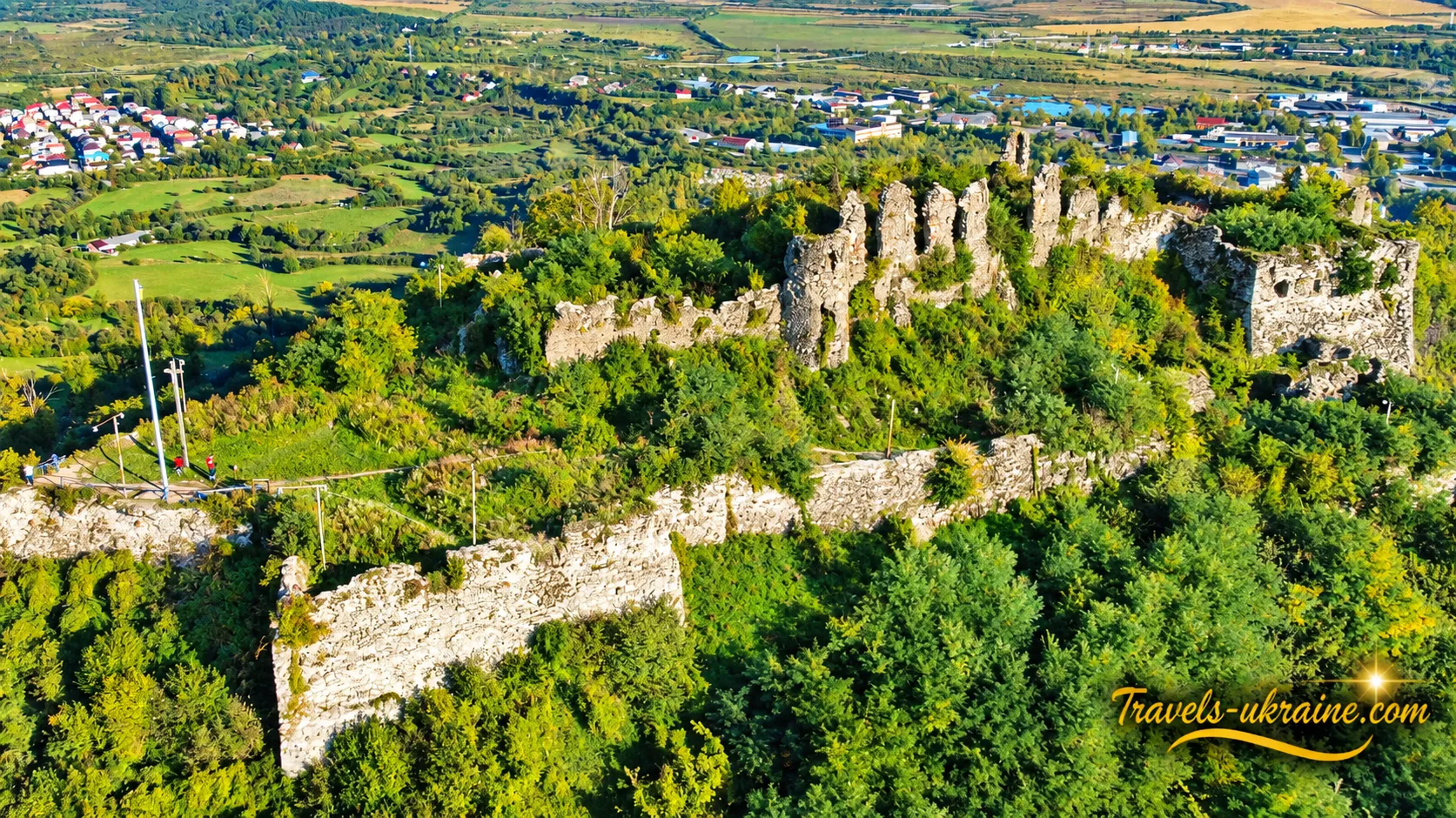
When you look today at the ruins of Khust Castle atop Castle Hill, it is difficult to imagine that a fortified stronghold once stood here, one that largely determined control over a significant part of Zakarpattia. What now appears to be a few fragments of old walls among grass and trees was once a complex defensive system with towers, bastions, gates, and a garrison.
The site for the fortress was chosen for a very good reason. From this height, the surrounding routes were clearly visible, and one of the region’s most important trade routes ran nearby—the salt route from the mines of Solotvyno. For centuries, strategically valuable salt was transported along it, and whoever controlled this route gained not only a military advantage but also considerable economic influence.
That is why the history of Khust Castle is not simply the story of an old fortress on a hill. It is a story of the struggle for roads, resources, and control over Maramures (a historical and geographical region in the Upper Tysa basin, now divided between Ukraine’s Zakarpattia Oblast and northern Romania). And although only ruins remain of the castle today, its walls were once so important that kings, princes, and entire armies fought for possession of them.
Why Khust Castle Was Built on Castle Hill
In the Middle Ages, salt was a far more important commodity than it may seem today. It was used not only in food but above all to preserve products, so control over salt deposits and transport routes had great economic and strategic importance. Rock salt from the mines near present-day Solotvyno was transported along the Tysa and onward into the Kingdom of Hungary, while the Khust fortress was intended to protect this route and the borderlands.
According to the Zakarpattia Regional Museum of Local History, construction of the fortification on Castle Hill began around 1090, during the reign of King Ladislaus I of Hungary. The traditional date marking the completion of one of the first major stages of construction is 1191, during the reign of King Béla III. These are the two dates most often cited when discussing the founding of Khust Castle. However, it would be wrong to imagine that the fortress took its final form in 1191 and never changed afterward. On the contrary, Khust Castle was rebuilt, restored, and strengthened over the centuries. Its defensive system evolved along with military technology, the political situation, and the importance of the town itself.
What Khust Castle Looked Like at the Height of Its Power
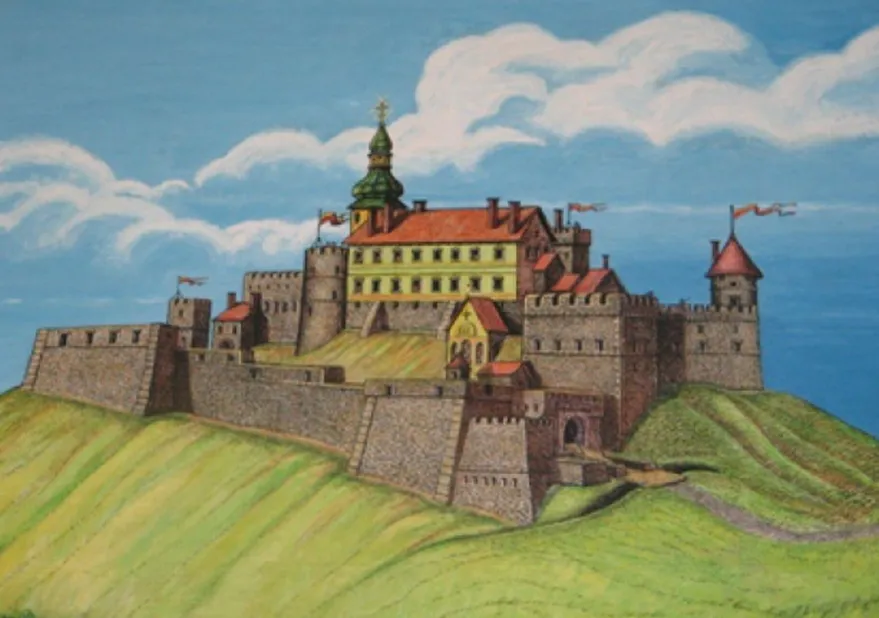
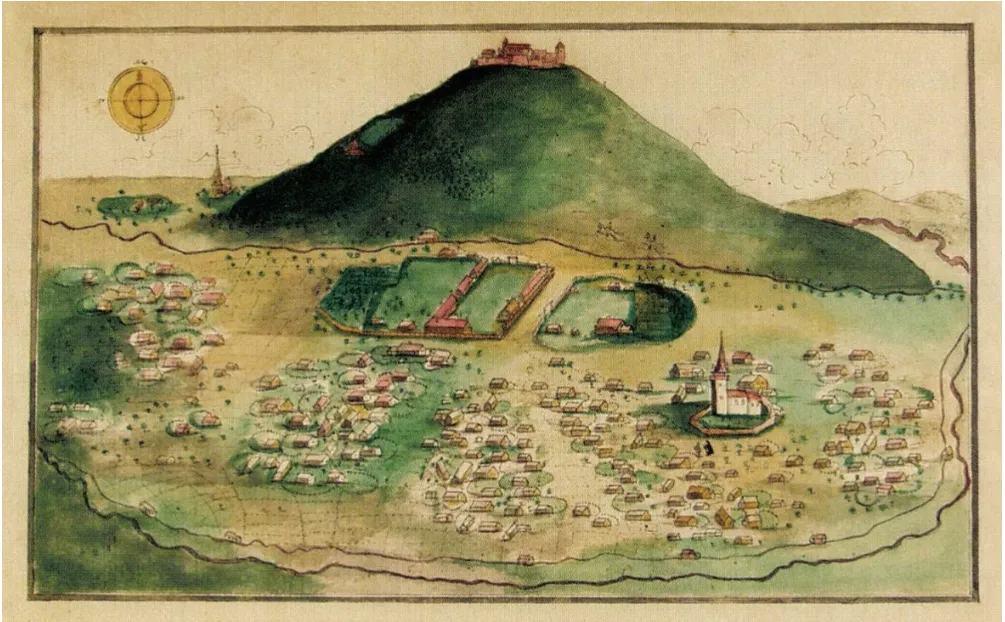
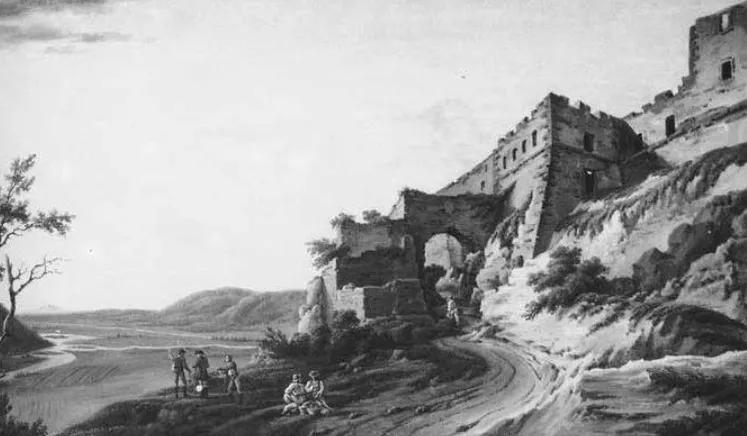
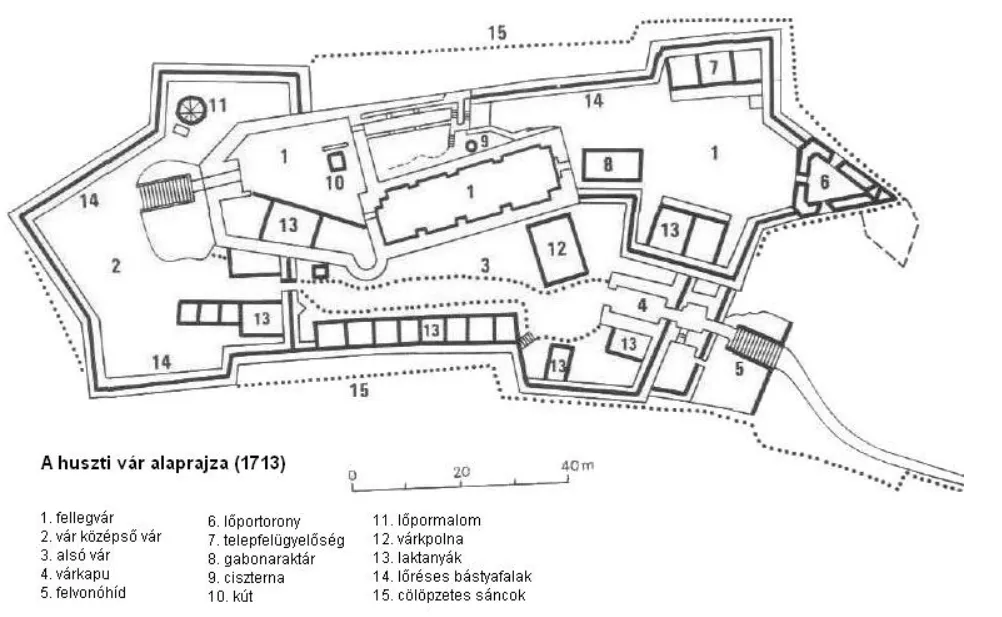
The present-day ruins of the castle in Khust offer only a faint idea of how complex this fortress was several centuries ago. It was not a single large stone building with a tower in the middle, but an entire system of defensive walls, gates, towers, bastions, living quarters, and service buildings designed to withstand a prolonged siege. Old plans show that the structures occupied the elongated summit of Castle Hill and consisted of several successive defensive zones.
Reaching the castle was much more difficult than simply following a road to the summit. From the west, a winding serpentine road led uphill from the Khustets River. Even before the main fortifications, travelers encountered a guard post that controlled the approach to the fortress, while massive gates and defensive towers protected the main entrance to the outer section of the castle. The space between them was arranged so that an enemy who broke through would find themselves in a narrow passage under fire from the defenders. In other words, getting past the first gate did not by any means mean reaching the heart of the fortress.
The route then led to the inner castle—the most heavily protected part of the complex. In front of its gate was a moat approximately 8.5 meters wide, crossed by a drawbridge. When the bridge was raised, the outer and inner sections of the fortress were effectively separated. Even if attackers managed to capture the first defensive line, the garrison could continue defending the inner castle.
Towers, Bastions, and Cannons Overlooking Khust
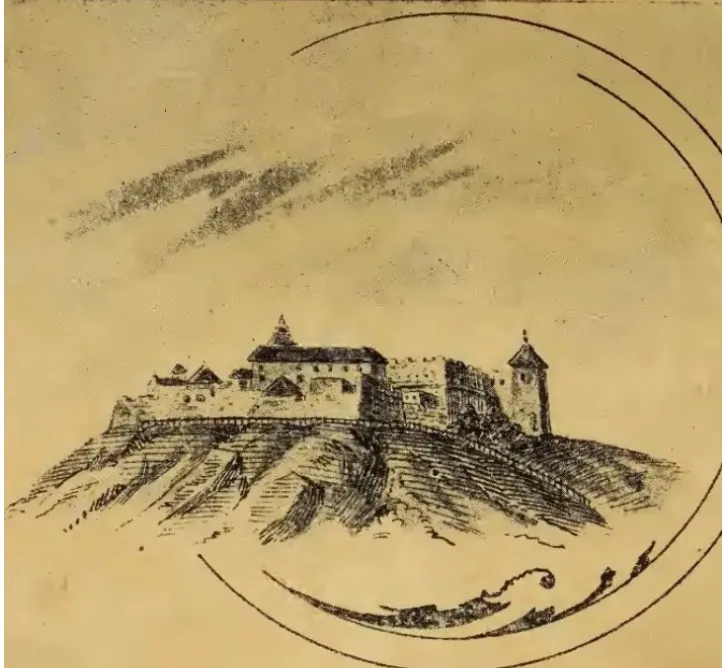
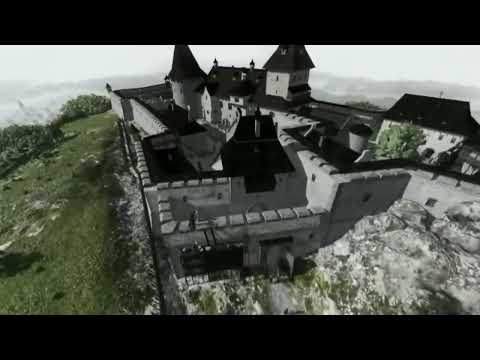
The silhouette of the old Khust Castle was defined by numerous defensive structures. Tall towers controlled the approaches to the gates and the valleys around Castle Hill, while platforms for heavy cannons were installed along the fortress walls. On the eastern side, the inner section of the fortress was protected by two powerful bastions and a high tower, while a separate watchtower controlled the northern approach.
A special place was occupied by Ferdinand’s Tower, built in 1554. One building served several functions at once: a powder magazine was located on the ground floor, a chapel above it, and the upper level was used as an arsenal. This arrangement shows how closely military and everyday life were intertwined within the fortress.
Gunpowder was also stored in other parts of the castle, while cannons of various calibers stood on the defensive platforms. According to descriptions of the fortress, a shot from the largest cannon was even used as a kind of signal for the town—it announced the beginning of a new day in the morning.
There Was a Small Fortified Town Behind the Walls
Most remarkably, the austere walls concealed more than just military infrastructure. Inside were living and administrative quarters, barracks, stables, a smithy, a kitchen, a bakery, and even an inn. The castle owners and the commandant had separate living quarters: the winter rooms were located near the watchtower, while the summer rooms stood on the southern side, where large windows offered views of the Tysa and the road below the castle.
For a fortress capable of withstanding a prolonged siege, water was critically important. That is why a well approximately 160 meters deep was dug into the rock inside the castle. This figure sounds impressive even by modern construction standards, while several centuries ago such a structure was one of the key elements of the garrison’s self-sufficiency.
Looking at the 1713 plan of Khust Castle makes it clear how deceptive the present-day ruins are. Where tourists now see grass, trees, and isolated fragments of stone walls, defensive lines once ran, while barracks, warehouses, towers, and service buildings stood there, connected by narrow passages linking the different parts of the fortress.
It is old plans and historical images that help us «reassemble» Khust Castle, at least in our imagination. This is especially fascinating to do directly on Castle Hill: to look at a small fragment of a wall and realize that several centuries ago it was merely a tiny part of a vast fortress that dominated the entire valley.
How Khust Castle Fell and What Remains of the Fortress Today
Over the course of several centuries, Khust Castle survived the Mongol invasion, the struggle between the Habsburgs and the princes of Transylvania, Tatar attacks, and assaults by Ottoman forces. The fortress was reinforced, rebuilt, and armed in preparation for new wars. But the event after which the castle would never regain its former power came not from an enemy army at all.
On July 3, 1766, a severe storm swept over Khust. At around six o’clock in the evening, lightning struck the fortress several times. After the first strikes, the roof caught fire, and the greatest fear of those inside was that the flames would reach the gunpowder stores. That was precisely what could not be prevented. A powerful explosion caused catastrophic damage to the fortress. Stones blocked the only exit, a major fire broke out, and there were human casualties. The residential and service buildings inside the castle either burned down or were severely damaged.
Paradoxically, the fortress that armies had spent centuries trying to conquer effectively lost to the forces of nature. After the disaster, attempts were made to begin repairs, and funds were even allocated for restoration, but it was no longer possible to return the enormous defensive complex to its former condition. The royal garrison left the castle, and the structures on Castle Hill gradually began to deteriorate.
The destruction did not end there. At the end of the 18th century, a storm damaged one of the last surviving towers. After that, the castle walls began to serve as a convenient source of building stone. Part of the fortress was dismantled, and the stones were used to construct buildings in Khust, including a Catholic church. Some items from the castle also made their way into the town, including a bell and a tower clock.
What Remains of Khust Castle Today
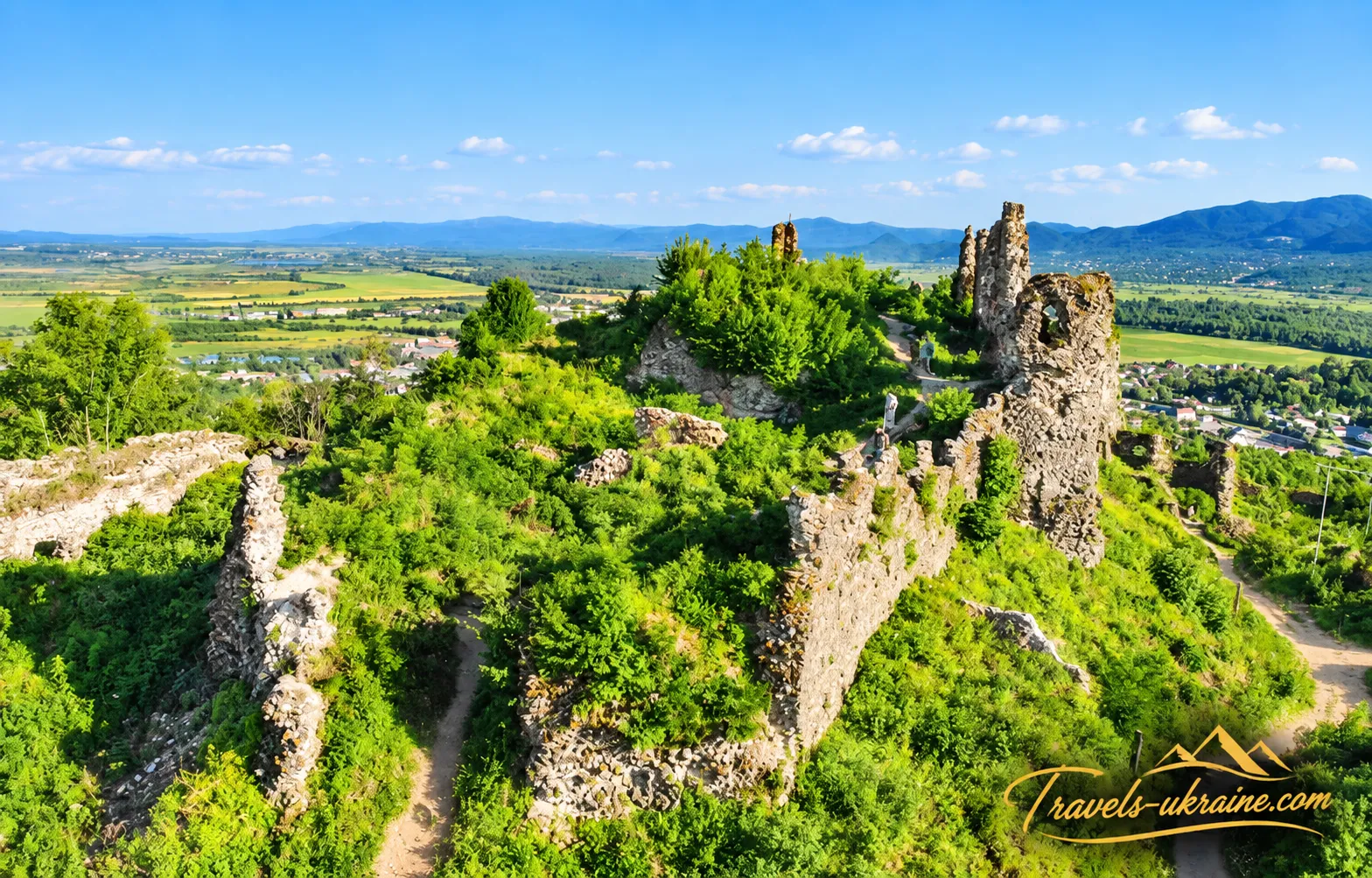
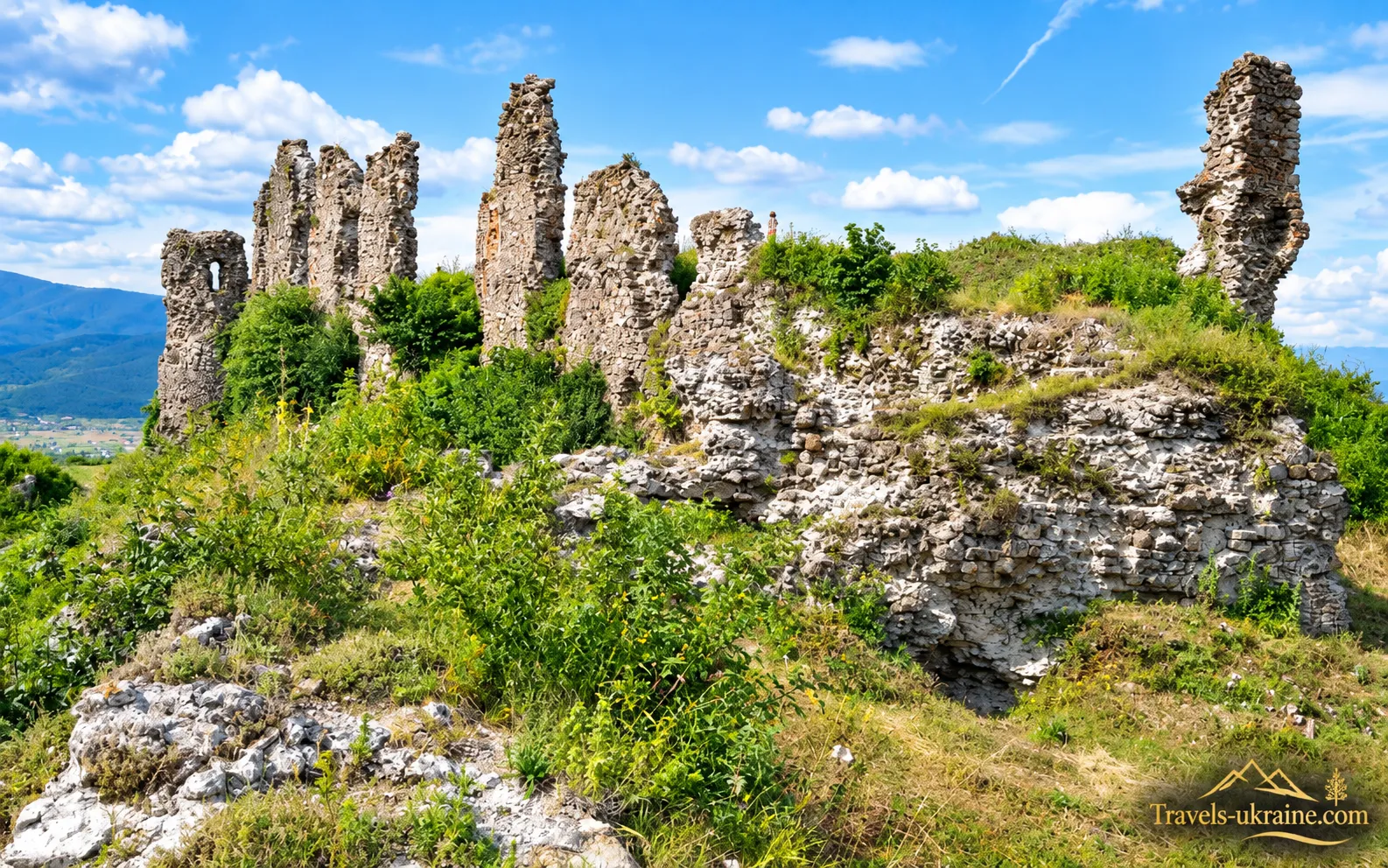
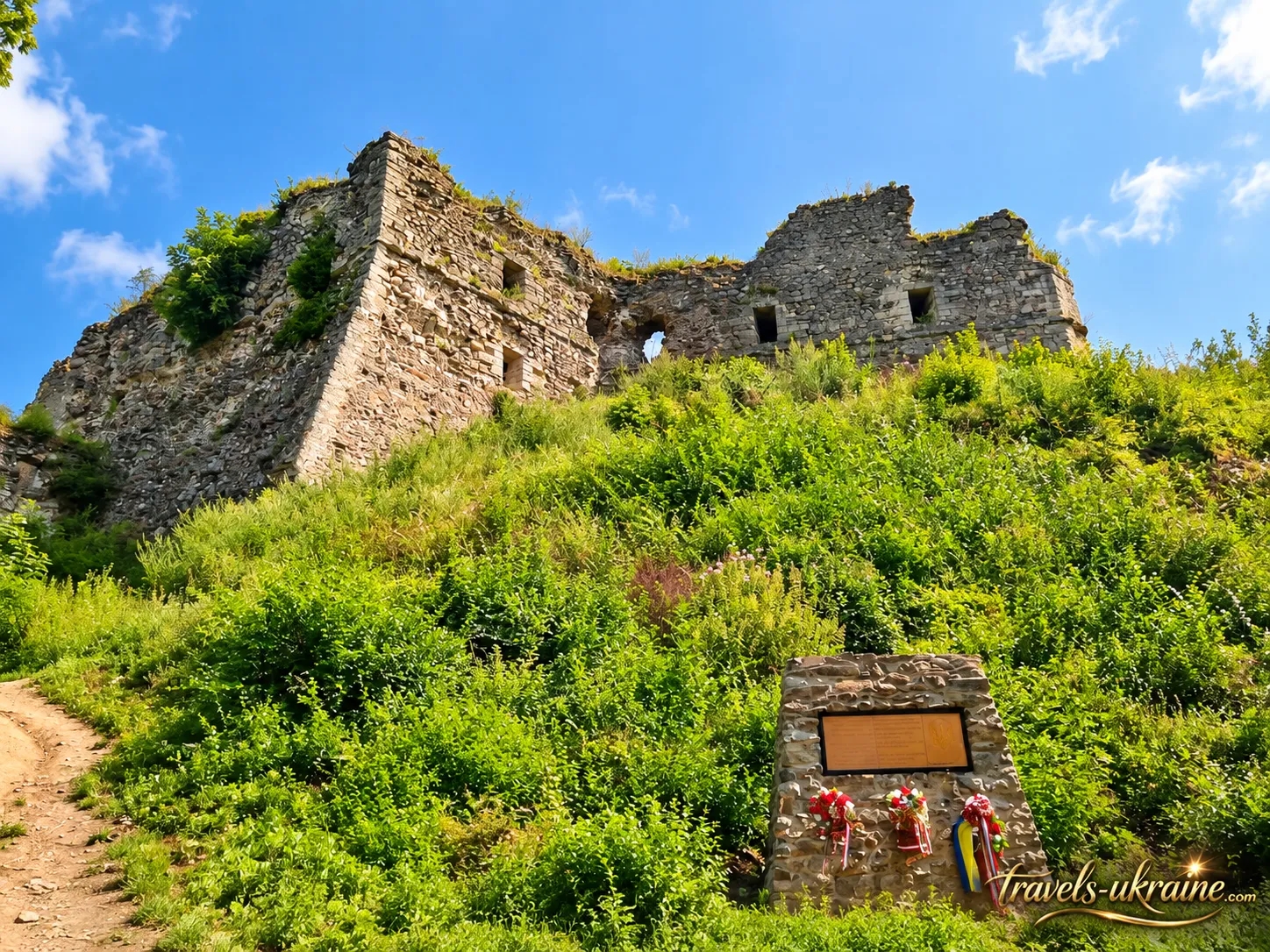
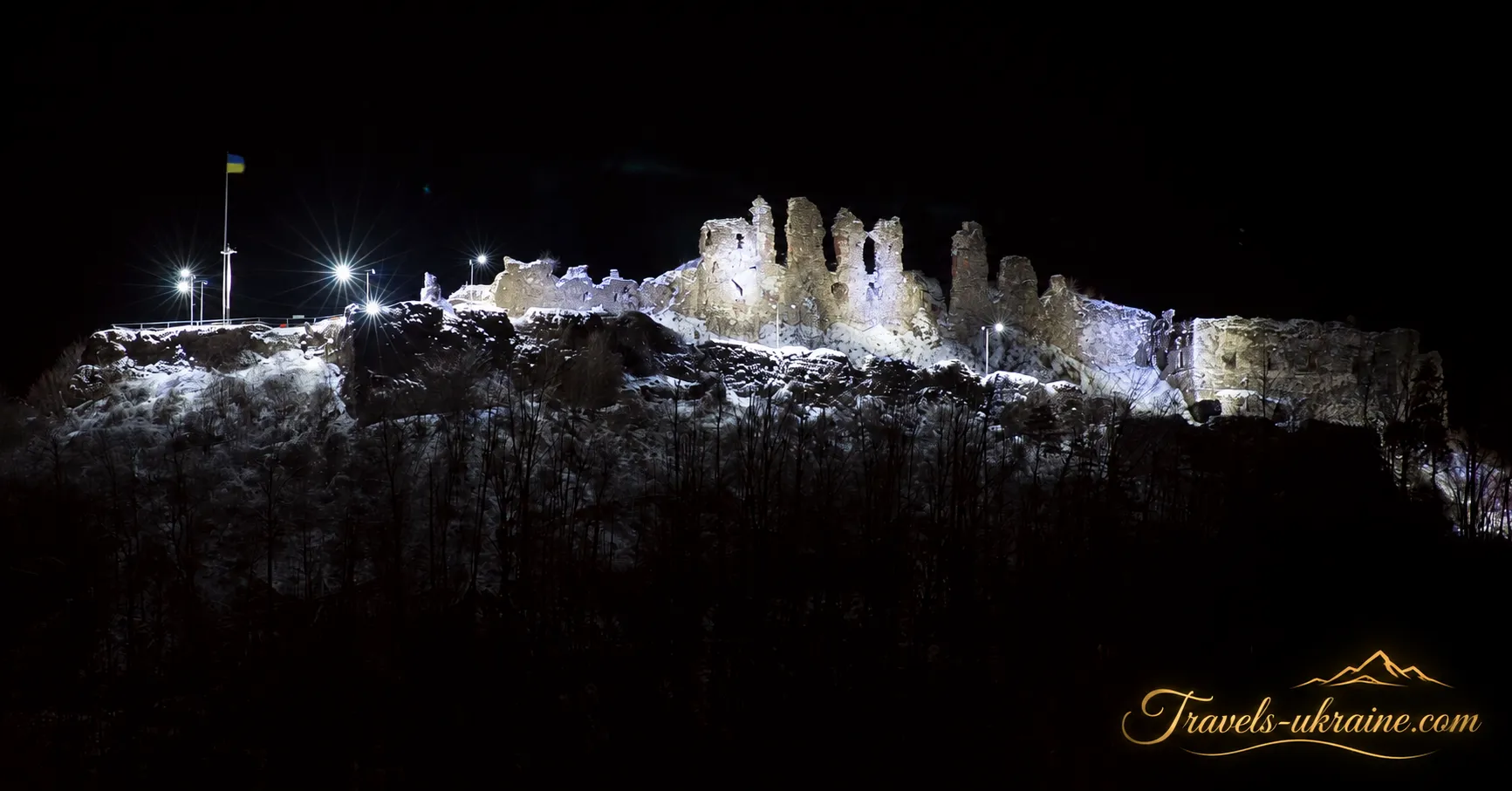
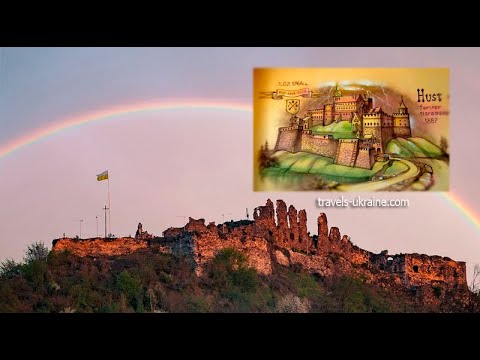
That is why tourists climbing Castle Hill in Khust for the first time should not expect a fortress like the well-preserved Palank Castle in Mukachevo. What remains of Khust Castle are fragments of stone defensive walls, remnants of towers, foundations, and individual fortifications. Some structures have almost merged with the ground, while others still make it possible to trace the outline of the former fortress.
Some details of the old castle can still be recognized today. Remains of the guard post that once controlled the road to the fortress have survived on the slope. Near the former entrance, the remains of defensive structures that protected the main gate can be seen. And if you look at the old 1713 plan of the castle before beginning the climb, a walk through the ruins becomes much more fascinating: individual fragments of walls stop looking like random stone structures and begin to form the outlines of what was once a vast defensive system.
This is where the contrast between the past and the present is felt most strongly. In old images, towers, roofs, and multilevel fortifications rise above Khust, while today grass and trees grow through the remains of the walls. Yet the site has not lost its atmosphere—in fact, the ruins leave room for the imagination and allow visitors to literally walk through the grounds of a fortress that no longer exists. There is another reason why the ruins of Khust Castle are worth seeing in person. Castle Hill itself was part of the fortress’s defenses, and the height that once helped the garrison control the roads and valley now gives tourists one of the finest panoramas of Khust. That is where the next part of our journey leads.
Climbing Castle Hill and the Panorama of Khust
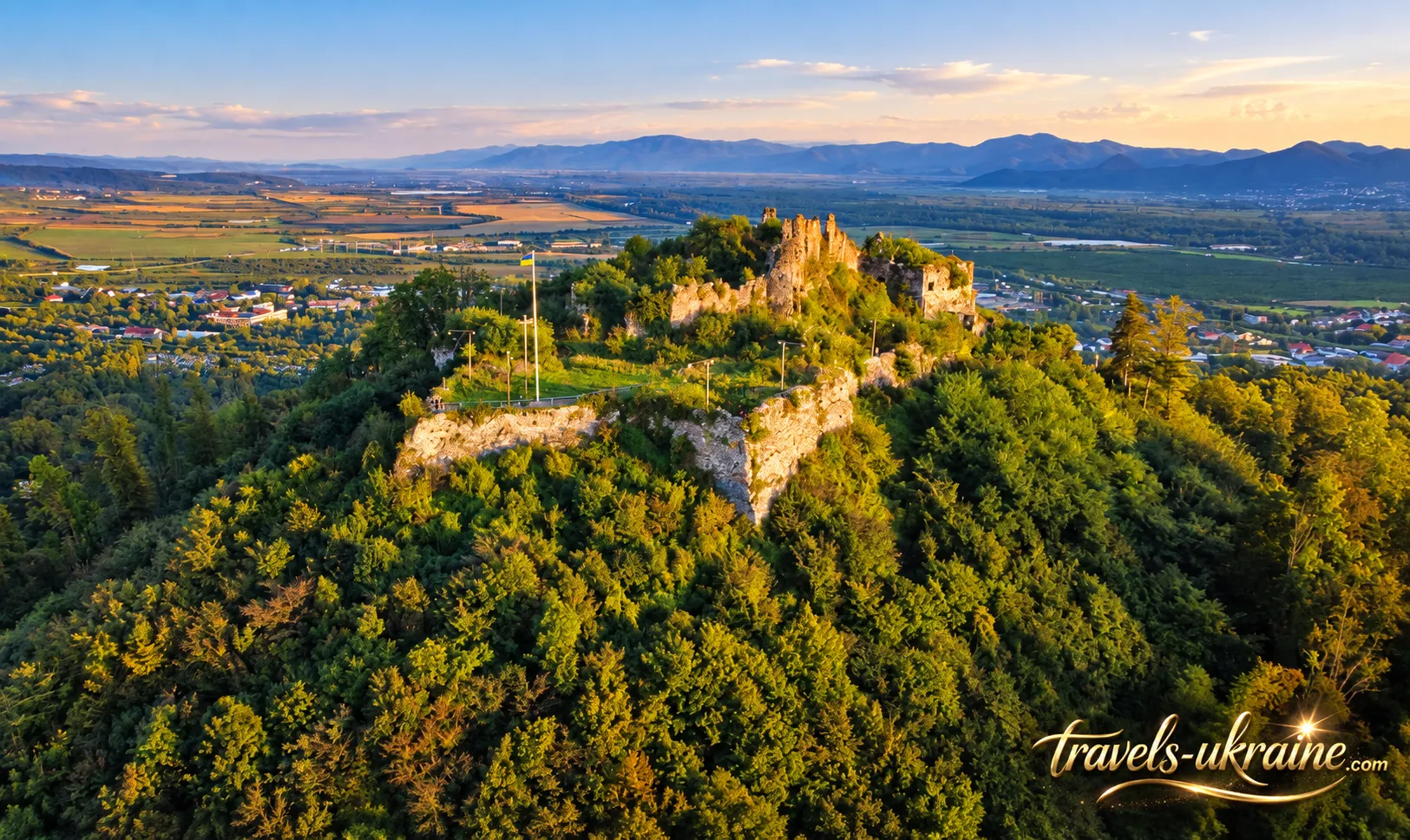
You do not have to travel far outside the town to reach the ruins of Khust Castle—Castle Hill rises practically above Khust itself. But it is best to cover the final part of the route on foot. This is one of those cases where the journey to the landmark is part of the experience: you gradually leave the town streets below, gain height along the serpentine road, and see more and more of the surrounding valley with every turn.
Historically, a winding serpentine road from the Khustets River also led to the fortress from the west. This means that today’s tourist partially follows the same route used for centuries by the castle’s residents, soldiers, messengers, and merchants. Admittedly, no one will check your intentions at the gate today.
How to Climb to Khust Castle
The easiest way to find your bearings is to head for Zamkova Street and the developed area at the foot of the hill. The road toward the ruins begins here. The climb does not require any special hiking equipment, but the hill still makes itself felt: the difference in elevation between the town and the summit is approximately 150–160 meters.
The road to the castle was substantially upgraded as part of an international tourism project. Khust City Council reports the reconstruction of approximately 1.1 km of the road to the ruins: it was paved with cobblestones, drainage was installed, and lighting, benches, bins, and information elements were added. A 1:20 scale model of Khust Castle has also appeared along one section of the route. And this model is very much in the right place here. After the old plans and descriptions from the previous section, you can finally see a three-dimensional model of the fortress and compare it with what remains on the hill. When you find yourself among the real ruins a little later, it becomes much easier to understand the former scale of the complex.
Allow approximately 20–30 minutes at a relaxed pace for the climb from the foot of the hill, although everything depends on your fitness level and how many stops you make. And there is plenty of reason to stop here: the views become increasingly expansive along the way, while the benches let you rest without turning the walk into a fitness test.
Khust panorama — the second reason to climb the hill
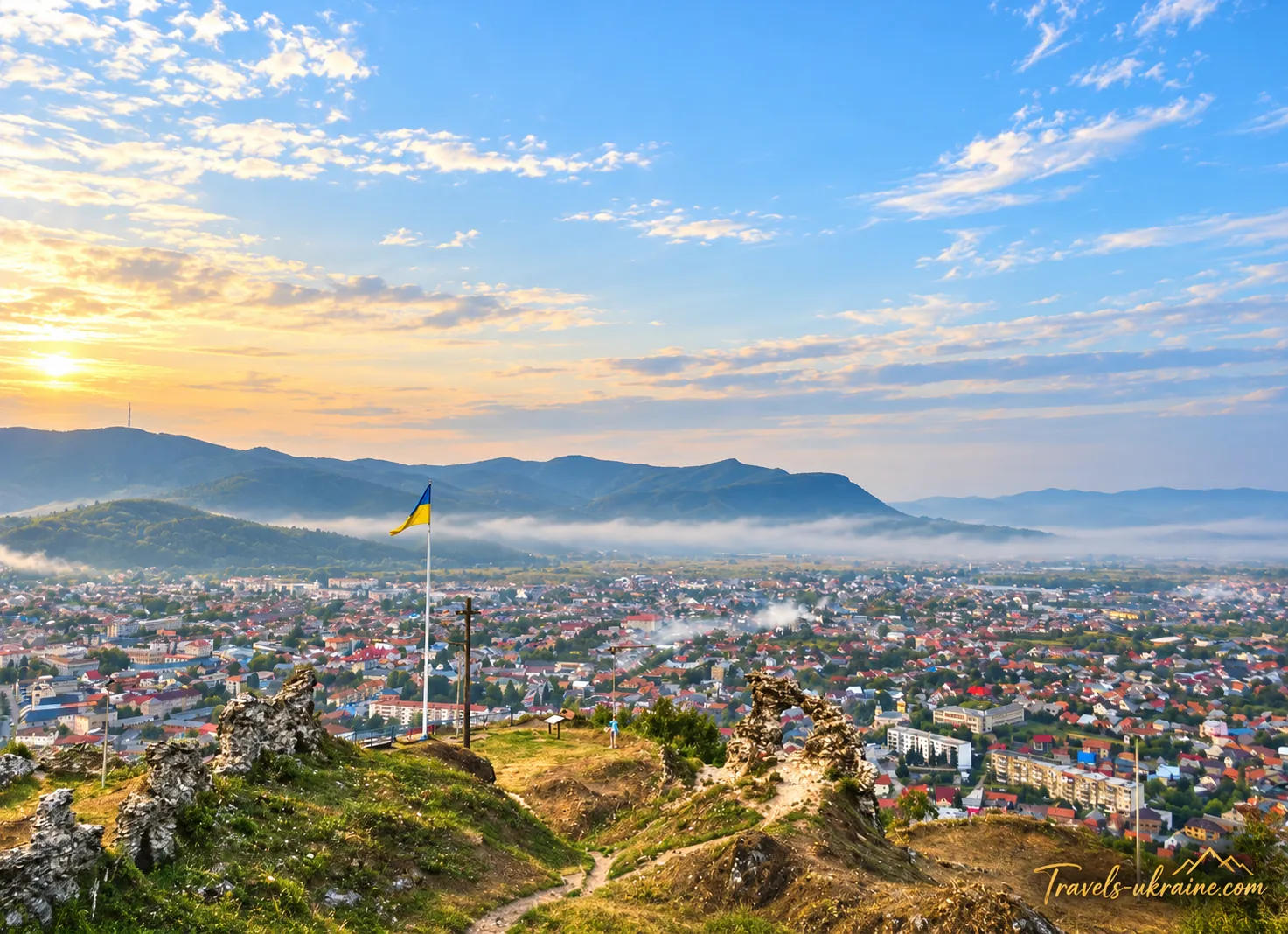
Even if even less of the fortress had survived, the panorama from Castle Hill would justify the climb on its own. From above, you can clearly see Khust, the cityscape, the surrounding valleys, and the mountain ranges on the horizon. This is where it becomes clear why medieval builders chose this particular summit for the fortress.
What tourists see today as a beautiful viewpoint was once an important military advantage. From here, it was possible to spot movement along the road in advance, control approaches to the city, and monitor the valley. Even without its walls, the height of Castle Hill continues to explain the history of the fortress better than many museum displays.
It is especially beautiful here in the afternoon and before sunset, when the light becomes softer and the contours of the surrounding mountains stand out more clearly. This is one of the most interesting times for photography, but it is best not to leave the descent until complete darkness, especially if this is your first time on the route.
For the entire walk — the climb, viewing the ruins, taking photographs, and the descent — allow approximately one and a half to two hours without rushing. If you enjoy examining old walls, comparing them with the fortress plan, and simply sitting on the summit, you can easily spend longer here. That is precisely why Khust Castle is interesting even to those who are not particularly fascinated by fortifications. You climb Castle Hill for the history, but at the top you also gain one of the best opportunities to see Khust from above.
What to see near Khust Castle
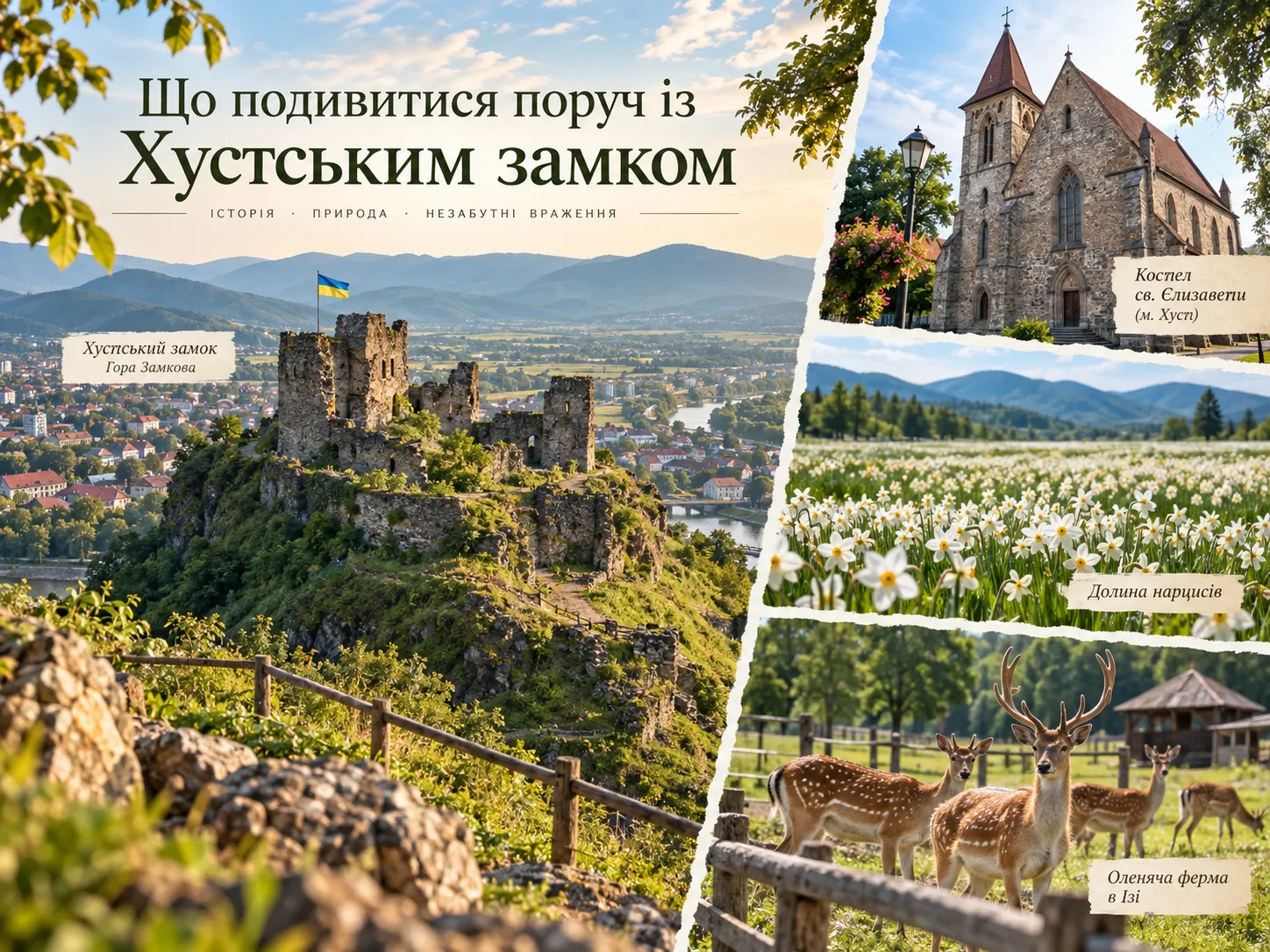
Khust Castle can easily be the main destination of a separate walk, but there is no need to spend an entire day in Khust just for the ruins. The city and its immediate surroundings offer several locations that complement the castle well and allow you to create a varied tourist route: medieval architecture, unique nature, and an encounter with fallow deer.
The first stop after descending from Castle Hill could be St. Elizabeth’s Church — one of Khust’s oldest architectural landmarks. Unlike the castle, of which mostly fragments of walls remain, this medieval church has survived to the present day and still allows you to see the city’s authentic Gothic architecture.
The church has a distinctive defensive character: it is surrounded by stone walls with gates, its walls are reinforced with buttresses, and its narrow Gothic windows resemble loopholes. Inside, an old organ, oak pews, church antiquities, and fragments of ancient frescoes have survived. Interestingly, the history of the church is directly intertwined with that of Khust Fortress — one of the former castle captains, among others, is buried beneath the floor. That is why the church is well worth visiting immediately after the castle. Up above, you see what remains of medieval Khust; below, you see a structure from the same historical era that has survived the centuries far better.
The Narcissus Valley — the best-known natural attraction near Khust
If you are traveling in spring, the Narcissus Valley in the Kireshi tract is practically an essential addition to your route. This protected area of the Carpathian Biosphere Reserve is known for the mass natural flowering of narrow-leaved narcissus. The most spectacular period usually falls in the first half of May. At that time, the meadows are covered with thousands of white flowers, and the ordinary-looking valley becomes one of Zakarpattia’s most recognizable spring destinations. The exact flowering period depends on the weather each year, so it is best to check updates from the Carpathian Biosphere Reserve before setting out.
There is also a beautiful connection with the castle itself: the tourist trail through the Narcissus Valley offers a panorama of Castle Hill with the ruins of Khust Castle. In a single day, you can therefore see the fortress from two very different perspectives — first walk along its walls, then look at the hill from a distance amid protected meadows.
The deer farm in Iza — fallow deer near Khust
If you are traveling with children, or simply want something completely different after visiting historical landmarks, it is worth stopping at the Deer Farm in Iza. It is located near Khust and is known for its large herd of fallow deer. This is not a traditional zoo with a few animals in a small enclosure. The deer live as a large herd in an extensive fenced area, while visitors can observe them and, subject to the farm’s current rules, feed them special food. Children particularly enjoy this stop, although adults often linger by the fence longer than planned as well.
Combining these places makes for an excellent one-day route: Khust Castle and the medieval church showcase historic Khust, the Narcissus Valley reveals the nature of the Khust region, and the Deer Farm in Iza adds a completely different kind of experience. All this can be done without spending half a day traveling between remote parts of Zakarpattia.
Frequently asked questions about Khust Castle
Where is Khust Castle located?
The ruins of Khust Castle are located on Castle Hill directly above the city of Khust in Zakarpattia Oblast. The foot of the hill is easily reached via Zamkova Street, where a pedestrian and parking area has been arranged, after which you can continue up the road to the summit.
How do you get up to Khust Castle?
The most convenient option is to leave your car near the foot of Castle Hill and continue on foot. The road to the landmark has been reconstructed: approximately 1.1 km of the route has been paved with cobblestones, with benches, lighting, and information elements installed along it. The climb is steady but does not require special hiking equipment.
How much time is needed to visit Khust Castle?
Allow approximately 20–30 minutes at a relaxed pace for the climb itself. Including the walk among the ruins, photography, rest at the summit, and the descent, it is convenient to plan for approximately 1.5–2 hours. If you enjoy examining historical landmarks and views in detail, you can stay longer.
Do you need to buy a ticket to Khust Castle?
The ruins are located outdoors on Castle Hill. The city’s official tourism pages do not mention a separate ticket office, admission fee, or fixed opening hours for the castle ruins. However, access conditions may change because of construction work, events, or the condition of the site, so it is worth checking the latest information before making a special trip.
Can you climb to Khust Castle with children?
Yes, the route is suitable for a family walk if the child is comfortable with uphill paths. However, children should be watched carefully once you reach the fortress grounds: these are real ruins with uneven ground, stones, and remnants of old walls, not a fully equipped museum site. For small children, a stroller may be inconvenient on the final section of the route among the ruins.
Can you drive directly to the ruins?
A reconstructed road leads to the castle, but for visitors the most convenient and predictable option is to use the pedestrian and parking area at the foot of Castle Hill and continue on foot. Whether vehicles can travel farther up may depend on current restrictions and traffic arrangements at the time.
What remains of Khust Castle today?
From the once-large fortress, fragments of defensive walls, remains of towers, foundations, and other fortifications have survived. There are no fully preserved palaces or towers here. To better imagine the original scale of the complex, look out for the 1:20 scale model of the castle along the way, and review the 1713 historical plan of the fortress before your trip.
Why did Khust Castle become a ruin?
The decisive event was the thunderstorm of July 3, 1766. Lightning caused a fire, and a strike on the powder tower led to a powerful explosion and extensive destruction. Attempts were made to repair the castle, but it was never fully restored. Later, some structures were further damaged by the elements and time, while stones from the old walls were used for construction in the city.
When is the best time to visit Khust Castle?
The most pleasant time to climb Castle Hill is in dry, clear weather in spring, early summer, or autumn. During hot months, it is better to come in the morning or toward evening. After heavy rain, in icy conditions, or in dense fog, the climb is less comfortable, and the route’s main reward — the panorama of Khust — may be almost invisible.
Is Khust Castle Worth Visiting?
Khust Castle no longer impresses visitors with towering turrets or restored palaces. All that remains of the once-mighty fortress are ruins, isolated fragments of walls, and traces of fortifications. Yet this is precisely where the scale of history can be felt: a site that controlled an important salt route for centuries and survived wars, sieges, and changes of power was ultimately destroyed by an ordinary thunderstorm.
It is worth climbing Castle Hill not only for the fortress itself. The panorama of Khust and the surrounding mountains is an integral part of the experience, while old plans and reconstructions help you see, behind the modern ruins, the castle that once dominated the entire valley. This place is best experienced not as a museum with a ready-made exhibition, but as a historic landscape that needs a little «reading.» Look at an old plan, follow the road to the summit, find the remains of the defensive walls, and try to imagine where the towers, cannons, barracks, and inner courtyards stood several centuries ago.
If you are looking for what to see in Khust, Khust Castle is definitely worth including in your itinerary. Together with the Valley of Narcissi, St. Elizabeth’s Church, and the Deer Farm in Iza, it lets you experience the Khust region from several perspectives at once—historical, natural, and touristic.


No Comment
You can post first response comment.