
 English
 Українська
 Latviešu
 Lietuvos
 Русский
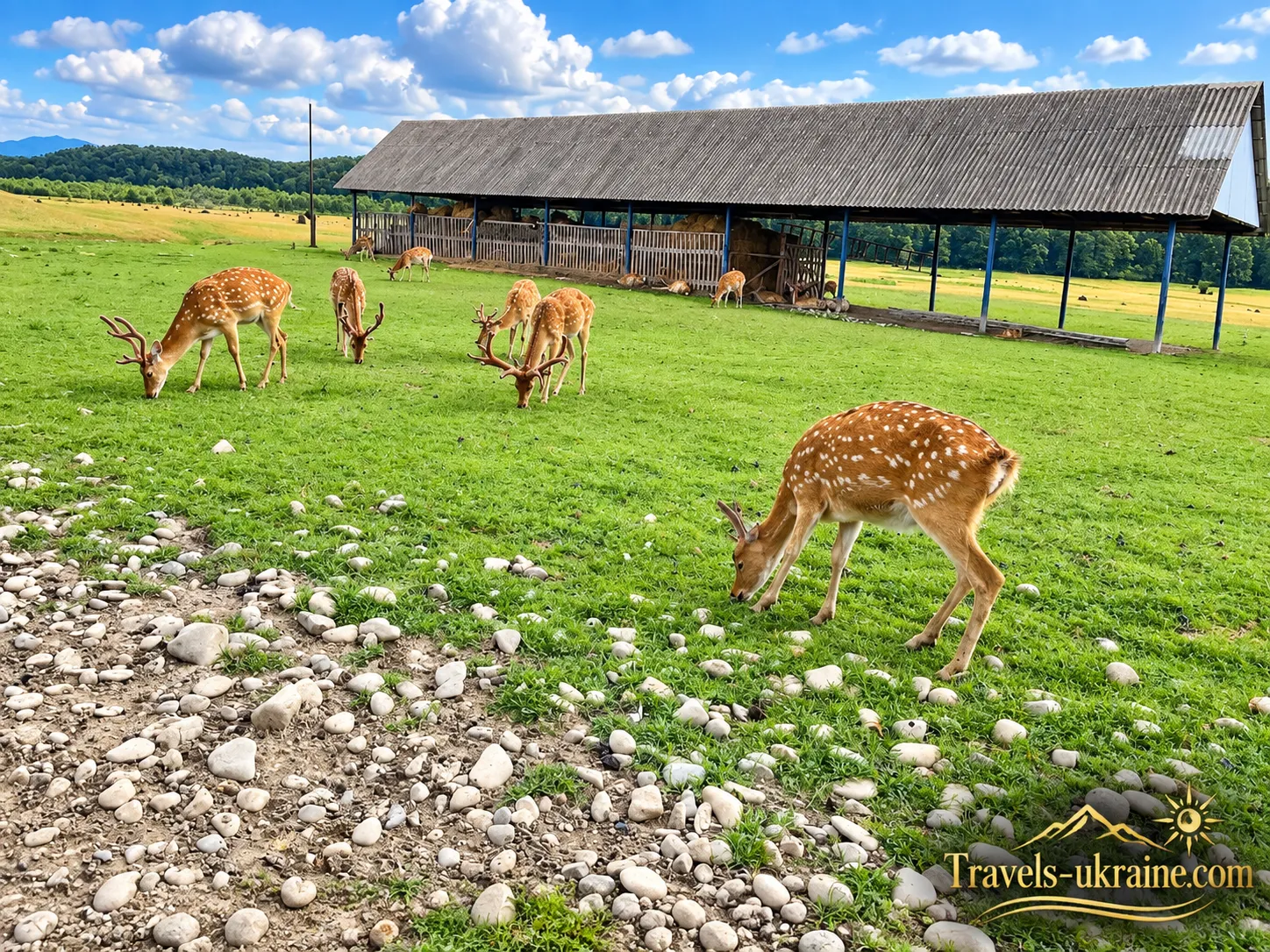
A few kilometres from Khust, between the villages of Iza and Lypcha, there is a place where, instead of cows, you can see an entire herd of spotted deer grazing. They emerge from the forest, gather by the fence, come for feed, and sometimes allow visitors to observe them from just a few metres away.
This is the deer farm in Iza—one of the best-known livestock and tourist attractions in the Khust area. The official tourism resource of Zakarpattia calls it the only specialised spotted-deer farm in Ukraine. But it is important to understand the nature of this place from the outset. This is not a petting zoo. Visitors do not enter the herd, walk among the animals, or cuddle fawns for photographs. The farm covers about 57 hectares of pasture, woodland, and water, and the entire area is fenced.
The deer live inside a large farm, while visitors watch them from the designated tourist area. The bolder animals may come right up to the fence themselves—especially if they realise that approved feed has appeared on the other side. So the main attraction here is very simple: watching, taking photographs, and observing the animals’ behaviour. Sometimes a deer comes very close; at other times, the herd decides that tourists are not part of its plans for the day and stays peacefully somewhere farther out in the pasture. That is actually one of the advantages. The animals are accustomed to people, but they have not become living props obliged to stand by the fence for photographs.
The deer are used to people, but that does not make them tame
A spotted deer can look so calm that you may instinctively want to reach out and stroke it. But this is precisely when it is best to remember that you are looking at a large hoofed animal, not an unusually tall domestic dog. Farm staff and official tourism materials warn that deer do not always react well to touch, especially when someone tries to touch their neck, head, or antlers. During the autumn rut, males may be even less receptive to tourist affection.
So the best rule is simple: watch the animal, let it come to you, and follow the farm’s rules. If a deer is interested in the feed, excellent. If it turns around and heads into the forest, you have to respect its decision.
Velvet antlers and pantocrine: why young antlers are removed from deer
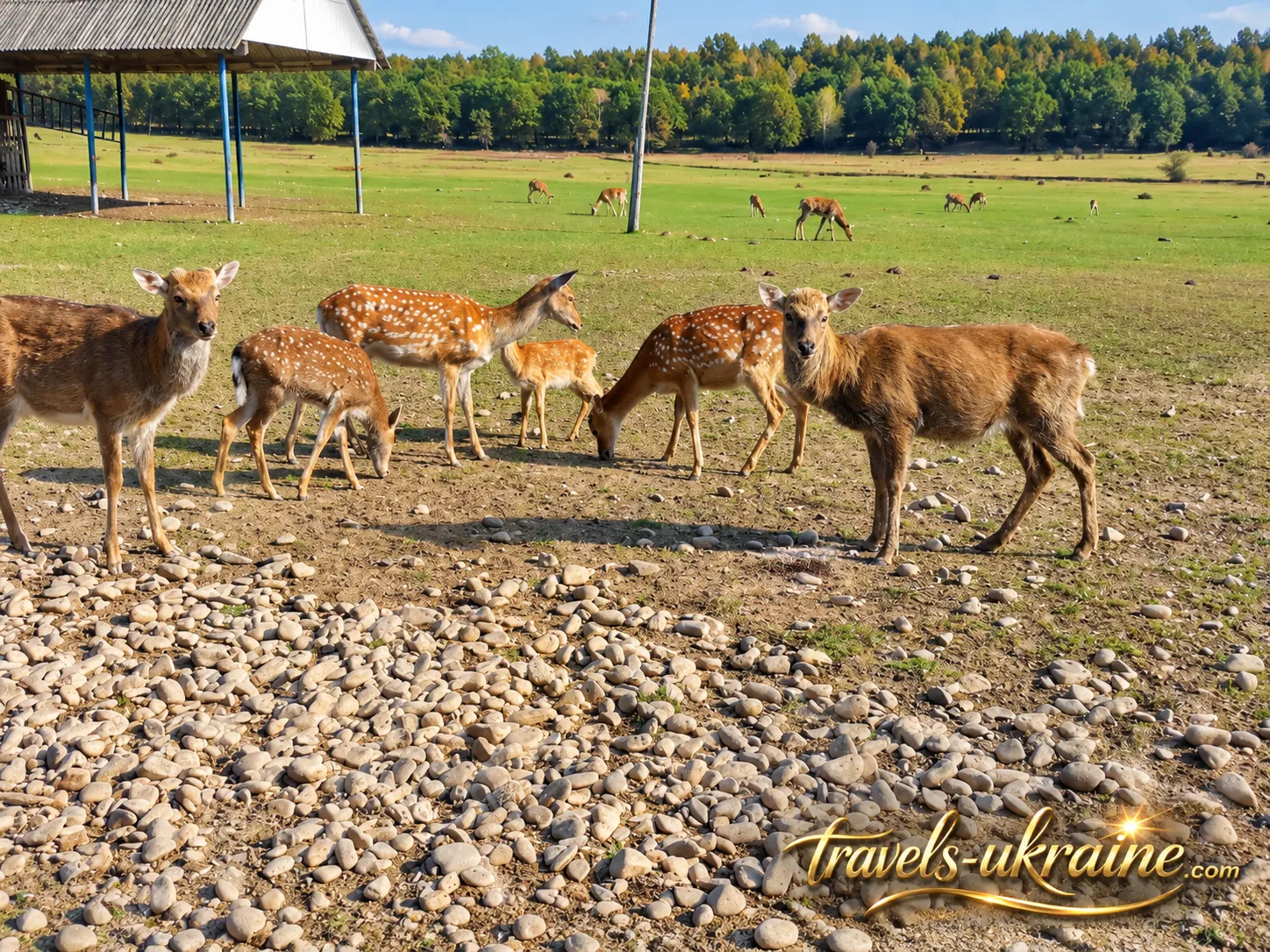
The most interesting part of the history of the Deer Farm in Iza is connected precisely with the antlers of its inhabitants. Spotted deer were brought here originally not for tourists: the farm was established to produce velvet antlers—the young, not-yet-hardened antlers of male deer. They were valuable raw material for producing pantocrine and other preparations based on deer antlers.
What are velvet antlers, and how do they differ from ordinary antlers?
A deer’s antlers are not a permanent part of its body. Male spotted deer shed their old antlers every year, after which new ones begin to grow. At first, they look nothing like the hard, bony antlers we are used to seeing in photographs of adult deer. A young antler is covered with thin velvet skin, supplied with blood vessels and nerves, and grows very quickly. At this stage, it is called a velvet antler.
This growth period lasts only a few months. Later, the blood supply stops, the antler mineralises, and it becomes hard. For raw-material production, the young velvet antlers were considered the most valuable, so they had to be removed before they fully ossified. In practice, a significant part of the old velvet-antler industry’s economy depended on how quickly the antlers grew.
Why was pantocrine made from velvet antlers?
Pantocrine is the name given to preparations and extracts made from young deer antlers. During the Soviet period, these products were widely used and advertised as tonics, particularly for fatigue, reduced work capacity, and low blood pressure. High demand for velvet antlers made spotted-deer farming economically attractive and was one of the main reasons the farm near Iza was established.
Today, the medicinal properties of deer-antler preparations should be approached much more cautiously than they were several decades ago. Extracts from young antlers do contain various biologically active substances, but clinical studies of their effectiveness have produced mixed results, and many popular claims still lack sufficient evidence. Pantocrine is therefore an interesting part of the farm’s history, but certainly no reason to regard velvet antlers as a universal «cure-all.»
Does it hurt a deer when its velvet antlers are removed?
A widespread myth surrounds this process: that young antlers can be removed as painlessly as hair or fingernails. In reality, growing velvet antlers have an extensive blood supply and nerve endings. That is why their removal requires proper handling of the animal and anaesthesia. In countries with regulated commercial deer farming, antler removal is a procedure subject to specific veterinary requirements.
This detail also matters to tourists because it offers a completely different perspective on deer antlers. They are not simply a beautiful male «crown,» but living tissue that, over several months, undergoes an astonishing transformation from a soft, velvet-covered antler into a strong bony structure.
Over time, the pharmaceutical side of the business lost its former profitability, and the Deer Farm near Khust increasingly began focusing on tourists. What once brought the first spotted deer here has now become more of an interesting part of the farm’s history—and a good explanation of why such an unusual enterprise appeared in Zakarpattia in the first place.
How spotted deer live and what tourists will see at the farm
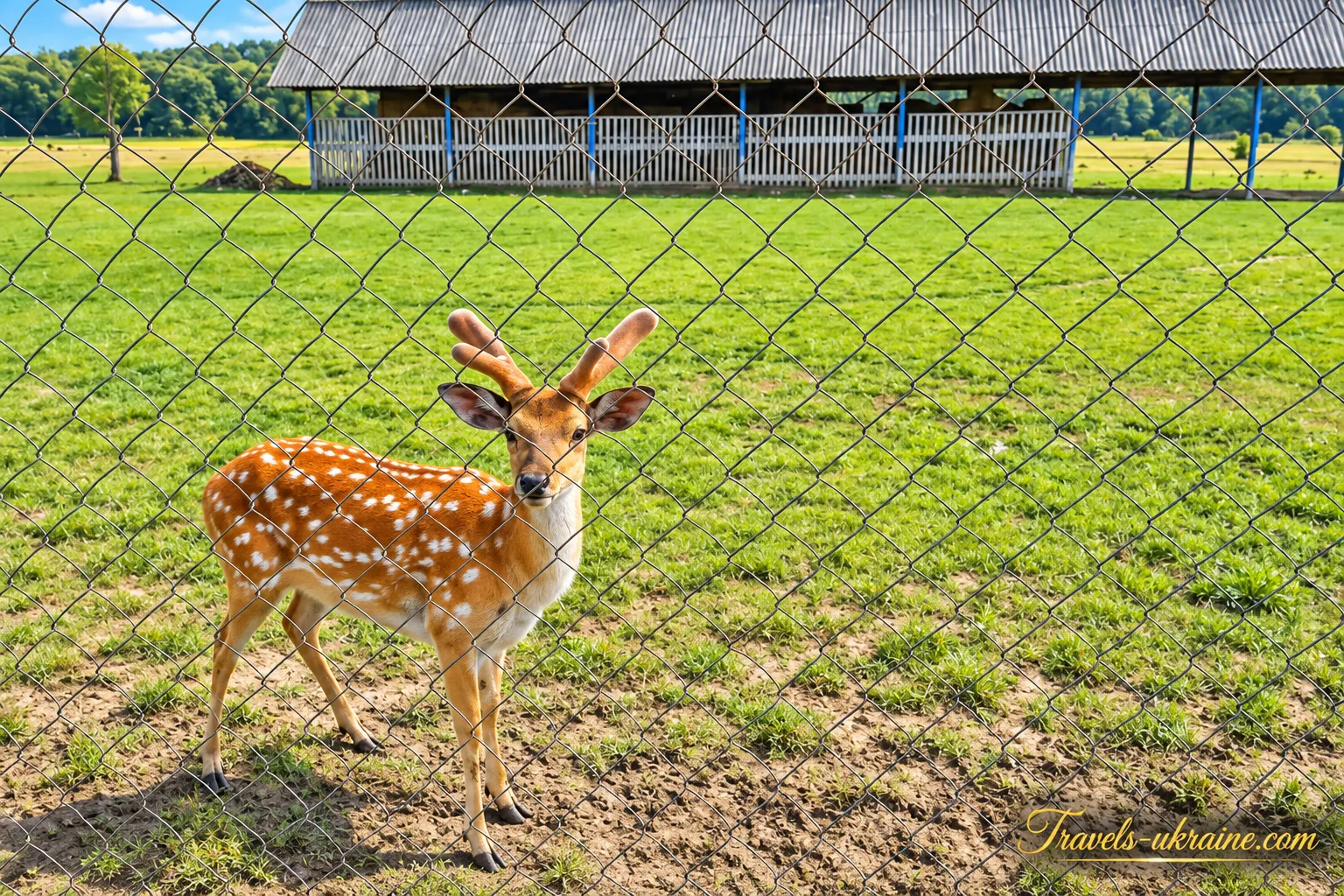
The Deer Farm in Iza is nothing like a small zoo with a few animals in a cramped enclosure. The deer are kept as a large herd across a spacious fenced area with meadows, trees, and sections of woodland. According to farm staff quoted by Suspilne, about 57 hectares are allocated to the animals. So most of the time, the deer behave as they please: grazing, resting in the grass, hiding in the shade, or staying away from the fence.
That is why visiting the farm is somewhat different from going to an ordinary petting zoo. There is no guarantee that the entire herd will stand in front of tourists and patiently wait to be photographed. The deer may be right nearby, or they may spread out across the large area. And that is precisely one of the attractions of the place: you are observing not an animal in a small cage, but a large herd of spotted deer in a spacious farm.
What attracts the most tourists, especially children, is the opportunity to feed the deer by hand. The animals have long been accustomed to visitors and know well that people by the fence often do not arrive empty-handed. Show them some feed, and the boldest deer will quickly come closer, often followed by others.
For feeding, it is best to use only the feed offered directly at the farm. In different years, visitors have been sold rusks or special unsweetened corn sticks. Do not bring biscuits, sweets, salty snacks, or other human food with you: even if a deer eagerly takes it, that does not mean it is good for the animal.
The feeding itself often becomes the most vivid memory of the farm. Up close, a spotted deer looks much larger than it does in photographs, and when several animals simultaneously stretch their muzzles towards a palm full of feed, a peaceful excursion quickly turns into a small contest for the attention of the hungriest «Bambi.»
Why deer are brightly spotted in summer but look different in winter
The appearance of spotted deer changes noticeably throughout the year. In the warm season, their coats become reddish-brown with clearly visible white spots—the way these animals are most often shown in tourist photographs. In winter, their fur becomes thicker, darker, and duller, while the spots are much less conspicuous.
The males also change throughout the year. In spring and summer, you may see young velvet antlers growing on them, as described in the previous section. At other times, adult males wear fully formed, hard antlers. So two visits to the farm in different seasons can produce completely different photographs.
You can observe them from close by, but they are still not domestic animals
Despite being accustomed to tourists, spotted deer remain large and cautious animals. They may take feed from your hand and approach the fence themselves, but that does not mean you should try to stroke them, grab their muzzles, or touch their antlers. Adult males require particular caution during the rut, when their behaviour can become much less predictable.
The best approach is very simple: do not shout, avoid sudden movements, and let the deer decide for themselves how close they want to come. That way, you can calmly watch the herd, take beautiful photographs, and observe the animals’ behaviour without unnecessary interference.
This simple format is exactly what makes the Deer Farm near Khust interesting. There is no elaborate entertainment programme, rides, or staged scenery—the deer themselves remain the main attraction. For some visitors, it will be a short stop on the way through Zakarpattia; for children, the chance to feed a spotted deer with their own hands may well become one of the most memorable moments of the entire trip.
What to see near the Deer Farm in Iza
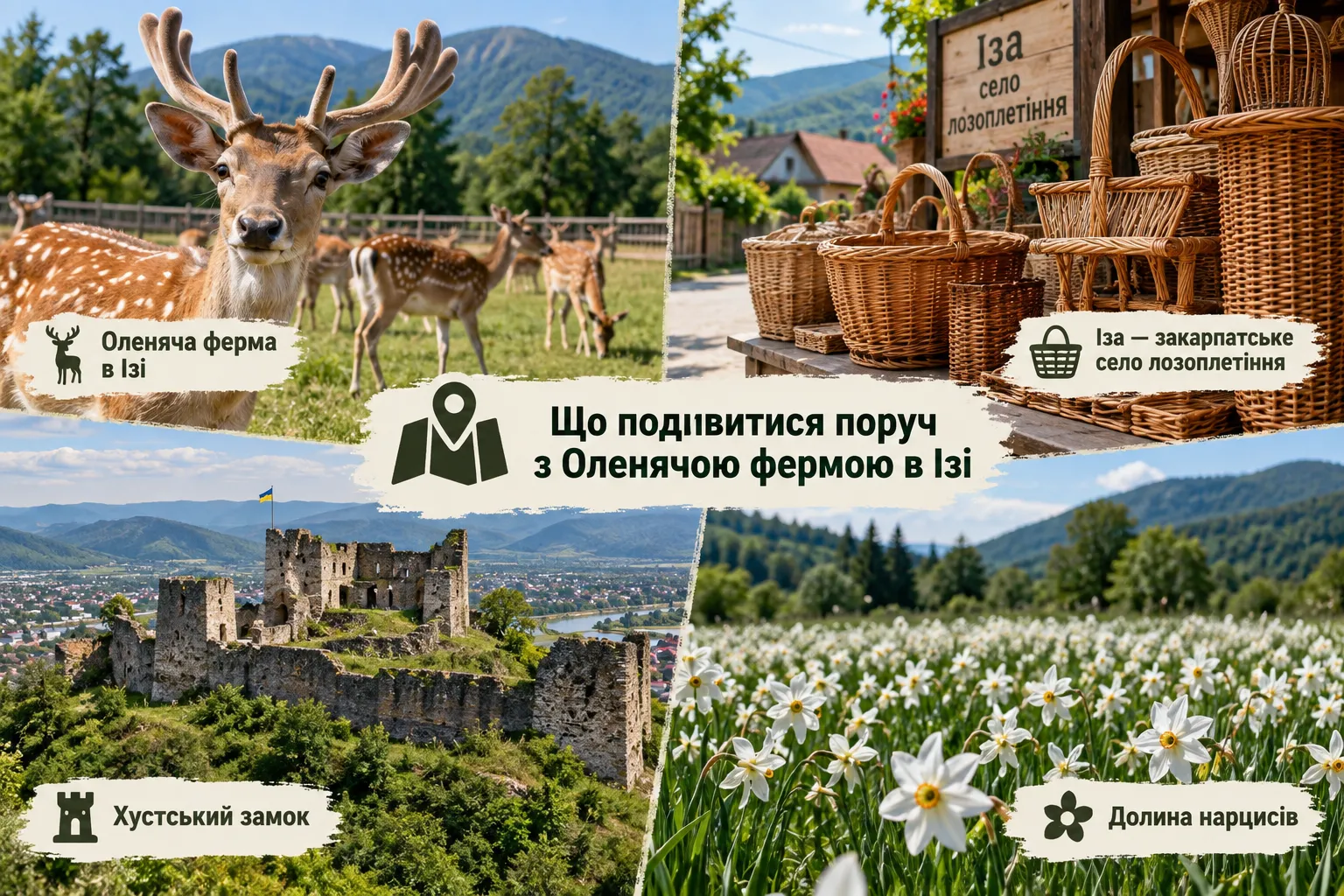
You do not need to plan an entire day around the deer farm in Iza alone. It is much more interesting to include it in a short trip around the Khust area: nearby are historical landmarks, natural attractions, and places that complement an introduction to Zakarpattia. In fact, one attraction begins literally before you have even left the village.
Iza—the Zakarpattia village of wickerwork
The village of Iza is well known far beyond the Khust area for its traditional wickerwork. Baskets, furniture, decorative items, and various household goods are made here from willow. The craft has become one of the village’s trademarks and is passed down through generations. For tourists, the most convenient thing is that there is no need to plan a separate tour to discover the local craft. You can see willow products simply while driving through the village: roadside stalls and small workshops operate along the road. So after visiting the deer farm, you can easily stop, admire the handmade work, and take home a souvenir from Zakarpattia with far more local character than yet another fridge magnet.
Khust Castle—the ruins of a fortress above the city
The next logical stop is Khust Castle. Only ruins remain today of the once-powerful medieval fortress, but the site is worth visiting for more than its history. The castle stands on Castle Hill, offering a broad panorama of Khust and the surrounding valley.
Construction of the stone fortress began as early as the end of the 11th century, while its completion is traditionally dated to 1191. The castle controlled an important salt route along the Tysa and held strategic significance for centuries. Its fate was effectively decided by a thunderstorm in 1766: lightning struck the powder magazines, and after the explosion the fortress was severely damaged and never regained its former importance.
The Narcissus Valley—the Khust area’s main spring natural attraction
If you are travelling in May, consider adding the Narcissus Valley near Khust to your itinerary—the territory of the Carpathian Biosphere Reserve where narrow-leaved narcissus grows in abundance. During the flowering season, large areas of meadow are covered with white flowers, attracting tourists from various regions of Ukraine.
But here, choosing the right time is especially important. The Carpathian Biosphere Reserve approximately indicates the blooming period as May 1 to 15, although the actual dates vary each year depending on temperature and weather. Therefore, it is best to check the reserve’s latest information before your trip—nature does not read tourist bus timetables and may start blooming a little earlier or later.
Outside the peak blooming season, the Valley of Narcissi remains a protected natural area, but there is no longer much point in coming here specifically for its famous white «carpet.» So in spring, combining the Deer Farm, the Valley of Narcissi, and Khust Castle makes for an especially rewarding one-day route: the animals, nature, and history are all located very close to one another while offering distinctly different experiences.
Frequently Asked Questions About the Deer Farm in Iza
Where is the Deer Farm in Zakarpattia?
The Deer Farm is located near the village of Iza in Khust Raion, Zakarpattia Oblast, not far from the city of Khust. Its location makes it easy to include in a one-day itinerary around Khust Raion, together with Khust Castle, the Valley of Narcissi, and Iza itself.
Is the Deer Farm worth visiting with children?
Yes. For children, it is one of the most exciting parts of a trip around Khust Raion, as they can see spotted deer up close and feed them. At the same time, young children should be kept close to you: the deer are accustomed to people but remain large animals.
Can you feed the deer by hand?
Yes, feeding the deer is one of the farm’s main attractions. It is best to use the feed offered directly on the farm grounds. Do not give the animals sweets, salty snacks, or other food not intended for them.
Can you see the deer from very close up?
Yes, especially during feeding, when the animals come over to visitors themselves. However, the farm covers a large area, so the entire herd may not be near the fence at the same time. These are living animals that move freely around the pasture and may stay farther away from people at certain times.
When is the best time to visit the Deer Farm in Iza?
For a first visit, late spring, summer, and early autumn are the most convenient times. During this period, there is plenty of greenery, the deer graze outdoors, and their summer coats feature clearly visible white spots. On hot days, it is better to arrive in the morning or toward evening.
How much time is needed to visit the Deer Farm?
For most visitors, approximately 30–60 minutes is enough to watch the herd, feed the deer, and take photographs. That is why the farm is easy to combine with other tourist attractions near Khust.
Is it safe to approach the spotted deer?
Yes, as long as you follow the farm’s rules and do not provoke the animals. Do not grab the deer, touch their antlers, or try to pet them by force. Particular care is needed around adult males in autumn during the mating season.
Is there an admission fee for the Deer Farm in Iza?
Visiting the farm is paid. Admission fees and visiting conditions may change, so it is best to check the current price directly with the farm or in up-to-date tourist sources before your trip. Current contact details, coordinates, and practical information are provided below in the information section.
Is the Deer Farm in Iza Worth Visiting?
The Deer Farm in Iza is a case where an interesting tourist attraction did not begin as a purpose-built entertainment venue. The farm, which once bred spotted deer primarily for their antlers in velvet, eventually became one of the most unusual places for a short stop while traveling around Khust Raion.
You should not come here for an elaborate tour program or a large variety of entertainment. The main attraction is the spotted deer themselves: the chance to see a large herd, observe the animals’ behavior, feed them, and spend literally a few dozen minutes right beside them.
The farm is especially well suited to traveling with children and as part of a one-day itinerary around Khust. A visit can easily be combined with the village of Iza and its traditional wickerwork, Khust Castle, and, in spring, the Valley of Narcissi as well.
If you are looking for things to see near Khust without long drives or complicated planning, the Deer Farm is well worth adding to your itinerary. It is a simple, lively, and genuinely characteristic Zakarpattia destination where the main attractions are not the scenery but the animals and the farm itself.

No Comment
You can post first response comment.