
 English
 Українська
 Latviešu
 Lietuvos
 Русский
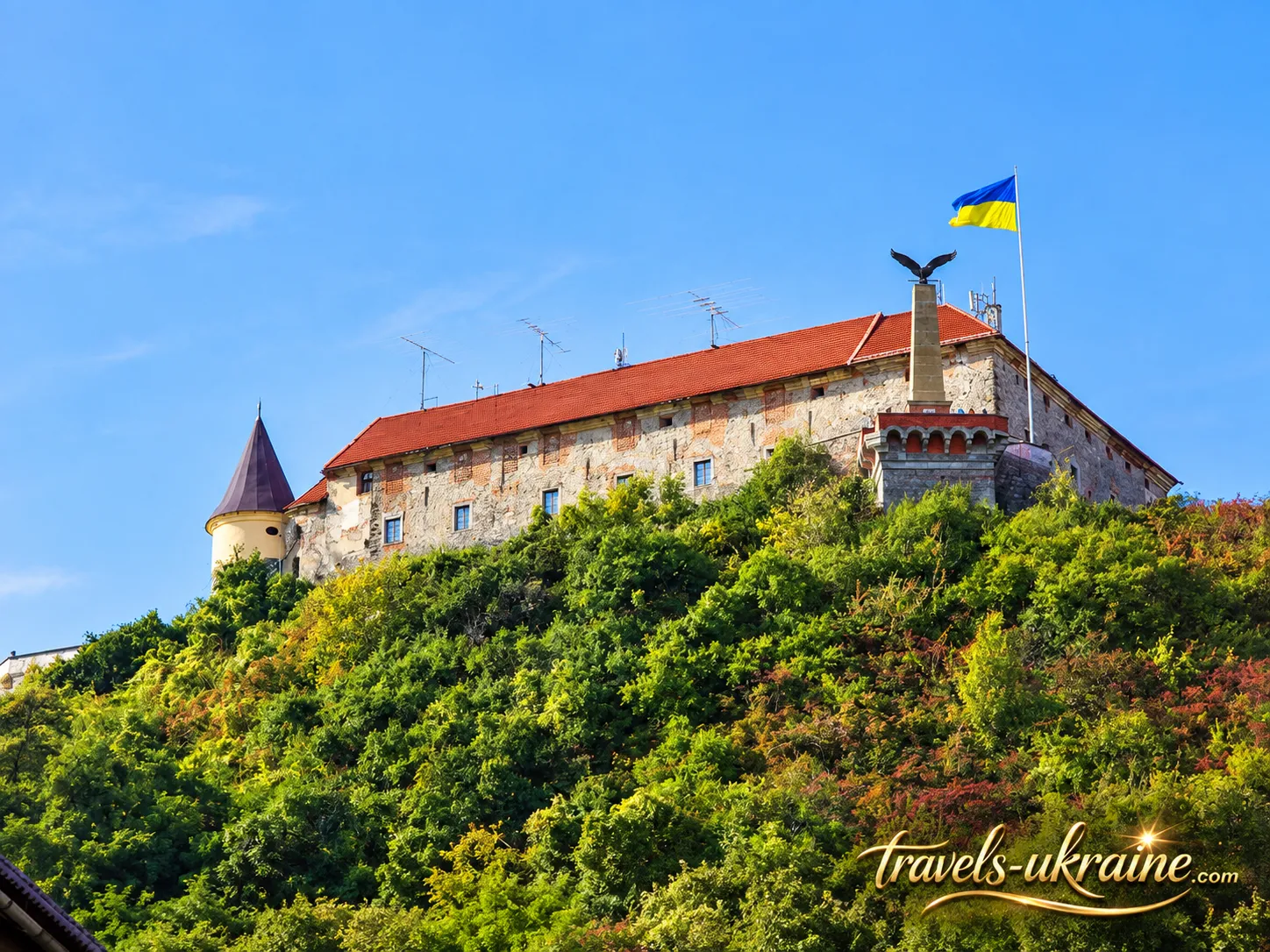
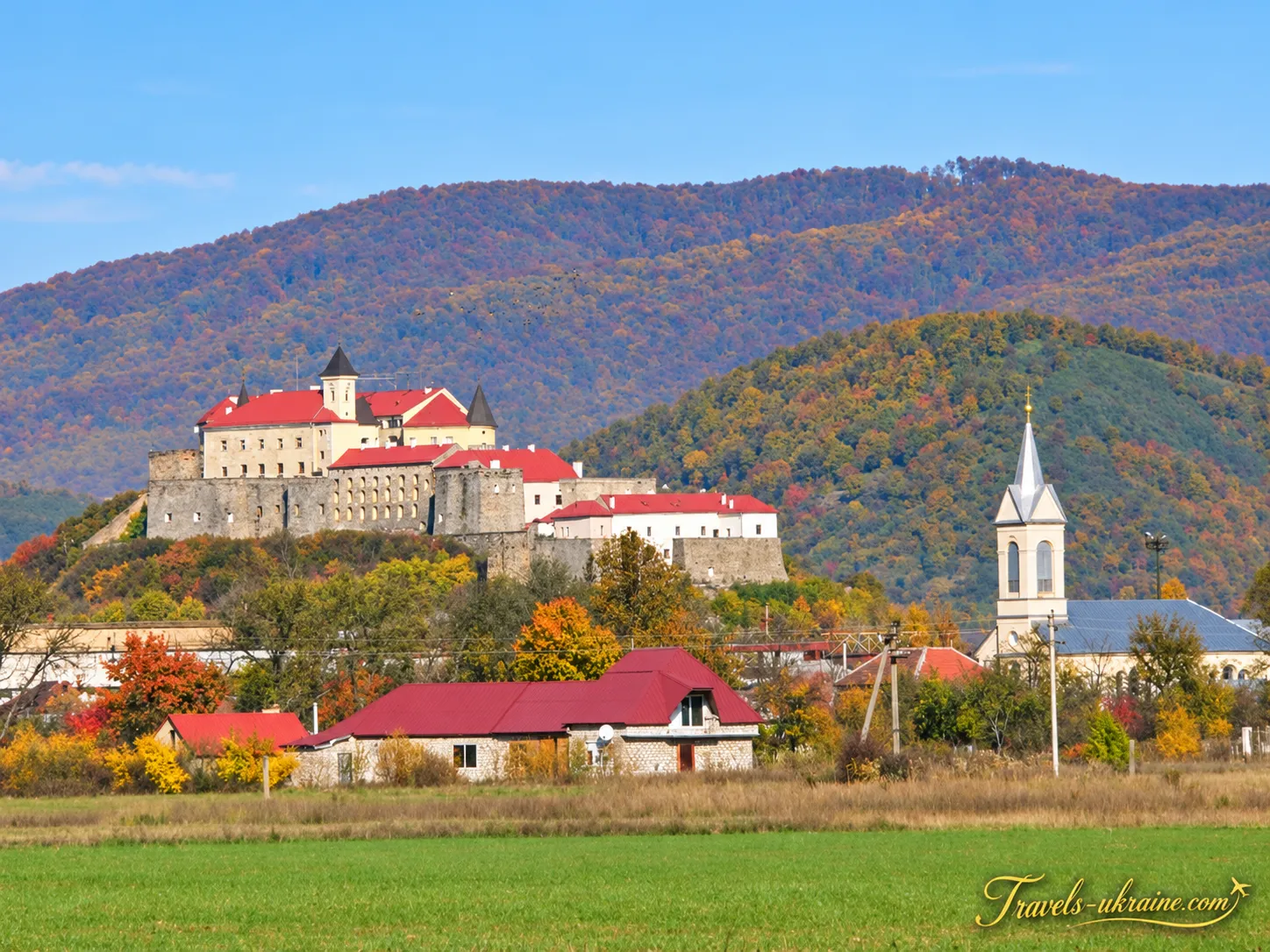
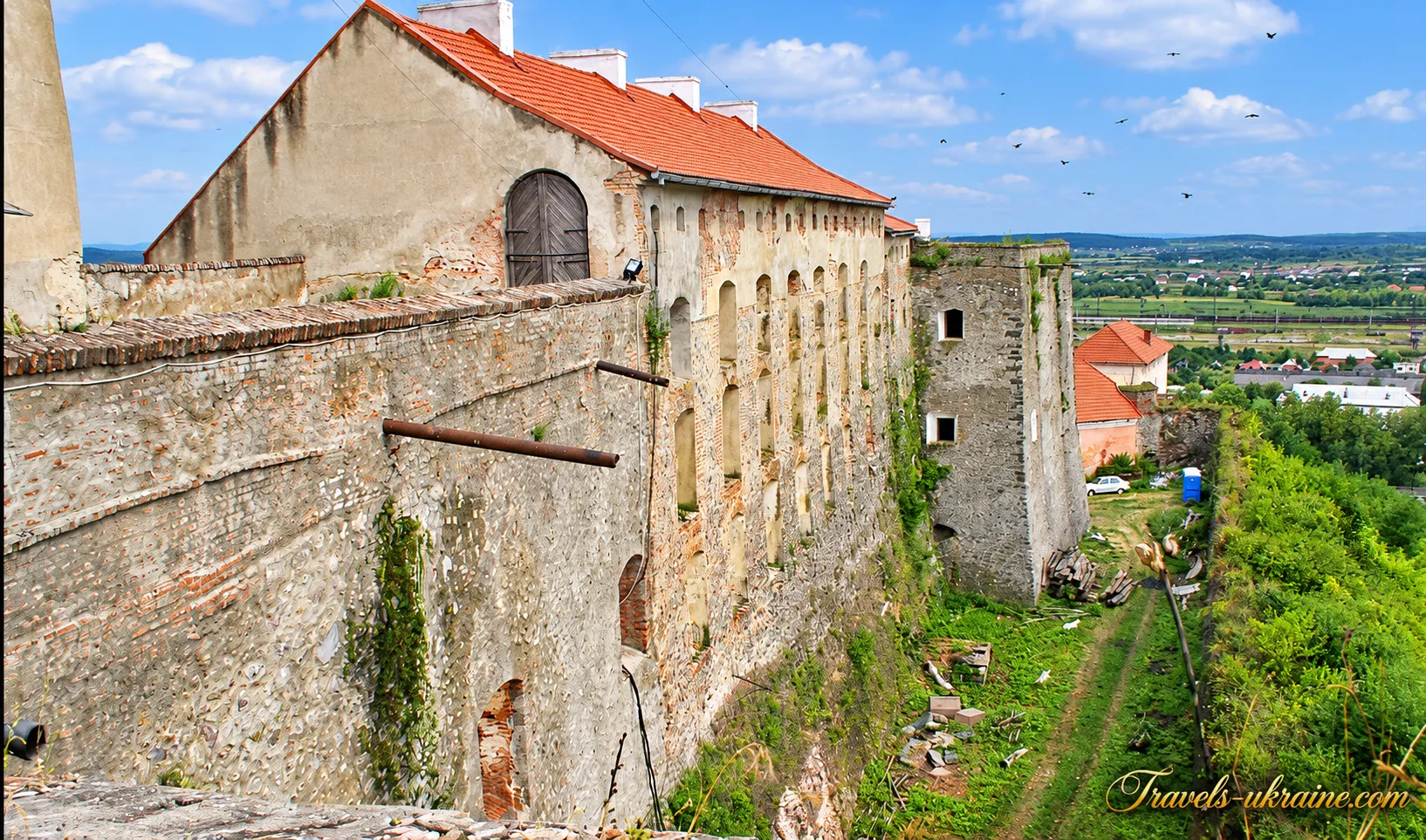
There is one feature of Mukachevo that is hard to miss, even for someone with no interest in castles at all. In the middle of the flat landscape, an isolated mountain suddenly rises, and atop it stand the walls of Palanok Castle. From a distance, they look almost like an extension of the hill itself.
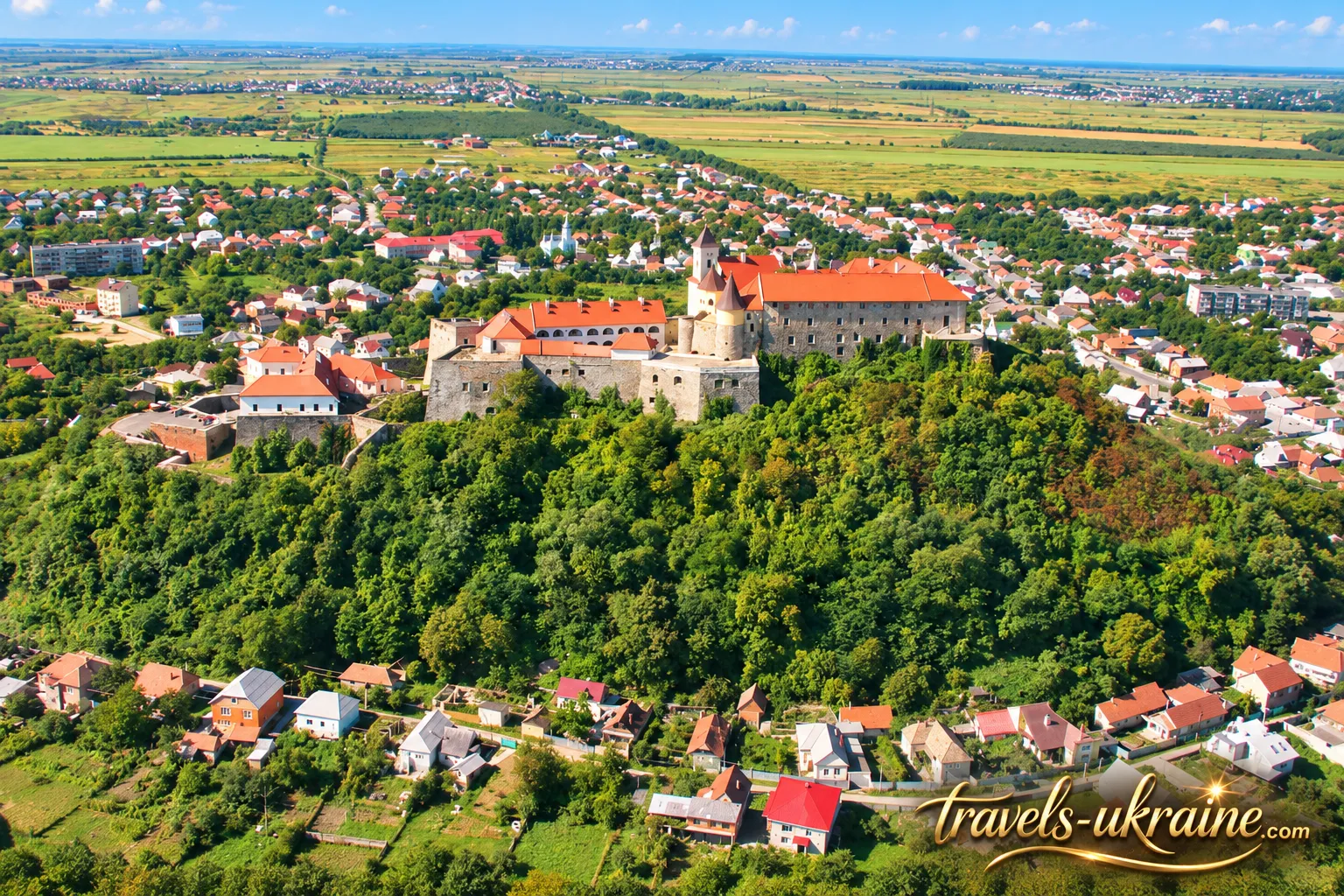
And this is no coincidence. The castle was built on a mountain of volcanic origin that rises approximately 68 meters above the surrounding terrain. Its summit lies about 188 meters above sea level. For a modern visitor, this primarily means a beautiful view of Mukachevo; for people in the Middle Ages, such a mountain had a more practical significance: the enemy could be seen from far away, would have to climb uphill, and the defenders would already be waiting above. In other words, long before the appearance of stone bastions, nature had already done much of the work of future fortification engineers.
The unusual location of Castle Hill gave rise to one of the best-known local legends. According to the tale, the hill was supposedly built up by hand, and people had to perform this work with such terrible suffering that the name Mukachevo supposedly later came from the word «torment.» The story is atmospheric—especially when looking up at the castle from below and imagining how much earth such a construction would have required. But geology leaves the legend little room to stand: Castle Hill is natural and volcanic in origin. No one built it by hand.
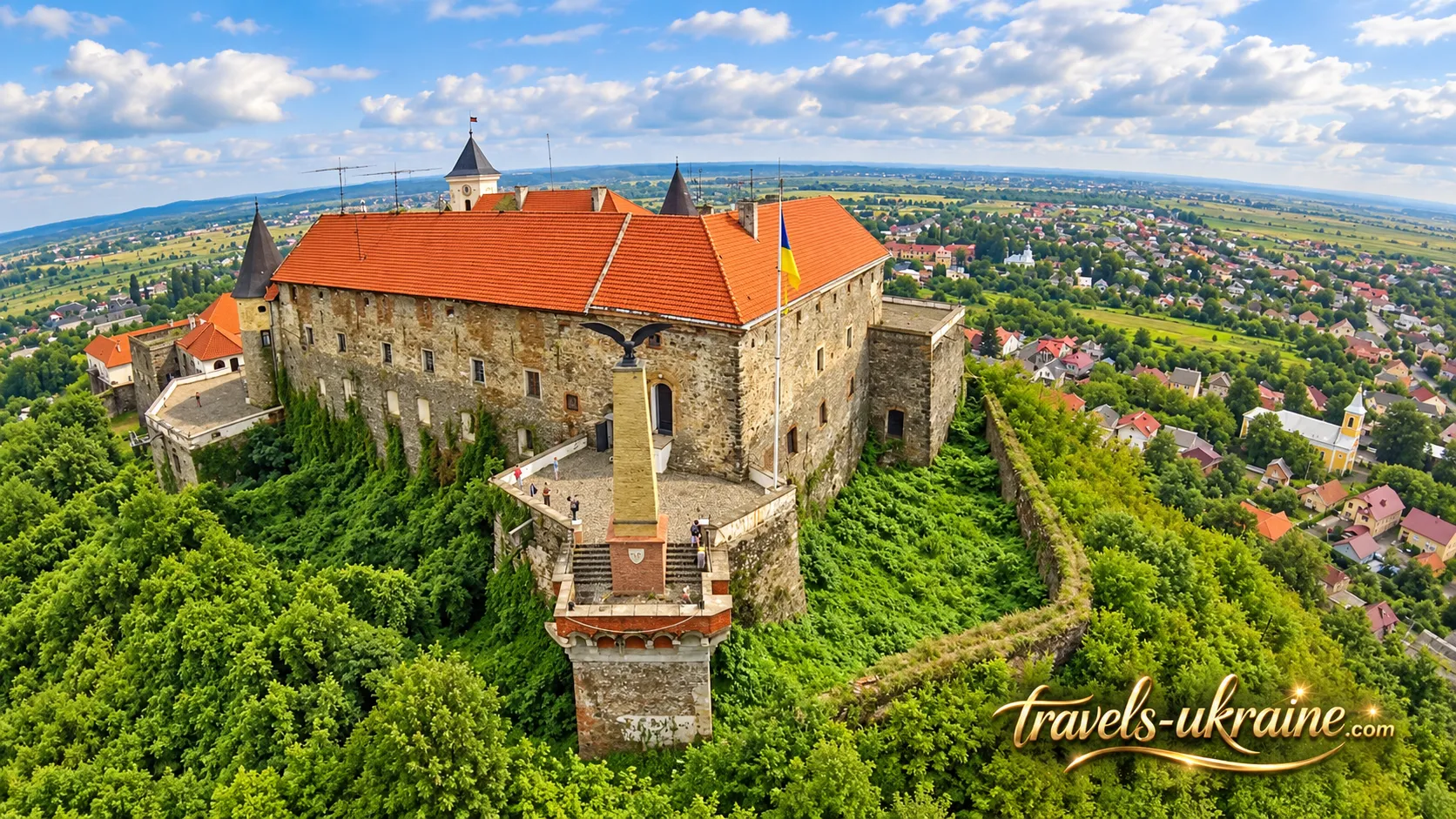
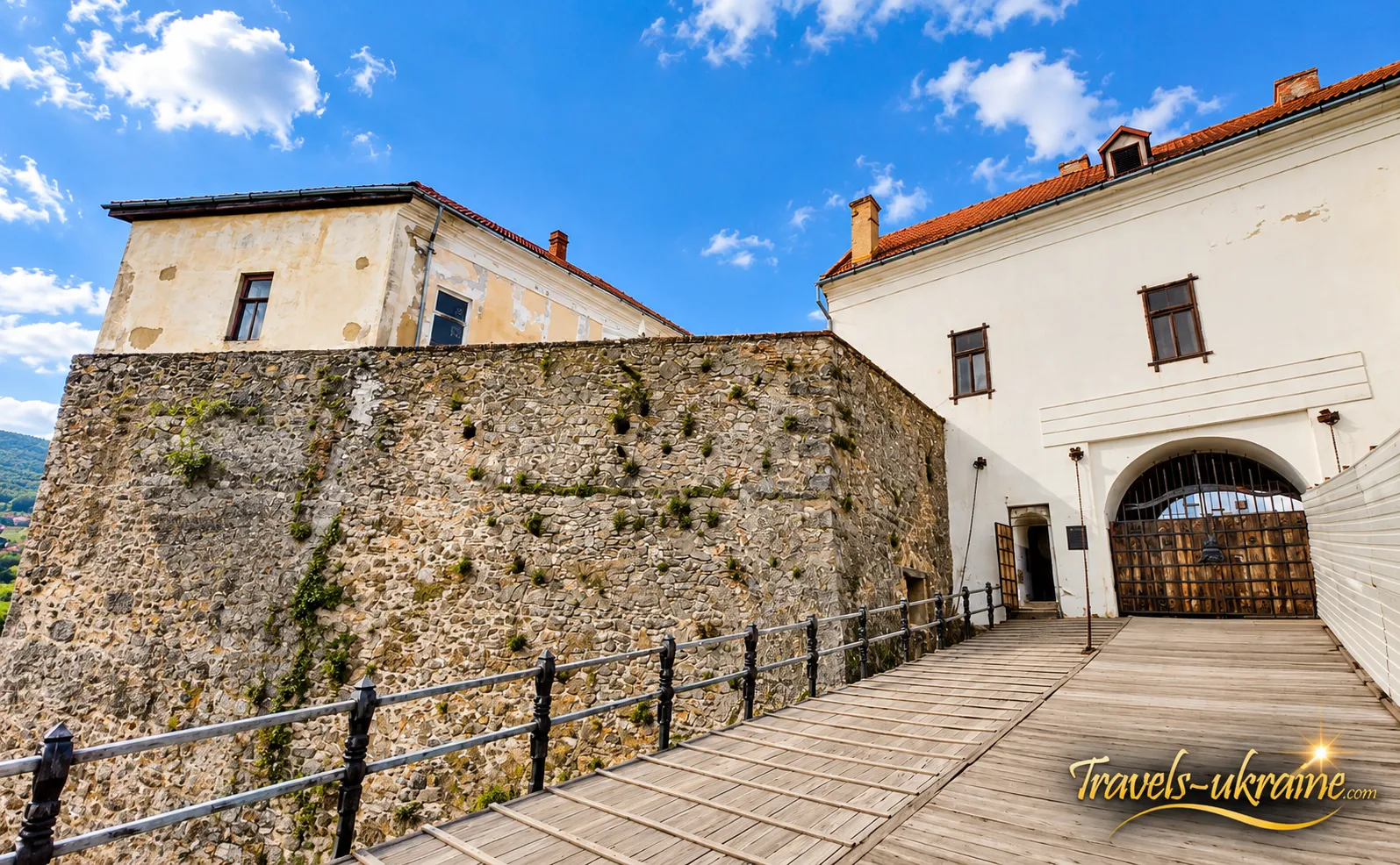
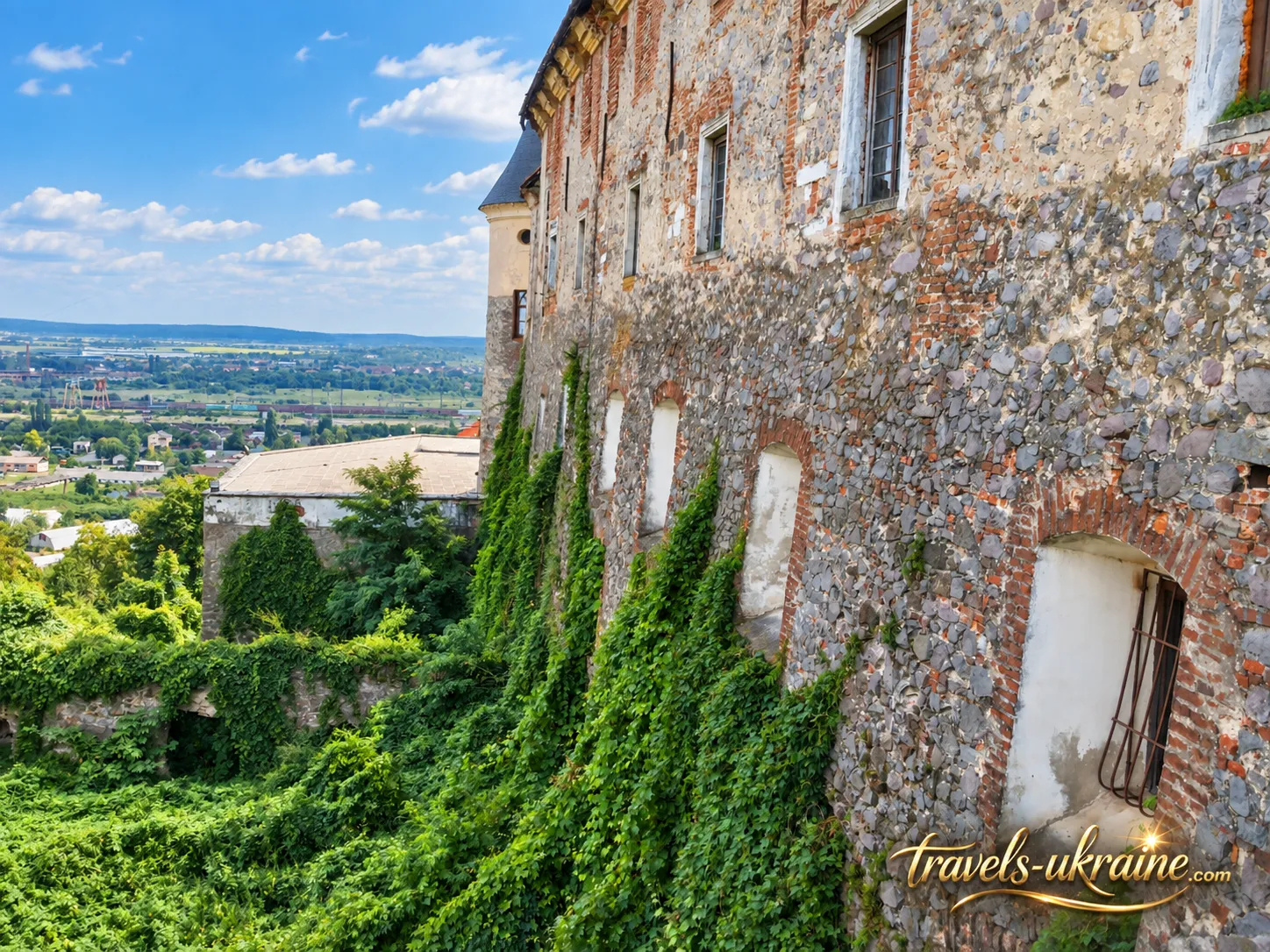
Still, reality proved no less interesting. People did not have to create the mountain—but over the centuries they transformed it into a complex system of fortifications. Buildings were arranged on different levels, and eventually the Upper, Middle, and Lower Castles took shape. What appears from the city to be a single stone fortress turns out inside to be a cascade of courtyards, walls, gates, moats, and defensive structures. And this is where things become truly interesting. Because Palanok Castle is valuable not only for its age or its panorama of Mukachevo. Its layout still reveals the logic of a real fortress: the higher an attacker climbed, the more obstacles remained ahead.
The Well, the Crown, and the Legends of Palanok: Stories That Are Easy to Walk Past
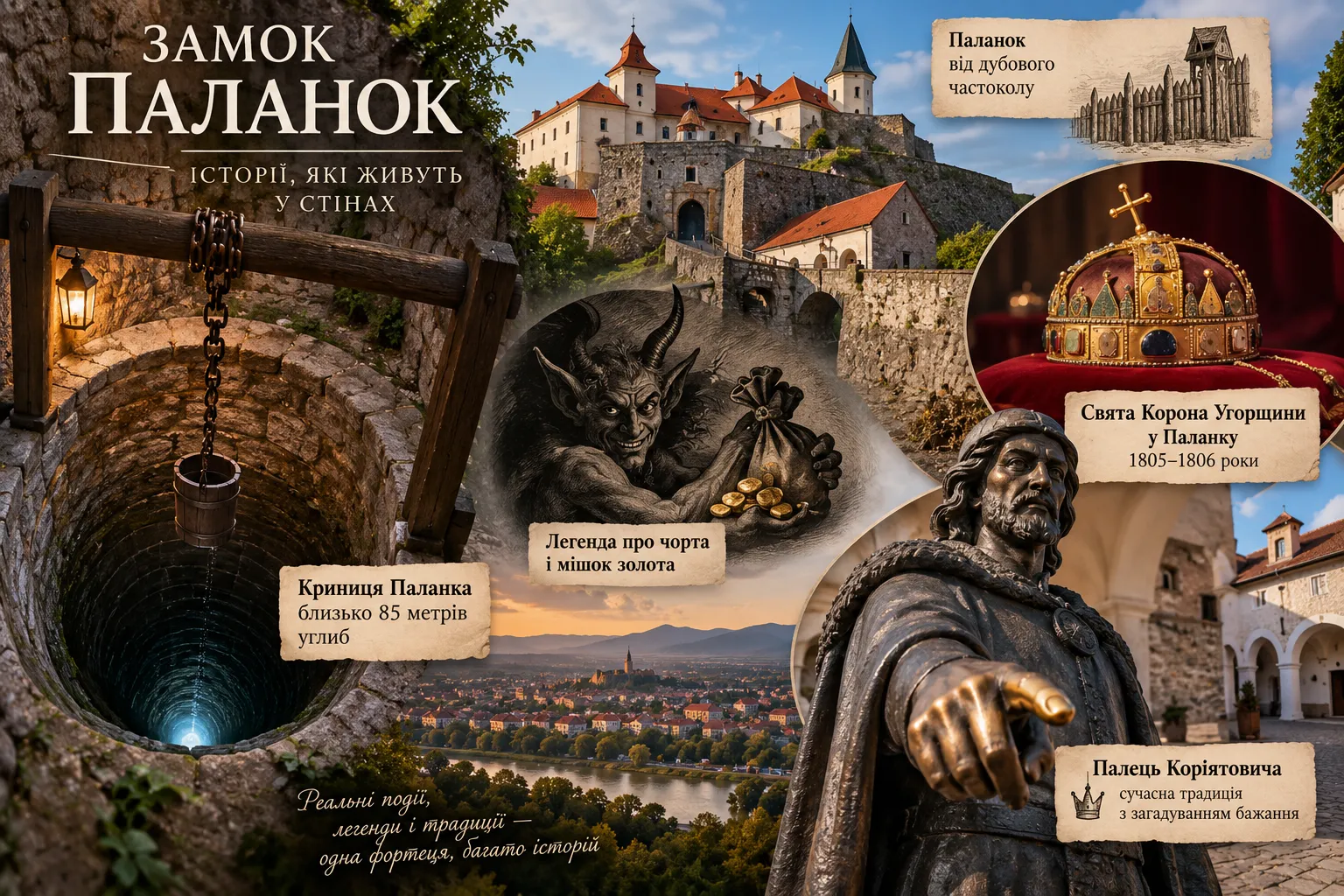
In large castles, the most interesting things are often hidden away from the grand halls. At Palanok Castle, all it takes is stepping away from the panorama of Mukachevo and taking a closer look at the inner courtyard to find a well almost as deep as a twenty-story building, hear about the devil who was supposedly outwitted with a few coins, learn where the name «Palanok» came from, and then suddenly discover that one of Central Europe’s most important state relics was once kept here. Most interesting of all, real events stand so close beside legends in this collection of stories that they are easy to confuse. So let us separate one from the other.
About 85 Meters Down: Why Palanok Has Such a Well
For a fortress on a mountaintop, water was not a household convenience but a matter of survival. As long as the garrison had food supplies and its own water source, a siege could last for months. Once the water ran out, even the thickest walls gradually lost their purpose.
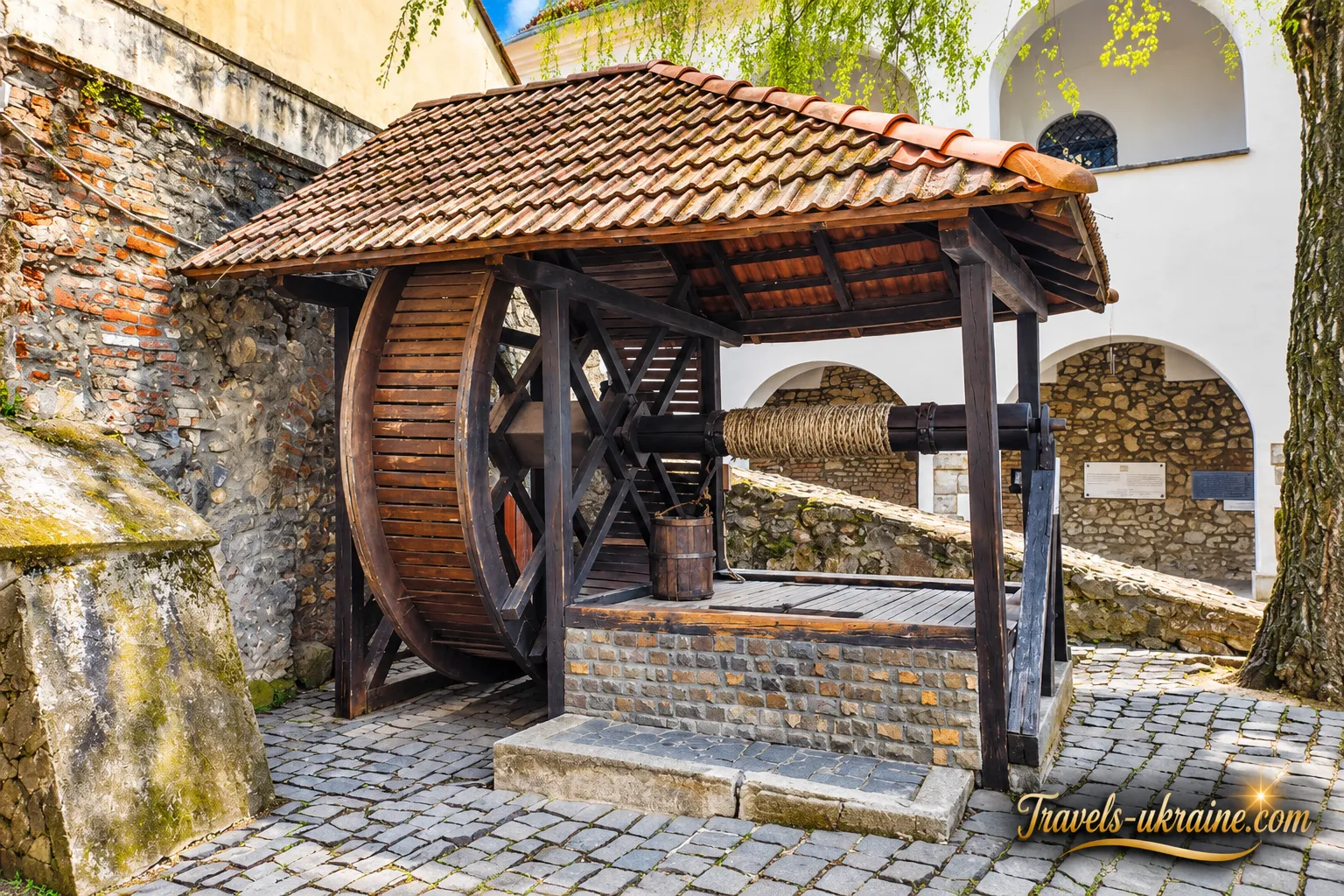
That is why the famous Palanok well was created in the Upper Castle, carved directly into the rock. Its depth is most often given as 85 meters, although some sources cite 86 meters. It is therefore more accurate to describe it as about 85 meters deep rather than argue over the final meter.
The first approximately 13 meters of the shaft are lined with dressed stone; beyond that, it passes directly through the rock. During the well’s cleaning in 2008, it was explored to a depth of more than 76 meters, revealing a water source as well as remnants of equipment and objects from different periods. There are tales of an underground passage from the well to the Latorca River and even of secret routes extending far beyond the fortress. It sounds wonderful, especially in the half-darkness of the castle courtyard, but there is no confirmed underground tunnel from the well to the river. The enormous shaft itself, however, is entirely real—and impressive enough without any additional secret passages.
Fedir Koriatovych, the Devil, and a Very Small Bag of Gold
The best-known legend about the castle well is connected with Prince Fedir Koriatovych. According to the tale, workers dug through the rock for a long time but found no water. Then the devil appeared and proposed a simple deal: he would provide water, and the prince would give him a bag of gold. The problem was that no large bag of gold could supposedly be found in the prince’s treasury. Then someone in his entourage noticed a legal detail that would have impressed a modern lawyer: the agreement never specified the size of the bag. So they placed several gold coins in a tiny pouch and handed over the promised reward. Outraged by this interpretation of the contract, the devil supposedly jumped into the well and remained there. His displeasure is said to still occasionally echo from the depths.
This is, of course, a legend, not a historical document. Moreover, even the traditional claim that Koriatovych ordered the well to be dug is treated cautiously by historians: the prince certainly played an important role in the history of Mukachevo Castle, but no direct documents survive that would allow all the structures and reconstructions traditionally associated with his name to be attributed to him without reservation. So the well is a fact. Its enormous depth is a fact. As for the devil with the bag of gold, let him remain where he is most comfortable—in a good castle legend.
Why Mukachevo Castle Is Called «Palanok»
Today, the names «Mukachevo Castle» and «Palanok Castle» are essentially understood as two names for the same fortress. But the word «Palanok» originally referred to something quite different from the entire castle.
An additional defensive line surrounded Castle Hill: a moat whose inner side was reinforced with a wooden palisade, particularly one made of oak. Such a palisade was called a palanok. Over time, the name of the defensive structure became attached to the fortress itself. So «Palanok» is not the name of a prince, the name of a volcano, or some mysterious medieval word for a castle. It began much more prosaically—with a wooden defensive enclosure. The palisade disappeared long ago, but its name survived the centuries.
When Palanok Was Entrusted with the Holy Crown of Hungary
One of the most remarkable chapters in the castle’s history had nothing to do with a siege. In 1805–1806, Palanok housed the Holy Crown of Hungary for approximately three months—a coronation relic closely associated with Hungarian statehood and the tradition of crowning monarchs. The reason was neither a ceremony nor a desire to display the relic to the people of Mukachevo. The Napoleonic Wars were raging across Europe. As the military situation worsened, the royal regalia were moved from Buda to a safer location. Palanok, far from the main theater of war and still protected by powerful fortifications, was an excellent choice.
In December 1805, the crown and other regalia were secretly brought to Mukachevo. In spring 1806, once the immediate danger had passed, they were taken back. Thus, the fortress—which by then had already begun to lose its former military importance—briefly became a repository for one of the most valuable relics of the Kingdom of Hungary. This episode illustrates Palanok’s reputation even after its most famous military era had ended: if the crown needed to be hidden from Napoleon’s army, the old fortress in Mukachevo still looked like a fairly convincing safe.
Ilona Zrínyi: When Palanok Faced a Real Siege
You can talk all you like about thick walls, towering bastions, and the castle’s advantageous location. But a fortress’s true value becomes clear only when an army that is determined to get inside appears beneath its walls. At the end of the 17th century, Mukachevo Castle faced such a test. And it lasted not a day, not a week, and not even a few months. The 1685–1688 Defence of Palanok became one of the best-known episodes in its history, and the person forever associated with this defence was Ilona Zrinyi.
To understand the siege, one need only look at a map of Central Europe at the time. Palanok found itself caught in the broader conflict between the Habsburgs, the Ottoman Empire, and the anti-Habsburg movement in the Kingdom of Hungary. Ilona was the widow of Ferenc I Rákóczi and later became the wife of Imre Thököly, one of the leaders of the anti-Habsburg Kuruc movement. This woman’s story is also linked to St. Miklos Castle in Chynadiyovo, located very close to Mukachevo, which became one of the best-known places associated with the personal history of Zrínyi and Imre Thököly. After the Ottoman Empire’s unsuccessful siege of Vienna in 1683, Thököly’s position deteriorated sharply. Imperial forces gradually seized the fortresses controlled by his supporters.
Mukachevo Castle remained one of the most important fortified positions not yet controlled by the Habsburgs. Thus, at the end of 1685, the emperor’s troops surrounded Palanok. At that moment, what we examined at the beginning of the article ceased to be mere architecture. The mountain, several defensive levels, gates, bastions, supplies, and its own water source now had to perform the very task for which they had been built.
A Woman Commanded the Fortress—and This Is Not a Romantic Legend
Ilona Zrínyi was not merely a symbolic «lady of the castle» who stayed behind the walls during military operations. She effectively led the defense of Palanok, handled correspondence, managed the fortress’s supplies, and took part in negotiations. Modern retellings sometimes embellish the story with almost cinematic scenes: the princess constantly standing on the bastion under cannon fire, personally commanding every volley, and leading the garrison into battle. Such details should be treated cautiously. But there is no need to exaggerate the essential point—the documented fact is that Ilona Zrínyi herself was the central political and organizational figure in the defense of Mukachevo Castle.
Her children were also in the fortress, including the future prince Ferenc II Rákóczi. A few years later, he would lead a major anti-Habsburg uprising and once again make Palanok an important military stronghold.
«The Three-Year Siege»—Correct, with a Small Qualification
Palanok is often described as having been defended by Ilona Zrínyi for three years. In a tourist text, this is an acceptable simplification, since the events covered 1685, 1686, 1687, and the beginning of 1688. But this does not mean that the same army stood continuously beneath the walls for three calendar years and attacked the fortress every day. The siege had different stages. Imperial forces blockaded the castle, increased the pressure, withdrew, and returned. Commanders changed, as did the military situation around Mukachevo. Yet the central fact remained unchanged: Palanok held out for more than two years, even as the defenders’ situation grew increasingly difficult.
And here, the difference between an impressive fortress and a truly viable defensive system becomes clear. It is not enough for the enemy simply to approach the walls. They must maintain the blockade, supply their own army, cut off the defenders’ provisions, and wait until resources inside begin to run out. That is why the very same deep well, which tourists today hear about in the legend of the devil, was far more important in the conditions of the 17th century than any beautiful story. A fortress without its own water supply could have had ten walls, but it would not have withstood a long siege.
Why Palanok Eventually Surrendered
By the beginning of 1688, the situation had become nearly hopeless. The anti-Habsburg forces were losing ground, no outside help was coming, and the prolonged blockade was gradually exhausting the garrison and its supplies. Popular accounts of Palanok often offer a more dramatic version: supposedly, Ilona Zrínyi was forced to surrender by means of a forged letter from her husband, Imre Thököly, or through the treachery of one of her close associates.
This story has indeed existed in popular tradition for a long time, but it should not be treated as an indisputably established fact. Historical research reveals a far more prosaic picture: after more than two years of blockade, the possibilities for continuing the resistance were practically exhausted, and by the end of 1687 Ilona already understood that it would be impossible to hold the fortress without outside assistance.
In January 1688, negotiations began over the surrender of the castle. By the middle of the month, the capitulation had been agreed, and on January 17, General Antonio Caraffa entered Palanok. This was not a classic final assault, after which the victors broke through a ruined gate. Palanok capitulated by agreement. This probably says more than anything else about its defensive capabilities: the imperial army took the fortress not because it breached all its walls in a single day, but after a prolonged period of isolation, exhaustion, and negotiations.
Palanok held out—but the war around it was lost
From a military point of view, the outcome is clear: the fortress came under Habsburg control. But the siege is remembered not because of the moment of capitulation itself. Over more than two years, it became clear that the fortification system of Mukachevo Castle really worked. Palanok could remain an isolated fortress for a long time even when the political and military situation around it had already turned against its defenders.
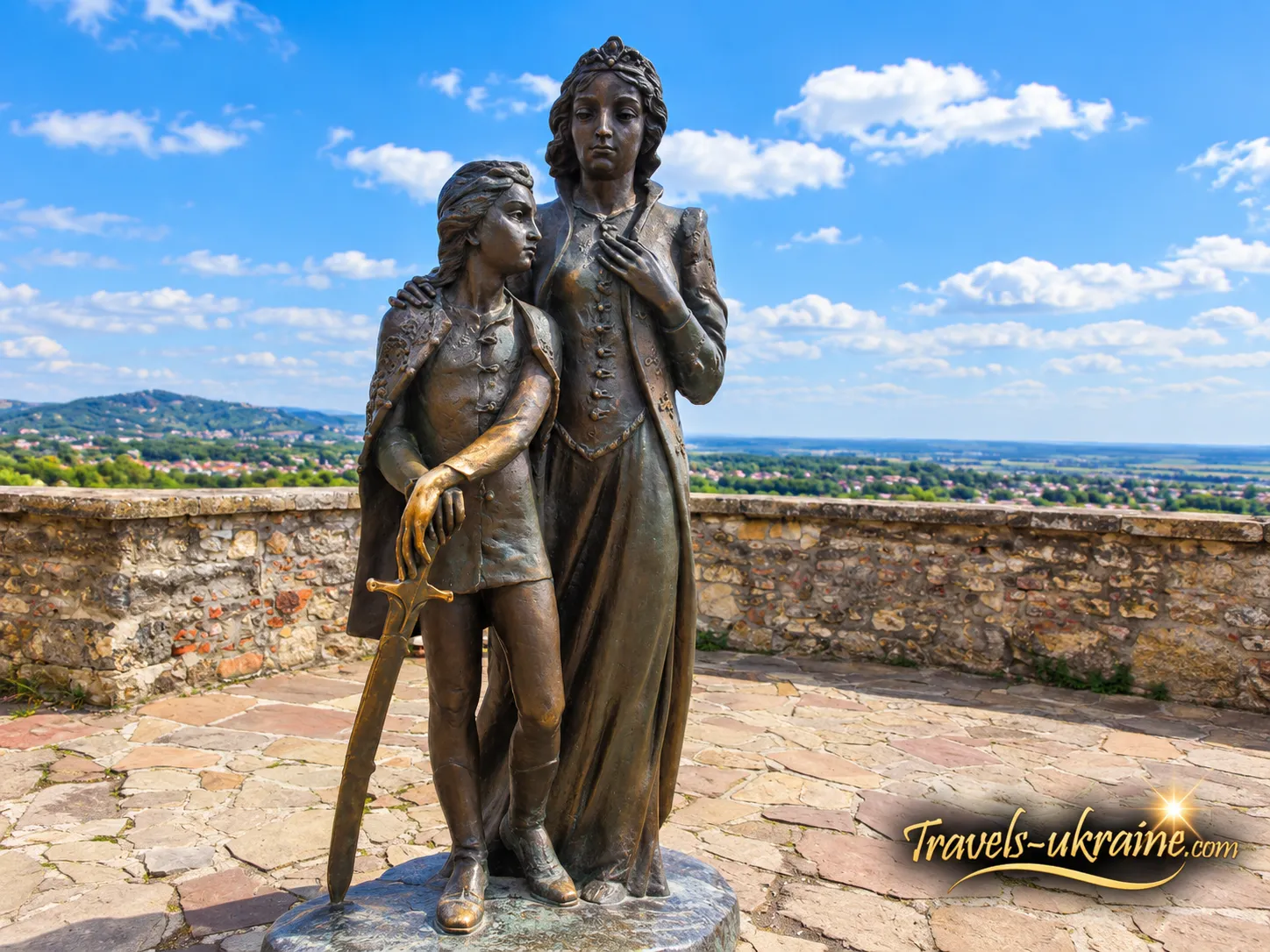
It was this defense that made Ilona Zrínyi one of the best-known figures in the castle’s history. Today, in the Upper Courtyard, she is depicted together with her son, Ferenc II Rákóczi—and this time the monument does not stand on the site of a beautiful invention. Behind it lies the real story of a woman who held one of the region’s strongest fortresses against the imperial army for more than two years.
Yet after all these sieges, Palanok faced a rather ironic twist. The fortress had been improved for centuries so that the enemy could not get inside. Less than a hundred years later, it began to be used for the opposite purpose—so that the people brought there could not get out.
From Impenetrable Fortress to Political Prison: Palanok’s Dark Chapter
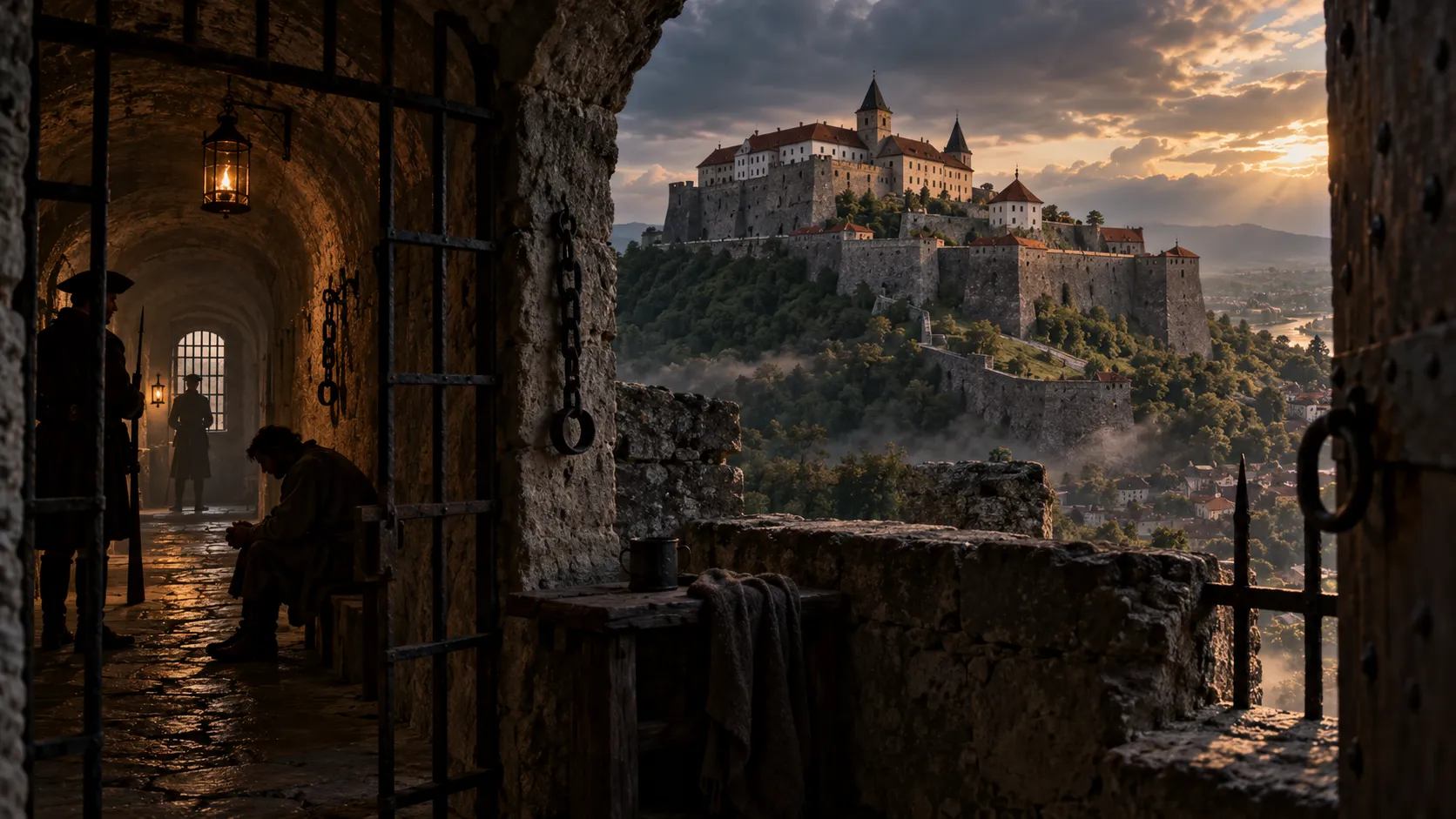
The history of Palanok Castle contains an almost perfect irony. For centuries, it was rebuilt so that a foreign army could not get inside. Once the fortress lost its former military importance, however, it turned out that those same walls, moats, and isolated rooms were perfectly suited to the opposite task—keeping people from getting out.
Thus began one of the darkest periods in the history of Mukachevo Castle. In the 18th century, its rooms were already being used to hold prisoners, and in 1782, by order of Emperor Joseph II, Palanok was converted into a political prison of the Habsburg Monarchy.
From then on, Mukachevo received not enemy garrisons but people whom the authorities considered dangerous because of their political activities, participation in uprisings, or involvement in anti-government organizations. Palanok is therefore sometimes even called the «Austrian Bastille.» This is more a later figurative comparison than the prison’s official name, but the scale of its use explains why the description took hold.
A fortress that now had to be escaped from, not entered
Palanok had almost everything required for a political prison: a high, isolated mountain, several defensive lines, thick walls, inner courtyards, and rooms that could easily be separated from one another. What once created problems for an army during an assault now created problems for a prisoner who might contemplate escape.
According to figures cited by museum and tourism sources, around 20,000 prisoners passed through Palanok during the prison’s existence. The precise figure for such a long period should be treated with caution, but one thing is clear: this was not merely a few cells for local offenders. Mukachevo Castle became part of a much broader penitentiary system of the monarchy.
The geography of its prisoners makes this clear as well. The people held here were connected not only with Transcarpathia or Hungary, but also with political movements in various parts of Europe.
Ferenc Kazinczy: the writer who came to Palanok after a death sentence
One of the best-known prisoners of Mukachevo Castle was Ferenc Kazinczy, a Hungarian writer, translator, and one of the leading figures in the renewal of the Hungarian literary language. In 1794, Kazinczy was arrested for his connection with the so-called Martinovics conspiracy, a movement of Hungarian Jacobins. He was initially sentenced to death, but the sentence was later commuted to imprisonment.
Palanok was far from his first prison. Kazinczy was transferred between several fortresses of the Habsburg Monarchy, including Brno and Kufstein. In 1800, he was brought to Mukachevo, where he spent the final period of his long imprisonment. In June 1801, Kazinczy was pardoned and released.
In total, he spent 2,387 days—approximately six and a half years behind bars. Kazinczy later described this experience in his own prison diary. Today, the Mukachevo Historical Museum has a separate memorial exhibition dedicated to him.
Alexander Ypsilantis: from the struggle for Greek independence to a cell in Mukachevo
Even more unexpectedly, the history of Palanok includes Alexander Ypsilantis, one of the leaders of the Greek national liberation movement. In 1821, he led an uprising against the Ottoman Empire in the Danubian Principalities. After its defeat, Ypsilantis crossed into the Austrian Empire, hoping to find safety. But Vienna’s policy toward revolutionary and liberation movements was far from welcoming. The Austrian authorities arrested him. Ypsilantis was initially held in Mukachevo Castle itself, and, for reasons of secrecy, he was registered under the assumed name Baron Schönwart. In 1823, he was transferred to the fortress of Theresienstadt, modern-day Terezín in the Czech Republic.
Thus, one cell at Palanok could form part of the story of a Hungarian language reformer, while another belonged to a man whose name was directly connected with the beginning of Greece’s struggle for independence. For a castle in a small Transcarpathian town, that is a remarkably telling scale.
1848: when the people of Mukachevo opened the prison doors themselves
The revolutionary events of 1848, which swept across much of Europe, reached Palanok as well. During the revolution, local residents opened the castle’s casemates and freed the prisoners. In memory of the event, a linden tree was planted in the Upper Castle and named the Tree of Freedom. It stood for more than a century, but in 1960 it was damaged by a severe storm. The history of Palanok as a prison did not end there, however. After the revolution was suppressed, the castle’s prison functions were restored, and it continued to be used to hold prisoners for several more decades.
When Palanok’s political prison was closed
The date most often given as the end of its prison era is 1896. During the celebrations marking the millennium of the arrival of the Hungarian tribes in the Carpathian Basin, Hungary’s Ministry of Justice officially shut down the prison in Mukachevo Castle. Some publications state that certain prison functions actually continued for several more years, until the beginning of the 20th century. It is therefore safer to speak specifically of the official closure of the prison in 1896, rather than turning a single date into an unnecessary point of dispute.
After that, Palanok lost the function for which it had been used for more than a century. It had long ceased to be a military stronghold, the political prison had closed, and the enormous complex required funds for maintenance. A new, much quieter—but not always easy—period began for the castle.
What to See at Palanok Castle Today
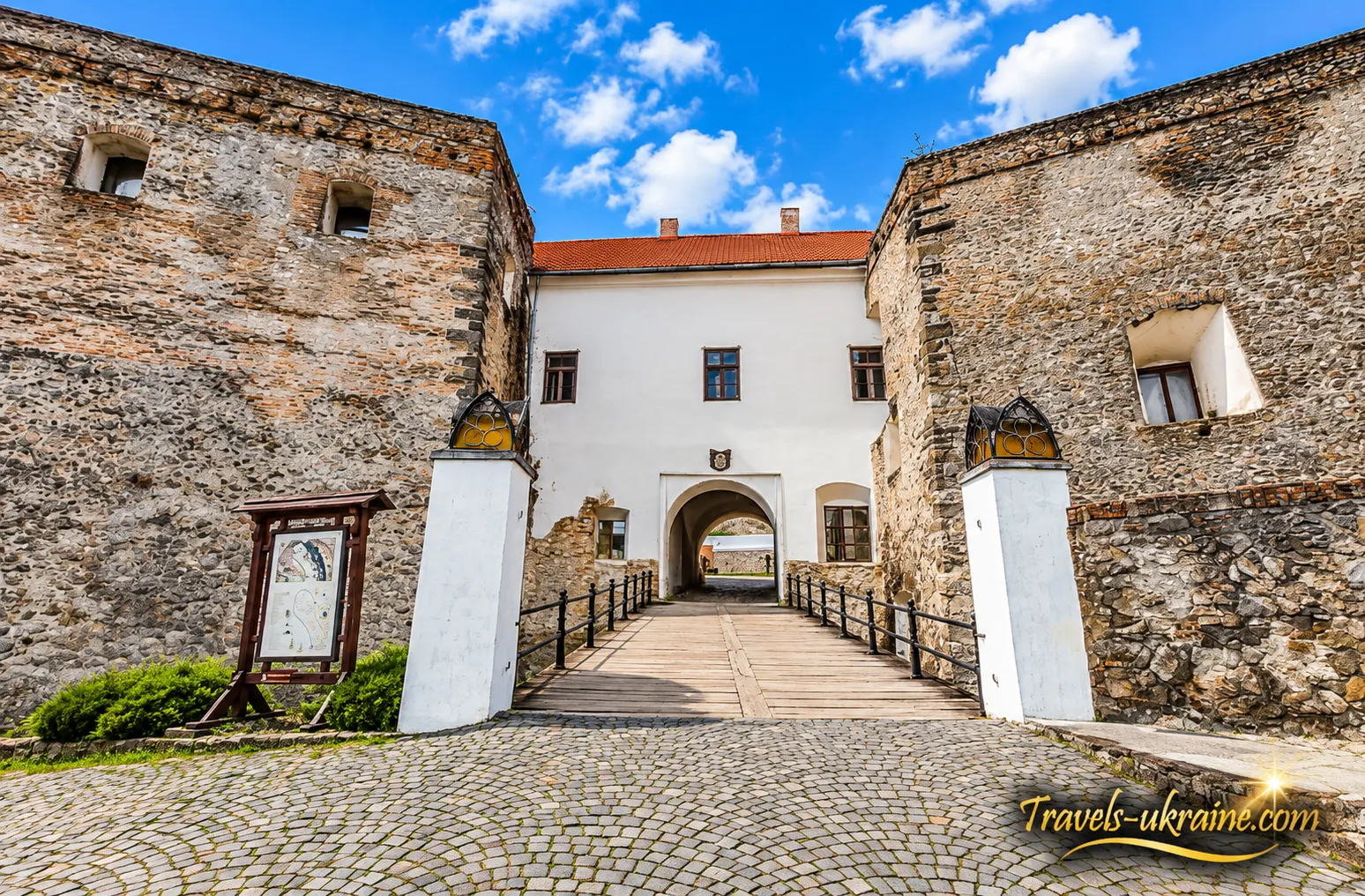
After stories of sieges, political prisoners, and crowns, it may seem that modern Palanok is simply a grand backdrop best admired from the outside. In fact, the opposite is true. The Mukachevo Historical Museum operates inside, and the route through the fortress lets you see with your own eyes—not merely on a diagram—the things discussed throughout this article.
The castle is quite large. The museum exhibitions cover more than 3.5 thousand square meters, and the collections contain more than 8,000 items. Trying to read every caption beside every exhibit carefully can quietly turn a short visit into half a day. It is therefore far more interesting to experience the castle as one continuous route: from the lower fortifications upward to the Upper Castle, gradually observing how an ordinary hill was transformed into a multilevel fortress.
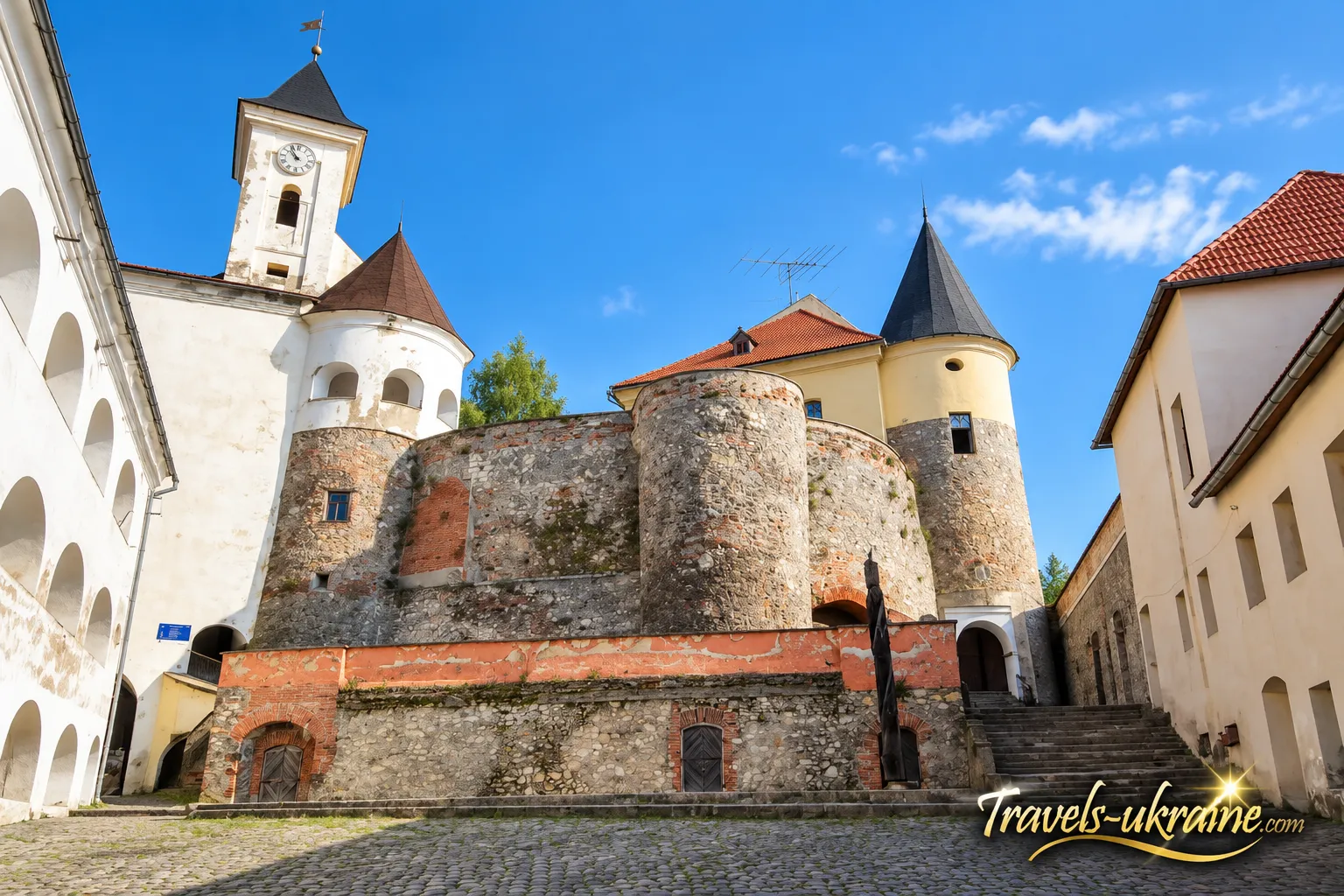
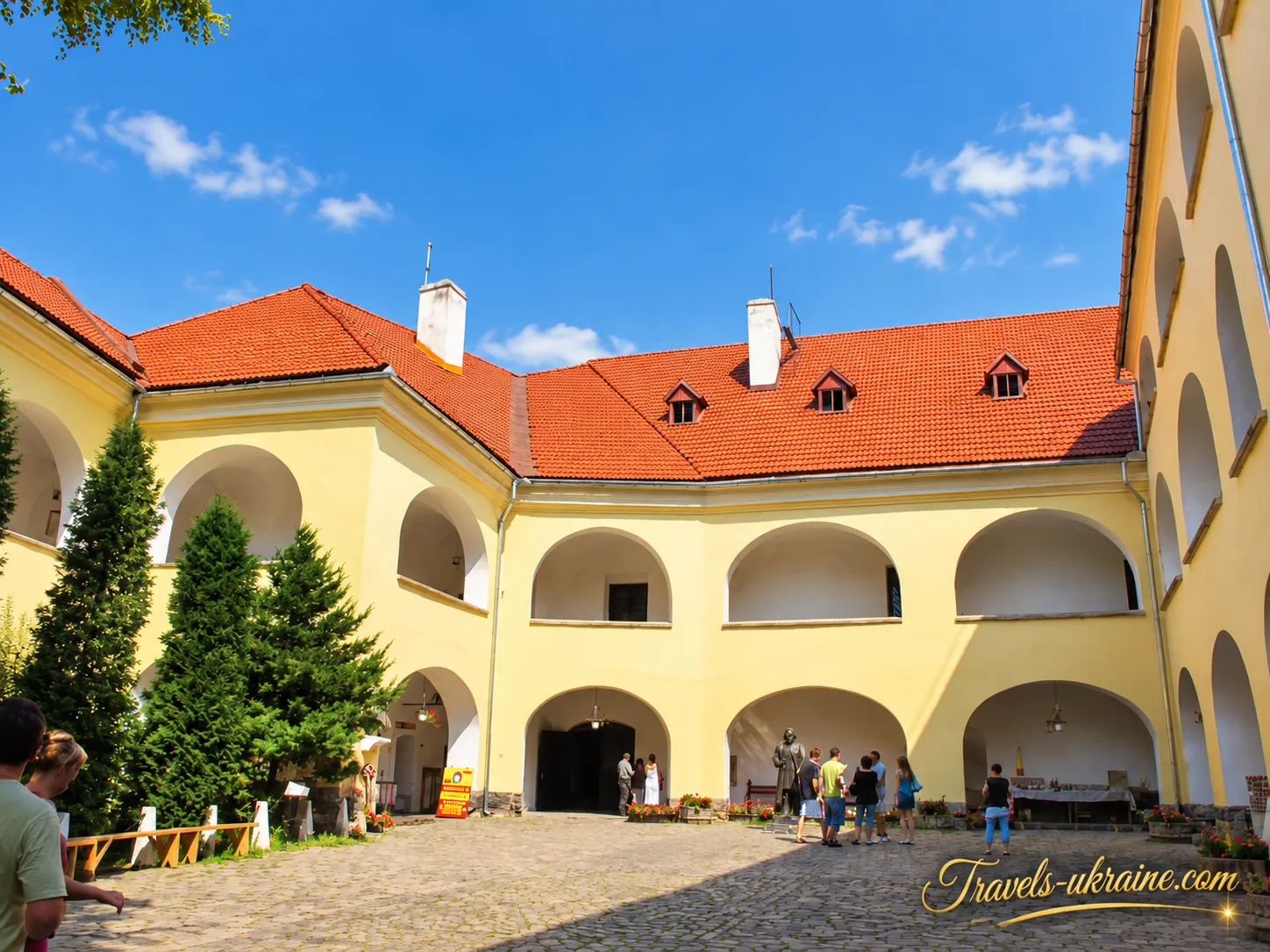
The first mistake it is easy to make at Palanok is to see the main palace building above and assume that everything interesting is located there. In reality, the ascent itself is part of the attraction. As you pass through the Lower, Middle, and Upper Castles, pay attention to the gates, the transitions between levels, the thickness of the walls, and the changes in elevation. This is where you can best understand something difficult to convey in a photograph: Palanok is not one large building on a hill, but a layered system of fortifications. During a peaceful walk, several gates and courtyards may seem simply like a beautiful route. But imagine that every gate is closed, the bridge raised, and defenders standing on the bastions—and the architecture suddenly looks entirely different.
Palanok’s Well: now you can appreciate the scale of the legend
After our story about Koriatovich and the devil, it would be a real shame to skip the castle well. It is located in the Upper Castle. From the surface, it is difficult to grasp its approximate depth of 85 meters—the dark shaft quickly disappears below. But once you remember that it was cut through solid rock to supply the fortress with water, this seemingly ordinary stone well becomes one of Palanok’s most important engineering structures. And this is where the legend of the evil spirit slightly gets in the way of reality. Digging such a shaft without modern equipment was probably harder than negotiating with the devil over the size of the sack.
Ilona Zrínyi and Ferenc II Rákóczi: now history has a specific place
A monument to Ilona Zrínyi and her son, Ferenc II Rákóczi, stands in the Upper Courtyard. After the story of the siege, it is no longer simply another bronze composition for a photograph. It was within these walls that Zrínyi endured a prolonged blockade by the imperial forces, while her son, then a child, would later lead a major anti-Habsburg uprising at the beginning of the 18th century. The monument should therefore be seen not separately from the castle, but as the point where two important chapters of Palanok’s history meet in a single courtyard.
Ferenc Kazinczy and the memory of the castle-prison
After Palanok’s defensive history, it is easy to forget that it was a political prison for more than a century. The museum also devotes attention to this period. In particular, it features the Ferenc Kazinczy Memorial Room, dedicated to the writer and reformer of the Hungarian language who spent the final part of his long imprisonment in Mukachevo Castle. This is a good point of transition from the «romantic medieval castle» to the reality of the 19th century, when the old stone rooms were no longer princely chambers or defensive positions, but part of a prison system.
Not just a castle: archaeology, ethnography, Rákóczi, and art
If you have enough time, Palanok is also worth experiencing as a full-fledged historical museum. Permanent exhibition themes include the history of Mukachevo, antiquities, ethnography, materials about the Rákóczi family, an art gallery, and other museum collections. The VVolodymyr Mykyta Author's Museum—dedicated to the renowned Transcarpathian artist—operates separately. So after cannons, princes, and political prisoners, Palanok can unexpectedly conclude with an entirely different chapter of Transcarpathia's history: the art of the 20th–21st centuries.
You do not have to explore every exhibition with the same level of attention. If you came primarily for the castle itself, it is better to choose a few subjects that genuinely interest you and leave the rest of your time for the courtyards and fortifications.
And finally—look beyond the walls
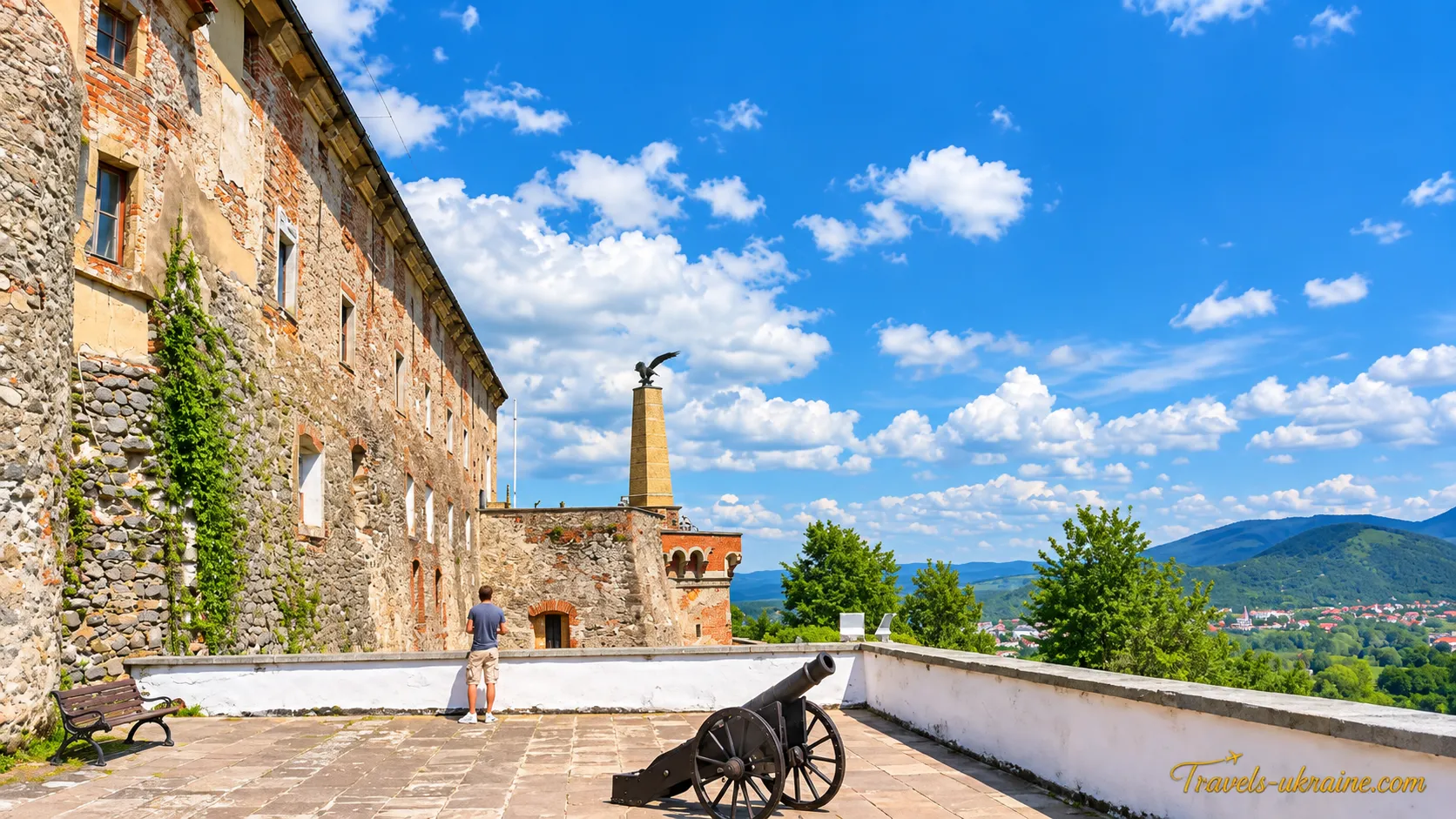
After visiting several halls, it is very easy to slip into museum mode and start looking only inward. But one of Palanok's main “exhibits” does not have a display case at all. From the upper parts of the castle, you can enjoy a broad panorama of Mukachevo, the Latorica Valley, and the surrounding mountains. This is where you can best see how wisely the fortress site was chosen. What sounded at the beginning of the article like a dry explanation—“the mountain rises approximately 68 meters above the plain”—becomes obvious up here without any figures. From this vantage point, it really was possible to control a vast surrounding territory. And this is probably where the tour should end. After the well, the prison stories, the Rákóczis, and the museum halls, simply step out to the walls and look at the city over which this fortress was so important to maintain control for centuries.
Frequently Asked Questions About Palanok Castle
Are Palanok Castle and Mukachevo Castle the same place?
Yes. Palanok Castle is Mukachevo Castle, located on Castle Hill in Mukachevo. Both names are widely used today. The name “Palanok” comes from the wooden palisade that once formed part of the fortress's outer defenses.
Does Palanok Castle really stand on a volcano?
Palanok stands on a mountain of volcanic origin that rises approximately 68 meters above the surrounding area. However, it would be incorrect to call it a modern «sleeping volcano.» It is an ancient volcanic formation created by geological processes long before the castle appeared.
When was Palanok Castle built?
There is no single exact construction date for Palanok. The fortress took shape over many centuries, and aspects of its early history remain disputed. The castle was not built as part of a single project—it was repeatedly rebuilt, expanded, and adapted to new methods of warfare. A significant contribution to the development of the complex is associated with Fedor Koriatovych and, later, the Rákóczi princes.
How many levels does Palanok Castle have?
The complex consists of three main sections—the Lower, Middle, and Upper Castles, situated on different terraces of Castle Hill. Once, each successive level was another obstacle for an attacker; today, visitors pass through these defensive lines while ascending to the Upper Castle.
How deep is the well at Palanok Castle?
The castle well is approximately 85 meters deep. Different sources give figures of 85 or 86 meters, so it is more accurate to say «about 85 meters.» It was built to supply the fortress with water during a siege. The famous legend about Fedor Koriatovych, the devil, and a sack of gold is associated with this well.
Was Palanok Castle really a political prison?
Yes. This is a historical fact, not a castle legend. In 1782, Palanok began to be used as a political prison of the Habsburg Monarchy. Notable prisoners included the Hungarian writer Ferenc Kazinczy and Alexander Ypsilantis, a figure in the Greek War of Independence. The prison officially ceased operating in 1896.
What are Palanok Castle's opening hours?
During the tourist season, the museum is usually open every day from approximately 09:00 to 18:00. In winter, hours may be reduced to 17:00, while on public and religious holidays the museum sometimes operates on a special schedule. If you are traveling to Mukachevo specifically to visit Palanok, it is best to check the opening hours in advance.
How much time is needed to see Palanok Castle?
For the main route through the castle grounds and several of the most interesting exhibitions, allow 1.5–2 hours. If you plan to examine the museum collections, «Chronicles of Palanok Castle,» memorial rooms, and galleries carefully, it is better to allow 2.5–3 hours.
Is Palanok Castle interesting to visit with children?
Yes. Palanok is engaging for children because history here can literally be experienced on foot: gates, bastions, inner courtyards, a deep well, old walls, and the interactive exhibition «Chronicles of Palanok Castle.» With small children, keep the climbs, stairs, and the considerable size of the complex in mind.
Why Palanok Castle Is Worth Seeing for More Than the View
Palanok Castle in Mukachevo is easy to dismiss as just another beautiful fortress on a hill: old walls, towers, a city panorama, and a few museum halls—the standard ingredients of a tourist photograph. But the longer you walk through its courtyards, the less it resembles mere scenery. Palanok is fascinating because almost every part of the castle has a clear reason for existing. The volcanic mountain provided elevation, the three levels made an assault more difficult, the deep well enabled the fortress to withstand a siege, the bastions controlled approaches, and its isolation later made the fortress a convenient political prison.
Here, you can see especially clearly how the same architecture can serve entirely different eras. Under Ilona Zrínyi, Palanok's purpose was to keep the imperial army out. Centuries later, those same walls kept political prisoners from getting out. Today, tourists pass through the former defensive gates every year. Then there are the stories that might seem invented elsewhere: a crown hidden from the Napoleonic Wars, a well nearly 85 meters deep, Prince Koriatovych, the legend of the devil, Ilona Zrínyi, Ferenc Kazinczy, and Alexander Ypsilantis. All of it is connected to one castle complex.
That is why Palanok is best not explored in a hurry. If you simply climb to the top, take a few photos, and go back down, it will remain a beautiful fortress. But if you understand why each level was created, why such a deep well was needed, and what happened behind these walls, the castle begins to read quite differently. And perhaps this is the best definition of Palanok: not simply a well-preserved castle, but a fortress where you can still see the logic of several centuries of European history.
So, when you find yourself on the upper walls and see Mukachevo below, it is worth putting your phone away for at least a minute. The same city was once observed from here by sentries, defenders during a siege, political prisoners, and the people who guarded one of Central Europe's most important royal relics. The view has changed since then. Palanok is much smaller.

No Comment
You can post first response comment.