
 English
 Українська
 Български
 Hrvatski
 Čeština
 Dansk
Dansk Nederlands
 Eesti
Eesti Suomi
Suomi Français
 Deutsch
 Ελληνικα
 Magyar
 Íslenska
 Italiano
 Latviešu
 Lietuvos
 Polski
 Português
 Română
 Русский
 Српски
 Slovenčina
 Slovenščina
 Español
 Svenska
 Türkçe
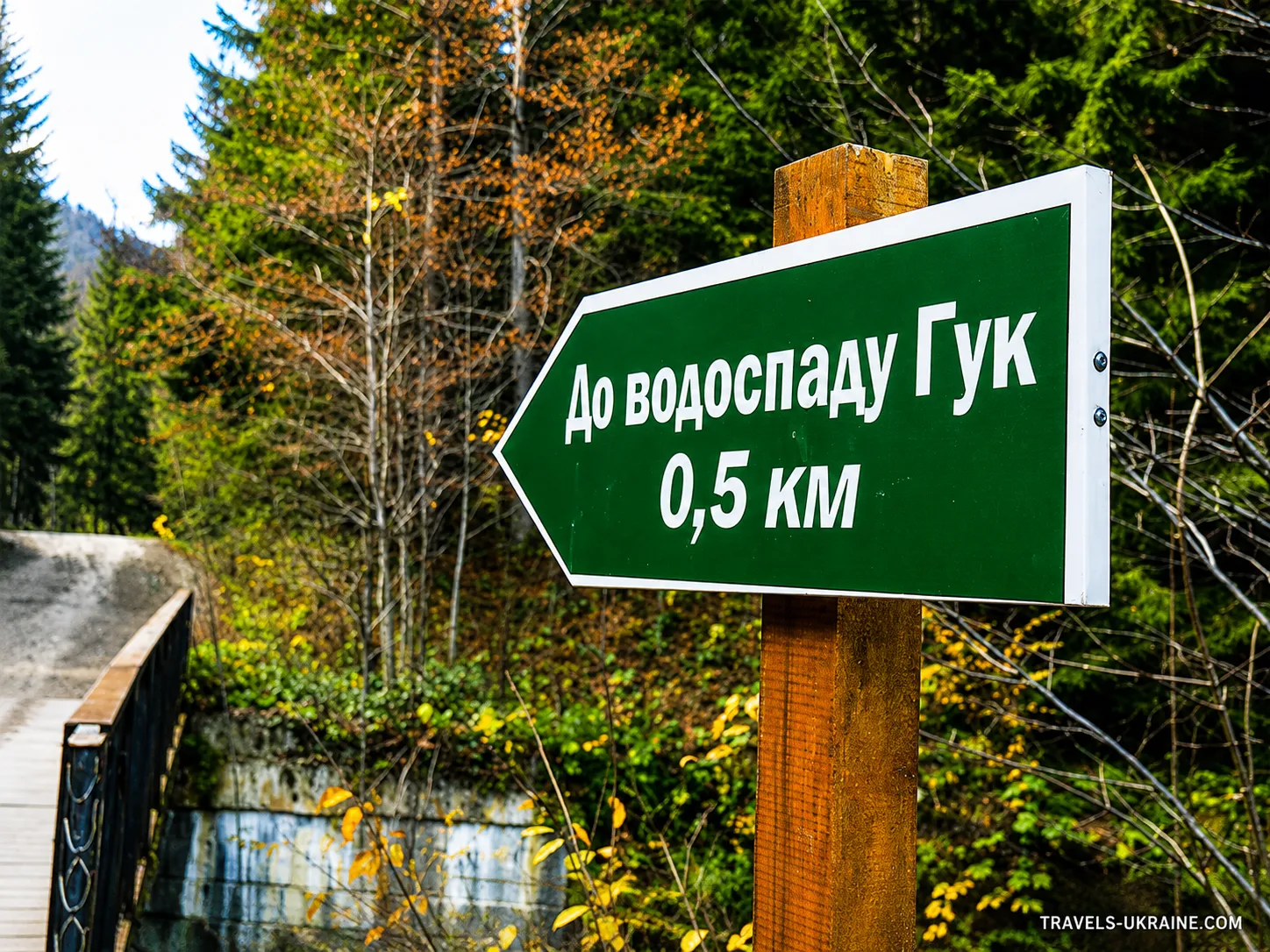
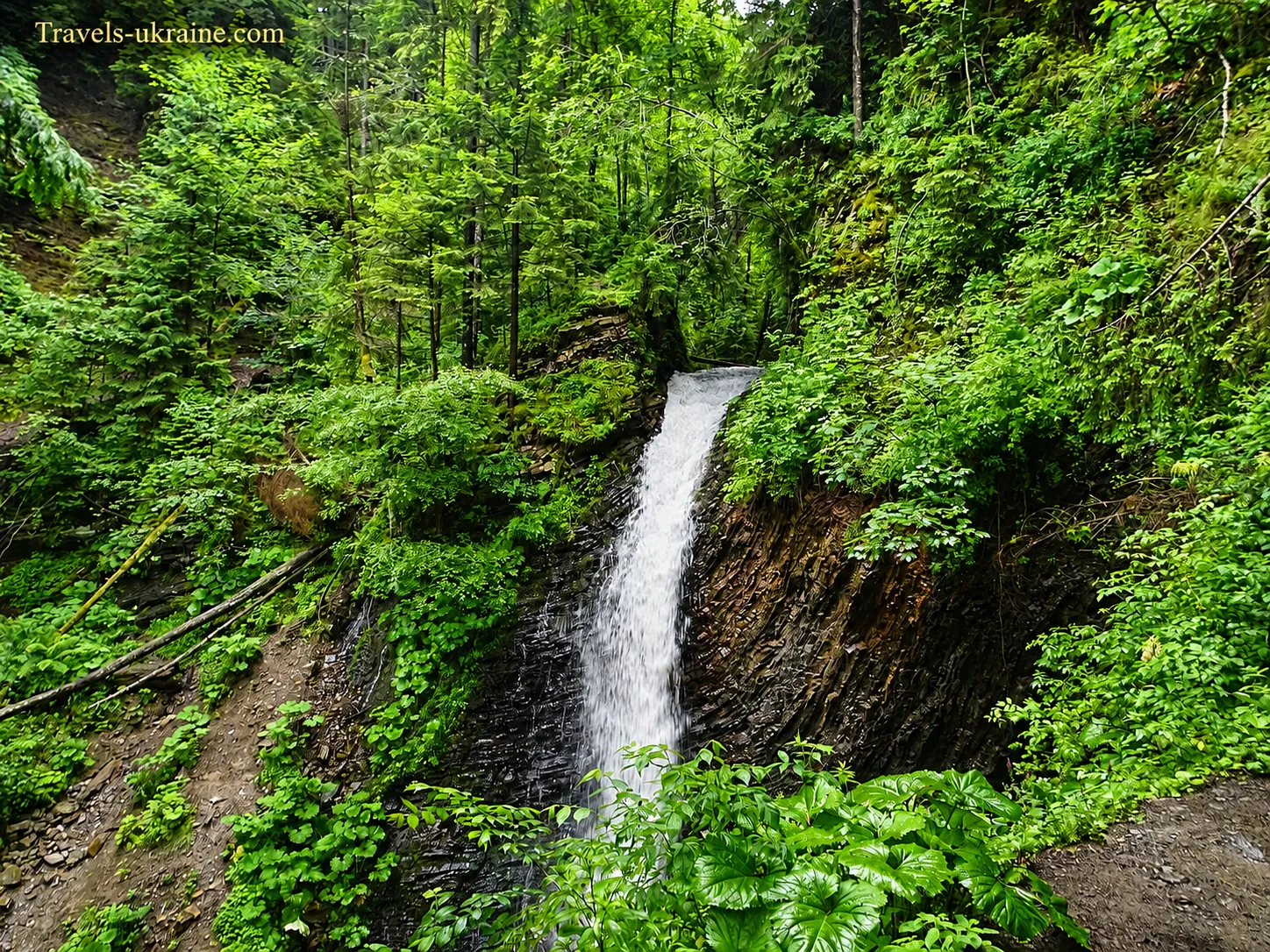
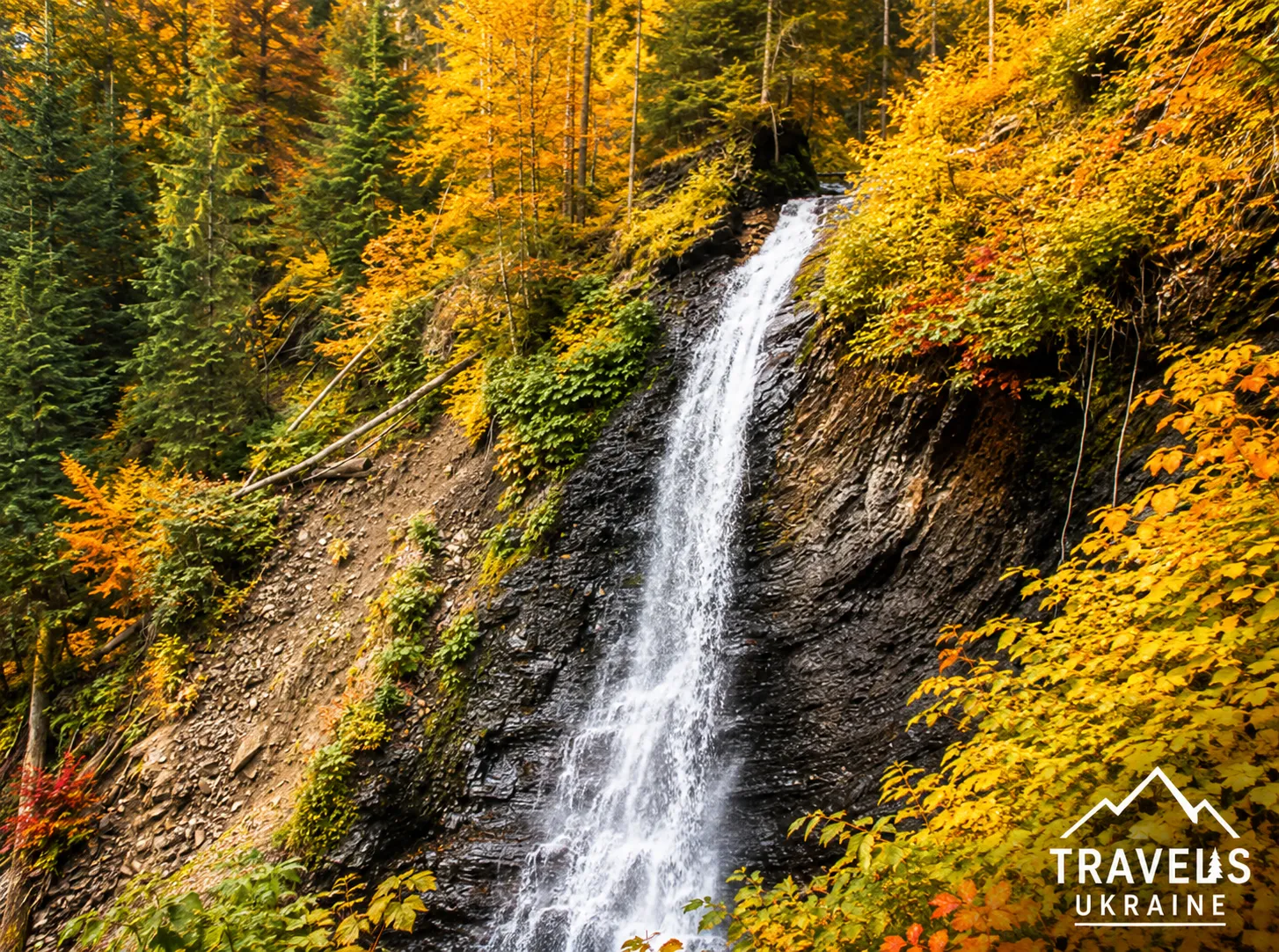
Zhenetskyi Huk Waterfall is one of those Carpathian destinations whose introduction begins long before the first glimpse of the water. At first, the traveler hears a muffled rumble breaking through the noise of the forest. With every step, it becomes clearer, deeper, and stronger, until a steep cascade in a mountain gorge appears beyond the trees. A powerful stream plunges from the rocks, crashes against the stones, and fills the surrounding space with a cool watery mist. Here, you can feel especially keenly that the Carpathians are not merely scenery but a living force of nature with their own voice, movement, and character.
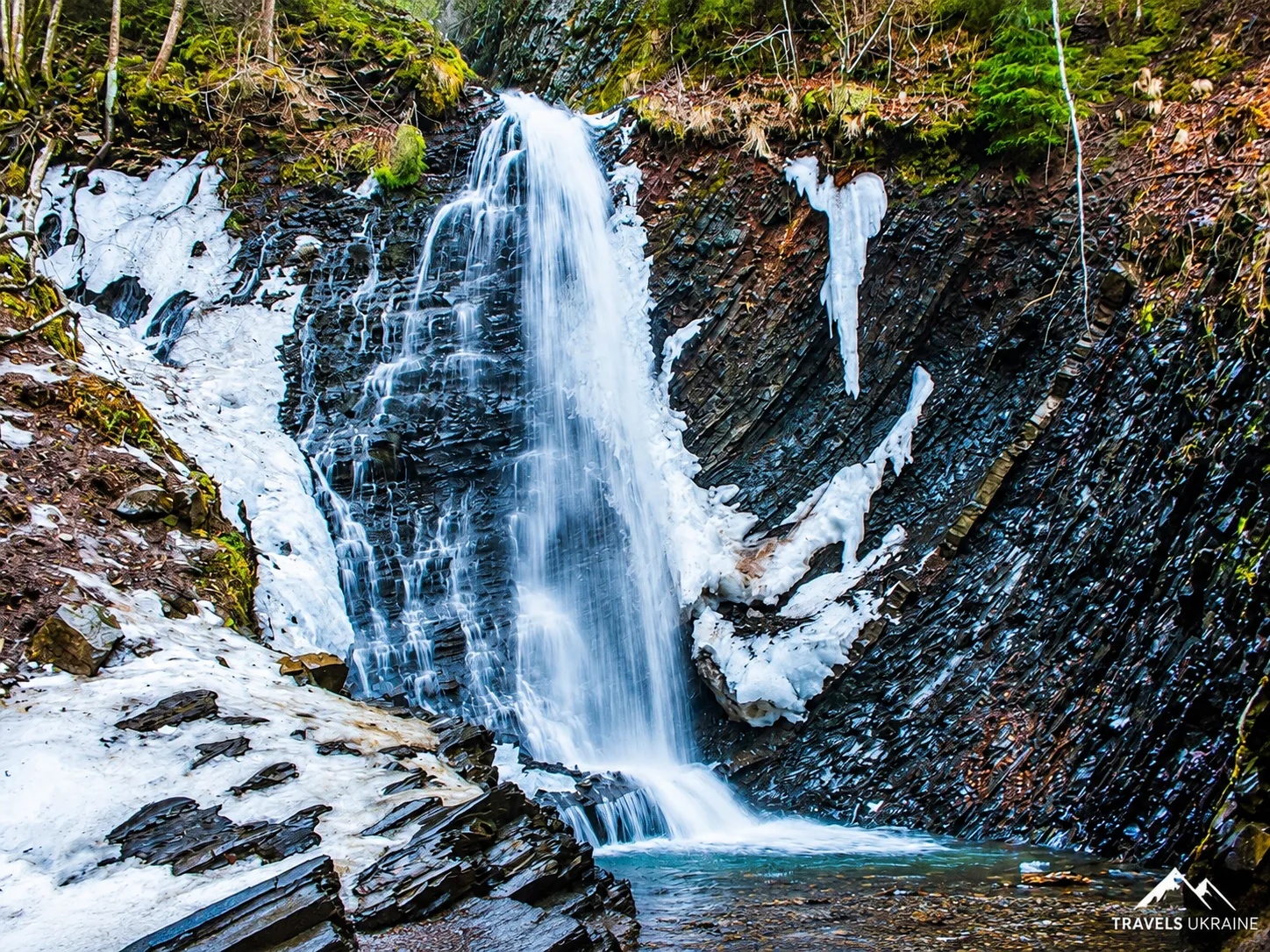
Zhenetskyi Waterfall, also known as Zhenetskyi Huk, Huk Waterfall, or Huk Zhenetskyi Waterfall, is located in the Zhenets tract near the villages of Mykulychyn and Tatariv in Ivano-Frankivsk Oblast. This picturesque waterfall in the Carpathians plunges from a height of approximately fifteen meters, creating a loud torrent amid the Carpathian forest. Because of its distinctive noise and rumble, local residents named the waterfall «Huk.»
Today, this steep cascade in a mountain gorge is considered one of the most popular natural attractions in the Yaremche region. Its appeal lies not only in the beauty of the cascade itself but also in the journey to reach it. The route follows the stream valley, among spruce-covered slopes, mountain brooks, small clearings, and rocky banks. This walk allows you to gradually leave the noise of cars behind, slow down, and feel the natural rhythm of the mountains.
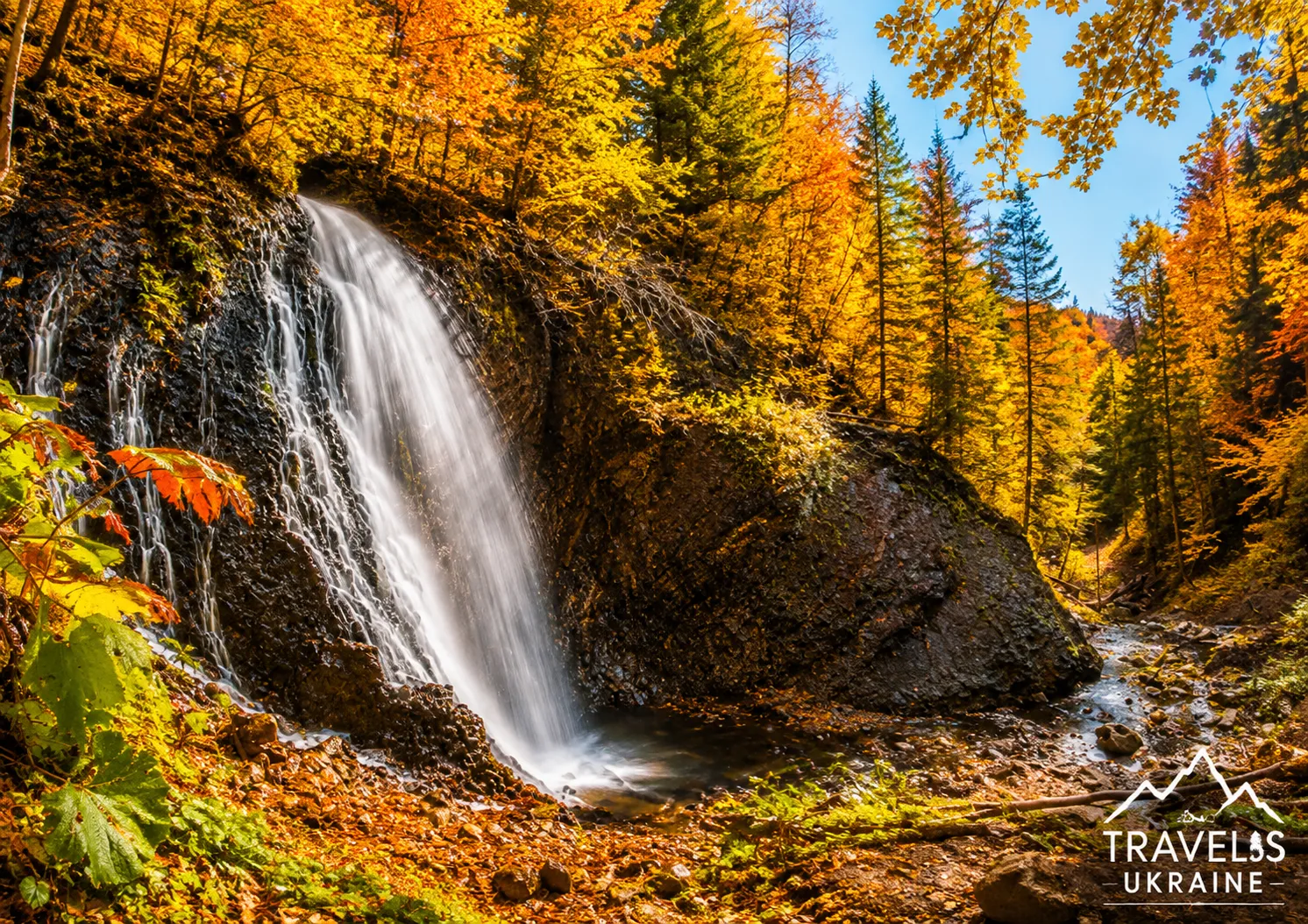
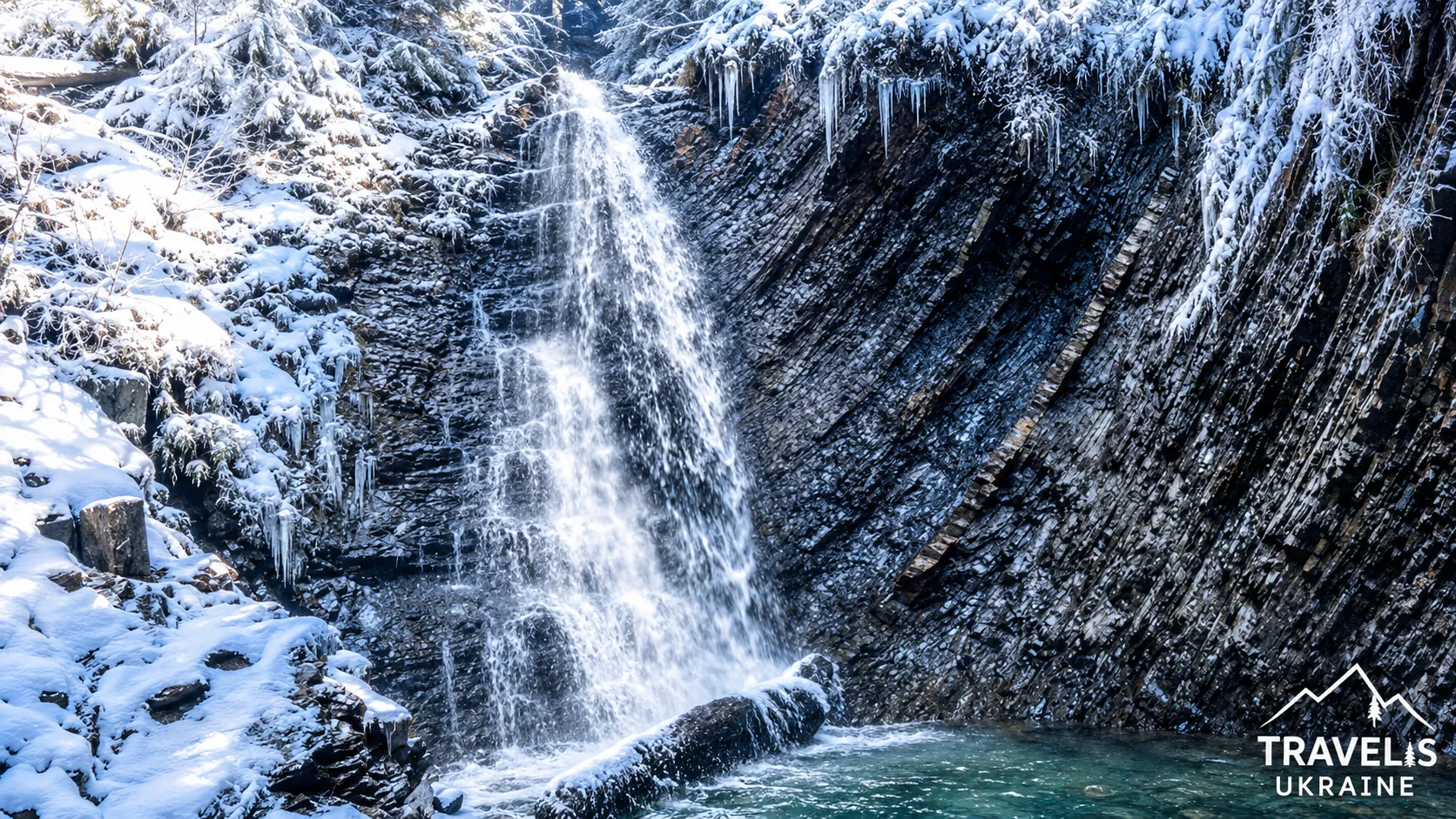
A trip to Huk Waterfall is suitable for those planning a family holiday in the Carpathians, an easy hiking route, an excursion with friends, or a leisurely walk in nature. The path does not require special mountaineering equipment, yet it remains a genuine mountain route where the weather, trail conditions, and season can significantly affect travel comfort. In spring, the cascade becomes especially full-flowing; in summer, it offers a pleasant refuge from the heat; in autumn, the surrounding forest fills with golden and crimson hues; and in winter, the water and rocks may transform into an intricate composition of ice and snow.
Zhenetskyi Huk is often called a picturesque jewel of the Carpathians, yet its true atmosphere is difficult to convey with a single apt epithet or photograph. This place must be heard, seen in motion, and experienced from just a few steps away. The roar of the water drowns out conversation, cool spray settles on your face, and the rocks and dense forest form a natural amphitheater around the stream. Even on days when many people gather near the viewing platform, the waterfall does not lose its power or its ability to draw everyone’s attention to the elements.
The History of Huk Waterfall: How a Carpathian Flood Created a Natural Landmark
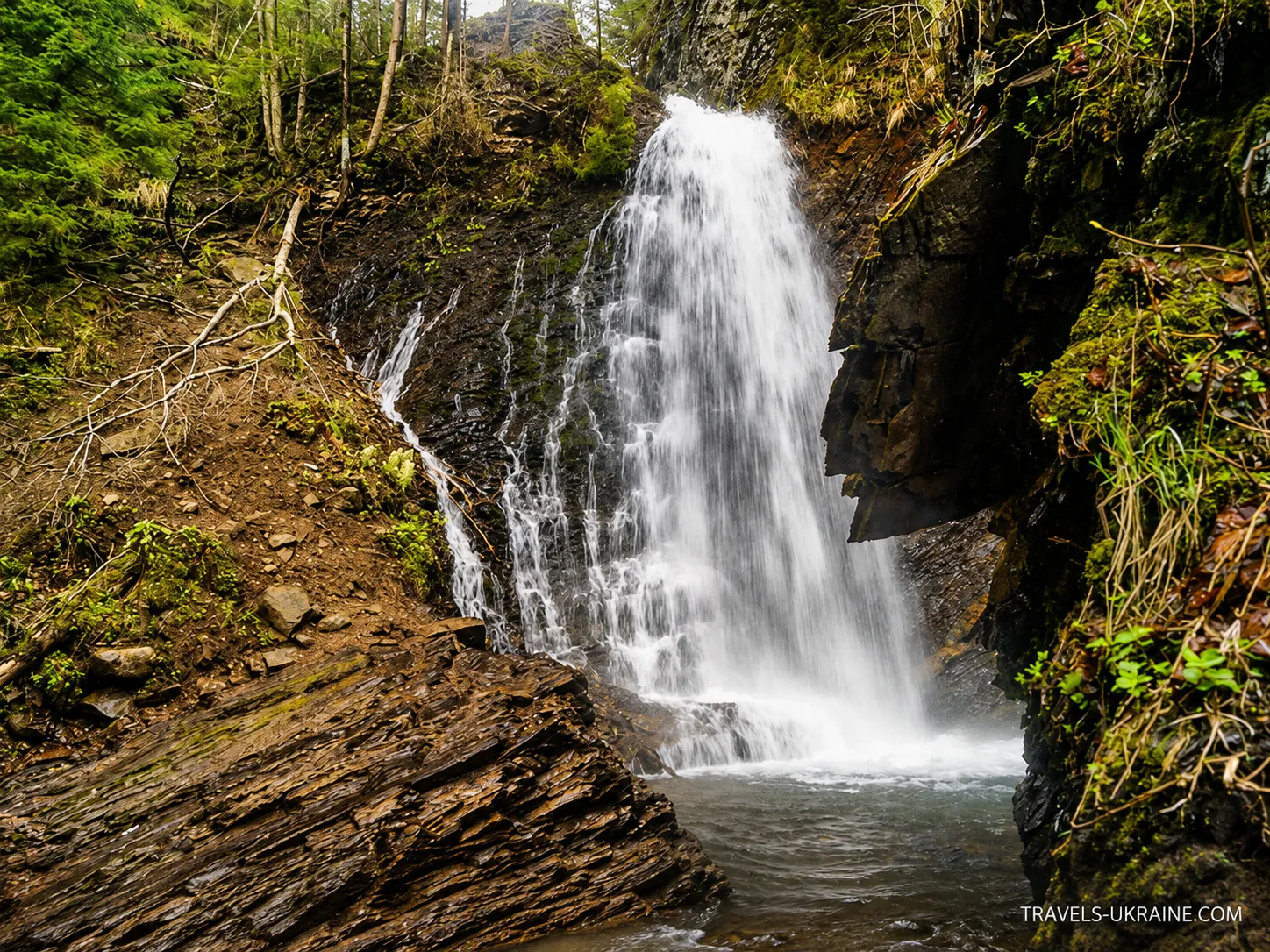
The powerful waterfall on the Zhenets River stands out among the Carpathians’ many natural landmarks because of its relatively recent history. Its present appearance took shape not thousands of years ago but in the mid-XX th century. In the postwar period, a powerful flood swept through the Zhenets stream valley, causing a rockslide and a significant change in the riverbed. The water found a new route over a rocky ledge, creating the steep cascade now known as Huk Waterfall in the Carpathians.
How Zhenetskyi Waterfall Became a Tourist Attraction in the Yaremche Region
After its formation, the waterfall remained primarily part of the local mountain landscape for a long time. Residents of nearby villages, foresters, shepherds, and people walking along the Zhenets valley to the mountain meadows and slopes knew about it. The development of tourism in the Yaremche region gradually turned this natural feature into a popular destination for hikes.
An important milestone was the establishment of the Carpathian National Nature Park in 1980. The territory of the Zhenets tract became part of a protected area where the preservation of mountain ecosystems, scientific observation, and organized nature tourism come together. An ecological trail was developed to the waterfall, beginning near the Zhenets Nature Protection Research Department and following the stream valley.
The route has repeatedly been affected by floods, rockfalls, and fallen trees. Park workers have cleared the riverbed, repaired crossings, reinforced certain sections, and restored access to the cascade. This is an important part of the site’s modern history: the force of nature that once created the waterfall continues to reshape the surrounding area and remind us that even a popular tourist route remains part of living mountain nature.
Zhenetskyi Huk as a Symbol of the Carpathians’ Changing Nature
The waterfall’s history shows the Carpathians not as a frozen backdrop but as an environment that is constantly evolving. Rain, floods, frost, melting snow, moving rocks, and the slow erosion of cliffs affect the shape of the riverbed every year. People may build a hiking trail, bridge, or viewing platform, but water remains the primary creator of this landscape.
That is why a trip to Zhenetskyi Huk Waterfall offers more than recreation; it is educational as well. Before the traveler stands the result of a real natural event that transformed part of the mountain gorge over a relatively short historical period. Today, this loud torrent amid the Carpathian forest has become one of the Yaremche region’s most popular attractions and a vivid testament to the power with which water can shape mountain terrain.
The Natural Features of Zhenetskyi Huk Waterfall in the Carpathians
The waterfall on the Zhenets stream lies in one of the most distinctive corners of the Gorgany Mountains, between the Yavirnyk and Khomyak-Synyak mountain ranges. The Zhenets tract is situated in the valley of the stream of the same name, at an elevation of approximately 900 meters above sea level. Here, steep wooded slopes converge around a narrow riverbed, creating a natural space in which the sound of the water intensifies and carries far between the trees.
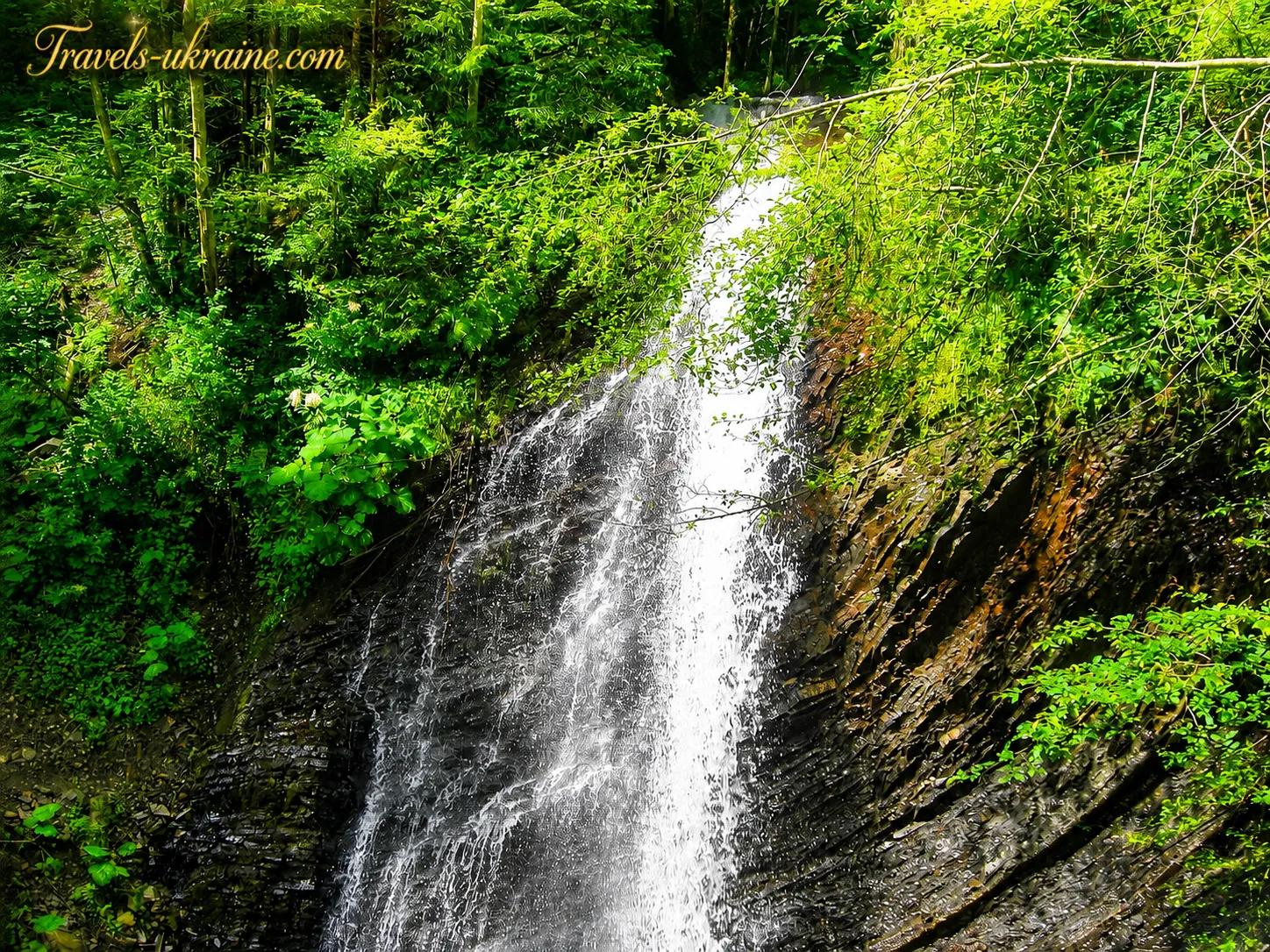
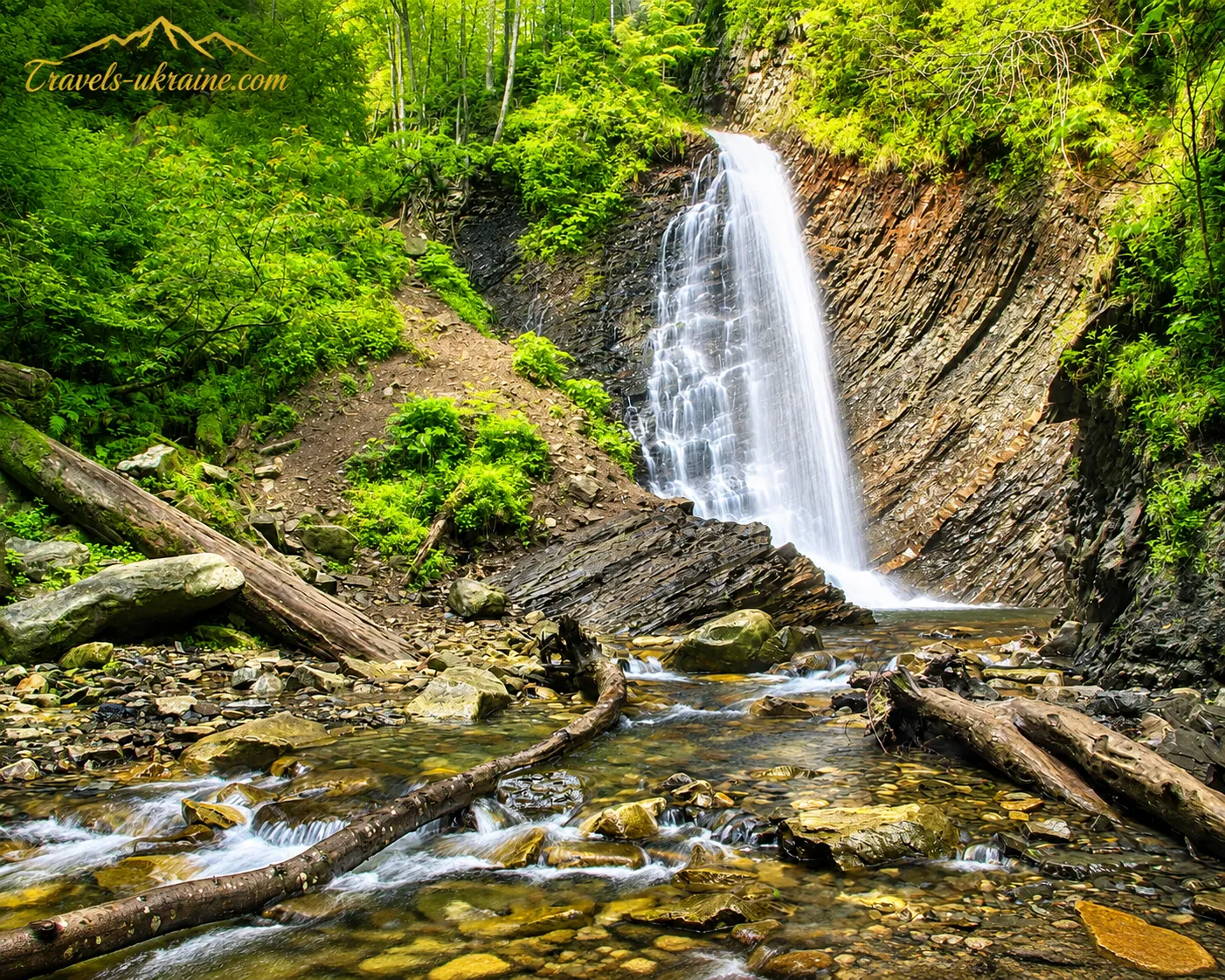
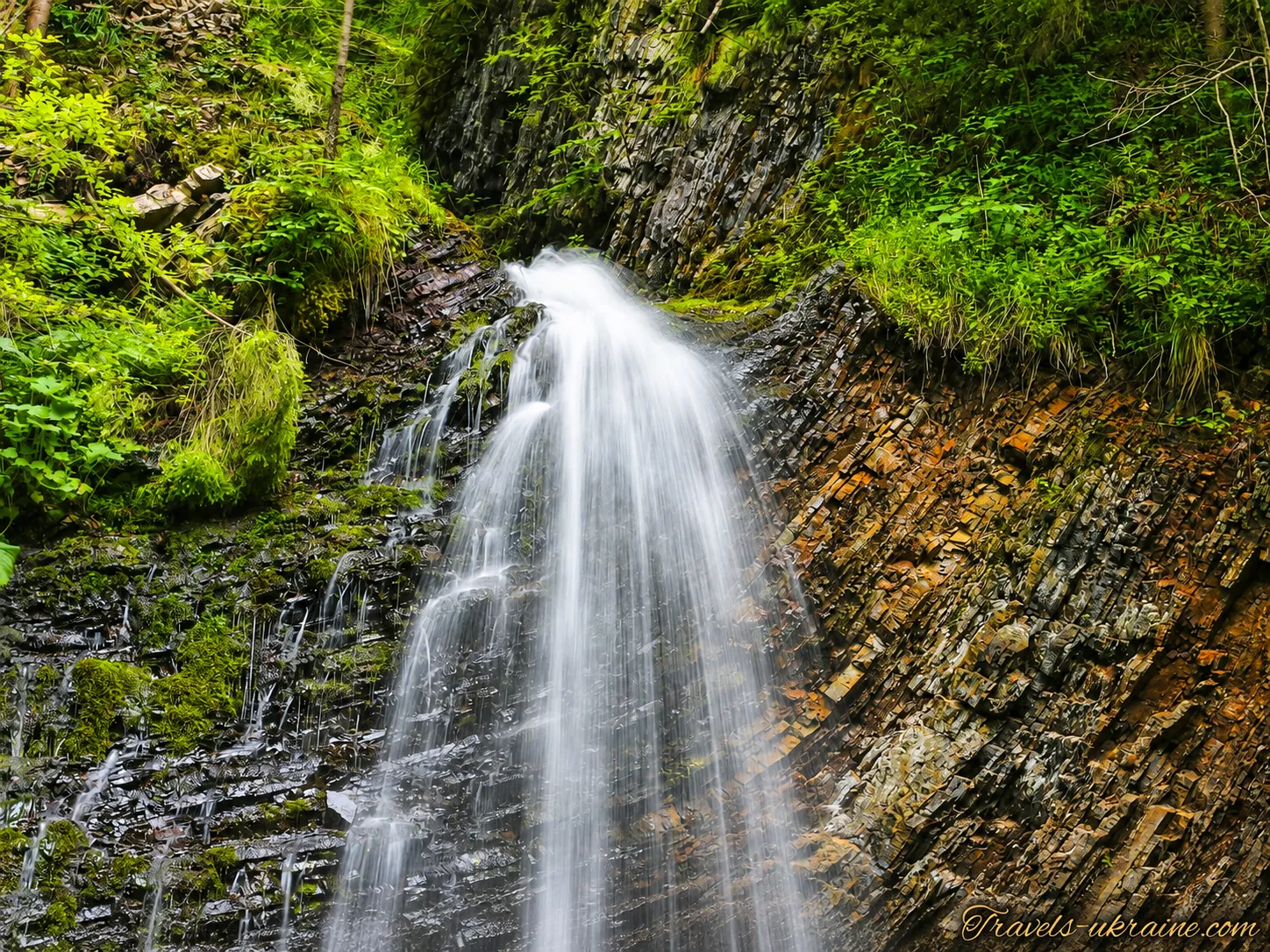
The main natural feature of Zhenetskyi Huk is the almost vertical drop of water from a rocky ledge. The main stream plunges from the cliff in a continuous column, while thinner threads of water appear beside it after rainfall. In the lower part of the cascade, the water crashes against the rocks, creating spray and a light, cool mist that is especially noticeable in warm weather.
A Steep Cascade in a Mountain Gorge
Huk Waterfall in the Carpathian Mountains is one of the Carpathians’ vertical waterfalls. Unlike long rapids, where water descends over several low steps, here it abruptly overcomes a significant difference in elevation. As a result, even a relatively narrow stream creates a powerful sound and a striking falling-water display.
The waterfall’s form depends on the amount of water in the Zhenets stream. After prolonged rainfall or spring snowmelt, the cascade becomes wider, darker, and more turbulent. During dry periods, the main stream narrows, but the unevenness of the rocky ledge becomes more visible, with the water separating into individual flows. Because of this variability, the same site can look completely different even just a few weeks apart.
The Zhenets Stream and the Power of Mountain Water
The waterfall near the villages of Mykulychyn and Tatariv is part of the broader water system of the Carpathian National Nature Park. The Zhenets collects water from the surrounding slopes and carries it to the Prut. Its flow depends on precipitation, snowmelt, and numerous small streams descending from the mountain slopes.
In dry weather, the stream may seem calm, but its character changes quickly after heavy rain. The water gathers speed, carrying small stones, branches, and forest debris. This ability of mountain streams to intensify suddenly explains why the Zhenets riverbed, its banks, and the approach to the waterfall are constantly subject to natural change.
Why Is Huk Waterfall So Loud?
The rumble is caused not only by the height of the drop. The stream strikes an uneven rocky base, breaks into countless jets, and creates continuous vibrations in the air. The narrow valley and steep slopes partially reflect the sound, making it seem even stronger near the cascade. This acoustic feature is precisely what made the name «Huk» so apt. This truly is a place where the Carpathians speak with the voice of water: at first, the traveler hears a muffled sound in the forest, and on the final stretch of the route it becomes a deep, almost continuous rumble.
The Carpathian Forest Around Zhenetskyi Waterfall
The road to Zhenetskyi Huk Waterfall passes through a characteristic Carpathian forest. The surrounding woodlands combine spruce, fir, and beech, while the lower layers of vegetation include ferns, mosses, grasses, and woodland shrubs. In shaded areas, moisture remains longer, so tree trunks, stones, and stream banks are often covered with rich green moss.
The forest performs an important natural function: it retains some precipitation, reinforces the soil with its roots, and softens sharp temperature fluctuations. Even on a hot day, it is cooler beneath the canopy, while near the stream the air feels fresh and humid. It is this combination of forest, rocks, and water that creates the atmosphere drawing nature-tourism enthusiasts here.
How Picturesque Huk Waterfall Changes Throughout the Year
Each season reveals a different character of Zhenetskyi Huk. The cascade’s water level, the color of the surrounding forest, the air temperature, and the condition of the hiking trail are constantly changing. Therefore, the choice of season affects not only the photographs but also the overall impression of the journey.
- In spring, the stream grows stronger thanks to snowmelt and precipitation, so the waterfall often looks most powerful and loud.
- In summer, the surrounding forest becomes dense and green, while the coolness near the water is especially pleasant on hot days.
- In autumn, yellow, copper, and crimson leaves create a striking backdrop for the white cascade and dark rocks.
- In winter, some of the water freezes, forming icicles and ice formations on the ledges, although the stream often continues flowing beneath them.
The waterfall looks most impressive after a period of moderate rainfall, when the stream is full but the route remains passable. During heavy downpours, floods, or sudden warming, it is best to avoid approaching the riverbed, since water levels in the mountains can change much faster than in lowland areas.
Zhenetskyi Huk as a Geomorphologically Valuable Natural Feature
The Carpathian National Nature Park classifies Zhenetskyi Huk as a geomorphologically valuable site. The waterfall clearly demonstrates how mountain water interacts with the terrain: eroding weaker sections of rock, transporting sediment, deepening the riverbed, and gradually reshaping the rocky ledge.
That is why this Carpathian waterfall should be viewed as more than a picturesque place for photographs. Visitors encounter a living natural process that did not end when the cascade was formed. Water continues to shape the Zhenets riverbed, while every flood, frosty season, or rockfall leaves new traces in the surrounding landscape.
Zhenetskyi Huk Waterfall: Route Duration and Difficulty
An excursion to Zhenetskyi Huk Waterfall is one of the easier Carpathian walks and requires no special equipment or mountaineering experience. The official educational ecological trail, «Zhenets Tract — Huk Waterfall,» is approximately 4.75 kilometers long one way. Thus, the complete hiking route to the waterfall and back is about 9.5 kilometers.
Carpathian National Nature Park rates the route as easy, with an estimated one-way walking time of about two hours. The actual duration depends on the starting point, the group’s pace, the number of stops, road conditions, and the weather. For an unhurried visit including photography, a break by the stream, and time to admire the waterfall itself, it is advisable to allow at least four to five hours.
Brief Overview of the Route to Zhenetskyi Waterfall
- Location type: natural landmark, mountain waterfall, and educational nature trail within Carpathian National Nature Park.
- Route length: approximately 4.75 km one way from the start of the official nature trail.
- Total distance: approximately 9.5 km to the waterfall and back.
- Walking time: approximately 3.5–5 hours, including the return journey, stops, and rest.
- Difficulty level: easy in dry weather, although slippery surfaces, snow, or heavy precipitation can make the route more challenging.
- Best way to visit: a walk, a family getaway in the Carpathians, nature tourism, or a leisurely day trip.
- Recommended season: from late spring through autumn; winter visits require suitable footwear and caution.
Who Will Enjoy the Walk to Zhenetskyi Waterfall
The route to Zhenetskyi Waterfall is suitable for most physically fit travelers who can walk for several hours along forest and dirt roads. Much of the route has no steep climbs, so the walk is generally easier than ascending a Carpathian peak. However, this is not an urban promenade: after rain, the road may have puddles, wet rocks, and eroded sections, while winter can bring icy conditions and deep snow.
For families with children, this excursion to Huk Waterfall can be a wonderful introduction to hiking routes in the Carpathians. A child’s age should be assessed not formally, but according to their stamina and willingness to walk several kilometers each way. Young children may need frequent breaks, and using a stroller on dirt and damaged sections can be inconvenient.
Older people and travelers with limited mobility should take into account the total distance, uneven surfaces, and the lack of a completely accessible approach to the waterfall. Even an easy hiking route can prove tiring if you walk quickly, set out in hot weather, or fail to bring enough drinking water.
Budget for a Getaway to Zhenetskyi Huk Waterfall
A basic walk to Zhenetskyi Waterfall does not require significant expenses. The main unavoidable cost is the fee for visiting the educational nature trail. Carpathian National Nature Park’s rates may change, so the current price should be confirmed directly before the trip.
The overall budget should also include travel to the Zhenets tract, parking if available, food, drinks, and souvenirs. Food stands and eateries operate near the waterfall, but their opening hours and selection depend on the season. The most economical option is to arrive by private or public transport, bring water and a light snack, and walk the entire route.
Estimated Budget Options for a Trip to Huk Waterfall
A minimum budget covers admission to the nature trail, independent travel, and your own snack. An average budget includes additional expenses for parking, lunch near the route, and locally made products. An extended option may include a transfer, a guide’s services, an organized excursion, or combining Zhenetskyi Huk with other tourist attractions in the Yaremche area.
When planning, it is important not to focus solely on the admission fee. Comfortable footwear, extra water, rain protection, and sufficient time for the return journey matter far more for a comfortable trip than saving a few dozen hryvnias. A well-organized getaway to Zhenetskyi Huk Waterfall remains affordable while also providing a complete sense of traveling in the Carpathians.
Events and Festivals Near Zhenetskyi Huk Waterfall
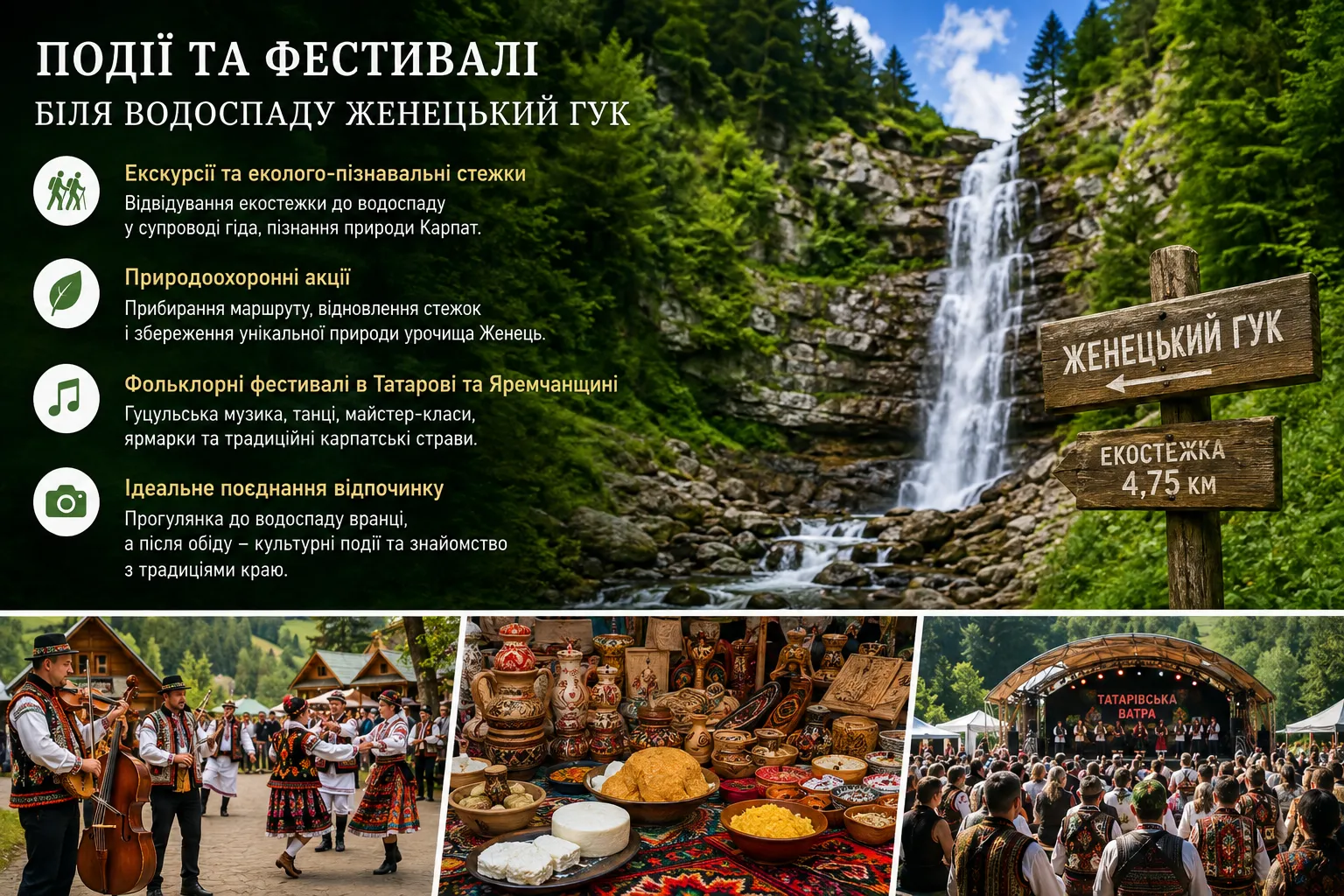
Huk in the Carpathians is primarily a natural landmark, not a festival venue. No permanent annual celebration with established dates, a large stage, and mass entertainment is held directly beside the waterfall. This approach helps preserve the natural character of the Zhenets tract and prevents excessive pressure on the mountain ecosystem.
At the same time, a trip to the waterfall can be combined with cultural events in the Yaremche area, seasonal celebrations in Tatariv, Mykulychyn, and neighboring Carpathian communities. At different times of year, these places host folk craft fairs, performances by folklore groups, gastronomic events, workshops, and festive programs dedicated to Hutsul traditions.
Excursions and Conservation Events on the Route to Huk Waterfall
Carpathian National Nature Park organizes guided visits to the «Zhenets Tract — Huk Waterfall» educational nature trail. Such an excursion offers an opportunity to see not only the waterfall itself, but also to better understand the features of mountain streams, forest ecosystems, the local terrain, and the rules of conduct in a protected area.
The route also hosts environmental initiatives involving road clearance, bridge reinforcement, site cleanups, and the restoration of damaged sections. In different years, park employees and volunteers have cleared fallen trees from the Zhenets riverbed, repaired the approach to the waterfall, and addressed the effects of floods and rockfalls. These activities do not always take the form of public tourist events, but they play an important role in preserving the site. Thanks to conservation work, the route to Huk Waterfall remains accessible, while the surrounding forest and mountain stream suffer less from the effects of mass visitation.
Folk Festivals in Tatariv and the Yaremche Area
One of Tatariv’s well-known cultural events was the regional folklore and ethnographic festival «Tatarivska Vatra». Its program introduced guests to Hutsul music, dances, folk crafts, traditional clothing, and local cuisine. Such celebrations help visitors see the Carpathians not only as a picturesque natural region, but also as a place with a living culture and distinctive customs.
Because festival programs, venues, and dates may change, it is unwise to plan a trip based solely on old posters. Before traveling, check current announcements from the local community, tourist information centers, and event organizers.
How to Combine an Excursion to Zhenetskyi Huk Waterfall with a Festival
The most convenient option is to visit the waterfall in the first half of the day and head to an event in Tatariv, Mykulychyn, or Yaremche after returning. This schedule allows you to complete the trail without rushing, spend time by the waterfall, and avoid returning along the forest road after dark.
On major festival days, the number of cars in the Yaremche area increases, and accommodation and popular venues may be busy. It is therefore advisable to book overnight accommodation in advance, set out on the route earlier, and allow extra time for travel between settlements.
The festival atmosphere should not be brought directly to the waterfall: do not play loud music, leave decorations, light fires, or hold large feasts beside the riverbed. A getaway in the Carpathians should remain peaceful and safe, because the main attraction here is nature itself—the roar of the stream amid the Carpathian forest, the coolness of the gorge, and the constant movement of the water.
What to Visit Near Zhenetskyi Huk Waterfall
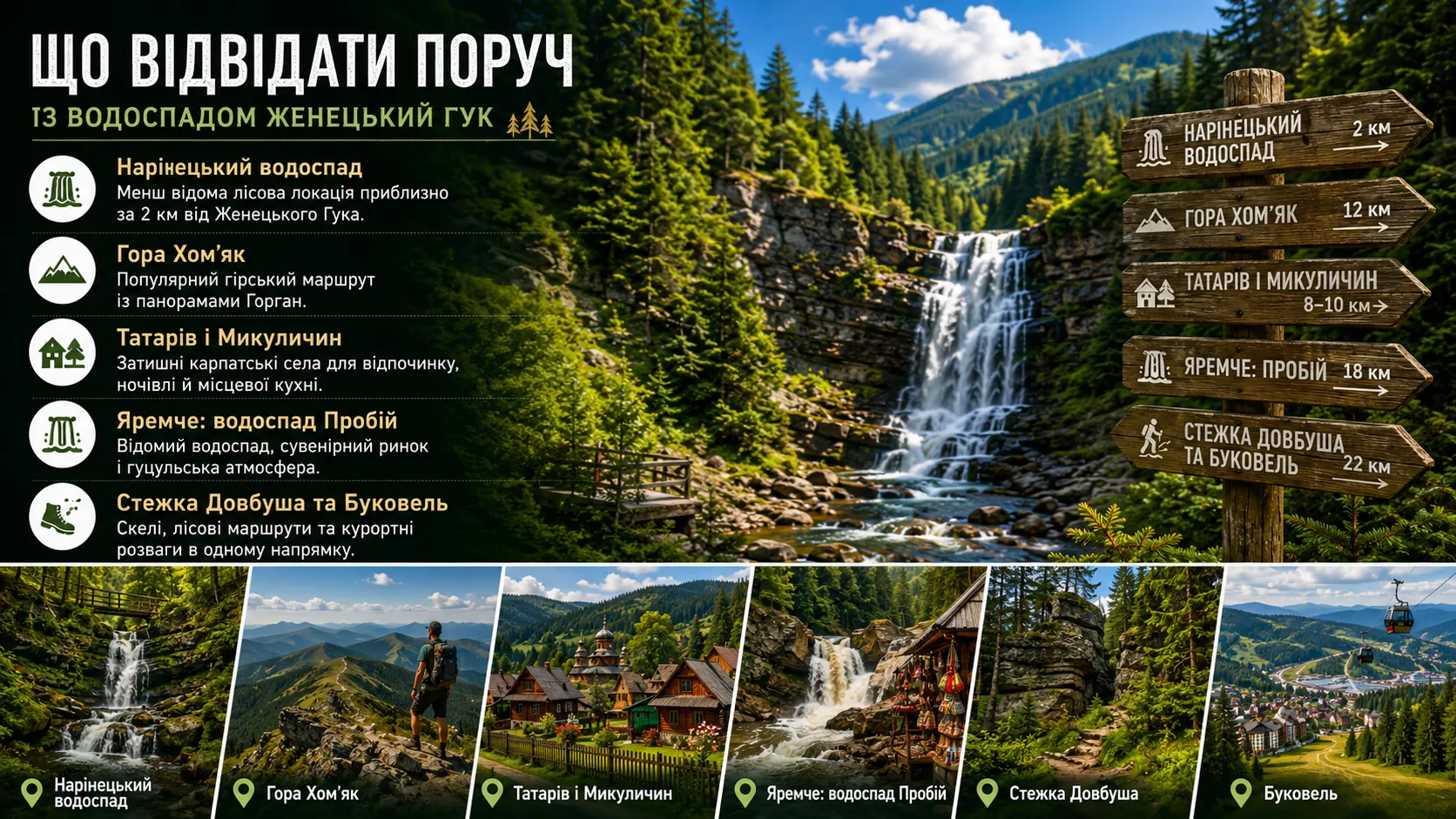
The roaring stream amid the Carpathian forest lies in a convenient part of Ivano-Frankivsk Oblast for travelers—between Tatariv, Mykulychyn, Yaremche, and Bukovel. This makes it easy to combine a walk through the Zhenets valley with a mountain hike, a visit to another waterfall, an introduction to Hutsul culture, or a relaxing break in a Carpathian village.
It is best not to plan an overly packed itinerary. The route to Zhenetskyi Huk Waterfall and back, including stops, takes up a substantial part of the day, so after the walk it is better to choose one or two nearby locations. More demanding mountain routes should be given a separate day.
Narинetskyi Waterfall — A Little-Known Site Near Zhenetskyi Huk
Approximately 2 km from Zhenetskyi Huk lies the lesser-known Narინetskyi Waterfall. Hidden in the Carpathian forest, it does not have an approach as well developed or clearly marked as the popular Huk Waterfall. As a result, it is usually much quieter and attracts fewer tourists.
A visit to Narинetskyi Waterfall should be planned only in dry, stable weather. The trail may be indistinct, slippery, or overgrown in places, so hiking footwear, an offline map, and plenty of time are essential. Families with young children and inexperienced travelers are better off limiting themselves to the main route to Huk.
Mount Khomiak — A Mountain Route Near Huk Waterfall
Active tourism enthusiasts can continue exploring the Gorgany range with a hike to Mount Khomiak. One ascent route begins near the checkpoint on the road to Zhenetskyi Waterfall. From the summit and open sections of the route, you can see the surrounding ridges, mountain meadows, and the distinctive rocky slopes of the Gorgany.
Combining the ascent of Khomiak with a full walk to the waterfall in one day is recommended only for physically prepared hikers. This is no longer an easy excursion along a forest road, but a longer mountain route involving elevation gain. Before setting out, check the weather forecast, the length of daylight, and the current condition of the trail.
Tatariv — The Nearest Carpathian Village to Zhenetskyi Waterfall
Tatariv is the closest settlement to the Zhenets tract. The village is a convenient place to stay overnight or a starting point for trips around the Yaremche area. It has guesthouses, hotels, eateries, and small shops where you can replenish your supplies before setting out on a hiking route.
Tatariv is well suited to travelers seeking a quieter atmosphere than that of the large resorts. After a walk to the waterfall, you can relax by the Prut, sample Carpathian dishes, and plan your next route toward Vorokhta, Yaremche, or Bukovel.
Probii Waterfall and the Souvenir Market in Yaremche
In Yaremche, it is worth seeing Probii Waterfall, one of the most powerful waterfalls in the Ukrainian Carpathians. It formed on the Prut River where erosion-resistant rock reaches the surface. Here, the water does not fall vertically as it does at Zhenetskyi Huk, but surges between large boulders.
Near Probii are a pedestrian bridge, a souvenir market, and a well-known Hutsul cuisine restaurant. This part of Yaremche is considerably busier and more active than the Zhenets tract, offering a different kind of Carpathian getaway—with a fair, crafts, eateries, and urban tourist infrastructure.
Dovbush Trail — Rocks, Forest, and Carpathian Legends
Near Yaremche runs the Dovbush Trail, a loop route through forest and rocky outcrops of Yamnа sandstone. Its name is associated with Oleksa Dovbush and Carpathian tales about the opryshky movement. The main trail is approximately 2 km long, and walking it at a leisurely pace takes about two hours.
The route pairs well with a trip to Zhenetskyi Waterfall: Huk showcases the power of mountain water, while the Dovbush Trail reveals unusual rock formations, forest terrain, and the folklore of the Yaremche region. Both locations can be visited in a single day only with an early start and favorable weather.
Bukovel — resort relaxation after a trip to Huk Waterfall
Bukovel can be added to the itinerary for those who want to end the day in a resort atmosphere. In winter, visitors come here for skiing, while during the warmer months they come for walks, scenic chairlifts, entertainment venues, and mountain panoramas.
The list of attractions, opening hours, and prices varies by season, so current information should be checked before the trip. After a long walk to the waterfall, it is better to choose a relaxed form of recreation rather than trying to fit all available activities into one day.
For a first introduction to the region, you can combine the waterfall with Tatariv or Mykulychyn, and visit Yaremche or Bukovel in the evening. This itinerary does not require a difficult mountain crossing and is suitable for a family trip.
Active travelers are better off dedicating a separate day to Khomyak, the mountain meadows, or the Yavirnyk ridge. Narineцьkyi Waterfall should also be treated as a separate additional destination rather than a mandatory short stop. Sensible planning will allow you to see more without rushing, becoming overtired, or risking a return after sunset.
Tourist infrastructure near Zhenetskyi Huk Waterfall
Zhenetskyi Huk Waterfall is located in a mountain tract, but the route to it is not entirely wild or far from civilization. A checkpoint of the Carpathian National Nature Park operates near the start of the ecological trail, rest areas have been arranged along the road, and souvenir stalls and a venue serving Carpathian dishes can be found near the cascade itself.
At the same time, you should not expect the infrastructure of an urban tourist complex. Part of the route runs along an unpaved road, mobile service may be unreliable, and the availability of certain services depends on the season, weather, and number of visitors. It is best to prepare everything necessary for the walk in advance: water, rain protection, medication, and a charged phone.
By car, you can travel along a secondary road toward the Zhenets tract. After the checkpoint, driving may be possible on a particular section, but the road surface is damaged in places, and the narrow road makes it difficult for oncoming vehicles to pass.
The availability of parking spaces depends on the day of the week and the season. Many tourists arrive on summer weekends, holidays, and during the golden autumn season, so it is better to set out in the morning. The car should be left only where it does not block traffic, obstruct emergency vehicles, or damage the roadside or forest vegetation. Do not assume that having your own car will let you drive directly to the cascade. The main value of the trip lies in walking through the Zhenets valley, while traffic restrictions help reduce the pressure on the natural area.
Roads, footbridges, and rest areas in the Zhenets tract
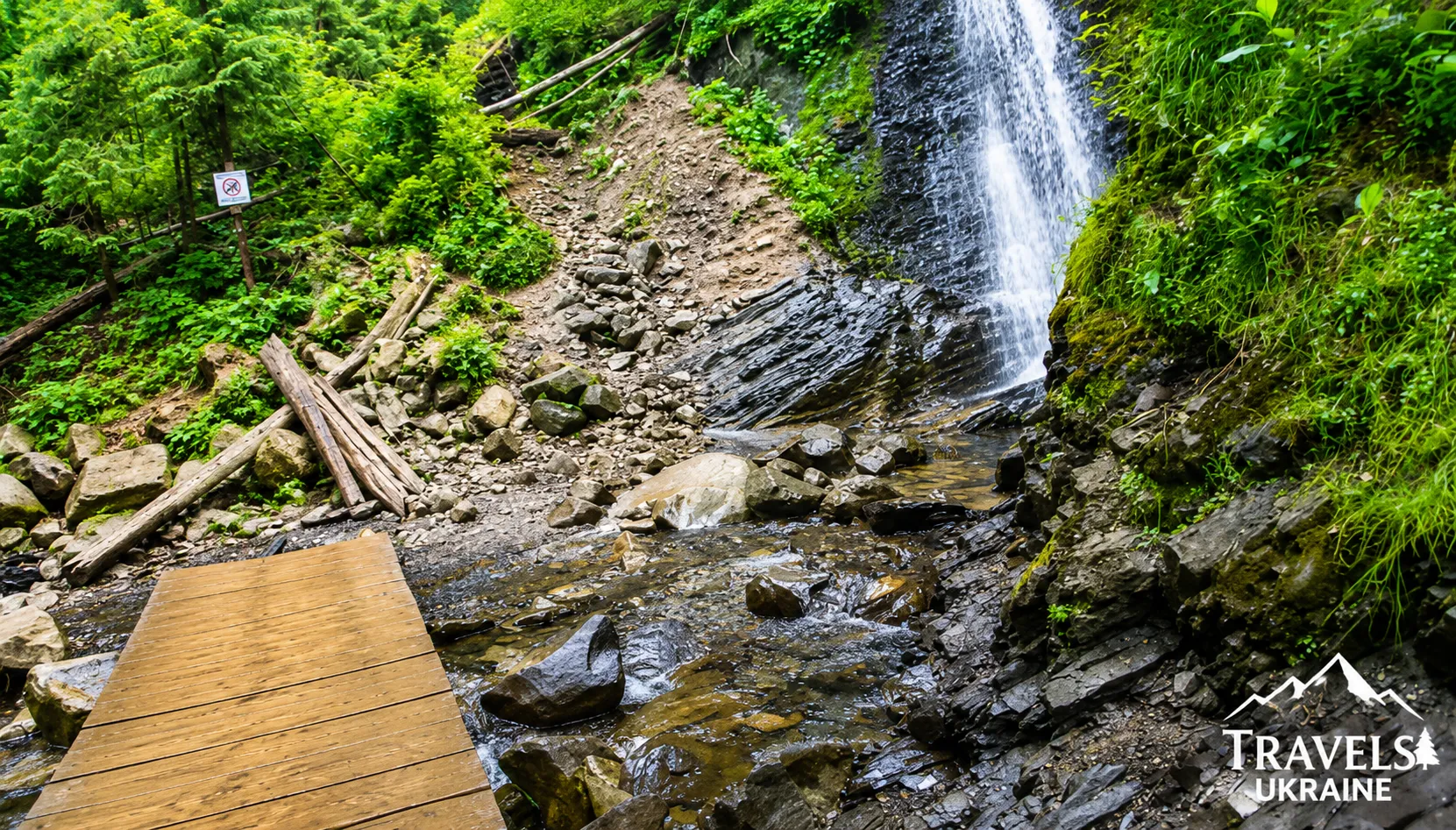
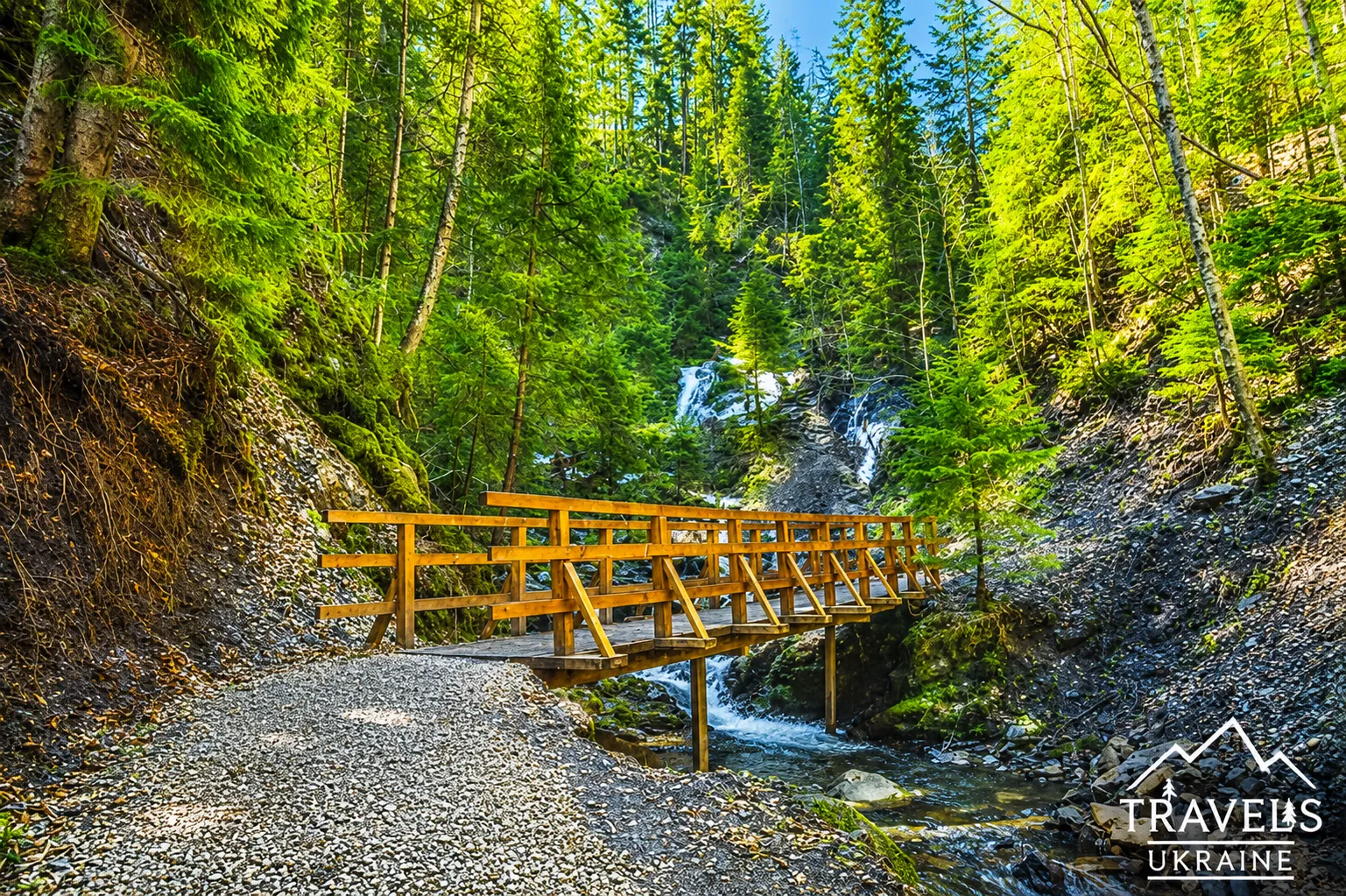
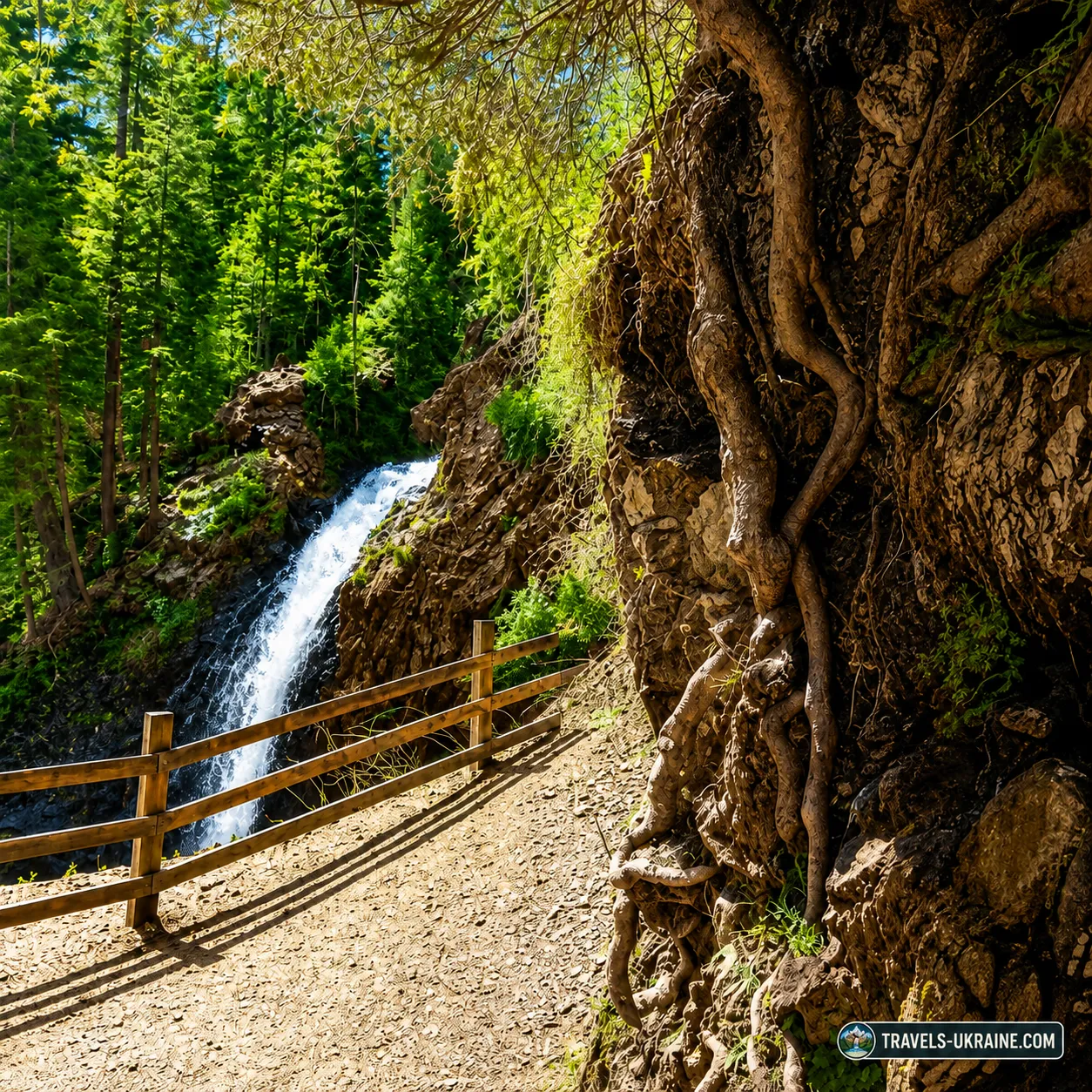
The initial part of the road has a firmer surface, but farther on the asphalt ends and the route becomes unpaved and rocky. Wooden footbridges cross streams and sections of the riverbed. After heavy rain, the surface may be wet, washed out, or slippery.
There are places along the route where you can stop, rest, and have a snack. Approximately one kilometer in, there is a picturesque clearing near a small cascade. It is suitable for a short break, especially during a family walk or a trip with children.
Established recreation areas do not mean that litter can be left on tables, near benches, or in the forest. All packaging, bottles, napkins, and food scraps should be taken with you if there is no suitable container nearby.
Koliba café and food near Zhenetskyi Huk Waterfall
A koliba café operates near the waterfall and may offer tourists traditional Carpathian dishes and hot drinks. It is a convenient option after a long walk, especially in cool or rainy weather. The establishment’s opening hours, menu, and payment methods may depend on the season. Therefore, you should not set out without water and at least a small snack of your own. Sandwiches, dried fruit, nuts, or other foods that do not require special storage and do not create much waste are suitable for the walk.
Frequently asked questions about Zhenetskyi Huk Waterfall
Where is Zhenetskyi Huk Waterfall located?
Zhenetskyi Huk Waterfall is located in the Zhenets tract within the Carpathian National Nature Park in Ivano-Frankivsk Oblast. The nearest settlements are Tatariv and Mykulychyn. The waterfall formed on the Zhenets mountain stream, a left tributary of the Prut.
How do you get to Zhenetskyi Waterfall?
To reach the trailhead, follow the road between Mykulychyn and Tatariv, then turn toward the Zhenets tract, following the tourist signs. The official ecological educational trail begins near the checkpoint of the Carpathian National Nature Park. It is recommended to walk most of the way to the waterfall.
How far is it to Zhenetskyi Huk Waterfall?
The official «Zhenets Tract — Huk Waterfall» route is approximately 4.75 km one way. The full walk to the cascade and back is about 9.5 km. The actual distance may vary depending on where the car is parked or where the route begins.
How long does the walk to Zhenetskyi Waterfall take?
Walking the route one way usually takes about two hours. For the journey to the waterfall and back, photography, short stops, and rest near the cascade, it is advisable to allow approximately four to five hours. Families with children and travelers walking at a leisurely pace may need more time.
How difficult is the route to Huk Waterfall?
The route to Huk Waterfall is considered easy and does not require mountaineering equipment. Much of the road follows the valley without a steep elevation gain. However, after rain, during snowfall, or in icy conditions, the rocky and unpaved surface becomes slippery, so sturdy shoes with a good tread are necessary.
Do you have to pay to visit Zhenetskyi Huk?
The route passes through the Carpathian National Nature Park, so a recreational fee is charged for visiting the ecological trail. The amount may change, so current prices for adults, children, and eligible groups should be checked on the park’s official website or directly at the checkpoint before starting the walk.
When is the best time to visit Zhenetskyi Huk Waterfall?
The waterfall is usually at its fullest in spring and after moderate rainfall. In summer, the route attracts visitors with its green forest and coolness; in autumn, with its vivid colors; and in winter, with its ice formations. For a first trip, the most convenient time is a dry day from late spring to mid-autumn.
Is the walk to Zhenetskyi Waterfall suitable for children?
The route is suitable for children who can walk several kilometers along a mountain road. The total distance should be taken into account, regular breaks should be planned, and children should not be left unsupervised near the stream or wet rocks. An ordinary city stroller may be inconvenient because of the uneven surface, puddles, and rocky sections.
Can you drive directly to the waterfall?
Driving to the cascade itself should not be considered guaranteed or recommended. The road beyond the checkpoint is narrow and damaged in places, and driving rules may change depending on the condition of the route. The most reliable option is to leave the car in an authorized location and continue on foot.
Can you swim at Zhenetskyi Huk Waterfall?
Zhenetskyi Huk is not an equipped swimming area. The stream falls with great force, the water remains cold even in summer, and the rocks at the base are constantly wet and slippery. For safety reasons, do not go under the cascade, cross the turbulent stream, or climb onto rocky ledges.
Zhenetskyi Waterfall — a journey that leaves the Carpathians in your heart
Zhenetskyi Huk Waterfall is one of those places you visit for the beautiful scenery but return from with much deeper impressions. At first, an ordinary mountain road leads you through trees, small streams, rocks, and cozy clearings. Then, somewhere ahead, a muted rumble begins to rise. The closer you get, the more powerfully it fills the space, until at last, beyond the forest, a mighty torrent comes into view, plunging from the cliffs.
In this moment, it becomes clear why the waterfall was named Huk. You do not simply see it—you feel it with your whole body. The roar of the water echoes off the slopes, cool spray touches your face, and the familiar noise of your thoughts gradually fades away. Faced with the power of the Carpathians, you want to stop, at least for a little while, put your phone aside, and simply watch as the water relentlessly overcomes the rocky ledge.
This powerful stream, plunging from the rocks, needs no embellishment. Its strength lies in its authenticity: in the wet, dark rocks, the dense forest, the cold stream, and the deep sound of the water. Here, nature does not try to please the traveler—it simply lives by its own laws. That is why Zhenetskyi Huk leaves an impression both on those visiting the Carpathians for the first time and on experienced hikers. For some, it becomes an introduction to hiking routes; for others, a welcome return to the mountains; and for others still, a place where they can finally slow down and rest—not only physically, but inwardly as well.



No Comment
You can post first response comment.