
 English
 Українська
 Latviešu
 Lietuvos
 Polski
 Português
 Română
 Русский
 Српски
 Slovenčina
 Slovenščina
 Español
 Svenska
 Türkçe
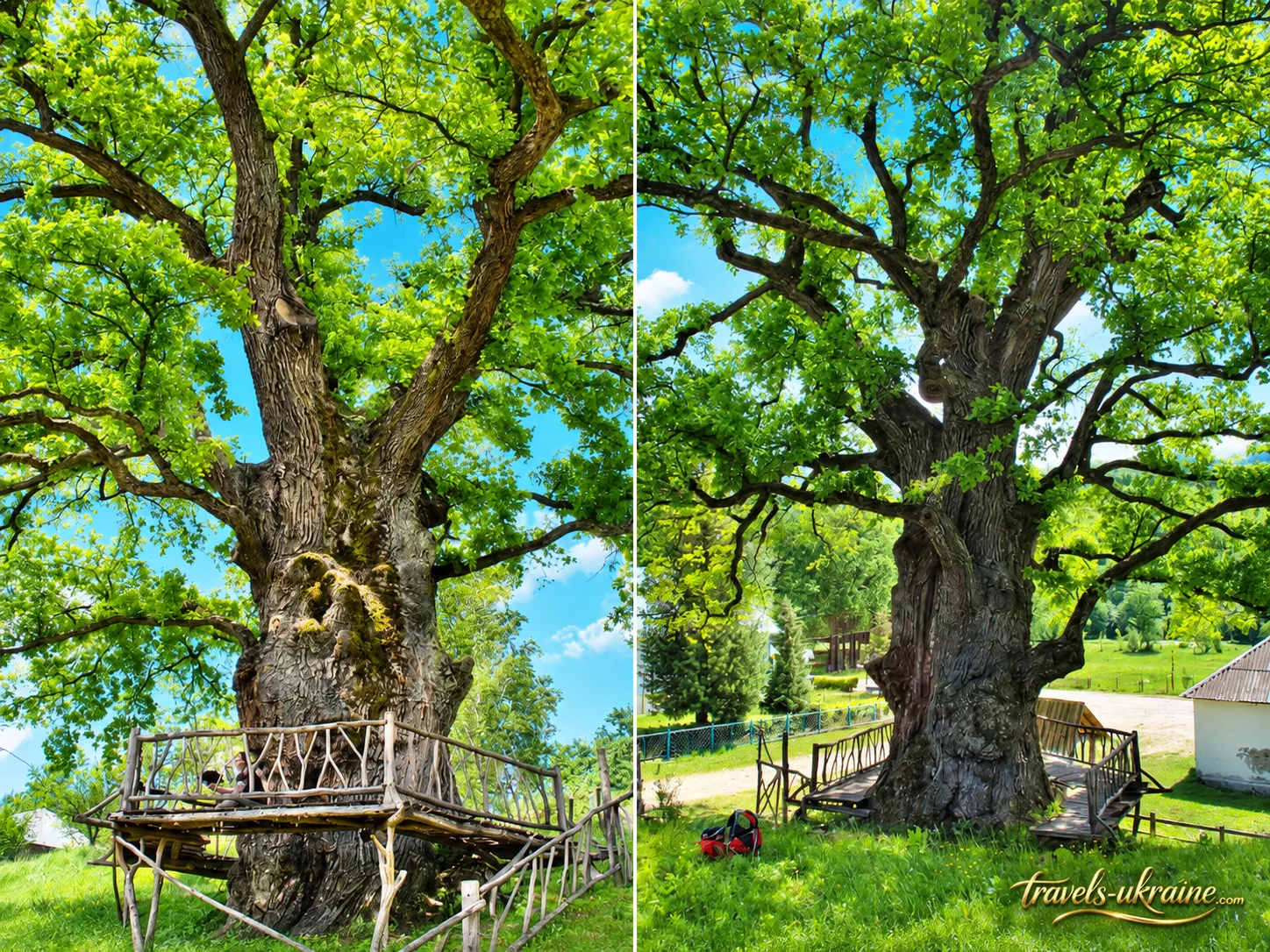
The Carpathians have no shortage of places where people feel small: high mountains, ancient primeval forests, and rocks between which rivers have carved their paths for thousands of years. But in the Zakarpattia village of Stuzhytsia, you do not even need to climb to a summit to feel that way. All you have to do is stand beside an oak and try to take in its trunk.
It is here, within the Uzhanskyi National Nature Park, that the famous Grandfather Oak and Champion Oak grow—trees that the park’s official website describes as among the oldest in Ukraine. Their trunks are so massive that photographs rarely convey their true scale. Until a person stands beside one, the oak simply looks large. Then it suddenly becomes clear that «large» was a very modest description.
They have long been called the millennia-old oaks of Stuzhytsia. The name is beautiful, easy to remember, and immediately sets the imagination running: princes, the Middle Ages, ancient Carpathian settlements, and generations of people who were born and disappeared while the tree continued standing in the same place. But the age of old trees presents one problem—the oak does not show its passport, and so far no one has managed to ask it directly.
The older a tree is, the harder it becomes to determine its year of birth. Part of the trunk may be damaged, the heartwood may be gone, and different assessment methods may produce different results.
So next we will look separately at how old Grandfather Oak and Champion Oak really are, where the figures of a thousand and even more than a thousand years came from, and how seriously they should be taken. Yet even if we forget the numbers for a few minutes, these trees are fascinating in their own right. Huge trunks with deep cracks in the bark, old hollows, massive branches, and crowns that have survived countless winters, storms, and Carpathian winds look nothing like oaks in an ordinary city park. A trip to the oaks, then, is not about arriving, photographing two trees, and ticking «seen» off a list five minutes later. The most interesting part begins when you grasp the scale of time standing before you.
People had time to redraw borders, build and destroy states, lay roads, and invent cars, airplanes, and smartphones, while this oak spent all that time doing roughly the same thing: growing. And judging by the result, it did so rather convincingly. That is why the millennia-old oaks in Stuzhytsia are interesting even to those who would not normally plan travel routes around «going to look at a tree.» This is about more than botany. It is a rare case in which history can be seen not on a museum plaque but literally in the bark, cracks, and enormous trunk before you.
Now let us get to the most interesting questions: do the Stuzhytsia oaks really remember a time a thousand years ago, which one is older, and how can the age of a tree be determined when no one is going to saw through its heartwood just to satisfy tourists’ curiosity?
How Old Are the Oaks of Stuzhytsia, and What Makes Them Truly Special?
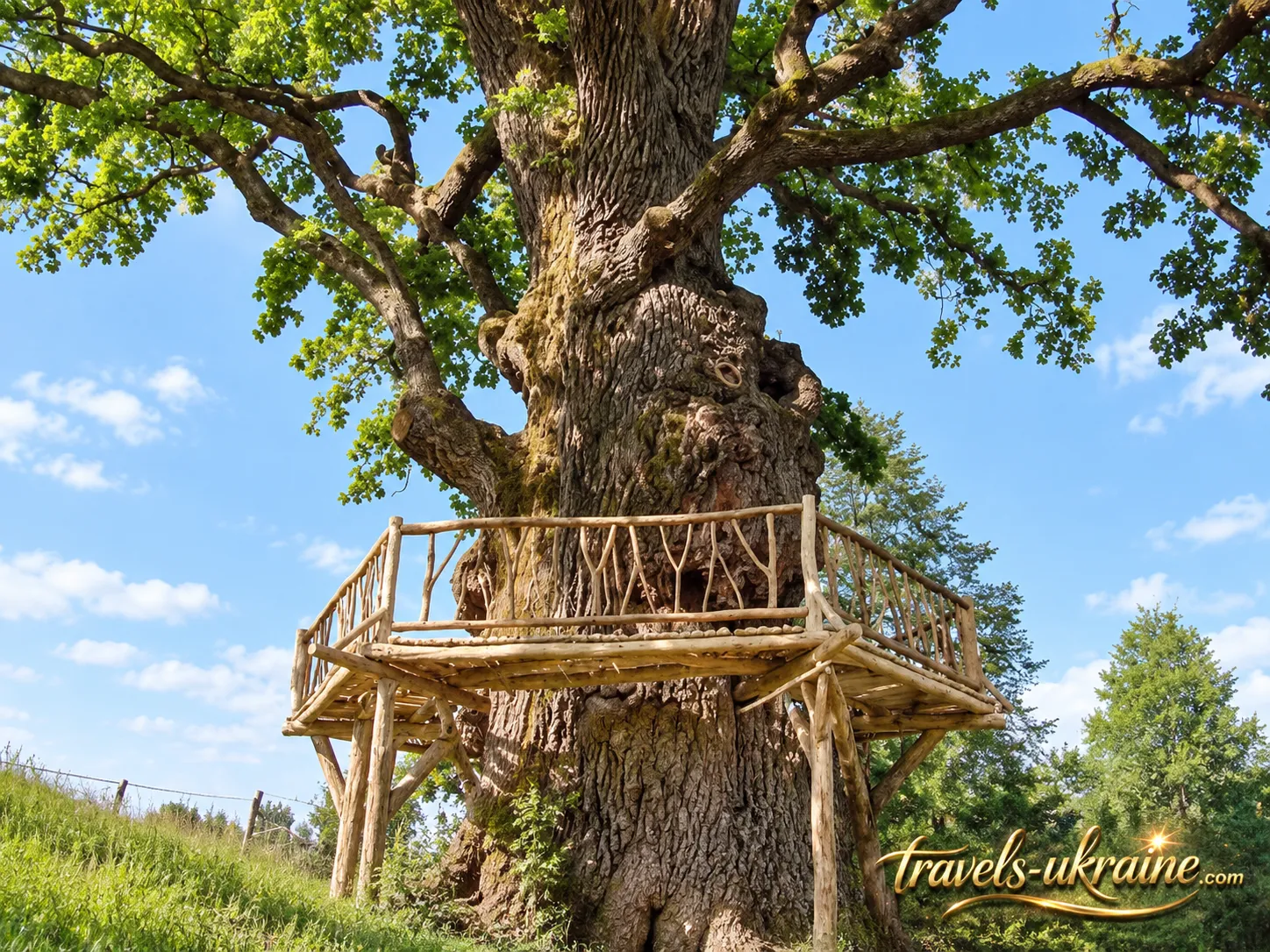
Let us start with the key question: are the oaks in Stuzhytsia really more than a thousand years old? If we go by data from Uzhanskyi National Nature Park, yes. Champion Oak is attributed an age of approximately 1300 years, while Grandfather Oak is estimated to be 1100–1200 years old. But there is one important word here—“estimated.” No one can say that Champion Oak sprouted, for example, on a Tuesday in the spring of 726. With living trees this old, determining an exact age is often nearly impossible. It is therefore better to regard the figure of 1300 years not as an entry on a birth certificate, but as a scientific and conservation-based estimate of the tree’s age.
Champion Oak: Ukraine’s Oldest Oak
The main record-holder of Stuzhytsia is considered to be Champion Oak. Uzhanskyi Nature Park calls it Ukraine’s oldest oak and estimates its age at approximately 1300 years. Even without that figure, the tree makes a remarkably convincing impression. Its trunk has a circumference of about 9.6 metres, and it is approximately 25 metres tall. Circumference conveys the scale best. In a photograph, a large tree remains simply a large tree, but in person, a trunk of this diameter already feels almost like a separate architectural structure.
To get a rough sense of its scale, try walking around the tree. Almost ten metres is no longer the kind of oak one person can romantically hug for a photograph. You will need a small team of like-minded people. Champion Oak’s trunk contains a large fire-scorched hollow. In an ordinary young tree, such a cavity would look alarming, but in ancient oaks, large hollows and the dying-off of some of the wood are entirely typical signs of very advanced age.
Grandfather Oak: Slightly Younger, but No Less Impressive
The second famous elder of Stuzhytsia has a much warmer folk name—Grandfather Oak. Uzhanskyi National Park estimates its age at approximately 1100–1200 years.
According to recent materials on the natural landmarks of Uzhanskyi Park, its trunk has a circumference of about 9.1 metres, and it reaches approximately 30 metres in height. So «slightly smaller» is a very relative term here. If Grandfather Oak grew in an ordinary city park without Champion Oak nearby, it would hardly occur to anyone to call it small.
Grandfather Oak grows on a hill in Stuzhytsia and has long been more than a botanical landmark—it is part of local history. A protective sign has been installed beside the tree, and the oak itself is under protection. Its old trunk also has hollows and signs of natural ageing. This is an important point: an old tree is not supposed to look like a perfect young oak from a picture. Huge cavities, dead branches, rough cracked bark, and an uneven crown are precisely part of its age.
How Is the Age of a Tree More Than a Thousand Years Old Determined?
The best-known way to determine a tree’s age is to count its annual rings. It sounds simple until you are faced with a living oak nearly ten metres around that no one intends to cut down merely to satisfy tourists’ curiosity. There is a method of extracting a thin core from the trunk with a special drill, after which the annual rings can be studied. But very old trees present another problem: their central part is often long since hollow or partially destroyed. The oldest layers of wood—the ones that would reveal the tree’s first years—may simply no longer exist.
Experts therefore use a combination of indicators: trunk circumference, growth patterns, the condition of the wood, historical data, and comparisons with other old trees. Even an enormous circumference is not a perfect calendar in itself—the growth rate depends on the soil, climate, light, and dozens of other factors. That is why it is more accurate to say that «Champion Oak’s age is estimated at approximately 1300 years,» rather than «the tree is exactly 1300 years old.»
Still, it would be wrong to regard the word «millennia-old» as mere tourist advertising. Even cautious official sources place both trees in the age category of more than a thousand years. In this case, then, the beautiful name has a thoroughly serious basis.
How Champion Oak Became One of Ukraine’s Oldest Trees
In 2010, Champion Oak gained another reason for its grand name. It became a prize-winner in the nationwide «National Tree of Ukraine» competition, taking third place in the «Oldest Tree of Ukraine» category. For a tree that has stood in one place for more than a thousand years, this is probably the closest equivalent to a sports medal.
The competition itself was held in 2009–2010 by the State Service for Protected Areas of the Ministry of Environmental Protection of Ukraine together with the Kyiv Ecological and Cultural Centre. Its purpose was to find the country’s most remarkable old, historically important, and particularly valuable trees, assess their condition, and draw attention to the need to protect them. As a result, 17 trees were selected and granted the status of nationally significant natural landmarks.
The trees competed not in one overall category but in several: «Oldest Tree of Ukraine,» «Memorial Tree of Ukraine,» «Historic Tree of Ukraine,» and «Aesthetically Valuable Tree of Ukraine.» In other words, the judges considered not only age but also a tree’s connection with historical events and notable people, as well as its natural and aesthetic value.
In its category, Champion Oak was surpassed only by two even older trees from the Nikitsky Botanical Garden in Crimea—an approximately 2000-year-old olive tree and a 1700-year-old pistachio tree. The Stuzhytsia oak, with an estimated age of about 1300 years, took third place. There is an important point here: the competition did not simply hand out attractive titles. One of its aims was to draw attention to the condition of very old trees and the need to preserve them. For such natural long-livers, popularity makes sense only when it helps protect the tree rather than turning it into a tourist attraction that everyone wants to touch, hug, and test for sturdiness.
Champion Oak’s third-place finish, then, is not merely an interesting line in a travel description. It officially established the tree as one of Ukraine’s most remarkable ancient trees and helped make Stuzhytsia known far beyond Zakarpattia.
Frequently Asked Questions About the Millennia-Old Oaks of Stuzhytsia
Where are the millennia-old oaks of Stuzhytsia located?
Champion Oak and Grandfather Oak grow in the village of Stuzhytsia, Uzhhorod Raion, Zakarpattia Oblast, within Uzhanskyi National Nature Park. The trees are located close to one another, so both can be seen during one short walk.
Are the oaks in Stuzhytsia really more than a thousand years old?
Yes, official materials from Uzhanskyi National Nature Park estimate Champion Oak’s age at approximately 1300 years, and Grandfather Oak’s at 1100–1200 years. However, this is an estimate rather than an exact sprouting date: in very old oaks, the central part of the trunk is often damaged or hollow, making it impossible to count every annual ring.
Which oak in Stuzhytsia is the oldest?
Champion Oak is considered the oldest, with an estimated age of approximately 1300 years. Its trunk has a circumference of about 9.6 metres. Grandfather Oak is slightly younger— approximately 1100–1200 years old—and has a circumference of about 9.1 metres. Here, of course, «slightly» must be understood on the scale of trees that have survived more than a thousand winters.
Can you reach the oaks by car?
You can reach the village of Stuzhytsia by car, and the oaks themselves are within the settlement. No demanding mountain hike is required to see them. However, local road conditions may depend on the weather and season, so it is best to take the final part of the route slowly and carefully.
Do visitors need permission from border guards to visit the oaks?
For visiting the oaks themselves in the village of Stuzhytsia, the official website of Uzhanskyi National Nature Park does not specify a separate permit requirement. However, some tourist routes from Stuzhytsia pass through the border zone—in particular, routes toward Mount Kremenets and the Chorni Mlaky tract. A permit must be arranged in advance for such hikes.
How much time is needed to see the thousand-year-old oaks?
If the sole purpose of your trip is to see the Champion Oak and Dido Oak, approximately 30–45 minutes is enough for an unhurried visit and some photographs. You will need considerably more time if you combine the oaks with a walk along one of the routes in Uzhanskyi National Nature Park.
When is the best time to visit the oaks in Stuzhytsia?
The most convenient time to visit Stuzhytsia is from spring through autumn. In summer, the trees have enormous green crowns, while in autumn the old oaks look especially striking amid the Carpathian forests. It is best to choose dry weather for your walk, especially if you plan to continue along the forest trails.
Can you climb into the hollows or onto the trunks of the old oaks?
It is better not to. The thousand-year-old oaks are protected natural objects, while their old hollows and damaged wood are part of living trees and provide habitats for many organisms. For a photograph, simply stand beside one: with a trunk circumference of more than nine metres, the scale in the frame will be more than convincing without any extra acrobatics.
Are the Thousand-Year-Old Oaks in Stuzhytsia Worth Visiting?
The thousand-year-old oaks of Stuzhytsia are not the kind of attraction where tourists spend half a day among dozens of sights. There are no museum halls, souvenir counters, or challenging routes here. The whole essence of the place comes down to two trees—and, strangely enough, that is quite enough. The main impression comes not from the number of things you see, but from the scale of time. Standing beside a tree estimated to be more than a thousand years old feels entirely different from simply reading that figure in a guidebook. For a few minutes, you gain a very clear sense of how brief human history is compared with the life of an old oak.
The Champion Oak and Dido Oak do not look perfect. Their trunks are cracked, there are large hollows inside, and some branches were lost long ago. But that is precisely what makes them interesting. These are not ornamental park trees, but living organisms that have endured winters, storms, diseases, and changes in the surrounding world for centuries.
It is worth coming here if you enjoy quiet natural places and do not need constant entertainment around you. It is enough to walk a little around the trunk, examine the bark, step back a few dozen metres, and appreciate the tree’s size once again. Then simply stand beside it without hurrying. And perhaps that is exactly the right way to experience this place. If, after visiting Stuzhytsia, you find yourself wanting to seek out more places like this, look beyond the best-known peaks, castles and fortresses, and waterfalls. Sometimes a single old lime tree or another tree can tell you just as much about a region as an entire museum.


No Comment
You can post first response comment.