
 English
 Українська
 Български
 Hrvatski
 Čeština
 Dansk
Dansk Nederlands
 Eesti
Eesti Suomi
Suomi Français
 Deutsch
 Ελληνικα
 Magyar
 Íslenska
 Italiano
 Latviešu
 Lietuvos
 Polski
 Português
 Română
 Русский
 Српски
 Slovenčina
 Slovenščina
 Español
 Svenska
 Türkçe
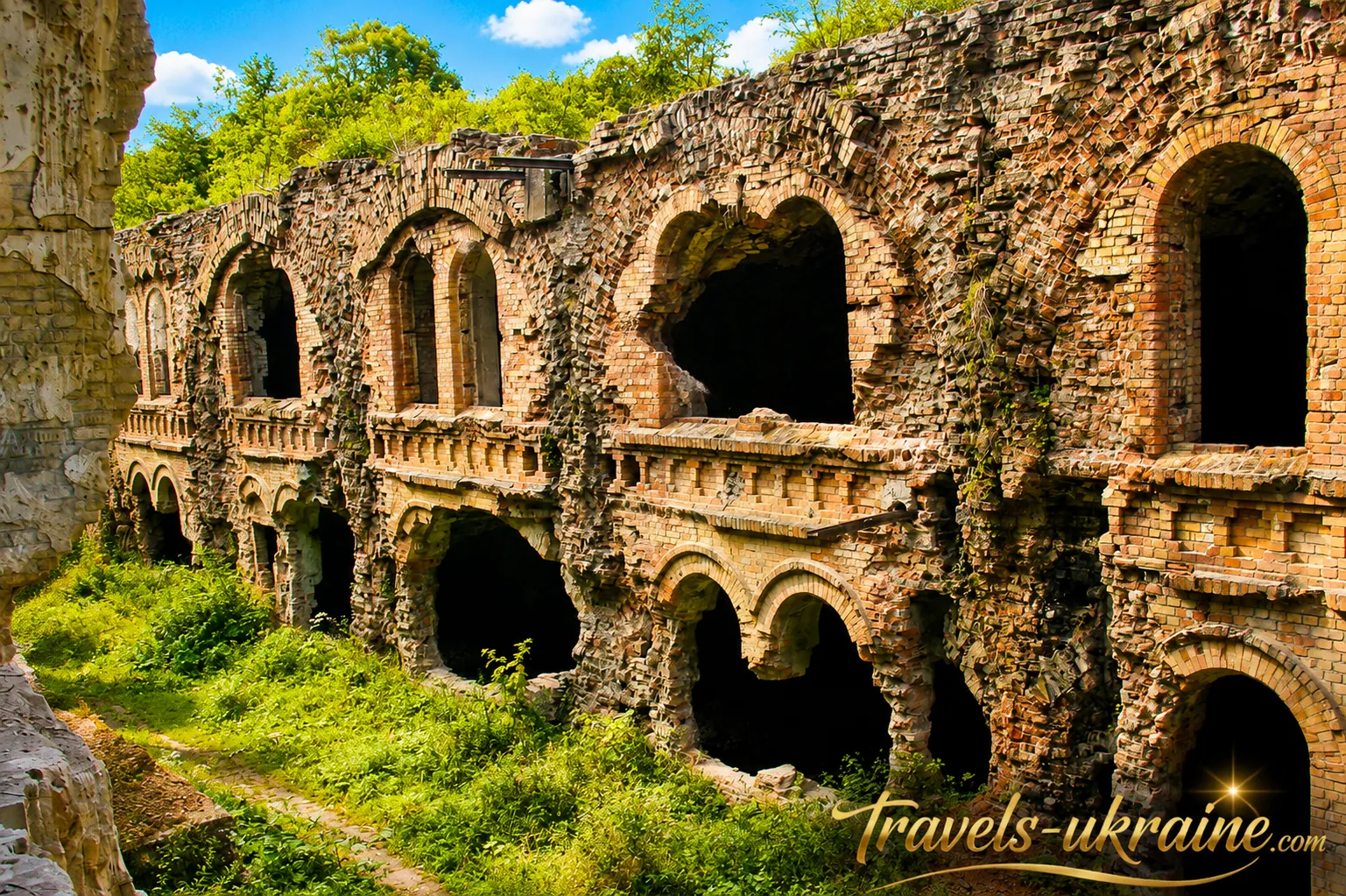
Some places are worth visiting not only for beautiful photographs, but for the feeling of stepping into another time. Tarakaniv Fort is exactly such a place. It does not greet visitors with gleaming restored façades, souvenir stalls or perfectly laid-out avenues. Quite the opposite: everything here rests on silence, old brickwork, damp underground passages, overgrown ramparts and the strange sense that the fortress still remembers the footsteps of soldiers. This abandoned fort near Dubno has long become one of the most atmospheric tourist attractions in Rivne Oblast, drawing travellers, photographers, history enthusiasts, fortification researchers and anyone seeking not an ordinary walk, but a genuine adventure.
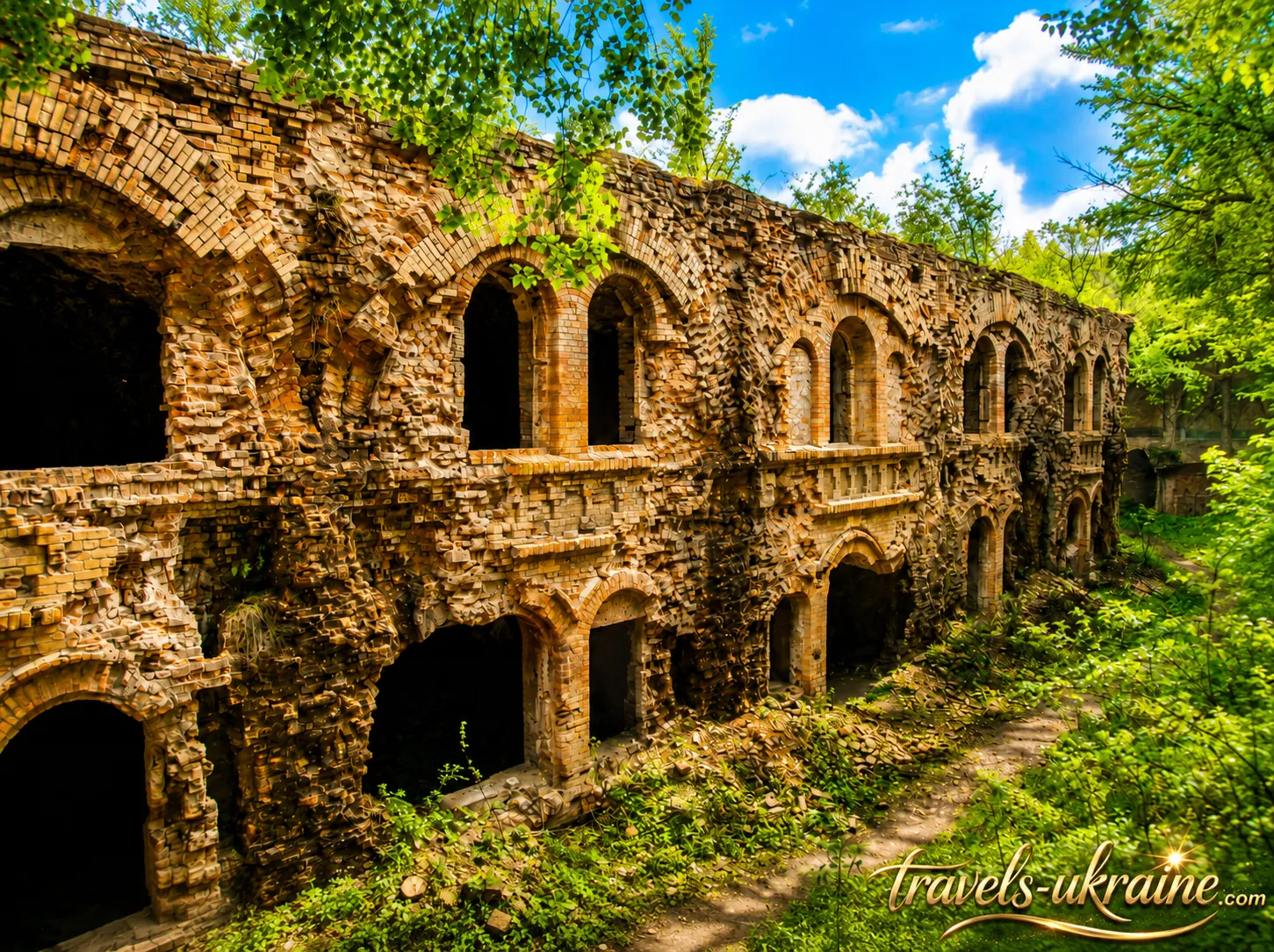
At first sight, the Dubno fort outpost looks more like a cinematic set than a real nineteenth-century military structure. Trees have grown across the ramparts, the arches have darkened with age, and some of the rooms are gradually collapsing. Yet this is precisely where the place’s magnetism lies. Tarakaniv Fortress presents history without embellishment: not as a museum display, but as a living space where you can see with your own eyes how defensive architecture is slowly merging with nature.
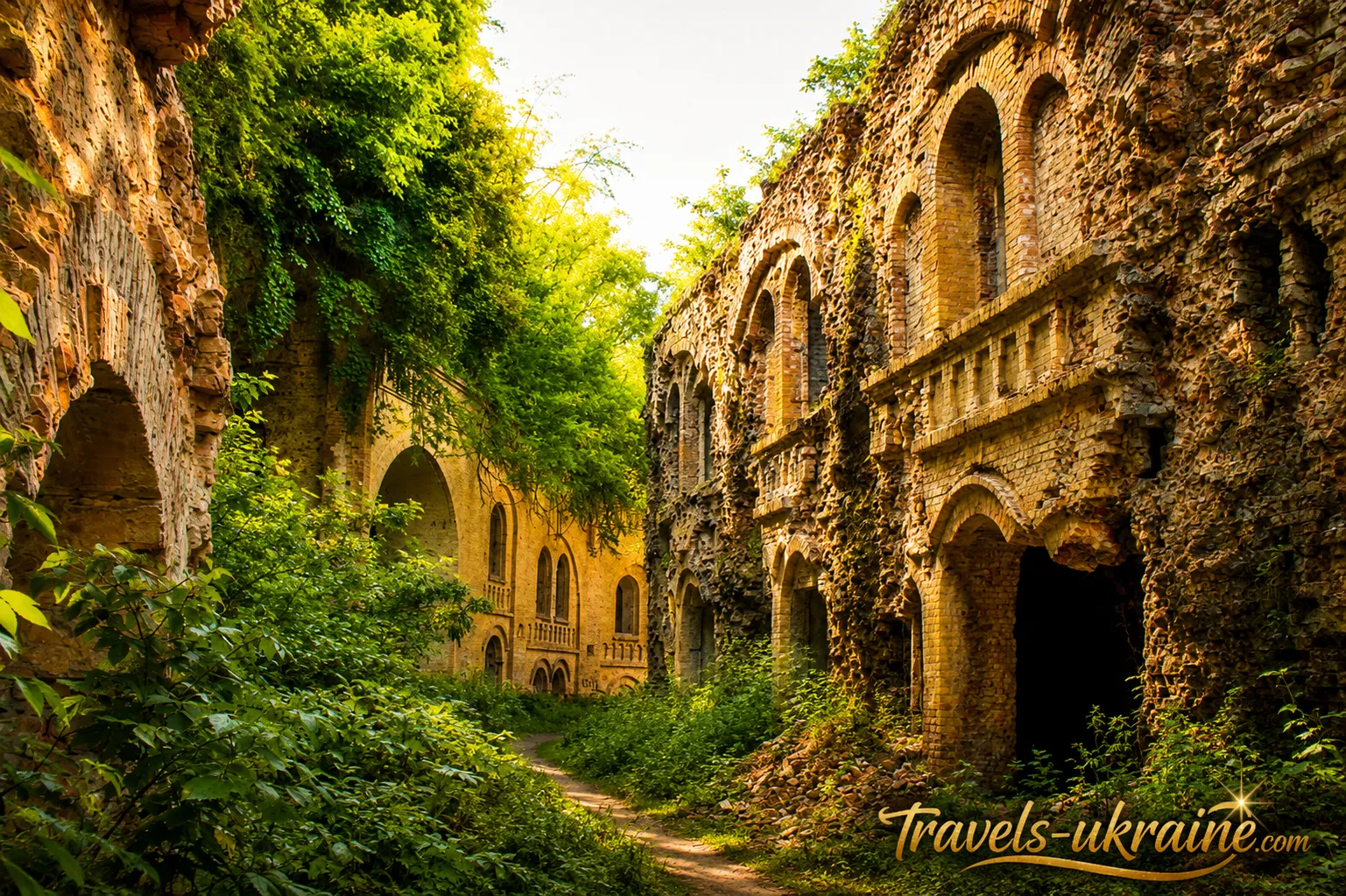
The site appeals to far more than military-history enthusiasts. A tour of Tarakaniv Fort offers the chance to explore a complex system of ramparts, ditches, tunnels, casemates and inner courtyards. For photographers, it is a location with extraordinary texture: brick arches, dim corridors, dense greenery and shafts of light breaking through gaps in the walls. Families should approach the site with caution, although with proper preparation it can be highly educational. For anyone who enjoys unusual travel routes across Ukraine, a trip to Tarakaniv Fort leaves a far stronger impression than many “polished” tourist attractions.
What atmosphere does the fort near Dubno have?
The atmosphere here is distinctive: slightly austere, slightly mystical, yet completely authentic. The ruins of Tarakaniv Fort make no attempt to appear comfortable or easy to explore. They openly reveal their neglect, the scars of time and the consequences of decades without full restoration. It is therefore important to arrive with the right expectations: this is not a conventional park for leisurely walks, but an old defensive structure where you must watch your step, avoid dangerous areas without a guide, never take risks for a photograph and choose daylight hours for your visit.
Even so, the abandoned Tarakaniv Fort has a remarkable ability to captivate visitors from the very first minutes. You walk through the greenery, approach the ramparts, and suddenly arches, walls, underground passages and the remains of a former military world appear before you. At moments like these, it is easy to understand why a tour of Tarakaniv Fortress has become popular with travellers who want to see not only castles, palaces and museums, but also Ukraine’s less obvious yet deeply powerful places.
In this article, we will look in detail at where the fort is located, how to reach it, what to see on the site, what makes its history so fascinating, which legends are associated with it, whether it is suitable for children, how to prepare for a visit, what else can be explored nearby and which safety rules you should know before travelling. This is a complete travel guide for anyone who wants to experience Tarakaniv Fort near Dubno not superficially, but with an understanding of its history, atmosphere and present condition.
The history of Tarakaniv Fort: how a military structure became a legend
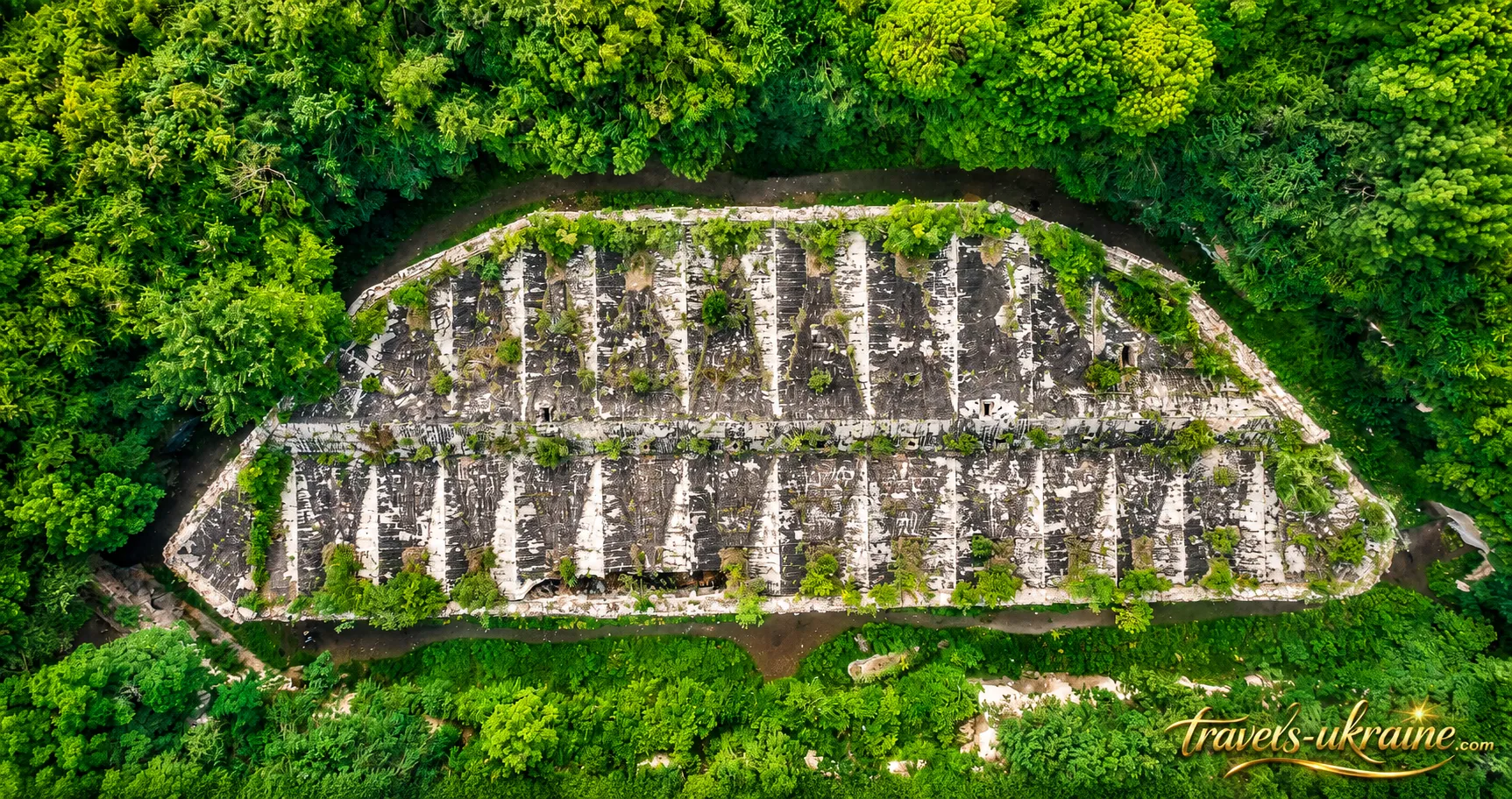
The Dubno fort outpost did not appear by chance, nor was it simply another military building on the map. Its construction was tied to the grand politics of the nineteenth century, shifting borders, the development of the railway and the fear of empires facing new wars. Today, visitors see the site as atmospheric ruins, a mysterious fortress surrounded by greenery and one of the most intriguing places in lists of “what to see near Dubno”. More than a century ago, however, it served an entirely different purpose: controlling a strategic direction, deterring a possible advance and protecting an important transport route.
Following the partitions of the Polish–Lithuanian Commonwealth, this territory came under particular scrutiny from the great powers. The western borders of the Russian Empire lay close to lands controlled by the Austrian Empire, giving the region between Dubno, Brody, Berestechko and farther west considerable military importance. It was in this context that the idea emerged to build a powerful military outpost — not a ceremonial fortress intended to display strength, but a practical defensive structure capable of protecting the approaches to key routes.
Preparatory work for the future fortification began as early as the 1860s. The site was not merely selected and built upon; it was physically shaped to meet the needs of the fortification. A hill was raised, while the system of ramparts, approaches, ditches and interior rooms was carefully planned. Construction intensified during the 1870s and 1880s, and the structure gradually developed into a complex defensive installation. For its time, Tarakaniv Fort Outpost was a fairly modern project, as builders used not only stone and brick but also concrete — a material that was only beginning to play an important role in military architecture.
Who was behind the construction of the Dubno fort outpost?
The idea of establishing fortifications along this route is associated with the renowned military engineer Eduard Totleben, one of the most respected fortification specialists of his era. Various sources also mention an engineer named Borisov, who worked directly on implementing the project. These names may seem remote to modern travellers, but it was thanks to people such as these that the fortress near Dubno acquired its intricate structure: ramparts, casemates, underground passages, an inner courtyard, barracks, storage rooms and defensive positions.
When entering the site today, it is easy to forget that this is not merely an old fort, but a carefully designed military machine. Every arch, passage and embankment served a purpose. The romantic appearance of the ruins was never intentional; it emerged much later, when time, nature and neglect transformed the austere military structure into one of Ukraine’s most mysterious tourist destinations.
Tarakaniv Fort during wartime and decline
The most dramatic chapters in the history of Tarakaniv Fort in Dubno are connected with the First World War. In 1915, the fortification found itself within the theatre of war. According to a widely accepted historical account, Russian forces abandoned the fort without a major battle, after which Austrian troops occupied it. The following year, the structure suffered extensive damage during military operations. These events became a turning point in the fort’s fate: conceived as a reliable shield, it gradually began to lose its original military importance.
During the interwar period and later, Tarakaniv Fort in Rivne Oblast never regained its former role. States, borders, armies and military technologies changed. What had been considered advanced defensive thinking at the end of the nineteenth century quickly became outdated during the twentieth. Artillery grew more powerful, aviation transformed the very logic of warfare, and old forts lost their practical value. In this way, Dubno Fort gradually moved from the category of strategic military installations to that of historic ruins.
The history of Tarakaniv Fort is valuable precisely because it did not end when the structure lost its military function. On the contrary, its decline marked the beginning of a new life — as a destination for tourism, research and photography, and as an almost legendary place. That is why a Tarakaniv Fort tour now attracts not only specialists in military architecture, but also ordinary travellers who want to experience Ukraine more deeply through places where stone, nature and memory speak more loudly than any information board.
The architecture of Tarakaniv Fort: casemates and underground passages
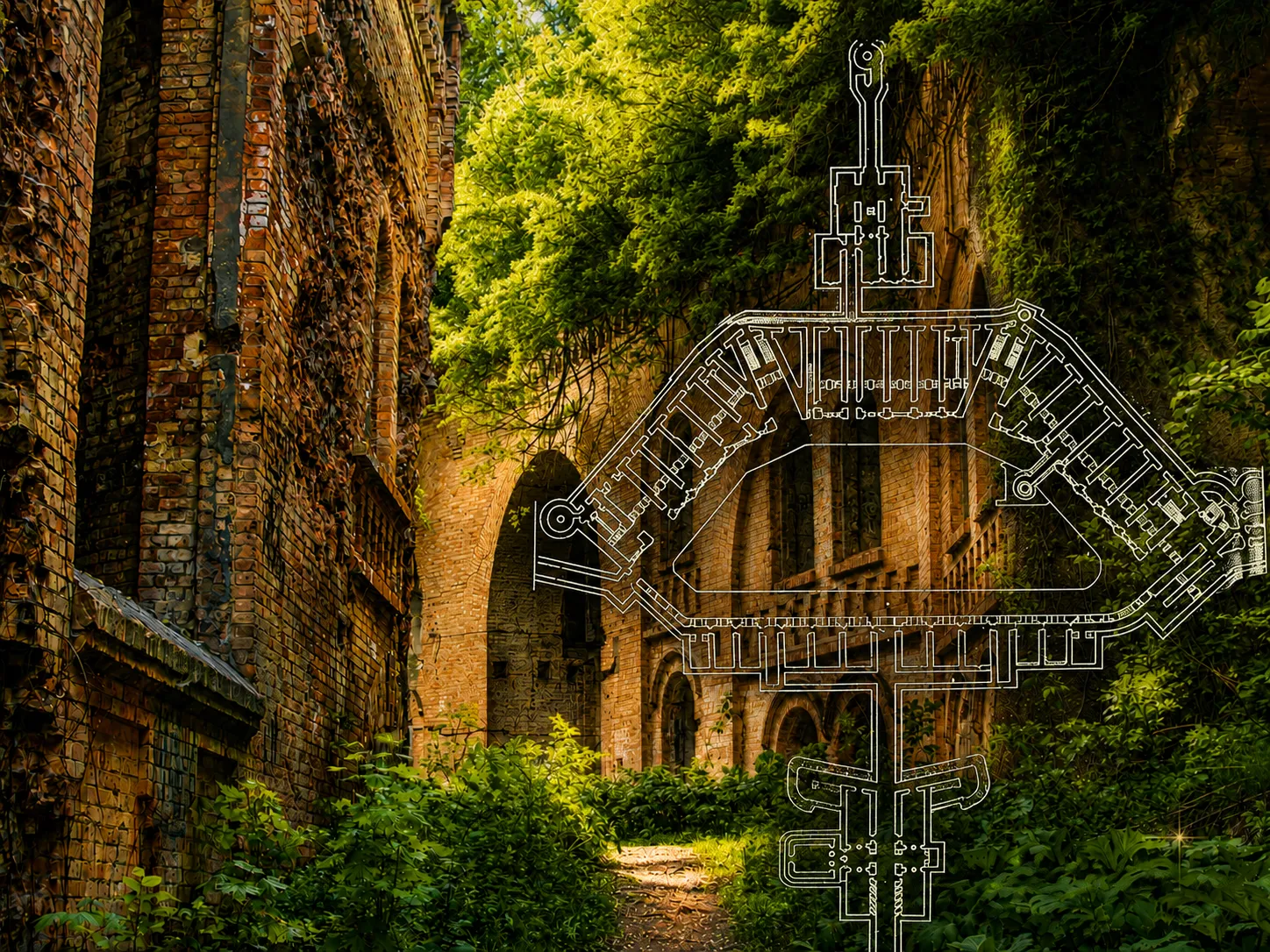
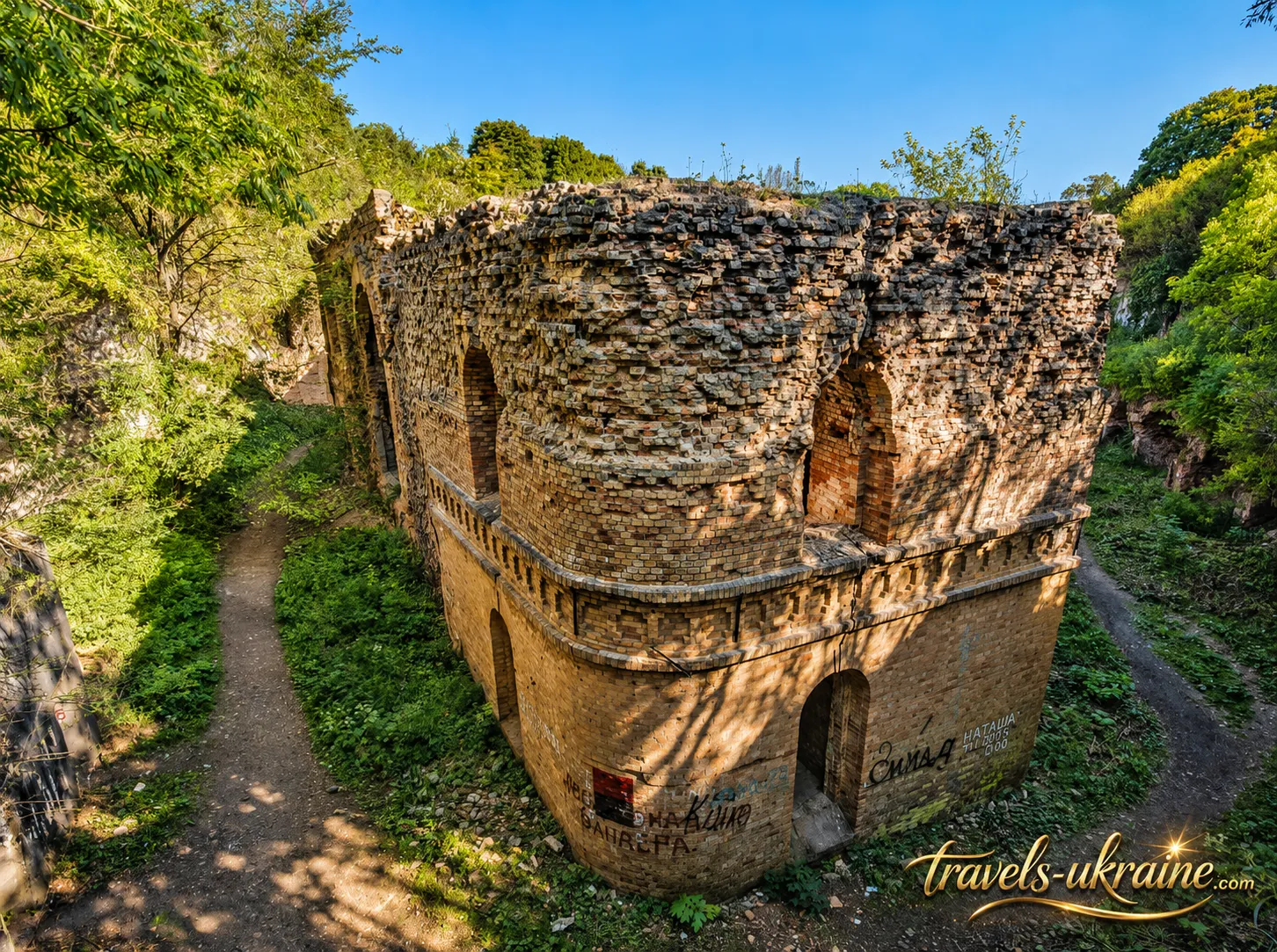
The fortification near Dubno is impressive not only for its history, but also for the way it was designed. These are not chaotic ruins, but a complex military outpost in which every level, rampart, corridor and casemate had a specific purpose. Viewed from above or on old plans, the fort’s layout can be seen to resemble a rhombus with sides measuring almost 240 metres. This shape made it possible to organise the defences more effectively, control the approaches and place military rooms within a protected perimeter.
Unlike medieval castles with tall towers, the fort outpost was built according to the principles of a more modern military age. Its strength lay not in the height of its walls, but in the combination of earthworks, a deep ditch, fortified walls, casemates and concealed passages. As a result, the site partly “grows into” the landscape: rather than rising above the surroundings like a traditional castle, it seems to hide within the ground. For visitors, this creates a very distinctive impression — instead of simply looking at an old building, you gradually enter an entire defensive world.
The casemates of Tarakaniv Fortress: the heart of the old military outpost
One of the most striking features of Tarakaniv Fortress is its casemates. Various descriptions state that more than a hundred casemate rooms were arranged around the perimeter of the complex. They were used not only for defence, but also for accommodation, storage and other military purposes. Some casemates had a two-tier structure, while their arches, friezes and brickwork show, even in their ruined state, that the fort was built not as a temporary camp, but as a substantial long-term military installation.
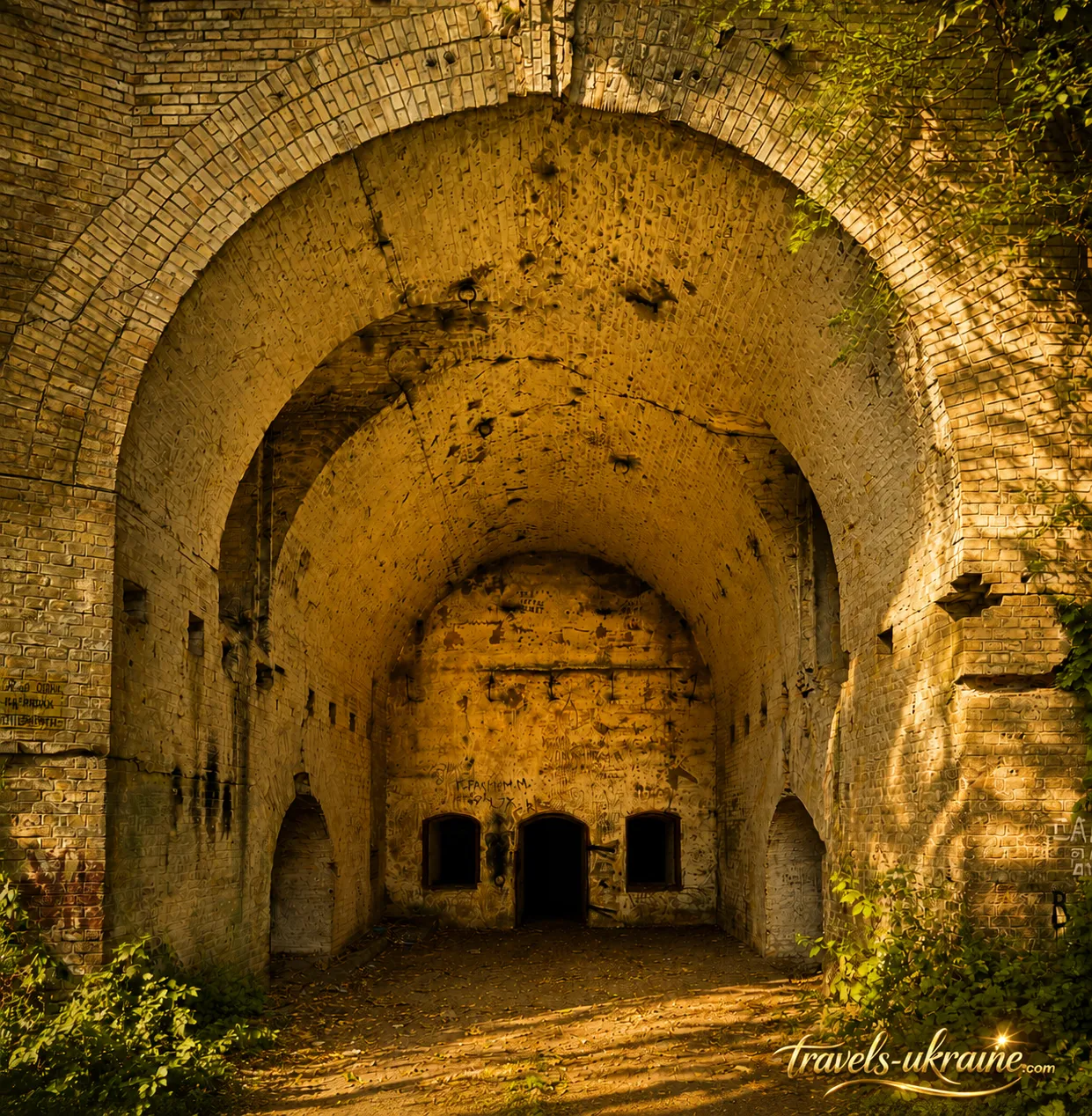
Today, the casemates create the very atmosphere that makes the abandoned fortress so memorable. Dim passages, damp bricks, signs of destruction, narrow openings and overgrown entrances all remind visitors that this is not a museum set, but a genuine defensive structure that survived wars, decline and decades without proper maintenance. Particular caution is required here: old ceilings, uneven floors, debris and dark passages can be dangerous.
Underground passages: what does the fort near Dubno conceal?
A two-storey barracks stands in the central part of the complex. It once contained living quarters, storage and utility rooms, as well as the headquarters of the fort commandant. Underground passages built beneath the earthworks led to the central area. These tunnels now capture visitors’ imaginations more than almost anything else: they feel like entrances into a hidden part of the past, where echoes of old military discipline can still be heard.
A tourist excursion to Tarakaniv Fort is often centred on these passages, as they clearly demonstrate just how complex the internal structure was. Within the fortress, it was important not only to hold positions above ground, but also to move safely through the fortification, store supplies, accommodate personnel and maintain communication between different parts of the complex. For this reason, the Dubno outpost should be viewed as an entire underground-and-above-ground settlement, rather than simply a collection of old walls among the trees.
The architecture of Tarakaniv Fort is fascinating because it does not reveal itself all at once. First you see ruins, then individual arches and walls; after that, you begin to notice the system, and only then do you understand the scale of the original concept. This is why Tarakaniv Fort in Dubno should be explored slowly, preferably with a guide or at least with some prior understanding of its history. The old military outpost then ceases to be merely an abandoned place and becomes a vast book written in brick, earth, tunnels and silence.
A brief visitor guide to Tarakaniv Fort
Tarakaniv Fort is not a tourist attraction to be visited quickly simply to tick it off a list. It is better approached as an atmospheric historic route where not only the walls matter, but also the overall mood of the place: the silence, vegetation, arches, old casemates, remnants of the defensive system and the feeling of an abandoned military outpost. Before travelling, it is therefore important to understand exactly where you are going, how much time to allow, what level of difficulty to expect and whether the location is suitable for children, older travellers or people without outdoor experience.
Unlike conventional museums, the Dubno Fort Outpost has no reliable infrastructure, clearly marked ticket area, even paths or completely safe route. This is an abandoned military fortress with unstable sections, so the best way to visit is during daylight with proper preparation, or on a tour of Tarakaniv Fort led by someone who knows the site well. This is particularly important if you want to do more than look at the façades and instead understand where the casemates were located, how the underground passages functioned, why the fort has its distinctive shape and what role it played near Dubno.
Tarakaniv Fort is conveniently located near the town of Dubno and the Kyiv–Chop road, which makes it easy to include in a broader itinerary. It is often added to journeys through Rivne Oblast together with Dubno Castle, Lutsk, Klevan, the Tunnel of Love and other nearby attractions. Its convenient location, however, does not mean the walk itself will be easy: the fort’s terrain is uneven, partly overgrown and slippery in places after rain, while some passages and underground areas may be dangerous.
- Type of attraction: historic fortification, old defensive structure, abandoned fort and monument of military architecture.
- Location: near the village of Tarakaniv, not far from the town of Dubno in Rivne Oblast.
- Best way to visit: a daytime trip, historical tour, photography outing or short weekend route.
- Approximate visit duration: 1–2 hours for a general look around, or up to 3 hours with a guide and a detailed explanation of the fort’s layout.
- Seasonality: spring, summer and autumn are the most comfortable seasons, preferably in dry weather.
Difficulty and accessibility of Tarakaniv Fort for visitors
Tarakaniv Fort is highly photogenic, but it is not an easy walking area. There are no fully developed tourist paths, ramps, fenced viewing platforms or reliable lighting in the dark passages. Families with small children, older travellers and visitors with limited mobility should therefore assess their abilities in advance. If your aim is simply to view the Dubno Fort landmark from outside and take a few photographs, the route will be considerably easier. If you plan to venture farther into the complex, you will need comfortable footwear, constant attention and preferably a guide.
Particular care must be taken around the underground passages and interior rooms. The ruins of Tarakaniv Fort contain unstable sections: old ceilings, debris, holes, open passages, dark corridors and areas that may become slippery after rain. Even if the location looks familiar from photographs, it feels very different in person. It is easy to become absorbed in the atmosphere and forget about safety, but this should never happen.
In brief, the Dubno fortress is a moderately difficult attraction best suited to a prepared daytime trip. Do not visit in a hurry, after dark or following heavy rain. The ideal approach is to arrive in the morning or during the day, wear comfortable footwear, bring a charged telephone, a torch and water, avoid entering questionable rooms without a guide, and allow enough time to experience the place rather than rushing through a few corridors simply for photographs.
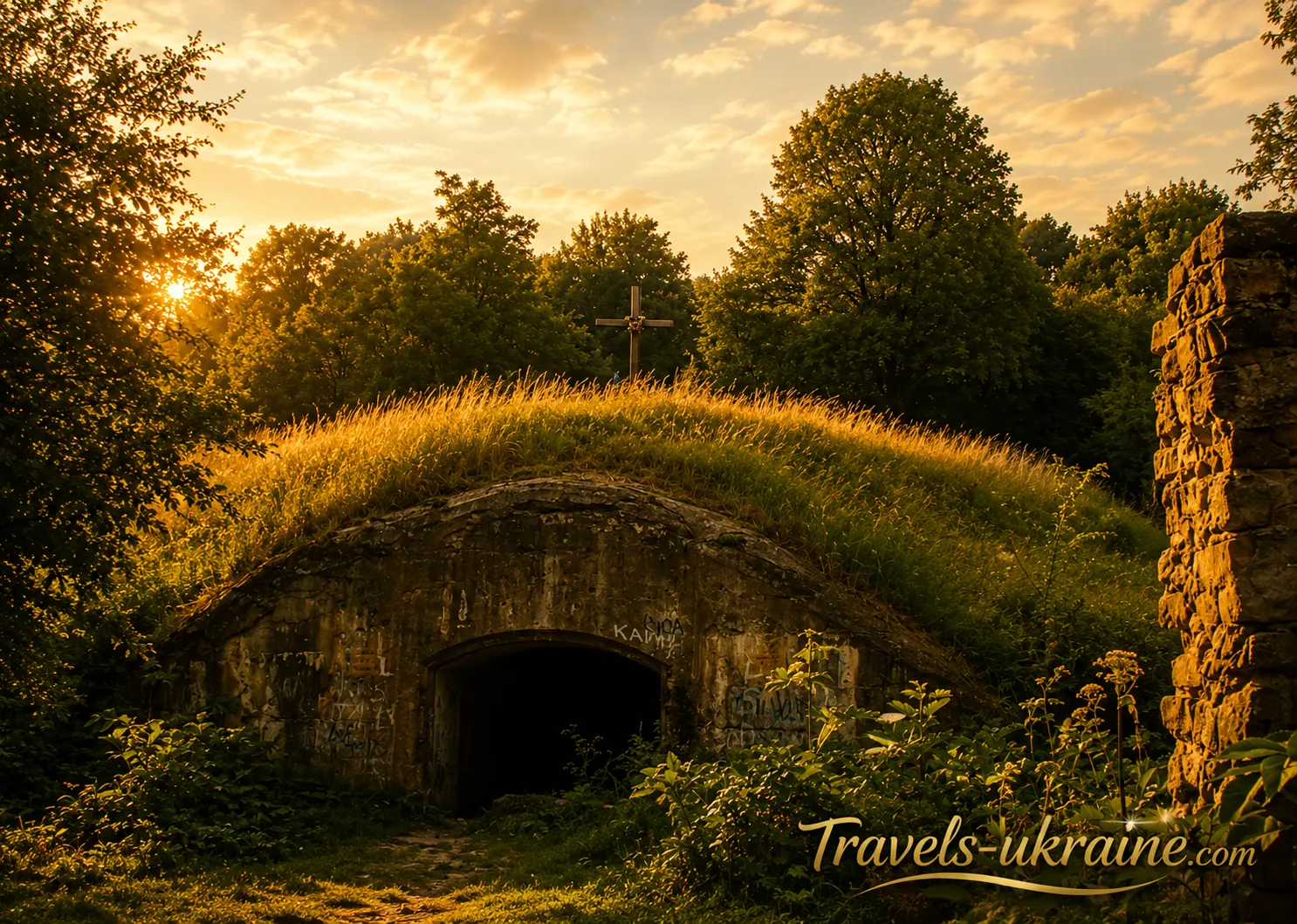
Photo and video gallery
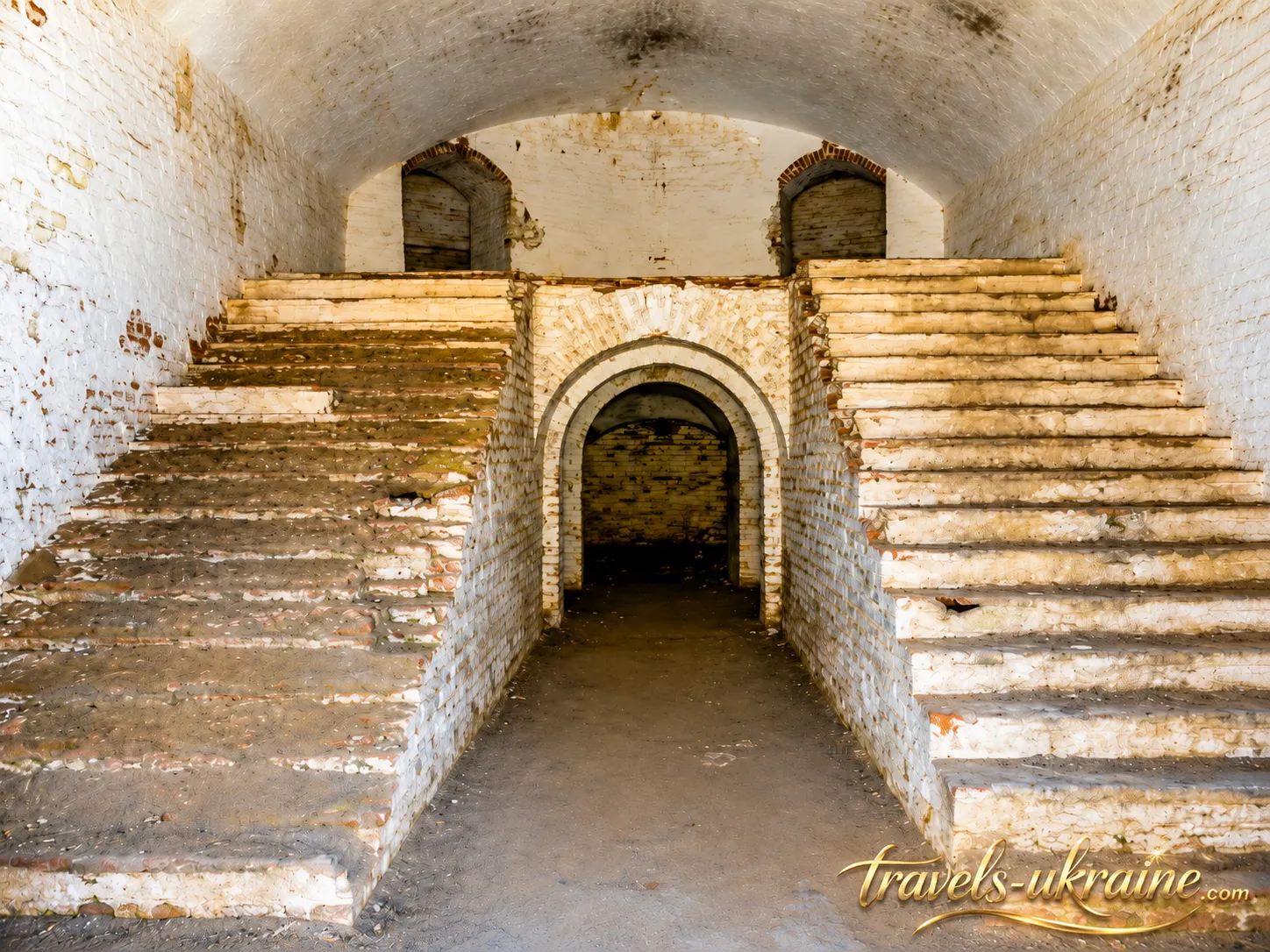
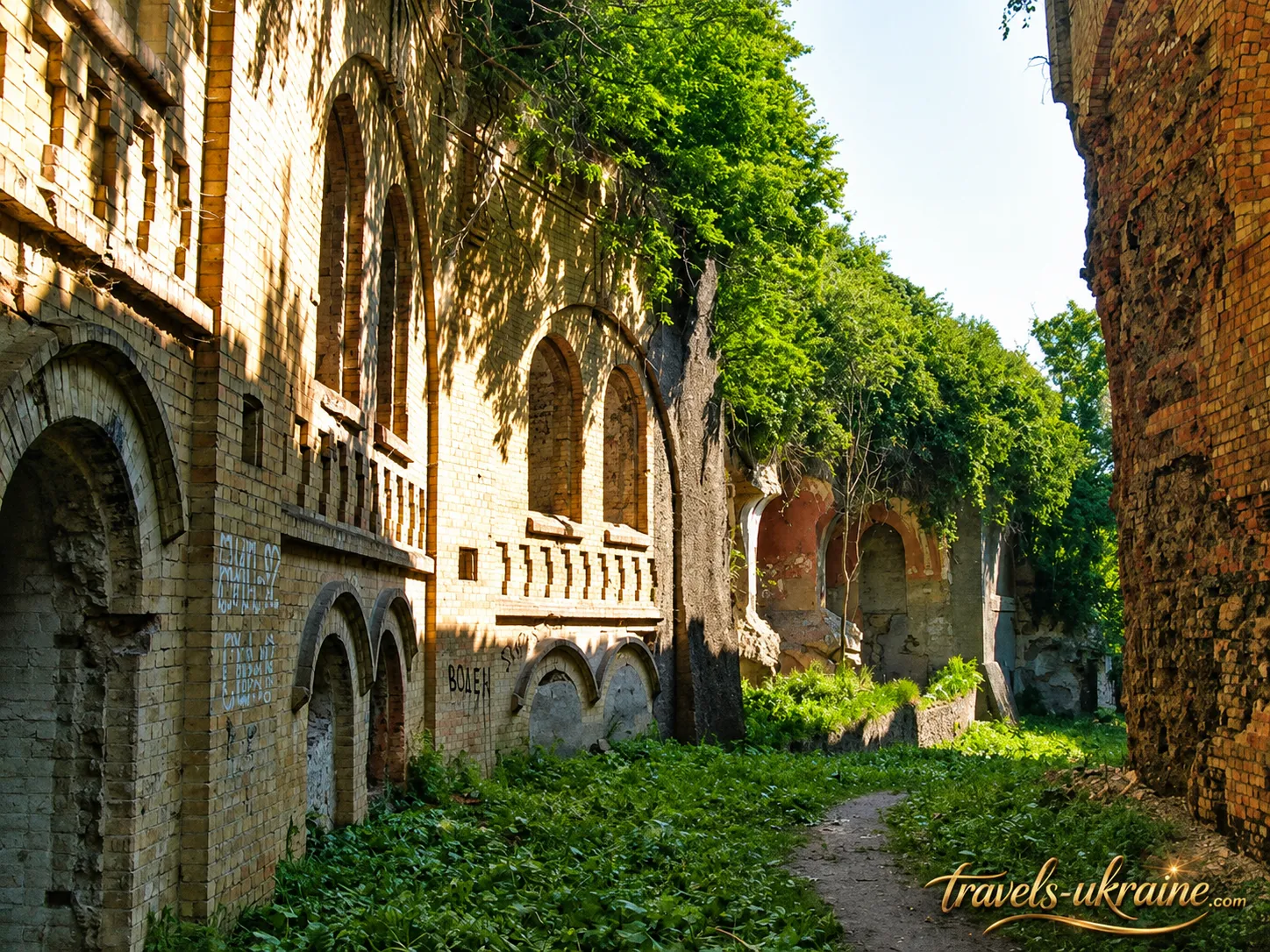
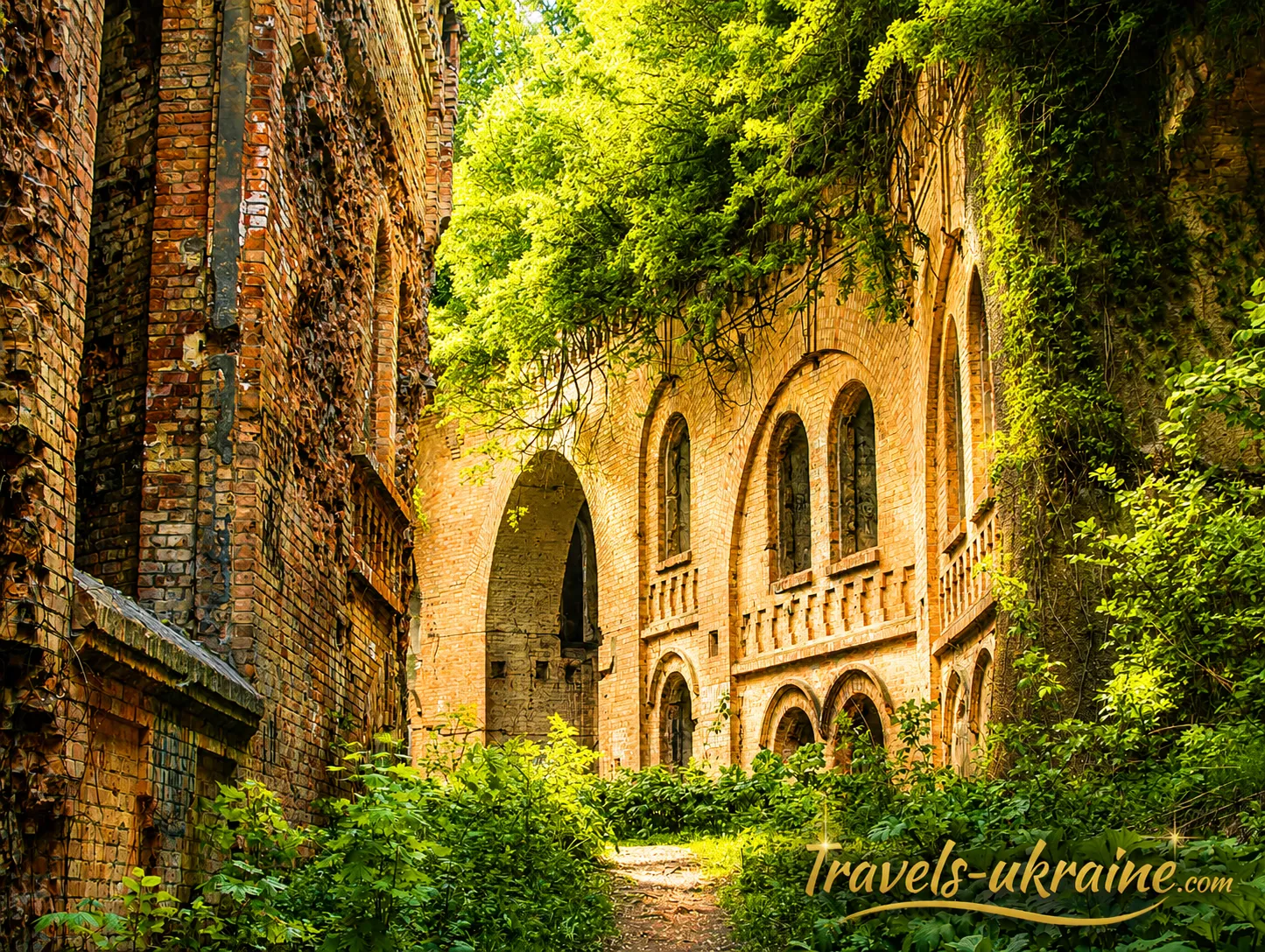
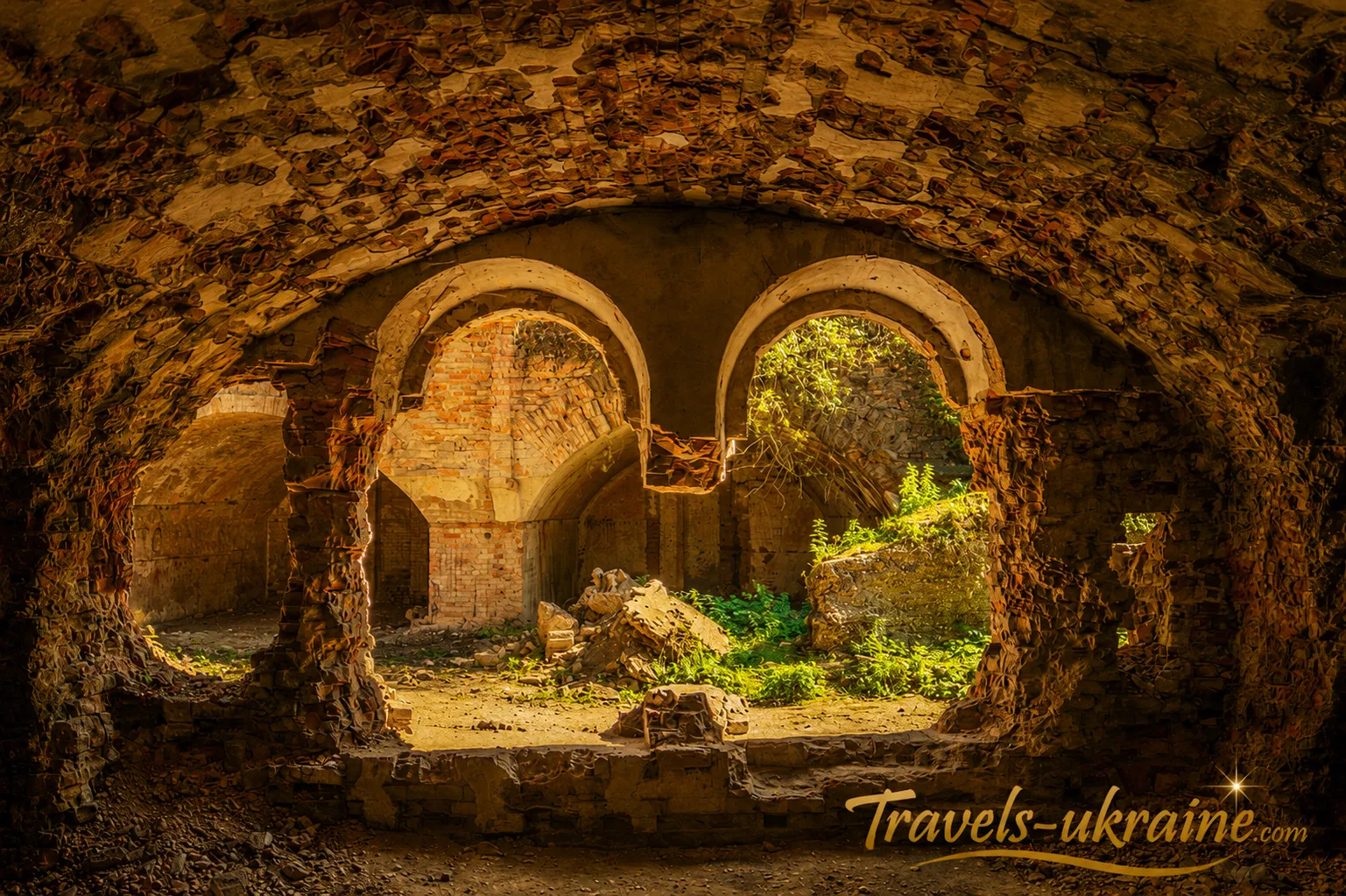
Is there a plan of Tarakaniv Fort, and what secrets does it conceal?
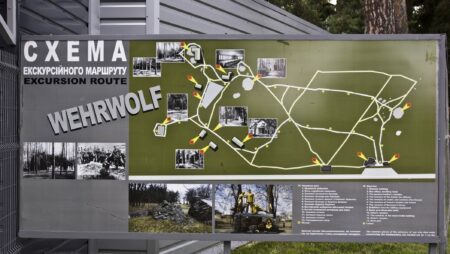
A plan of Tarakaniv Fort does indeed exist, and it offers an entirely different view of the site. From the outside, the fort may appear to be a chaotic collection of ruins hidden among the greenery, but the drawings reveal a clear military logic: defensive ramparts, a ditch, a central section, entrances, passages, rooms for the garrison and a complex network of internal corridors. The detailed outpost plan shows that this was not simply an old fortress near Dubno, but a carefully designed work of military engineering.
A map of Tarakaniv Fort helps visitors understand its scale, but it does not provide every answer. On paper, everything appears orderly: lines, corridors, casemates, ramparts and a central space. In reality, however, the fort now exists in a very different form. Nature has long since altered its appearance: trees grow through the walls, some paths have disappeared into the undergrowth, several entrances are difficult to recognise, and certain areas look as though they have been deliberately hidden from view. For this reason, a Tarakaniv Fort map may be useful for general orientation, but it should never be treated as a safe route for exploring every room independently.
Most intriguingly, the fort plan does not dispel the mystery — it deepens it. Once you see how complex the internal system was, even more questions arise: which rooms were used most intensively, which passages served staff, where ammunition was stored, how the garrison moved around the complex, and which sections were rebuilt or damaged during wartime? The fort seems to offer a key without opening every door.
In other words, a plan exists, but it is primarily a historical and architectural drawing rather than a modern visitor-navigation map. When exploring the real site, you should not rely on the plan alone: Tarakaniv Fort is abandoned, many passages and rooms may be unsafe, and underground sections require particular caution.
If you examine the plan of the Dubno fort outpost before your journey, treat it as an invitation to careful exploration rather than as instructions for a risky adventure. It will help you understand the logic of the defensive structure and the positions of its casemates and tunnels, but the fort’s greatest mystery can still only be discovered on the spot — standing among the old walls, listening to the silence of the underground passages and realising that not every story connected with this place was ever written down.
How many underground levels does Tarakaniv Fort have?
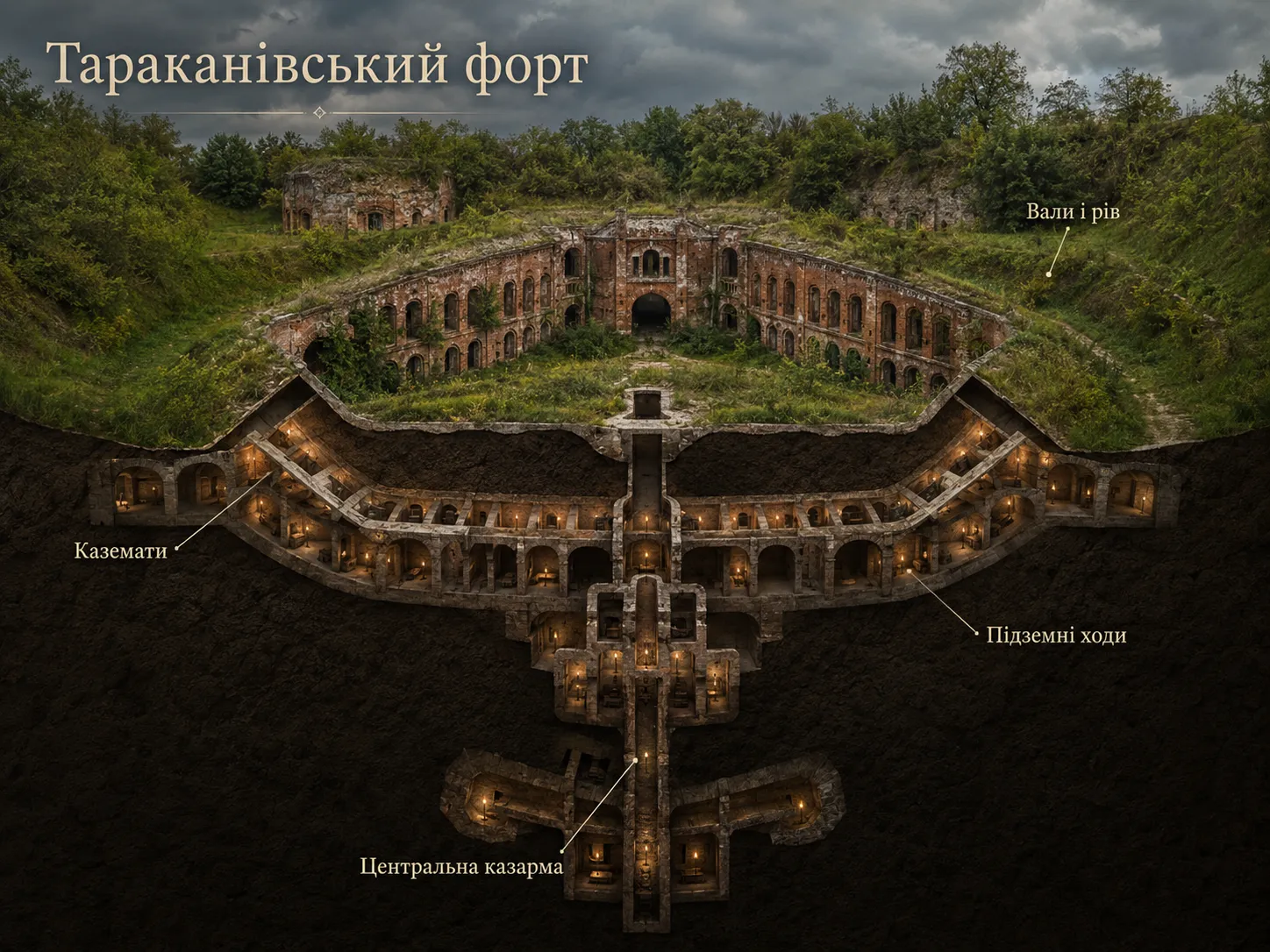
It is known that the fort had two main levels of casemates, while the central barracks was a two-storey building. These are the sections most commonly mentioned when people discuss the depth and levels of Tarakaniv Fort. If the question is broadened, however — how many floors does Tarakaniv Fort have when its underground passages, technical rooms, buried tunnels and unstable sections are included? — there is no single definitive answer. Some areas have been destroyed, others are inaccessible, and several passages are difficult to match with what survives on the old plans.
This is precisely why the underground spaces of Tarakaniv Fort have such a powerful hold on travellers’ imaginations. It is easy to believe that an entire underground town exists beneath your feet, complete with passages between casemates, concealed service corridors, former garrison rooms and mysterious branches that are now either buried or unsafe to explore. The underground chambers of Tarakaniv Fort do not resemble a developed visitor route; they are the remains of a complex military system in which every dark arch recalls the engineering logic of the past.
The underground passages of Tarakaniv add another layer of intrigue. They were created not for legends, but for practical defence: allowing troops to move through the fortification, maintain communication between separate sections, use protected routes and avoid unnecessary exposure in open areas. Today, however, these passages look as though they have themselves become part of the mystery.
The answer to the question of how many underground levels the fort contains should therefore be phrased carefully. The two main tiers of casemates and the two-storey central barracks are the clearest features in surviving documents and on the site, but the actual system of tunnels, technical passages and buried areas is more complex than a simple count of floors suggests. The fort is not like a modern building where one can simply identify a ground floor, first floor and basement. It is a defensive complex in which different levels, passages, embankments and casemates functioned as a single system.
Perhaps this is the place’s greatest magic. Tarakaniv Fort does not offer visitors a ready-made answer. It hints, encourages you to look into dark passages, compare reality with old plans, listen to guides’ stories and leave room for speculation. Here, it is easy to feel that the most fascinating aspect of the fort is not only what has already been revealed, but also what it is still in no hurry to disclose.
Tarakaniv Fort in a computer game
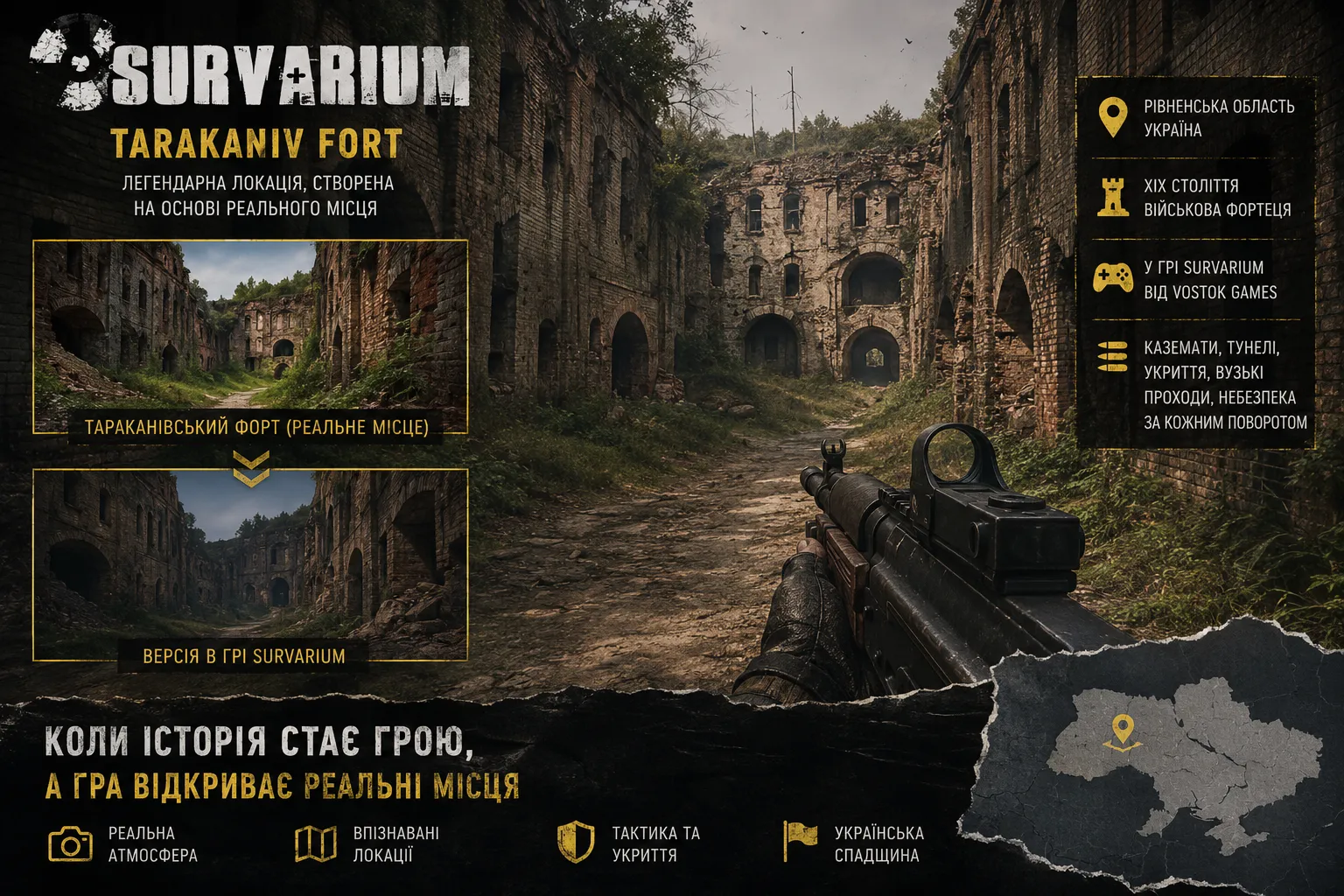
Tarakaniv Fort has such a powerful atmosphere that its story has reached far beyond tourist routes. The old casemates, dark tunnels, overgrown ramparts and sense of an abandoned site make it feel like a ready-made setting for a post-apocalyptic world. It is therefore unsurprising that the Fort Outpost attracted not only travellers, photographers and historical researchers, but also computer-game developers.
The best-known example is Tarakaniv Fort in the game Survarium by the Ukrainian studio Vostok Games. The location was created on the basis of the real fort near Dubno, and for many players it became their first introduction to this mysterious monument. Searches for Tarakaniv Fort Survarium remain interesting because they demonstrate how a real Ukrainian fortress entered the digital world while preserving its defining quality — a tense, unsettling and almost cinematic atmosphere.
Why did Survarium choose Tarakaniv Fort as a game location?
Survarium did not select Tarakaniv Fort by accident. The fortress was ideally suited to a game in which not only corridors, cover and routes of movement matter, but also the emotional impact of the environment. The real fort contains everything required for a game map: a multi-level structure, narrow passages, open areas, casemates, dark arches, natural cover and the sense that danger may be waiting around every corner.
For the developers, it was important not merely to transfer the architecture into the game, but to capture the spirit of the place. Vostok Games’ Tarakaniv Fort was reimagined as a post-apocalyptic environment in which real history merged with fictional unease. In the game, the fort is not an exact copy of the tourist attraction, but an artistic interpretation: recognisable, bleak, dynamic and distinctly Ukrainian in origin. This is where the main intrigue lies. Players do not see an exact tourist map, but a digital legend inspired by a real place. The fortress gave the game its form, mood and character, while the game added a new cultural layer to the fortress. In this way, the abandoned Tarakaniv Fort began to live not only in tours, travel blogs and photographs, but also in the memories of gamers.
The Survarium story demonstrates the broader potential of Ukrainian locations in video games. Ukraine has many places with a distinctive identity: old castles, industrial ruins, fortresses, underground chambers, abandoned military sites, Carpathian villages, steppe landscapes, Soviet infrastructure and unique urban environments. Yet few landmarks have entered digital culture as vividly as Tarakaniv Fort in Rivne Oblast.
This is why real places in Ukraine featured in games are more than a curiosity for gamers. They offer another way to tell the world about the country. A person may first encounter the image of a Ukrainian location through a game, become interested in its history, search for photographs, read about the fort and eventually plan a real journey. In this way, the digital world becomes an unexpected but highly effective bridge to tourism.
Tarakaniv Fort on screen: how the fortress became a legendary film location
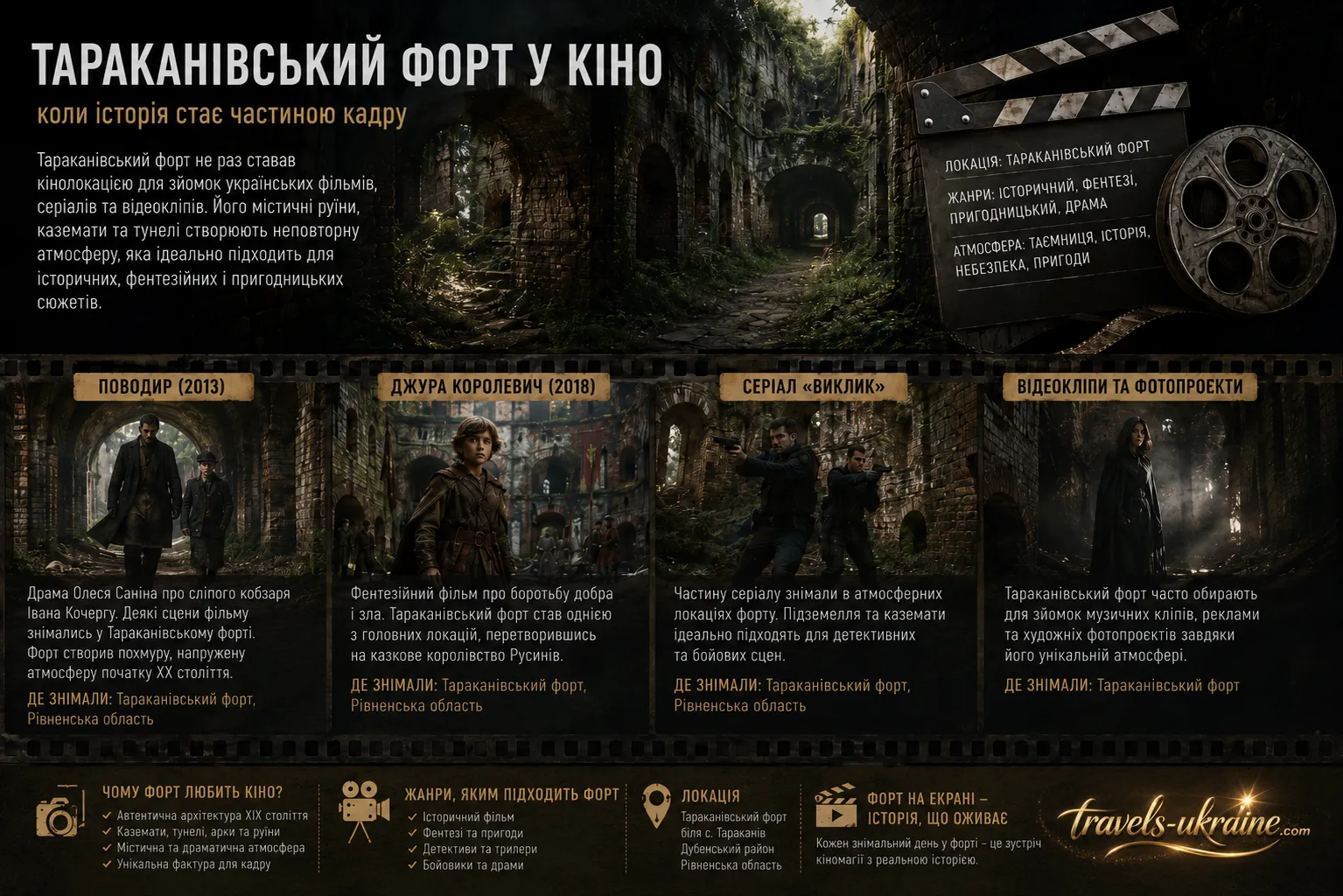
Tarakaniv Fort looks so natural on camera that it might have been built not only for defence, but for the cinema. Old arches, dark casemates, damp tunnels, overgrown walls, cracked bricks and the atmosphere of an abandoned world create a ready-made cinematic setting. There is little need to invent elaborate scenery here: place the camera in the right position, and the fort immediately begins to function as a character in its own right.
This is why Tarakaniv Fort in films is perceived as far more than a backdrop. It is a location with character. It can become a secret refuge, an old Cossack fortress, a gloomy palace, a medieval town, a place of danger or a setting where the audience immediately senses tension. This is the fort’s strength: it does not need to “act”. It creates the necessary mood by itself.
For a director, the Dubno outpost as a film set is valuable because it does not look overly “museum-like”. It lacks the sterile neatness that can undermine a historical scene. Instead, the fort offers rough textures, irregularity, wildness, darkness and space for the imagination. On screen, the structure can therefore easily become a place where something important happens: a conspiracy, escape, meeting, pursuit, battle or discovery of an old secret.
Which films were shot at Tarakaniv Fort?
To answer briefly the question of which Ukrainian films were shot at Tarakaniv Fort, two well-known Ukrainian productions are mentioned most often: the historical drama “The Guide” and the fantasy film “Dzhura Korolevych”. These titles show particularly well how differently the same location can appear on screen. In one case, the site serves as a sombre historical setting; in the other, it becomes a fantasy kingdom.
- “The Guide” — a historical drama in which the fort was used for several atmospheric scenes.
- “Dzhura Korolevych” — a fantasy film for which Tarakaniv Fort became one of the main locations.
- Television and video projects — the fort periodically appears in productions thanks to its distinctive textures and powerful visual identity.
Filming at Tarakaniv Fort should be understood as more than simply using an attractive set. It is also a story about how a real landmark becomes part of cultural memory. Well-known films featuring Tarakaniv Fort demonstrate that this abandoned fortress has far greater potential than merely serving as a tourist stop for a few hours.
Ultimately, Tarakaniv Fort enriched Ukrainian cinema not through spectacle, but through authenticity. The place needs few special effects because it already possesses its own drama. Its walls remember military history, the ruins create a sense of danger, and nature adds wild beauty to every frame. This is why Tarakaniv Fort accommodates film productions so naturally: it does not merely stand in the background, but helps to tell the story.
The anomaly of Tarakaniv Fort: a mystery visitors sense before it is explained
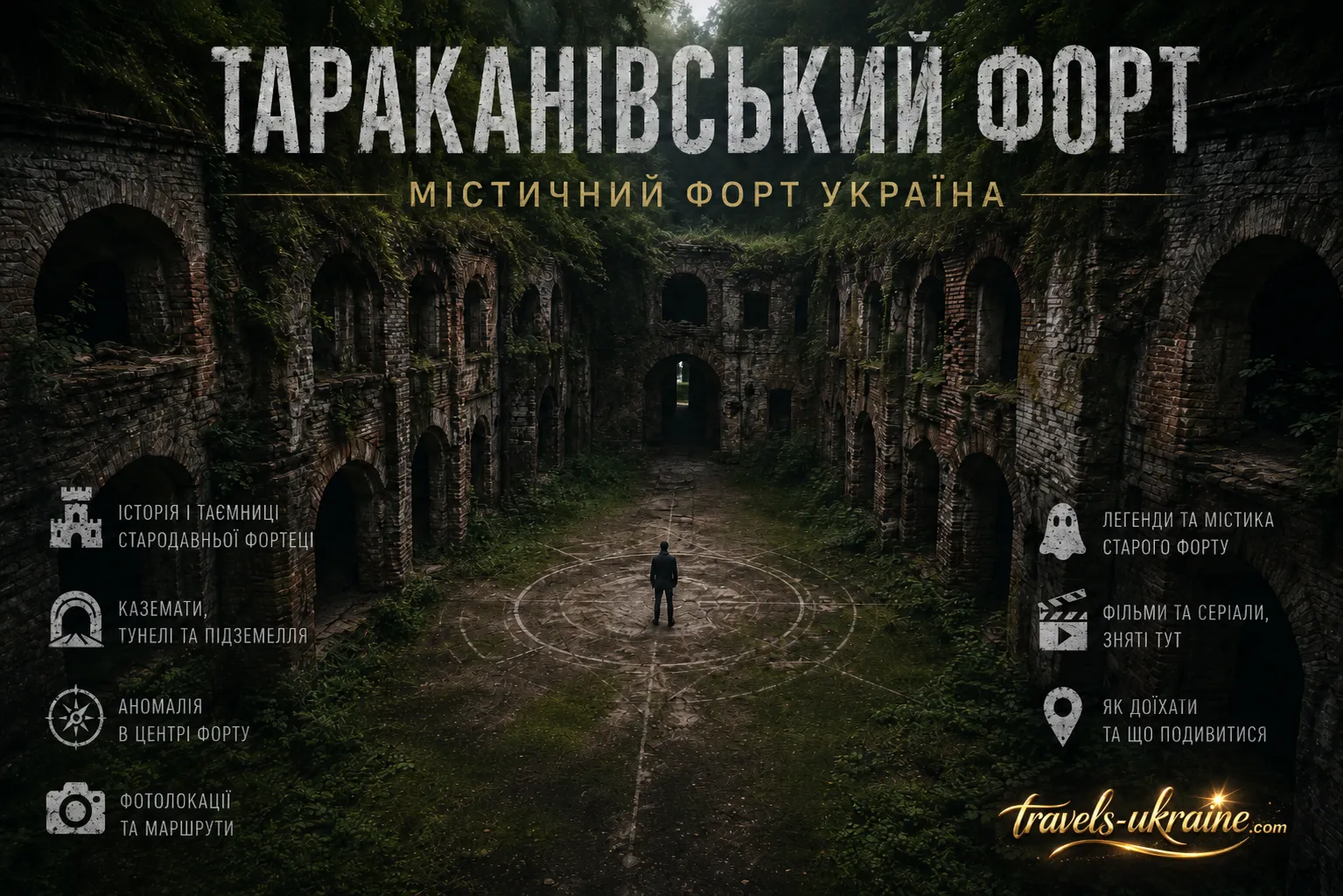
Among all the stories told about the fort, the so-called anomaly at the centre of Tarakaniv Fort occupies a special place. It should not be regarded as a scientifically proven fact or a mystical truth, but as part of the visitor experience it has long been one of the site’s most intriguing legends. Travellers often notice that the perception of space changes most strongly in the central section of the fort. It feels quieter and cooler, sounds behave unusually, and the old walls seem to concentrate a sense of tension around them.
The centre of the fort genuinely has a distinctive energy, even when explained without mysticism. It is surrounded by casemates, underground passages, the remains of the barracks, tall walls, overgrown routes and an open inner space. This architecture creates a kind of “bowl” in which sound rebounds from the bricks, wind moves through the arches and light changes abruptly between dark corridors and the open courtyard. This is why the abandoned fort near Dubno can sometimes feel like a place where ordinary things are perceived more intensely.
Look closely at the fort and it becomes clear that its “anomalous” quality comes not from invention, but from the character of the place itself. The monument of military architecture was designed so that everything served defence, isolation and control of the surrounding space. There were no accidental passages or walls. Every direction, level and arch had a practical purpose. The centre of the complex therefore does feel unusually concentrated, as though the entire structure converges at a single point.
It is here that the former life of the garrison is easiest to imagine: soldiers’ footsteps, commands, movement between rooms and the expectation of danger. Although only the ruins of a military structure remain today, the centre continues to retain a sense of tension. It need not be supernatural. Sometimes real history, old brickwork and silence are enough for a place to affect the imagination more powerfully than any legend.
The anomaly and the mysteries of Tarakaniv Fort are better understood as a combination of history, architecture, acoustics, darkness and human imagination. Yet these are precisely the places that remain most strongly in the memory. They offer no ready-made answer, never explain themselves completely and leave visitors with a slight sense of unfinished business. Perhaps this is why the outpost continues to attract travellers: everyone arrives to see the ruins, an abandoned fort said to be haunted and hear frightening stories, but discovers a mystery of their own. Perhaps the true power of the place lies here — it gives no final answers, but leaves you wanting to return and look more closely.
What to visit near Tarakaniv Fort: interesting places for travellers
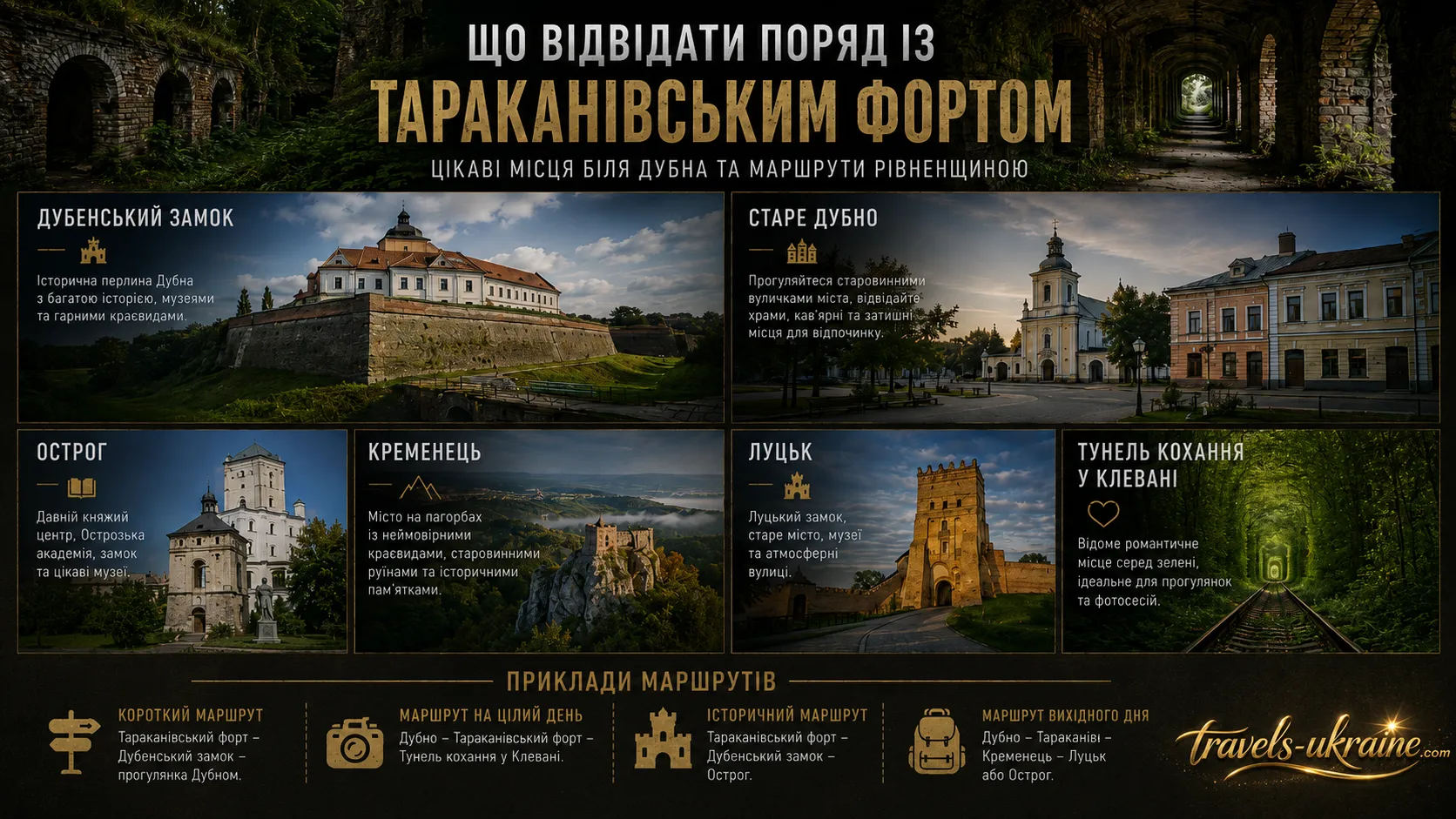
Tarakaniv Fort is easy to combine with other attractions in Rivne Oblast, as several important historical and tourist destinations are located nearby. If you are wondering what to see near Dubno, do not limit your route to the fort alone. It is best to plan your journey so that you can experience different sides of the region: an abandoned military structure, an old castle, urban landmarks, ancient monasteries, atmospheric streets and natural attractions.
For a day trip, the most convenient option is to combine the fort outpost in Tarakaniv with Dubno Castle and a walk through the town. If you have an entire day or a weekend, the route can be extended to Ostroh, Kremenets, Lutsk or Klevan. This turns the trip from a visit to a single abandoned fortress into a complete journey through western Ukraine.
If your journey is not limited to a few hours, you can plan a broader historical route. Ostroh is ideal for those interested in early education, princely history and museums. Kremenets is worth choosing for its combination of town atmosphere, hills and ancient ruins overlooking the streets. In this kind of itinerary, Kremenets Castle is an excellent choice. Lutsk is a good destination for a full weekend trip, with its castle, old town, museums, cafés and plenty of space for walking.
These destinations work well for travellers who want to see more than one abandoned outpost. A historical tour of Tarakaniv Fort can become the emotional highlight of the route, while the surrounding towns provide its cultural continuation. The resulting journey is varied: a little mysticism, some architecture, ancient history and plenty of vivid impressions.
Another popular place to combine with the fort is the Tunnel of Love in Klevan. It offers a completely different mood: green, romantic, lighter and more photogenic in the conventional tourist sense. After the fort’s austere atmosphere, this stop creates an attractive contrast and gives the route an emotional balance.
This option is particularly suitable for travellers who want to combine history and nature. Spend the morning at Tarakaniv Fortress among the casemates and old walls, then head to the green tunnel after lunch for a walk and relaxed photographs. It is one of the most convenient itineraries for a family outing or a trip with friends.
Examples of routes near Tarakaniv Fort
- Short route: Tarakaniv Fort — Dubno Castle — a walk through Dubno.
- Full-day route: Dubno — Tarakaniv Fort Outpost — the Tunnel of Love in Klevan.
- Historical route: Tarakaniv Fort — Dubno Castle — Ostroh.
- Weekend route: Dubno — Tarakaniv — Kremenets — Lutsk or Ostroh.
The best advice is not to overload the day. Tarakaniv Fort is emotionally powerful, and afterwards it is worth allowing time for a calmer continuation of your journey through Ukraine. The trip will then remain in your memory not as a chaotic checklist of places, but as a complete story: from abandoned casemates and old tunnels to castles, towns, green routes and the discovery of Rivne Oblast from several different perspectives.
Tarakaniv Fort and the secret German laboratory: a legend that keeps the mystery alive
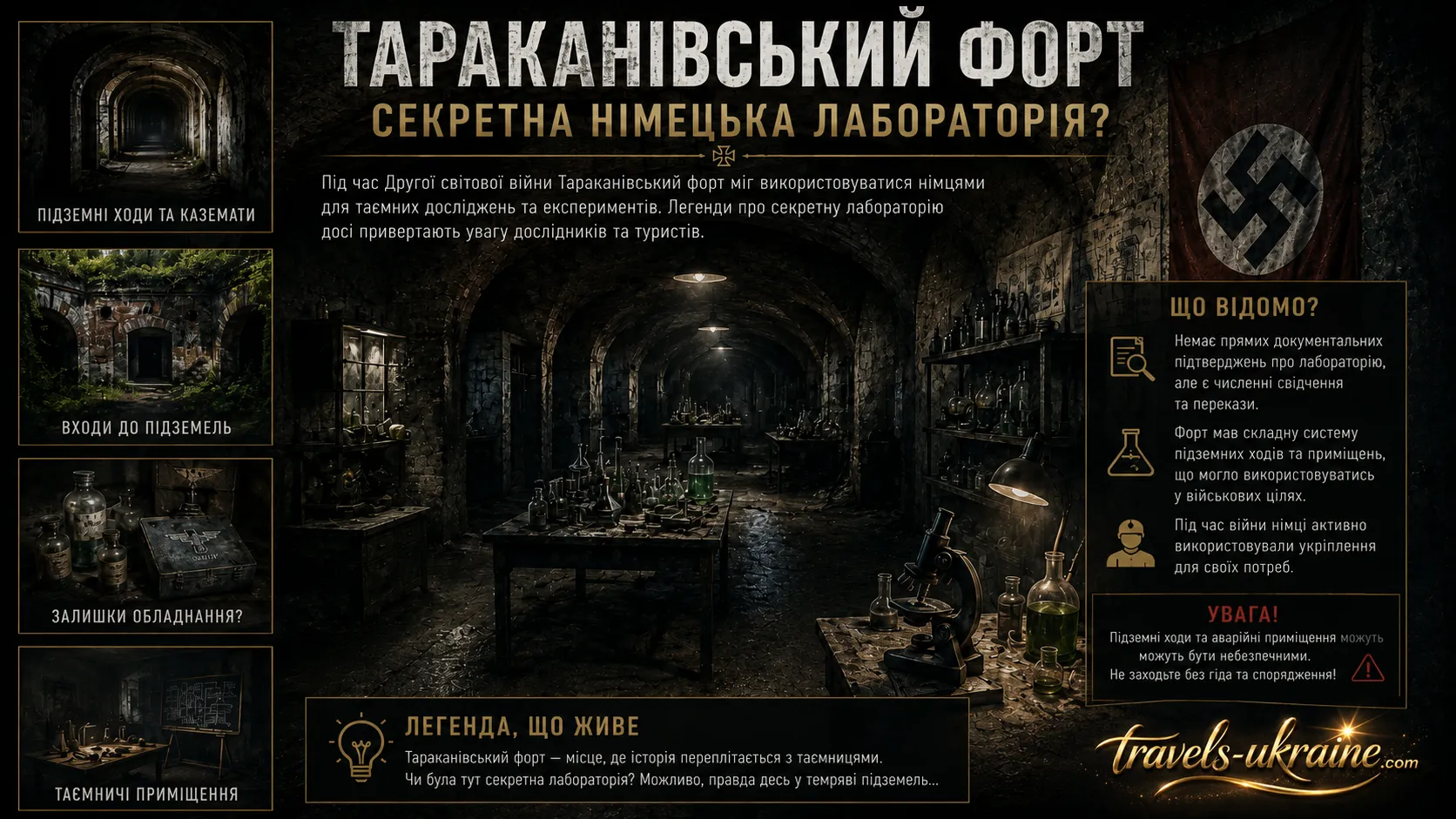
Among the most mysterious stories associated with the fortress near Dubno, one of the most frequently mentioned is the idea of Tarakaniv Fort as a secret German laboratory. The story sounds so cinematic that it immediately captures the imagination: abandoned casemates, dark underground passages, damp corridors, sealed rooms and the sense that something unknown may still be hidden below ground. This is why the legend of a German laboratory in Tarakaniv Fort has become part of local tourist folklore.
It is important to understand that there is currently no reliable publicly available evidence confirming the existence of a fully developed secret laboratory in the form commonly described in local tales. It is therefore more accurate to speak not of an established historical fact, but of a legend of Tarakaniv Fort that emerged from the site’s genuine wartime history, its abandoned condition and the distinctive atmosphere of its underground spaces.
This is part of Tarakaniv Fort’s special power: even where historians remain cautiously silent, the place continues to speak through shadows, arches and underground corridors. The legend of the secret German laboratory does not artificially make the fort “more frightening”; it simply reinforces what almost every visitor feels within these walls.
Where might the legend of the German laboratory have come from, and what may actually have happened?
During the Second World War, many fortifications, warehouses, underground rooms and old military facilities were used in different ways: as storage areas, technical zones, temporary bases or auxiliary premises. This general historical pattern may have formed the basis for rumours that Tarakaniv Fort concealed a laboratory in its underground chambers. Visitors’ imaginations readily seize upon the idea, because the underground spaces of Tarakaniv Fort genuinely look as though more than one secret story could have unfolded there. Long corridors, casemates, partly buried passages, darkness, unexplained branches and ruins create a setting in which even an ordinary storehouse or technical room can gradually become a secret facility in local legend.
The most cautious and responsible interpretation is that the fort may have been used for various practical purposes during wartime, but the claim that there was a secret German laboratory at Tarakaniv Fort requires documentary evidence. Without archival material, official reports or reliable research, the story should not be presented as a proven fact.
Even as a legend, however, the idea helps explain why the fort has such a powerful effect on the imagination. It has every feature of a place where mysteries arise easily: a complex plan, several levels, dark casemates, underground passages, unstable areas and large sections that cannot be understood at first glance. Visitors therefore often feel that the mystical Tarakaniv Fort conceals more than can be seen during a short tour.
The laboratory story undoubtedly adds another layer of intrigue and mystery to the fort. Looking at an old nineteenth-century defensive structure is one thing; imagining that secret military activities may have taken place in its underground rooms during different periods, leaving no clear signs or explanations, is quite another. In this way, the abandoned Tarakaniv Fort is transformed from a historical monument into a place where facts, assumptions and human imagination intertwine to create one compelling travel story.
Frequently asked questions about Tarakaniv Fort
Where is Tarakaniv Fort located?
Tarakaniv Fort is located in Rivne Oblast, near the town of Dubno and the village of Tarakaniv. This is why people often search for it as Tarakaniv Fort Dubno, the fort near Dubno or the fortress near Dubno. It can easily be included in an itinerary featuring Dubno, Dubno Castle and other historical attractions in Rivne Oblast.
How do you reach Tarakaniv Fort?
The most convenient options are travelling by private car or joining an organised excursion. If you are planning an independent trip to Tarakaniv Fort, check the route on a map, the weather and the condition of the access road in advance. The final part of the journey may be less comfortable after rain, so dry weather and daylight hours are preferable.
Do you need to buy a ticket for Tarakaniv Fort?
Tarakaniv Fort should not be regarded as a conventional museum with a permanent ticket office, fixed opening hours and reliable visitor infrastructure. Access conditions may change, so it is best to check current information with local guides or tour organisers before travelling. If you choose a Tarakaniv Fort tour, the price will usually depend on the format, transport and guiding service.
Is Tarakaniv Fort safe to visit?
The ruins of Tarakaniv Fort contain unstable areas, dark passages, old staircases, uneven ground and underground chambers. It is best to visit during the day, in dry weather, wearing comfortable closed footwear and preferably accompanied by someone experienced. Do not enter dark tunnels, climb unstable walls or take risks for photographs.
Can you visit Tarakaniv Fort with children?
You may visit with children, but only under constant adult supervision. Tarakaniv Fortress has no level paths, fenced routes or safe viewing platforms. For a family trip, it is better to limit the visit to the outer ramparts, central area, safe arches and a short historical introduction, without descending into dangerous underground passages.
Can you enter the underground areas of Tarakaniv Fort?
The underground chambers of Tarakaniv Fort and its old passages are highly atmospheric, but dangerous. There may be holes, collapses, slippery floors, dark branches and unstable ceilings. If you want to see the underground passages of Tarakaniv Fort, do so only during daylight, with a torch, suitable footwear and a guide who knows a safe route.
How much time is needed to explore Tarakaniv Fort?
Allow approximately 1–2 hours for a brief introduction to the fort. If you are planning a full tour of Tarakaniv Fort, including the casemates, ramparts, central barracks and an account of the structure’s history, it is better to allow up to 3 hours. There is no need to rush: the fort reveals itself through its details, silence and old walls.
Where can you take the best photographs at Tarakaniv Fort?
The most striking photographs can be taken near the arched passages, in the central area, beside the brick façades, along paths through the vegetation and wherever light falls beautifully through the old walls. The abandoned Tarakaniv Fort is particularly photogenic in the morning or towards evening. Always take photographs from safe places and never enter unstable areas.
What can you see near Dubno after visiting Tarakaniv Fort?
After the fort, the most convenient option is to visit Dubno Castle and walk through old Dubno. If you have more time, the route can be extended to Ostroh, Kremenets, Lutsk or the Tunnel of Love in Klevan. In this way, Tarakaniv Fort near Dubno becomes part of a complete journey through Rivne Oblast and Volyn.
Why is Tarakaniv Fort considered a mystical place?
The fort’s mystical atmosphere comes from the combination of history, ruins, underground passages, dark casemates, legends and wild nature gradually reclaiming the old defensive structure. Tarakaniv Fort is often described as one of Ukraine’s most atmospheric places, but its mystery is best understood as part of the travel experience rather than as a proven supernatural fact.
Conclusion: why Tarakaniv Fort near Dubno is worth the journey
Tarakaniv Fort is more than an old structure in Rivne Oblast; it is a place with a powerful atmosphere. History can be felt in the chill of its brick walls, the silence of the casemates, the dark tunnels, the overgrown ramparts and the ruins slowly being reclaimed by nature. This is why the fort near Dubno often leaves a stronger impression than many conventional tourist attractions.
For some travellers, the Fort Outpost is a monument of nineteenth-century military architecture; for others, it is a collection of abandoned military ruins filled with legends, underground spaces and a mystical mood. It is worth visiting for anyone who enjoys unusual routes through Ukraine, old fortresses, photography and places with a distinctive character.
What should you remember before travelling?
- Tarakaniv Fort is in ruins, so caution is essential.
- It is best to visit during the day, in dry weather and wearing comfortable closed footwear.
- For a first visit, choosing a tour with a local guide is recommended.
- The fort must be protected: do not leave litter, damage the bricks or enter dangerous areas.
If you are looking for interesting places to see near Dubno, Tarakaniv Fort certainly deserves a place on your itinerary. It is a mystical place in Ukraine where old walls, legends, nature and silence create a journey that remains in the memory for a long time.

No Comment
You can post first response comment.