
 English
 Українська
 Български
 Hrvatski
 Čeština
 Dansk
Dansk Nederlands
 Eesti
Eesti Suomi
Suomi Français
 Deutsch
 Ελληνικα
 Magyar
 Íslenska
 Italiano
 Latviešu
 Lietuvos
 Polski
 Português
 Română
 Русский
 Српски
 Slovenčina
 Slovenščina
 Español
 Svenska
 Türkçe
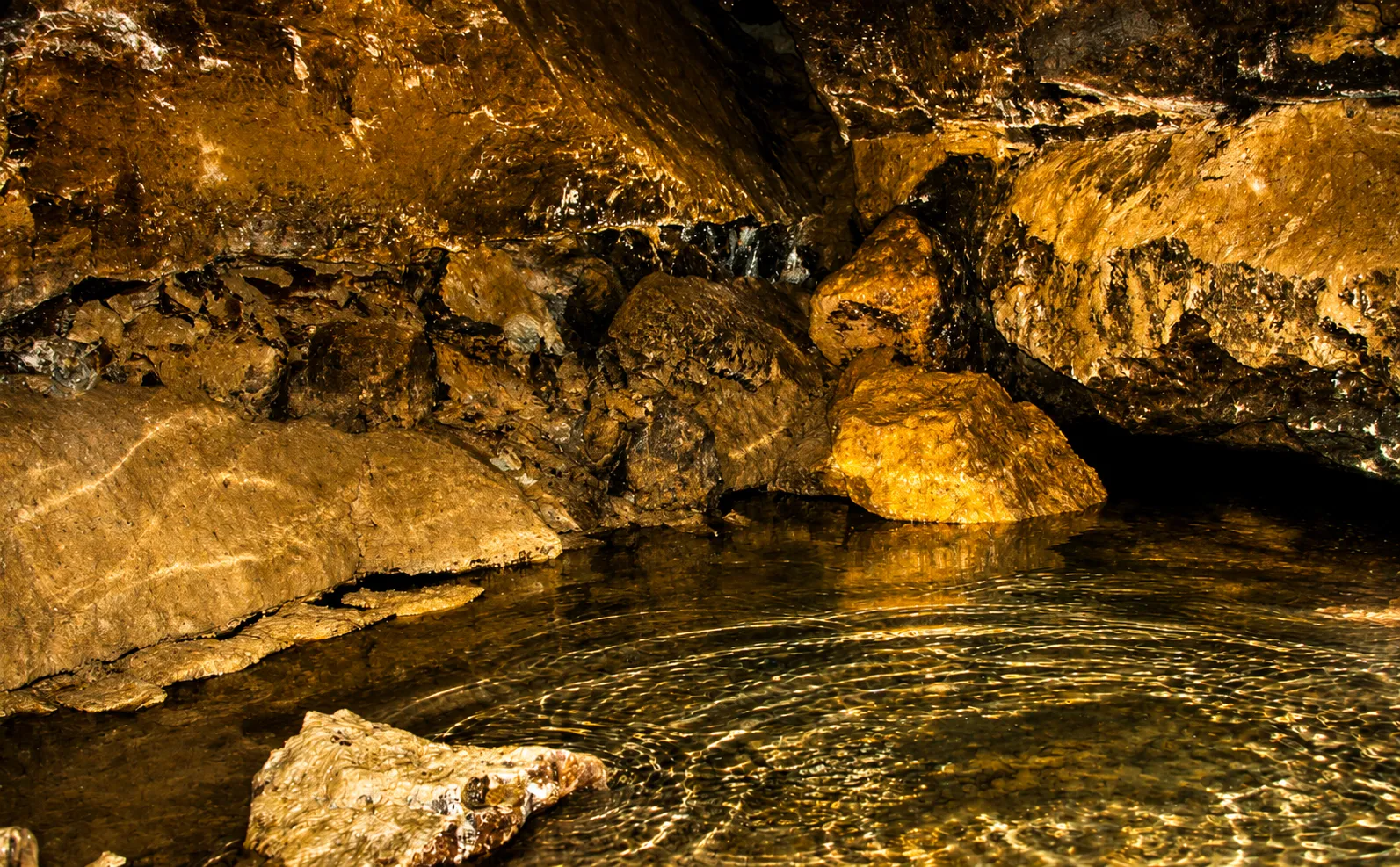
Did you know that Ukraine is home to the longest gypsum cave in the world? Beneath the ordinary fields of Ternopil region lies such a vast and intricate underground labyrinth that researchers continue to discover new passages in it even decades after the first descent. This is Optimist Cave—a mysterious world of silence, darkness, gypsum crystals, and hundreds of kilometers of underground corridors.
Nothing on the surface hints at the scale of what lies underground. All around are the tranquil Podillia landscapes, fields, shelterbelts, and the small village of Korolivka. But approach the cave entrance, put on a helmet, switch on your headlamp, and take your first steps into the darkness—and the familiar world is left behind. A completely different reality begins ahead, with no sunlight or urban noise.
What Makes an Underground Tour of Optimist Cave Special
An Optimist Cave tour is very different from visiting developed tourist caves. Here, the route may pass through clay corridors, low passages, and sections where visitors have to bend, move in a crouch, or carefully negotiate uneven ground. The difficulty depends on the program selected: shorter introductory routes are available for beginners, while extended caving expeditions lead into remote areas of the underground.
This is not an attraction with decorative lighting, but a genuine cave tour during which visitors see a natural labyrinth much as the first explorers found it. That is why visits take place only with an experienced guide and appropriate equipment. Entering the cave alone is dangerous: its complex network of branches quickly erases any sense of direction, and an ordinary map of Optimist Cave is of little help underground without knowledge of the route.
In this article, we will explain in detail how Ukraine’s longest cave was discovered, how its areas differ, which routes are available to tourists, how to prepare for a caving expedition, and what you can see near Korolivka. We will also cover safety rules, equipment, tour duration, infrastructure, and practical advice for anyone planning their own underground journey through Ternopil region.
The Discovery of Optimist Cave: From an Unknown Fissure to a World Record
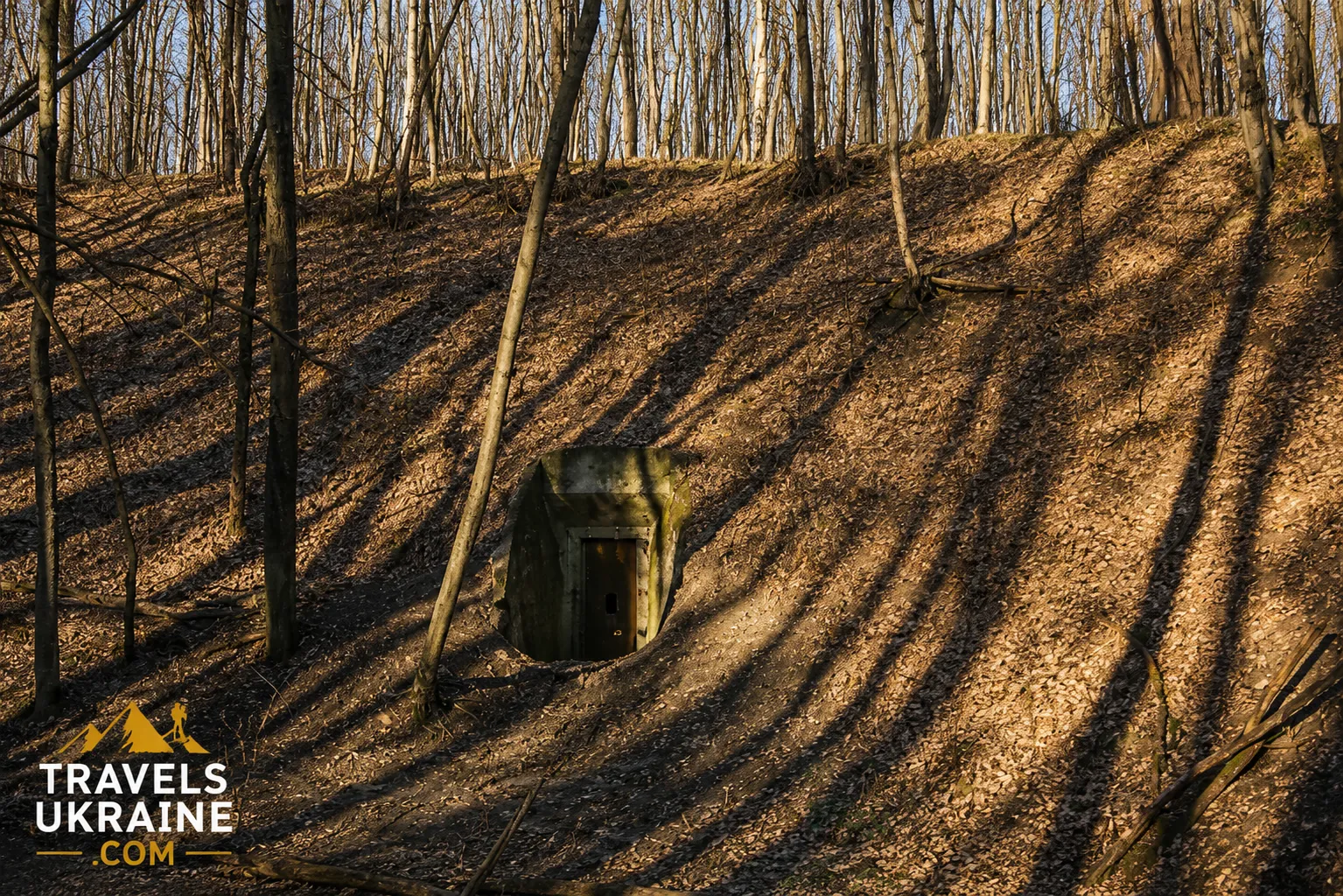
The history of Optimist Cave did not begin with a casual walk or a spectacular discovery of a spacious underground chamber. At first, there was only a karst sinkhole in the middle of Korolivskyi Forest, a small stream disappearing beneath a gypsum block, and a barely noticeable draft of air from a narrow fissure. To most people, the place would hardly have seemed remarkable. But experienced cavers understood that if water and air passed deep into the rock, substantial cavities might be hidden underground.
In the spring of 1965, a group of Lviv cavers was working near the village of Korolivka, carrying out a topographic survey of Vitrova Cave. Local residents showed the researchers a sinkhole located several hundred meters from the already known cave. At its bottom, water disappeared beneath a gypsum monolith, as if pointing the way to an unknown underground world.
An immediate attempt to enter ended in failure. The passage was blocked by a dense clay siphon, and the narrow fissure prevented further progress. The cavers returned to the surface but did not abandon their search. The underground seemed to have closed its doors in front of them while leaving enough evidence that a much larger system might begin beyond the clay obstruction.
How Optimist Cave Was Discovered near the Village of Korolivka
The explorers returned to the mysterious sinkhole a year later. In May 1966, Lviv Cyclops Club cavers Myron Savchyn and Oleksii Soliar began clearing the channel of an underground stream. The work was slow and exhausting: they had to remove wet clay and stones and widen the narrow passage almost entirely by hand.
On May 8, 1966, the researchers managed to overcome the obstruction. Beyond the excavated section, an approximately one-hundred-meter-long, difficult passage opened up and gradually led them to a system of more spacious corridors and chambers. Thus began the documented history of the world’s longest gypsum cave.
The First 400 Meters of the Unknown Underground Labyrinth
During their first outing, the cavers spent about five hours underground and covered approximately 400 meters of passages. It was already clear that they were not facing a small cavity, but part of a vast labyrinth formed within the gypsum. The corridors branched in different directions, new passages appeared, and the light from their lamps did not reach the ends of some galleries. In his first report, Myron Savchyn suggested that the total length of the discovered system could be at least several kilometers. Surface studies above the cave even suggested the possibility of a labyrinth tens of kilometers long.
At the time, such an assumption may have seemed overly bold. No one yet knew that the underground’s true scale would exceed the initial estimates many times over.
Why the Cave Was Named «Optimist»
The cave’s name reflected the mood of its first explorers. To continue excavating after the failed attempt, they had to believe that a large labyrinth truly existed beyond the clay siphon. Optimism was also essential later, when another corridor ended in a collapse and finding a continuation required hours of hard work.
The researchers named the new cave Optimist, expressing in advance their confidence in future discoveries. Time proved that the name was remarkably apt. Beyond the first narrow passage, a grand and mysterious labyrinth truly began, and cavers increased its known length with almost every expedition.
Today, the name is understood symbolically. It reminds us that one of Ukraine’s most important natural discoveries became possible thanks to the persistence of people who did not give up after their first failure.
The First Expeditions and the Creation of the Map of Optimist Cave
Approximately a month after the first entry, the first specialized expedition of the «Cyclops» caving club set up camp near the entrance. Systematic work began: participants explored new directions, widened difficult passages, measured corridors, and transferred the resulting data onto a map.
In those days, creating a cave plan was a painstaking process. Cavers used mining compasses, measuring cords, and field journals. Each section had to be traversed, measured, and recorded, with its direction noted, and only after returning to camp could it be transferred onto paper. Thus, the first map of Optimist Cave gradually took shape.
During the initial expedition, the researchers mapped more than 1,300 meters of passages in just two days. In August 1966, a second major expedition took place, involving not only topographic work but also observations of temperature, humidity, atmospheric pressure, and the characteristics of the cave soil.
By the end of that expedition, the length of the explored passages already exceeded six kilometers. In the autumn of the same year, successive groups continued the work, bringing the total length of the known part of the labyrinth close to nine kilometers. In just a few months, a modest fissure in Korolivskyi Forest had become one of the most promising cave systems of its time.
How New Areas of Optimist Cave’s Gypsum Labyrinth Were Discovered
As the explorers advanced deeper into the labyrinth, the journey to unknown sections grew longer. Cavers had to spend more and more time simply reaching the edge of the already explored part of the cave. As a result, they began arranging routes and places for short rest underground, and later established underground camps for multiday expeditions.
The first explored section was named the Old Area. Later, the Globes, Central, Far, Lake, Beyond-the-Lake, Anaconda, Mirage, and other areas appeared on the map. Each name was connected with the character of the location, the first explorers’ impressions, or events that occurred during an expedition.
New sections could open beyond narrow cracks, clay siphons, or collapses. Sometimes cavers widened a passage for hours without knowing whether it continued beyond it. The reward was a corridor no person had ever entered before, a new cave chamber, or an entire network of branching passages.
Cavers from various Ukrainian cities, scientists, and participants in international expeditions joined the exploration. For decades, they carried out topographic, geological, meteorological, and other observations. Thanks to this work, Optimist Cave in Ternopil region became not only a tourist attraction but also an important site for studying karst processes and gypsum caves. Today, the total length of the cave’s surveyed passages exceeds 260 km, and the cave itself, recognized as the world’s longest gypsum cave, has entered the Guinness World Records.
The History of Optimist Cave Continues Today
The most remarkable thing about Optimist Cave’s history is that it is not over yet. Unlike landmarks whose boundaries have long been known, this cave continues to reveal new secrets. Cavers return to promising areas, examine narrow fissures, clear passages, and refine the map of the underground labyrinth.
Every new meter requires physical endurance, precision, and teamwork. An explorer cannot simply move forward without recording the route and ensuring a safe return. That is why cave exploration proceeds slowly, and unknown sections may wait years for their first explorers.
From a small stream disappearing beneath a gypsum block to hundreds of kilometers of underground passages, Optimist Cave’s journey has become one of the brightest chapters in Ukrainian speleology. Its discovery proved that genuine geographical mysteries may lie not beyond distant oceans, but right beneath the fields and forests of their native Ternopil region.
Optimist Cave: Natural Features

Optimist Cave impresses not only with its length. Its true value lies in the complex structure of its underground labyrinth and the variety of its forms and mineral formations. Here, nature has created its own architecture: gypsum partitions instead of columns and arches, crystals instead of ornamentation, and a dense web of passages branching in different directions instead of straight corridors.
The cave is formed in a 20–25-meter-thick layer of gypsum lying at a depth of 60–80 meters. Its passages occupy a relatively small area but intertwine so densely that their total surveyed length is measured in hundreds of kilometers. This unusual structure explains why the world’s longest gypsum cave does not extend as one straight tunnel but resembles a multilevel network with thousands of turns, intersections, and dead ends.
On a map, this underground world resembles a gigantic web. Some passages run parallel to one another, others intersect at almost right angles, and between them open grottoes, small cave chambers, and complex branching networks. In some areas, the passages form several levels arranged one above another. As a result, even an experienced traveler would find it extremely difficult to understand where they were or which direction to take without a guide.
How the Gypsum Labyrinths of Podillia Were Formed
Water was the cave’s principal architect. Over a long geological period, groundwater moved through a system of natural fissures in the gypsum rock and gradually dissolved it. At first, these were thin channels, almost imperceptible within the solid layer. Over time, they widened, connected with one another, and transformed into a dense network of underground passages.
Gypsum dissolves in water much more easily than many other rocks. However, this does not mean that the enormous cave formed quickly. Creating such a labyrinth required a complex combination of geological conditions: a thick gypsum layer, a system of cracks, groundwater movement, and a long period of time.
Scientists classify Ukraine’s gypsum caves as a special type of karst formation. A significant part of their passages began forming when the gypsum layer was covered by other rocks and water circulated through it under pressure. It seeped into cracks from different directions, widening not one main channel but an entire network at once. This is why Optimistic Cave has such a complex labyrinthine structure.
Why Optimistic Cave Has So Many Underground Passages
The direction of the corridors was largely determined by natural cracks in the gypsum layer. Water flowed along weakened sections of the rock, dissolving them and creating new cavities. Where several cracks intersected, wider sections, grottoes, or cave chambers formed. Where the flow weakened, narrow fissures and difficult crawlways remained.
As a result, what formed was not a typical tunnel with one entrance and one exit, but a mysterious labyrinth in which a short distance in a straight line can become a lengthy route with dozens of turns. Sometimes two points are very close to each other, but there is no direct passage between them, so visitors have to navigate an entire system of corridors.
Gypsum Crystals — Optimistic Cave’s Main Natural Treasure
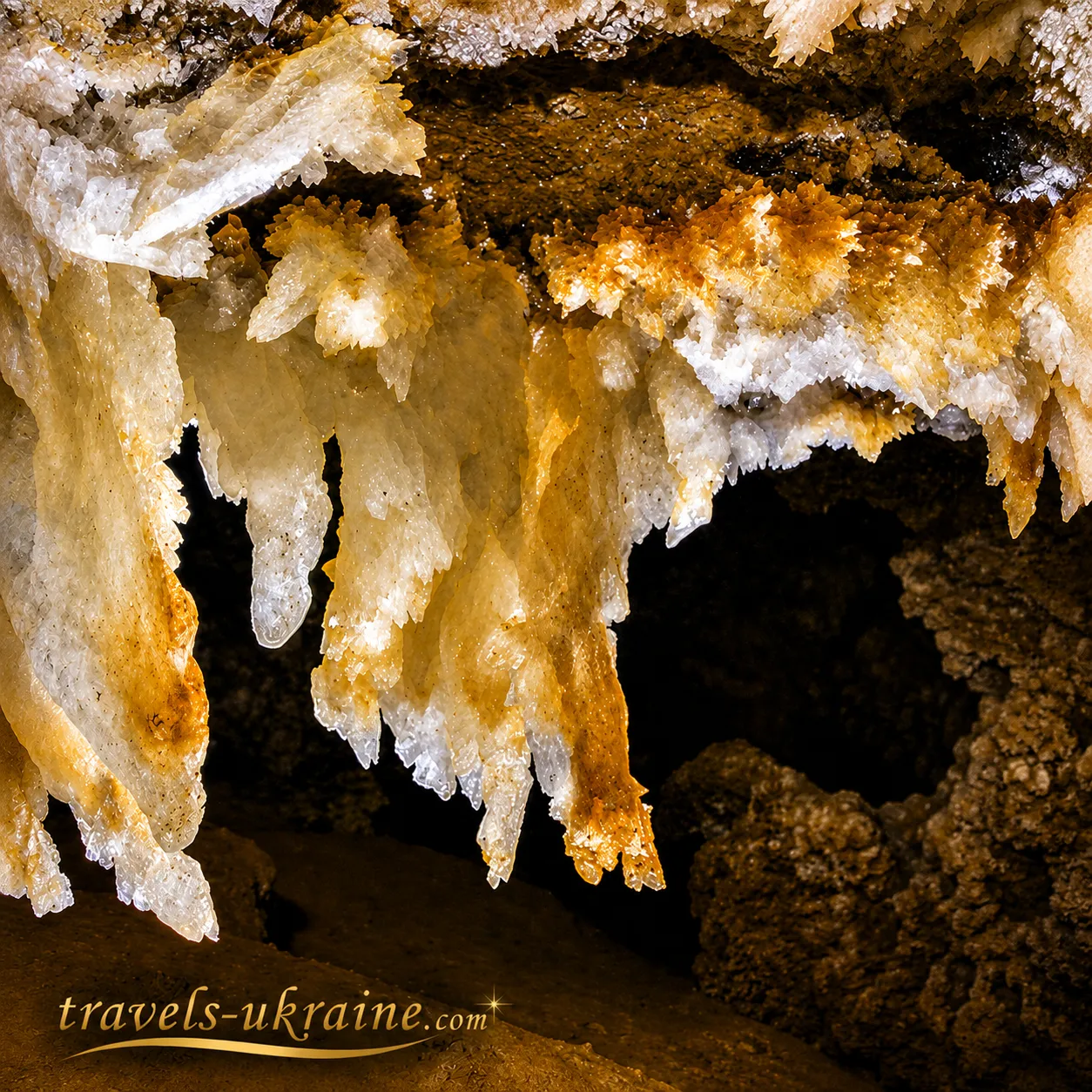
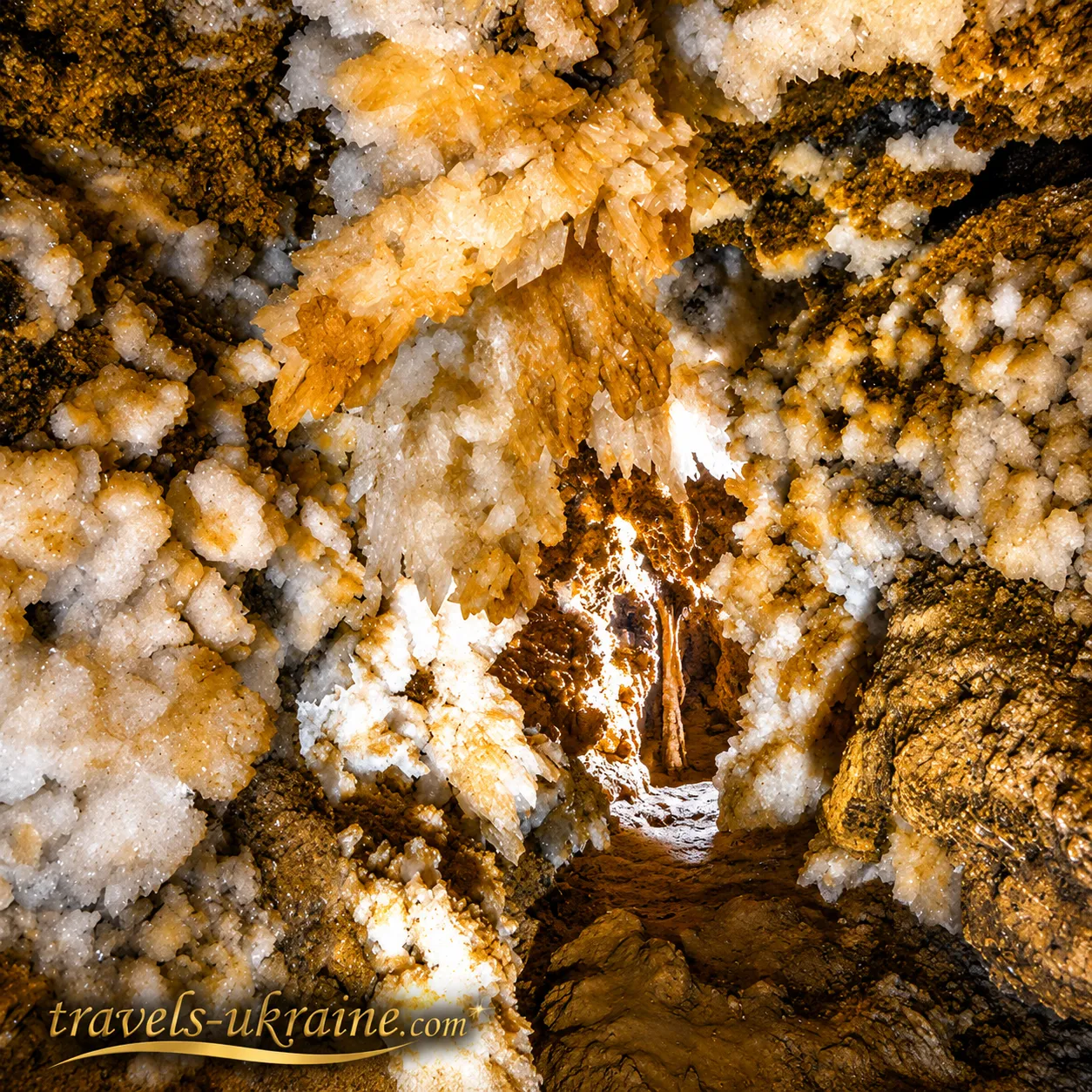
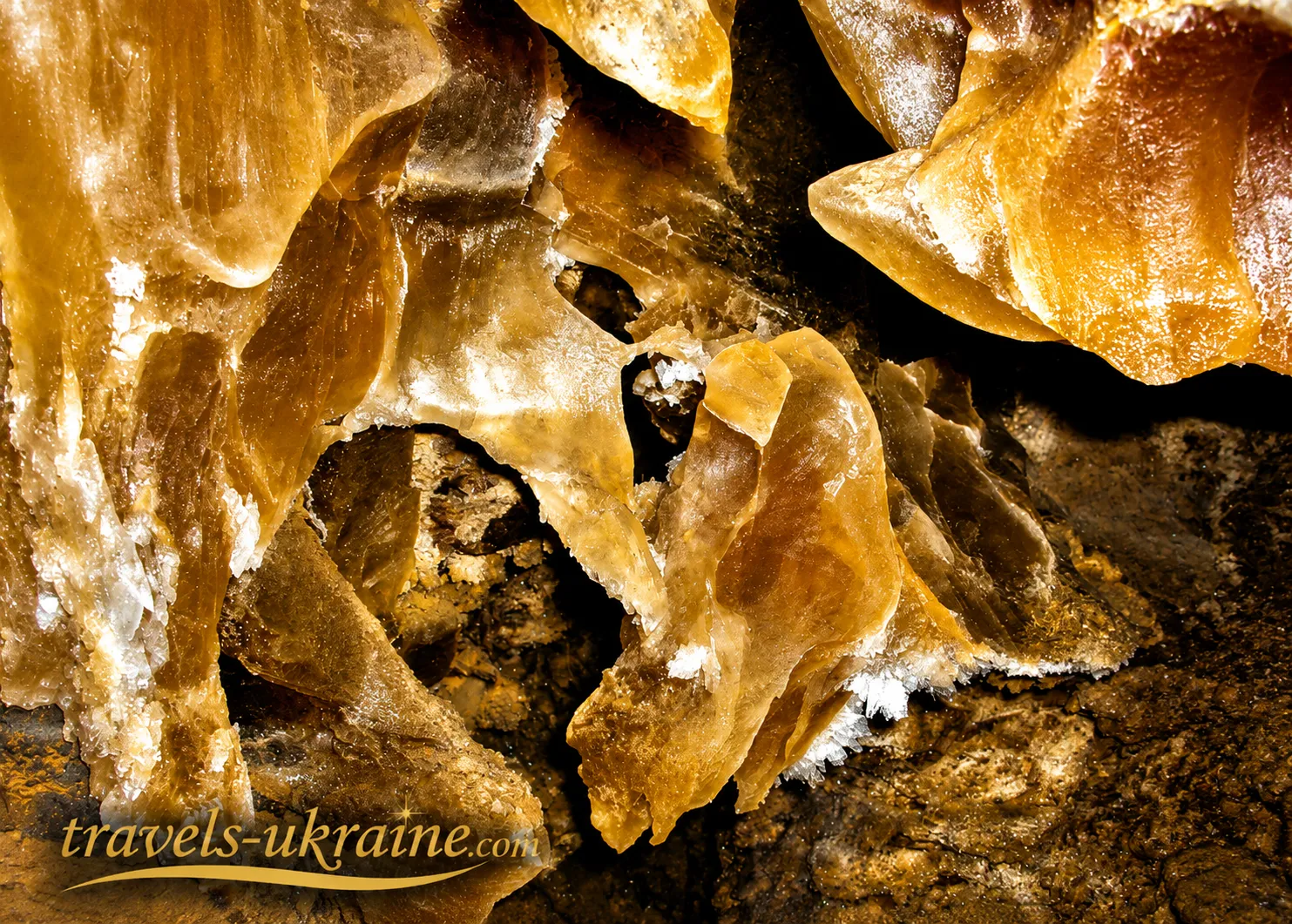
What impresses travelers most are the crystals. In the light of a headlamp, they flash with white, transparent, yellowish, or cream-colored reflections. Some resemble slender needles, while others cluster into dense rosettes, bushes, or bizarre flowers. There are also large transparent crystals that speleologists call plafonds.
These formations are not part of the main gypsum wall. They appeared later, when mineral-rich water entered already formed cavities. As the temperature, humidity, and chemical composition of the solution changed, gypsum was redeposited on the walls and ceiling, gradually forming crystals.
Their growth was an extraordinarily slow process. What looks today like a small crystal branch may have formed over thousands of years. That is why even a light touch can damage a formation that nature created over a period far longer than a human lifetime.
Helictites, Stalactites, and Other Formations of the Underground World
In addition to ordinary crystals, the cave contains helictites—mineral formations that grow in different directions, seemingly defying gravity. They can bend, branch, and form complex shapes resembling corals, roots, or slender stone branches.
In some areas, visitors can see stalactites, stalagmites, and calcite flowstone formations. They form differently from gypsum crystals: mineral-rich water seeps through the rock, depositing material drop by drop on the ceiling, walls, or floor. As a result, a single underground chamber may combine several different types of mineral decoration.
Galleries where delicate helictites stand alongside larger crystals and pale flowstone formations are especially beautiful. In the beam of a lamp, their shadows move across the walls, making it seem as though the cave changes shape with every step.
Optimistic Cave’s Chambers, Galleries, and Narrow Passages
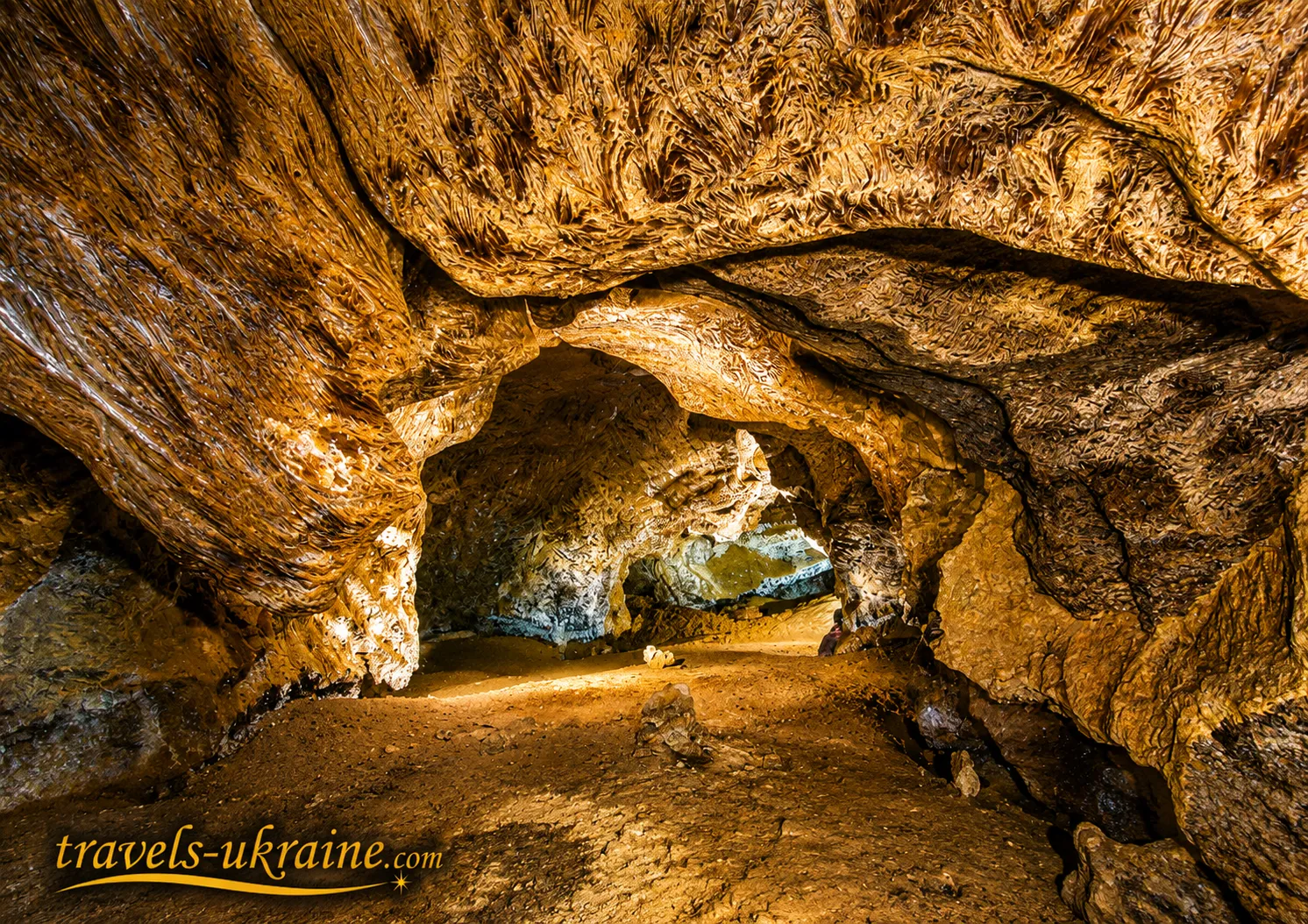
The cave’s underground terrain is highly varied. In one place, a person can walk almost fully upright, while just a few meters farther on, the corridor becomes so low that they must bend down or get on their knees. More spacious underground chambers give way to narrow passages, clay-covered sections, and piles of large boulders.
Some corridors have smooth walls, as though they had been deliberately leveled. Others are covered with projections, cracks, and sharp edges. Clay often lies on the floor, becoming slippery in damp areas and sticking to footwear and clothing. That is why an excursion requires protective coveralls, gloves, and sturdy footwear.
The cave also contains areas bearing traces of ancient collapses. Large gypsum blocks broke away from the ceiling and blocked the passages, creating natural obstacles. Some can be walked around, while others require squeezing between the rocks. Such places are a reminder that the cave is a living geological system, not a frozen backdrop.
Underground Lakes in Optimistic Cave
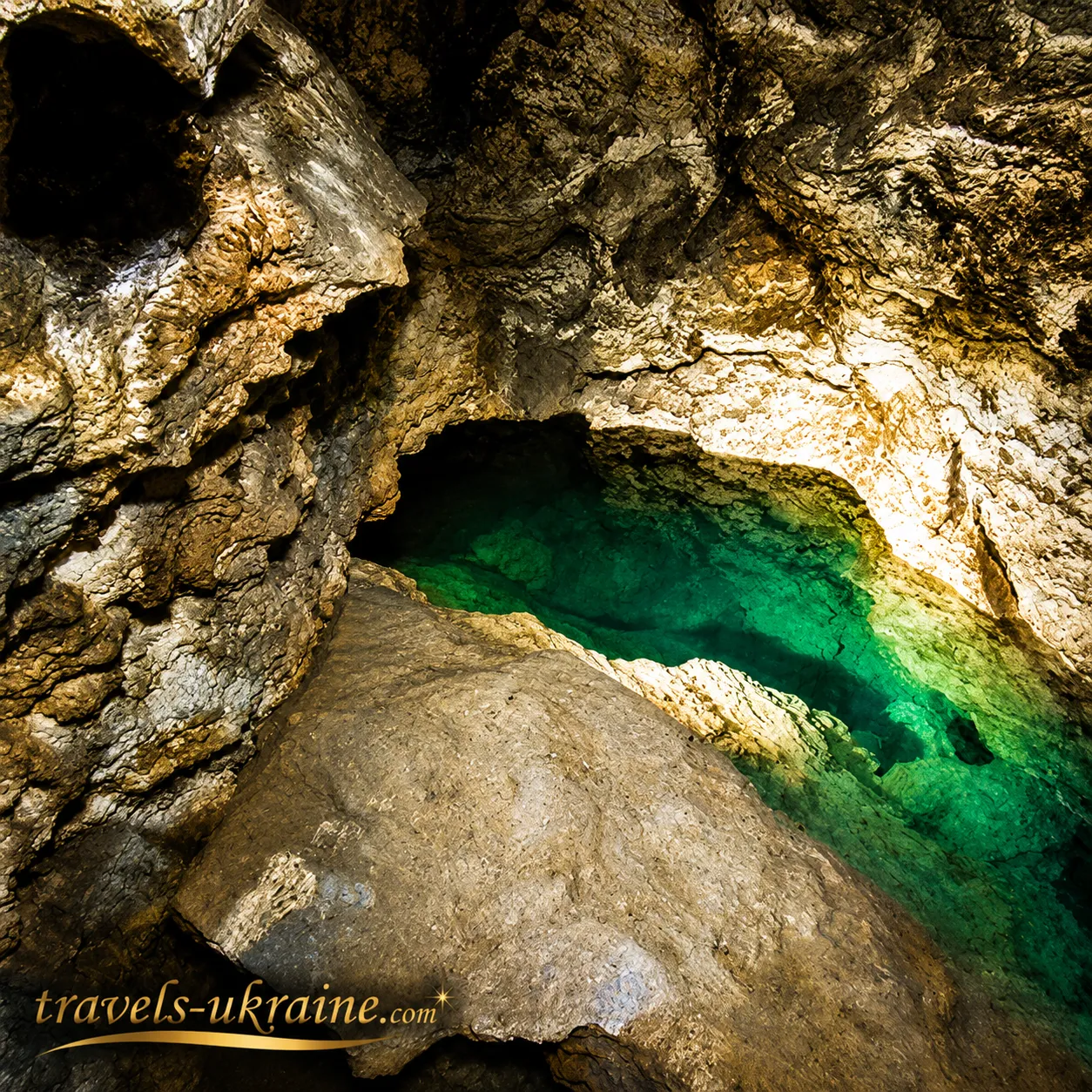
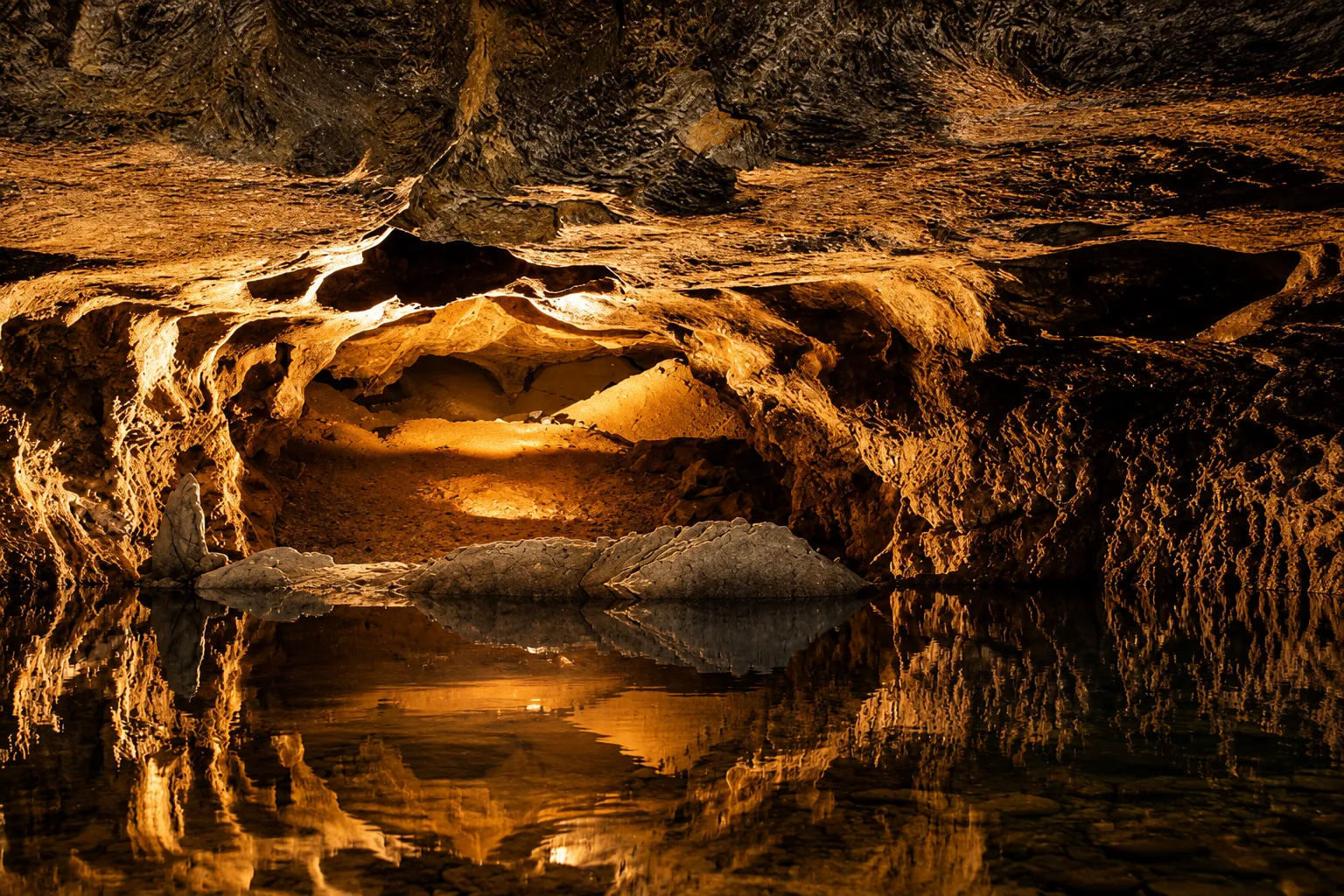
Hidden in the depths of Optimistic Cave are underground bodies of water, each with its own name and distinct character. They include the lakes Mriia, Chastynka Boha, Piatykutne, Permske, Frike, Mystyk, Kyshenka, and Mikron. Their still surfaces reflect the light of lamps, while the cold water heightens the feeling that the traveler has entered a remote, almost unreal world.
The most impressive is Lake Mikron, which is a contender for the title of Ukraine’s largest underground lake. It reaches a depth of approximately 5–6 meters, its water surface covers about 500 m², and the water temperature remains at just 7 °C. In the darkness of the cave, this body of water seems like a silent underground abyss guarding its secrets far from the sunlight.
Optimistic Cave’s Microclimate
Underground, there are no sharp daily temperature fluctuations, sunlight, or wind. Cool temperatures, high humidity, and nearly unchanging conditions prevail throughout the year. Even on a hot summer day, warm clothing is needed inside, while in winter the cave may be warmer than the surface.
Because of the humidity and physical exertion, the perceived temperature can be deceptive. At the beginning of the route, a tourist may feel cold, but while moving in coveralls, they quickly warm up. That is why it is best to dress in layers and avoid clothing that takes a long time to dry or restricts movement.
The complete absence of natural light is also an important feature of the underground environment. Turn off the lamp, and you find yourself in darkness to which your eyes cannot adapt, even after a long time. Without a light source, it is impossible to see either the walls or your own palm.
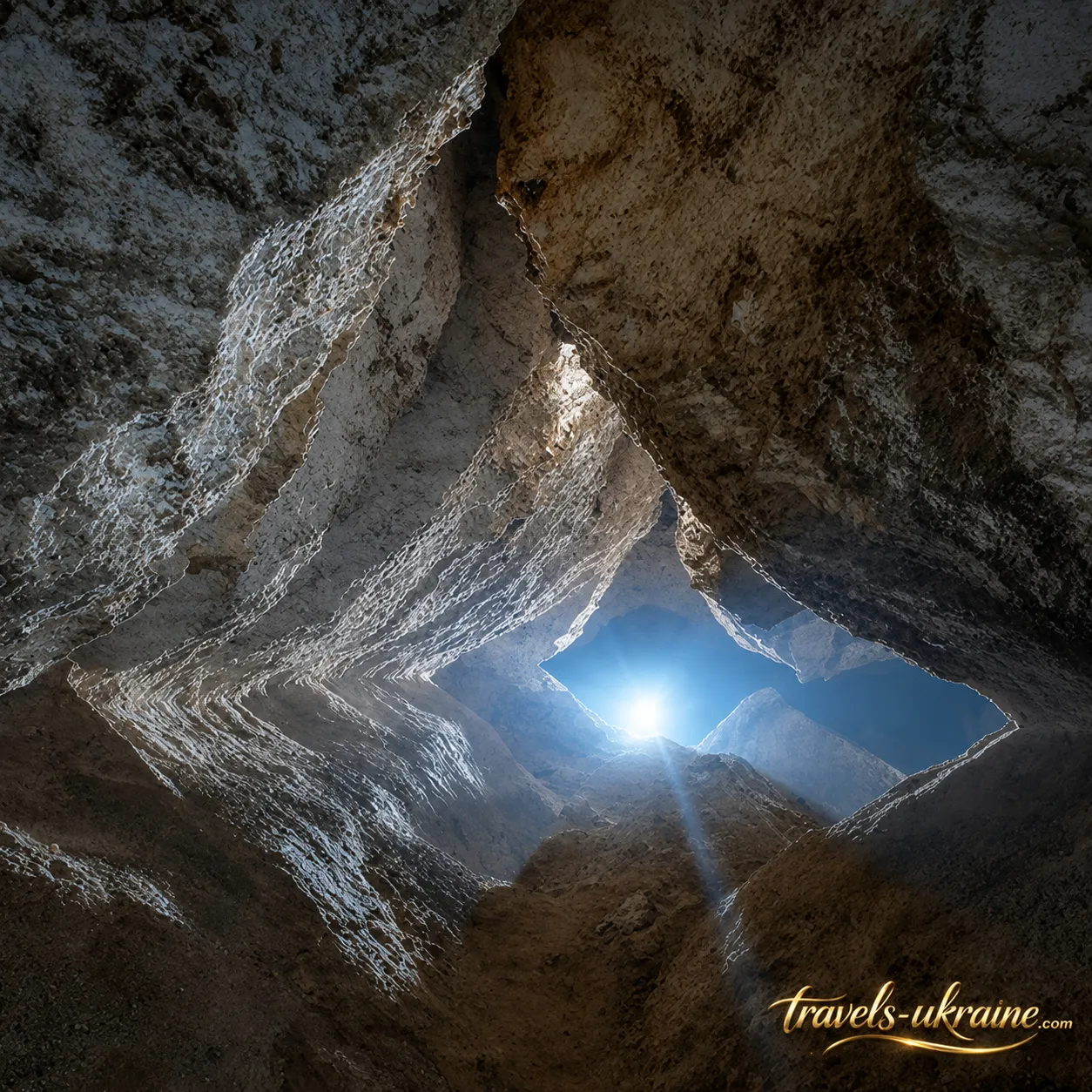
Photo and Video Gallery




A Brief Tourist Guide to Visiting Optimistic Cave
Optimistic Cave in Ternopil Oblast is not an ordinary sightseeing location that can be visited independently. The journey underground takes place only as part of an organized group and accompanied by an experienced guide. The format depends on the route: from a short introductory tour for beginners to a multi-hour speleological expedition into remote areas of the cave.
Before booking a tour of Optimistic Cave, honestly assess your physical fitness, your attitude toward confined spaces, and your readiness to move through clay corridors. Even an easy route involves spending time in complete darkness, moving across uneven surfaces, and wearing a helmet with a headlamp.
What Tours Are Available in Optimistic Cave
Tourists can choose routes of varying difficulty. The shortest programs introduce visitors to the cave’s entrance area, underground museum, clay sculptures, first chambers, and speleologists’ camp. These excursions suit people without special physical training who are entering underground passages for the first time.
Moderately difficult routes lead farther from the entrance—to more spacious galleries, crystal formations, and individual lakes. During such a journey, visitors must cover long stretches, pass between large boulders, bend through low corridors, and move across slippery clay sections.
The most challenging speleological tours are intended for physically fit travelers. They may last almost an entire day and lead to remote areas, narrow crawlways, large crystals, and underground lakes. Such routes should not be chosen solely for impressive photographs—they require strength, endurance, discipline, and a willingness to follow all the guide’s instructions.
Approximate Route Durations
- Introductory route: approximately up to 2 hours underground.
- Easy route to selected underground sites: about 3–4 hours.
- Moderately difficult route: approximately 4 to 7 hours.
- Challenging speleological tour: approximately 8 to 11 hours, sometimes longer depending on the group and route.
How Much Does a Tour of Optimistic Cave Cost, and What Equipment Is Needed?
A protective helmet and a reliable headlamp are essential. Longer routes also require spare batteries or an additional light source. Clothing should be comfortable, warm, and suitable for getting dirty with clay. The best options are a speleological coverall or sturdy outerwear, work gloves, and rubber boots or closed-toe shoes with a lugged sole. Some equipment can usually be rented, but its availability, sizes, and cost should be confirmed when booking.
The cost of a visit depends on the route’s duration and difficulty, the number of people in the group, guide services, equipment rental, meals, and accommodation. For some programs, the total price is set for the group and then divided among its participants.
It is best not to include a fixed amount in your budget without prior confirmation, as conditions and rates may change. Before the trip, confirm the full program cost and ask exactly what the price includes: the guide’s services, helmet, lamp, coveralls, boots, accommodation, or meals.
For a first introduction to the underground world, the best choice is a short introductory route. It lets you experience the cave’s atmosphere, see its natural formations, and understand how comfortable you feel in darkness and confined spaces. After that, you can plan a longer tour of Optimistic Cave—to crystal galleries, underground camps, and remote lakes.
What to See in Optimistic Cave
Optimistic gypsum cave in Ternopil Oblast is not one of those tourist destinations where you simply walk up to a viewing platform, take a few photos, and move on. Here, the journey itself becomes the main part of the experience. Tourists gradually get used to the darkness, learn to watch their footing carefully, notice the glints of crystals, and read the underground terrain with the help of the narrow beam of a headlamp.
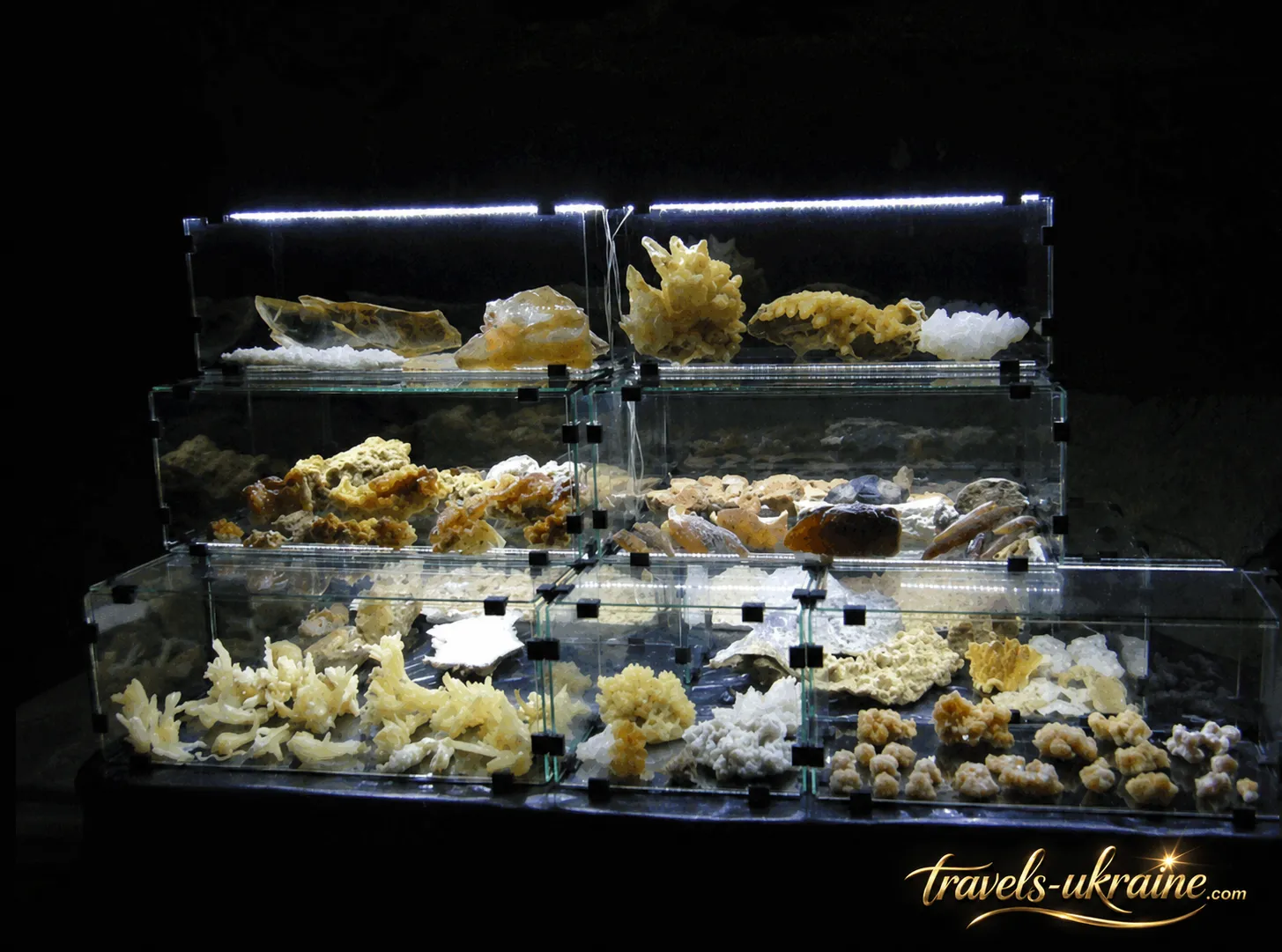
One of the most accessible and informative sites in the cave is the underground museum. It was created directly inside the cave to showcase the diversity of mineral formations without removing them from the underground environment. Here, visitors can examine gypsum crystals, helictites, flowstone formations, transparent plafonds, and other natural formations characteristic of different parts of the labyrinth.
The value of this exhibition lies in the fact that tourists see not artificial copies but genuine fragments of the underground world in the environment where they formed. The guide explains how the crystals developed, why they have different shapes and colors, and why even a light touch can cause irreparable damage. The museum is often included in short introductory routes, making it well suited to a first visit to Optimistic Cave. It offers an opportunity to see the cave’s characteristic natural features without a multi-hour trek to remote areas.
See Clay Sculptures in the Underground Passages
In the entrance area of the cave, visitors can see an unusual collection of cave-clay sculptures. They include fantastic fish, mermaids, cyclopes, animals, and imaginary creatures. The figures were created by speleologists and visitors, leaving distinctive creative traces in the underground.
Clay sculptures add a touch of fairy-tale charm to the route without overshadowing the cave’s natural beauty. Children especially enjoy them, although adults also find it fascinating to see how people created entire compositions in complete darkness and with almost none of the tools they were used to. At the same time, you should not sculpt new figures yourself without the guide’s permission. Even cave clay is part of the natural environment, so any activity inside must take place only in designated areas and according to the organizers’ rules.
Visit the first underground camp, «Cyclops»
Another landmark site is the «Cyclops» underground camp. It was one of the first base camps established by speleologists to work deep inside the labyrinth. Researchers rested here, prepared food, stored equipment, and planned their next expeditions into unexplored areas.
Visiting the camp makes it easier to understand how real speleological expeditions work. Underground, there is no usual distinction between day and night; time is measured by the clock and the work schedule. After walking for many hours, even a simple resting place feels like a real base amid an endless labyrinth.
The route to «Cyclops» is among the most accessible and is often combined with a visit to the museum and the clay sculpture exhibition. It lets visitors discover not only the natural history of Optymistychna, but also its research history.
See gypsum crystals and the «Milky Way» gallery
For many travelers, the main attraction is the gypsum crystals. In flashlight beams, they sparkle with white, transparent, and golden glints. Against the dark walls, the crystal clusters sometimes resemble stars scattered across a stone sky.
The «Milky Way» gallery is especially famous. Its name comes from the abundance of pale crystals that create the illusion of a night sky in the beams of flashlights. Reaching these areas usually requires choosing a longer route and being prepared for several hours of active movement.
Another popular destination is the «Radio Lux» area, known for its large crystals, transparent formations, and crystal «snow.» These routes require better physical fitness because the path leads through long galleries, low corridors, and natural obstacles.
Challenge yourself on an active caving route
Those seeking not only an educational tour but also a physical challenge may enjoy a medium- or high-difficulty caving tour of Optymistychna Cave. These routes involve moving among large gypsum boulders, ducking through low corridors, squeezing through narrow passages, and traversing long galleries.
This is not a race against the clock. The main task is to move carefully, conserve your energy, and keep pace with the group. The guide determines the order for passing difficult sections, shows where to place your foot or hand, and makes sure no one falls behind. After such a route, people feel not only tired but also genuinely pleased with what they have accomplished. The underground journey makes you focus on simple things: the next step, the flashlight’s beam, the guide’s voice, and the support of the other participants.
Organize a family tour of Optymistychna Cave
Families with children should choose a short introductory route. It may include the entrance area, the clay sculptures, the underground museum, and the «Cyclops» camp. This program makes it possible to see the cave’s main features without a long and physically demanding trek.
The minimum age for participation must be confirmed with the organizers. It is important to consider not only physical endurance but also a child’s reaction to darkness, narrow corridors, and confined spaces. Children must follow the guide’s instructions and stay with the group.
For a first visit, it is best not to choose the longest route. It is better to leave yourself wanting to return than to turn your introduction to the underground world into an exhausting ordeal.
Make an underground tour part of a trip through Ternopil region
A tour of Optymistychna Cave can become a full weekend trip. After going underground, allow time for rest, changing clothes, and a leisurely dinner. The next day, you can continue exploring the caves of Ternopil region, visit Borshchiv, see the Verteba archaeological cave, or discover other natural and historical landmarks of Chortkiv area.
Do not try to fit a demanding, hours-long tourist route and several distant locations into one day. Even a fit person may feel tired after a cave tour. It is better to plan your trip so that Optymistychna remains the day’s main event rather than a brief stop between other attractions.
What to see near Optymistychna Cave
A trip to Optymistychna Cave does not have to end as soon as you return to the surface. Southern Ternopil region is so rich in natural and historical landmarks that it is easy to plan a full one-day or weekend itinerary around Korolivka. You can see other gypsum caves, learn about Trypillian culture, climb to the ruins of an old castle, visit a waterfall, and walk the streets of historic Chortkiv.
This region’s special appeal lies in its remarkable combination of underground nature and human history. In the morning, a traveler may walk through dark gypsum labyrinths, spend the afternoon examining Trypillian pottery, and stand at dusk beside defensive walls above the Zbruch Valley. That is why the cave near the village of Korolivka is ideal not only for a separate excursion but also as the centerpiece of a larger trip through Podolia.
Borshchiv — the nearest town to Optymistychna Cave
Your first stop after Korolivka could be Borshchiv, located approximately 12 km from the village. Most routes to the cave pass through the town, making it convenient to buy essentials, have lunch, replenish your water supplies, or stay overnight.
However, Borshchiv deserves attention as more than just a transport hub. The town is known for its unique tradition of black Borshchiv embroidery. Dense patterns, made mostly with dark threads, cover shirt sleeves so completely that the white fabric is barely visible in places. Each village in the Borshchiv area had its own designs, techniques, and methods of decorating clothing.
Authentic shirts, old photographs, archaeological finds, and household objects can be seen at the Borshchiv Regional Museum of Local Lore. A visit helps visitors better understand the culture of the region, beneath whose fields Ukraine’s largest gypsum labyrinths are hidden.
Verteba Cave — an underground museum of Trypillian culture
Near the village of Bilche-Zolote lies Verteba Cave, one of the most fascinating archaeological landmarks in Ternopil region. Unlike Optymistychna, which impresses mainly with the scale of its labyrinth and its crystals, Verteba is known for its numerous finds associated with Trypillian culture.
At various times, archaeologists have discovered fragments of painted pottery, clay figurines, tools, and other traces of ancient human habitation here. Today, the cave houses a museum exhibition recreating scenes from Trypillian life and presenting materials from archaeological research.
The underground route in Verteba has a different character from a tour of Optymistychna Cave. Here, the focus is not on physically overcoming difficult passages but on history, archaeology, and imagining the world of the people who lived in Podolia thousands of years ago.
Crystal Cave in Kryvche — a more accessible underground route
Another famous natural landmark is Crystal Cave, located near the village of Kryvche. Its passages extend for approximately 23 km, but visitors can access only the equipped section of the underground route.
Crystal Cave is considered easier to explore than most routes in Optymistychna. Its corridors are generally dry, and the tourist section is adapted for a standard sightseeing tour. The temperature inside remains nearly constant year-round—approximately +10.6 °C—so warm clothing is necessary even in summer.
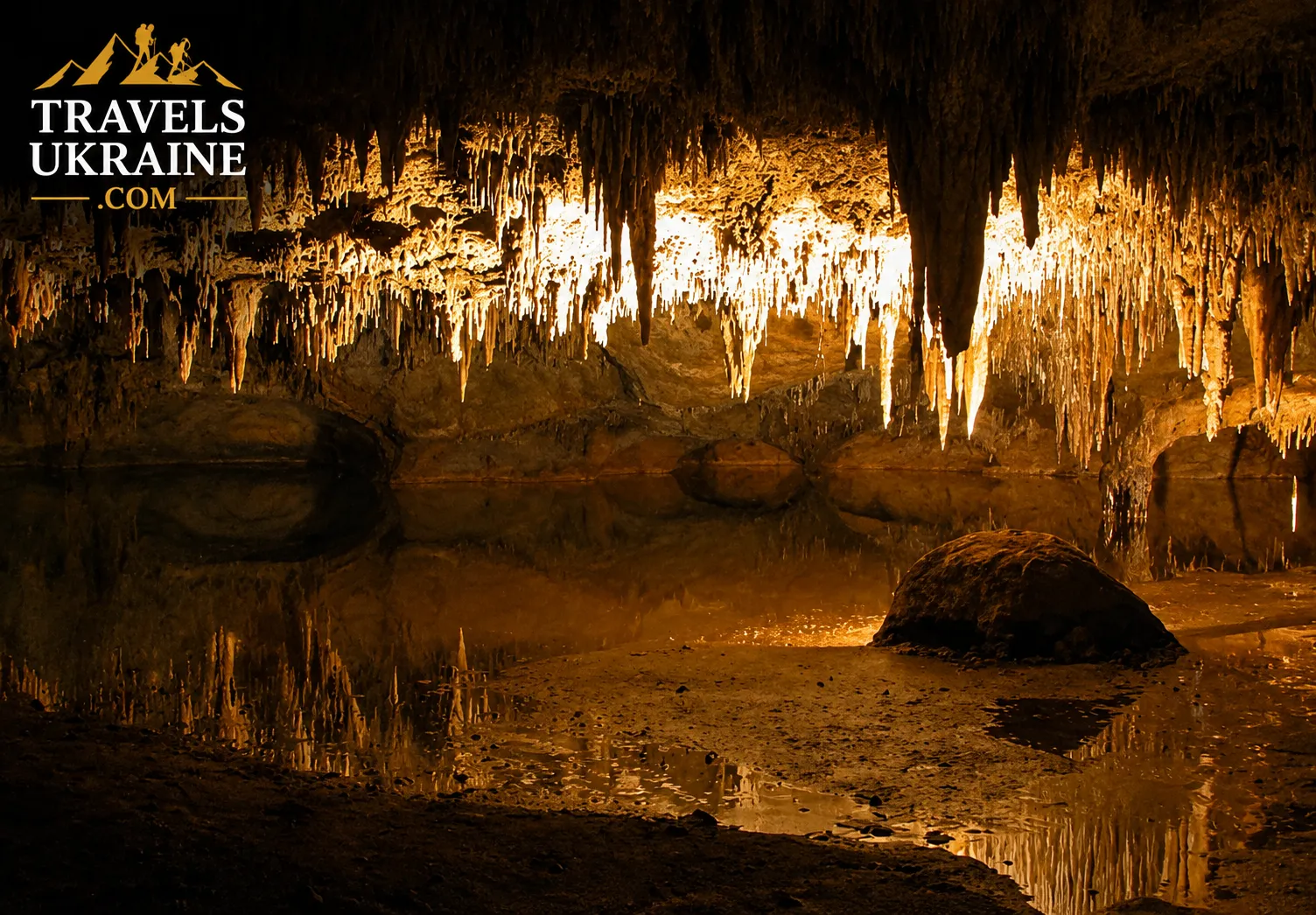
The cave walls are covered with gypsum crystals that create silvery, cream, and golden glints in the lamplight. Some formations resemble fantastical flowers, animals, or stone figures, which is why the chambers and corridors have been given evocative names. Visiting both caves reveals different sides of caving in Ternopil region. Optymistychna offers the feeling of a real expedition, while Crystal Cave is better suited to a relaxed introduction to the underground world, especially for families and travelers who are not ready for challenging crawls.
Kudrynets Castle — ruins above the Zbruch Valley
After several hours underground, it is especially pleasant to return to the open air. The Kudrynets Castle is ideal for this change of scenery; its ruins rise on Strilka Mountain near the village of Kudryntsi. The fortress was built on a high bank of the Zbruch, offering convenient control of the surrounding area and routes through the valley. Fragments of defensive walls, towers, and inner structures have survived to this day. The castle has not been restored to its original appearance, and its beauty lies precisely in the combination of old stone, silence, and the sweeping Podolian landscape.
Take care while walking: the site may contain uneven ground, steep slopes, and unstable sections of wall. Do not climb unsafe walls or enter areas that appear dangerous. The ruins of Kudrynets Castle will especially appeal to photographers and those who enjoy little-visited historical places. Unlike large restored fortresses, this site does not feel like a museum set—there are only ruins, wind, and the river valley stretching below.
Dzhuryn Waterfall and the ruins of Chervonohorod Castle
For a full day outdoors, continue to the Chervone tract near the village of Nyrkiv. Here you will find Dzhuryn Waterfall and the ruins of Chervonohorod Castle, among the best-known natural attractions in Ternopil region. Water cascades over a broad, rocky ledge, filling the valley with constant sound, while the castle ruins and green hills create one of the region’s most striking landscapes.
Dniester Canyon National Nature Park is developing an ecological route here that combines natural and historical sites: the remains of an old bridge, the Hermit’s Cave, Div’ochi Slozy Waterfall, and the ruins of a former residence. The road to the tract may be difficult in places, especially after heavy rain. Before setting out, check the access conditions, weather forecast, and current restrictions. The rocks near the waterfall are often wet and slippery, so keep away from the edges and never leave children unsupervised.
When planning what to see near Optymistychna Cave, do not try to visit every attraction in a single trip. Southern Ternopil region is best discovered without rushing: with a morning drive between villages, long stops by old walls, and enough time to rest after the underground route.
Optymistychna can be just the beginning of a grand introduction to Podolia. Underground museums, crystal galleries, ancient castles, waterfalls, and historic towns show how varied a holiday in Ternopil region can be—from the darkness of a gypsum labyrinth to the open vistas above the Dniester Canyon.
Infrastructure near Optymistychna Cave
The infrastructure and amenities near Optimist Cave are primarily designed for active tourists, speleologists, and organized groups. There is no large tourist complex or five-star accommodation in Korolivka, so the excursion, lodging, equipment, and transport need to be planned in advance.
Optimist Cave can only be visited by prior arrangement and accompanied by a guide. When booking, you need to provide the number of participants, their ages, the preferred route duration, and their level of physical fitness.
Food, accommodation near Optimist Cave, and equipment rental
A speleohostel with basic accommodation operates near the cave. Tourists stay in shared rooms, so it is advisable to bring your own sleeping bag or check in advance whether one can be rented. The speleological base suits undemanding travelers and groups planning an early or extended route. Those who prefer a private room and standard hotel amenities should stay in Borshchiv.
A helmet, headlamp, sturdy footwear, gloves, and comfortable clothing that you do not mind getting covered in clay are required for descending into the cave. At the base, you can inquire about renting coveralls, rubber boots, sleeping bags, and protective bags for equipment.
There is no wide selection of cafés directly near the cave. It is best to buy food, water, and essential small items in Borshchiv. Meal options, shower facilities, and other basic amenities at the speleological base should be confirmed when booking the excursion.
Frequently asked questions about Optimist Cave
Where is Optimist Cave located?
Optimist Cave is located near the village of Korolivka in Chortkiv Raion, Ternopil Oblast. The most convenient route is via Borshchiv, approximately 12 km from Korolivka. The exact meeting point for the group should be confirmed when booking the excursion.
Is Optimist really the longest gypsum cave in the world?
Yes. Optimist is officially recognized as the longest gypsum cave in the world and is listed in the Guinness World Records. Today, the length of the explored and mapped passages exceeds 260 km, although the cave is still not considered fully explored.
Can you enter Optimist Cave on your own?
No. Visiting independently is dangerous because of the complex network of passages, total darkness, and lack of natural landmarks. The cave may only be entered as part of an organized group and accompanied by an experienced guide.
Can Optimist Cave be visited with children?
Families with children can take short educational routes to the entrance area, underground museum, clay sculptures, and Cyclops Camp. The permitted age of the child, equipment size, and difficulty level should be agreed upon with the organizers in advance.
What is the temperature in Optimist Cave?
The underground temperature remains approximately +10 °C year-round. Because of the high humidity, the coolness may feel more intense, so even in summer you need warm clothing, closed-toe shoes, and protective coveralls.
What equipment is needed for a cave tour?
A protective helmet, headlamp, work gloves, sturdy footwear, and clothing that you do not mind getting covered in clay are essential. Longer routes also require spare batteries, coveralls, and a small supply of water. Some equipment can be rented on site.
How much does a tour of Optimist Cave cost?
The cost depends on the route duration, difficulty, number of participants, guide services, and equipment rental. For some programs, the total price is calculated for the entire group. The current price and list of included services should be confirmed directly when booking.
Do you need to book a tour to Optimist Cave in advance?
Yes. The organizers recommend arranging the excursion in advance, preferably 1–2 weeks ahead. This is especially important for weekends, large groups, families with children, and tourists planning a challenging or several-hour route.
When is the best time to visit Optimist Cave?
The cave can be visited year-round because the underground temperature barely depends on the season. However, in spring and autumn, consider the rain and condition of rural roads; in winter, possible icy conditions; and in summer, do not forget warm clothing for the descent.
Why visit Optimist Cave
A journey to Optimist offers an experience that is difficult to compare with an ordinary excursion. There is no decorative lighting, even walkways, or opportunity simply to observe nature from the sidelines. Travelers make their way through the corridors themselves, duck beneath low ceilings, help other group members, and gradually adjust to the silence, coolness, and absolute darkness.
For some, the main discovery will be the gypsum crystals; for others, the underground lakes, vast galleries, or the story of the speleologists who have spent decades exploring the labyrinth. Some will remember most vividly the moment when the group switches off its headlamps and not a single ray of light remains around them. These are the moments that turn a cave tour into a personal adventure rather than just another tourist program.
Optimist Cave in Ternopil Oblast proves that you do not have to travel to another continent for incredible natural discoveries. Beneath the fields of Podillia lie a world record, labyrinths, underground lakes, and an exploration story that is still unfolding. Perhaps after returning to the surface, your clothes will be covered in clay, your legs will feel tired, and ordinary daylight will seem unusually bright. Yet you will take away something far more valuable: the feeling that for a few hours, you became part of a great underground mystery.


No Comment
You can post first response comment.