
 English
 Українська
 Български
 Hrvatski
 Čeština
 Dansk
Dansk Nederlands
 Eesti
Eesti Suomi
Suomi Français
 Deutsch
 Ελληνικα
 Magyar
 Íslenska
 Italiano
 Latviešu
 Lietuvos
 Polski
 Português
 Română
 Русский
 Српски
 Slovenčina
 Slovenščina
 Español
 Svenska
 Türkçe
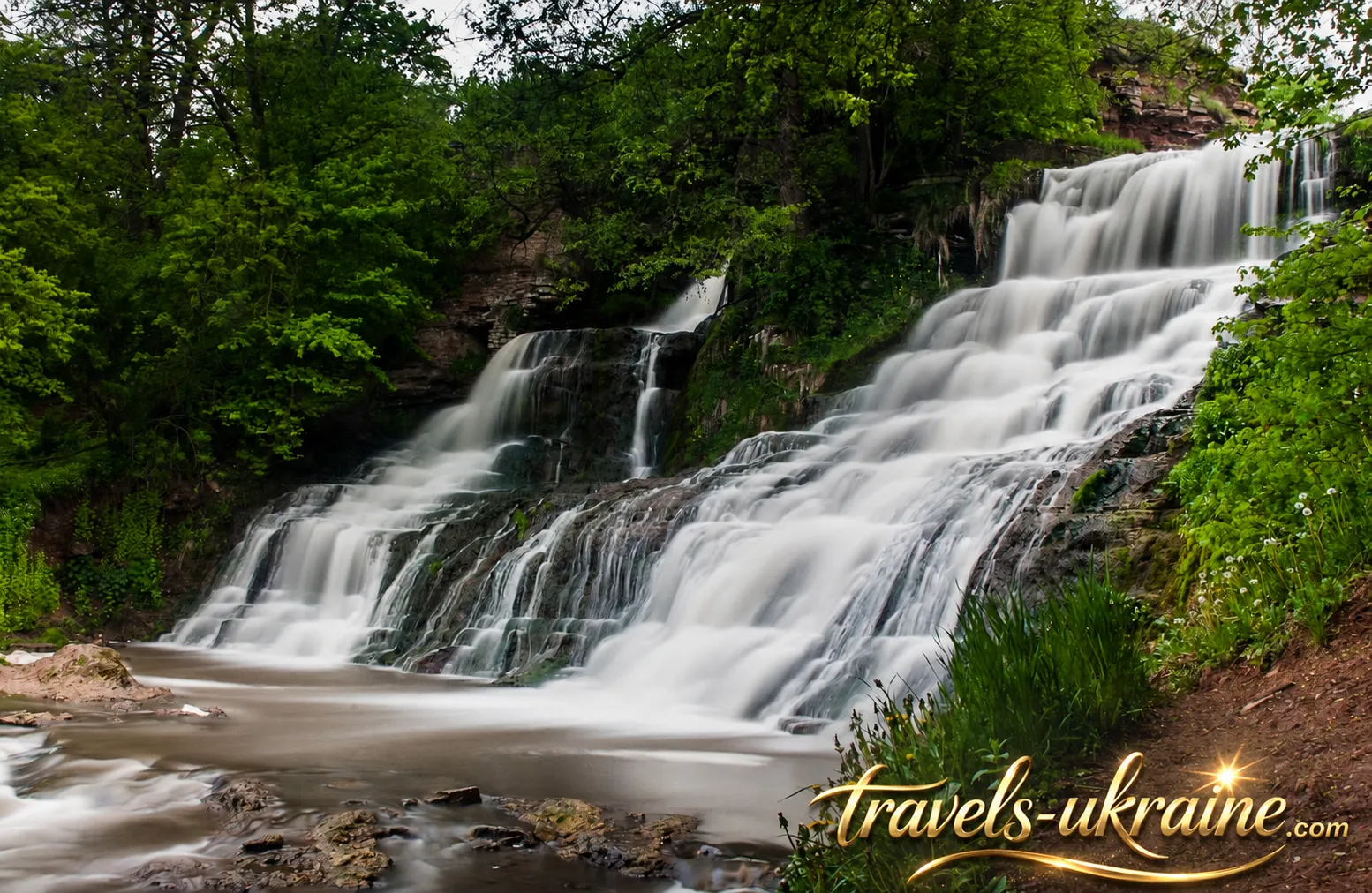
Some places need no lengthy explanation: it is enough to hear their sound once, see the movement of the water, and feel the coolness in the air. Dzhuryn Waterfall is one of them — a powerful cascade on the Dzhuryn River, hidden among the picturesque Podillia hills near the village of Nyrkiv. It is also often called Chervonohorod Waterfall, as Chervonohorod lies nearby — a historic area and a town that has disappeared from the map, leaving behind the ruins of an ancient castle, reddish hills, and the special atmosphere of an abandoned settlement where nature has intertwined with legends.
Dzhuryn Waterfall in Ternopil Oblast is not merely a beautiful spot on the map for taking photos. It is one of those destinations worth planning a separate trip to Ternopil region for: people come here for weekends, with their families and children, as couples, in groups of friends, and as part of organized tours. For some, it is a waterfall near Nyrkiv where they can relax in nature and experience the power of the water up close. For others, it is a place of power where every step reveals a new view: the rushing water, the green valley, or the old walls that recall entirely different times.
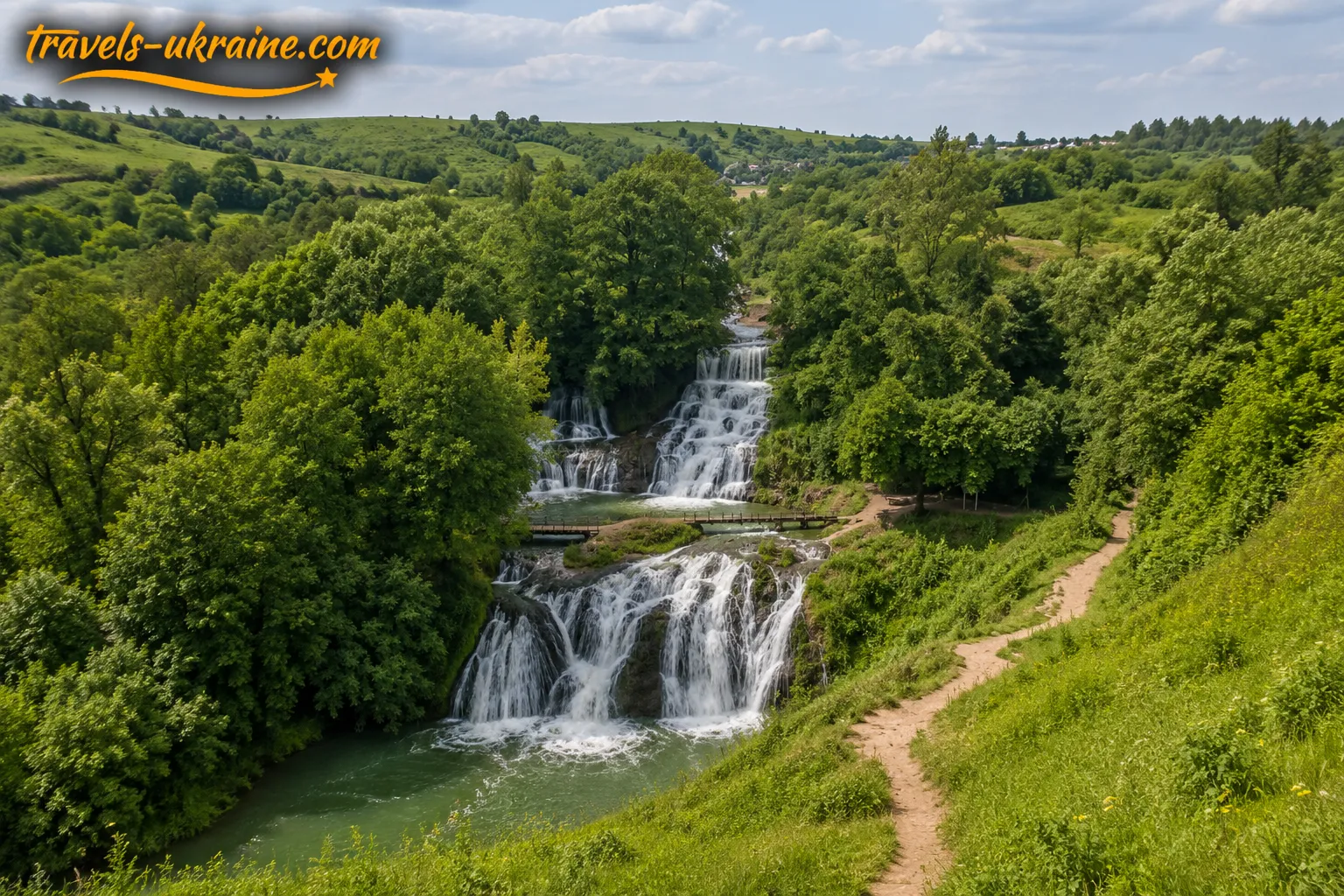
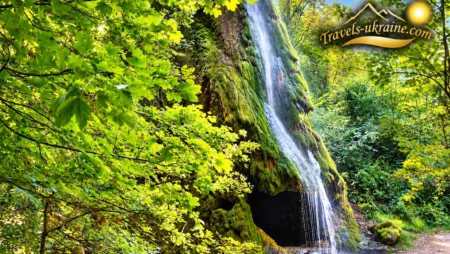
Dzhuryn Waterfall is rightly considered the largest lowland waterfall in Ukraine. It reaches about 16 meters in height, and the powerful stream plunging down in several cascades makes a strong impression even on those who have already seen many natural attractions. Here, the water does not simply fall — it seems to breathe, move, and speak to the valley in its deep voice. For nature lovers, this place becomes a true discovery: the roar of the waterfall, cool spray, damp rocks, and surrounding greenery create the feeling of a living organism that exists by its own laws and needs no human intervention.
Chervonohorod Castle and Dzhuryn Waterfall: a journey into a valley of legends, water, and stone
Dzhuryn Waterfall and the ruins of Chervonohorod Castle are closely connected by a shared history — one so ancient that it seems to extend beyond ordinary time. The difference is that only silent ruins remain of the once-magnificent structure, while the waterfall, despite the passing centuries, continues to plunge endlessly in cascades, filling the valley with rumbling water, spray, and living force. Here, it feels as though nature has not merely preserved the memory of the past but has learned to tell it in its own way — through stone, the sound of the river, wind in the treetops, and the shadows of old walls.
In recent years, the waterfall of Podillia has attracted more and more tourists from every corner of Ukraine. And this is no coincidence. Nature here truly possesses a special magic: the powerful waterfall, clean air, wooded slopes, picturesque valleys, and sense of space create an atmosphere you want to immerse yourself in without hurrying. A few hours here are enough for the bustle of the city to recede into the distance, while entirely different things come to the fore — peace, the scent of grass after rain, and the feeling that you have arrived somewhere time moves more slowly.
The valley where the castle ruins stand is particularly intriguing. Its shape is genuinely unusual: the landscape resembles a giant natural bowl or funnel, immediately giving rise to countless guesses and questions. That is why travelers sometimes mention one of the most fascinating theories — that this mysterious depression may have been formed by the impact of a large meteorite. There is currently no scientific evidence to support this hypothesis, but the legend itself adds even more mystery to Chervonohorod. Standing among the ruins and looking at the surrounding slopes, you cannot help wondering: what if this land really conceals far more than is visible at first glance?
A brief history of Dzhuryn Waterfall and Chervonohorod Castle
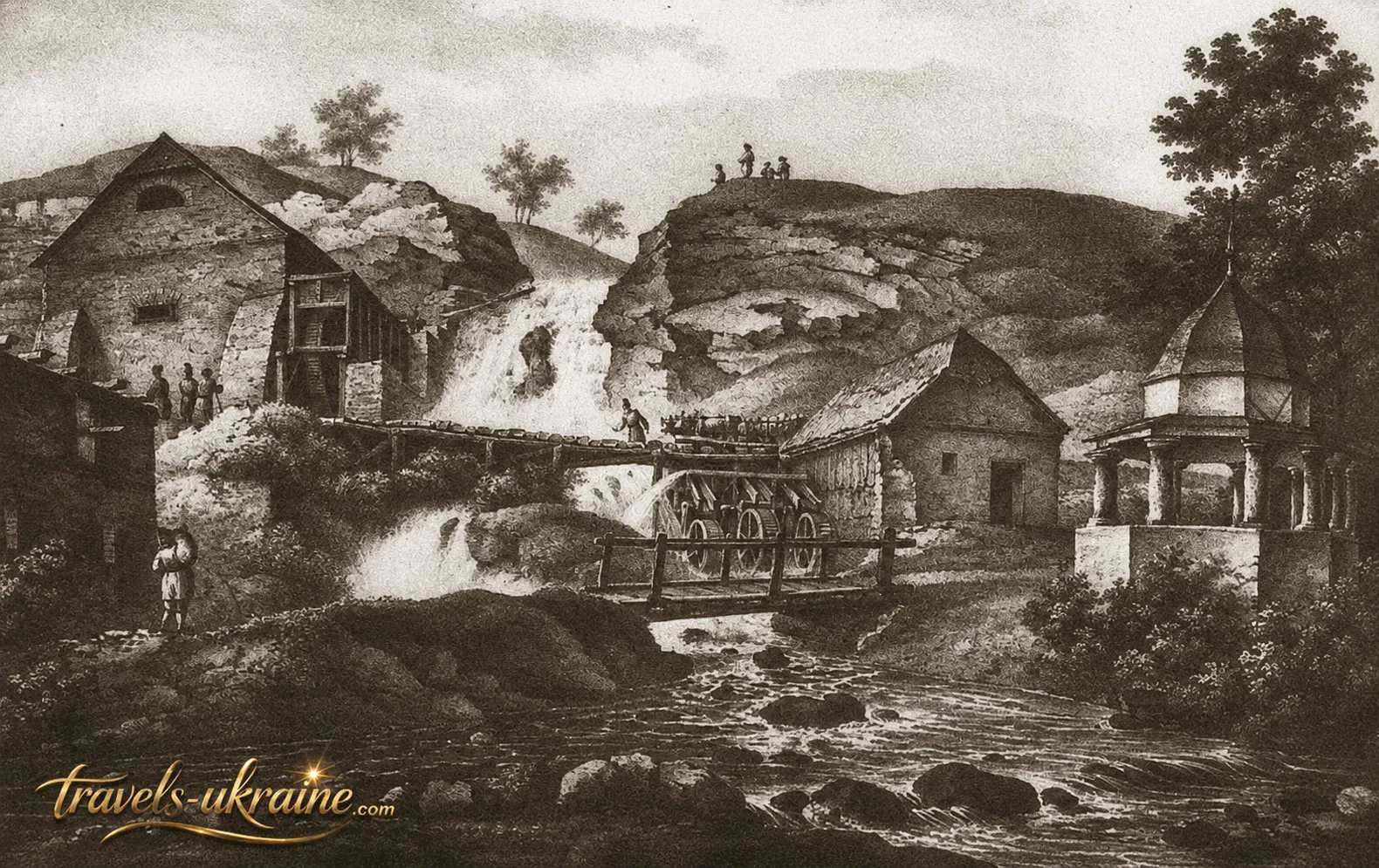
The history of Dzhuryn Waterfall does not exist separately from the history of Chervonohorod. Here, in a deep Podillia valley, water, stone, and human memory have become so tightly intertwined that it is difficult to say where the natural attraction ends and the legend begins. That is why Dzhuryn Waterfall, or Chervonohorod Waterfall, is perceived not merely as a picturesque cascade on the Dzhuryn River, but as part of a grand historical stage where life once thrived, walls rose, roads passed, and residents’ voices could be heard — while today only ruins, silence, and the unceasing sound of water remain.
Unfortunately, Chervonohorod in Ternopil region is now officially considered a vanished town. But do not hurry to imagine an empty spot on the map where the wind merely turns the pages of history. Chervonohorod has formally disappeared, yet it still possesses a remarkable power — it greets travelers as if it had simply paused for a few centuries and now silently watches to see who has finally come to visit. Before you lies neither an ordinary village nor another tourist stop for «five minutes of photos,» but a place where the landscape seems to have preserved the outlines of the past, even though the town vanished from the map long ago.
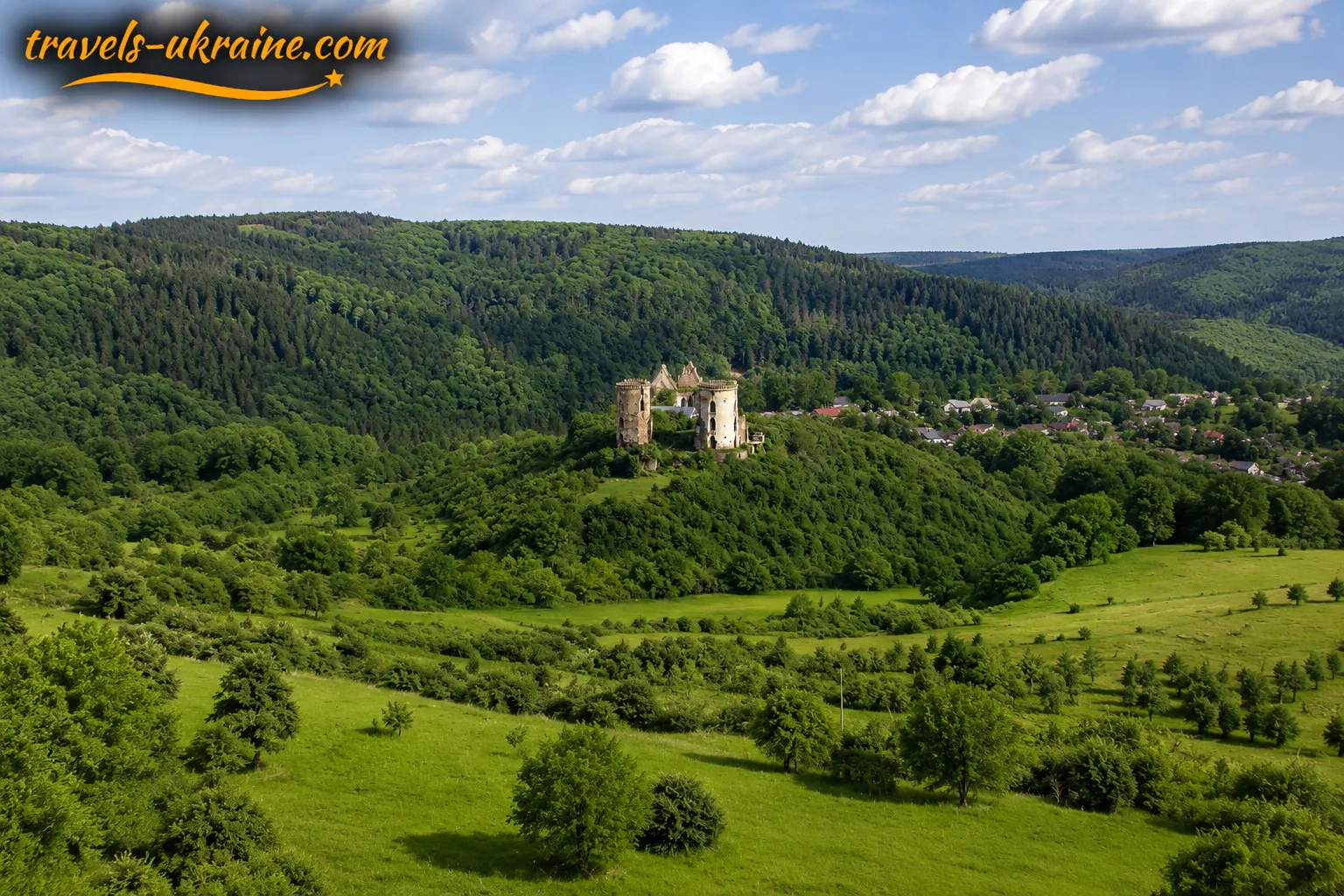
There was once a fortified area here, later a castle residence around which life bustled: some traded, some defended themselves, some made plans, and some may already have been complaining about the poor roads. Today, the ruins of Chervonohorod Castle, remnants of walls, hills with a distinctive reddish hue, and the Dzhuryn Valley itself recall its former grandeur, encircling the area in an almost theatrical sweep. In this circle, the leading roles have long been assigned: the castle is silent, the waterfall speaks for everyone, and tourists try to understand how such a place could have remained outside the public eye for so long.
The vanished town of Chervonohorod and the castle ruins: shadows of the past
The town that is no longer on today’s map was first mentioned as early as the XIII century. At that time, Chervonohorod was an important defensive stronghold located at a crossroads of trade routes. It developed, changed hands, and witnessed Lithuanians, Poles, Turks, and many others who very much wanted to leave their mark here. History in this place seems never to have taken a vacation. Over time, however, the town declined, and by the XIX century, little remained of its former glory beyond memories, legends, and castle ruins that still stand with such dignity, as if simply waiting for a restorer with an unlimited budget and strong nerves.
The Chervonohorod castle structure, now reduced to ruins, was built in the XIV century and initially served as an impregnable fortress. It survived more than one siege, became the scene of fierce battles, and withstood the blows of time and human ambitions, which, as we know, can sometimes destroy almost as effectively as cannons. Despite everything, the castle towered proudly over the local landscape for centuries, completing the image of vanished Chervonohorod and giving the valley a distinctly dramatic character.
In the XVIII century, the austere fortress was transformed into a luxurious Baroque palace, decorated with towers, refined details, and aristocratic charm. Noble life once flourished here: guests’ voices echoed through the grand halls, glasses clinked, important matters were discussed and, most likely, gossip of no less importance. The mighty walls witnessed festive banquets, fierce battles, and moments in history after which even the stones probably longed for a little quiet.
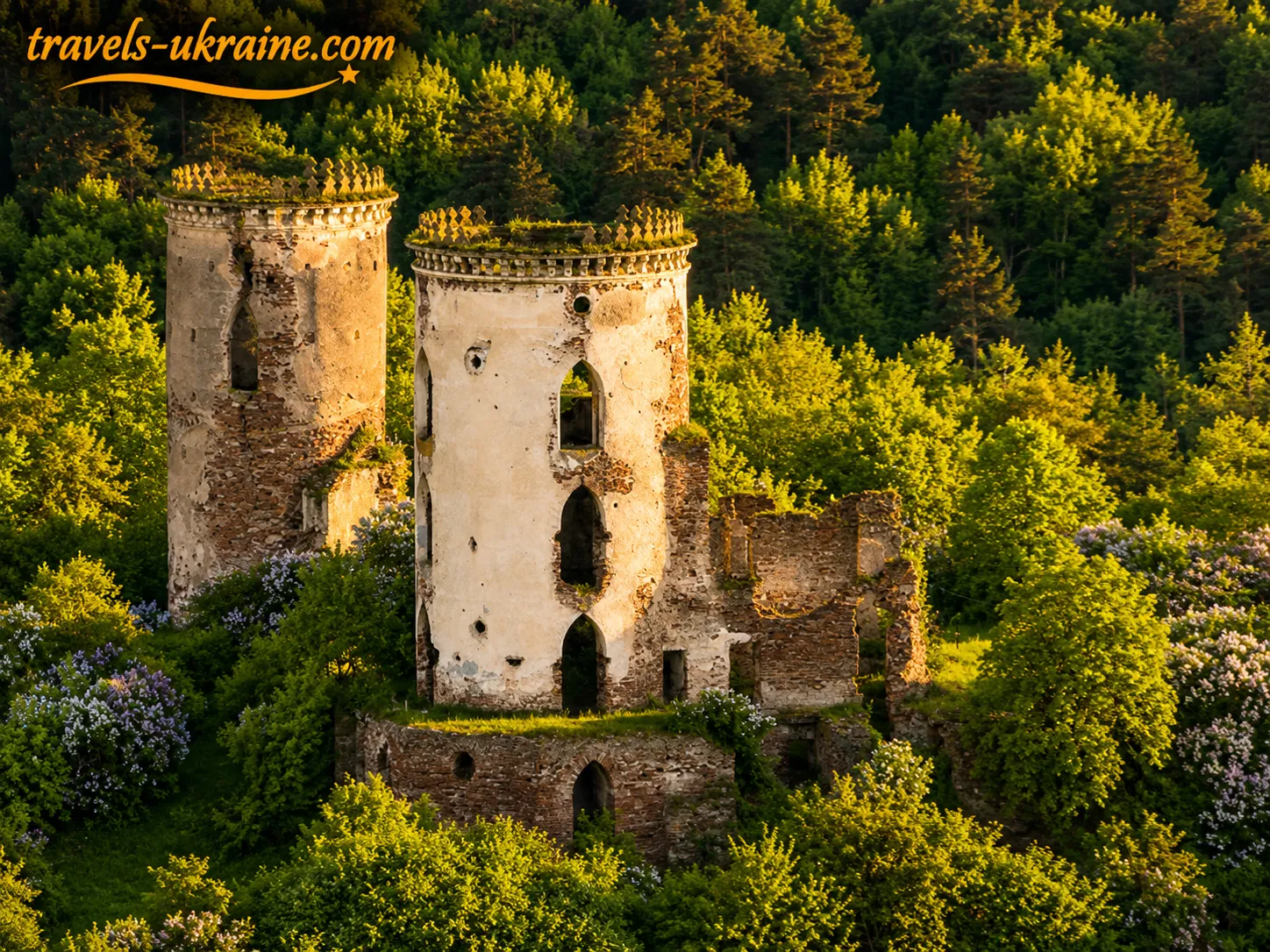
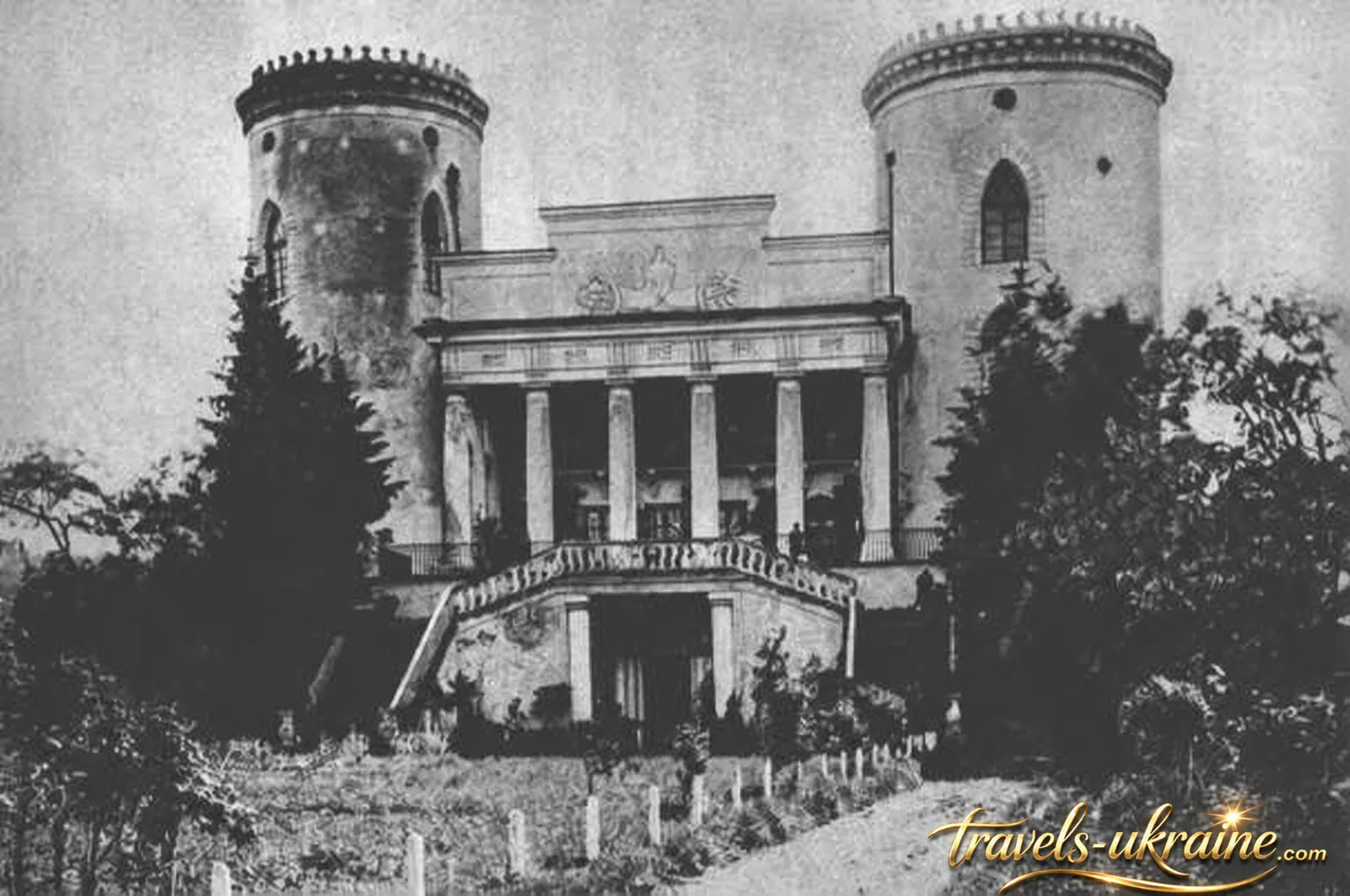
Today, fragments of towers and walls are all that remain of its former grandeur, silently telling of bygone centuries. Although the castle no longer impresses with the splendor of its halls, it has another kind of power — the power of a ruin that makes you stop and imagine what this place was like when Chervonohorod was still alive and thriving. The stones conceal countless secrets, while local tales add even more intrigue to the atmosphere: people speak of treasures hidden in underground chambers and ghosts supposedly appearing at misty dawns. Of course, encountering a ghost is uncertain, but experiencing a powerful impression of history, nature, and silence here is almost guaranteed.
Chervonohorod Castle and Dzhuryn Waterfall: two memories of one valley
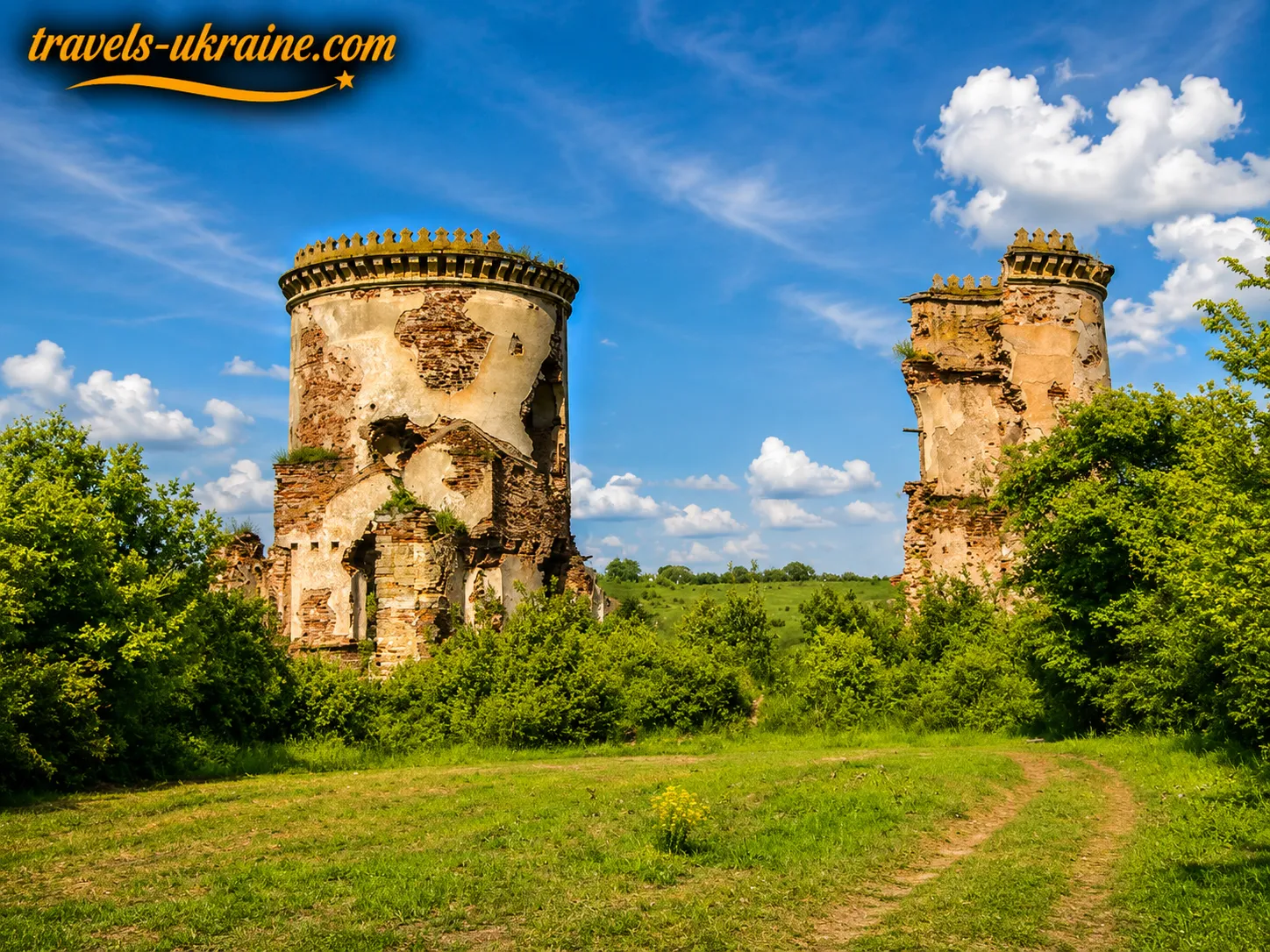
Chervonohorod Castle is one of those ruins that need not be perfectly preserved to impress. On the contrary, its half-ruined form gives the place exceptional depth. Two towers, remnants of walls, and a solitary silhouette above the valley create the impression that history has not disappeared completely but has simply grown quieter. It no longer speaks through residents’ voices or the ringing of castle gates, but it can be felt in the stone, the terrain, and the view of the valley, where the waterfall near Chervonohorod Castle roars nearby.
It is precisely the proximity of the castle and waterfall that makes this location so unusual. Ukraine has many beautiful natural places and quite a few historic ruins, but they are not always combined so dramatically. Here, water plunges in powerful cascades, while nearby stand traces of human grandeur that neither time, people, nor common sense managed to preserve. The waterfall continues to move, change, and sound, while the castle has frozen in silence. This contrast between living water and motionless stone creates Chervonohorod’s distinctive atmosphere.
It is no surprise that Dzhuryn Waterfall and Chervonohorod Canyon are perceived as a single tourist route rather than two separate points. Tourists come here not only to see Ukraine’s largest lowland waterfall, but also to walk through places where every slope carries its own shadow of the past. The valley looks as if it were created especially for a historical novel: red rock, greenery, water, ruins, paths disappearing between the hills, and a sense of gentle mystery accompanying the traveler from the first glance to the final photo.
The origins of Dzhuryn Waterfall: between facts and mysteries
Several theories surround the origins of the waterfall in Ternopil region, and this adds even more intrigue to the place. The most widespread legend says that people may have altered the course of the Dzhuryn River during ancient military events, and that the waterfall supposedly appeared as a result of this intervention. Other explanations link the cascade to the features of the local terrain, old agricultural works, or a change in the river’s course. In any case, it is important to understand that some of these stories belong to folklore, while others are assumptions that should be treated with caution.
For travelers, however, this uncertainty does not diminish the location’s value. On the contrary, it makes the waterfall on the Dzhuryn River even more fascinating. Standing below and watching the water plunge from the ledge, it is easy to imagine all that this valley has witnessed: changing settlements, defensive structures, human tragedies, periods of oblivion, and the site’s rediscovery by tourists. Here, history is not presented as a dry date in a textbook — it is experienced through space, sound, and details you want to observe for longer.
Even so, the most logical explanation for the origins of Dzhuryn Waterfall is considered to be a thoroughly practical need of Chervonohorod’s owners — to have their own mill. And it must be admitted that the idea was based on sound economic reasoning. On the one hand, the powerful drop in the water level could provide the mill with ample force; on the other, mills were scarce in the area, while demand for milling services was more than evident. So, as has often happened throughout history, nature was slightly «adjusted» to human needs.
The Dzhuryn River was effectively «split in two»: some of the water continued flowing through its old channel, while part was redirected into a new one, where a mill was built. Thus the waterfall came into being — a waterfall that now amazes tourists with its beauty, although it likely began not as a romantic adornment of Podillia, but as a highly practical engineering project. The irony of history is that the mill long ago disappeared from the everyday life of Chervonohorod, as did the town itself, while the waterfall remained — and even became the area’s biggest star.
This evidently happened before 1880, because that was the year Volume I of the «Geographical Dictionary of the Kingdom of Poland» was published, already mentioning the Chervonohorod Mill. Thus, even at the end of the 19th century, this water system was not merely a picturesque detail of the valley but part of the region’s economic life. Today, however, Dzhuryn Waterfall is perceived quite differently: as the natural jewel of Ternopil Oblast, a place for travel, photos, legends, and the delighted exclamations of tourists who are unlikely to immediately guess that behind this beauty may lie the ordinary need to grind grain.
Why the History of Chervonohorod Matters When Visiting Dzhuryn Waterfall
If you come here solely for a photo by the water, you may see a beautiful natural site. But if you know even part of Chervonohorod’s history, Dzhuryn Waterfall near Nyrkiv reveals itself in a completely different way. The sound of the water then becomes more than background noise—it becomes the voice of a valley that has endured far more than it might seem at first glance. The castle ruins cease to be merely a «beautiful backdrop» and become a key to understanding the place.
That is why this location is worth considering one of the most interesting routes for those seeking tourist attractions in Ternopil Oblast where nature is inseparable from history. Here, you can combine a walk by the waterfall, a visit to the ruins, valley photography, a short picnic, and an unhurried introduction to the Podolian landscape. This is a journey to a place where every element has meaning: water speaks of the power of nature, stone of the past, and the silence between them leaves room for your own thoughts.
- For history lovers: the ruins of Chervonohorod Castle reveal the site not only as a natural attraction but also as part of Podolia’s cultural memory.
- For tourists who love legends: Chervonohorod has enough mysteries to ensure that a walk is not limited to viewing the waterfall.
- For a family trip: the history of the site can easily be presented to children as a vivid story about a castle, a river, a vanished town, and the power of nature.
- For photographers: the combination of cascades, ruins, red slopes, and greenery creates highly expressive images in every season.
The history of Dzhuryn Waterfall is not only a story about water. It is the story of a place that has survived changing eras and nevertheless remained alive. The castle lost its grandeur, the town disappeared from the map, and the roads changed direction, but the Dzhuryn River continues to carry its flow through the valley. Perhaps that is Chervonohorod’s greatest intrigue: people come and go, walls crumble, legends change their form, and the waterfall continues to resound—as if it remembers everything.
Natural Features of Dzhuryn Waterfall
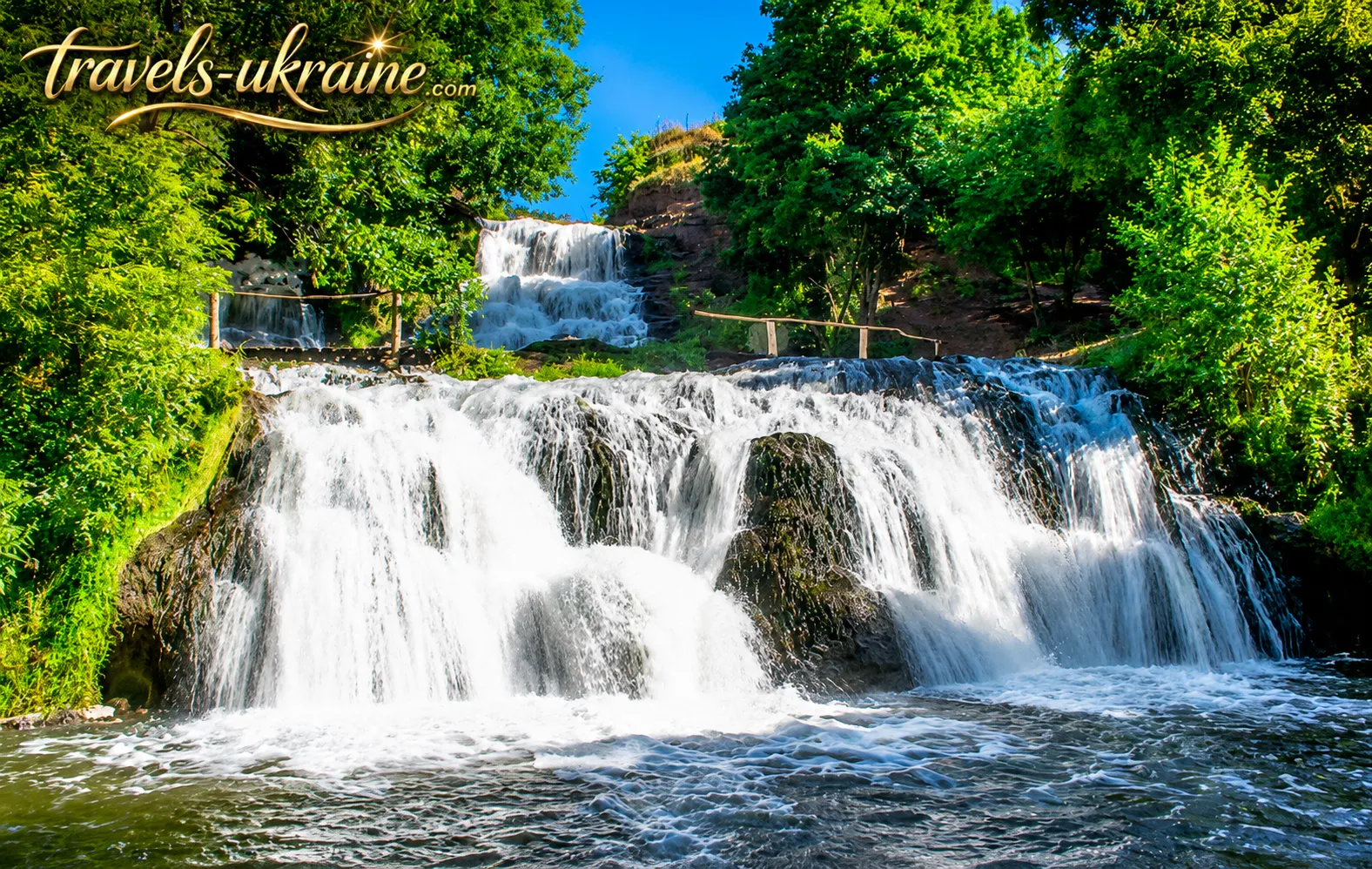
Dzhuryn Waterfall near Nyrkiv impresses not only with its height or the force of its flow. Its true magic lies in the combination of everything around it: water, stone, green slopes, reddish hills, and that distinctive Podolian silence, which the waterfall constantly—but very beautifully—breaks. Nature is not trying to be modest here. It steps onto the stage with confidence—with a roar and such scale that it seems to have been waiting a long time for an appreciative audience.
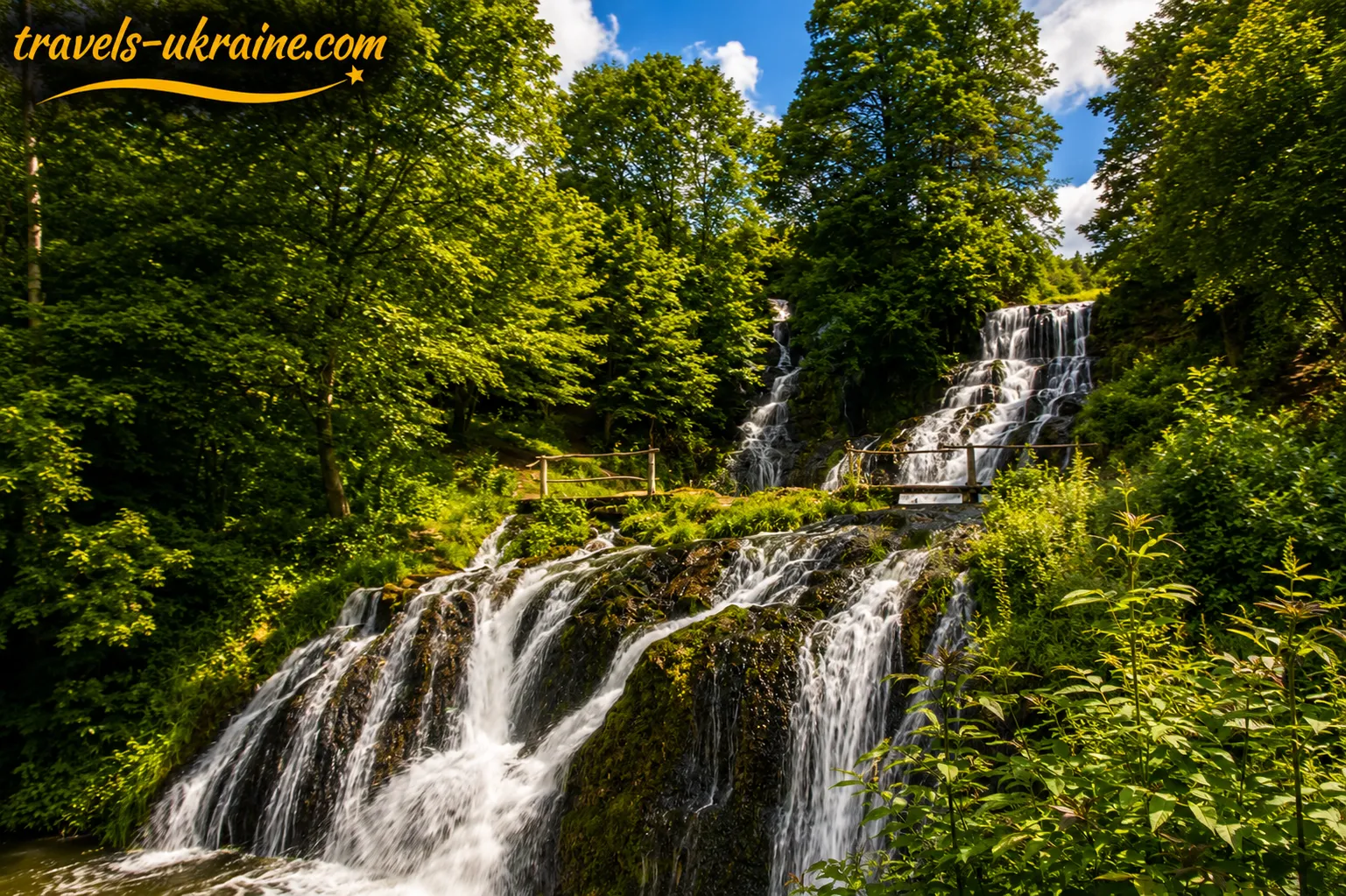
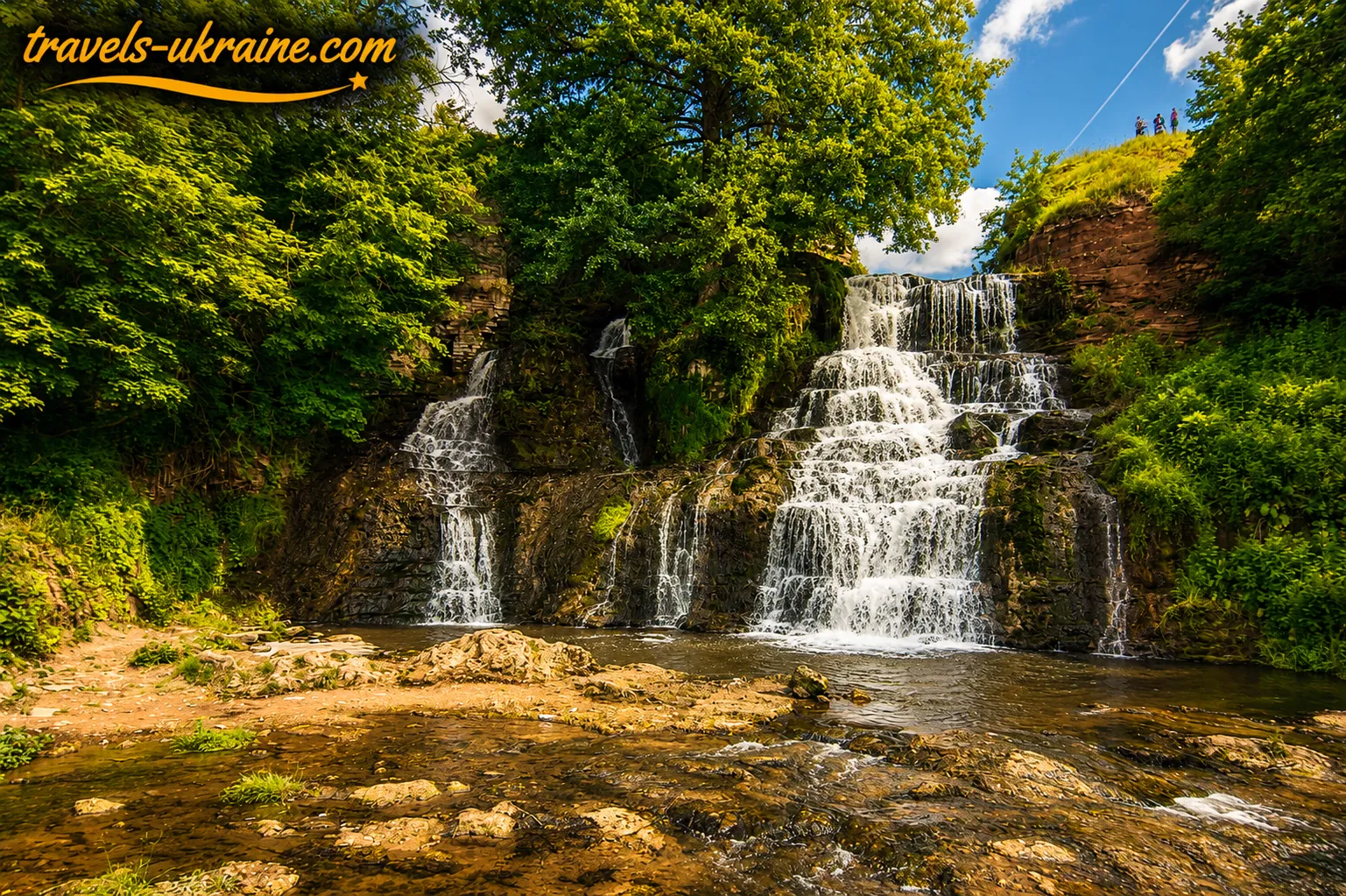
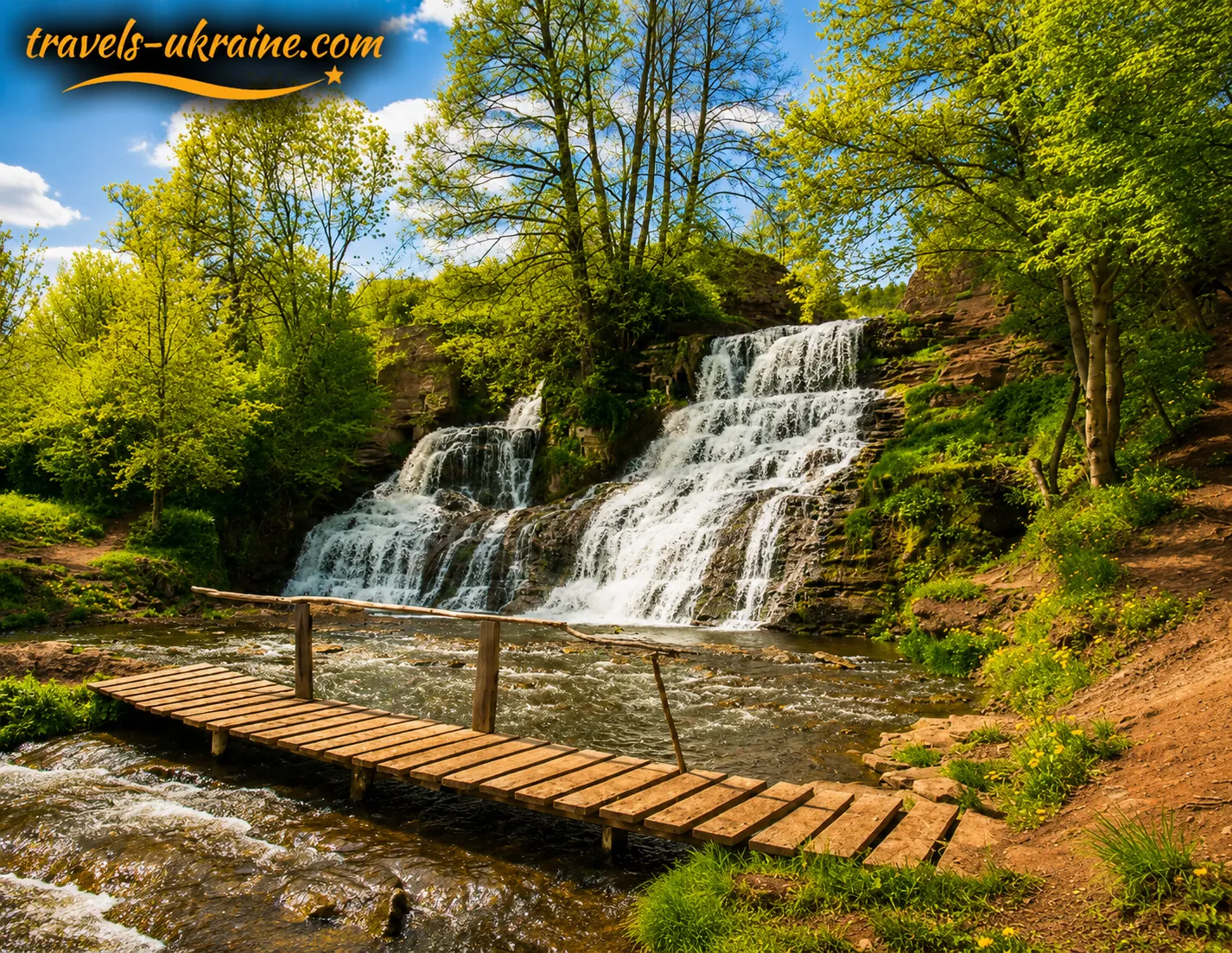
Dzhuryn Waterfall is approximately 16 metres high, reaches up to 20 metres in width, and flows down in three cascades. On paper, these figures may seem fairly restrained, but on site they quickly take on an entirely different meaning. Water roars, spray flies through the air, stones glisten with moisture, and tourists soon realise that «just taking a quick look for a few minutes» is unlikely to happen here.
From a distance, the most beautiful waterfall in Ternopil Oblast looks like a picturesque white ribbon amid the greenery, but come closer and the site immediately changes character: the sound grows deeper, the air cooler, and your thoughts noticeably quieter. The hustle of city life quickly loses its authority here, because arguing with a waterfall is pointless—it will speak louder anyway.
This natural landmark covers 0.7 hectares. By Decision No. 537 of the Executive Committee of the Ternopil Regional Council, dated October 23, 1972, the local waterfall was declared part of the nature reserve fund. And rightly so: a site like this deserves not only admiring photos on a phone but also official status, reminding us that this is not merely a pleasant place for a walk but a valuable natural landmark of Ternopil Oblast, part of Dniester Canyon National Nature Park.
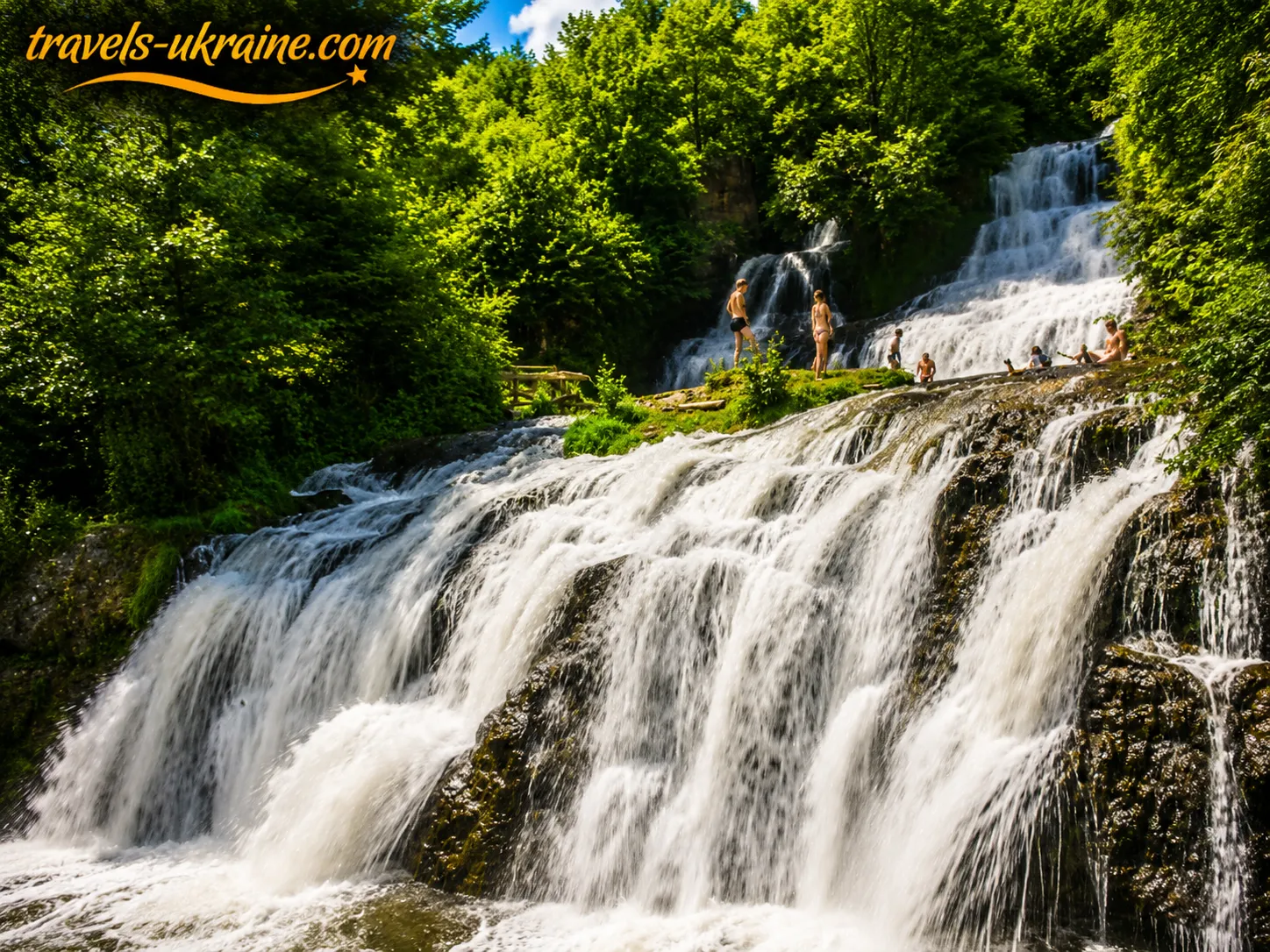
This water jewel has scientific, aesthetic, and educational value, although most travellers initially react much more simply: “Wow, it’s beautiful!” And that is also an honest form of appreciation. On warm days, people relax here, take photos, listen to the sound of the water, go for walks, and swim—those who are not afraid of the cool water and slippery stones, at least. Visitors come not only from Ternopil Oblast but from across Ukraine and abroad. And it seems Dzhuryn Waterfall has long grown accustomed to such attention: it simply keeps roaring, as if saying, “Look, admire me, just behave yourselves.” Because nature here is beautiful, powerful, and very patient, but it still deserves respect.
Ukraine’s Highest Lowland Waterfall: The Power of Water Without the Grandstanding
Dzhuryn Waterfall in Podolia is often called Ukraine’s highest lowland waterfall of artificial origin. There is a particular intrigue in that: when we imagine a major waterfall, our thoughts usually flee straight to the Carpathians—to rushing mountain streams, rocky gorges, and trails after which your legs remind you of the romance of travel for quite some time. But Dzhuryn Waterfall in Dniester Canyon National Nature Park confidently breaks that stereotype. It lies among the lowland landscapes of Podolia, yet has such power and character that it is simply impossible to call it a “calm lowland waterfall.”
Its cascades do more than decorate the valley in the Chervone tract between the villages of Nyrkiv and Ustechko—they set its rhythm. The water plunges downward with such energy that it seems to prove every day that Podolia can impress just as much as the mountains. It is hard to remain indifferent beside this flow. Someone immediately takes out a phone for photos, someone silently watches the water, and someone starts speaking louder because otherwise the waterfall wins the conversation without the slightest diplomatic effort. And, honestly, it deserves the victory.
This living force makes the site appealing not only for a brief stop but also for a full-fledged nature getaway. You will want to linger by Dzhuryn Waterfall: view the flow from different angles, walk along the paths, feel the cool spray, listen to the water, and allow yourself a few unhurried minutes. For a modern person, this is almost a luxury—to be somewhere where the main sound of the day is not a phone notification, a car horn, or a neighbour’s renovation, but a river plunging over stone, roaring through the valley, and demanding nothing from you. Except perhaps a little attention, caution, and respect for nature.
A Picturesque Site Near Nyrkiv for a Peaceful Getaway
The waterfall in the Chervone tract is a place where it is easy to find your own style of travel and relaxation. Some come for the spectacle and photographs, others for a walk, and others for the sense of calm so often missing from everyday life. Everyone usually finds something of their own. Dzhuryn Waterfall, or Chervonohorod Waterfall, does not impose a script: it simply exists—powerful, noisy, alive—and the traveller decides whether to take a dozen photos, sit on the grass, walk to the castle ruins, or simply stand and watch the water do what it does best.
This site offers photographers many advantages. There is moving water, textured stone, greenery, open panoramas, old walls nearby, and distinctive red slopes. Photos by Dzhuryn Waterfall look different depending on the light: softer and calmer in the morning, more contrasting during the day, and warmer and more atmospheric in the evening. And if a light mist rises over the valley after rain, Chervonohorod begins to look like the setting of a historical film—with no director, but with remarkably convincing natural scenery.
The natural features of Dzhuryn Waterfall are not only about water plunging from a height. They are about an entire atmosphere: hills, the sound of the valley, coolness near the cascades, old paths, greenery, stones, and the feeling that you have arrived somewhere nature takes its time but certainly knows how to make an impression. Perhaps that is why the most beautiful waterfall in Ternopil Oblast is something you want not merely to see but to remember—with its sound, the scent of damp earth, spray on your face, and the gentle thought: «I’m glad I came here.»
Dzhuryn Waterfall: A Brief Tourist Guide
Before you visit Dzhuryn Waterfall, it is worth having a short, honest guide to the site in mind. As experience shows, even the most romantic journey begins not with legends but with simple questions: Where is it? How much time is needed? Is it convenient to go with children? What shoes should you wear? And will you later have to recall the route using words that are not particularly suitable for a blog?
The hydrological natural landmark is located in the Chervone tract, near historic Chervonohorod, between the villages of Nyrkiv and Ustechko in Ternopil Oblast. This natural jewel is part of the picturesque territory of Dniester Canyon National Nature Park and one of those places where Podolia suddenly stops being “just a lowland region” and convincingly reveals its character. There is a waterfall, ruins, paths, reddish slopes, space for photos, and enough atmosphere to turn an ordinary trip into a small adventure and an ecotourism experience.
In terms of format, this is an ideal destination for a weekend itinerary. You can come for a few hours, combine a walk through the forest zone and relaxation by the waterfall with a visit to the ruins of Chervonohorod Castle, take photos, listen to the sound of the water, and give yourself a break from the pace of the city. If you are the kind of traveller who first says, «We’ll just take a look,» and then disappears for half a day among paths and views, Dzhuryn Waterfall will understand you too.
- Type of site: natural landmark, waterfall on the Dzhuryn River, historical and natural route near Chervonohorod.
- Recommended visit duration: 1.5 to 3 hours if you plan to see the waterfall, walk through the valley, and visit the castle ruins without rushing.
- Trip format: day trip, weekend itinerary, family getaway, romantic walk, or short nature tour.
- Suitable for: families, couples, photographers, history lovers, nature enthusiasts, and anyone who wants to see beautiful places in Ternopil Oblast.
Accessibility of the Route to Dzhuryn Waterfall
Dzhuryn Waterfall for children can make for a vivid adventure, but this is not the kind of place where adults should completely relax and leave everything to tourist luck. The area around the waterfall is natural, rocky, and uneven, and the stones right by the water can be slippery. So you can come here with children, but it is best to choose dry weather, comfortable footwear, a relaxed pace, and one firm rule: do not approach the edge of the cascades, even if the photo «would be really beautiful.»
Older travellers and people who find uneven terrain difficult should also approach the route with care. This is not a city park with level paths and benches every ten metres. What it does offer is genuine nature, living terrain, and views that do not look staged. That is precisely where the site’s charm lies: Dzhuryn Waterfall does not pretend to be a comfortable shopping centre in the open air—it honestly remains a waterfall.
Getting to Dzhuryn Waterfall is not difficult: there are signs along the way, and Google Maps usually does not spring any dramatic surprises, so the chances of ending up exactly where you need to be are fairly high. As you drive through village streets, past small shops, courtyards, gardens, and locals who seem to have long grown accustomed to the tourist traffic, simply follow the signs—and getting lost will be difficult, although some people still manage it for the sake of a fuller adventure.
At the entrance to the canyon area, you will come across a barrier. As a rule, the most respected person in the vicinity is on duty here—a person who knows who is going where, how many cars have already descended to the waterfall, and perhaps even suspects who will return with wet shoes. This is where tourists are asked to pay a symbolic fee to enter the area, after which you can confidently continue on your way.
It is possible to drive almost all the way to the waterfall. But not for everyone—only for those who are confident driving over rocks, potholes, and natural «road trainers,» and whose vehicle has high ground clearance. In that case, you can try to get closer. Still, it is worth honestly assessing both your car and your nerves: sometimes leaving the vehicle in the parking area and walking the remaining few minutes—about 100 meters—is not a defeat but a wise travel decision. Besides, the walk here only adds to the mood, and the waterfall is not going anywhere.
Budget and Seasonality for a Trip to Dzhuryn Waterfall
The budget for a trip to Dzhuryn Waterfall depends on how exactly you plan your holiday: by private car, as part of a guided tour, or within a larger route through Ternopil region. In most cases, the main expenses are transportation, food, possible tour services, or additional stops along the way. If you are planning a tourist route to Dzhuryn Waterfall or an organized short excursion, be sure to clarify the itinerary with your guide in advance, including the time allocated to the location and whether Chervonohorod Castle, the Dniester Canyon, or Zalishchyky is included.
The most popular season for relaxing near Dzhuryn Waterfall is the warm part of the year, when you can walk longer, take photographs, enjoy a short picnic, and cool off by the water. In spring, the waterfall often looks more powerful after the rains; in summer, it attracts visitors with its greenery and opportunities to enjoy nature; in autumn, it enchants with the warm colors of the slopes; and in winter, it reveals a quieter, more restrained, almost intimate atmosphere. In other words, the location works year-round—it simply changes its mood with each season, like an experienced actor without unnecessary theatrics.
In short, a trip to Dzhuryn Waterfall does not require complicated preparation, but it rewards those who arrive with care and attention. This is an excellent place for a first introduction to the natural attractions of Ternopil region, a family itinerary, a romantic walk, or those moments when you simply want to spend time beside water that roars louder than all your everyday worries.
Photo and Video Gallery


Chervonohorod as Part of the History of Bohdan Khmelnytsky
Bohdan Khmelnytsky, the prominent Ukrainian hetman and a figure without whom it is difficult to imagine the history of the National Liberation War of 1648–1657, is associated with many places across Ukraine. One such mysterious point on the historical map is considered to be Chervonohorod—a vanished town in Ternopil region where, according to certain legends and historical theories, an important event in the future hetman’s personal life may have taken place: his marriage to Hanna Somko.
In those days, Chervonohorod was not merely a beautiful place among the Podolian hills, but a notable center of noble life, fortifications, and magnate influence. Family interests, military routes, political calculations, and, as often happens in history, personal destinies intersected here. According to one theory, it was in Chervonohorod that Bohdan Khmelnytsky may have married Hanna Somko, a member of an influential family. Whether this ceremony took place specifically in Chervonohorod Castle is difficult to say with certainty. As we know, history does not always leave us neatly labeled wedding photo albums—especially when the 17th century is involved.
That same theory gives Chervonohorod a special intrigue. Imagining the future hetman’s wedding among castle walls, in a place that has now become a ruin, is almost a ready-made scene for a historical novel. Once, the voices of guests, the clatter of horses’ hooves, music, congratulations, and cautious political conversations may have sounded here, because noble weddings were often not only matters of the heart but also subtle diplomacy. Put simply, even love in those days often had its own political route.
Chervonohorod may have been an important episode in Khmelnytsky’s youth, before he became a symbol of the great Ukrainian uprising. There is little precise documentary evidence of his presence here, so it is worth speaking cautiously—not of an indisputable fact, but of an interesting historical theory that deserves attention. Yet it is precisely such theories that make a journey to Chervonohorod more meaningful. You are seeing not merely the ruins of a castle near Dzhuryn Waterfall, but a place where the personal history of a man who would later change the course of the Ukrainian nation may have left its mark.
Today, Chervonohorod preserves not only traces of ancient architecture but also a distinctive atmosphere of things left unsaid. Much here cannot be conclusively proven, yet much invites the imagination. And that is precisely its strength: the ruins remain silent, the waterfall roars, the hills guard their secrets, and the traveler stands in the middle of this scene, realizing that history is not always a dry collection of dates. Sometimes it is a half-erased path, an old legend, a few cautious assumptions, and the feeling that the past is somewhere nearby—it simply is not in much of a hurry to give an interview.
Chervonohorod and the Khmelnytsky Family: Confirmed Facts
Of course, there is currently no compelling evidence that Bohdan Khmelnytsky married Hanna Somko within the walls of Chervonohorod Castle. However, confirmed historical data exist that may serve as a kind of bridge in this matter, so the possibility of such an event does not seem entirely fanciful. So, what do we have?
Legends about the Khmelnytsky family are associated with Chervonohorod, and this is already an important part of the area’s historical memory. Scholarly works do indeed confirm a connection between Bohdan Khmelnytsky’s father, Mykhailo, and the powerful Danylovych family—and that, too, is a historical fact.
If the families really did have good relations, which may well have been the case, then the idea of a possible wedding in Chervonohorod no longer seems entirely fanciful, although it still requires a cautious approach and reliable evidence. It was probably this convergence of family and geographical connections that gave rise to local legends about the possible presence of the Khmelnytskys in Chervonohorod.
Of course, this argument does not justify claiming that Bohdan Khmelnytsky married Hanna Somko specifically in Chervonohorod Castle, but neither does it allow us to categorically rule out the possibility. This appealing historical theory deserves further study by historians, and perhaps one day we will read not a legend but a proven fact. History here is like an old castle wall: its outline is clearly visible, but some stones are missing, so filling them in with imagination requires great caution.
The Energy of Dzhuryn Waterfall: A Place of Power or Simply a Picturesque Spot?
The waterfall among Chervonohorod’s red hills attracts tourists not only with its beauty but also with its distinctive atmosphere. Everything here works its magic: the roar of the water, cool spray, green slopes, stones beneath your feet, and views that unexpectedly make even those who were confidently saying a minute ago that they had «seen enough waterfalls already» fall silent. Near Dzhuryn Waterfall, a question quickly arises: is this simply a picturesque corner of nature, or is it a place that truly knows how to influence your mood?
For many travelers, Dzhuryn Waterfall in Western Podolia becomes a place where they can feel nature’s special energy. Some speak of cleansing, others of inner peace, while some simply sit nearby, listen to the water, and finally stop checking their phones every three minutes. That alone is a small miracle of modern life. Of course, the mystical power of the waterfall is difficult to measure with a ruler or add to a travel checklist, but the experiences of numerous visitors suggest that this place truly helps them pause, breathe out, and, in a sense, put themselves back together from within.
Humanity noticed long ago that the sound of falling water is not merely a natural phenomenon but a kind of rhythm that calms the mind. At first glance, a waterfall seems extremely loud, yet this very roar has a strange quality: it does not irritate but instead drives unnecessary noise out of your head. You stand nearby, listen to the water falling in cascades, and suddenly all your everyday worries lose their solemn importance. Plans, deadlines, messages, minor grievances, and major «musts» recede into the background. The noisy adornment of the Dzhuryn Valley seems not to negotiate with stress—it simply shouts louder than it does.
Of course, denying the effect of nature on well-being would be foolish. A walk by the waterfall, fresh air, the coolness of the spray, movement, and watching the living flow can genuinely help relieve tension and restore a sense of balance. There is no need to search for complicated explanations here: sometimes all a person needs is to step away from the asphalt, take a deep breath, and watch for a few minutes as water carries out its work perfectly, without meetings, instructions, or motivational courses.
Perhaps that is why Ny rkiv Waterfall and the Dzhuryn Canyon are so beloved by photographers, artists, travelers, and everyone seeking not just a beautiful image but a feeling as well. The beauty of the area is not static: the water is constantly moving, the light is changing, spray catches the sun, and the valley reveals itself a little differently each time. For creative people, it is a true gift. It is easy to find a shot, a mood, a metaphor, or at least a convincing reason to say, «I’m not just taking a walk—I’m gathering inspiration.»
Dzhuryn Waterfall is often perceived as a place of power near Chervonohorod Castle. You do not have to believe in mysticism to feel its influence. It is enough to stand nearby, listen to the roar of the water, watch the stream endlessly plunge downward, and realize that nature speaks very convincingly here. It does not lecture, offer advice, or promise instant enlightenment, but after a few minutes by the waterfall, you really do feel a little lighter.
So, the picturesque location near Nyrkiv is not merely a tourist spot in Ternopil region but a place with character. Here, natural power, the quiet of the valley, the roar of the water, a touch of Chervonohorod mystique, and that special feeling of wanting to slow down all come together. Whether you see the waterfall as an energetic destination or simply as a beautiful place to visit, it leaves a strong impression either way. And perhaps that is its greatest magic: you arrive to look at the water, and leave with the feeling that the water has looked back at you a little, too.
Dzhuryn Waterfall: Personal Impressions After a Hot Journey
For me personally, the question of whether this place truly possesses some kind of mystical power is rather rhetorical. I am not one of those people who immediately see energy flows in every stone and look for special signs in the rustling of leaves. But I can say one thing with confidence: I genuinely felt the positive effect of Dzhuryn Waterfall on my well-being. And this was not one of those cases when you feel compelled to invent something for a beautiful travel paragraph. On the contrary, everything happened very simply, almost routinely, yet it stayed with me for a long time.
So, as the family’s chief guide to «outdoor recreation in Ternopil Oblast», I set about planning another outing for my family. This time, I had to take the children’s main demand into account: «Just not a castle!» So, after a lengthy round of preparations, several «Where’s my cap?» moments, and our traditional family departure that was not quite on schedule, we set off in our own car from the city of Volochysk to Dzhuryn Waterfall. Outside, the heat was unbearable, exhaustion hung in the air, and there was a touch of nervousness inside the car because, as everyone knows, travelling with small children is not simply a trip but a separate quest with an unpredictable plot.
Although a great deal of time has passed—it was still before the full-scale war—my memories remain remarkably vivid. I especially remember the drive through the villages. People were preparing for the Green Holidays: green branches were everywhere; some people carried them on carts, others in armfuls, while for some they cheerfully poked out of car trunks. The villages seemed to breathe a festive anticipation—slightly hectic, slightly solemn, and very much alive. And we drove on, tired, warmed by the sun, and sharing that honest family thought: «Why didn’t we just stay home?»
Still, we made it to Dzhuryn Waterfall. After changing clothes, we headed for the water almost immediately, because after such heat it was no longer a desire but an internal command from our bodies. And then everything seemed to change. The roar of the water, the cool spray, the children’s laughter, and the greenery all around seemed to wipe the fatigue from our shoulders. The joy of my sons knew no bounds, especially when their father carefully led the children beneath the waterfall cascade. At that moment, the trip had definitely stopped feeling like a mistake.
After swimming, we returned to the car, which, incidentally, we had somehow managed to drive almost right up to the water—onto a meadow. Of course, we were not the only «off-road champions» there, but the feeling was still satisfying: if the car had survived this little Podillia expedition, the day had certainly been a success. By the way, it was possible to pitch a tent in the meadow—at least at that time, we noticed no restrictions. And that, you must admit, is almost a small bonus for a family day outdoors.
It was then that I caught myself thinking that my anxiety, fatigue, and worries had seemingly disappeared. They had not merely lessened or moved into the background—they had been erased, as if someone had run an eraser over my inner list of concerns. I do not believe in unsupported mysticism, but I will not deny the fact that I felt better. There really is a special atmosphere near Dzhuryn Waterfall: the water roars, the children laugh, the heat recedes, and you suddenly realise that sometimes you do not need complicated rituals for an emotional reset. All it takes is a road, water, a little adventure, and a place that knows how to return you to yourself. Author’s recollection: N. I. Hrebovych.
What to do at Dzhuryn Waterfall?
Dzhuryn Waterfall is not the kind of place where a tourist arrives, ticks a box, takes one photo, and immediately moves on. Everything here works against haste: the sound of the water, the green valley, Chervonohorod Castle, the paths between the hills, and that strange feeling that the place is quietly saying, «Why are you rushing? I haven’t shown you everything yet.» That is why it is better to see a trip to the waterfall not as a brief stop but as a small journey with several interesting stops.
The main reason people come here is the cascade waterfall on the Dzhuryn River. It is worth seeing from different angles: from a distance, when the streams of water look like a white ribbon amid the greenery; up close, when the roar is so loud that every conversation becomes almost a «negotiation with nature»; and from below, where the force of the flow is especially apparent. Near the waterfall, it is easy to understand why it is considered one of the main natural landmarks of Chervonohorod and the most beautiful waterfall in Ternopil Oblast.
A walk around the waterfall is the first thing worth planning after you arrive. Do not rush straight to the loudest spot, even if the children are already pulling you by the hand and your phone is practically begging to take a photo. It is better to walk slowly, look back at the slopes, observe how the Dzhuryn River shapes the surrounding space, and only then descend closer to the cascades. This allows the location to reveal itself much more fully.
Dzhuryn Waterfall swimming: cool water, spray, and a little common sense
During the warmer months, many travellers are interested in swimming at Dzhuryn Waterfall. And indeed, on a hot day, the water looks extremely inviting. After the road, dust, and sunshine, the coolness near the cascades feels almost like a reward for all the family preparations, the search for caps and water bottles, and the traditional «Are we absolutely sure we packed everything?» Swimming near Dzhuryn Waterfall can become a vivid memory, especially for children, but it is important to remember safety.
The rocks near the water are often slippery, the current is strong in places, and the terrain is not always predictable. So enter the water carefully, without trying to play the hero or prove to the whole family that you are «still in your prime.» Children should be kept close and not allowed to run around the cascades on their own. The waterfall is beautiful, but it is not a ride in a city park. The main rule is simple: admire it boldly, behave sensibly.
Ruins of Chervonohorod Castle: history beside the roar of the water
Another reason to stay longer is the ruins of Chervonohorod Castle. They are located nearby and make an excellent addition to the trip to the waterfall. After the vibrant roar of the water, the castle ruins of the vanished town of Chervonohorod in Ternopil Oblast are perceived quite differently: they do not roar, impress with the force of a current, or splash your face, but they have a presence of their own. Their silence works no less effectively than any guided-tour narration.
Here, it is worth walking slowly, examining the walls, looking down over the valley, and imagining what Chervonohorod was like when this place was not yet called a vanished town. The ruins add depth to the trip: without them, Dzhuryn Waterfall would simply be a beautiful natural site, but together they create a route where nature and history echo one another.
So, what is there to see near Dzhuryn Waterfall? First and foremost, the waterfall itself, the Dzhuryn Valley, the ruins of Chervonohorod Castle, and the surrounding landscapes. And what is there to do? Walk, take photos, listen to the water, swim cautiously in the warmer months, relax with the children, and have a picnic. In good weather, you can pitch a tent and spend the night near the waterfall without unnecessary haste. Because sometimes the best part of a trip is not a point on the map but the moment when you finally stop checking the time.
What to visit near Dzhuryn Waterfall?
Dzhuryn Waterfall in Western Podillia is an excellent main reason for a tourist trip, but certainly not the only one. Its great advantage is that several interesting places are gathered nearby: historical, natural, slightly mysterious, and highly photogenic. So if you have already reached this part of Ternopil Oblast, do not rush to tick «waterfall seen» and head home. Chervonohorod does not let you go that easily—it still has plenty to show, even if it does so silently, through ruins, paths, slopes, and old legends.
It is best to approach this trip as a short weekend tourist route. First comes Dzhuryn Waterfall, followed by the ruins of Chervonohorod Castle, then a walk through the valley, and, if you have the energy and time, the Hermit’s Cave and Divichi Slozy Waterfall—all in one area. Alternatively, consider a longer route towards the Dniester Canyon. It all depends on your pace, the weather, the group you are travelling with, and how quickly the children begin asking the ultimate tourist question: «Are we going to eat soon?»
Ruins of Chervonohorod Castle: the main historical site near the waterfall
The first thing worth seeing nearby is, of course, the ruins of Chervonohorod Castle. They are within sight of the waterfall and form a single historical and natural picture with it. The waterfall roars, the castle is silent, and between them emerges the very atmosphere that makes people love travelling: you seem to have come to nature, yet you have arrived somewhere where every stone has its own biography.
Today, Chervonohorod Castle does not welcome tourists with restored halls or the gleam of museum display cases. Its power lies elsewhere—in the silhouettes of old towers, fragments of walls, and the feeling of a vanished town that still seems present in the valley. Walk around slowly, view the ruins from different sides, imagine ancient Chervonohorod, and do not expect the place to look perfectly «picture-postcard.» It is beautiful precisely because so much is left unsaid. And, honestly, it is a little like a story that has not ended but has simply forgotten to add a full stop.
The Hermit’s Cave: a place for those who love mysteries
Another interesting nearby location is the Hermit’s Cave, which is often included in routes around Dzhuryn Waterfall. It has a completely different mood from the noisy cascade. If the waterfall speaks across the entire valley, the cave seems to invite you to lower your voice and listen. These contrasts make the route near Nyrkiv especially engaging: in a single day, you can see both the resounding power of water and the quiet mystery of stone.
Places like this always leave room for imagination. Some people see the cave as part of ancient tales, others as an interesting natural site, while some are simply glad that the route is not just «waterfall and back» but includes several more stops for adventure. The main thing is to remain cautious: the paths may be uneven, and the location does not always have comfortable tourist infrastructure. What it does have is atmosphere—and, you must admit, that is sometimes worth much more than another bench with a sign.
Divichi Slozy Waterfall: an intimate natural site nearby
If, after Dzhuryn Waterfall, you feel that you have had enough water for one day, do not jump to conclusions. Tourist routes in this area often mention another waterfall nearby—Divichi Slozy. It cannot compete with Dzhuryn in scale or power, but it has its own, more intimate character. It is like comparing a loud orchestra with a quiet melody: both can impress, simply in different ways.
Divichi Slozy Waterfall is a good choice for those who want to extend their walk and see not only the area’s main tourist star but also its less obvious corners. Attentive travellers especially appreciate such places—people who are not chasing only the highest, biggest, and loudest sights but know how to notice details. Sometimes a small waterfall, a quiet path, or an unexpected view leaves no less of an impression than the route’s main landmark.
Dniester Canyon, Zalishchyky: exploring Ternopil Oblast
If you have more time, the Dniester Canyon makes an excellent continuation of the route. Dzhuryn Waterfall lies within a national nature park, so this trip naturally fits into a broader exploration of the Podillian landscapes. Here, you can plan not just a brief stop but a full tourist route: Dniester panoramas, viewpoints, nature trails, photo stops, and an unhurried discovery of one of Ukraine’s most picturesque regions.
The Dniester Canyon will especially appeal to those who love open space. After the dense atmosphere of Chervonohorod and the roar of the waterfall, it is wonderful to head out to broader panoramas, where the river, slopes, and sky create an entirely different sense of scale. This is no longer an intimate story of ruins and cascades but a vast natural picture in which Podillia reveals itself more calmly, broadly, and very convincingly.
For those planning a route lasting not just a few hours but an entire day or weekend, it is worth considering other destinations as well. From Dzhuryn Waterfall, you can continue your journey toward Zalishchyky, where breathtaking views of the Dniester Canyon await. This route is well suited to travelers by car who value the freedom to stop whenever they wish and do not want to depend on a strict tour schedule.
- Short route: Dzhuryn Waterfall, a walk near the cascades, photos, and a short rest in the valley.
- Optimal route: the waterfall, the ruins of Chervonohorod Castle, views over the valley, the Hermit's Cave, or Maiden's Tears Waterfall.
- Full-day route: Dzhuryn Waterfall, the castle ruins, and the Dniester Canyon in Zalishchyky.
- For families with children: it is better not to overload the day: the waterfall, the ruins, and a relaxing time in nature will be more than enough.
So, what is there to see near Dzhuryn Waterfall? First and foremost, Chervonohorod Castle, the Dzhuryn Valley, the Hermit's Cave, Maiden's Tears Waterfall, and the wider routes through the Dniester Canyon. Together, these places create not simply a list of tourist attractions, but a complete story of Podillia—with water, stone, ruins, legends, roads through villages, and that pleasant feeling that the day was not spent in vain.
Frequently asked questions about Dzhuryn Waterfall near Nyrkiv
Where is Dzhuryn Waterfall located?
Dzhuryn Waterfall is located in Ternopil Oblast, near the village of Nyrkiv, in the historic area of Chervonohorod. It lies on the Dzhuryn River, not far from the ruins of Chervonohorod Castle, which is why it is also often called Chervonohorod Waterfall. It is one of Podillia's best-known natural attractions and a popular weekend destination for travelers from Ternopil, Chortkiv, Zalishchyky, and other cities in Ukraine.
Why is Dzhuryn Waterfall called Chervonohorod Waterfall?
The name Chervonohorod Waterfall is connected with the historic area of Chervonohorod, which lies nearby. A town once stood here, and today it is remembered by the ruins of Chervonohorod Castle, the reddish hills, and the distinctive atmosphere of a vanished settlement. That is why both names—Dzhuryn Waterfall and Chervonohorod Waterfall—refer to the same location.
Can you swim in Dzhuryn Waterfall?
During the warmer months, tourists often swim near Dzhuryn Waterfall, especially on hot days. However, this should be done carefully: the rocks near the cascades can be slippery, the current is strong in places, and the shape of the riverbed is not always predictable. Children should not be left near the water unsupervised, and adults should avoid taking risks for the sake of a photo or getting as close as possible to the powerful current.
How do you get to Dzhuryn Waterfall by car?
The most convenient way to reach Dzhuryn Waterfall is by car via the village of Nyrkiv. There are signs along the way, and navigation usually guides you well to the location. The final section may be unpaved, rocky, or difficult after rain, so drivers of low-clearance cars should assess the road conditions before descending. If in doubt, it is better to leave the car in a safer place and walk the rest of the way—the waterfall will certainly be no less beautiful for it.
Is Dzhuryn Waterfall suitable for a trip with children?
Yes, Dzhuryn Waterfall is well suited to a family trip with children as long as safety rules are followed. Children usually find plenty to enjoy here: water, spray, rocks, trails, and open space create a sense of real adventure. However, care is essential near the cascades: do not let children run on wet rocks, enter the water on their own, or approach the strong current without an adult.
What can you see near Dzhuryn Waterfall?
Near Dzhuryn Waterfall, it is worth seeing the ruins of Chervonohorod Castle, the Dzhuryn Valley, the reddish hills of Chervonohorod, the Hermit's Cave, and Maiden's Tears Waterfall. If you have more time, you can extend the route to the Dniester Canyon or Zalishchyky. It is precisely the combination of the waterfall, ruins, legends, and scenery that makes this one of the most interesting destinations in Ternopil Oblast.
When is the best time to visit Dzhuryn Waterfall?
The most popular time to visit Dzhuryn Waterfall is late spring, summer, and early autumn. In spring, the waterfall often has a stronger flow after the rains; in summer, it attracts visitors with its coolness and the opportunity to relax by the water; and in autumn, the Chervonohorod Valley becomes especially picturesque. If you want fewer people and better photos, it is best to arrive in the morning or on a weekday.
Can you pitch a tent near Dzhuryn Waterfall?
There are clearings near Dzhuryn Waterfall where tourists sometimes stay for longer visits or pitch tents. However, before spending the night, check the current local rules, as the area is connected with a protected zone and requirements may change. If overnight stays are permitted, it is important not to leave rubbish, damage the grass, light fires in prohibited places, or disturb nature.
Are there cafés or shops near Dzhuryn Waterfall?
During the tourist season, small stands selling food, drinks, souvenirs, or local products may operate near Dzhuryn Waterfall. However, you should not rely on them exclusively. It is better to bring water, a snack, tissues, a change of clothes for children, and a rubbish bag. This is a natural attraction, not a fully equipped resort, so a little preparation will make the trip much more comfortable.
How much time is needed to visit Dzhuryn Waterfall?
Approximately 1–1.5 hours is enough for a quick look at Dzhuryn Waterfall. But if you want to stroll leisurely through the valley, take photos, visit the ruins of Chervonohorod Castle, sit by the water, and avoid rushing, it is better to plan for 2–3 hours. If you add the Hermit's Cave, Maiden's Tears Waterfall, or the Dniester Canyon, the route can easily become a full-day trip through Ternopil Oblast.
Dzhuryn Waterfall near Nyrkiv: a place you will want to remember
Dzhuryn Waterfall is a place where the road, the heat, fatigue, and every small doubt quickly recede before the roar of the water. Step closer, feel the cool spray, see the green Dzhuryn Valley and the ruins of Chervonohorod Castle nearby—and it becomes clear that you did not come here in vain. This is not a convenient resort with perfect infrastructure. It is somewhat wild, occasionally uncomfortable, noisy, and authentic. That is precisely its strength. Here, the water does not pose for photos, although it looks wonderful in the frame, while the old ruins do not tell their story aloud but make you stop and imagine Chervonohorod as it once was.
If you are looking for where to go in Ternopil Oblast, where to spend a day in nature, or what to show your children, Dzhuryn Waterfall is an excellent choice. You can stroll near the cascades, see the castle ruins, take atmospheric photos, sit by the water, and simply enjoy some unhurried time. After a trip like this, it is not only the scenery that stays in your memory, but also the sound—the deep roar of the water, which first seems loud and then becomes strangely soothing. The spray, slippery rocks, children's laughter, the road home, and the pleasant fatigue of a day that certainly was not wasted all remain with you.
A few final words
Travel to Dzhuryn Waterfall without rushing and without overly high expectations of comfort. Bring comfortable shoes, water, a snack, a charged phone, and a rubbish bag. See the waterfall, walk to the ruins, sit by the water, and leave the place clean behind you. Because Dzhuryn Waterfall in Ternopil Oblast is not just a point on the map. It is a day when the water roars louder than all your worries, and Podillia suddenly feels very close.




No Comment
You can post first response comment.