
 English
 Українська
 Български
 Hrvatski
 Čeština
 Dansk
Dansk Nederlands
 Eesti
Eesti Suomi
Suomi Français
 Deutsch
 Ελληνικα
 Magyar
 Íslenska
 Italiano
 Latviešu
 Lietuvos
 Polski
 Português
 Română
 Русский
 Српски
 Slovenčina
 Slovenščina
 Español
 Svenska
 Türkçe
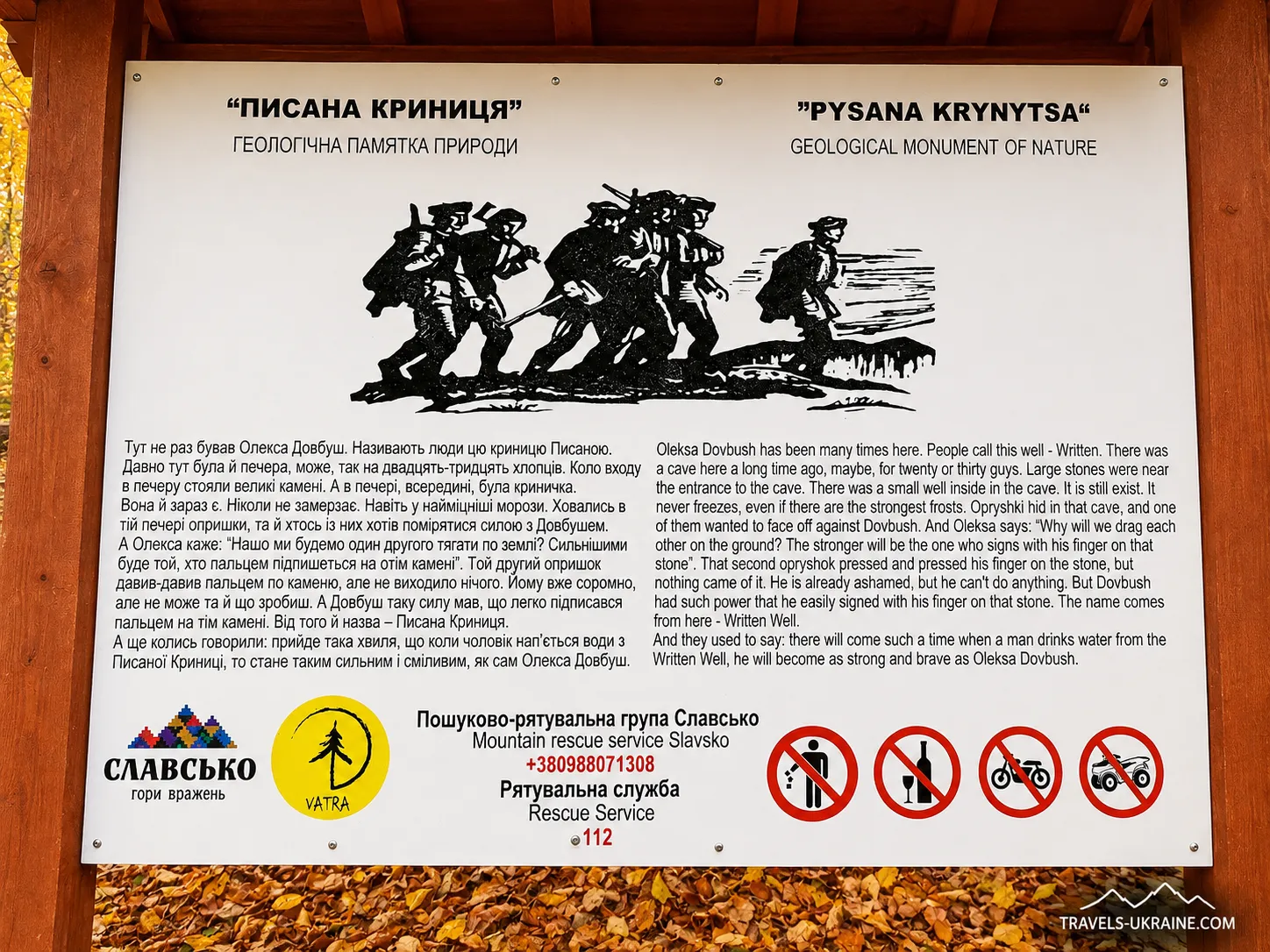
The Carpathians are home to places that attract visitors not through their scale, but through the combination of nature and the stories preserved around them. Pysana Krynytsia near Slavske is one such place. Hidden among beech trees and large sandstone boulders is a small cave with a natural spring, where a legend about the most famous Carpathian opryshok—Oleksa Dovbush—has been passed down for generations.
Today, the Pysana Krynytsia spring is a protected geological natural monument. At first glance, the site is quite intimate: rocky outcrops, a small rock cavity, forest, and water emerging among the sandstone. Yet this simplicity creates a unique atmosphere. Visitors come here not for a large tourist complex, but for the feeling of an authentic mountain location hidden in the Carpathian forest.
The best-known story also explains the spring’s unusual name. According to an old local legend, Oleksa Dovbush was here with his opryshky. One of his companions supposedly decided to test his strength, but instead of an ordinary contest, Dovbush proposed a different challenge: the winner would be the one who could leave his signature on the rock with a finger. His opponent failed, while Dovbush, according to the legend, easily «signed» the cliff. This, supposedly, is where the name Pysana Krynytsia came from.
This story should be understood as a folk tale, not a documented episode from Dovbush’s life. However, the legend is not a modern tourist invention: the story of Pysana Krynytsia in Slavske has been recorded in collections of Carpathian folk tales. They mention both a cave where the opryshky supposedly may have hidden and a stone bearing a mysterious «signature.»
For today’s traveler, Pysana Krynytsia is also interesting because of its location. It lies in the Vysokyi Verkh massif, so a visit to the spring can become part of a full mountain route. One well-known hiking option starts in Slavske, passes through Pysana Krynytsia, and continues to Vysokyi Verkh. In this way, the small natural monument becomes not a final destination, but one of the most fascinating stops on the way to Carpathian panoramas.
Still, coming here solely for «Dovbush’s water» would be an overly narrow view of the site. Pysana Krynytsia is interesting as a combination of geology, Carpathian forest, old folklore, and a hiking route. Here you can see a natural spring emerging through fractured sandstone, examine the rock formations, rest in the shade of the beech forest, and continue toward Vysokyi Verkh.
Below, we will explore what Pysana Krynytsia really is, how its rocks and cave formed, where the legend of Dovbush came from, how to get here from Slavske, and how to combine the spring with a hike to Vysokyi Verkh. We will also look at what else is worth seeing around this little-known yet highly atmospheric part of the Slavske Beskids.
What Is Pysana Krynytsia, and How Did Its Rocks and Cave Form?
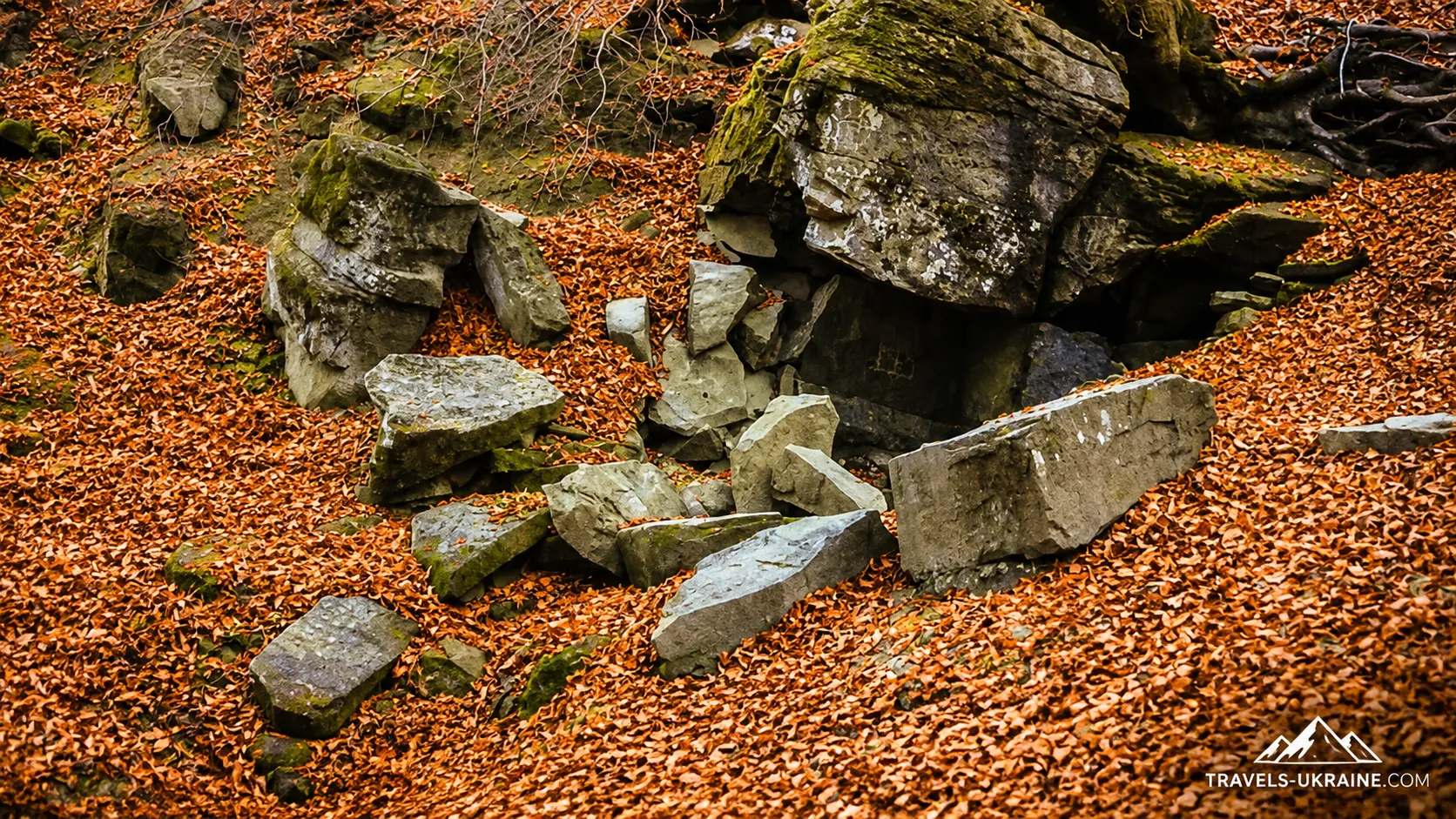
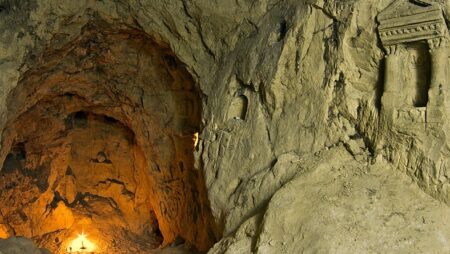
Pysana Krynytsia is more than just a mountain spring. Officially, the natural complex is protected as a geological natural monument of local importance covering 0.1 hectares. Its main feature is a small cave in rocky outcrops of fractured Paleogene sandstone, surrounded by beech forest. Water emerges among these boulders, giving the site its name.
The monument is located in the Vysokyi Verkh area of the Slavske Beskids. Unlike large karst caves formed in limestone, Pysana Krynytsia is associated with sandstone formations. Its origin is therefore best explained by fractures in the rocks, weathering, and the effects of water and frost, together with the gradual breakdown of less resistant parts of the rock.
Where Did the Sandstone Rocks Come From?
The rocks around Pysana Krynytsia consist of Paleogene sandstone. These formations developed from ancient sandy sediments that accumulated in a marine basin long before the modern Carpathians appeared. Over time, the sediments compacted and turned into rock; during the formation of the Carpathian mountain structures, they were uplifted, deformed, and broken by numerous cracks.
Once the rocks came closer to the surface, their gradual destruction began. Water seeped into the cracks, froze in winter, and expanded them, while temperature fluctuations, tree roots, and gravity slowly separated individual blocks of stone. Over a very long period, this process formed the distinctive rocky outcrops, boulders, and small cavities that visitors see near Pysana Krynytsia today.
Is Pysana Krynytsia Really a Cave?
Yes. In official nature-conservation documents, the site is listed as the «Pysana Krynytsia» cave. At the same time, it should not be imagined as a long system of underground galleries. It is a relatively small natural cavity among sandstone rocks. Its shape is linked to natural fractures and the gradual weathering of the rock. Parts of the sandstone weathered unevenly: more resistant blocks remained in place, while weaker sections were gradually washed away and crumbled. The result was a rocky recess that is traditionally called a cave today.
This natural shelter later became an important part of the legends about Oleksa Dovbush and his opryshky. But the existence of the cave itself is a geological fact, whereas Dovbush’s presence here belongs to the realm of folk tradition.
Where Does the Water of Pysana Krynytsia Come From?
Rainwater and melting snow gradually seep through the soil and the network of cracks in the sandstone. Inside the rock, the water moves through natural channels, and where the cracks reach the surface, a spring forms. This is why water emerges directly among the rocky outcrops. The surrounding beech forest also helps maintain soil moisture and influences the local water regime, creating a characteristically cool atmosphere even during the warm season.
Tourist descriptions often claim that the water of Pysana Krynytsia has «healing properties» or gives people strength. However, these stories originate primarily from the legend of Dovbush. Without a current laboratory analysis of the water, its medicinal properties should not be claimed, nor should its safety for drinking be guaranteed.
Why Was Pysana Krynytsia Protected?
The value of this site lies not in its size. The geological monument covers just 0.1 hectares, yet this small area preserves a distinctive natural complex: sandstone outcrops, a cave cavity, a spring, and beech forest. That is why it is not only the water that is protected, but the entire geomorphological formation. Damage to the rocks, inscriptions carved into stone, enlargement of natural cavities, or other mechanical interference could permanently alter a site formed by natural processes over a very long period.
For travelers, Pysana Krynytsia is a good example of how a geological monument does not have to be a huge cave or a canyon stretching for kilometers. Sometimes a few rocks, a small natural cavity, and a spring are enough to literally show how water, stone, and time shape the Carpathian landscape.
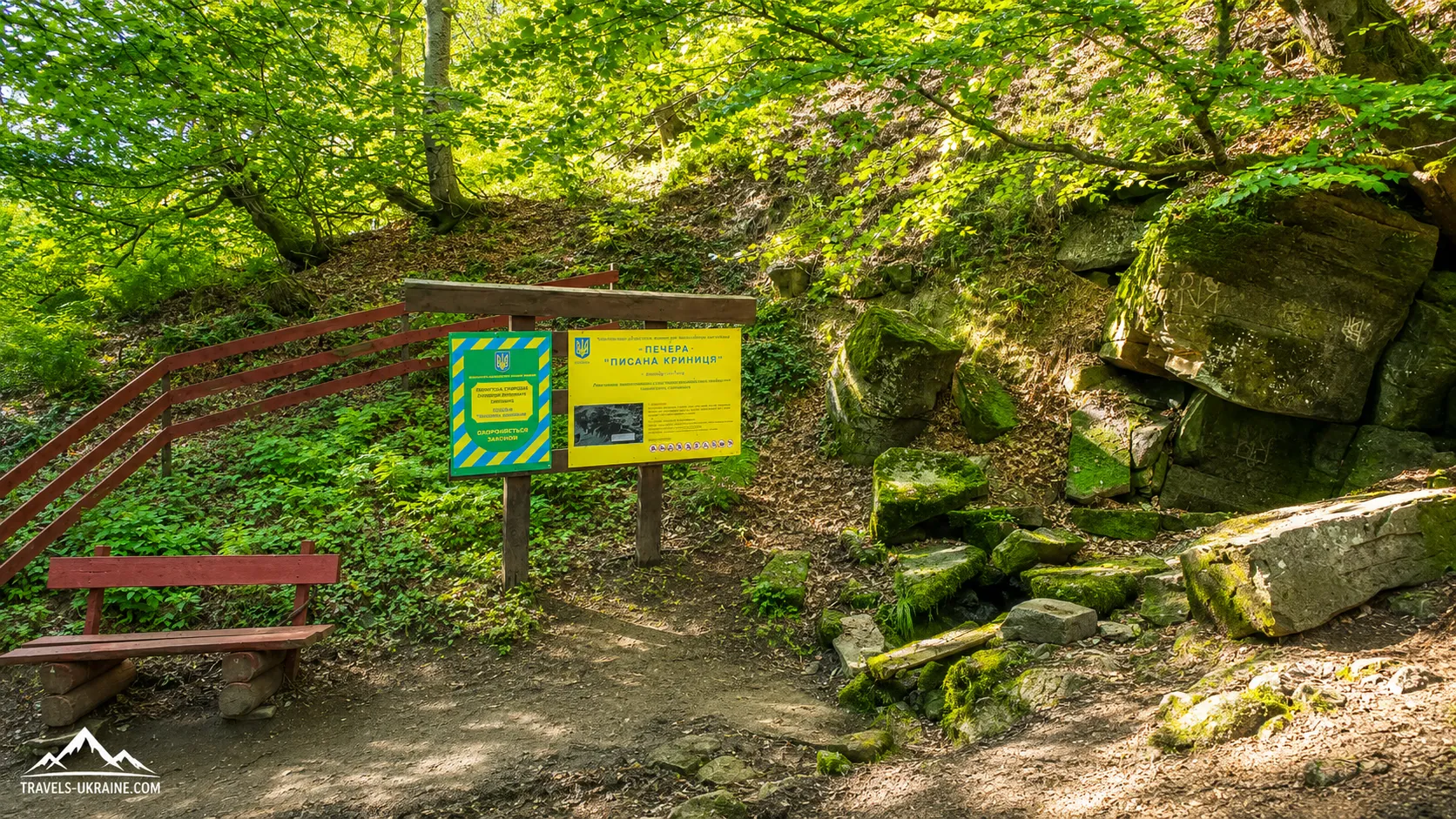
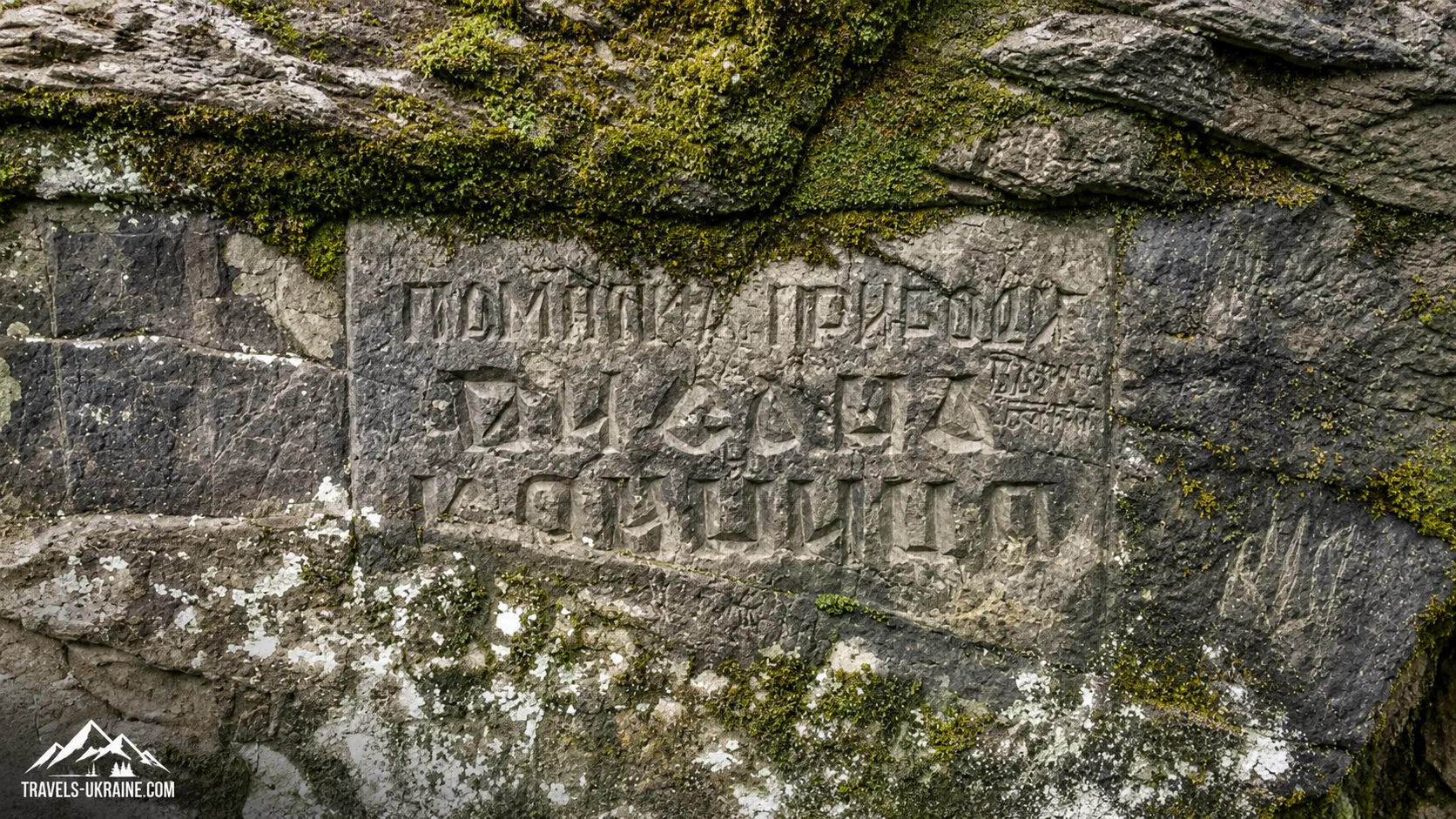
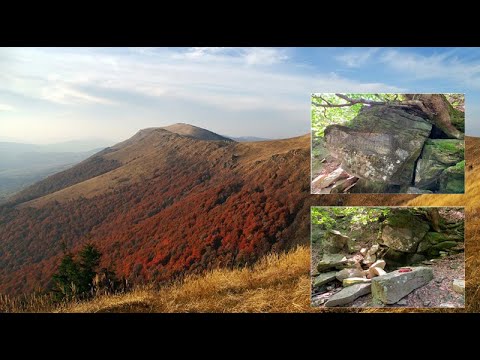
Legends of Pysana Krynytsia
The best-known story associated with Pysana Krynytsia takes us back to the era of the Carpathian opryshky and Oleksa Dovbush. This tale explains the spring’s unusual name and transforms a small cave among sandstone rocks into one of the most atmospheric natural sites around Slavske.
The legend has several versions, but its main storyline remains almost unchanged. An old account titled «Pysana Krynytsia in Slavske» says that Dovbush and his opryshky visited these places repeatedly. Large stones stood beside the cave, and a spring was found inside it.
The Opryshky Cave in Folk Tradition
An old folklore account contains another interesting detail. According to the tale, there was once a cave large enough to hold several dozen people near the spring, where Dovbush supposedly hid with his companions. Today, the natural cavity near the spring is much more modest than the image created by the legend. This is another example of how a real natural formation may have grown larger over time in the popular imagination. A small cave among remote Carpathian forests could easily become an ideal setting for stories about opryshky, secret hideouts, and pursuit.
At the same time, the existence of the cave itself is not a legend: the natural site is officially protected as the «Pysana Krynytsia» cave. However, there is currently no documentary evidence that Oleksa Dovbush or his band actually stayed here.
Why Is the Water Associated with Dovbush’s Strength?
Another tale has developed around the spring: supposedly, anyone who drinks from Pysana Krynytsia will receive a share of Dovbush’s heroic strength. Modern tourist descriptions also include versions involving youth, beauty, and the water’s «healing properties.» Such claims should be understood solely as part of local folklore. No reliable modern laboratory studies confirming the medicinal properties of Pysana Krynytsia’s water are available in public sources.
Thus, the legend of Dovbush’s strength can be an interesting part of the journey, but it should not be turned into medical advice.
Why Did Dovbush Become the Hero of This Legend?
Oleksa Dovbush became one of the best-known heroes of Carpathian folklore. In the 18th century, he led one of the bands of opryshky who operated in the Carpathians and opposed representatives of the authorities and large landowners. After Dovbush’s death, the real historical figure gradually became a folk hero credited with extraordinary physical strength, invulnerability, the ability to open springs in rocks, and the power to leave marks on stone.
That is why Dovbush rocks, stones, caves, springs, and trails can be found throughout the Carpathian region. Far from all of them have a documented connection to the opryshky, but together they form a vast layer of folk memory about Dovbush.
Pysana Krynytsia is one such place. Its value lies not in the fact that the legend can be proven archaeologically, but in the way a real natural monument became part of the local oral tradition over generations.
Why the Legend of Pysana Krynytsia Matters
It is not necessary to prove every legend as a historical fact for a place to have tourist value. Pysana Krynytsia is already an interesting geological monument in its own right, while the tale of Dovbush gives it a cultural dimension. This combination of a real cave, a spring, an old beech forest, and Carpathian folklore makes the site special. Standing beside the rocks, it is easy to understand why remote places protected by nature became the basis for stories about opryshky.
How to Get to Pysana Krynytsia from Slavske
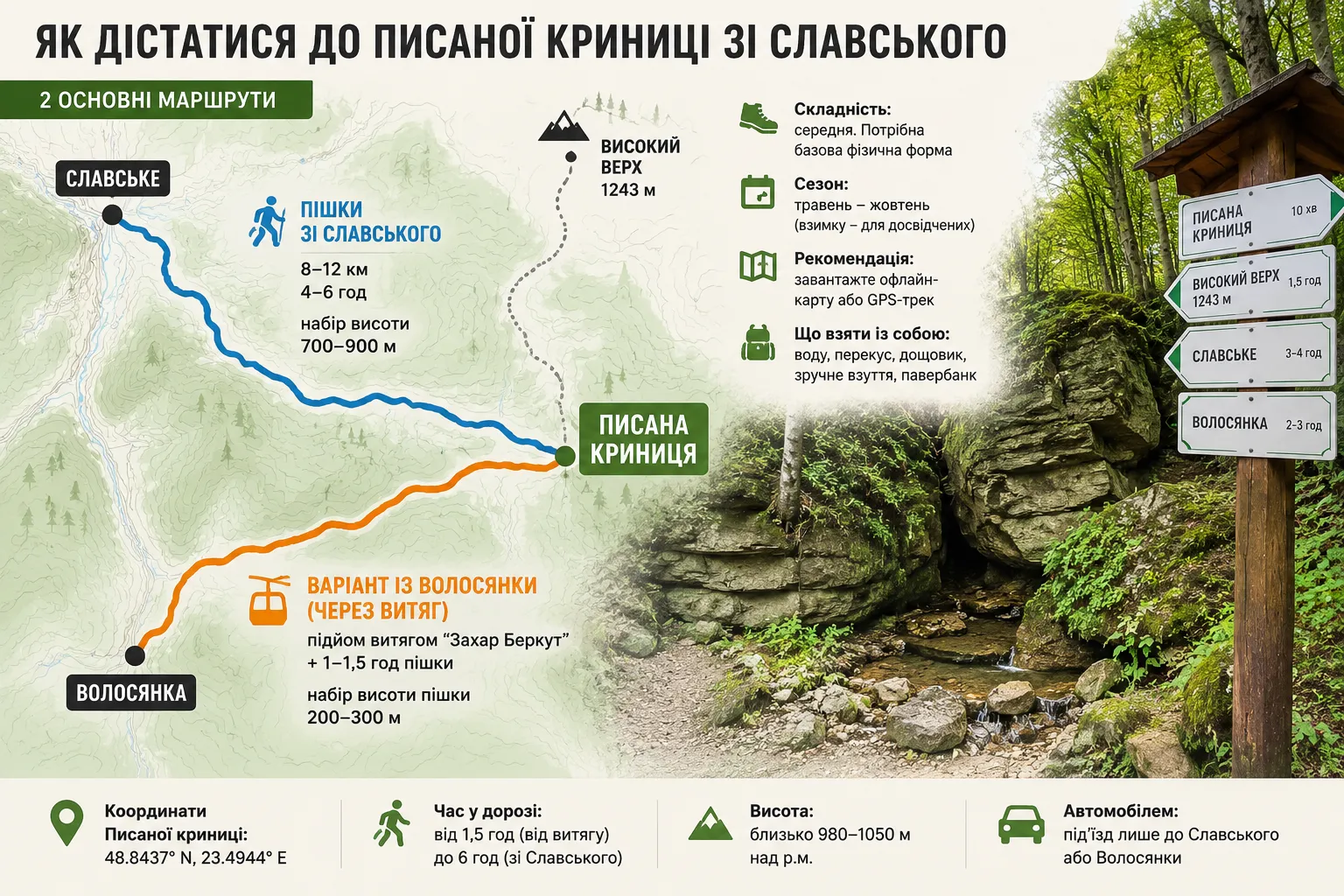
The route to Pysana Krynytsia can be planned in several ways. The most interesting option is to set out on foot directly from Slavske and turn your visit to the spring into a full mountain hike. Those who prefer to avoid a major elevation gain may find it more convenient to begin from the Volosianka side, near the «Zakhar Berkut» tourist complex.
That is why different travel descriptions may give very different figures for distance and duration. Some routes lead to the spring directly from the valley, while others pass through Vysokyi Verkh; part of the elevation can also be covered by chairlift. Before setting out, it is important to decide whether Pysana Krynytsia will be the main destination or just one stop on a longer route.
On foot from Slavske
The classic hiking option starts in Slavske. One long-established route begins in the central part of the settlement near the church and then gradually gains elevation toward the mountain range.
Pysana Krynytsia is already quite high above the valley, so a walk from Slavske should not be treated as a short trip to a spring. Modern GPS tracks show approximately 8–12 km depending on the chosen trail from central Slavske to Pysana Krynytsia. The difference is due to different starting points and variations in the forest-road route.
The road gradually moves from built-up areas and open slopes into forest sections. Much of the route involves walking uphill, so even without technically difficult sections, the main challenges are the distance and elevation gain.
If the main goal is simply to visit the spring and return to Slavske, it is best to set aside most of the day for the trip. The actual duration depends greatly on your pace, the weather, the condition of the road, and the number of stops.
Option from the Volosianka side
Another convenient route begins in the village of Volosianka. The lower station of the Zakhar Berkut tourist complex’s chairlift is located here, taking visitors toward the Vysokyi Verkh area.
Mountain roads and trails also lead from Volosianka to Pysana Krynytsia. If you complete the entire route on foot, you should expect several hours of walking and a considerable elevation gain. This option is suitable for those who want to avoid the long approach directly from the center of Slavske.
The route can be shortened even further by using the Zakhar Berkut chairlift. After ascending to the upper part of the ridge, you can continue on foot toward the spring. In this format, Pysana Krynytsia is more accessible to travelers who are not planning a multi-hour ascent from the valley.
However, be sure to check the current chairlift operating schedule before your trip. Its operation depends on the season, weather, maintenance, and the tourist complex’s schedule.
How difficult is the route to Pysana Krynytsia?
Mountaineering equipment is not required to visit the spring. The main routes follow forest roads and trails without technically challenging climbing. However, it would also be incorrect to call the full hiking approach from Slavske an easy walk. The considerable distance, prolonged elevation gain, and uneven ground require a reasonable level of fitness. After rain, rocks, tree roots, and earthen sections can become slippery.
Hiking shoes or boots with good tread are best for the trek. You should also bring extra water, a light snack, a rain jacket, a charged phone, and a power bank.
Can you drive directly to the spring?
You should not expect ordinary road access directly to Pysana Krynytsia. This is a natural site in a mountain forest, and the final part of the route must be completed on foot in any case. By car, it is convenient to drive to Slavske or Volosianka and start the route from there. The option from Volosianka is especially practical for those planning to use the chairlift and reduce the elevation gain.
The hike itself is an important part of the experience at this location. Pysana Krynytsia does not appear immediately beside a parking area: you have to walk through the Carpathian forest, gradually gain elevation, and only then reach the sandstone cliffs associated with the old legend of Dovbush.
What to see near Pysana Krynytsia
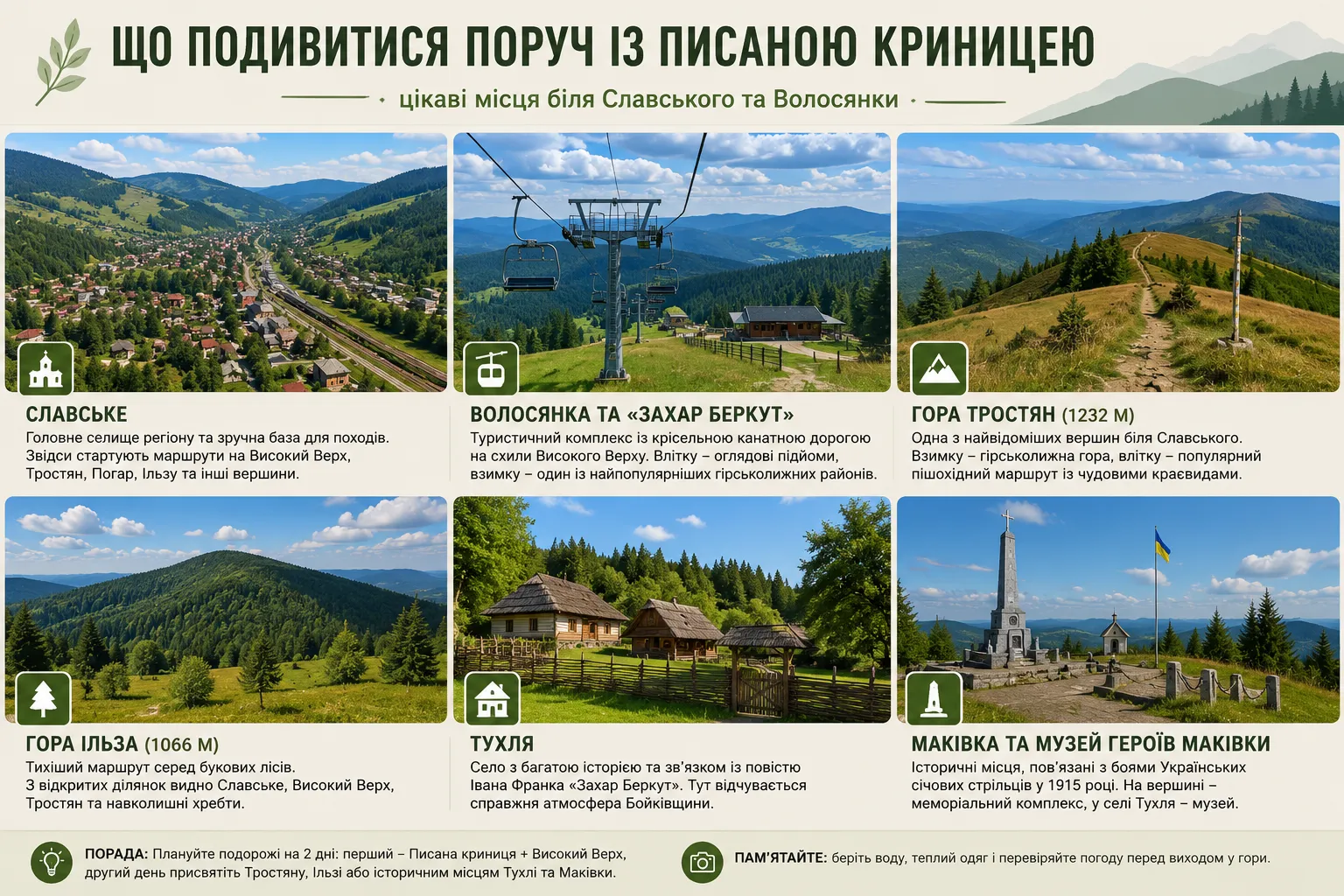
Pysana Krynytsia is well suited not only as a standalone hiking destination. Its location between Slavske, Volosianka, and Vysokyi Verkh makes it easy to combine this natural landmark with other interesting places in the Slavske community. You can continue the day with another summit, use the cableway, explore Slavske, or spend the next day visiting the historical sites of Tukhlya and Makivka.
It is best not to try to see everything at once. After a full hike from Slavske via Pysana Krynytsia and Vysokyi Verkh, tackling several more mountains on the same day is unlikely to bring much enjoyment. It makes far more sense to divide the surrounding area into several shorter routes.
Slavske — a convenient base for exploring the Beskids
Slavske is the most convenient starting point for discovering Pysana Krynytsia and the surrounding mountains. The settlement lies in a valley among several popular ridges, and railway connections make it possible to get here without a car. From Slavske, you can plan hikes to Trostian, Pohar, Ilza, Vysokyi Verkh, and other peaks. After a hike, it is much easier to find accommodation, food, and transport here than directly beside remote mountain trails.
If only a few hours remain after visiting Pysana Krynytsia, it is better not to start another challenging route. Instead, take a walk around the settlement, visit the Slavske resort, and rest before the next day in the mountains or at the complex’s slopes. There is something for travelers to do here in every season.
Volosianka and the Zakhar Berkut complex
The nearest tourist center to the Vysokyi Verkh area is Volosianka. The Zakhar Berkut tourist complex operates here, with a chairlift that significantly reduces the ascent to the upper part of the ridge. The complex is located approximately 6 km from Slavske. In summer, the cableway is used for scenic rides, while in winter the area becomes one of the main ski destinations in the Slavske community.
For travelers who want to see Pysana Krynytsia without a long ascent from the valley, Volosianka is one of the most convenient starting points. After returning, you can stay in the area around the complex, use the local tourist infrastructure, or simply relax while enjoying the mountain views.
Mount Trostian
Another well-known peak near Slavske is Trostian, standing at approximately 1232 meters. It is located on the other side of the valley and is clearly visible from many sections of the route to Vysokyi Verkh. Trostian is particularly famous as a ski mountain, but it is also interesting during the warmer months. Open sections of the ridge offer panoramas of Slavske and the surrounding Beskids, and several hiking routes lead to the summit.
I would not try to combine Pysana Krynytsia and Trostian into one long hiking day. It is much better to dedicate one day to Vysokyi Verkh and leave Trostian for the next. That way, neither route will turn into an exhausting race to conquer peaks.
Mount Ilza — a quieter alternative to popular peaks
For those seeking a more peaceful route after the busy Vysokyi Verkh, Mount Ilza, at approximately 1066 meters, can be an interesting alternative. It is located between Slavske and Volosianka and is covered mostly by beech forest. Ilza is less well known than Trostian or Vysokyi Verkh, so the route has a completely different character. There is less tourist infrastructure, but more quiet forest walking and a stronger sense of being away from the resort center.
From open sections, you can see Slavske, Volosianka, Trostian, and Vysokyi Verkh. Ilza is therefore well suited to the second day of a trip if you would like another hike, but without being tied to popular tourist complexes.
Tukhlya and the history of «Zakhar Berkut»
If you want to change the character of your trip after several days in the mountains, head to Tukhlya. The village is closely connected with the history and literary image of Zakhar Berkut — this very region inspired Ivan Franko’s famous novella. Today, Tukhlya can be a worthwhile addition to the natural part of your trip. Here, you can learn more about the area’s history, Boyko culture, and the events of World War I.
The village is home to the Makivka Heroes Museum, dedicated to the 1915 battles of the Ukrainian Sich Riflemen. Mount Makivka itself can also be included in a separate historical hiking route: its summit is home to a memorial complex honoring the soldiers of the Ukrainian Sich Riflemen.
How to plan a two-day itinerary
If you have two full days in the area around Slavske, I would keep the itinerary simple. Day one can be devoted to the Slavske — Pysana Krynytsia — Vysokyi Verkh route, returning to Slavske or descending to Volosianka.
Day two can be chosen according to your mood. Trostian or Ilza are good options for another hike. If you want less physical exertion, choose Volosianka, a scenic cableway ride, and a walk around Slavske. For a historical itinerary, head to Tukhlya and Makivka.
This format lets you experience the area around Pysana Krynytsia near Slavske from different perspectives: the natural landmark and Dovbush legend, open mountain panoramas, resort infrastructure, and the history of Boykivshchyna come together in one rich but manageable trip.
Frequently asked questions about Pysana Krynytsia
Where is Pysana Krynytsia located?
Pysana Krynytsia is located in the Vysokyi Verkh mountain massif near Slavske and Volosianka in Lviv Oblast. It is a geological natural landmark surrounded by beech forest and sandstone cliffs.
How do you get to Pysana Krynytsia from Slavske?
You can hike to Pysana Krynytsia from Slavske along mountain and forest roads toward Vysokyi Verkh. Depending on the starting point and chosen trail, the distance to the spring is approximately 8–12 km. It is best to set aside most of the day for this hike.
Is there a shorter route to Pysana Krynytsia?
Yes. A shorter option can be planned from the Volosianka side, using the chairlift at the Zakhar Berkut tourist complex, if it is operating. After the ascent, part of the route to the spring area must still be covered on foot.
Can you drive directly to Pysana Krynytsia?
Ordinary passenger cars cannot drive directly to the natural landmark. The most convenient option is to leave your car in Slavske or Volosianka and continue on foot. Part of the elevation gain can be avoided by taking the chairlift from the Volosianka side.
Can Pysana Krynytsia be combined with Vysokyi Verkh?
Yes. One of the most interesting one-day options follows the route Slavske — Pysana Krynytsia — Vysokyi Verkh — Slavske. This hike requires a reasonable level of fitness, plenty of time, and stable weather.
Can you drink the water from Pysana Krynytsia?
Water naturally emerges among the sandstone cliffs, but without up-to-date laboratory analysis, its composition or sanitary safety cannot be guaranteed. Claims about the water’s «healing properties» mostly belong to local legends, so it is best to bring drinking water with you for the hike.
What is the connection between Pysana Krynytsia and Oleksa Dovbush?
According to local lore, Oleksa Dovbush visited the spring with his opryshky and supposedly left a mark on the stone with his finger. The legend connects this «signature» with the name Pysana Krynytsia. There is no documentary evidence that Dovbush was here specifically.
Is there a real cave near Pysana Krynytsia?
Yes. The site is officially called the «Pysana Krynytsia» cave and is protected as a geological nature monument of local significance. It is a small natural cavity among fractured sandstone cliffs, not a large system of underground galleries.
When is the best time to visit Pysana Krynytsia?
The most convenient period for a first hike is from late spring to mid-autumn. After heavy rain, forest roads, roots, and rocks become slippery. In winter, the route requires more preparation because of snow, shorter daylight hours, and more difficult navigation.
Is the route to Pysana Krynytsia suitable for children?
It depends on the route chosen and the child’s age. The full hike from Slavske is fairly long and requires stamina. For families, the option from the Volosianka side may be more convenient, as a lift can reduce the elevation gain. Children must be supervised at all times near the cliffs.
What else can you see near Pysana Krynytsia?
The most logical combination is to visit the spring together with Vysokyi Verkh and Volosianka. For a separate second day, suitable options include Trostian Mountain, Ilza, Slavske, Tukhlya, and Makivka Mountain with its memorial complex dedicated to the Ukrainian Sich Riflemen.
Is Pysana Krynytsia near Slavske worth visiting?
Pysana Krynytsia is not the kind of Carpathian destination where you should expect a major tourist complex, a spectacular waterfall, or a grand panorama immediately after getting out of the car. Its appeal lies elsewhere: a small mountain spring is hidden among beech forest, sandstone cliffs, and a natural cave, while the journey there becomes part of the experience itself.
What makes this place especially interesting is the combination of a real geological monument and old Carpathian folklore. The cave, rock outcrops, and spring genuinely exist and are protected, while the story of Oleksa Dovbush, his extraordinary strength, and his «signature» on the stone remains a folk legend. This clear distinction between fact and legend makes the story of Pysana Krynytsia no less interesting; on the contrary, it gives the site its authentic Carpathian character.
For hikers, a major advantage is the ability to choose a trip format that suits their fitness level. The hike from Slavske allows you to spend most of the day among mountains and forests, while the option from the Volosianka side via Vysokyi Verkh helps shorten the climb. If you have enough time and stamina, Pysana Krynytsia can be included in a full route leading to Vysokyi Verkh.
This is the format in which the destination is best experienced. You can stop by the spring among the cliffs and the quiet of the forest, then, after some time, find yourself on an open ridge overlooking the Slavske Beskids. A small natural monument becomes a meaningful part of a much larger mountain journey.
Pysana Krynytsia is also well suited to those who have already visited Slavske and want to see more than the popular ski slopes and tourist complexes. There is no need to rush from one attraction to another here—the main elements are the forest, stone, water, an old legend, and the road through the mountains.
If you enjoy lesser-known natural places, Carpathian legends, and routes where the trail itself is no less interesting than the destination, Pysana Krynytsia near Slavske is definitely worth including in your trip. And if you continue on to Vysokyi Verkh after visiting the spring, an ordinary walk can easily become one of the most atmospheric day hikes in the vicinity of Slavske.

No Comment
You can post first response comment.