
 English
 Українська
 Latviešu
 Lietuvos
 Русский
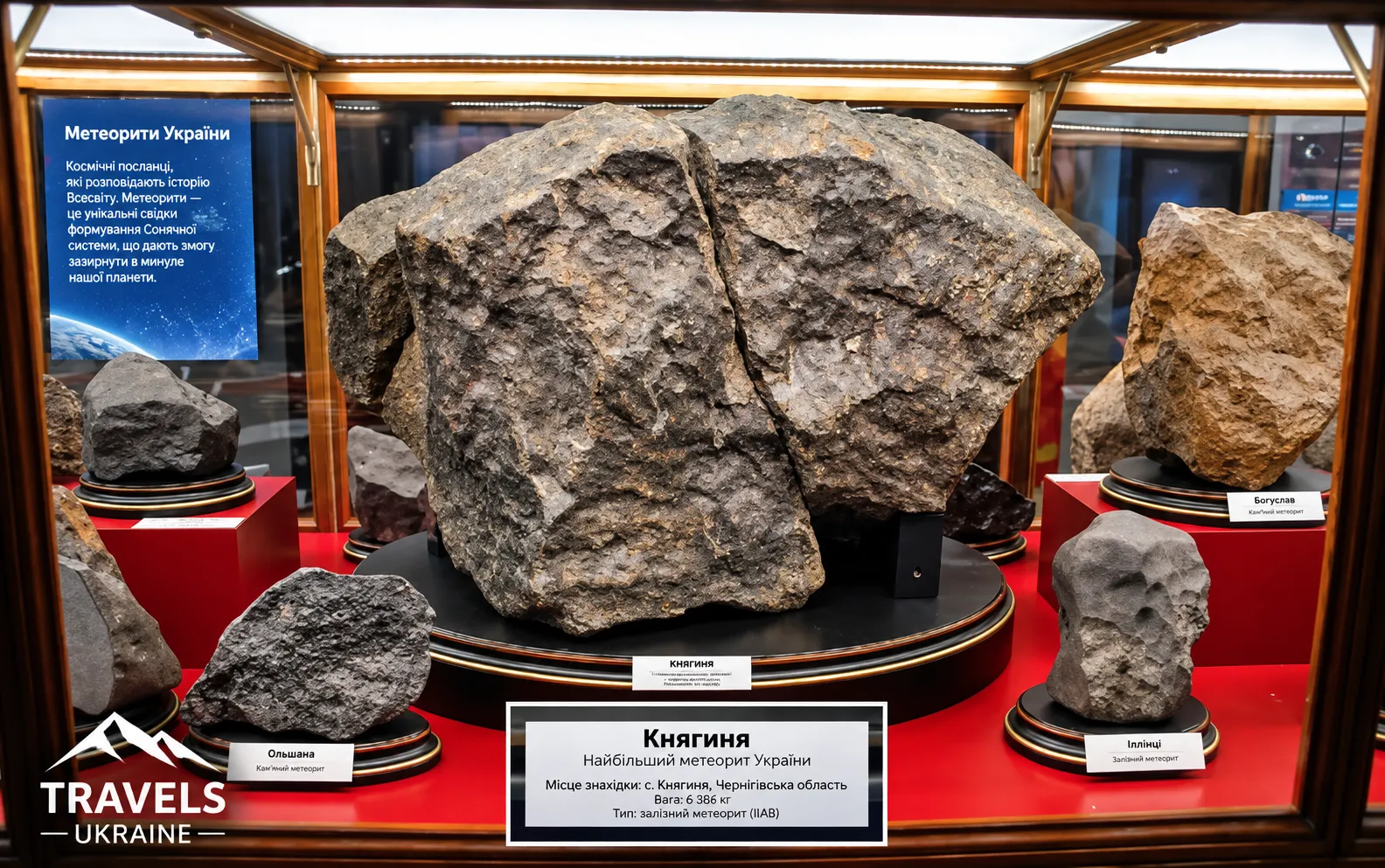
In the afternoon of June 9, 1866, an event unfolded over the Carpathians that would have been hard even for a modern person to forget. A bright bolide appeared in the sky, and soon a genuine meteorite shower passed over the territory of present-day Zakarpattia. Stones fell around the villages of Knyahinya, Stuzhytsia, and Zbui, landing in fields, on roads, and around human settlements.
Today, this event is known in international catalogs as the Knyahinya meteorite — «Knyahinya». The International Meteoritical Bulletin Database records it as a reliably observed fall in 1866, with a total recovered mass of about 500 kilograms. For a small Carpathian village, this was a local event only in geographical terms — news of it quickly reached the scientific community across Europe.
The Meteorite Fell in Broad Daylight, Not at Night
One detail makes the story even more intriguing. The fall occurred approximately a few minutes before five o’clock in the evening. In other words, people saw the spectacular celestial object not against a dark starry sky, where a bright meteor might seem more natural, but in broad daylight.
A large number of eyewitnesses observed the event, and detailed scientific descriptions — as well as depictions of the event itself created in 1866 — appeared soon after the fall. One such drawing, published by the Austrian geologist Wilhelm von Haidinger, has survived to this day. It shows a bright trail across the mountainous landscape — essentially a visual reconstruction created when eyewitness memories were still entirely fresh.
Instead of One Meteorite, Hundreds of Stones Rained Down on the Carpathians
It is not entirely accurate to speak of «the place where the meteorite fell.» Before reaching the ground, the celestial body broke apart into a large number of fragments, which scattered across a considerable area. That is why it is more accurate to refer to the historical event as a meteorite or stony meteorite shower. Different sources give different numbers of fragments. Uzhanskyi National Nature Park estimates the number at anywhere from approximately two hundred to considerably more stones, while historical scientific works from the 19th century suggested that there may have been more than a thousand. The most accurate description, therefore, is this: hundreds of fragments of various sizes fell to Earth—from tiny pieces to stones weighing tens or even hundreds of kilograms.
The meteorite shower’s dispersion area was extensive. Stones were found near settlements and on the slopes of the Carpathians, and the fragments varied in mass. The total recovered material is estimated at approximately half a ton.
Why the Meteorite Was Named «Knyahinya»
The meteorite was named after the village of Knyahinya, near which one of the main fall zones was located. In the 19th century, this territory belonged to the Kingdom of Hungary within the Austrian Empire, which is why old scientific literature may contain Hungarian and German versions of geographical names. The name Knyahinya is used in the modern international catalogue.
Today, the villages of Knyahinya and neighboring Stuzhytsia lie within or close to the territory of Uzhanskyi National Nature Park, not far from the borders of Poland and Slovakia. The Carpathian ridges among which the cosmic stone once scattered give little indication of the event of 1866 — there are forests, meadows, and quiet mountain roads all around. And that is precisely why the story of «Knyahinya» sounds so extraordinary today. In a place now associated with beech forests, ancient oaks, and mountain trails, stones from space literally rained down one June day.
A Fall That Quickly Captured the Interest of European Scientists
The scale of the event and the large amount of material recovered made «Kniahynia» an exceptionally valuable subject for 19th-century science. The fragments began to be collected, described, and transferred to scientific collections. Parts of the meteorite later found their way into museums and research institutions in various countries. But the real sensation awaited a little farther from the main fall zone. In the Chorni Mlaky tract, on the slope of Stinka Mountain, a fragment was found that was so large it became one of the world’s best-known stony meteorites for decades.
Its mass was approximately 279–280 kilograms. The stone pierced the ground, and the story of its discovery by a local resident later almost became a Carpathian legend in its own right. This fragment marked the beginning of the second chapter in the extraordinary journey of the Knyahinya meteorite — from a quiet tract in the Carpathians to one of Europe’s best-known natural history collections.
280 Kilograms from Space: How the Main Fragment Was Found
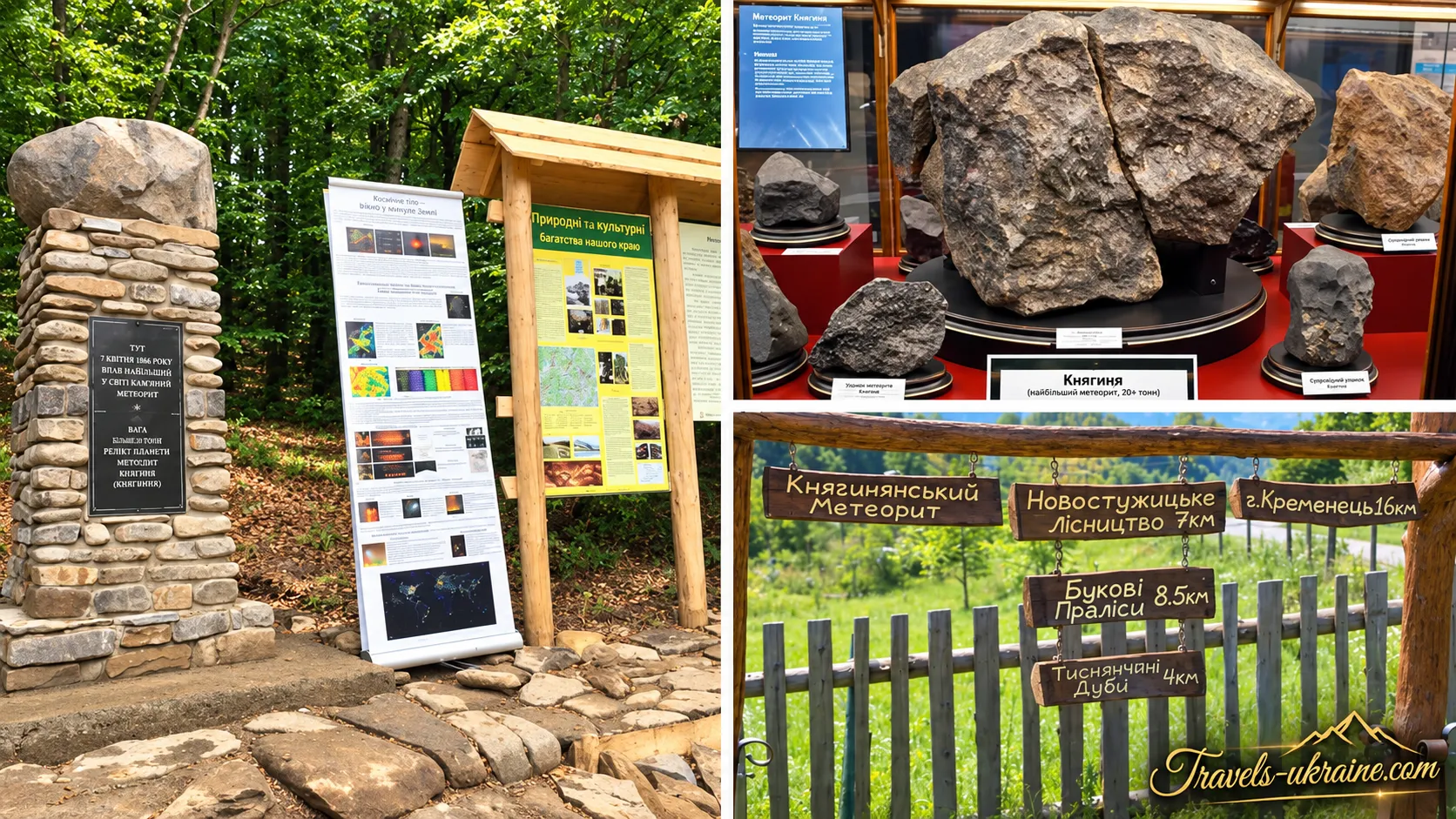
After the meteorite shower, residents of Knyahinya, Stuzhytsia, and the surrounding villages began finding strange dark stones in fields, on roads, and in meadows. Dozens of fragments were collected in the first few days, but the greatest discovery lay farther away — on the slope of Stinka Mountain, in the tract of Chorni Mlaky. It was here that the main fragment of the Knyahinya meteorite was found — the cosmic body that had passed through the atmosphere only days earlier and now lay beneath the soil in a quiet Carpathian forest.
The discovery is associated with a local peasant, Vasyl Kryvianyk. According to eyewitness accounts, he knew the tract well because he regularly mowed hay there. Several days after the meteorite fell, the man came to cut hay and noticed a new, deep hole in a familiar patch of ground. Intrigued, Kryvianyk began digging into the soil. At a depth of more than two meters, he came upon a huge stone that clearly was not part of the local rock. Thus the largest known fragment of the Knyahinya meteorite was discovered.
Today, Uzhanskyi National Nature Park even specifies the location of the discovery: along the route from Stuzhytsia to Chorni Mlaky are three small meadows, and it was on the third meadow that the man found the main fragment, which had split into two nearly equal parts weighing approximately 141.8 and 137.9 kg. A further small fragment weighing about 2.35 kg broke away from one of them.
Even separately, each of the two large pieces weighed more than an adult person. Together, they amounted to almost 280 kilograms — an extraordinary mass for a stony meteorite recovered after a documented fall. This scale was precisely what made the discovery a sensation. «Knyahinya» quickly ceased to be merely a strange stone from a Carpathian village and became an object of interest to European natural scientists.
The Story of the Two Oxen: Fact or a Beautiful Detail?
News of the discovery soon reached Anton Pokorny, a forester from Velykyi Bereznyi. What follows is one of the best-known stories associated with the meteorite. According to later accounts, Pokorny bought the cosmic stone from Vasyl for two oxen, with the peasant supposedly being allowed to choose the animals himself. This detail is repeated in numerous local-history and meteorite sources, but no documented sales agreement conclusively confirming precisely this price has survived.
The story of the two oxen is therefore best understood as a well-known historical account. At the same time, the essential fact is beyond doubt: after its discovery, the enormous fragment passed from local residents to people who understood its scientific and collectible value.
Why the Main Fragment Did Not Remain in Zakarpattia
In the 19th century, a large meteorite was more than just a curiosity. To natural scientists, it was rare material that made it possible to study matter that had reached Earth from outer space. Interest in «Knyahinya» therefore quickly grew among collectors and scientific institutions. The main fragment ultimately ended up in Vienna, in the imperial natural history collection that later became part of the modern Natural History Museum. This means that today there is a very direct link between the quiet Chorni Mlaky tract and a museum display case in the heart of Vienna.
The site of the discovery remained in the Carpathians, while the nearly 280-kilogram cosmic stone embarked on a journey that made the name of a small Zakarpattia village known to meteoriticists around the world. And the story did not end there. In Vienna, «Knyahinya» became more than a large museum exhibit — for a long time, it held the status of one of the world’s best-known stony meteorites and was used in serious scientific research.
Where the Knyahinya Meteorite Is Today
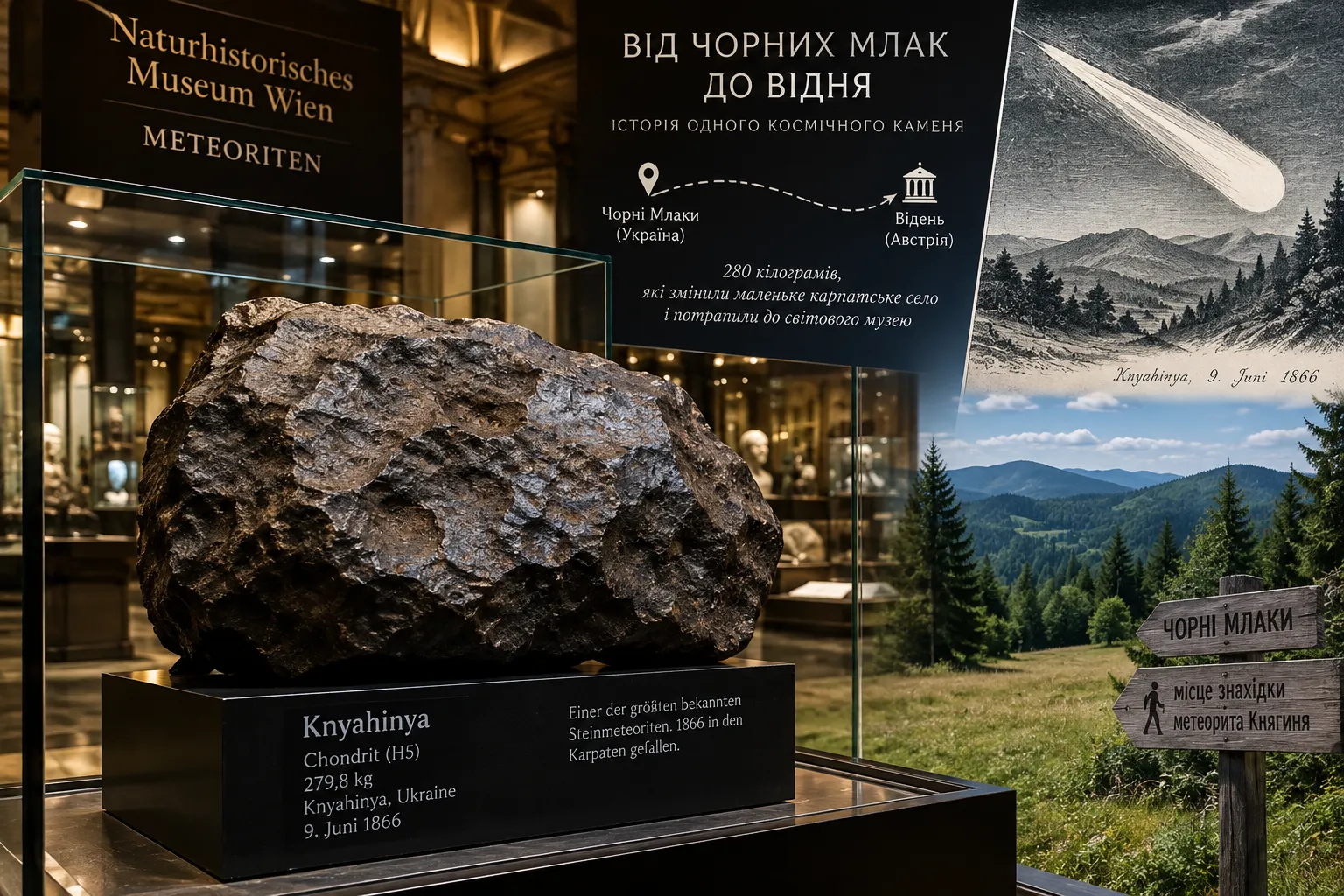
Today, a tourist who reaches the tract of Chorni Mlaky will not see a 280-kilogram cosmic stone there. The site of its fall and discovery remains in the Carpathians, while the main fragment of the meteorite has been associated with Vienna for more than a century and a half. It is now one of the best-known exhibits at the Natural History Museum in Vienna — Naturhistorisches Museum Wien. The museum describes Knyahinya as a stony meteorite weighing nearly 300 kg and emphasizes that for a long time it was the largest known stony meteorite in the world.
«Knyahinya» can be seen in the Vienna museum’s famous Meteorite Hall No. 5. Its location was far from arbitrary: the large Zakarpattia stone stands at the center of a display devoted to particularly important stony and stony-iron meteorites. The hall itself also deserves special attention. Following its modernization in 2012, it presented approximately 1,100 meteorite specimens, representing around 650 different meteorites. The museum calls this display the largest permanent meteorite exhibition in the world.
Among hundreds of cosmic stones from different continents, one of the central exhibits remains the fragment that fell in the Ukrainian Carpathians. For the small village of Knyahinya, this is a remarkably unusual place in the history of world museums.
Why Does the Museum Say «Nearly 300 kg» If the Fragment Weighed About 280?
Different sources give slightly different figures. Historical descriptions of the discovery often cite the main fragment’s precise mass as approximately 279.8 kg, while the Vienna museum rounds it to «nearly 300 kg» in its visitor information. These are not two different meteorites, nor is there any contradiction in the story itself. It is the same main stone from Chorni Mlaky, whose mass is rounded in the popular museum display. That is why articles about «Knyahinya» may refer to both «280 kg» and «nearly 300 kg.»
Former World Record Holder Among Stony Meteorites
The size of the main fragment was so unusual that “Knyahinya” was considered the largest known stony meteorite for many years. This made it famous far beyond the borders of the Austro-Hungarian Empire of the time. An important clarification is needed: it is no longer correct to call it “the largest stony meteorite in the world.” That record was lost long ago. For example, after the 2013 Chelyabinsk event, a stony fragment weighing approximately 650 kg was recovered from Lake Chebarkul — more than twice the weight of Knyahinya’s main fragment.
The accurate wording is therefore this: the main fragment of the Knyahinya meteorite was the largest known stony meteorite for a considerable period of time.
Not All of the Knyahinya Meteorite Is in Vienna
The cosmic body broke apart into hundreds of pieces, so it would be incorrect to say that «the entire meteorite is preserved in Vienna.» Its famous main fragment reached the Austrian capital, while smaller fragments eventually entered scientific, museum, and private collections in various countries. For example, a Knyahinya specimen is held in the collection of the American Museum of Natural History in New York, where it is displayed in the meteorite exhibition. The International Meteoritical Bulletin Database also refers to specimens in other major museum collections.
This is one reason the name of a small Zakarpattia village now appears in meteorite catalogs around the world. The stone shower of 1866 literally scattered pieces of a single cosmic body not only across the Carpathians, but later across museum collections in different countries as well.
Chorni Mlaky and Vienna — Two Halves of One Story
As a result, there are now two entirely different ways to «see» the Knyahinya meteorite. In Vienna, you can stand before a genuine fragment, examine its surface through museum glass, and realize that this stone came from space. In Chorni Mlaky, there is no museum display case—but you can walk through the same Carpathian forest and reach the clearing where this fragment entered the ground in 1866.
And it is precisely this distance between a quiet mountain meadow and one of Europe’s largest natural history museums that makes the story of «Knyahinya» so special. But the meteorite’s value was not limited to its record-breaking mass and compelling museum history. When the stone came into the hands of scientists, they began seeking answers inside it to much larger questions—about the origin of Solar System matter, cosmic irradiation, and even the possibility of life beyond Earth.
What the Knyahinya Meteorite Revealed to Scientists
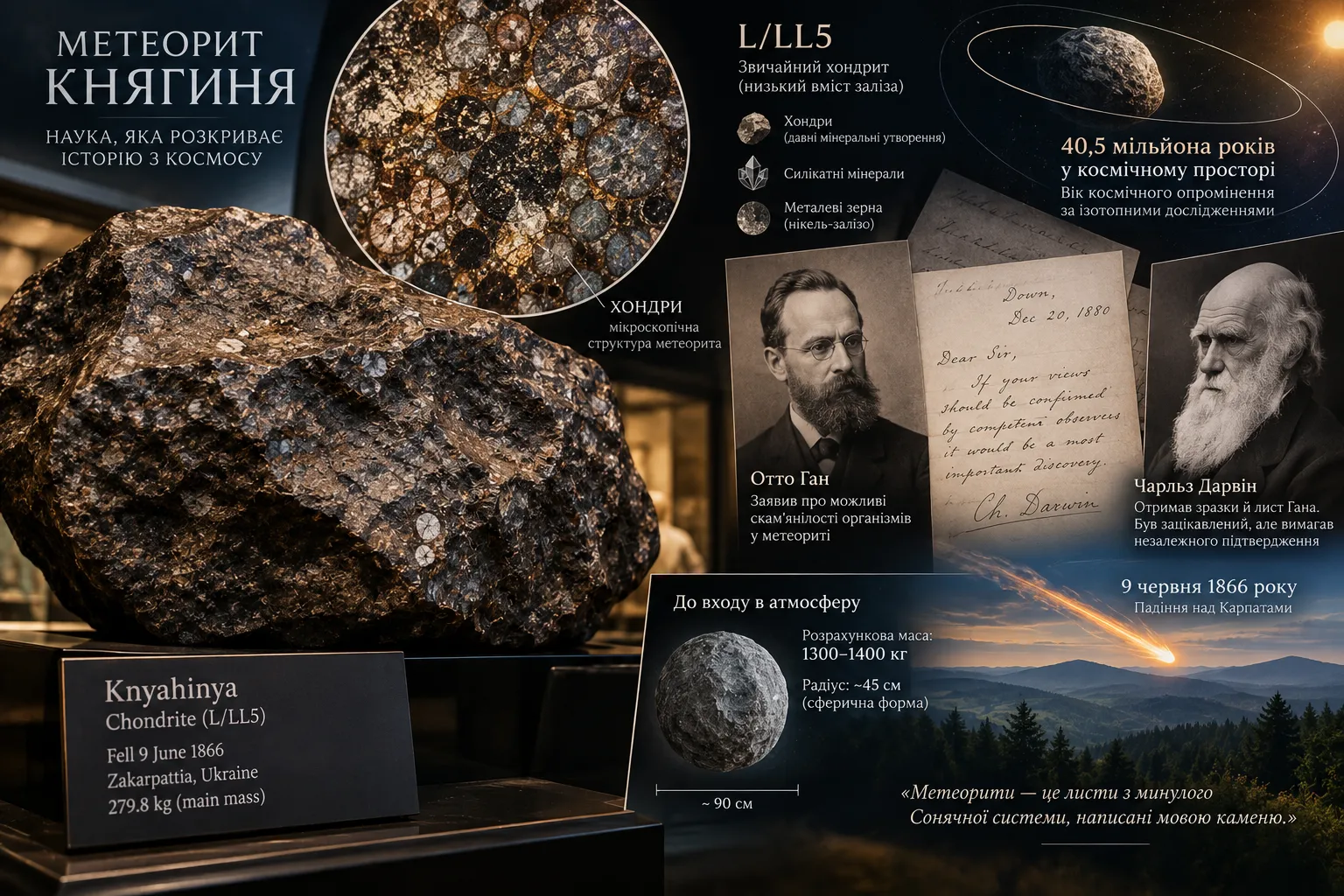
The fragment’s enormous size made the Knyahinya meteorite a famous museum exhibit, but what lay inside the stone proved far more important to science. Its minerals, microscopic structure, and isotopic composition allowed researchers to reconstruct part of the history of a cosmic body long before it exploded over the Carpathians.
«Knyahinya» has been studied for more than a century and a half, and during that time it became the subject not only of serious geochemical research but also of one of the strangest scientific disputes of the 19th century—over the alleged discovery of fossils of extraterrestrial organisms in the meteorite.
Of course, before entering the atmosphere, «Knyahinya» was considerably larger. The roughly 500 kg of fragments recovered represent only what could be collected after the fall. In space, the body was far more massive. In 1990, an international team of researchers analyzed cosmogenic isotopes and traces of nuclear particles in samples from different parts of the meteorite. According to their calculations, immediately before entering Earth’s atmosphere, the meteoroid was approximately spherical, with a radius of about 45 cm and an estimated mass of 1,300–1,400 kg.
In other words, what was breaking apart over the Carpathians in 1866 was not the 280-kilogram stone in the Vienna display case, but a cosmic body weighing more than a tonne. Much of its material was lost while passing through the atmosphere, fragmenting, and falling, while the hundreds of fragments recovered are merely the remains of the original meteoroid.
40.5 Million Years under Cosmic Rays
The same study produced another striking figure—40.5 million years. But it is easy to draw the wrong conclusion here: this is neither the age of the stone itself nor the time when the Solar System formed. It refers to the so-called cosmic-ray exposure age. When a fragment breaks away from a larger asteroid and begins moving independently through space, its surface and inner layers are constantly bombarded by high-energy cosmic particles. These create distinctive isotopes and microscopic traces in minerals, which can be measured even millions of years later.
Using these «cosmic clocks,» scientists determined that «Knyahinya» existed as a separate small cosmic body for approximately 40.5 million years before encountering Earth. Researchers also concluded that its exposure history was relatively simple, with no evidence that the meteoroid repeatedly broke apart and changed size again during this stage of its journey.
Otto Hahn and the «Fossils» inside the Meteorite
But the strangest chapter in Knyahinya’s scientific history began not in the 20th century, but just over a decade after the fall. In 1880, the German researcher and amateur geologist Otto Hahn claimed that, under a microscope, he had seen structures in thin sections of the meteorite that resembled the remains of sponges, corals, and even plants. This gave rise to a sensational hypothesis: if these structures were truly biological, the meteorite might have brought evidence of life beyond Earth to our planet.
For 19th-century science, this was an extraordinarily bold claim. At the time, the idea of panspermia—the possibility that the seeds of life could be transferred between celestial bodies—was being actively debated. The meteorite from the Carpathians therefore unexpectedly found itself at the center of a much broader discussion about the origin of life.
But What Did Charles Darwin Really Say?
This is where a story began that was later retold many times in a far more dramatic form than the sources allow. Hahn sent his materials to Charles Darwin, and the two did correspond. In a draft letter dated December 20, 1880, Darwin responded cautiously: if Hahn could convince several reliable specialists, it might become an extraordinarily important discovery. In other words, Darwin did not claim that extraterrestrial life had already been proven—he made acceptance of such a conclusion conditional on independent confirmation.
By contrast, a much more sensational version appeared in the journal Science in 1881. It claimed that Hahn had personally brought the specimens to Darwin, who looked through the microscope and was astonished by the «discovery.» Later historical analysis showed that there is no evidence that such a meeting took place. No confirmation of Hahn’s visit has been found in Darwin’s archives or other verified documents. Moreover, the correspondence indicates that Darwin later rejected the claim that he had recognized these structures as organic. One of his contemporaries explicitly observed that Hahn had probably mistaken mineral structures for biological ones.
Did They Find Life from Space in «Knyahinya»?
No. Modern meteoritics does not regard the microscopic structures described by Otto Hahn as evidence of extraterrestrial life. The story is interesting precisely as an example of how easily an unusual geological form can be interpreted through the expectations and scientific debates of its era. That does not make the episode any less important, however. «Knyahinya» found itself at the very center of early discussions about life in the Universe decades before modern astrobiology emerged. The meteorite became a kind of mirror of 19th-century science—a time when researchers were already trying to answer cosmic questions but did not yet have modern tools to test them.
Why «Knyahinya» Still Matters to Science
The meteorite’s true scientific value lay not in the sensational «fossils,» but in its well-preserved material and exceptionally large main fragment. This allowed researchers to take samples from different depths of the same cosmic body and compare how the effects of cosmic rays changed from the surface to the inner layers. «Knyahinya» became an important object of study for cosmogenic isotopes, nuclear tracks, the shielding of matter from cosmic radiation, and the history of meteoroids in interplanetary space. The 1990 study is still cited in research on the cosmic irradiation of meteorites.
That is why «Knyahinya» is interesting on several levels at once. For a tourist, it is the story of a space rock that fell in the Carpathians. For a museum, it is an almost 300-kilogram exhibit with a record-breaking past. And for a scientist, it is a piece of ancient cosmic matter that helped reconstruct tens of millions of years of history before a stone rain fell over Chorni Mlaky.
Meteorites and Meteorite Craters of Ukraine: What Makes «Knyahinya» Special
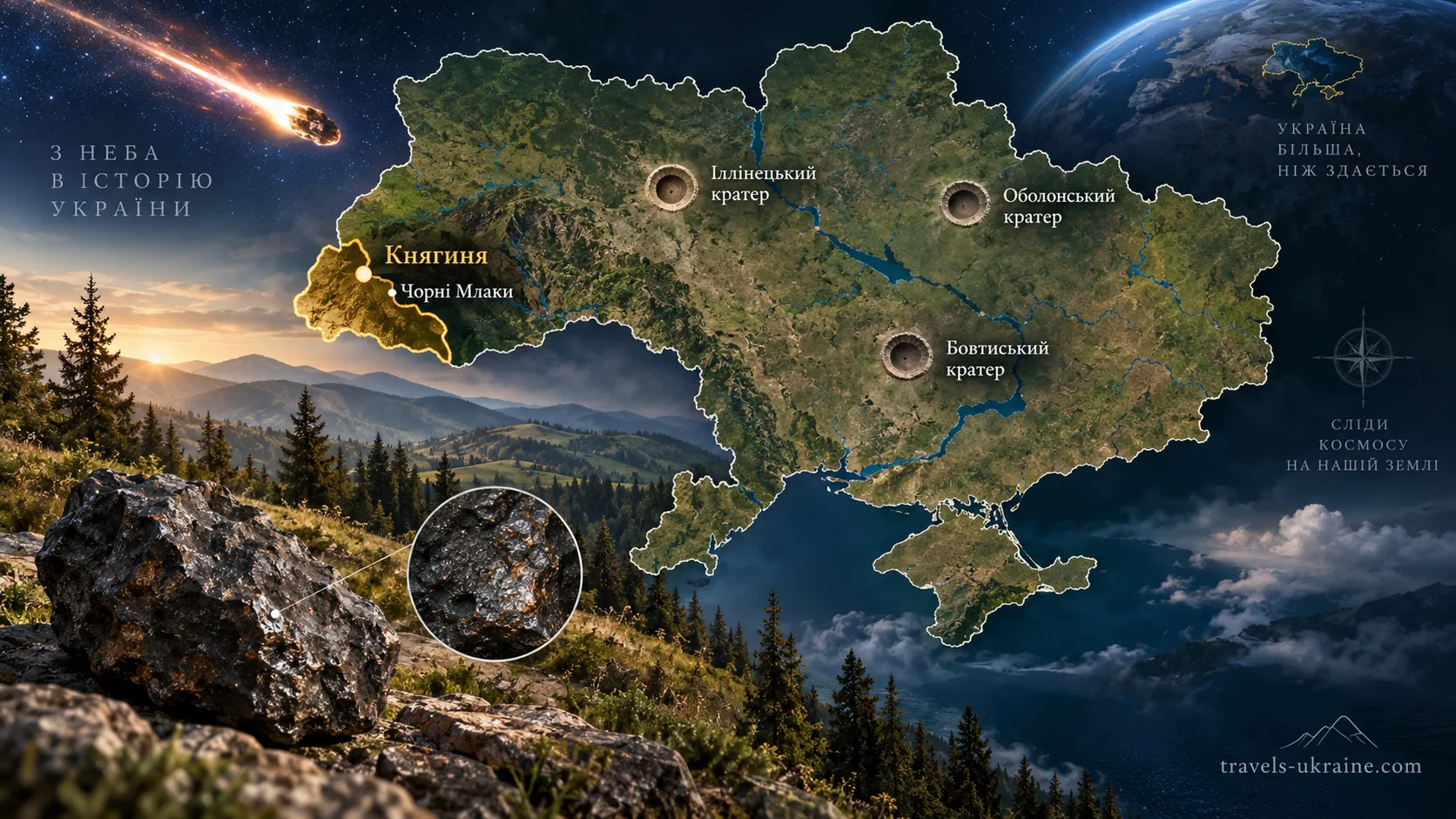
The Knyahinya meteorite is far from the only cosmic object whose traces are known in Ukraine. Documented meteorite falls have been recorded in various regions, while much older structures are preserved in deeper geological layers—enormous craters formed by impacts from cosmic bodies millions of years ago.
But it is important here to distinguish between two entirely different phenomena. A meteorite fall and a meteorite crater are not the same thing. «Knyahinya» is remarkable because people witnessed its fall, collected fragments afterward, and the largest of them has survived to this day. Ukraine’s ancient astroblemes tell an entirely different story—of impacts so old that usually nothing remains of the cosmic body itself.
Why There Is No Giant Meteorite Crater in Chorni Mlaky
After hearing about an almost 280-kilogram fragment, it is easy to imagine that a tourist in Chorni Mlaky should see a gigantic crater. In fact, there is no such crater here. The Knyahinya cosmic body broke apart into a large number of separate stones as it passed through the atmosphere. They created a broad fall zone, while the largest fragment penetrated approximately two metres into the ground. This is a substantial local pit, but it is nothing like the geological crater formed when a much larger body strikes at cosmic speed.
Thus, the tourist appeal of Chorni Mlaky lies not in a spectacular circular crater, but in the fact that it is the precisely documented site of one of the best-known meteorite falls of the 19th century.
The Illintsi Crater—Evidence of an Impact Hundreds of Millions of Years Old
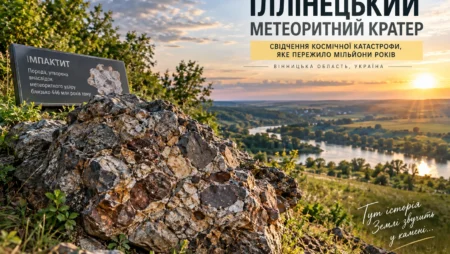
A completely different example can be found in Vinnytsia region. The Illintsi astrobleme is one of Ukraine’s best-known ancient meteorite craters. The current international database of impact structures estimates its age at approximately 445,8 ± 0,8 million years. The original crater was several kilometres in diameter, but erosion has almost completely altered its appearance over hundreds of millions of years.
Today, a tourist will not see a perfect circular bowl here like those in photographs of lunar craters. The ancient cosmic impact is evidenced by the geological structure and impactites—rocks altered by the extreme temperatures and pressure of the collision. Interestingly, people used these rocks long before they understood their cosmic origin. The Encyclopedia of Modern Ukraine notes that the impactites of the Illintsi crater were quarried for making hand-operated millstones as early as antiquity.
The Boltysh Crater—24 Kilometres of Hidden Cosmic History
An even larger trace lies in what is now Kirovohrad region—the Boltysh impact crater. The international database of meteorite structures gives it a diameter of about 24 km and an age of approximately 65.17 ± 0.64 million years. This is a structure on an entirely different scale from the site of the Knyahinya fall. Yet seeing the Boltysh crater as a huge circle in the landscape is also difficult: it is concealed beneath younger geological deposits. Its existence was established not by a striking visible depression, but through geology, drilling, and the study of rocks.
The Obolon Crater—Another Hidden Astrobleme
The Obolon impact structure is known in Poltava region. Its diameter is estimated at approximately 20 km, and its age at about 169 ± 7 million years. Like the Boltysh crater, it does not currently appear at the surface as an obvious meteorite bowl. Overall, the Encyclopedia of Modern Ukraine describes seven known astroblemes of the Ukrainian Shield: Illintsi, Boltysh, Obolon, Rotmistrivka, Terny, Zelenyi Hai, and Bililivka, which is also found under the name «Zapadnaya» in international catalogues.
But Ukraine Has More Than Ancient Craters
Many meteorites found or observed in the territory of present-day Ukraine are registered in the international Meteoritical Bulletin database. Some of them are witnessed falls—events that people saw directly. For example, in 1852, in Transcarpathia, the Borkut meteorite fell, with a total known mass of approximately 7 kg. In 1946, the Krymka meteorite fell in Mykolaiv Oblast, yielding approximately 50 kg of collected material. Other Ukrainian meteorites include Kuleschovka, Kagarlyk, Kukschin, Zvonkov, and others.
Against this background, «Knyahinya» stands out very clearly: the international catalogue gives it about 500 kg of recovered material. That is an order of magnitude more than many other documented Ukrainian falls.
So What Makes «Knyahinya» Special among Ukraine’s Cosmic Traces?
The Illintsi, Bovtyshka, and Obolon craters are far larger than the event of 1866. But they are so ancient that no one witnessed their formation, and the meteorites themselves disappeared long ago or became part of rocks altered by the impact. The case of the Knyahinya meteorite is almost the opposite:
- its fall was witnessed by people;
- the exact date is known — June 9, 1866;
- historical accounts and a drawing of the celestial phenomenon have survived;
- hundreds of fragments were collected after the fall;
- the specific location where the largest stone was found is known;
- the main fragment, weighing nearly 280 kg, has survived to the present day;
- it can be seen in a major European museum;
- meteorite samples are still used in scientific research.
And that is precisely what makes «Knyahinya» special. Ukraine has much larger traces of cosmic catastrophes, but there are few places where one can trace such a clear line from the specific day of the fall, through a specific Carpathian clearing, to a specific stone that now lies in a museum display case. So Chorni Mlaky is not Ukraine’s largest meteorite crater—and, in the geological sense, it is not a crater at all. Its value is different: here, the history of space ceases to be measured in hundreds of millions of years and becomes almost human, with a date, eyewitnesses, the name of the person who found the fragment, and a route that tourists can walk today.
An Unanswered Question: Why Must We Look Abroad for Our Cosmic History?
When working on the story of the Knyahinya meteorite, it is difficult to escape one question. A fragment weighing nearly 280 kilograms fell in the Carpathians and was found in the Chorni Mlaky tract; it was named after the Zakarpattia village of Knyahinya—but to see this stone with your own eyes today, you have to travel to the Natural History Museum in Vienna. There, «Knyahinya» occupies a place of honor at the center of one of the world’s best-known meteorite exhibitions. The Austrian museum does not conceal the exhibit’s origin: its official description explicitly states that the meteorite fell in the Ukrainian Carpathians. The nearly 300-kilogram stone was the largest known stony meteorite for decades and remains one of the most prominent objects in the museum hall today.
Historically speaking, the situation is more complex than it may seem today. In 1866, Transcarpathia was not part of modern-day Ukraine, state borders were different, and Vienna was one of the empire’s main scientific centers. Therefore, it would be inaccurate to simply say that the meteorite was once «stolen from Ukraine.» The history of nineteenth-century museum collections is far more complex. But that does not make the other question go away: why does the very territory that gave the world’s scientific community such a famous meteorite have almost no modern museum history of its own about it today?
In Chorni Mlaky, you can walk to the place where the main fragment was found. You can stand on the same Carpathian clearing where the cosmic stone was discovered. But the exhibit itself is not here. Nor is there a major modern center where tourists could see a full-size replica of the meteorite, a map of the fall area, historical documents, a reconstruction of the stone rain, or the results of scientific research. So what is it—negligence or indifference?
And «Knyahinya» Is Not the Only Example
A similar thought arises when reading about the Illintsi meteorite crater in Vinnytsia region. During research into its impactites, an exceptionally large agate was found. In materials from a scientific conference at Lviv National University, this discovery is described as the world’s largest agate secretion, measuring approximately 25 × 35 cm, preserved in the collection of the Museum of Natural History in Berlin. And once again, the same feeling emerges. Ukraine is home to one of Europe’s most fascinating ancient meteorite craters, as well as impact diamonds, unique rocks, and a huge agate—but some of the best-known material evidence of this history must be sought far from where it originated.
Perhaps the main question is not even whether all such finds should physically return to the places where they were once discovered. Museum collections were formed over centuries; objects were bought, sold, donated, and exchanged between scientific institutions, while state borders changed repeatedly during that time. Major international museums have also done a great deal for these objects. The Vienna museum did not merely preserve «Knyahinya»—it made it accessible to generations of researchers and continues to present it among the most important meteorites in its collection. It was precisely such old scientific collections that made research possible, the results of which we still use today. But that does not prevent us from asking another question: why does Ukraine still make so little use of its own natural heritage?
Chorni Mlaky Today: What Tourists Will See and How to Reach the Fall Site
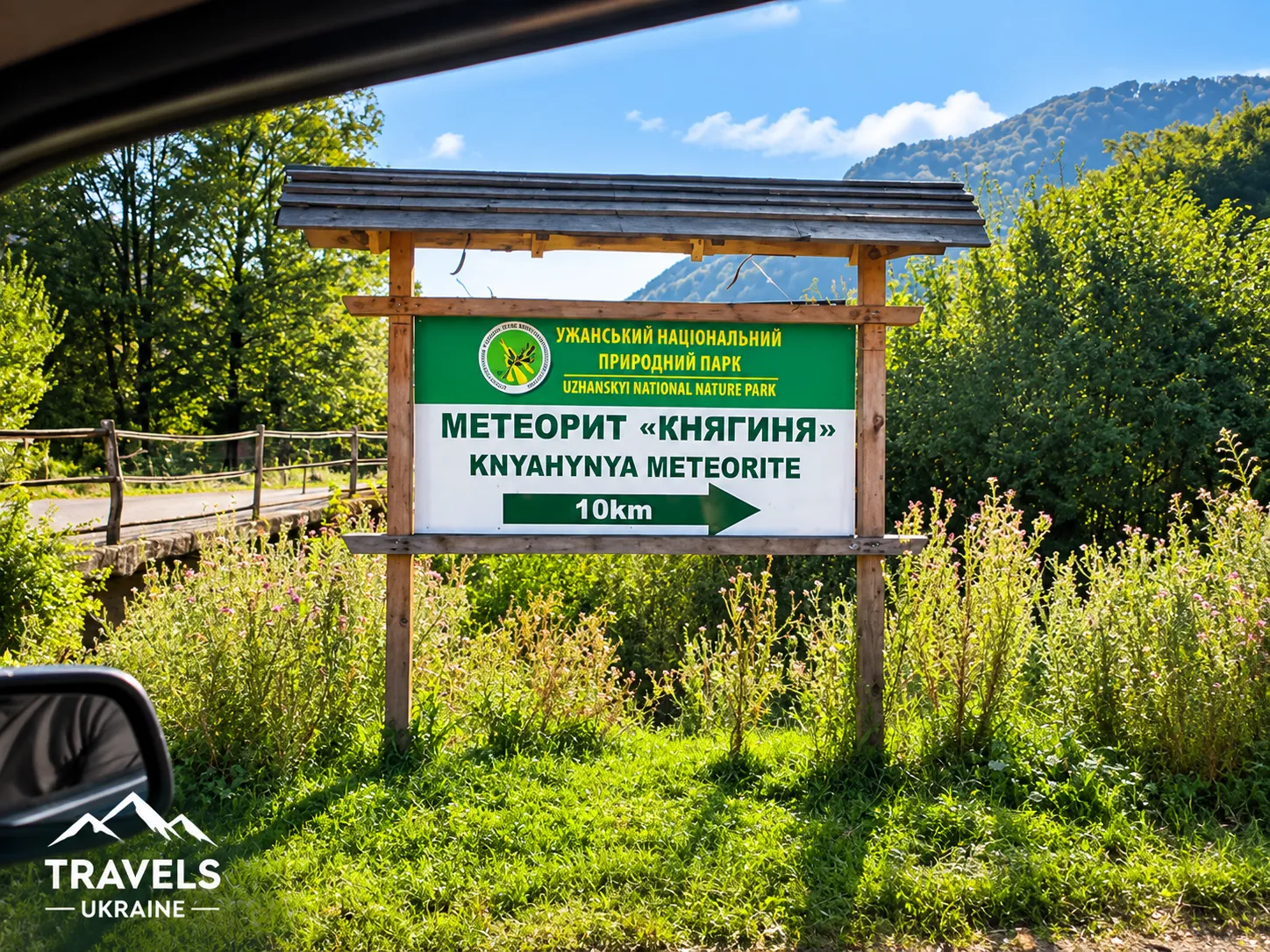
After stories of the stone rain, the 280-kilogram fragment, and the museum display case in Vienna, the Chorni Mlaky tract may seem like a place where tourists will find a huge crater or at least a piece of meteorite in the forest. In reality, everything is much calmer—and that is precisely what gives the location its distinctive atmosphere. Today, Chorni Mlaky is part of Uzhanskyi National Park: beech forests, small mountain meadows, springs, and natural wetlands. No spectacular crater remains here from the cosmic event of 1866. The main fragment has long been in Vienna, while the place where it was found has gradually become part of an ordinary Carpathian landscape.
That is why people come here not for an object they can photograph in five minutes. The main impression is the realization that 160 years ago, on one of these quiet mountain meadows, a nearly 280-kilogram stone from space crashed into the ground. And the official route of Uzhanskyi National Park leads through the forest to the tract, where there are three small meadows. According to the park, it was on the third clearing that a local peasant found the largest fragment of the «Knyahinya» meteorite.
This is the very site where the history of the space rock that later ended up in Vienna’s Natural History Museum began. Today, there is no two-meter-deep excavation preserved from the nineteenth century, so you should not expect an obvious «impact mark.» The landscape has long since changed, and nature has reclaimed the fall site. Yet it is precisely the absence of a tourist attraction that makes Chorni Mlaky unusual. You are standing in an ordinary Carpathian meadow, while its history conceals an event described by European scientists and discussed far beyond Transcarpathia.
The Most Convenient Route: Stuzhytsia—Chorni Mlaky
For tourists who primarily want to see the fall site of the Knyahinya meteorite, the simplest official option begins in the village of Stuzhytsia, where the Millennial Oaks of Zakarpattia grow. Uzhanskyi National Park classifies this hiking route as easy, and its total length is approximately 5 km. The trail starts near the bridge where the Paportnyi stream flows into the Stuzhyčanka. It then crosses a field, enters the forest, and leads through the Paportni tract. Along the way there is a mineral spring and an equipped rest area.
The forest here is also worth attention: beech, sycamore, ash, silver fir, and Norway spruce grow there, along with old trees of impressive size. The trail gradually gains elevation and reaches the three clearings of Chorni Mlaky. After exploring the tract, you do not have to return by the same route. From the first clearing, the trail descends in switchbacks through the beech forest and brings hikers back to Stuzhytsia. Thus, it is not merely a hike «to a point on the map,» but a full forest walk.
The Longer Route from Knyahinya—16 km Through Forests and Meadows
For those who find a short walk insufficient, the park offers the Knyahinya—Chorni Mlaky—Dubovyi Hai Tourist Base route. It is approximately 16 km long and is rated as moderate in difficulty. The route begins in the village of Knyahinya and gradually climbs toward the tract. Along the way, views open up of the Stinka Ridge and Knyahynytsia Mountain. Beyond Chorni Mlaky, the trail passes through meadows, beech, hornbeam-and-birch, and oak forests; from some sections, you can see the Yavirnyk Ridge and Domashynskyi Verkh.
This option is best treated as a full-day hike rather than a short excursion to the meteorite fall site. You will need proper hiking shoes, a supply of water, a snack, and enough time to finish before dark.
Frequently Asked Questions About the Knyahinya Meteorite and Chorni Mlaky
When did the Knyahinya meteorite fall?
The Knyahinya meteorite fell on June 9, 1866. The cosmic body broke apart in the atmosphere, after which a meteorite shower passed over the territory of modern Zakarpattia. The international Meteoritical Bulletin Database records Knyahinya as a confirmed observed fall with a total known mass of approximately 500 kg.
Exactly where did the Knyahinya meteorite fall?
Fragments fell across a large area between the villages of Knyahinya, Stuzhytsia, and Zbui in modern Zakarpattia. The largest fragment was found in the Chorni Mlaky tract on the slope of Stinka Mountain. Uzhanskyi National Park specifies that the find spot was the third of the tract’s three small clearings.
How much did the largest meteorite fragment weigh?
The main fragment weighed approximately 279–280 kg. It was found in Chorni Mlaky by a local peasant, Vasyl Kryvianyk. Vienna museum tourism materials often round its mass up to «nearly 300 kg.»
Where is the main fragment of the Knyahinya meteorite now?
The main fragment is on display at the Natural History Museum in Vienna—Naturhistorisches Museum Wien, in the famous Meteorite Hall No. 5. For a long time, it was considered the largest known stony meteorite in the world.
Is there a large meteorite crater in Chorni Mlaky?
No. «Knyahinya» broke apart in the atmosphere into a large number of fragments, so no enormous geological crater formed in Chorni Mlaky. The largest stone penetrated the soil, but today tourists come here specifically to see the historic site where it was found, not a preserved impact crater.
What does the L/LL5 meteorite classification mean?
«Knyahinya» belongs to the group of ordinary chondrites. The designation L/LL characterizes it as an intermediate type between groups with low and very low contents of metallic iron, while the number 5 indicates the degree of thermal alteration of the material inside the parent asteroid. The international Meteoritical Bulletin Database currently recommends the L/LL5 classification.
Was extraterrestrial life really found in the Knyahinya meteorite?
No. In the nineteenth century, Otto Hahn claimed that he could see the remains of organisms in the meteorite’s microscopic structures, but modern science does not confirm these structures as evidence of extraterrestrial life. Today, this story is interesting primarily as an episode in the early debates about panspermia and the possibility of life beyond Earth.
Is it true that Charles Darwin and Jules Verne were interested in the Knyahinya meteorite?
Otto Hahn did indeed correspond with Charles Darwin about his claims concerning possible organic structures, but Darwin did not confirm them as evidence of extraterrestrial life. As for Jules Verne, Uzhanskyi NNP mentions a theory that he was interested in the site and may have visited the impact location; however, there is no reliable documentary evidence of such a trip. Therefore, this story should properly be presented as an account passed down over time.
How do you get to the Chorni Mlaky tract?
The simplest official route begins in the village of Stuzhytsia. It is about 5 km long, and Uzhanskyi NNP rates it as suitable for beginners. There is also a longer route from the village of Knyahynia through Chorni Mlaky to «Dubovyi Hai» — approximately 16 km with a moderate difficulty level.
Do you need a permit to hike to Chorni Mlaky?
Yes. The official routes to Chorni Mlaky pass through the border zone. Uzhanskyi NNP recommends contacting the park administration in advance to confirm the current permit application procedure. Some border routes may also require an escort from a national park representative.
Chorni Mlaky: Where the Carpathians Met Outer Space
The Knyahynia meteorite left behind far more than several hundred stone fragments. Its fall brought together in a single story a Carpathian village, nineteenth-century scientists, museum collections across Europe, debates about life in the Universe, and an ordinary mountain clearing that can still be reached on foot today. The 280-kilogram stone itself has long since left the tract — it is on display in Vienna. Nor is there a huge crater here that could be seen from a distance. But that is precisely what makes the site special: visitors encounter not a purpose-built attraction, but the real location of a historic event, where nature has almost completely erased the visible traces of what happened in 1866.
To truly appreciate this location, it is worth learning its history before setting out on the route. Then the ordinary beech forest, three small clearings, and a marshy area begin to look entirely different. Somewhere here, after tens of millions of years of traveling through space, a fragment completed its journey — a fragment that would later become one of the world’s best-known stony meteorites.
A trip to Chorni Mlaky is especially well suited to those who enjoy places where nature, history, and science overlap. There is no ticket queue for a single exhibit here; instead, there is a forest trail, the story of a real meteorite fall, and the chance to literally walk to the place where the international scientific biography of «Knyahynia» began.
And if, after the hike, you ever find yourself in Vienna standing before a huge dark stone in the meteorite hall, it will no longer look like just another museum exhibit. It will be easy to imagine the Carpathians, Chorni Mlaky, and that June day when stones from space literally fell on Zakarpattia.

No Comment
You can post first response comment.