
 English
 Українська
 Latviešu
 Lietuvos
 Русский
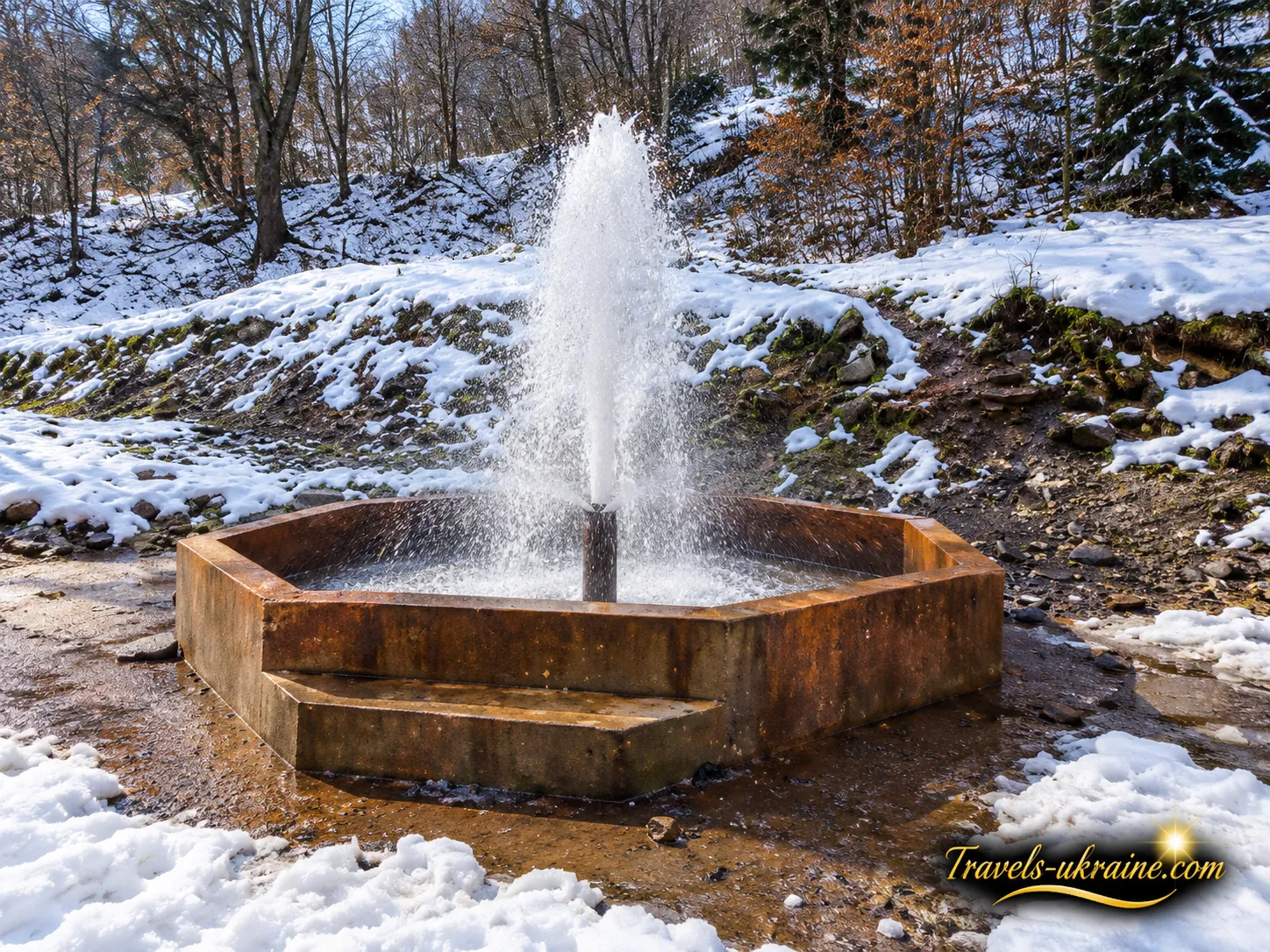
If the word «geyser» makes you think of Iceland, hot steam, and boiling water, Zakarpattia will quickly challenge that image. Near the village of Vuchkove, in the Petrovets tract, a several-metre-high jet of mineral water periodically bursts from the ground. But the water here is not boiling, there are no lava fields around, and instead of clouds of steam, there is a Carpathian forest, a mountain stream, and a clearing coloured in rusty orange tones.
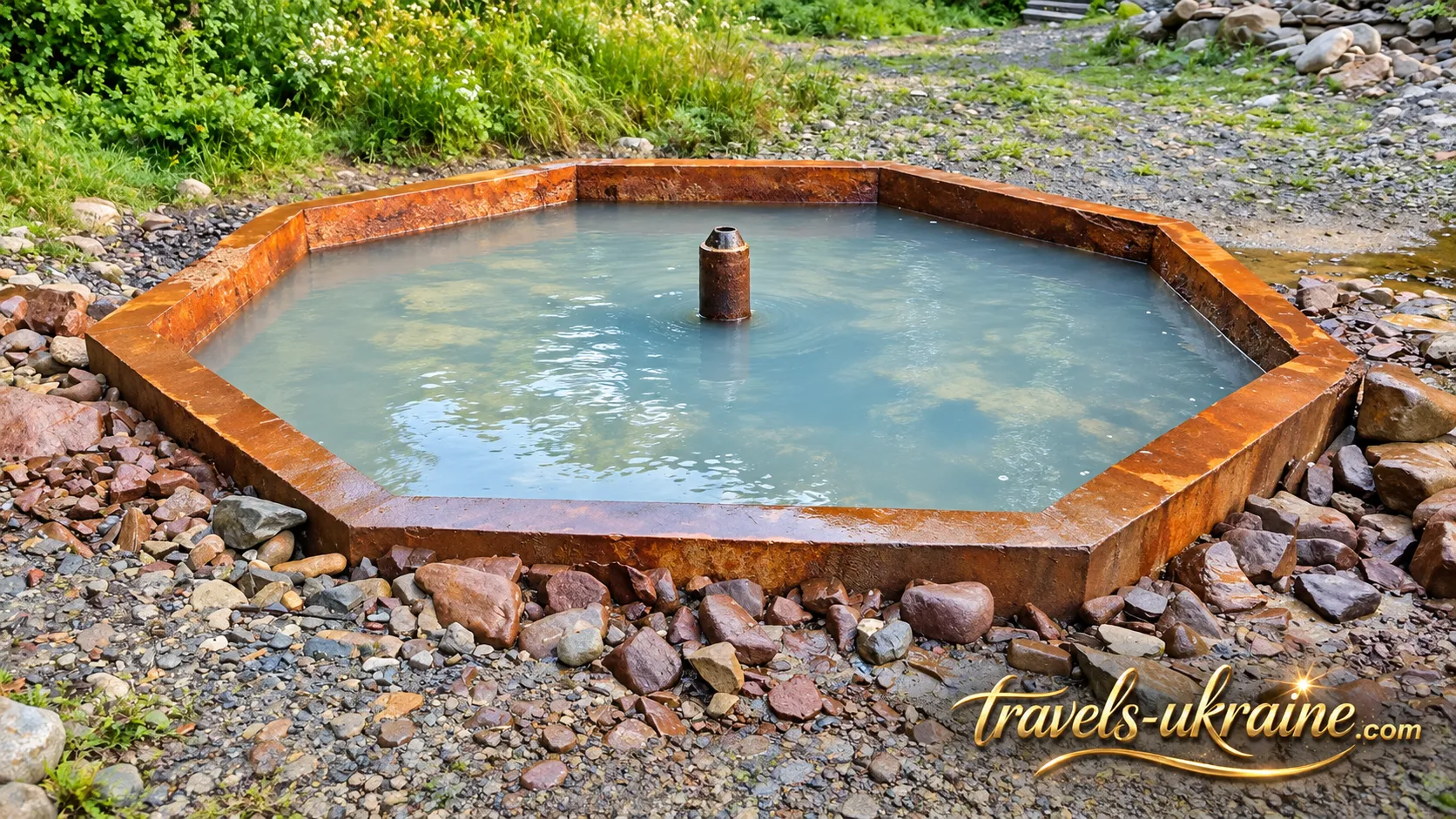
This is the Vuchkivsky Geyser—one of Zakarpattia’s strangest natural and geological sites. At first glance, the place does not even try to impress. There is a pipe, some stones, water, and silence before you. If you arrive between eruptions, it is easy to think: «Is that all?»
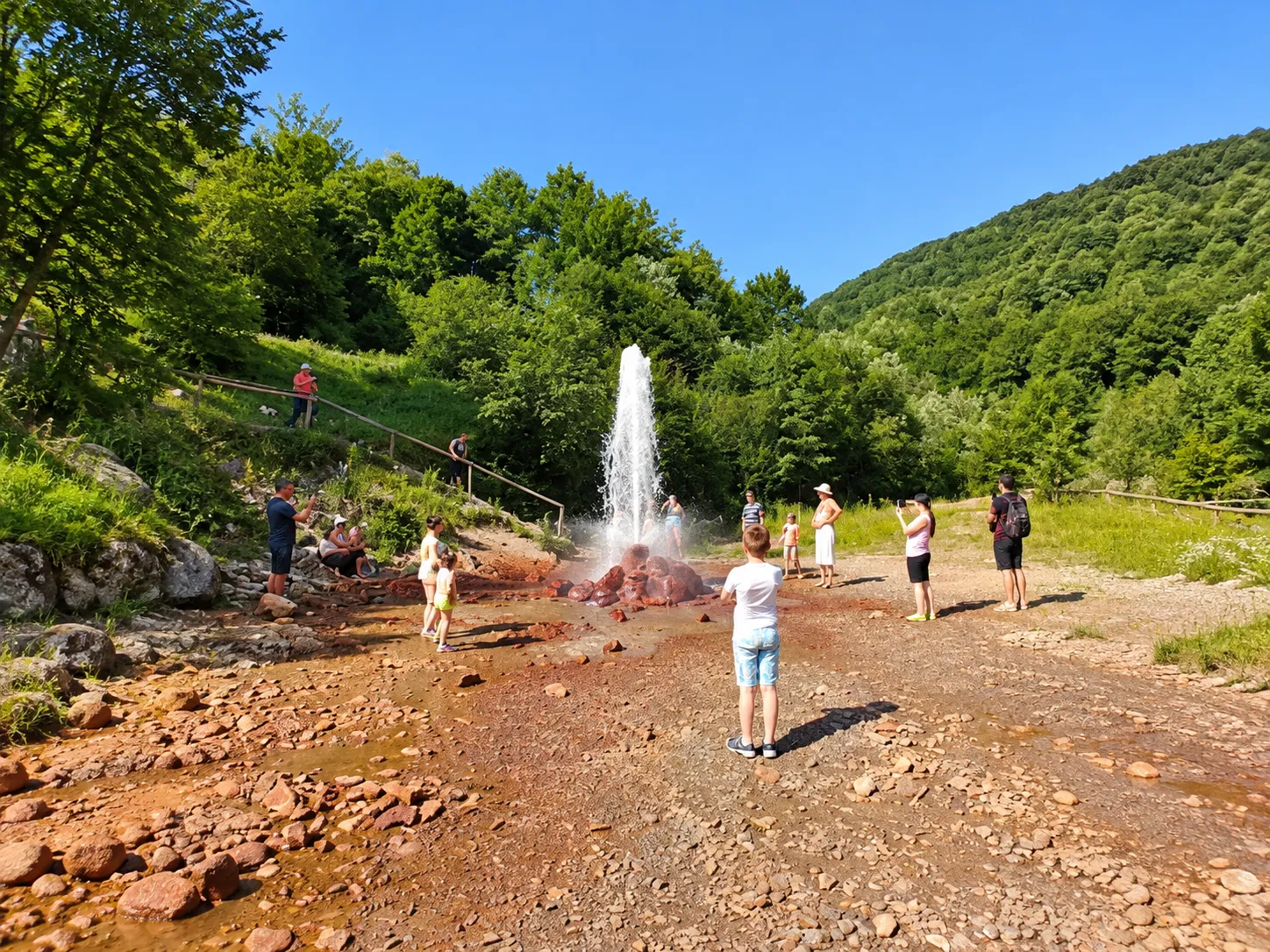
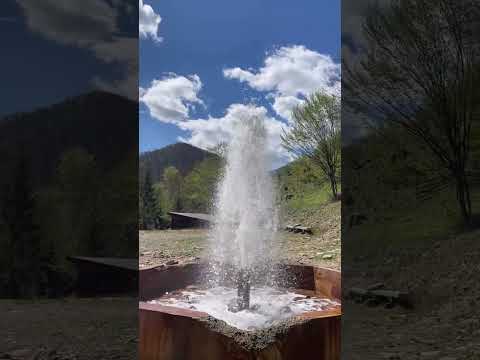
Then a distinctive gurgling begins to rise from the depths. Within a few minutes, the quiet clearing changes: a stream of mineral water bursts from the pipe and can rise approximately 4–6 metres. The active phase lasts about 10 minutes, after which the jet weakens, the water calms again, and the site returns to its usual appearance.
Next time, it may happen again in roughly a few hours. Roughly, that is: there is no schedule nailed to a tree by the entrance of Vuchkivskyi Geyser. The intervals depend on natural conditions, water levels, the season, and the weather. So arriving at 2:03 p.m. and demanding that the Carpathians start the show at 2:05 p.m. is unlikely to work.
The Water Here Is Cold—and That Is the First Mystery
The biggest surprise awaits those accustomed to the classic idea of a geyser. The water in Vuchkove is cold. This is not a hot spring or a fountain of boiling water heated by an active volcano. It is highly mineralised, slightly salty, and rich in iron. That is why the stones, soil, and channel around the water outlet gradually become covered with a distinctive rusty-orange deposit. Even when the geyser itself is silent, the surrounding landscape makes one thing clear: there is definitely something unusual about the spring water here.
Tourist descriptions often call Vuchkove the site of Ukraine’s only mineral-water geyser. The wording is appealing and has long been associated with the location. But when the phenomenon is viewed through geological rather than tourist eyes, the story becomes much more interesting.
The modern jet does not emerge from a picturesque fissure between rocks, but through a metal pipe. Nor is it a decorative structure installed merely for tourists’ convenience. Scientific studies of the area indicate that in the 1960s, a borehole numbered 234 and approximately 20 metres deep was drilled on the right bank of the Petrovets stream. It was this borehole that produced the pulsating outflow of mineral water now known as the Vuchkivsky Geyser.
And here a perfectly logical question arises: if the water comes from a borehole, is not heated by a volcano, and erupts through a pipe, is it really correct to call it a true geyser? The answer cannot be reduced to a simple «yes» or «no». There is natural mineral water, underground pressure, and a pulsating pattern of eruptions—but there is also human intervention, without which the site would look entirely different today. So the most interesting part of Vuchkove begins not when the water rises several metres into the air. It begins with the question: what exactly makes it do this—and where, in the story of the Vuchkivsky Geyser, does nature end and human influence begin?
Geyser or Borehole: What Is Really Bursting from the Ground in Vuchkove?
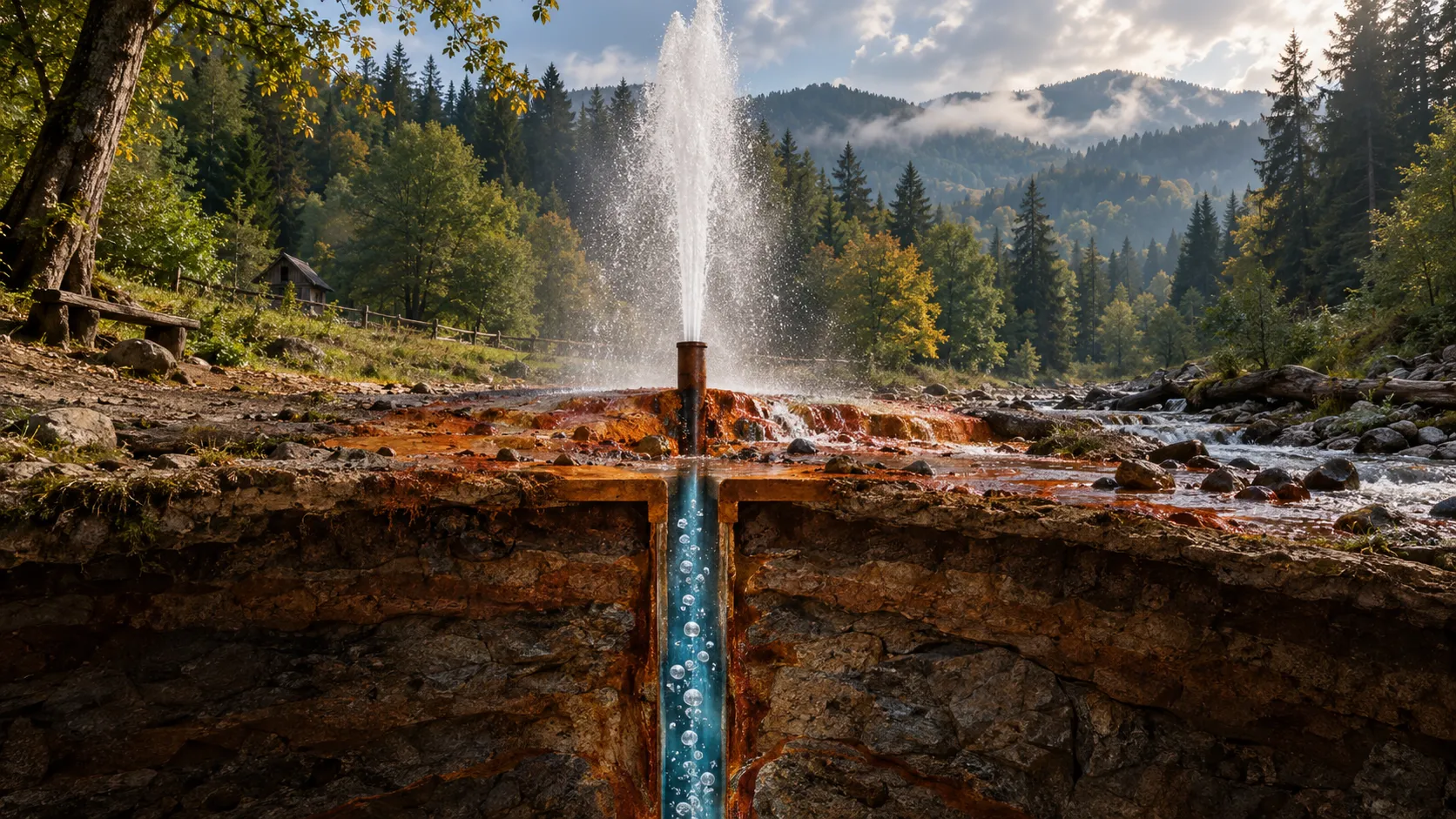
After your first encounter with the mineral geyser, a perfectly natural question arises. If the water is cold, a metal pipe stands where a natural vent should be, and the fountain appeared after a borehole was drilled—could this not be a geyser at all? This is where the story becomes more interesting than the usual tourist claim of «Ukraine’s only geyser». The Vuchkivsky site is indeed very different from the hot geysers of Iceland or Yellowstone. But calling it simply an artificial fountain would also be wrong. The most accurate definition is a cold-water geyser formed in a borehole with mineral carbonated water.
Classic Geysers Run on Heat; Vuchkivsky Does Not
The mechanism of a classic hot geyser is well known. Underground water comes into contact with intensely heated rocks, its temperature rises, some of the water turns into steam, pressure in the underground system increases, and eventually a mixture of hot water and steam bursts out. That is why the word «geyser» usually brings steam, hot water, and volcanic landscapes to mind.
In Vuchkove, everything is different. A study of the springs of the Mizhhirria area found that the water temperature in borehole No. 234 is approximately 12 °C. In other words, it is nowhere near boiling. But the water is highly mineralised and contains dissolved carbon dioxide—CO₂. Such waters can produce another type of geyser: cold-water geysers.
Imagine a Bottle of Mineral Water, Only 20 Metres Deep
The mechanism of a cold-water geyser is easiest to imagine using an ordinary bottle of highly carbonated mineral water. While the bottle is closed, carbon dioxide remains dissolved in the water under pressure. Open the cap, and the pressure drops; the gas begins to form bubbles and escape. If you shake the bottle well beforehand, you usually end up wiping the consequences off the table.
A much more complex but fundamentally similar process occurs in a cold-water geyser. Mineral water saturated with CO₂ enters the borehole. Under pressure, some of the gas remains dissolved. When conditions change and the water rises, the pressure decreases, and carbon dioxide begins to separate from the water in the form of bubbles.
The bubbles rise, expand, and displace some of the water outward. This causes the pressure in the column of water to fall even further, releasing another portion of gas from the solution—and the process rapidly intensifies. At a certain point, the system shifts from quiet accumulation to an active outflow, and the water shoots out of the borehole in a pulsating jet. Once the excess water and gas escape, the pressure drops, the fountain weakens, the borehole fills again, and the cycle starts over. That is why a cold geyser can «erupt» without any boiling at all.
But Has This Exact Mechanism Been Proven for the Vuchkove Geyser?
It is important here not to do what often happens with tourist attractions: take a general scientific mechanism and present it as a detailed study of a specific site. For cold-water geysers in Germany, the United States, and other countries, the mechanism by which CO₂ is released from mineral water as pressure falls has been well studied. The Vuchkove borehole has the features necessary for this process: cold water, significant mineralisation, a high carbon dioxide content, and pulsating eruptions.
However, detailed long-term pressure measurements inside borehole No. 234 that would make it possible to reconstruct its operating cycle second by second were not found in publicly available scientific materials. It is therefore more accurate to say that the behaviour of the Vuchkivsky Geyser corresponds to the mechanism of CO₂-driven cold-water geysers, rather than inventing a separate, unstudied «volcanic system» for it.
So Is It Natural or Artificial?
The most interesting answer is: both natural and created by humans at the same time. The water is natural. Its mineral composition is natural. The carbon dioxide in the groundwater is not injected by tourists before each eruption, either. The geological system supplying the water existed independently of humans. But the route by which the water reaches the surface today is the result of human intervention.
In the 1960s, borehole No. 234, 20 metres deep, was drilled on the right bank of the Petrovets stream. It was after its creation that the pulsating jet appeared, and researchers directly call it a geyser. At first, it operated fairly regularly: approximately once every two hours, it sent water 5–7 metres into the air, and the active phase could last up to ten minutes. In a 2024 scientific paper, the degree of naturalness of this spring is classified as anthropogenic, while its type of development is listed as a «borehole». That probably settles the debate over a «completely natural geyser». Without natural mineral water, there would be no geyser. But without the borehole, it most likely would not exist in its present form either.
And That Does Not Make the Vuchkivsky Geyser Any Less Interesting
It may seem that the word «borehole» makes all the magic disappear. In fact, the opposite is true. Cold-water geysers are extremely rare in their own right. Researchers of the Vuchkove spring specifically note that most of the world’s known cold-water geysers also originated at borehole sites. One of the best-known examples is the Andernach geyser in Germany, where cold water saturated with CO₂ erupts dozens of metres into the air. So the metal pipe in Vuchkove is not proof that this is a «fake tourist attraction». It has effectively become an artificial channel through which a natural underground system reveals itself.
There is another reason not to rush into the romantic version of a completely untouched natural wonder. Over approximately sixty years, people have altered the geyser’s structure several times. The water was diverted to the side, the outlet was rebuilt, and in 2016 it was once again directed vertically, with a concrete basin constructed around it. According to the researchers’ conclusions, these interventions even changed the borehole’s operating regime. The jet used to be more regular. Now the intervals can increase to approximately 3–4 hours, and the water itself has become less salty. Even the process by which mineral deposits form around the outlet has changed.
But the most significant intervention may have occurred even earlier. In the 1990s, the water of the Vuchkivsky Geyser was intended for use in a sanatorium complex. Part of the flow was even diverted to the side. In the end, the sanatorium never became the resort planned for this site. And the story of how a tourist attraction nearly became a source for a major health resort deserves a chapter of its own.
The Sanatorium That Never Was: How People Changed the Vuchkivsky Geyser
If the story of the Vuchkivsky Geyser had developed according to plans from the early 1990s, tourists might today be visiting the Petrovets tract not a pipe amid a Carpathian clearing, but a large sanatorium complex with mineral baths. At that time, local mineral water was to be used for more than just a natural curiosity. Plans called for a sanatorium complex to be built in the tract, and part of the flow from borehole No. 234 was diverted horizontally for the future needs of the health facility. The project never became a full-fledged resort. But the intervention in the borehole remained—and effectively changed the geyser itself.
The Geyser That Began Shooting Sideways Instead of Upward
Originally, after the borehole was drilled in the 1960s, the water erupted vertically. According to researchers’ descriptions, the jet rose approximately 5–7 metres, recurred roughly once every two hours, and lasted up to ten minutes. After the site was rebuilt, part of the water was directed through a horizontal outlet. This is where the tourist image of the geyser became somewhat strange: instead of an impressive fountain shooting upward, the mineral water for a time shot almost sideways, towards the stream. Formally, the natural mechanism had not disappeared—the water and gas continued to come from the borehole. But people changed the route by which they reached the surface. The geyser thus became a good example of how easily even a small geological feature can be altered simply by pointing a pipe slightly the wrong way.
In 2016, the Geyser Regained Its Vertical Jet
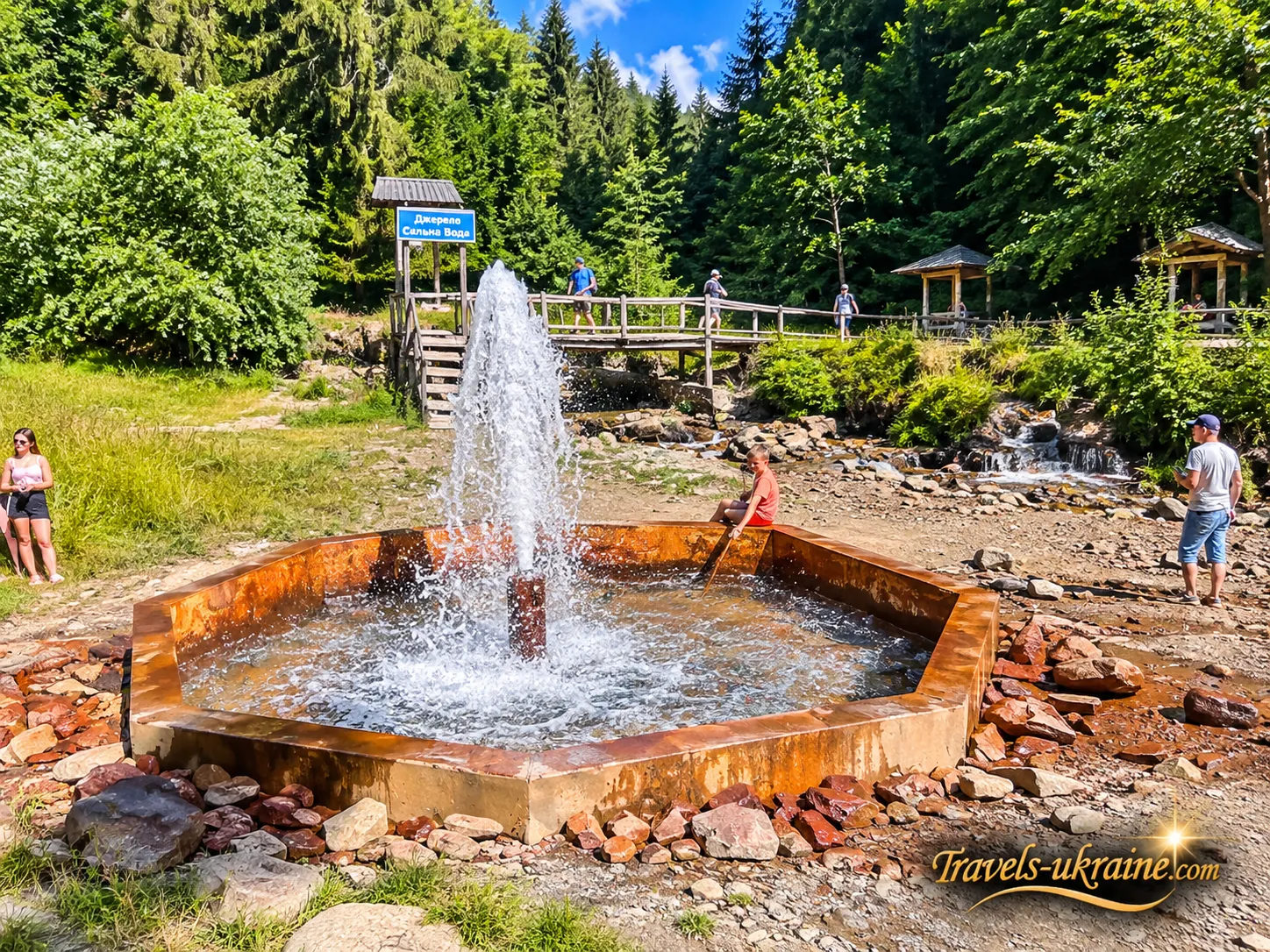
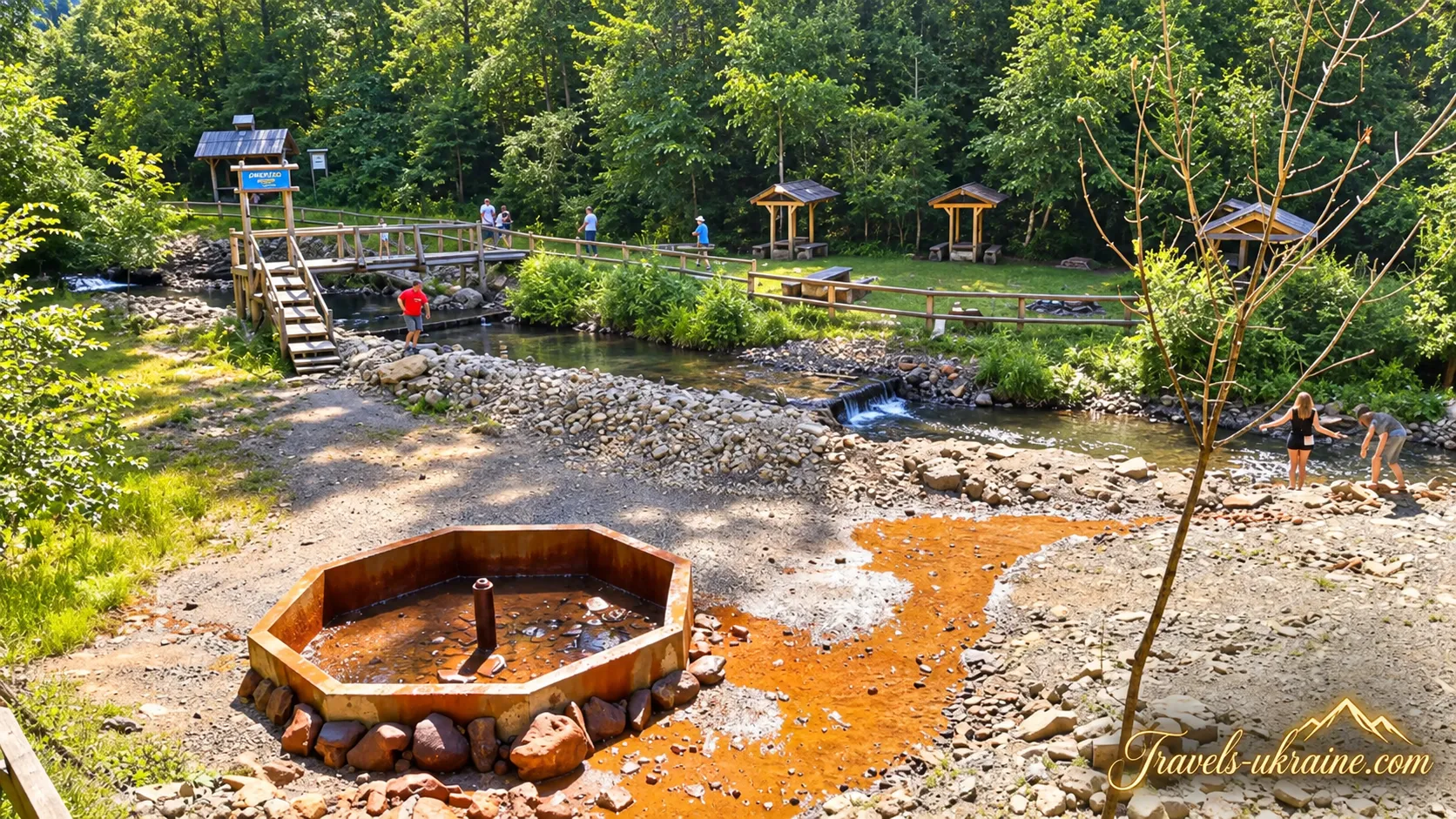
The next major stage came in 2016. The water outlet was once again directed vertically, and a concrete basin was built around the pipe. This is how modern tourists mostly see the Vuchkivsky Geyser. At first glance, everything seems logical: the geyser shoots upward again, it is easier to watch, and the area looks tidier. But for the spring itself, yet another reconstruction was not entirely neutral.
Researchers note that repeated interventions in the well's structure disrupted its original operating regime. While the geyser used to work much more regularly, today the intervals may be approximately 3–4 hours, and the water itself has become noticeably less salty. In other words, the modern Vuchkivsky Geyser is no longer quite the same feature that emerged after the well was drilled in the 1960s.
Along with the «improvements,» what nature had created over years disappeared
The most unfortunate detail of this story concerns not even the jet itself. Around the geyser's artificial outlet, the mineral water gradually left behind travertine deposits—a layered ochre-brown crust that reached approximately 30 centimeters in thickness in places. This was a kind of geological archive of the spring's activity: water reached the surface, the pressure changed, minerals precipitated from the solution, and layer by layer deposits formed around the well.
During the improvement of the site, these formations were destroyed. And, particularly interestingly, they did not return after the new fountain was installed. Researchers link this to changes in the water's mineralization and in the well's pulsation regime. In other words, by changing the geyser's structure, people changed not only the direction of the jet but also the processes taking place around it.
The sanatorium complex for which the water flow was partially altered never became a major tourist or health destination. The well itself, however, survived all the plans, reconstructions, and changes in the direction of the water—and eventually became a tourist attraction in its own right. Today, people come here not for treatments at the sanatorium but to sit in the meadow and wait for the moment when an ordinary-looking pipe suddenly starts gurgling and shoots several meters of mineral water into the air. Perhaps this is a good example of how history sometimes handles plans in its own way: the resort was never built, but its future spring became better known than the unrealized project itself.
And if the sanatorium never managed to bring the Vuchkivsky Geyser under its control, tourists still have to adapt to it. The next «eruption» may begin in an hour, in three—or precisely when you have decided that you have waited long enough.
Why the rocks around the geyser are rusty and what is known about the water in Vuchkove
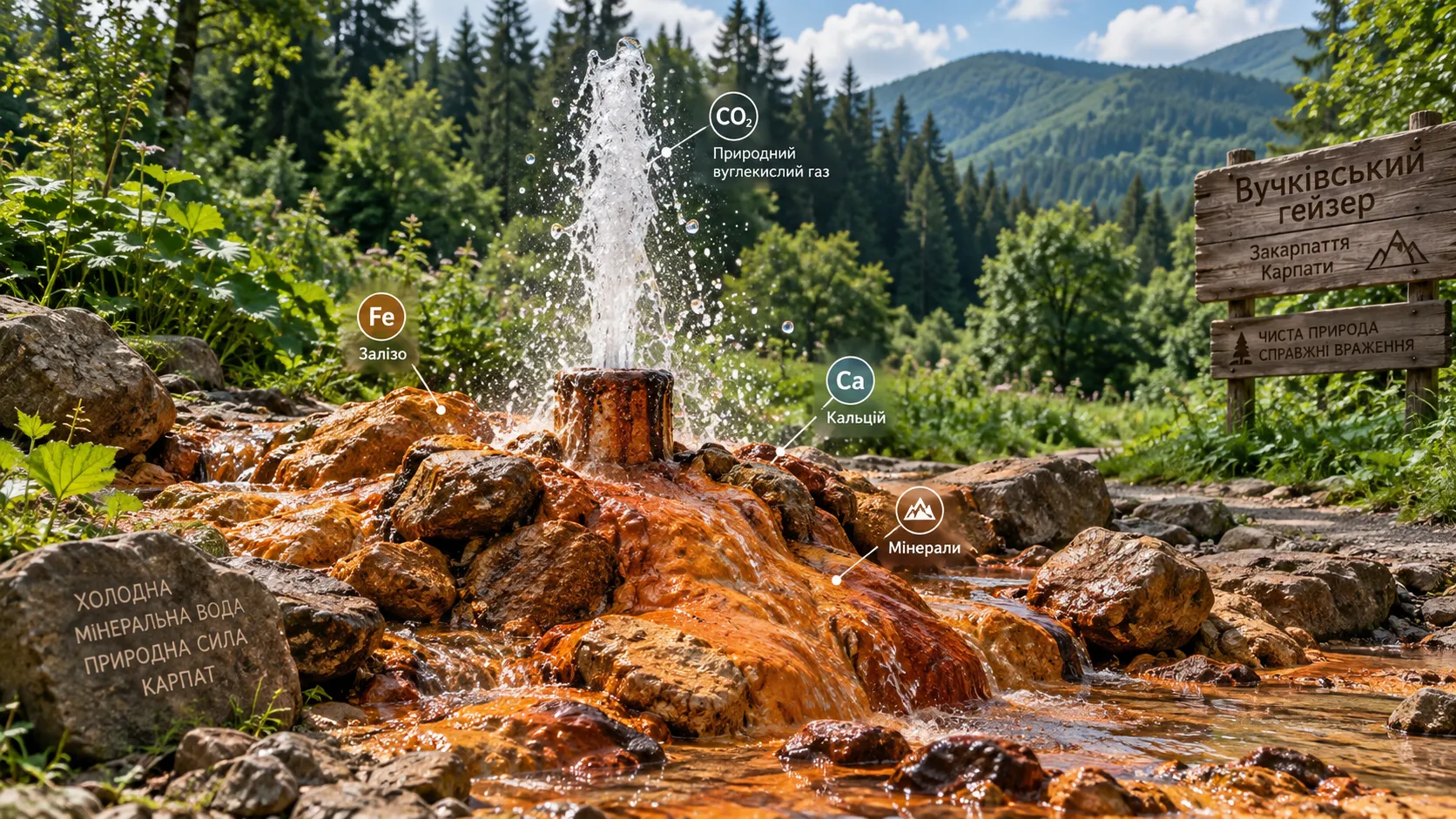
Even if you arrive in Vuchkove when the geyser is silent, the spring is still easy to recognize. The rocks, soil, and surface around the water outlet have distinctive yellow, orange, and brownish-red shades. It looks as though someone had been pouring rusty water here for years. In fact, that is roughly what happened—only without buckets or human involvement.
The Tysa River Basin Water Resources Authority describes the water of the Vuchkivsky Geyser as highly mineralized, salty, and rich, among other things, in iron and calcium compounds. When such water reaches the surface, the pressure, temperature, and contact with the air change. Some dissolved substances begin to precipitate. Iron compounds oxidize and form characteristic yellow-brown and rusty deposits, which gradually stain the rocks around the spring. Thus, the orange surface near the geyser is neither decoration nor the result of paint pollution. It is the trace left behind by the mineral water.
There is, however, an important scientific detail: the chemical composition table for the Vuchkivsky well, published by researchers from Lviv University in 2024, contains no separate current iron reading for well No. 234. The authors used earlier water analyses valid through 2016, while the value for Fe is marked as unavailable. Therefore, we will not claim an exact modern iron concentration.
How mineral-rich is this water?
The overall mineralization in the older laboratory data, however, looks very impressive—about 21.5 g of dissolved substances per liter of water. The following approximate figures have also been reported for the Vuchkivsky well:
- 1200 mg/L of carbon dioxide CO₂;
- 462 mg/L of calcium;
- 42.8 mg/L of magnesium;
- more than 7300 mg/L of sodium and potassium combined;
- nearly 4000 mg/L of bicarbonates;
- pH of about 6.4;
- water temperature of approximately 12 °C.
The figures immediately explain two features of the geyser. First, the water really does have a pronounced mineral, slightly salty taste. Second, the large amount of dissolved CO₂ helps explain why cold water can behave like a geyser. There is a caveat, though: these chemical indicators cannot automatically be considered a current water analysis. Scientists specifically note that the data for Vuchkove are valid through 2016, and that after the fountain was reconstructed, the water became noticeably less salty.
Can you drink the water from the Vuchkivsky Geyser?
This is where old tourist materials create some confusion. Websites and local publications often say that the water can be drunk directly from the jet, call it «healing», and attribute benefits to it for various illnesses. Similar wording even appears in an older publication by the Tysa River Basin Water Resources Authority. But for a modern tourist, I would not turn this recommendation into an instruction.
The reason is simple: we do not have a current sanitary analysis specifically confirming the drinkability of water from well No. 234. In addition, its historical mineralization was very high, its composition changed after the reconstruction, and a natural well is simply not automatically a certified source of drinking water. So tasting the water just because «that is what locals do» is a personal choice for each tourist, but recommending it for regular consumption, let alone treatment, without current laboratory and medical data would be wrong.
What about its «healing properties»?
The mineral waters of the Mizhhiria region do indeed have a long balneological history. In Soymy, Kelechyn, Verkhnii Bystryi, and other places, they were used long before the advent of modern tourism. But there is a major difference between the claims that «the water has a rich mineral composition» and that «this water cures a specific disease». The first can be verified through laboratory analysis. The second requires defined medical indications, dosage, method of use, and supervision by a doctor.
So in Vuchkove, it is best to leave medicine to medicine and the geyser to its real distinction. Even without promises of curing half the body, there is plenty to see here: cold, carbonated mineral water builds up pressure on its own, bursts to the surface, and leaves behind traces of chemical processes that are usually hidden deep underground.
What to see near the Vuchkivsky Geyser and where to go nearby
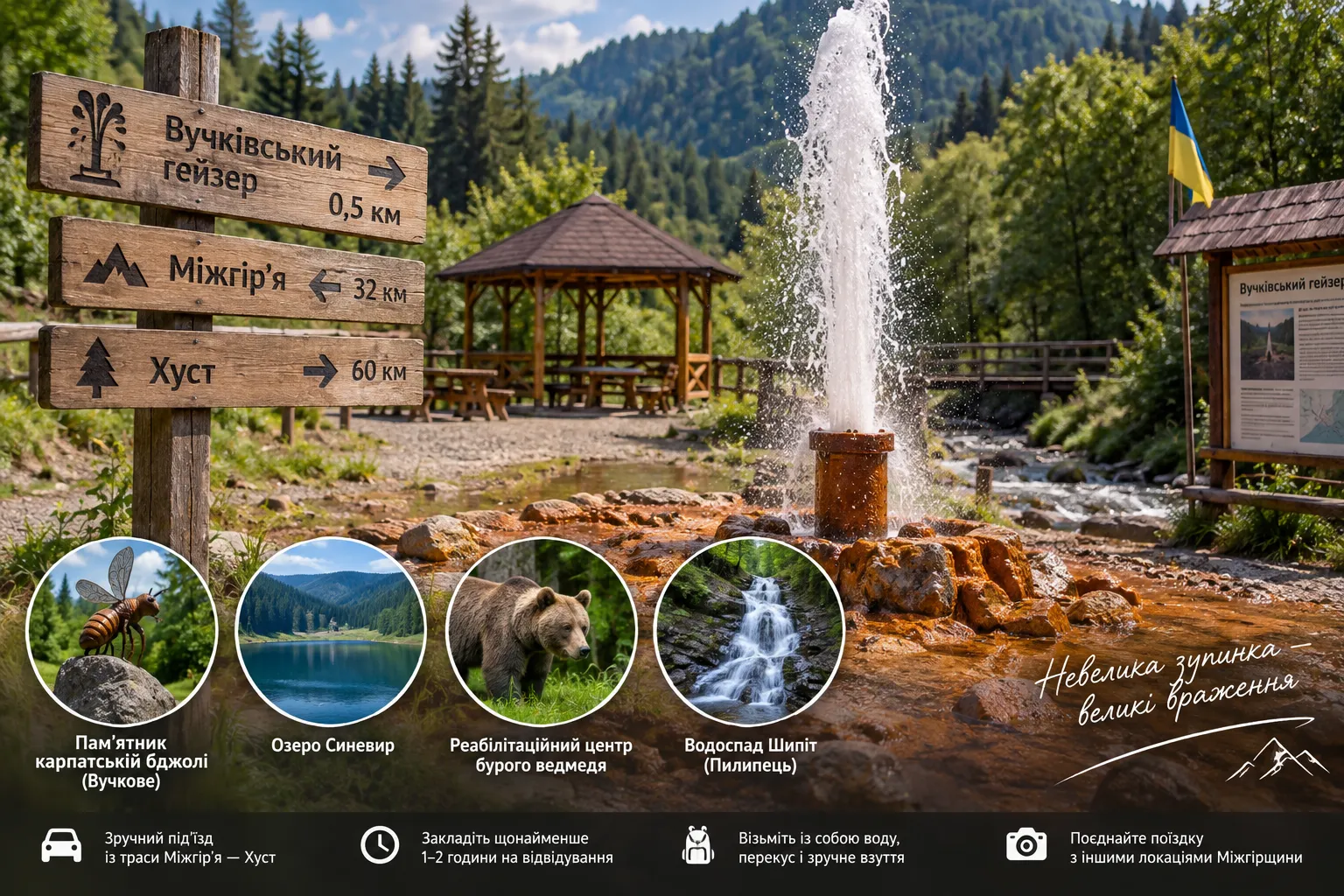
It is best to visit the Vuchkivsky Geyser with realistic expectations. This is not a large tourist complex with a ticket office, guided tours, and a board announcing «the next eruption in 17 minutes.» The main attraction here is a small Carpathian meadow, a mineral spring, the Petrovets stream, and a well that may look completely calm most of the time. That is precisely why the worst-case scenario is to arrive for ten minutes, see a silent pipe, conclude that «the geyser does not work,» and leave.
Do not look for an Icelandic landscape... In photographs, the word «geyser» easily creates inflated expectations. Vuchkove has no enormous crater, clouds of steam, or fenced geothermal field. The modern geyser is primarily an outfitted well outlet amid a wooded Carpathian landscape. Rusty and orange traces of mineral water are clearly visible around it, a mountain stream flows nearby, and an ordinary Carpathian forest begins just a few dozen meters away.
The appearance of the water outlet itself has also changed over the years. The pipes were reconstructed, some of the water was diverted horizontally, and then the jet was directed upward again. Even modern publications sometimes describe it differently. So do not come here expecting an exact reproduction of a photograph you saw online ten years ago.
How to find the Vuchkivsky Geyser
The geyser is located in the village of Vuchkove, Khust Raion, in the Petrovets tract, not far from the road between Mizhhiria and Khust. If you are traveling from the direction of Mizhhiria, one of the most prominent local landmarks is the Carpathian Bee Monument. Near it, turn off the main road toward the Petrovets tract.
From there, a local dirt road begins. Different descriptions of the tourist route indicate approximately 500 meters to 1 kilometer to the meadow near the geyser. The difference depends on exactly where the approach is considered to begin. It is best to download the location to your navigation app in advance. Mobile internet in mountainous areas is not the partner you should trust unreservedly during the final five minutes of the route.
Infrastructure: it is best to rely primarily on yourself
The area around the geyser has been developed in various years: gazebos were installed, the surrounding grounds were arranged, and a small pond was created; some publications also mentioned a seasonal café. But this does not mean you can reliably count on an open food outlet, shop, or other full tourist infrastructure before every trip. So it is best to bring drinking water, snacks, and everything you need for several hours of waiting. And, of course, take your rubbish with you. At a small natural site, a few abandoned bottles and bags stand out much more than they would at a popular resort.
What to see near the Vuchkivsky Geyser
The Vuchkivsky Geyser itself is unlikely to take up an entire day, so it is convenient to include it in a longer route through the Mizhhiria region. There are enough places to visit in the area that even several hours of waiting for the next eruption will not become a wasted part of the trip.
- Carpathian Bee Monument in Vuchkove—an unusual local landmark located literally on the way to the geyser.
- Synevyr Lake—one of Zakarpattia's main natural attractions, easily combined with a trip through Mizhhiria.
- Brown Bear Rehabilitation Center—located in the Synevyr area and a good addition to a nature-focused route.
- Kolochava—a mountain village with museums, old homesteads, and several tourist attractions where you can spend several hours.
- Shypit Waterfall and Pylypets—a good option if the route continues toward the northern part of the Mizhhiria region.
That is why I would view Vuchkove not as a separate «trip to the geyser» but as one of the interesting stops on a route through Zakarpattia. Even if the well decides to remain silent for several hours, the day will certainly not be wasted.
Frequently asked questions about the Vuchkivsky Geyser
Where is the Vuchkivsky Geyser located?
Vuchkivskyi Geyser is located near the village of Vuchkove in Khust Raion, Zakarpattia Oblast, in the Petrovets tract. The most convenient route is the road between Mizhhiria and Khust; in Vuchkove, turn toward the tract. A short section of a local road remains from the main road to the geyser.
Is Vuchkivskyi Geyser really a geyser?
It differs substantially from the classic hot geysers of Iceland or Yellowstone. In Vuchkove, there is cold mineral water saturated with carbon dioxide that is periodically ejected from a borehole. In terms of how it operates, the site is closest to cold-water CO₂ geysers.
Why is the water in Vuchkivskyi Geyser cold?
Because the ejection here is not caused by water boiling due to modern volcanic heat. According to published studies, the water temperature was approximately 12 °C. Mineral water, dissolved CO₂, and pressure changes in the borehole play the main role in the pulsing.
Is Vuchkivskyi Geyser natural or artificial?
The most accurate description is: a natural phenomenon whose expression has been substantially altered by humans. The mineral water, underground gas, and geological system are natural, but the current outlet is connected to borehole No. 234, drilled in the 1960s to a depth of approximately 20 metres. The outlet structure was later rebuilt several more times.
How often does Vuchkivskyi Geyser erupt?
Older descriptions indicate approximately once every two hours, but after the borehole was rebuilt, the pattern became less stable. Modern scientific materials describe intervals of approximately 3–4 hours, but there is no exact schedule. The frequency may depend on natural conditions.
How high does the water rise, and how long does an eruption last?
Historically, the Vuchkivskyi Geyser jet was described as rising approximately 5–7 metres. Some modern descriptions give a height of about 4–6 metres. The active phase may last approximately up to 10 minutes, although the jet does not remain at its maximum height throughout that time.
How can you tell that the geyser is about to erupt?
Before the active phase, you can often hear a characteristic bubbling sound from the pipe, along with increased movement of the water. This means that pressure is changing inside the borehole and an eruption may begin soon. However, it is impossible to determine the exact moment in advance.
Do you have to pay to visit Vuchkivskyi Geyser?
No, visiting Vuchkivskyi Geyser is completely free. It is a natural landmark located in an open area in the Petrovets tract in Zakarpattia. There are no ticket booths, fences, or entrance fees here.
Is it worth visiting Vuchkivskyi Geyser with children?
Yes. For children, it is an exciting way to see natural processes right before their eyes. However, there may be wet and slippery rocks near the spring, a stream flows nearby, and during the active phase the water emerges under considerable pressure. Therefore, young children should be kept away from the pipe itself.
How much time is needed to visit Vuchkivskyi Geyser?
Viewing the site itself takes approximately 20–30 minutes. But if you definitely want to see an active eruption, you should allow at least 1–2 hours of extra time, and sometimes you may have to wait longer. That is why the geyser is best combined with other places in the Mizhhiria area.
Why Vuchkivskyi Geyser is worth a stop
This mineral geyser in Zakarpattia is interesting precisely because it is nothing like what the word «geyser» might lead you to imagine. There is no boiling water, cloud of steam, or volcanic crater here. There is cold mineral water, underground carbon dioxide, a borehole in the Carpathians, and a system that suddenly comes to life from time to time, sending water several metres into the air. This ambiguity is probably what makes the place special. The geyser is both natural and shaped by human involvement: the water, gas, and geological processes existed here on their own, but the modern jet appeared after the borehole was drilled and has changed repeatedly as a result of further intervention.
Over several decades, plans were made to build a sanatorium here, the direction of the water outlet was changed, the old mineral deposits were destroyed, and the vertical jet was restored once again — yet the geyser continued to operate according to its own, decidedly non-tourist schedule. So it is better to come here not just for one spectacular photo, but out of curiosity about the process itself. Sit by the stream, look at the rusty traces of mineral water, listen to the silence — and wait for the moment when bubbling begins to rise from the depths.
You may have to wait longer than you would like. But when an ordinary-looking pipe suddenly turns into a fountain several metres high, it becomes clear why the geyser in Vuchkove has remained one of Zakarpattia’s most unusual destinations for many years. This is not the Carpathian Iceland — and that is precisely why it does not need to be. Vuchkivskyi Geyser has a history of its own: a little geology, a little human intervention, a little chance, and enough character to make a traveller wait by a pipe for several hours — and still say that it was worth it.

No Comment
You can post first response comment.