
 English
 Українська
 Latviešu
 Lietuvos
 Русский
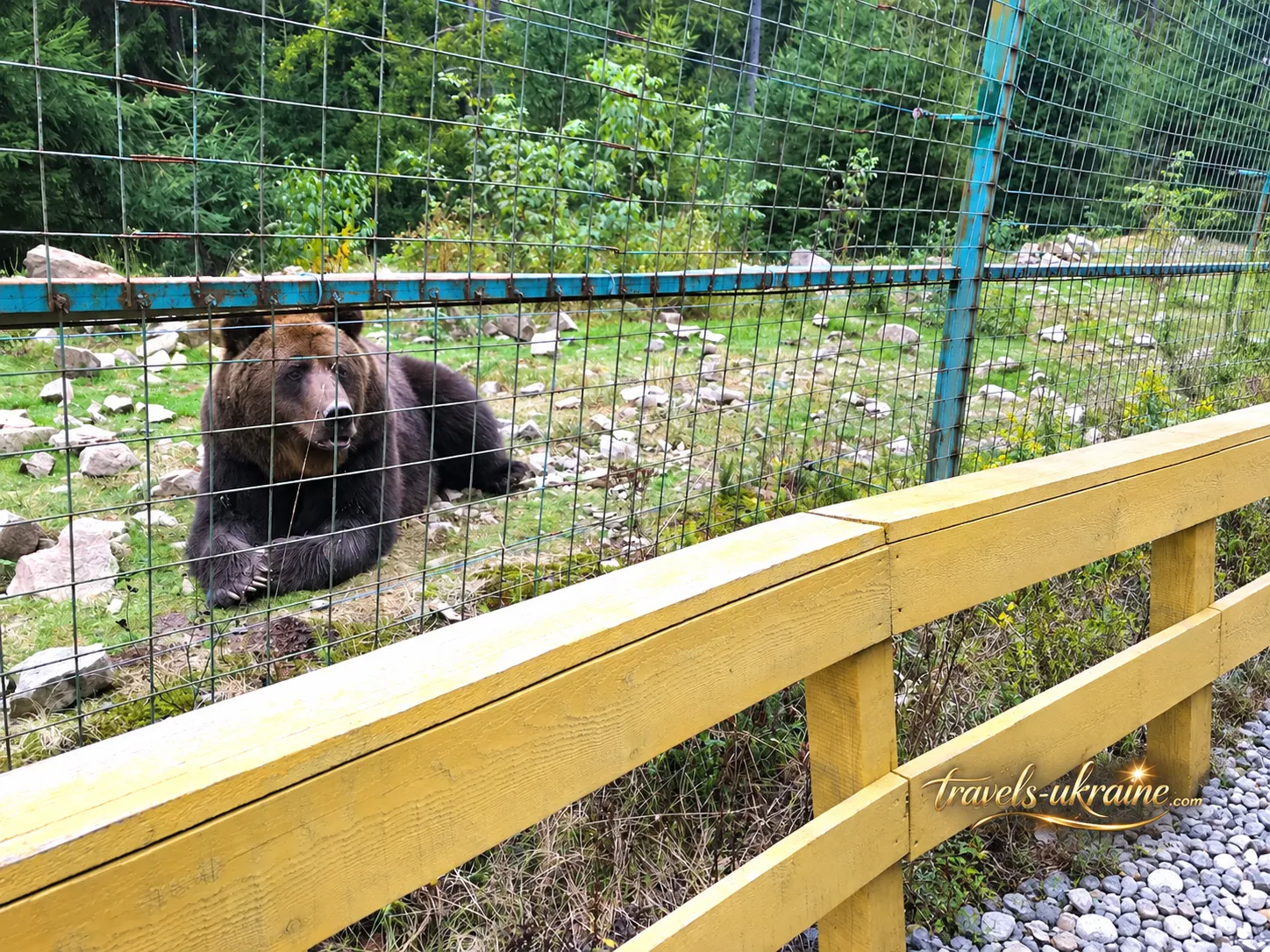
Near Synevyr lies a place that is very easy to mistakenly call a «bear zoo.» Dozens of bears really do live behind the fence, viewing areas have been arranged for visitors, and tourists come here to photograph the animals. But the Brown Bear Rehabilitation Center was created for an entirely different purpose—not to provide the Carpathians with yet another tourist attraction.
Bears do not come here for tourists—they come here because they are being rescued from people.
The center is home to animals that were kept for years in circuses, traveling menageries, restaurant-and-hotel complexes, or private cages that bore little resemblance to a brown bear’s normal life. Some animals are confiscated after being kept illegally or subjected to cruelty. Sometimes a new resident arrives after decades of a life whose main scenery consisted of metal bars and concrete.
It was for such animals that a special rehabilitation center was established in Synevyr National Nature Park in 2011. The location was not chosen by chance: the local climate, terrain, and beech-fir-spruce forests closely match the brown bear’s natural environment.
Today, the center covers around 12 hectares of forest. It has quarantine areas, separate sections for animals of different ages and health conditions, large natural enclosures, pools, and dens. In other words, after a tiny cage, a bear does not move into a slightly larger cage, but into a space where it can walk through the forest, swim, search for food, dig in the earth, and gradually rediscover behaviors it often had no opportunity to express in captivity.
And it is precisely the word «rehabilitation» that matters most here. A new bear is not immediately released among the other residents with a «well, get used to it now.» First, veterinarians examine and treat the animal, perform the necessary procedures, and keep it in quarantine; only afterward is it gradually moved into more natural conditions. For the staff, success does not mean that a bear poses attractively by the fence for a photograph. On the contrary, it matters far more when the bear begins to behave less like a human and more like a bear: finding its own activities, avoiding unnecessary contact, preparing for winter sleep, and even building its own den.
That is why visiting the center as a tourist is also somewhat different from visiting an ordinary zoo. A bear is not obliged to wait for you by the fence. It may lie among the trees, move to another part of the enclosure, or decide that today’s tourist photo session will take place without it. And, when you think about it, the ability to ignore people is one of the best results of its new life.
In this article, we will not count the bears or compile a catalogue of their names. It is much more interesting to explore how an animal that spent many years in captivity is taught to be a bear again, why some residents build their own dens, where they come from to Synevyr, and how tourists can visit the center without turning their curiosity into another source of stress for the animals.
How a Bear Is Taught to Be a Bear Again
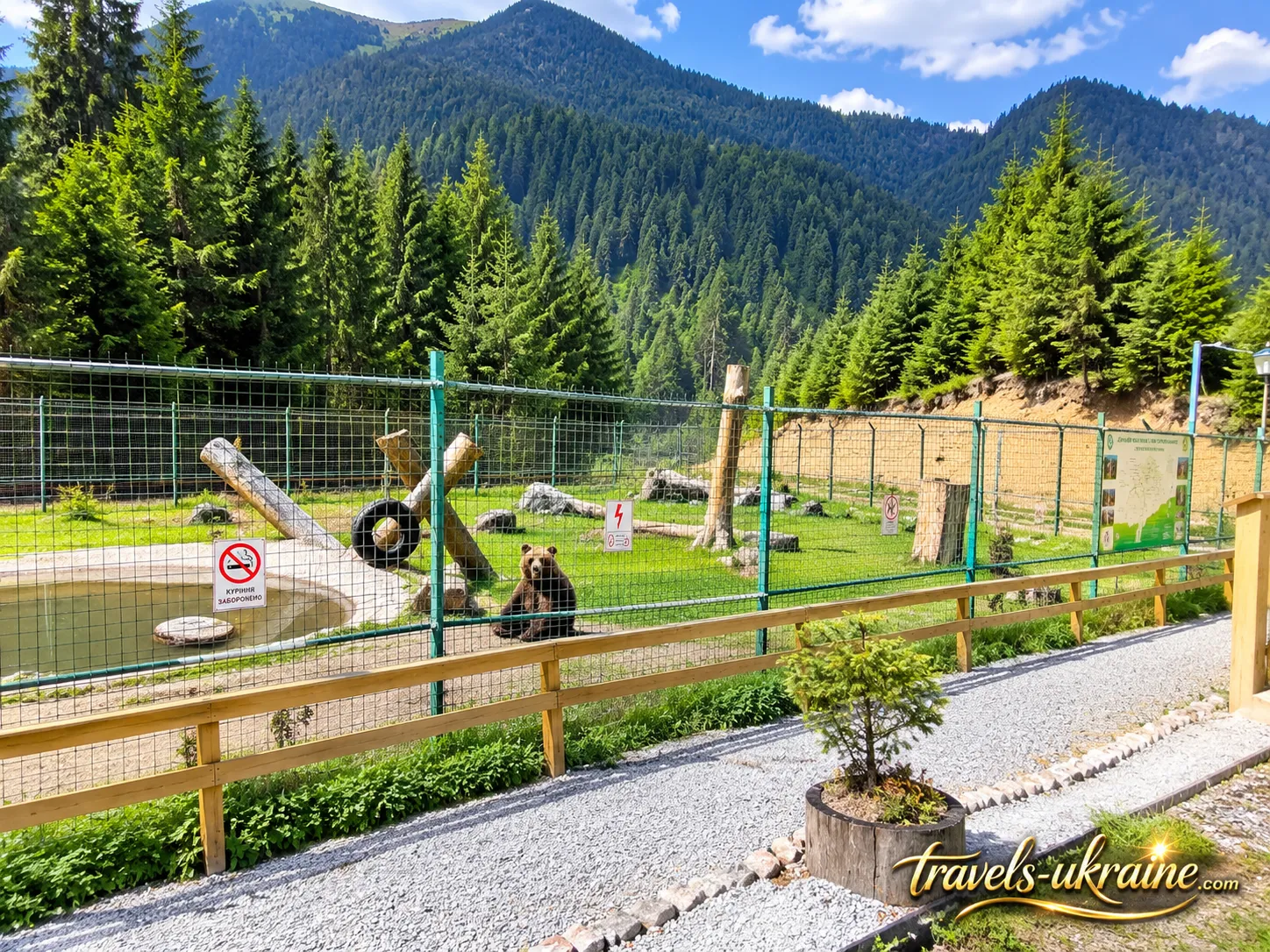
The phrase «bear rehabilitation» sounds a little strange until you consider what an animal can lose after ten or twenty years in a small cage. A bear does not forget that it is a bear, but its behavior gradually adapts to an unnatural life: limited space, the constant presence of people, a monotonous diet, and the absence of opportunities to do what would be an ordinary part of every day in the forest.
So the center’s main task is not to teach the animal tricks or even make it «friendly toward people.» Quite the opposite. Successful rehabilitation means that the bear gradually returns to natural behavior and becomes less and less dependent on contact with humans. It is a long process that begins well before the animal enters a large forest enclosure.
First the Veterinarian, Then the Carpathian Forest
Every new animal arrives in Synevyr with its own story. One bear lived in a circus for years, another in a private menagerie, while a third suffered because of an improper diet or inadequate living conditions. So releasing a new resident straight into twelve hectares of forest would not be rehabilitation, but a rather risky experiment.
After arrival, the bear undergoes a medical examination. Veterinarians assess the animal’s general condition, perform the necessary sanitary procedures, provide vaccinations and vitamin therapy, and treat dental and other problems accumulated during its previous years of life. Dental problems, incidentally, are by no means uncommon. An improper diet, sweets, scraps of human food, and years of inadequate care can have very serious consequences. For some new residents, then, their introduction to the Carpathians begins not with a walk in the forest, but with a veterinary examination. The center also conducts scheduled full medical examinations of its residents in spring and autumn. In other words, an animal’s condition is monitored not only when it first arrives.
Quarantine: A Bear Is Not Introduced to Every Neighbor on the First Day
After the examination, the new resident spends some time in a quarantine enclosure. This is necessary both to monitor its health and to help it gradually adapt to its new surroundings. Separate cages and exercise areas are located nearby. Bears can see and sense the presence of other animals and gradually get used to them, while the center’s staff remain in control of the situation.
After all, a large brown bear is not a dog in a park that can simply be brought up to a new friend with the words «meet each other.» Each animal’s character, sex, age, health, and previous experience matter. Only after specialists are certain that the bear’s condition allows it to move on is it transferred to the main large enclosure, which covers around 12 hectares of forest. Here, the scale of life is entirely different: spruce forest, raspberry bushes, natural streams, pools, slopes, and places where the bear can hide from people.
Why Does a Bear Build Its Own Den When People Have Already Made One?
One of the most interesting signs of successful rehabilitation appears in autumn. The center has artificially prepared dens. Logically, one might assume that a bear would simply enter a ready-made, dry shelter and that the matter of wintering would be settled. But bears have their own opinion on the subject.
Park staff have repeatedly noticed that animals that have adapted well often do not use the ready-made dens, but build their own. They choose the location themselves, dig into the ground, prepare a shelter, and behave as their wild relatives would. This behavior is precisely what delights specialists. A human builds a bear a ready-made house. The bear looks at it, thinks, and decides: «Thank you, I’ll do it myself.» From a service perspective, perhaps a little ungrateful. From a rehabilitation perspective, an excellent result.
Winter Sleep Is One Sign That Natural Instincts Are Returning
Not all bears at the center behave the same way in winter. Some enter a prolonged winter sleep, others only doze periodically, and some may remain active for a significant part of the winter. This is influenced by the weather, physical condition, accumulated fat reserves, and how well a particular animal has adapted after life in captivity. Center specialists consider preparing one’s own den and entering winter sleep important signs that natural instincts are returning.
Interestingly, even the weather can significantly change the residents’ behavior. During severe frosts, more bears retreat into their dens, while a prolonged thaw may wake some of them and bring them back outside. So a tourist who comes in winter and does not see half of the center’s residents may actually be witnessing not a problem, but a very positive rehabilitation outcome.
The next question arises naturally: where do these animals come from, and what happened to them before Synevyr? Every bear here has its own story, and it is often far from a happy one.
From Circuses and Cramped Cages to the Carpathian Forest: The Stories of Synevyr’s Bears
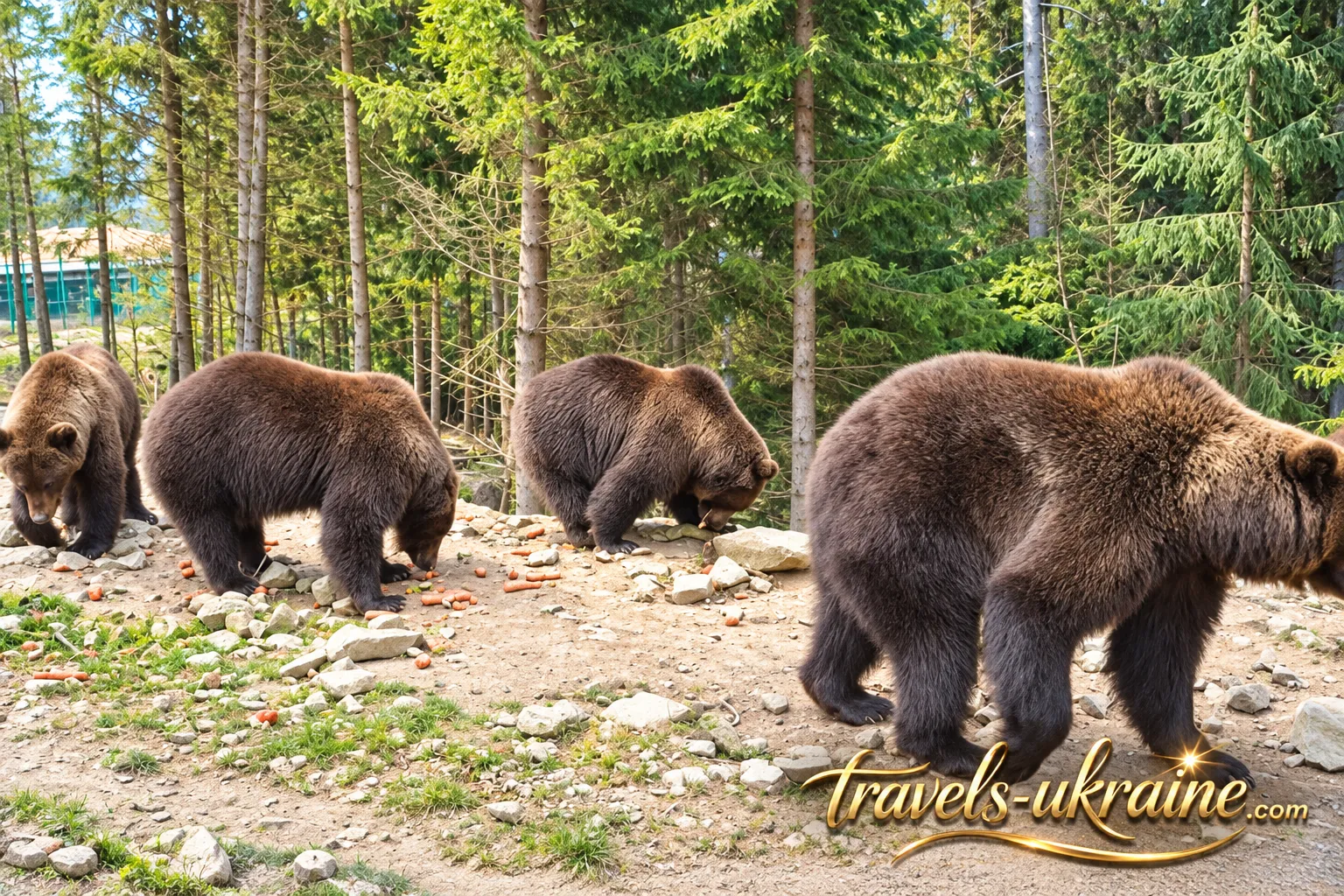
Around three dozen animals live at the Brown Bear Rehabilitation Center, but it would be wrong to see them simply as «30 bears.» Each resident arrived by its own path: a circus, a private menagerie, an entertainment complex, illegal captivity, or a situation in which a wild animal could no longer survive without human help. These stories best explain why the center exists at all. Between a bear that now calmly walks among Carpathian trees and its previous life, there can sometimes be such an abyss that it is hard to believe they concern the same animal.
Potap: The Cage Now Shown to Tourists
Near one of the stops on the center’s route, visitors can see a cramped metal cage. It remains there not as a decoration or to make the tour more dramatic. A bear named Potap was once kept in this cage. According to the official guide of Synevyr National Nature Park, before arriving at the center, Potap was kept at the Bars sports club in Luhansk, where he was used as bait during hunting-dog training.
A collar was put on the bear while he was still young. Potap grew, but the collar remained the same and gradually cut into his body, causing deep wounds. Even without further details, this story clearly explains the difference between «was kept» and «an animal lived.» Formally, the bear had food and a cage. It had almost nothing to do with a normal bear’s life. Today, that same cage serves as a very simple visual exhibit. Comparing its size with the center’s large forest enclosure is enough to understand what a change in conditions means for an animal.
Benia: When a Circus «Trick» Stays with a Bear for a Long Time
The story of another resident, Benia, shows that the consequences of captivity can remain not only in the body, but also in behavior. Benia lived in a traveling circus. According to the rehabilitation center itself, he was forced to «dance» using a heated surface: the animal shifted its paws in response to the pain, and the movements were then presented to spectators as a circus act.
The problem is that after such «training» stops, the memory does not simply disappear. Center staff noticed that when he heard music or saw a person approaching, Benia would nervously shift his paws—repeating behavior that had once been ingrained through fear. The act ended, the circus became part of the past, but the reaction to music remained inside the bear for some time. Such cases clearly show why rehabilitation does not end with veterinary treatment. A wound can be treated much faster than an animal can stop expecting danger from a sound or an approaching person.
Roma and Ania: A Completely Different Rescue Story
But not all of Synevyr’s residents arrive after a circus or years of captivity. In the summer of 2026, the center took in two orphaned bear cubs found without their mother in the forests of Ivano-Frankivsk region. The cubs were named Roma and Ania after the people who found them and helped organize their rescue.
When the cubs were brought to Synevyr, they were frightened and highly dependent on care. The first stage consisted of veterinary monitoring, proper nutrition, and adaptation to an entirely new environment. After 40 days, the park reported important progress: Roma and Ania were moved to a larger quarantine enclosure. They became more active, explored their surroundings with greater confidence, and gradually moved on to the next stage of development.
And here rehabilitation has a different task. If Beniuk or Potap had to be weaned off the effects of prolonged contact with people, then for the little bear cubs it is especially important not to turn rescue into domestication. A cute bear weighing a few kilograms very quickly becomes a several-hundred-kilogram predator. The best thing a person can do for such an animal is help it grow into a bear, not a large household pet.
Not every rescued bear automatically returns to the wild
After hearing about rehabilitation, a natural question arises: if a bear has recovered, why not simply open the gates and release it into the Carpathians? Here, everything is much more complicated. An animal that has lived alongside people for many years may lose important survival skills or become too accustomed to human presence. After release, such a bear may seek out people and populated areas, which is dangerous both for the bear and for people.
Physical health does not always mean readiness for a completely wild life, either. The age, injuries, behavioral traits, and origins of each bear matter. That is why, for many residents, the center’s main goal is not necessarily to return them to completely wild nature, but to provide the most natural and peaceful life possible in semi-free conditions. This is an important distinction. Rehabilitation does not always end with a beautiful scene in which the gates open and a bear runs into the mountains to the sound of music. Sometimes the best possible outcome is a large forest enclosure, its own den, proper food, and the right to live out the rest of its life without circuses, chains, or the need to entertain people.
That is why, when a tourist comes to the center, they see not simply a group of large animals behind a fence. Before them are several dozen entirely different stories about what happened before Synevyr and what has been changed here.
What tourists will see at the brown bear center and how to visit it responsibly
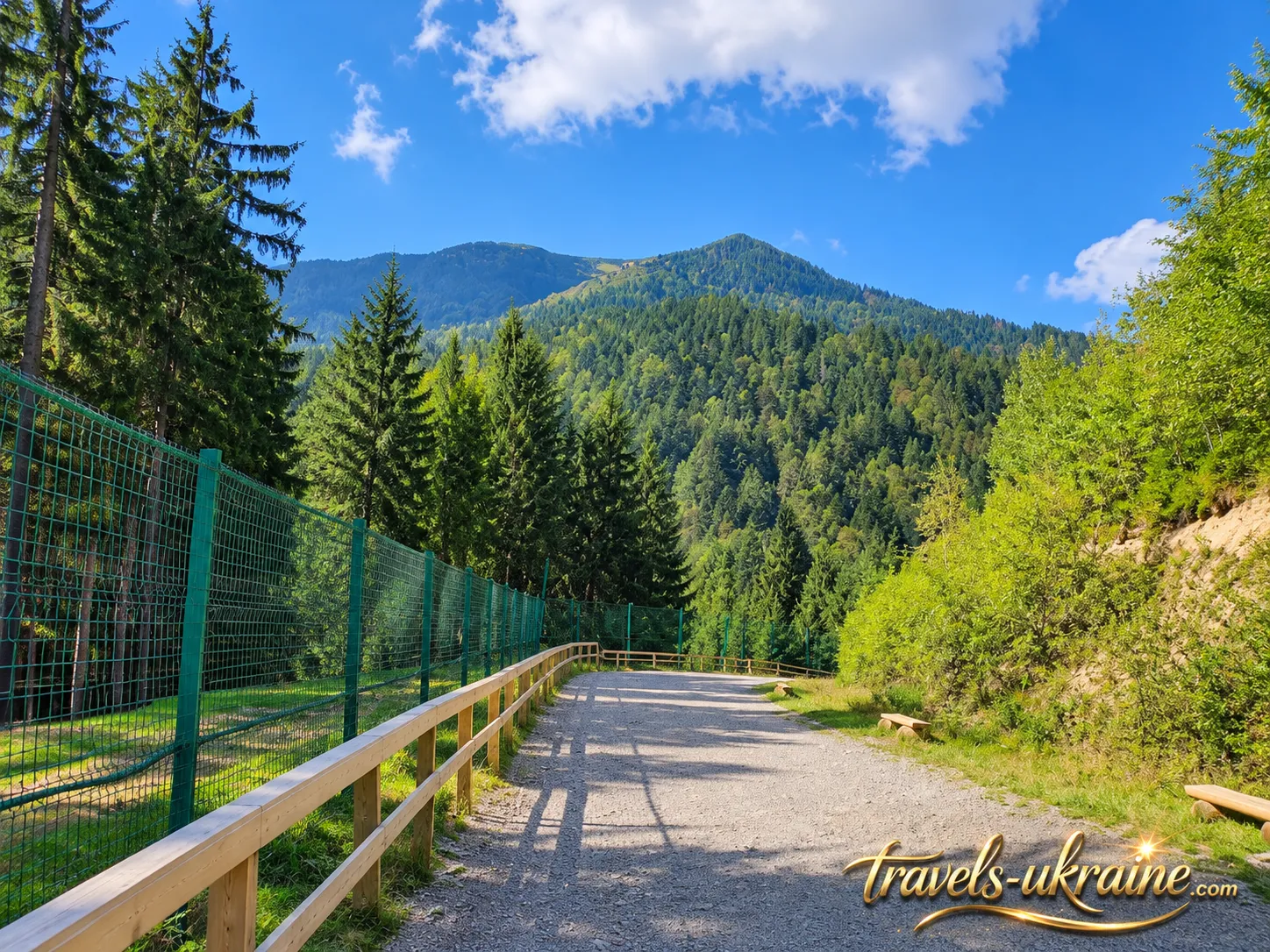
After all the stories about rescued bears, you might imagine that during your visit they will politely stand by the fence and take turns showing tourists the results of their rehabilitation. Fortunately, the Brown Bear Rehabilitation Center works nothing like that. There is no guarantee that you will see all the residents during a single walk. The enclosures cover a vast forested area, and each bear decides where it wants to be: by the water, among the trees, on a slope, near the feeding area, or simply away from human eyes. For tourists, this can sometimes be a little inconvenient. For the bears, it is exactly what the center was created for.
The route through the center is designed so that visitors gradually see not only the animals themselves, but also the difference between their former and present lives. One of the stops is the same cramped cage where Potap was once kept. Beyond it, an entirely different scale unfolds: a large forest enclosure with spruce woodland, raspberry bushes, natural streams, pools, and separate sections. Sometimes this comparison makes a stronger impression than seeing a bear just a few meters away. It is one thing to read the phrase «the animal was kept in inadequate conditions,» and quite another to see the size of the old cage and then look at the hectares of forest it can roam today.
Not all the bears will be near the viewing platform. It is important to know this before your trip. The large enclosure was created for the bears, not for the most convenient possible observation of them. The animals may wander far into the forested part of the grounds, hide among the vegetation, or simply lie somewhere tourists can barely see them. This is especially true of animals that have adapted well and do not seek constant human attention. So a day when you manage to take twenty impressive portraits of a bear is not necessarily «better» than a day when the bear quietly goes about its business far among the trees.
In winter, some residents may not come out to visitors at all
The season also has a major influence on what you will see. During the cold period, some of the center’s residents settle into their dens. The number of such animals depends on the temperature and the particular winter: during frosts, activity drops sharply, while during thaws some bears may come out again. So if the main purpose of your trip is to see as many active bears as possible on the way to Lake Synevyr, the warmer part of the year is more predictable. In winter, it is interesting to observe another side of natural behavior—or, if luck is not on your side, a very convincing absence of bears. Demanding a refund because an animal decided to sleep would be a little unfair. After all, it had not read the tourist schedule.
The most important rule—do not feed the bears or attract their attention
Even if a bear comes closer, sits opposite you, and looks at you as though it last saw food sometime around last Thursday, you must not throw it cookies, bread, fruit, or any other food. Synevyr National Nature Park explicitly states that feeding the bears independently is strictly prohibited. Each animal has its own diet, designed with its health, age, and needs in mind. Additional food from tourists can disrupt the feeding routine, harm the animal’s health, and create the worst habit for rehabilitation: associating the appearance of a person with easy food. In essence, we are trying to wean some of the animals here from precisely this dependence on people.
Another simple piece of advice is not to shout, bang on the fence, or provoke an animal for the sake of a photograph. A bear lying with its back to you is not doing so out of contempt for Zakarpattia’s tourism industry. It simply has the right not to take part in your photo shoot. The most interesting thing here is to observe natural behavior: how an animal moves around the grounds, looks for food, bathes, interacts with other bears, or simply gets on with utterly incomprehensible bear business. The less we interfere with this behavior, the more meaning the word «rehabilitation» has.
It is worth coming here with children—but this is a place for conversation, not a show
For children, the center can be one of the most interesting places near Synevyr. Seeing a large brown bear in real life is entirely different from looking at one on an encyclopedia page. But this is also a wonderful opportunity to explain the difference between a wild animal and a pet, why bears must not be fed, why they ended up at the center, and why an animal needs plenty of space. Instead of simply saying, «Look at that cute little bear,» the trip can easily become a short lesson in responsible attitudes toward wild animals. And that is probably one of the best reasons to bring children here.
Is it worth combining the center with Lake Synevyr?
Yes. This is one of the most logical tourist routes in this part of Zakarpattia. The Brown Bear Rehabilitation Center and Lake Synevyr are located within the same national nature park, so they are easy to combine into one trip. At the same time, the experiences are completely different: at the lake, the main attraction is the Carpathian landscape, while at the center, it is the stories of individual animals and the work of the people trying to restore their normal behavior. I just would not try to rush through both locations in an hour. The Carpathians are much better enjoyed when the itinerary leaves time for more than just a photo beside a sign.
And if, after your visit, you leave with more than just the thought «I saw a bear,» but rather «now I understand a little better why a wild bear should not live in a circus cage,» the center will have accomplished another important part of its work.
Frequently asked questions about the Brown Bear Rehabilitation Center
Where is the Brown Bear Rehabilitation Center located?
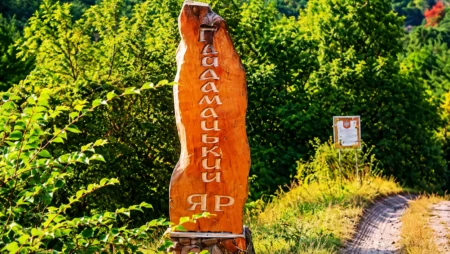
The center is located within Synevyr National Nature Park in Zakarpattia Oblast, along the road toward the village of Synevyrska Polyana and Lake Synevyr. There is a sign for the bear center beside the road, after which part of the route must be covered on foot.
How do you get to the bear center?
The most convenient way is to drive from Mizhhiria toward Synevyr and Synevyrska Polyana. The rehabilitation center is located near the main road, and from the sign to the grounds you need to walk approximately 150 meters uphill along an unpaved road. For navigation, it is best to use Google Maps or another up-to-date mapping service.
What are the bear center’s opening hours?
Tourist services most often indicate visiting hours of approximately 09:00 to 18:00; however, the official Synevyr National Nature Park service page does not publish a separate fixed daily schedule. Before planning a special trip, it is best to confirm the operating hours with the park administration.
How many bears live at the center?
The number of residents changes because the center accepts newly rescued animals. Current materials from Synevyr National Nature Park mention approximately three dozen brown bears. Therefore, figures in older tourist articles may no longer be accurate.
Can you see the bears in winter?
Yes, but in winter some of the animals may be in their dens. Some residents settle into winter sleep, while others only doze periodically, and they may come out again during thaws. If you want to see as many active animals as possible, spring, summer, and early autumn are more predictable.
Can the bears be fed?
No, feeding the bears independently is strictly prohibited. Each animal has its own diet, and outside food can harm its health and teach the bear to associate people with food. If you would like to help the center with food, Synevyr National Nature Park allows you to give vegetables and fruit to the center’s staff—but not to throw them to the animals yourself.
Is it worth visiting the center with children?
Yes. For children, it is a good opportunity to see brown bears in much more natural conditions and understand why wild animals should not live in circus cages or private menageries. It is important to explain the rules in advance: do not feed the animals, shout, or try to attract their attention.
How much time is needed for a visit?
For a leisurely walk along the route, you should plan approximately 45–60 minutes. If you are traveling with children, taking photographs, or the bears are active near the viewing areas, you can easily spend a little longer here.
Are rehabilitated bears released back into the wild?
Rehabilitation helps animals regain their health and natural skills, but that does not mean every resident is automatically released into the Carpathians. Many bears lived alongside people for years, have injuries or behavioral traits that can make independent life in the wild dangerous. For such animals, the center’s large forest enclosure becomes a permanent environment, as close to natural conditions as possible.
Why the Brown Bear Rehabilitation Center Is Worth Visiting
The Brown Bear Rehabilitation Center in Synevyr is one of those tourist attractions where visitors remember not only what they saw, but also the reason this place exists. Yes, people come here to see bears. But within a few minutes, it becomes clear that the main story is not about the chance to photograph a large predator up close. It is about what happens to a wild animal after years in a circus, a cramped cage, or unsuitable conditions—and how much time it takes to give it back even part of a normal life.
That is why the best outcome of a visit may not be a photograph of a bear by the fence. It is much more important to see an animal calmly walking among the trees, swimming, looking for food, or simply choosing to hide from people in the far part of the enclosure. At an ordinary zoo, a tourist may be disappointed if an animal does not come out to the viewing area. Here, it is the opposite: a bear that does not need constant human attention is precisely a sign that the center is moving in the right direction.
This trip works especially well with children. Not as yet another place where you can say, «Look, a bear,» but as an opportunity to explain why a wild animal should not live in a circus cage, why it must not be fed through a fence, and why a large forest enclosure matters more than a good phone photo. And if, after walking around the center, you start looking a little differently at circuses with animals, private menageries, or photographs of bears on chains outside tourist establishments, then this place has fulfilled another important function.
You should come here not only for the bears, but to understand what responsible treatment of wildlife should look like. After visiting the center, you can continue your route to Lake Synevyr, leaving the bears the most valuable gift a tourist can give them—peace and a little more space without human interference.


One Response Comment
You can post first response comment.