
 English
 Українська
 Български
 Hrvatski
 Čeština
 Dansk
Dansk Nederlands
 Eesti
Eesti Suomi
Suomi Français
 Deutsch
 Ελληνικα
 Magyar
 Íslenska
 Italiano
 Latviešu
 Lietuvos
 Polski
 Português
 Română
 Русский
 Српски
 Slovenčina
 Slovenščina
 Español
 Svenska
 Türkçe
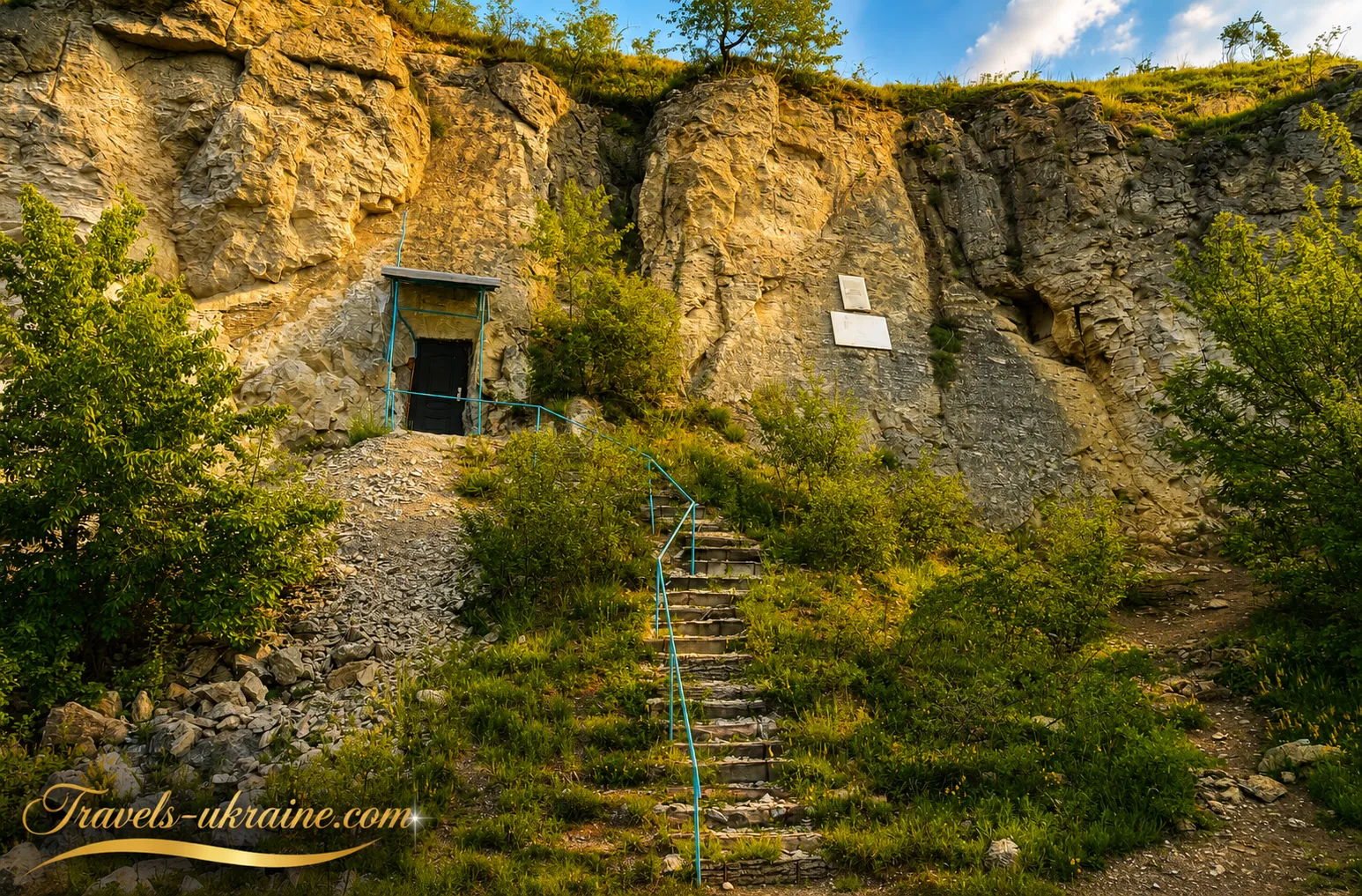
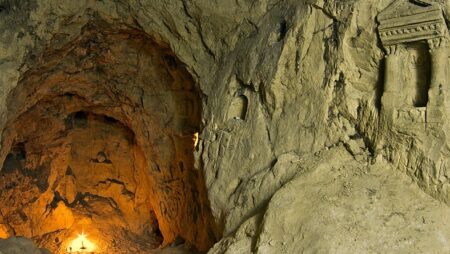
The first beam of a headlamp pulls white, yellowish, and pink crystals from the darkness, along with uneven vaults and passages disappearing between underground chambers. A few more steps—and the familiar world is left far behind. Atlantida Cave reveals itself gradually: it does not show everything at once, but leads travelers through silence, coolness, and bizarre forms created by water within layers of gypsum rock.
Atlantida Karst Cave is located near the village of Zavallia in Kamianets-Podilskyi Raion, on the slope of the Zbruch River valley. It lies within the territory of the Podilski Tovtry National Nature Park and has the status of a geological natural monument of national importance. Its three-tiered structure, branching passages, spacious chambers, and diverse crystal formations have made this cave near Zavallia one of Ukraine’s best-known speleological landmarks.
Atlantida is not a developed underground museum with even paths, handrails, and decorative lighting. Here, visitors must navigate natural terrain, pass through narrow corridors, bend beneath low vaults, and carefully follow the route. That is why an excursion to Atlantida Cave is remembered not as an ordinary sightseeing visit, but as a genuine speleological journey in which every new turn may reveal an unexpected scene.
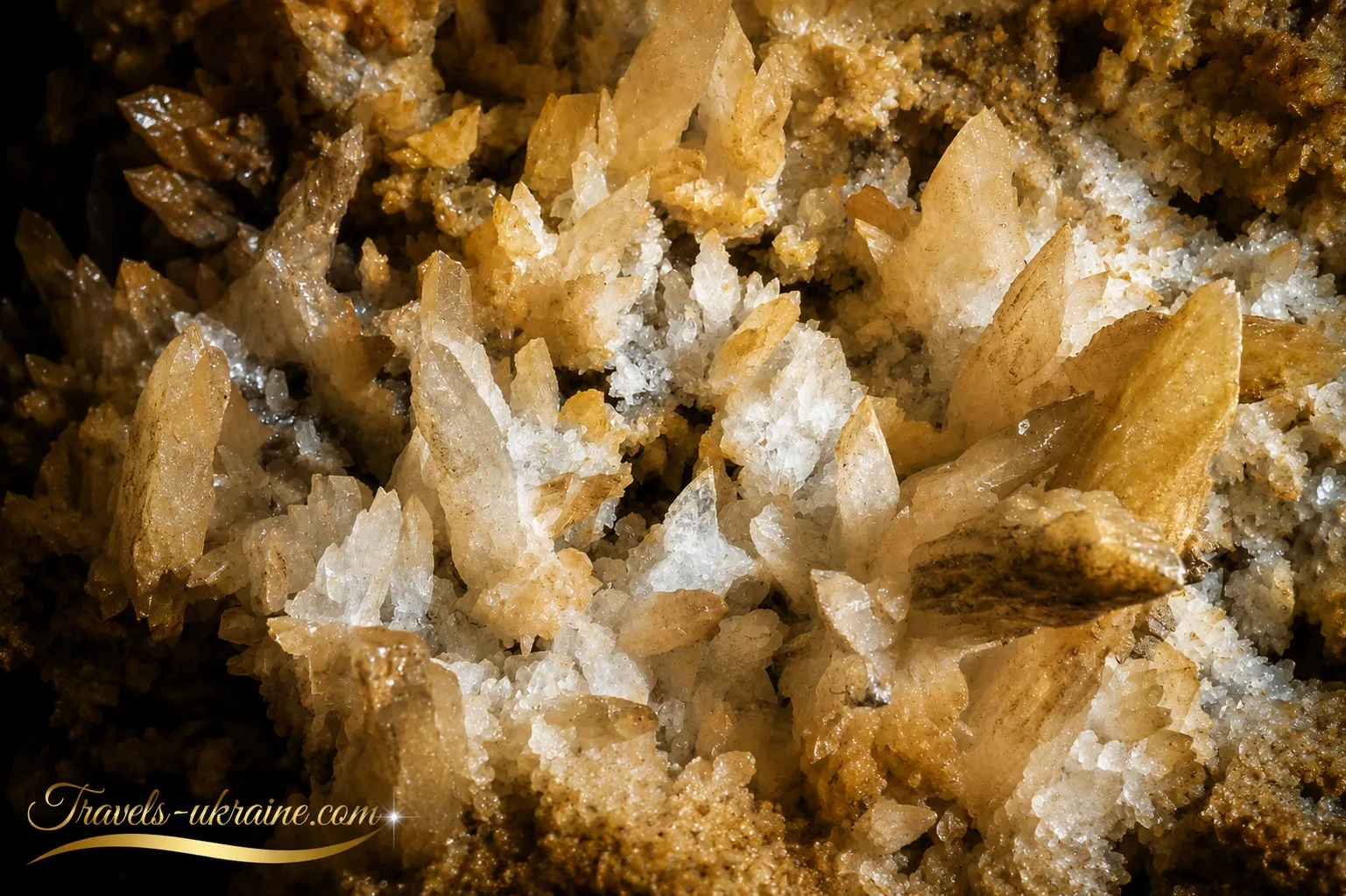
The gypsum crystal formations are the most impressive: delicate needles, fibrous structures, transparent plates, and astonishing «flowers» covering certain walls and vaults. In the light of a lamp, they change color, sparkle, and create the feeling that the cave is continuing to form right before your eyes. Yet beauty is only one reason to visit Zavallia. It is equally fascinating to learn how this multilayered complex formed, why it was named Atlantida, and what truly awaits visitors beyond the unassuming entrance into the hillside.
Next, we will trace the history of the cave’s discovery, look into its most fascinating chambers, explore the difficulty of its routes, and find out how to prepare for the descent. You will learn what to bring, how to dress properly, whether the cave can be visited with children, and which nearby tourist attractions are worth seeing. So let us lift the veil on this underground world and try to understand the true mystery of Atlantida—is it found in the crystals, its unusual structure, or the special feeling that remains after returning to the surface?
History of Atlantida Cave: From Accidental Discovery to a Natural Landmark of Podillia
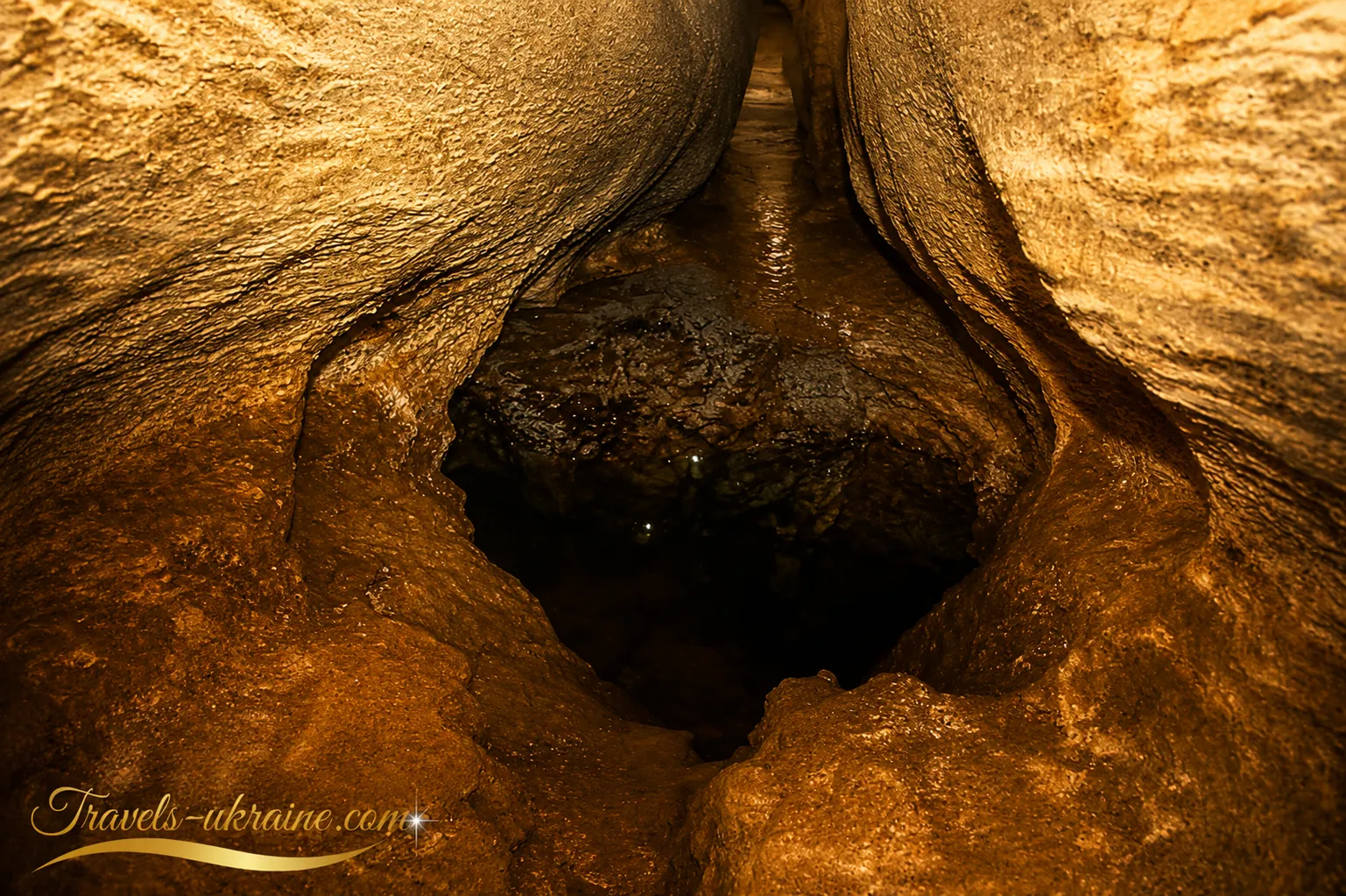
The history of Atlantida Cave did not begin with a grand scientific expedition, an ancient treasure map, or even a daring traveler who accidentally fell underground. It was much more prosaic: in the 1950s, a clay quarry was being developed near the village of Zavallia. During the work, several small openings appeared in the rock, but at first no one regarded them as an entrance to a large cave system.
They seemed like ordinary cracks—what could a Podillian hillside possibly conceal? But, as later became clear, nature was simply in no hurry to reveal all its cards. Behind the inconspicuous openings lay an extensive underground complex with spacious chambers, multilevel passages, and crystal galleries, whose true size and beauty no one yet suspected.
How Atlantida Cave Near Zavallia Was Discovered
In 1968, young speleologists from Kyiv became interested in the cave openings. Initial surveys showed that much larger cavities might exist beyond the narrow sections, but they could not reach them immediately. The researchers had to clear the passages and gradually move deeper into the rock, overcoming blockages and tight crevices.
The decisive moment came in the summer of 1969. After excavating several meters, the speleologists entered a large chamber from which new passages branched off in different directions. Thus, underground Atlantida was discovered—a sprawling natural labyrinth of galleries, grottoes, vertical passages, and crystal chambers.
The discovery was important not only for Khmelnytskyi region. Researchers encountered a multilayered system rare for Podillia, containing a great variety of secondary gypsum formations. The karst cave in Zavallia quickly attracted the attention of speleologists, geologists, and tourists, while its name became a symbol of a hidden world that had remained unknown to people for a long time.
Early Exploration of Atlantida’s Underground Galleries
After its discovery, the cave underwent its initial survey. Speleologists entered new chambers, checked side passages, described crystal formations, and searched for connections between separate parts of the underground system. The work required endurance and caution: there was no lighting, developed trails, or reliable landmarks inside, and around the next bend there might be either a spacious grotto or a narrow fissure that quickly cooled the explorers’ enthusiasm.
The discoverers and expedition members gave the chambers imaginative names inspired by the colors of the crystals, the shapes of the vaults, and their own impressions. Thus, the underground toponymy came to include «Tenderness,» «Golden Autumn,» «Red Poppies,» «The Snow Queen,» and «Temple of the Gods.» These names transformed a dry map of passages into a distinctive map of images, giving each chamber its own character and mood.
Systematic study of the cave began in the autumn of 1979, when a speleological team led by Oleksandr Borysovych Klymchuk carried out detailed topographic surveying. The researchers determined the direction and length of the passages, recorded changes in elevation and connections between tiers, and gradually reconstructed the spatial structure of Atlantida’s underground galleries. The cave did not make their task easy: instead of convenient corridors, it offered confusing branches, tight passages, and unexpected vertical sections. The results of this painstaking work made it possible to define the structure of the underground complex more precisely and provided an important foundation for further scientific research.
Scientific Study of Atlantida Cave
In 1981, specialists from the Institute of Geological Sciences of the Academy of Sciences of the Ukrainian SSR conducted geological, hydrogeological, karstological, and speleological research in the cave. Scientists studied its origin, internal morphology, microclimate, secondary deposits, and the condition of the rock. Particular attention was paid to the possibility of safely using the cave as a tourist and excursion site.
The research confirmed that «Atlantida» has not only aesthetic but also considerable scientific value. Deposits accumulated in the galleries over a long period help scientists reconstruct changes in the ancient water systems and natural conditions of Podillia. The cave is therefore a kind of geological archive, preserving traces of the processes that shaped this region long before the modern landscape emerged.
How Atlantida Cave Became a Geological Natural Monument
Already in the first years after its discovery, it became clear that uncontrolled visitation could cause irreparable harm to the unique cave of Khmelnytskyi region. Some visitors tried to break off crystals as souvenirs, as though nature had set up a free gift shop underground. Others left marks on the walls or damaged fragile surfaces. Such actions are dangerous for the cave: crystal formations took an extraordinarily long time to develop, and unfortunately even the most industrious nature could not restore them over a weekend.
In 1975, the Atlantida underground complex and the surrounding area received the status of a geological natural monument of national importance. This decision was an important step toward preserving the unique site and, at the same time, a perfectly clear reminder: you may admire the crystals, but you may not take them with you. Later, the cave became part of the Podilski Tovtry nature park, strengthening its importance as a protected site, natural laboratory, and tourist gem of Khmelnytskyi region.
Today, the history of Atlantida reminds us how unexpected a great discovery can be. If the development of the small quarry had not exposed the cave openings, the crystal chambers might still be quietly hidden within the Podillian hillside, unaware of their future popularity with tourists. Yet even after decades of research, the cave has not lost its mystery. Its complex structure, multilevel passages, and natural origins still leave scientists with many questions. Atlantida seems happy to display its beauty, but in no hurry to provide answers—and that is precisely why every new study of this underground world may bring unexpected discoveries.
Natural Features of Atlantida Cave
Atlantida Cave in Khmelnytskyi region impresses not only with the beauty of its crystals but also with its complex internal structure. Its passages do not form one straight corridor that visitors can leisurely follow from entrance to exit, pausing occasionally beside information boards. Instead, travelers encounter a genuine natural underground labyrinth of broad galleries, narrow passages, vertical sections, grottoes, and chambers of varying heights. Nature evidently used neither a ruler nor a spirit level, so every part of the cave acquired its own shape, mood, and character.
To better understand what distinguishes Atlantida from other caves in Ukraine, it is worth taking a closer look at its origins, three-tiered structure, crystal formations, and unusual underground galleries. It is precisely the combination of these features that turns a descent underground into a fascinating journey through the geological history of Podillia.
The Three-Tiered Structure of Atlantida Cave
According to updated mapping data, the total surveyed length of the cave’s passages is 7493 meters. Older official and popular-science sources give smaller figures—1800 or 2525 meters—because they reflect the results of earlier stages of research into the underground system. On paper, these are simply numbers, but inside the cave they quickly acquire a tangible scale: after a few turns, it becomes clear that you are not in an ordinary corridor but in a true natural underground labyrinth. Without an experienced guide, the innocent desire to «just take a quick look around the corner» can turn into an overly lengthy introduction to the underground geography of Podillia.
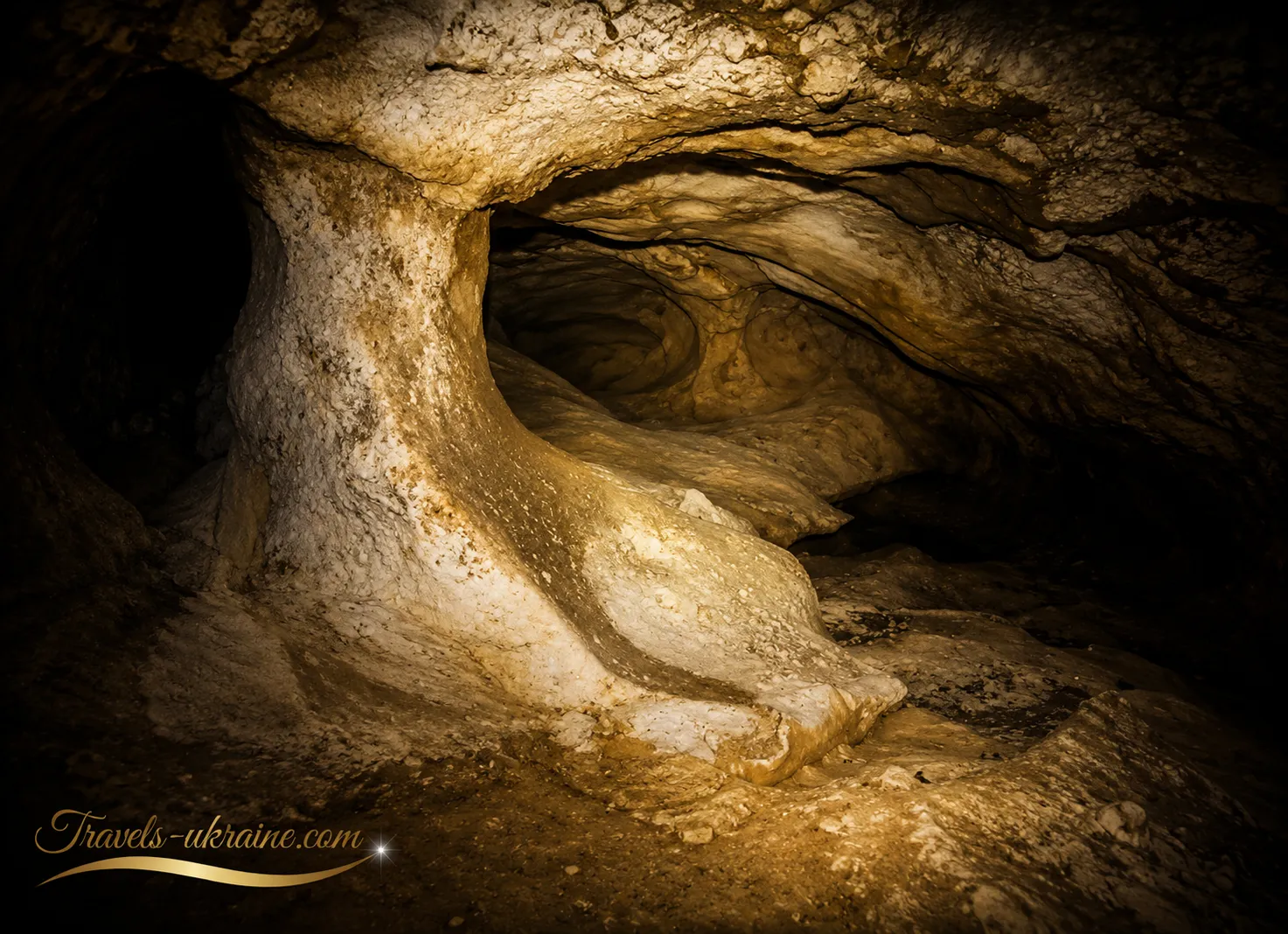
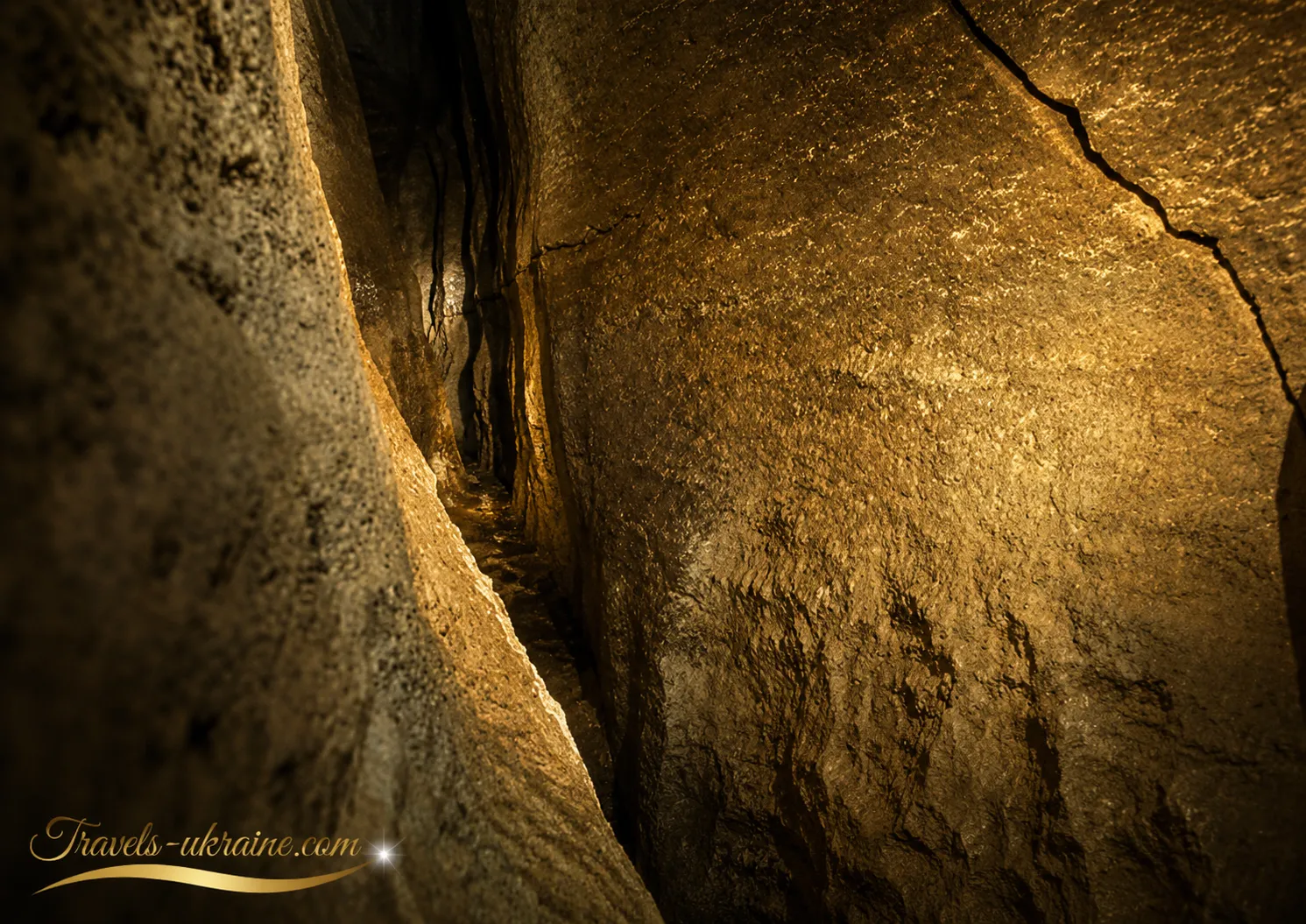
Atlantida’s main natural feature is its clearly defined three-level, or three-tiered, structure, unique among the caves of Podillia. The lower, first tier consists of high, wide galleries through which powerful underground water flows moved in the distant past. Some passages resemble natural tunnels disappearing into the darkness, while the spacious vaults and numerous branches best convey the true scale of the underground complex.
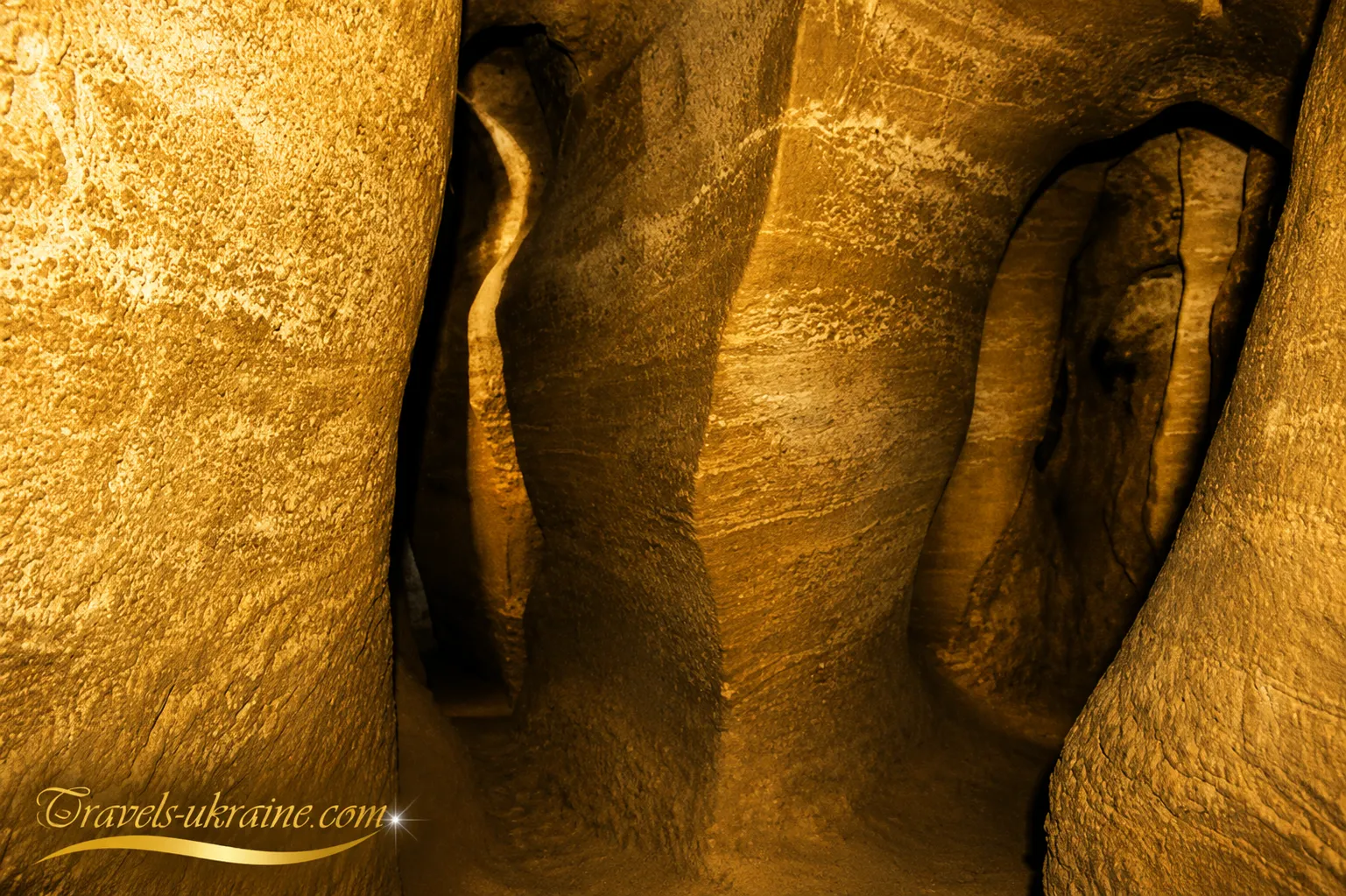
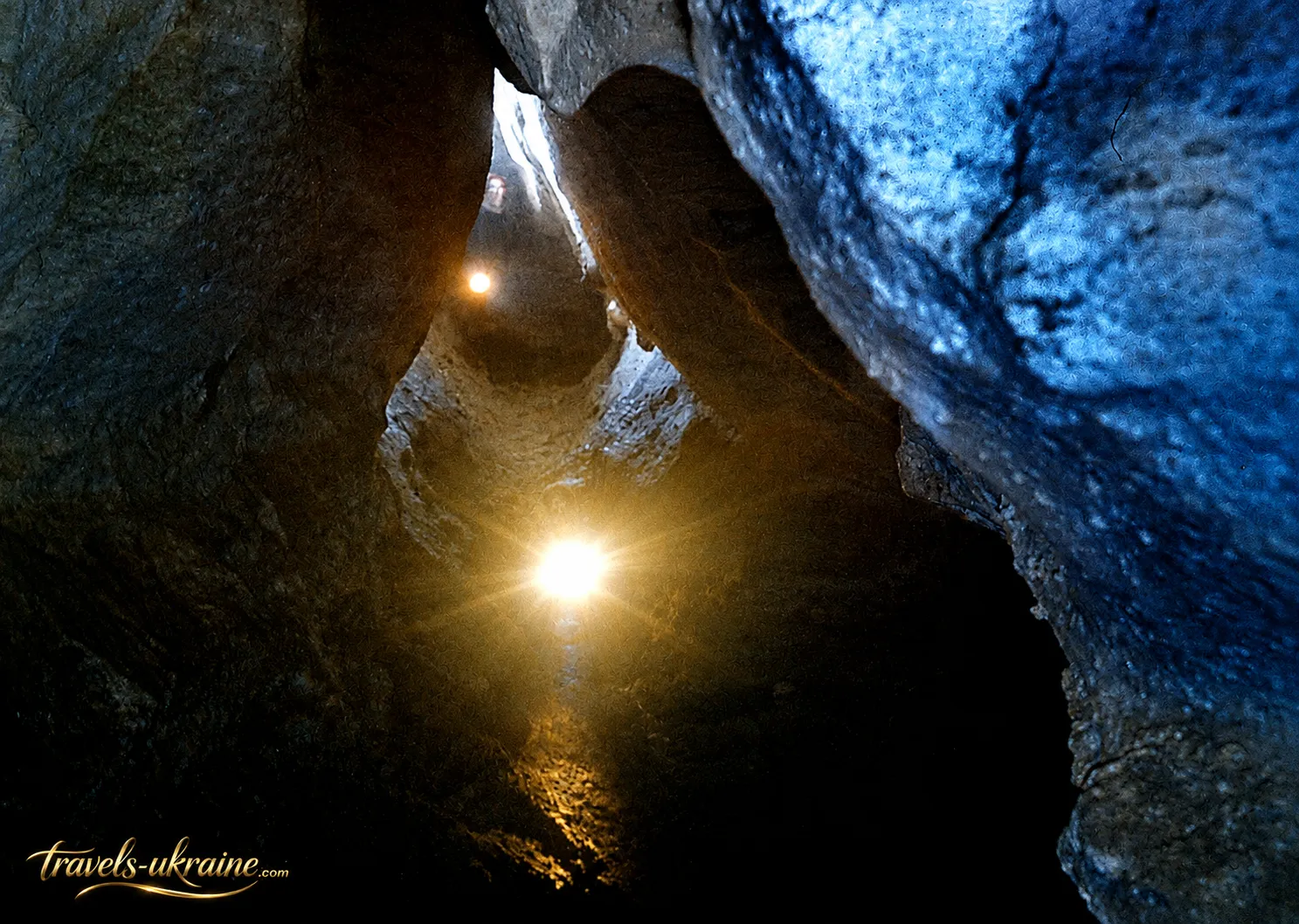
The second tier has an entirely different character. In some sections, its cavities narrow to 1–1.5 meters, making the route tighter and requiring greater attention with every movement. Here, the cave subtly tests flexibility, endurance, and the seriousness of a tourist’s intentions: if a traveler truly came looking for adventure, Atlantida is ready to deliver it without a shortened program.
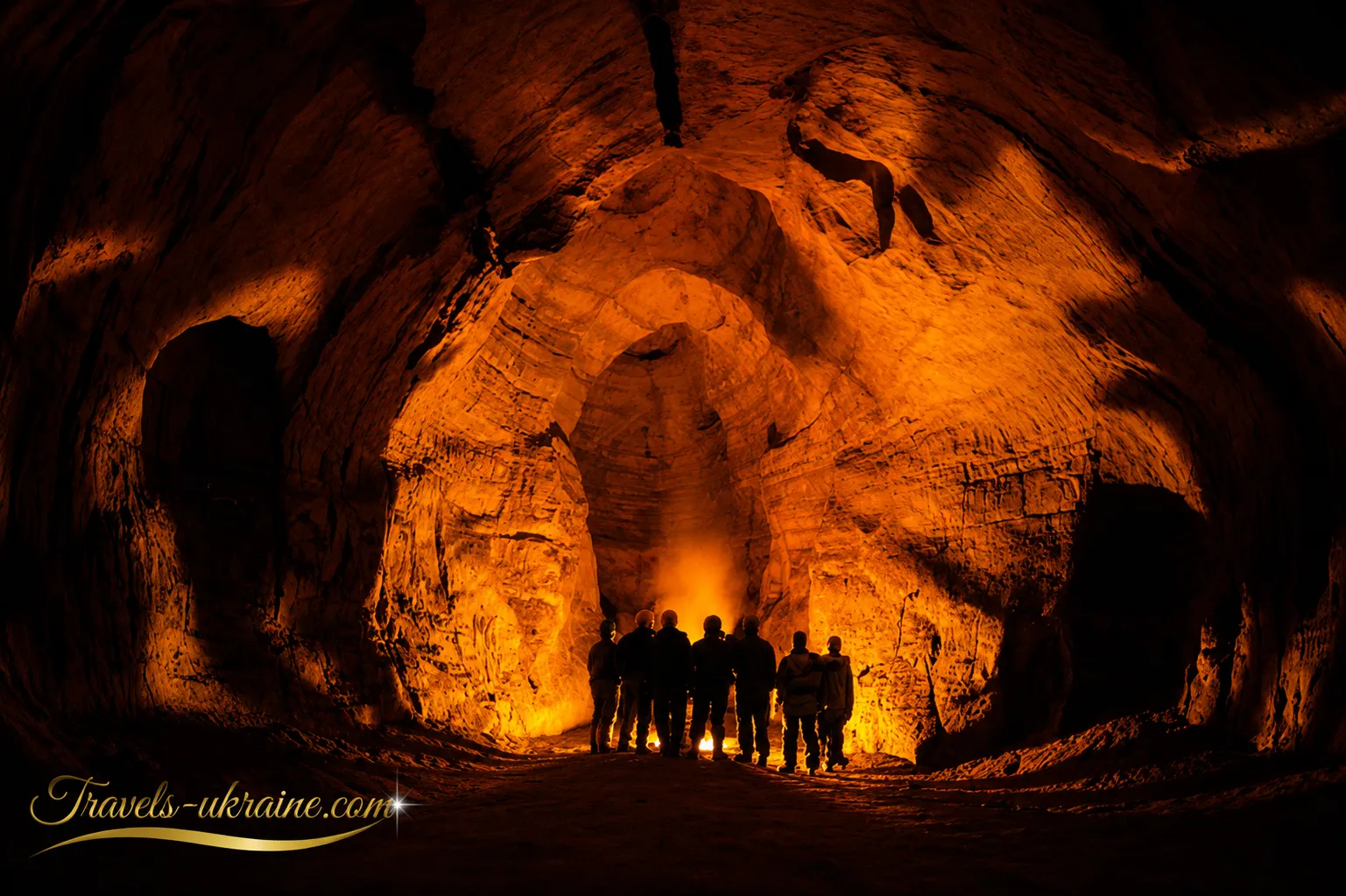
The third tier consists of two small upper passages up to five meters high. Particularly impressive are the points where the galleries of the first and second levels intersect, forming large chambers up to twelve meters high. After narrow passages, they open suddenly, like underground cathedrals built without blueprints, construction equipment, or project approval. This contrast—from tight fissures to vast cavities—is what makes the three-tiered Atlantida one of Podillia’s most fascinating geological wonders.
Atlantida’s Crystal Chambers and Gypsum «Flowers»
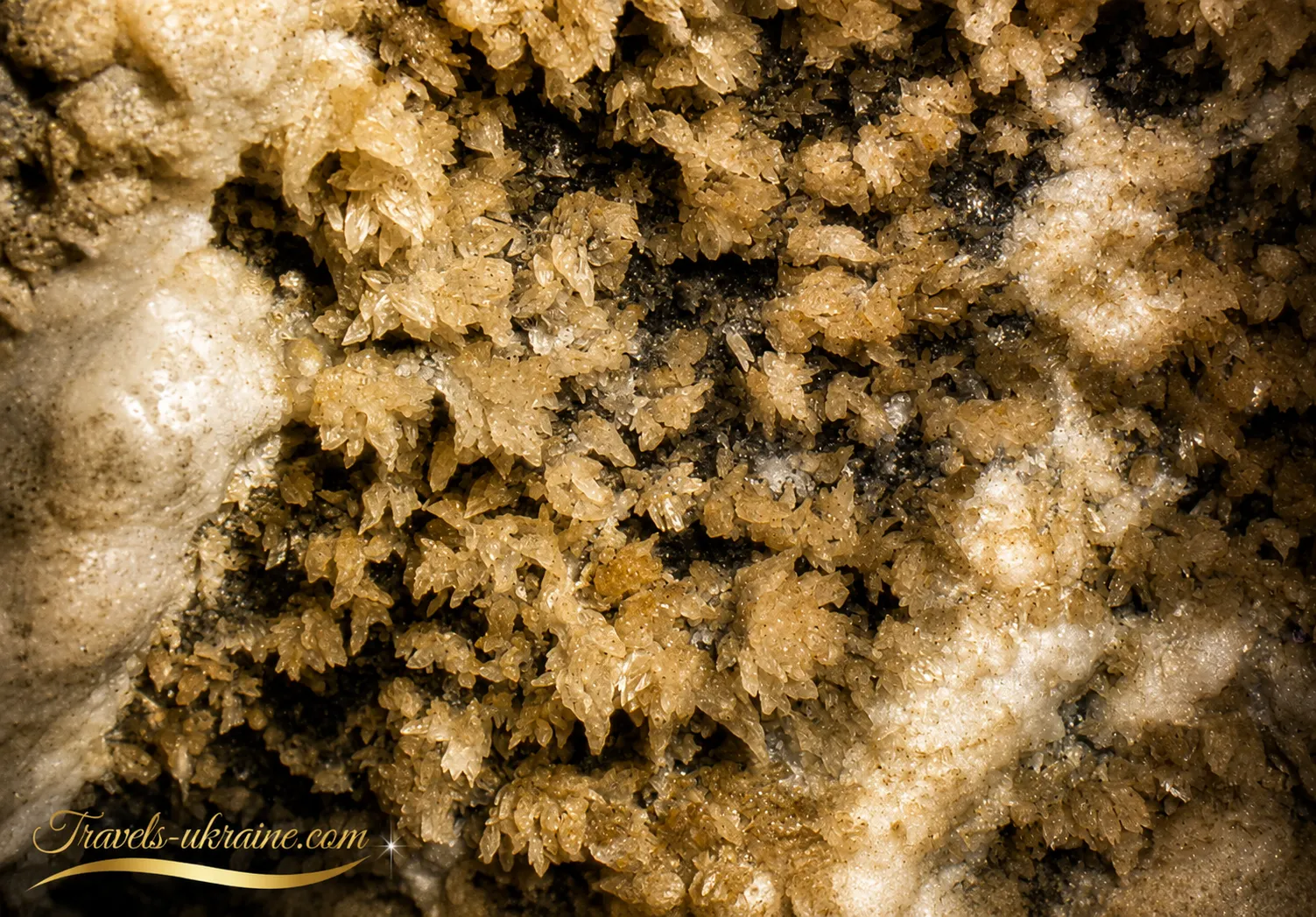
The cave’s most famous natural treasure is its gypsum crystals. After the underground cavities were drained, water continued to seep slowly through the layers of rock. Saturated with calcium sulfate, it reached the walls, floor, and ceiling, where the mineral gradually crystallized. These formations are why the karst cave near Zavallia is often called a natural mineralogical museum.
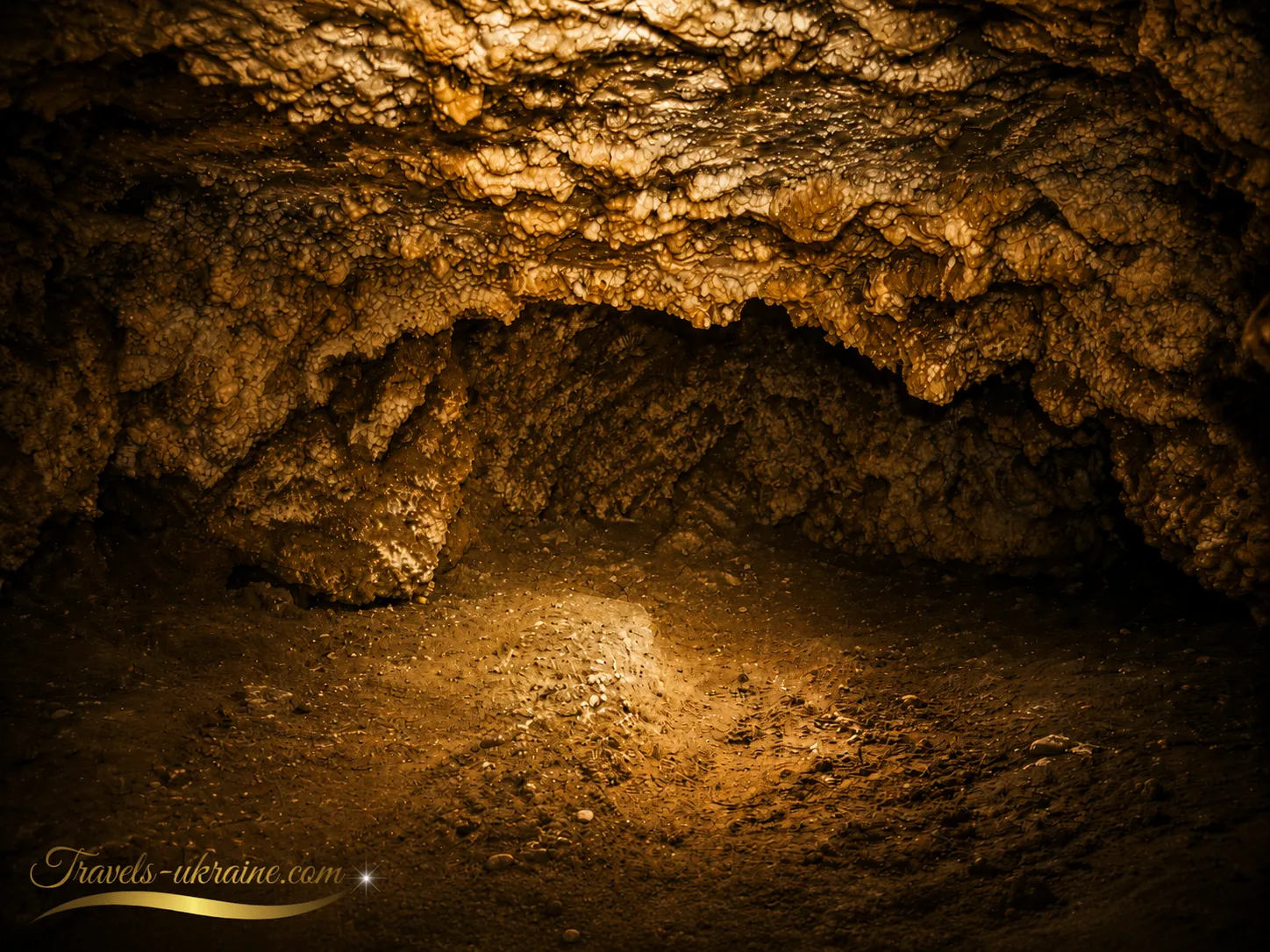
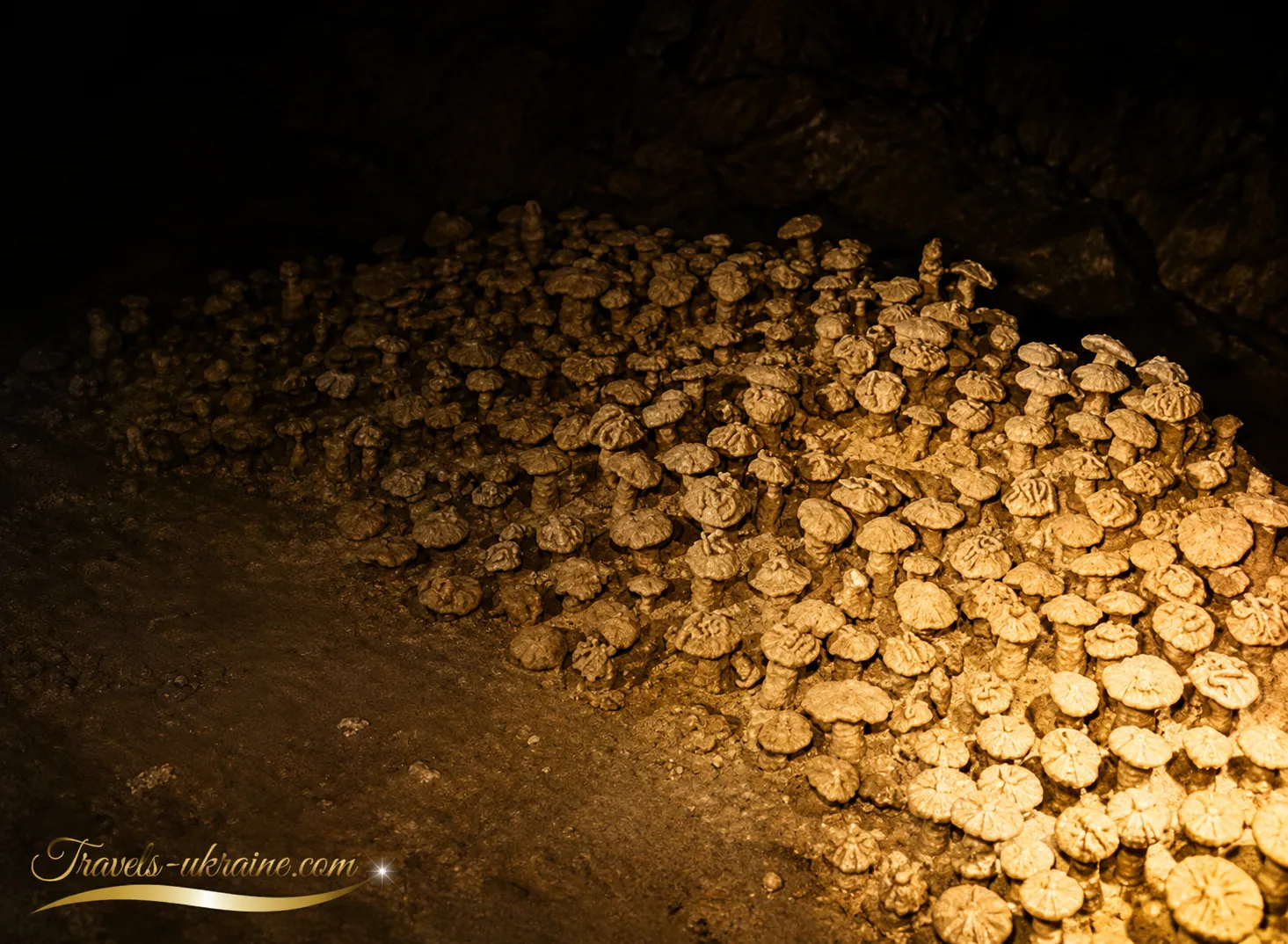
In different parts of the cave, you can see transparent, white, cream, yellowish, and pink crystals. Some resemble thin needles, while others look like plates, stars, petals, or frozen icicles. The most unusual are helictites—curved mineral formations that grow in different directions and completely disregard human ideas about which way is up or down.
Some areas contain long, fibrous crystals, while entire clusters form distinctive stone bouquets. In the light of a headlamp, their surfaces reflect the beams, making the walls seem to flare with tiny sparks. This very variability makes the crystal halls of Atlantis especially photogenic, although no photograph can fully convey the depth of the darkness, the silence, and the sudden gleam of the minerals.
Why Crystals Come in Different Colors
Pure gypsum is usually pale or transparent, but natural impurities give crystals other shades. Particles of clay, iron oxides, manganese compounds, and minerals carried by water can color surfaces yellow, pink, reddish, gray, or dark. As a result, every gallery has its own color palette, and neighboring formations sometimes look as though they were deliberately selected for an underground exhibition.
Color also depends on lighting. In the cave’s natural darkness, the crystals are almost invisible, but a focused beam reveals their transparency, texture, and inner iridescence. Simply change the angle of the lamp, and a familiar wall looks different. Atlantis does not change its scenery; it simply lets you see it from a new perspective.
Silence, Darkness, and a Sense of Space in the Cave
Atlantis’s natural features are experienced not only through the eyes. Deep inside, sounds from the surface are almost inaudible, so footsteps, voices, and the accidental movement of a pebble seem much louder. Spacious halls produce a slight echo, while sound quickly fades in narrow passages. If the group switches off its lamps and falls silent for a few seconds, absolute darkness descends—an unusual experience even for those who believe they are afraid of nothing.
It is the combination of its multilayered structure, crystal formations, natural silence, and undeveloped terrain that makes Atlantis Podillia Cave a true geological wonder. There is no need to invent scenery or special effects here: water, gypsum, and time have already done all the work. All that remains is to move through this world carefully, look around attentively, and remember that even the smallest crystal is part of a history that began long before the first travelers appeared.
Photo and Video Gallery
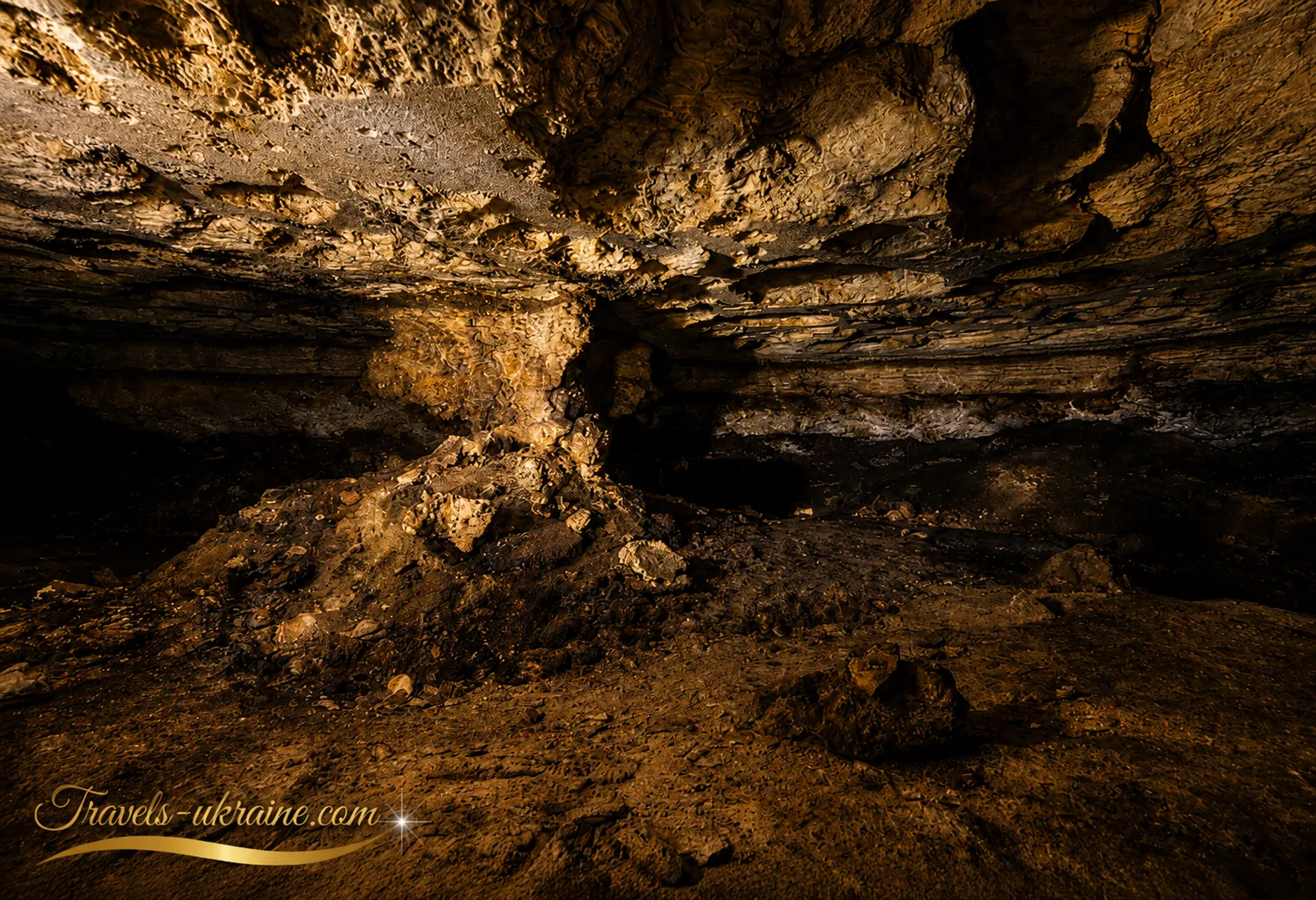
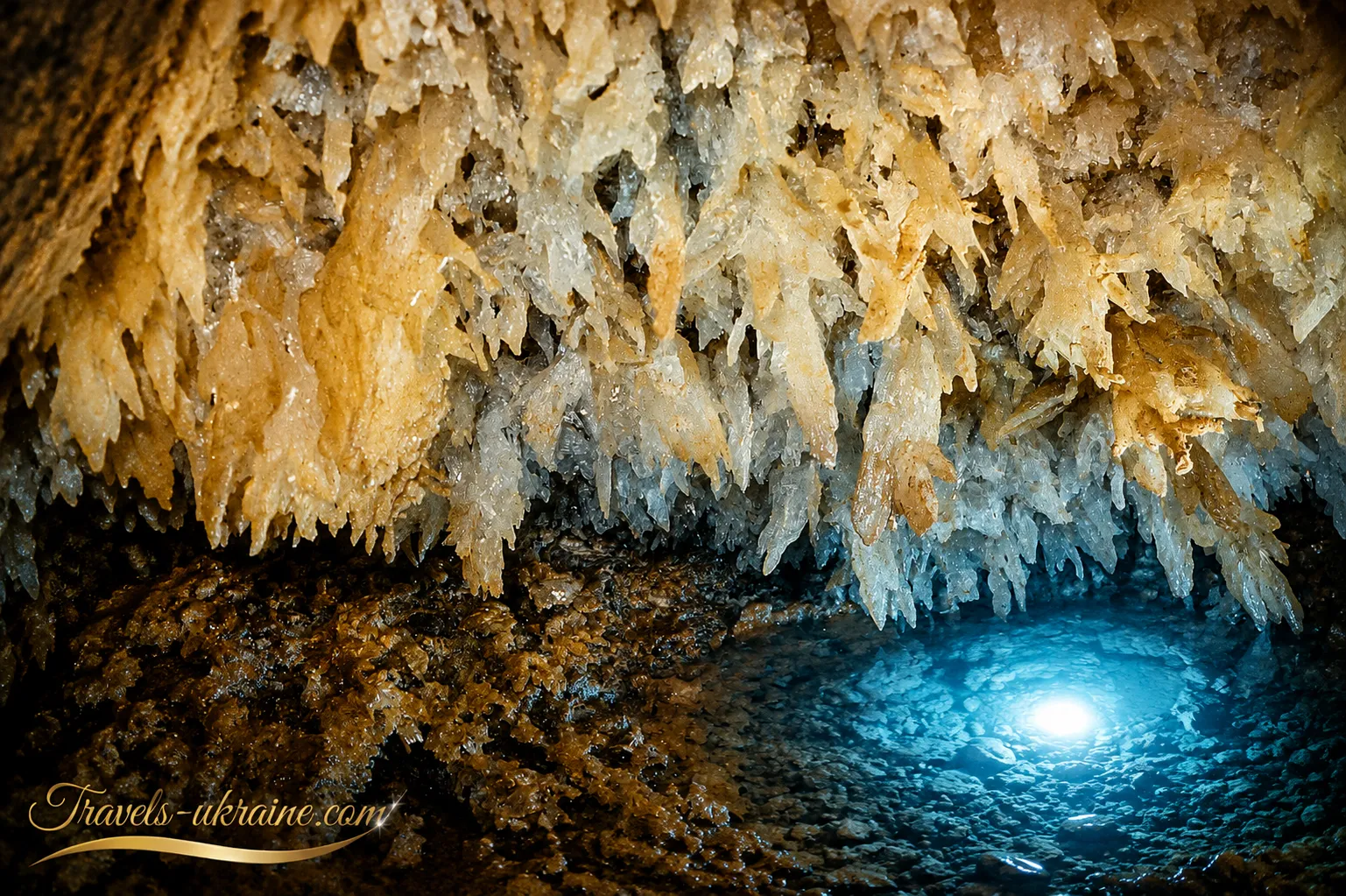
A Brief Travel Guide to Atlantis Cave
Atlantis in Zavallia is not an ordinary sightseeing attraction where buying a ticket and strolling along a lit path is enough. Visits take the form of an active caving tour: before descending, tourists receive a briefing, the necessary equipment, and head underground with a guide. Previous experience is not required, but being ready to move, bend, negotiate uneven sections, and not be frightened by your own shadow in the beam of a lamp will certainly come in handy.
It is a natural karst cave, a protected speleological natural site, and an active-tourism destination. Independent visits are not permitted: the complex network of passages, lack of permanent lighting, and uneven terrain require an instructor who knows the route and oversees the group’s safety. That is why a group tour of Atlantis Cave feels more like a short underground expedition than a conventional walk through a tourist attraction.
A standard tour usually takes about 2.5 hours, although more challenging or extended routes can last up to 3–3.5 hours. You should also allow time for the briefing, choosing a coverall, preparing the equipment, and changing clothes after returning. In total, it is best to set aside at least half a day for the cave rather than trying to squeeze Atlantis in between lunch and evening coffee in Kamianets-Podilskyi.
Atlantis Cave Route Difficulty and Physical Preparation
The basic route is designed for people without specialized caving experience, but calling it completely easy would be overly optimistic. Along the way, there are low ceilings, narrow passages, slippery or clay-covered sections, uneven floors, and places where you have to use your hands for support. Excellent physical fitness is not essential, but reasonable mobility, stamina, and the absence of serious medical contraindications are important.
For people with pronounced claustrophobia, serious heart, respiratory, or musculoskeletal conditions, or coordination problems, such a trip may be difficult. The final decision about taking part should be made after consulting the route organizer and, in the case of chronic conditions, a doctor as well.
Age restrictions depend on the program selected. Tourist packages include routes for children aged 6 or 10 and older, so before booking, be sure to confirm the minimum age, duration, and difficulty of the specific excursion. It is important to consider not only the child’s age but also their attitude toward darkness, confined spaces, and prolonged physical activity.
The route is not accessible: the cave is unsuitable for strollers, wheelchairs, or people who have difficulty overcoming natural obstacles. Atlantis preserves its original terrain and is not particularly concerned with urban comfort standards—which is part of its appeal, but also its main limitation.
Atlantis Cave: Price and Estimated Trip Budget
The cost depends on the route selected, its duration, the number of participants, and the equipment provided. The current price should be confirmed directly with the organizer when booking.
In addition to the main budget, allow for travel, food, gloves, a change of clothes, and accommodation if needed. If you are planning a day trip to Atlantis Cave from Kamianets-Podilskyi or another city, the total cost will depend on the transfer and the travel program. It is best to set aside a small reserve: the cave does not add surprises to the bill, but the road, lunch, and an extra stop at a nearby attraction certainly might.
Interesting Facts About Atlantis Cave
Atlantis Cave near Kamianets-Podilskyi is fascinating not only for its geological structure and crystal halls. Over decades of exploration, a distinct world of names, caving traditions, local legends, and small mysteries has grown around it. Some stories have entirely documentary origins, while others are passed from guides to tourists and acquire new details each time. Underground, this happens especially easily: dim the lamp, pause for a moment, and even an ordinary rocky ledge begins to resemble an entrance to a lost city.
Why the Cave Was Named Atlantis
The name emerged almost immediately after the large underground system was discovered. To the first explorers, the galleries found behind inconspicuous openings seemed like a truly unknown world—hidden, vast, and unexpected. The association with the legendary Atlantis proved so apt that the cave never needed another name.
There is a certain symbolism in this. The mythical Atlantis was sought in the middle of the ocean, while the Podillia version was found inside a hill near the Zbruch River. The geography is, of course, somewhat different, but the atmosphere of a mysterious lost world has remained almost unchanged.
Unusual Names of Atlantis’s Halls and Galleries
The first large hall was named «Joy.» It captured the feelings of the speleologists who, after clearing the passage for a long time, finally reached a spacious cavity. The name was simple but remarkably precise: after narrow fissures and uncertainty, any large hall truly feels like a reason for sincere celebration.
The cave has an emotional geography of its own. Names arose not from dry numbering but from colors, shapes, moods, and events that accompanied the exploration. As a result, a map of Atlantis resembles not a technical drawing but the contents page of an adventure novel.
The underground complex also contains halls called «Golden Autumn,» «Laughter,» «Starry Night,» «Tenderness,» «Temple of the Gods,» and other cavities with equally vivid names. Some galleries are known as «Partisan» and «Three Unfortunates,» while one of the corridors is called «The Devil’s Tail.»
Every name reflects a particular association: the color of the crystals, the shape of the ceiling, the character of the passage, or an event that happened to the explorers. Some names sound romantic; others immediately suggest that the route may not be especially welcoming. If the guide says «Tenderness» lies ahead, you can relax. But if «The Devil’s Tail» suddenly enters the conversation, it is best to check that your coverall is securely fastened.
Constant Temperature in Atlantis Cave
The temperature inside the cave remains approximately +11 °C throughout the year. The underground microclimate barely responds to summer heat or winter frost, so Atlantis can be visited in different seasons. That said, it does not mean you should descend underground in a T-shirt in July: the cave does not read the calendar or pay attention to the weather forecast.
The steady coolness is especially noticeable after negotiating active, narrow sections. Damp air, clay, and prolonged time without sunlight quickly remind you why warm clothing and closed-toe footwear are part of the equipment, not an unnecessary precaution imposed by the organizers.
The Symbolic Oath of Cave Conquerors
During some excursions, those descending into Atlantis for the first time take part in a playful initiation or symbolic caver’s oath. It is usually associated with the «Cave Conquerors» hall. Guides do not rush to reveal the ritual’s details in advance, because without a little surprise, an underground adventure would lose some of its atmosphere.
There is no need to worry: the initiation does not require passing a geology exam or spending years as a member of a caving club. Usually, it is enough to complete the route, keep your sense of humor, and return to the surface with respect for the cave. After several hours among clay, crystals, and narrow passages, the title of «conqueror» feels well deserved anyway.
What to See and Do in Atlantis Cave
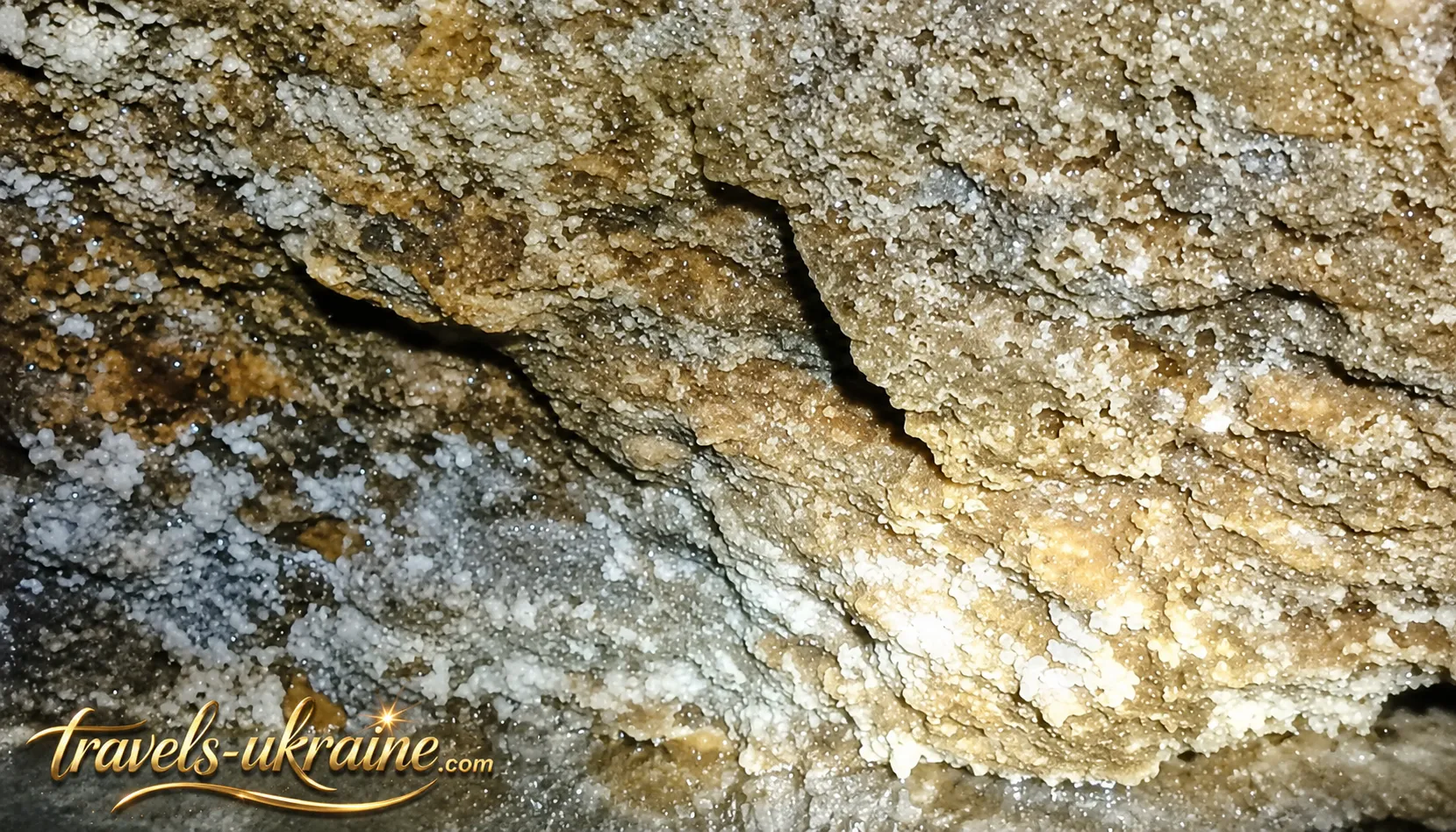
A tour of Atlantis Cave is not a passive visit to a natural attraction but a full-fledged journey into an underground world. Simply looking around is not enough: you will need to move carefully across uneven terrain, pass through narrow sections, bend beneath low ceilings, and listen to the instructor. The cave quickly makes it clear that the main form of tourist transport underground is still your own two feet—and sometimes your hands join in as well.
The route’s greatest value lies in its constant change of impressions. Spacious galleries give way to cramped passages, dark corridors suddenly open into large halls, and an ordinary-looking wall begins to shimmer with dozens of crystals in the beam of a lamp. That is why a caving adventure is remembered not for one particular object but for an entire sequence of discoveries.
The most eagerly anticipated part of the adventure is meeting the gypsum crystals. They cover certain sections of the walls and vaults, forming needles, plates, fibers, petals, and bizarre mineral «flowers.» Depending on impurities and the angle of the light, the surfaces may appear white, transparent, cream-colored, yellowish, or pink.
Crystals are best viewed without rushing. Change the direction of the beam, and a familiar section looks completely different: a gleam appears, while delicate facets and inner iridescence become visible. Atlantis does not switch on decorative lighting according to a schedule, so each visitor essentially discovers its beauty with the help of a headlamp.
Follow Atlantis Cave’s natural tourist route
One of the main activities inside is simply following the route. It sounds easy only until a low passage, a muddy section, or a turn with no visible continuation appears in front of the visitor. In different parts of the cave, you have to adjust your pace, place your feet carefully, and follow the guide’s instructions.
The difficulty of a particular tour depends on the program, the condition of the route, and the group’s abilities. An experienced Atlantis Cave guide helps choose a safe direction, explains movement techniques, and points out sections an unprepared tourist might pass without noticing anything special. Improvising on your own is inappropriate here: an underground labyrinth does not have a convenient «return to main menu» function.
During the excursion, participants may see halls and passages that speleologists have given imaginative names. «Joy,» «Golden Autumn,» «Tenderness,» «Starry Night,» and «Temple of the Gods» sound like titles from an adventure novel, but each is connected with the shape of the space, the colors of the minerals, or the impressions of the discoverers.
It is especially interesting to hear the instructor’s explanations right there on site. When the story behind a name is told in a dark hall among crystals and echoes, it feels completely different from how it would in an ordinary tourist brochure. Even the most reserved participants begin looking more closely at the vaults—perhaps the name really does offer a clue.
Take photos of Atlantis’s underground galleries
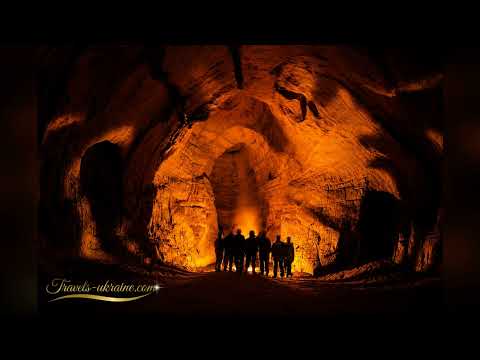
The cave offers many unusual subjects for photography: people’s silhouettes in the light of headlamps, sparkling crystals, textured walls, narrow passages, and spacious halls. At the same time, taking pictures underground is more difficult than it seems. There is little light, the surfaces have high contrast, and a free hand is often needed not for a phone but for moving safely.
You should take photos only where the instructor allows it and where stopping does not interfere with the group. Do not leave the route for the sake of a good shot, touch the crystals, or place equipment on fragile formations. The best photo from Atlantis is the one after which everything remains in its proper place, including the photographer.
Observe the cave’s inhabitants without unnecessary interference
Bats and other representatives of cave fauna may be found in underground cavities. An encounter with them should be seen as a rare opportunity to observe animals in their natural environment, not as an invitation to a close-up photo session. Do not touch the bats, wake them, shout loudly, or shine a powerful beam directly at an animal.
The best approach is to calmly follow the guide’s instructions and not linger near a wintering site. In this underground complex, people are guests, while the bats are local residents who are not obliged to pose for tourists simply because those tourists made the journey to Zavallia.
Hear the cave’s history from the instructor
The guide’s story helps visitors see Atlantis as more than just a collection of dark corridors. Along the route, you can learn how water dissolved the gypsum rock, why different levels formed, where the names of the halls came from, and how researchers created the first maps of the system.
Do not be afraid to ask questions, but it is better to do so during stops rather than in the middle of a narrow passage. A good instructor will explain geological processes in simple language, talk about speleological traditions, and draw attention to details that are easy to miss. These explanations are what turn a popular tourist attraction into an understandable, vivid story of nature.
Atlantis Cave in Kamianets-Podilskyi Raion does not offer conventional tourist entertainment, and that is precisely its advantage. There is no need for rides, decorative sets, or special effects here. Geology serves as the screenwriter, a headlamp provides the lighting, and the main adventure is moving through a real underground labyrinth. After such a route, even ordinary daylight outside the entrance feels like a separate and very pleasant attraction.
What to visit near Atlantis Cave
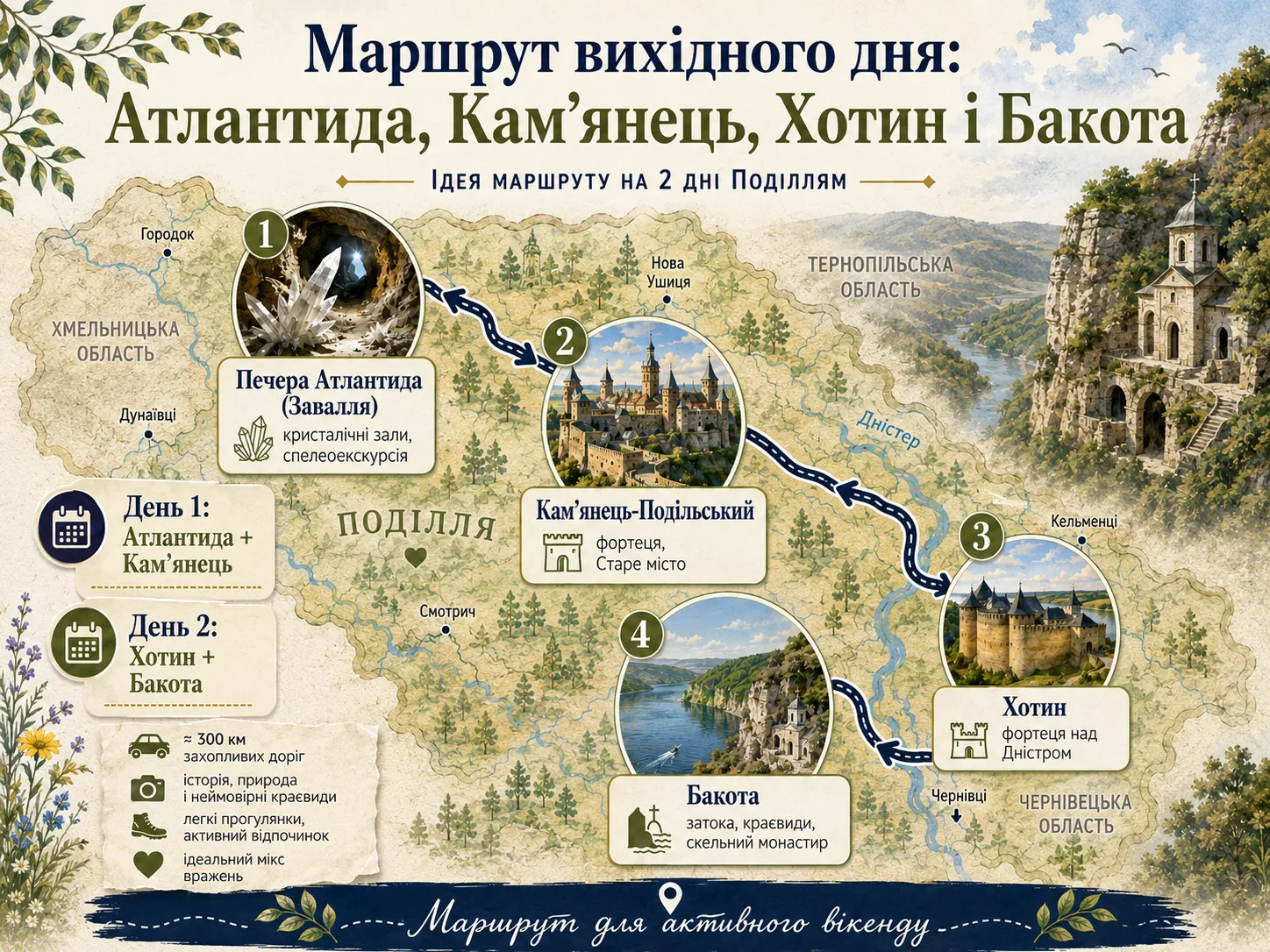
Atlantis Cave in Khmelnytskyi Oblast is ideally located for an enriching journey through Podillia. After several hours among crystals, muddy passages, and complete darkness, you can trade underground scenery for fortresses, canyons, cliffside monasteries, and broad views of the Dniester. The key is not to try to see everything in one day; otherwise, relaxation will quickly turn into a tourist marathon with coffee instead of a relay baton.
The most convenient approach is to decide on the main purpose of the trip in advance. For a one-day itinerary, it is enough to combine Atlantis in Zavallia with one major attraction. If you have two or three days available, you can add Kamianets-Podilskyi, Khotyn, Bakota, and the natural landmarks of Podilski Tovtry National Nature Park.
Kamianets-Podilskyi Fortress and the Old Town
Kamianets-Podilskyi is the most obvious continuation of the route after visiting the cave. Its historic part is located on a rocky island surrounded by the canyon of the Smotrych River, while the Old Castle remains the city’s main symbol. Here you can walk along the fortress walls, view the towers, see the Castle Bridge, and linger at the observation platforms.
The Old Town is interesting for more than just its fortress. Its relatively compact area contains churches, historic stone houses, squares, remnants of defensive structures, and cozy streets. After Atlantis’s natural corridors, the city lanes seem almost perfectly straight, although Kamianets can also quietly lead travelers onto the wrong street—though at least navigation works here.
Bakota Bay and the cliffside monastery
Bakota is one of the best-known natural attractions in Khmelnytskyi Oblast. Today, the name is primarily associated with the broad bay of the Dniester Reservoir, green hills, rocky shores, and observation platforms. People come here for walks, peaceful relaxation, water excursions, and views of the Kamianets Dniester region.
The Bakota rock-cut monastery also deserves special attention. It is connected with the history of ancient Bakota. A natural route along the slopes above the Dniester leads to it. The combination of monastery caves, rocks, springs, and the bay creates a completely different mood from Atlantis: here, underground history gradually gives way to open space, sunshine, and distant horizons.
It is better to set aside a separate part of the day for Bakota. It is technically possible to arrive quickly, take one photo, and immediately move on, but there is not much point in doing so. This place reveals itself slowly and does not care for tourists who keep looking at the clock.
Khotyn Fortress above the Dniester
Khotyn Fortress is already located in Chernivtsi Oblast, but it is often included in a shared itinerary with Kamianets-Podilskyi and Atlantis Cave. Massive walls, tall towers, an inner courtyard, and views of the Dniester create one of Ukraine’s most striking fortification ensembles.
You should allow plenty of time to explore the fortress, as the grounds are considerably larger than they may appear in photographs. After the underground journey through Atlantis, walking across the spacious courtyard and along the walls feels especially pleasant. Even someone who confidently claimed a few hours earlier not to be afraid of narrow passages suddenly begins to appreciate the open sky immensely.
A ready-made one-day itinerary near Atlantis Cave
For a one-day trip, it is best to choose one of two options. The first is a morning or daytime tour of Atlantis Cave, followed by a trip to Kamianets-Podilskyi, a walk through the Old Town, and an evening by the fortress. The second option is to combine the cave with a relaxing stop in the Zbruch Valley or a short nature walk without a long drive.
It is not worth trying to fully explore Atlantis, Kamianets, Khotyn, and Bakota in a single day. Technically, a car might manage it, but tourists are unlikely to have time to understand where they actually were. A quality trip is measured not by the number of pins on the map, but by impressions that have not blended into one enormous fortress with crystals and a bay in the middle of its courtyard.
The area around Zavallia makes it possible to turn a trip to the cave into a complete tourist itinerary through Podillia. It is easy to combine nature tourism, historical landmarks, ecotourism, and peaceful relaxation by the water here. Atlantis will be a vivid beginning to such a journey, but certainly not the only reason to stay in the region for at least a few more days.
The depth effect: why caves attract us so strongly
Caves create a special depth effect: ahead, you can see a narrow passage, a sharp turn, or a dark cavity, but it is impossible to guess what lies beyond. The human brain does not particularly like unfinished stories, so it immediately demands a continuation and persuades you to take a few more steps. Even if common sense is politely reminding you at that moment that the exit is behind you and was, actually, quite a cozy place.
A cave somehow feels both like a reliable shelter and a dangerous unknown world. Stone walls create a sense of protection, but the darkness, silence, and echoes keep the imagination working without breaks or overtime pay. An ordinary drop of water suddenly sounds like the beginning of an adventure film, the rustle of a coverall resembles someone’s cautious footsteps, and your own shadow behaves so suspiciously that it seems to know the route better than you do.
It is precisely this combination of curiosity, mild fear, and mystery that makes us keep moving. Every turn reveals a new hall, a crystal wall, or a bizarre vault, while also presenting another dark corridor. The underground labyrinth of Atlantis seems to constantly promise an answer to the main question, but instead it offers a few more mysteries and silently watches as the tourist completely loses track of time.
Perhaps that is why people set out on an underground journey: to feel like explorers for at least a few hours, see a world the sun’s rays never reach, and find out what lies beyond the next turn. It might be a spacious crystal hall, a narrow crevice, or another helping of clay on your knees. Or perhaps a dragon? Science confidently states that there are no dragons in the cave. Still, it is better not to turn off the flashlight—science is science, but darkness has persuasive arguments.
Rules for visiting Atlantis Cave
The rules for visiting Atlantis Cave are not designed to ruin tourists’ adventure with a long list of prohibitions. Their main purpose is to protect people, fragile gypsum crystals, and the inhabitants of the underground world. Atlantis formed over an immense period of time, so one careless movement can damage in a few seconds what nature created over thousands of years. It is, of course, very patient—but even its patience should not be subjected to field testing.
The underground complex has no permanent lighting, level paths, or signs saying «exit to the right.» That is why it should be visited only with an experienced guide, following the designated route and the instructor’s commands. Underground etiquette is simple: do not break anything, take anything, or leave anything behind, and do not try to find out where «that interesting passage over there» leads. For this reason, every group receives a mandatory briefing before descending. The guide explains how to use the equipment, move through difficult sections, keep a safe distance, and act in an unforeseen situation.
Stay with the group and do not change the route
The famous cave near Zavallya consists of numerous chambers, branches, and passages that may look very similar to inexperienced visitors. Falling behind, turning into side passages on your own, or staying behind for a photograph is dangerous. Atlantis Cave has no mobile navigation, and the phrase «I remember the way» becomes outdated much faster underground than it does on the surface.
Participants must be able to see the person ahead and keep an eye on the person behind. If someone stops, loses a glove, feels tired, or needs help, the instructor must be informed immediately. A group route is not a race: the guide will reach the exit first anyway, because only the guide knows exactly where it is.
The cave floor may be uneven, wet, or slippery. The route includes rocks, clay, low ceilings, and sections where you need to use your hands for support. Move calmly, placing your feet carefully, and do not overtake other participants. Any sudden burst of athletic enthusiasm is best left on the surface.
Before a difficult passage, wait until the participant ahead has cleared enough space. Do not push the person in front of you or grab their backpack without warning. If you need help, say so aloud. The underground is excellent for developing teamwork, although sometimes it starts with a simple lesson: «watch where you put your foot.»
Take photographs without harming the cave or the group
Photograph underground galleries only during stops and with the instructor’s permission. Do not leave the route for a better angle, climb onto ledges, or touch crystals to position them more attractively in the frame. No photograph is worth damaging a landmark or injuring a tourist.
Atlantis’s crystals are extremely fragile. Even a light touch can leave a mark, damage a delicate formation, or soil its surface. Oil and moisture from your hands settle on the mineral, causing it to lose its natural sheen and darken over time. Admire the crystals from a distance instead of checking with your fingers whether they are real.
Breaking off crystals, stones, or parts of flowstone formations is strictly forbidden. Atlantis Cave is a geological landmark, not a free souvenir warehouse. The best things to take from underground are photographs, impressions, and the conviction that a coverall has never had so many shades of clay on it.
Use flash and powerful lights cautiously, especially near bats. Also, do not hold up the entire group with a lengthy photo session. Atlantis really is photogenic, but it is in no hurry—unlike the people behind you in the narrow passage, who have already studied your backpack down to its smallest buckle.
Do not disturb bats or other cave inhabitants
Bats are natural inhabitants of underground cavities. Do not touch, wake, chase, or shine a powerful beam at them from close range. The animals are especially vulnerable during hibernation, when any awakening forces them to use up their energy reserves.
If you see a bat, remain calm and follow the guide’s instructions. The animals are not waiting for a chance to attack a tourist, nor do they have a plan to get tangled in anyone’s hair. Most of the time, they simply want a large, noisy group with flashlights to pass by so they can get back to their important bat business.
Do not leave litter, graffiti, or foreign objects behind
Everything a tourist brings into the cave must be taken back out. Wrappers, bottles, tissues, batteries, and other waste do not decompose quickly in the stable underground environment and may remain there for years. Even a small object disrupts the cave’s natural appearance and can harm its inhabitants.
Do not leave names, dates, arrows, or other inscriptions on the walls. The phrase «Peter was here» does not become a historical landmark simply because it was scratched into gypsum. Atlantis existed perfectly well without autographs for thousands of years and will most likely be happy to continue in the same style.
Stay calm and respect other participants
There is no need to shout constantly, play music loudly, or deliberately create echoes. Excessive noise makes it difficult to hear the instructor’s commands, disturbs the animals, and prevents other travelers from experiencing the cave’s natural silence. You may talk, but make sure the guide’s voice remains the main sound landmark.
Do not make fun of someone who becomes anxious in a narrow passage or complete darkness. Claustrophobia, fatigue, and fear can appear unexpectedly even in confident travelers. Calm support works much better than saying, «It’s not scary at all,» especially when the speaker has been holding onto the wall for five minutes themselves.
Proper behavior in Atlantis does not require special speleological talents. It is enough to listen to the guide, respect other participants, and remember that people are guests in the cave. If no new scratches have appeared on the crystals after the tour, the bats are sleeping peacefully, and all the litter has returned to the surface with the tourists, underground etiquette can be considered successfully mastered.
Safety in Atlantis Cave: Well-Being and Essential Advice
Safety in Atlantis Cave begins long before the first step underground. It depends on choosing the right route, honestly assessing your physical abilities, wearing comfortable clothing, and paying close attention to the instructor’s words. The cave is not deliberately trying to make life difficult for tourists, but it certainly is not going to adapt the natural terrain to anyone’s favorite white sneakers.
Atlantis remains a natural underground complex without level paths or urban conveniences. The route may include low ceilings, clay, rocks, tight passages, and uneven surfaces. The best strategy is therefore not to display heroism, but to move calmly, conserve your energy, and tell the guide about any discomfort.
Who should not visit Atlantis Cave
Descending underground involves several hours of active movement in a cool, damp, enclosed space. People with serious cardiovascular or respiratory conditions, significant problems affecting the musculoskeletal system, coordination, or balance should обязательно discuss the trip with a doctor and the tour organizer. The same applies to recent injuries, surgeries, or conditions in which physical exertion could worsen their well-being.
Pronounced claustrophobia requires particular attention. Mild nervousness before entering is natural, but severe panic in a narrow passage can endanger both the person and the group. Do not hide your fear, hoping it will disappear along with the daylight. Instead, describe your feelings to the instructor in advance. The guide will assess the situation, stop the group, provide assistance, or arrange a safe return.
Cool temperatures, dampness, and the risk of hypothermia
Even a moderately cool environment feels different when your clothes or footwear are wet and you have been without sunlight for a long time. Chills, fatigue, clumsiness, confusion, or impaired coordination must not be ignored. These are reasons to inform the guide immediately, stop exerting yourself, and follow the guide’s instructions.
Children, older participants, and people who get cold easily require especially close attention. They may not mention discomfort immediately, trying not to delay the group. However, silent heroism is poor at keeping you warm, so it is better to ask for a stop in time than to convince everyone that blue lips go perfectly with a coverall.
Breathing and well-being underground
During the route, monitor your breathing and do not move faster than your endurance allows. If you experience severe shortness of breath, dizziness, nausea, weakness, chest pain, or a feeling of insufficient air, stop immediately and inform the instructor. There is no point in trying to «endure just a little longer» on an underground route.
Accurate air-composition figures for a specific part of the cave can be provided only on the basis of professional measurements. Therefore, unverified claims about an exceptionally high percentage of oxygen should not be used as a safety argument. A tourist’s main guides should be their own well-being, the prepared route, and the guide’s supervision.
What to do if panic begins
Anxiety can arise suddenly because of the darkness, confined space, or the realization that a substantial layer of rock lies above your head. In this situation, stop, lean against a stable surface, steady your breathing, and tell the instructor how you feel. Do not run sharply back, push others, or search for a shorter route to the exit on your own.
It helps to focus on concrete things: the flashlight’s beam, the guide’s voice, a slow inhale and exhale, and the feeling of solid ground beneath your feet. Panic thrives on uncertainty, so clear instructions and a calm pace gradually restore control. Sometimes the bravest thing to do in a cave is not to crawl farther, but to say honestly, «I need a minute.»
What to do in the event of an injury or equipment failure
If a participant slips, hits themselves, twists an ankle, or damages their equipment, the group must stop. The injured person should not get up abruptly and continue without assessing their condition. Report any injury to the instructor immediately; they will determine what to do next and arrange a return if necessary.
Do not separate yourself from the group, even if the exit seems very close. In an underground labyrinth, the word «close» has a special sense of humor. The safest approach is to remain where you are, stay calm, and follow the commands of the person who knows the route.
The main secret of a safe caving trip is simple: do not hurry, do not hide poor health, and do not argue with the natural terrain. Atlantis does not demand fearlessness from tourists—only attentiveness, respect, and common sense. And if all these qualities make it to the exit along with a good mood and a dirty coverall, the tour can be considered a success.
Tips for Travelers: How to Plan a Tour of Atlantis Cave
A cave trip begins not at the entrance to the underground, but at home—when you choose a date, arrange things with the instructor, and decide what to put in your backpack. The more carefully your trip to Atlantis Cave is planned, the less time you will have to spend looking for the way, changing clothes at the last minute, and philosophizing about why the spare socks stayed at home.
Atlantis does not require complicated expedition training, but it does appreciate organized travelers. The key is to plan your time properly, avoid overloading the day with other locations, clarify the tour conditions in advance, and leave room for surprises. The cave will take care of the impressions itself — all visitors need to do is avoid ruining them with poor planning.
So, it is best to book a tour of Atlantis Cave several days before your trip, and even earlier for weekends, holidays, and large groups. Visits take place by prior arrangement, so arriving in Zavallia without a booking and hoping that a free instructor will happen to be waiting specifically for you is not the most reliable travel plan.
When booking, clarify not only the start time, but also the preparation time, route difficulty, minimum age for children, equipment provided, and payment terms. If you are planning a private tour of Atlantis Cave, discuss your preferred pace and the number of participants in advance.
And remember: ideally, you should arrive approximately 30–40 minutes before the agreed start time. This time will be needed to find the meeting point, meet the guide, change clothes, choose a coverall, and attend the briefing. Arriving at the last minute creates unnecessary bustle, while putting on protective equipment at top speed is a pastime that is difficult to recommend even to the most enthusiastic adventure seekers.
You should not take a large city backpack, an umbrella, glass bottles, or items that can easily be damaged on the underground route. The more compact your gear, the easier it is to pass through narrow sections. Your phone, documents, and keys should be placed in a securely closed pocket or protective case.
The essentials are water, personal medication, a change of clothes, spare socks, a towel, gloves, and a bag for dirty equipment. After returning to the surface, an ordinary plastic bag sometimes proves strategically more important than half of the tourist gadgets so convincingly advertised online.
A well-planned tour of Atlantis Cave does not require complicated logistics, but it rewards attentiveness. Once the booking is confirmed, your things are packed, the route is saved, and the day’s schedule no longer resembles a military operation, the most enjoyable part remains — put on your headlamp, step into the darkness, and let Atlantis surprise you. It will almost certainly manage.
Frequently Asked Questions About Atlantis Cave
Where is Atlantis Cave located, and how do you get there?
Atlantis Cave is located near the village of Zavallia in Kamianets-Podilskyi Raion, Khmelnytskyi Oblast, in the valley of the Zbruch River. From Kamianets-Podilskyi, you can reach Zavallia by private car, taxi, pre-booked transfer, or scheduled bus. The distance along the tourist route is approximately 24 km, but the driving distance and travel time depend on the road chosen. You should obtain the exact meeting point and coordinates from the organizer, since the speleological club’s base and the actual cave entrance are not necessarily marked as the same point on the map.
Can Atlantis Cave be visited independently?
No, independent visits to the cave are not permitted. Atlantis has a complex system of chambers, levels, and side passages, and it is not equipped with permanent lighting or even tourist walkways. The descent takes place only with an instructor and along an agreed route. The underground impulse to «just take a quick look around the bend» is best left unrealized here.
How do you register and book a tour of Atlantis Cave?
To book a tour of Atlantis Cave, contact the speleological club or tour organizer in advance. When registering, clarify the date, meeting time, route difficulty, number of participants, age restrictions, and the equipment included in the price. Arriving without a prior arrangement does not guarantee that the tour will take place, even if the traveler is already mentally prepared for crystals and clay.
How long does a tour of Atlantis Cave last?
The duration depends on the selected program, the group’s abilities, and the difficulty of the route. Common routes take approximately 2.5–3.5 hours. Additional time is needed for the briefing, choosing a coverall, changing clothes, and preparing the equipment, so it is best to set aside at least half a day for the entire trip.
How much does a tour of Atlantis Cave cost?
The cost of a tour of Atlantis Cave depends on the route, number of participants, program duration, equipment rental, and additional services. There is no single fixed rate for all formats, so you should confirm the current price directly when booking. Also account separately for travel, food, overnight accommodation, and visits to other tourist attractions.
Are coveralls, helmets, and headlamps provided?
Many organized programs provide a coverall, headlamp, and other basic equipment, but the set depends on the specific route. When registering, be sure to ask whether a helmet, lighting, gloves, and protective clothing are included in the price. Hoping that a complete set in exactly your size will happen to be available on site is a bold, but not particularly reliable, strategy.
What should you wear, and what footwear is needed for Atlantis Cave?
Clothing should be warm, sporty, comfortable, and suitable for getting dirty. The temperature inside remains approximately +11 °C year-round. You need closed-toe footwear with a treaded sole that fits securely and does not slip on clay. After the tour, you will need spare socks, clean shoes, and a change of clothes.
Can Atlantis Cave be visited with children?
Atlantis Cave with children is accessible only on routes permitted by the organizer. There is no single age restriction for all programs: it depends on the difficulty, duration, and nature of the obstacles. Before booking, clarify the minimum age and honestly assess whether the child is ready for darkness, narrow passages, cool temperatures, and several hours of active movement.
Is physical fitness required to go through the cave?
Special speleological experience is generally not required for basic programs. At the same time, participants must be prepared to walk on uneven ground, bend, squat, pass through tight sections, and remain active for several hours. People with serious heart, respiratory, or musculoskeletal conditions, or pronounced claustrophobia, should consult a doctor and an instructor beforehand.
What should you bring to Atlantis Cave?
Bring a change of clothes, spare socks, clean shoes, work gloves, a small towel, water, personal medication, and a bag for soiled items. Your phone and documents should be kept in a securely closed pocket or protective case. It is best to leave a large backpack at the base: in a narrow passage, even one small unnecessary item suddenly starts behaving like a full-fledged member of the expedition.
Atlantis Cave — the Underground Gem of Khmelnytskyi Oblast Worth Seeing
Atlantis Cave in Zavallia is much more than dark corridors, gypsum crystals, and several hours of active exploration. It is a journey into the deep geological history of Podillia, where water, stone, and time created a complex three-level labyrinth without blueprints, construction equipment, or a permit to begin the work.
Here, every turn changes the mood of the route. A spacious chamber may open up after a narrow passage, an ordinary-looking wall may suddenly flare with crystalline brilliance, and a few seconds of complete darkness make you appreciate even the simplest headlamp in a new way. It is this unpredictability that turns a tour of Atlantis into a true speleological journey rather than an ordinary tour of a tourist attraction.
At the same time, this natural landmark of Podillia does not try to be convenient for everyone. There are no level paths, decorative lighting, or opportunities to leave through the nearest door at any moment. The tourist route requires attentiveness, comfortable clothing, proper preparation, and respect for the instructor’s guidance. That is why, before the trip, it is important to book the tour in advance, clarify the program’s difficulty, prepare a change of clothes, and honestly assess your own physical abilities.
Is it worth traveling to Zavallia for several hours underground? If you are interested in nature tourism, unusual routes, geological landmarks, and adventures without artificial scenery — absolutely. The underground Atlantis does not promise resort comfort, but it offers the feeling of a genuine discovery that is difficult to experience on an ordinary city tour.
After returning to the surface, daylight seems brighter, open space feels wider, and an ordinary level road inspires almost sincere gratitude. Yet your thoughts keep returning for a long time to the dark passages, lofty chambers, and crystals that flashed in the beam of the lamp. Perhaps that is Atlantis’s greatest mystery: the cave remains underground, but the traveler takes part of its enigmatic world away with them.


No Comment
You can post first response comment.