
 English
 Українська
 Latviešu
 Lietuvos
 Русский
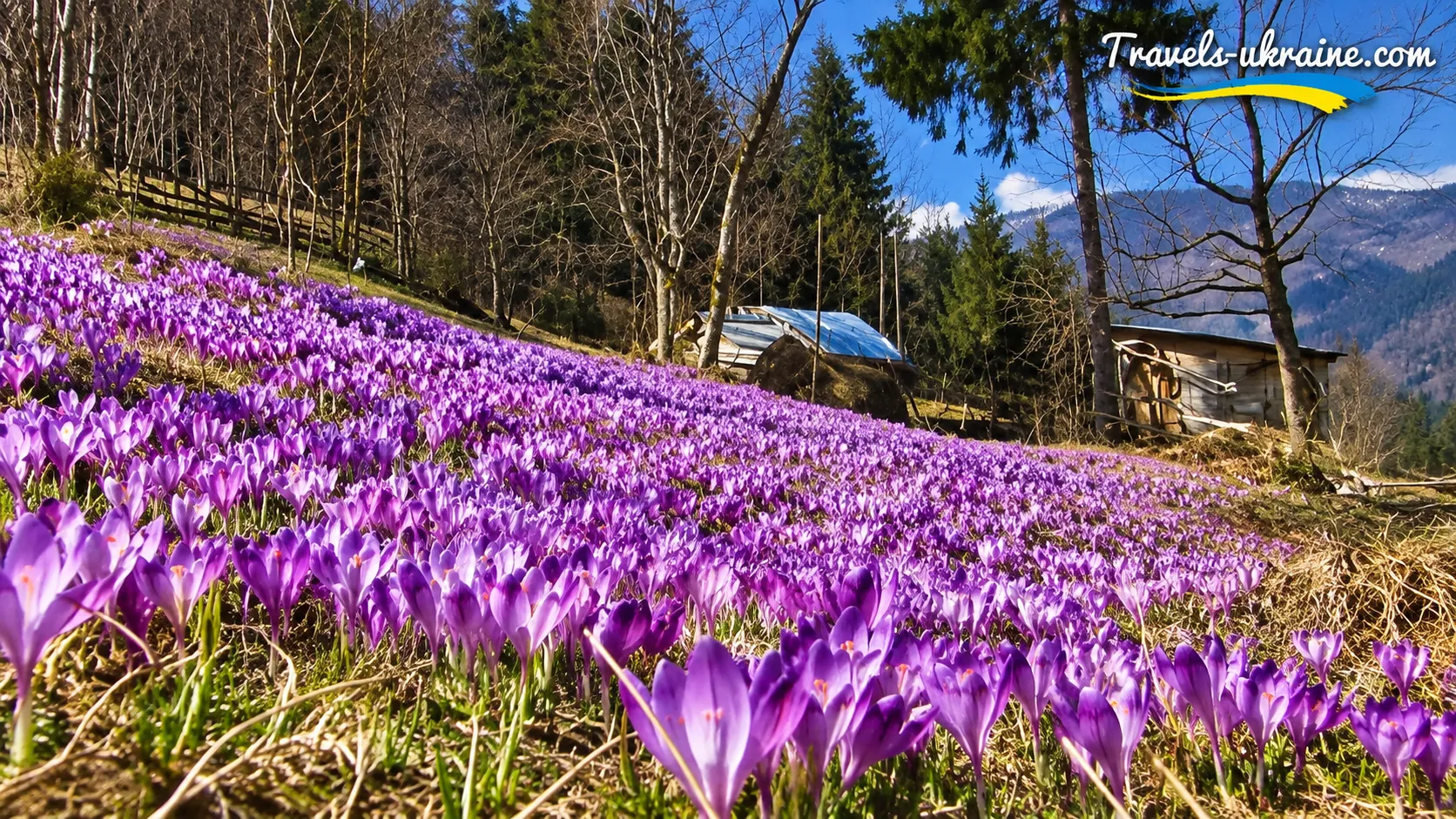
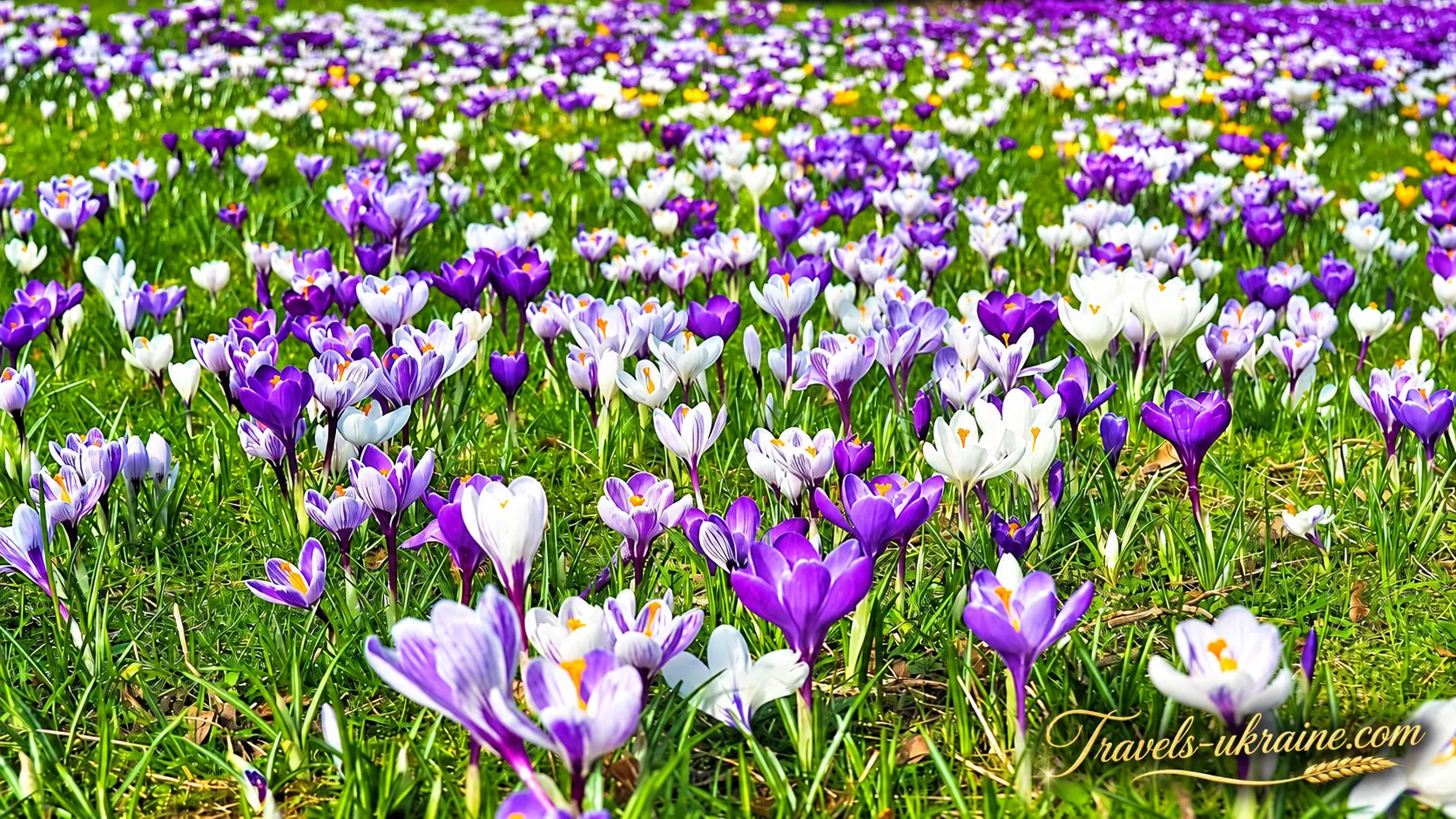
In early spring, Kolochava changes beyond recognition for several weeks. As soon as the snow retreats and the ground begins to warm, hundreds and eventually thousands of purple flowers appear among last year's grass. This is Heuffel's saffron—a wild Carpathian crocus whose mass flowering created one of Zakarpattia's best-known spring destinations, the Crocus Valley in Kolochava.
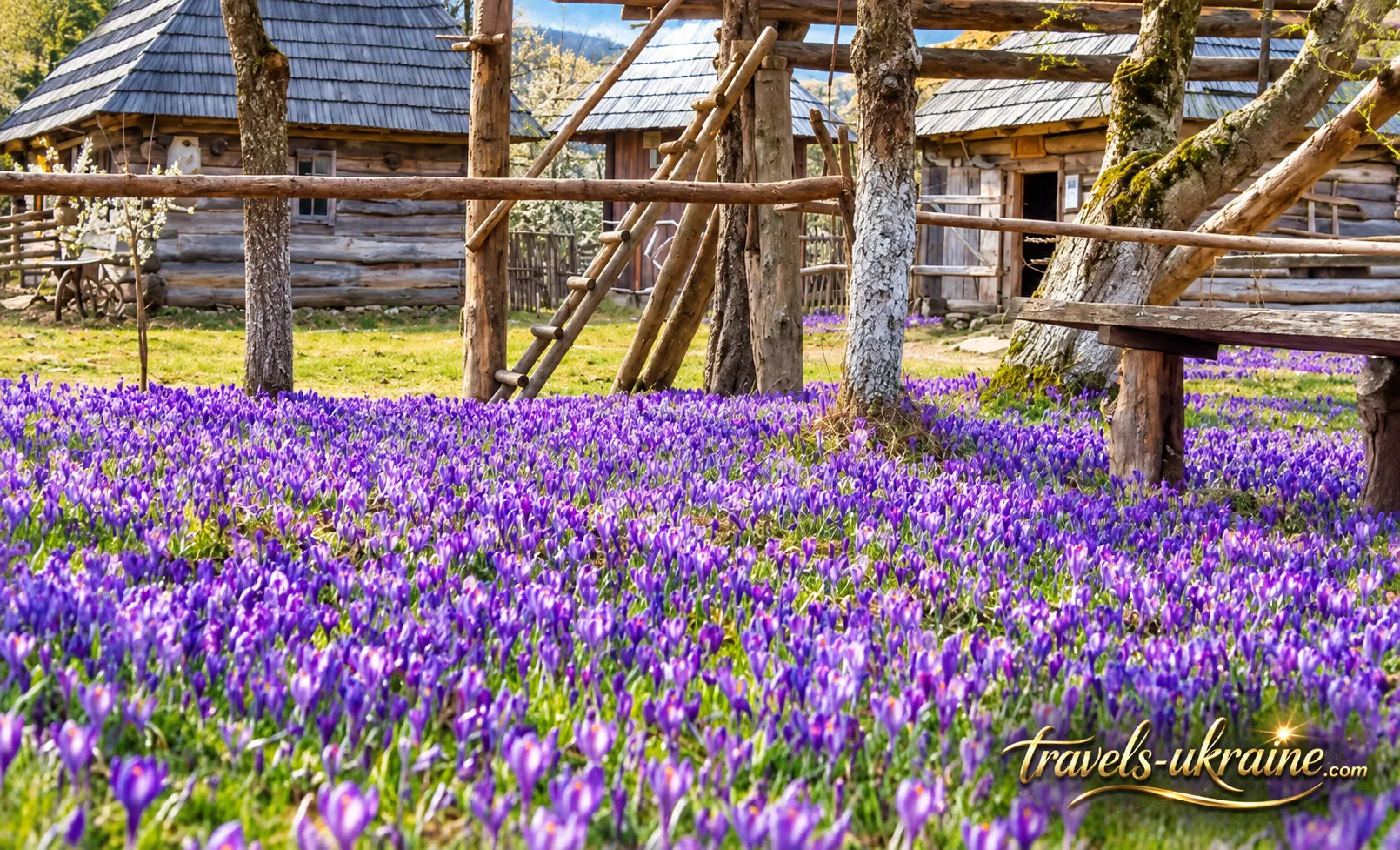
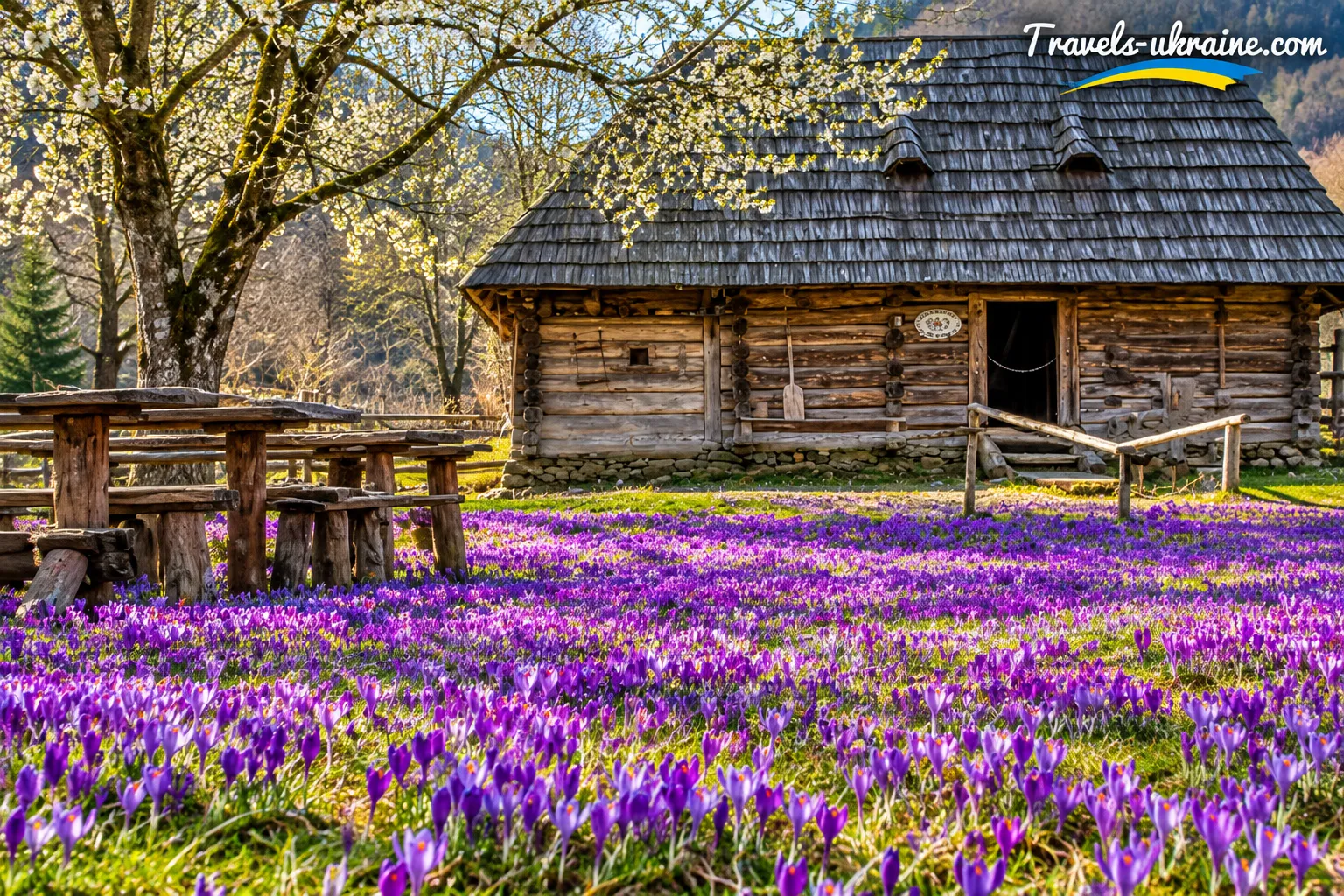
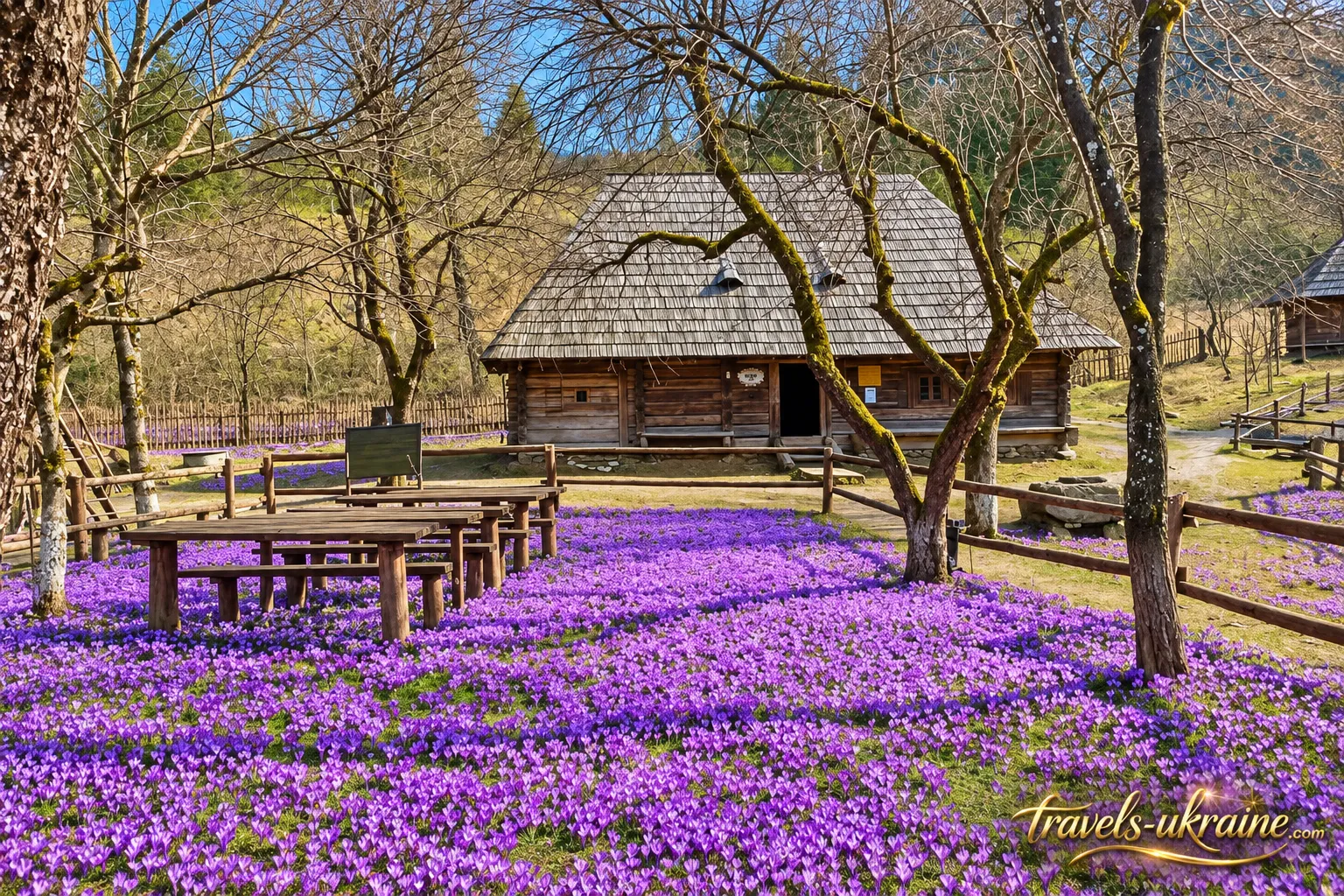
The name can be slightly misleading. Do not imagine a separate mountain valley that requires several hours of hiking with a backpack. Kolochava's best-known crocus meadows are located right on the grounds of the Stare Selo open-air museum. In other words, you can arrive by an ordinary road, enter the museum, and find yourself among old Carpathian houses, wooden outbuildings, and purple crocuses.
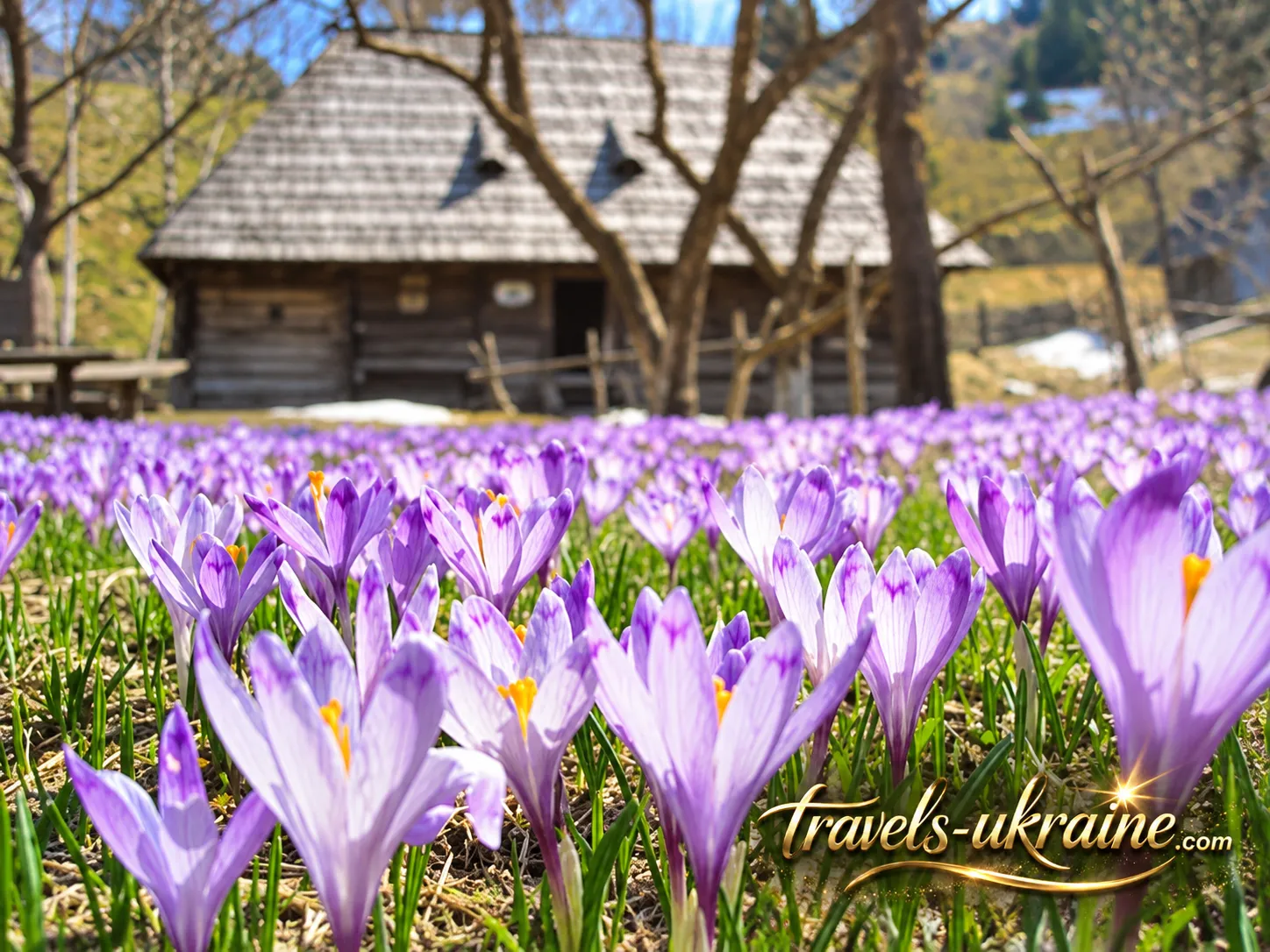
It is precisely the combination of nature and old architecture that makes this place special. This is an open-air museum of architecture and everyday life, with nearly two dozen buildings and outbuildings illustrating approximately 300 years of life in the Verkhovyna region. In spring, the museum gains another completely natural exhibition. Purple flowers appear beside wooden houses, old fences, paths, and farmyards. The result is a landscape difficult to confuse with an ordinary botanical garden: crocuses bloom literally amid a recreated old Carpathian village.
That is why people come here for more than flower photographs. In a single walk, you can see the Carpathians' spring bloom while also discovering Kolochava's traditional architecture, crafts, and way of life from past centuries. For travelers, this is far more interesting than simply visiting a field, taking a few pictures, and moving on.
The Purple Carpet That Appears Only Briefly
During peak bloom, some meadows become so densely covered with flowers that the green grass almost disappears beneath purple petals. But this landscape is highly seasonal. Heuffel's saffron is an early-spring plant: it takes advantage of the short period after the snow melts, when the trees have not yet developed dense foliage and other vegetation is only beginning to awaken. This brief flowering period makes the crocus bloom in Kolochava so desirable to travelers. Within a few weeks, the vivid meadows disappear and the museum returns to its usual green appearance. So simply planning to “drop by for the crocuses sometime in spring” is not the best approach: your travel date must be timed to nature.
Heuffel's Saffron and Culinary Saffron: Why Carpathian Crocuses Are Not a Spice
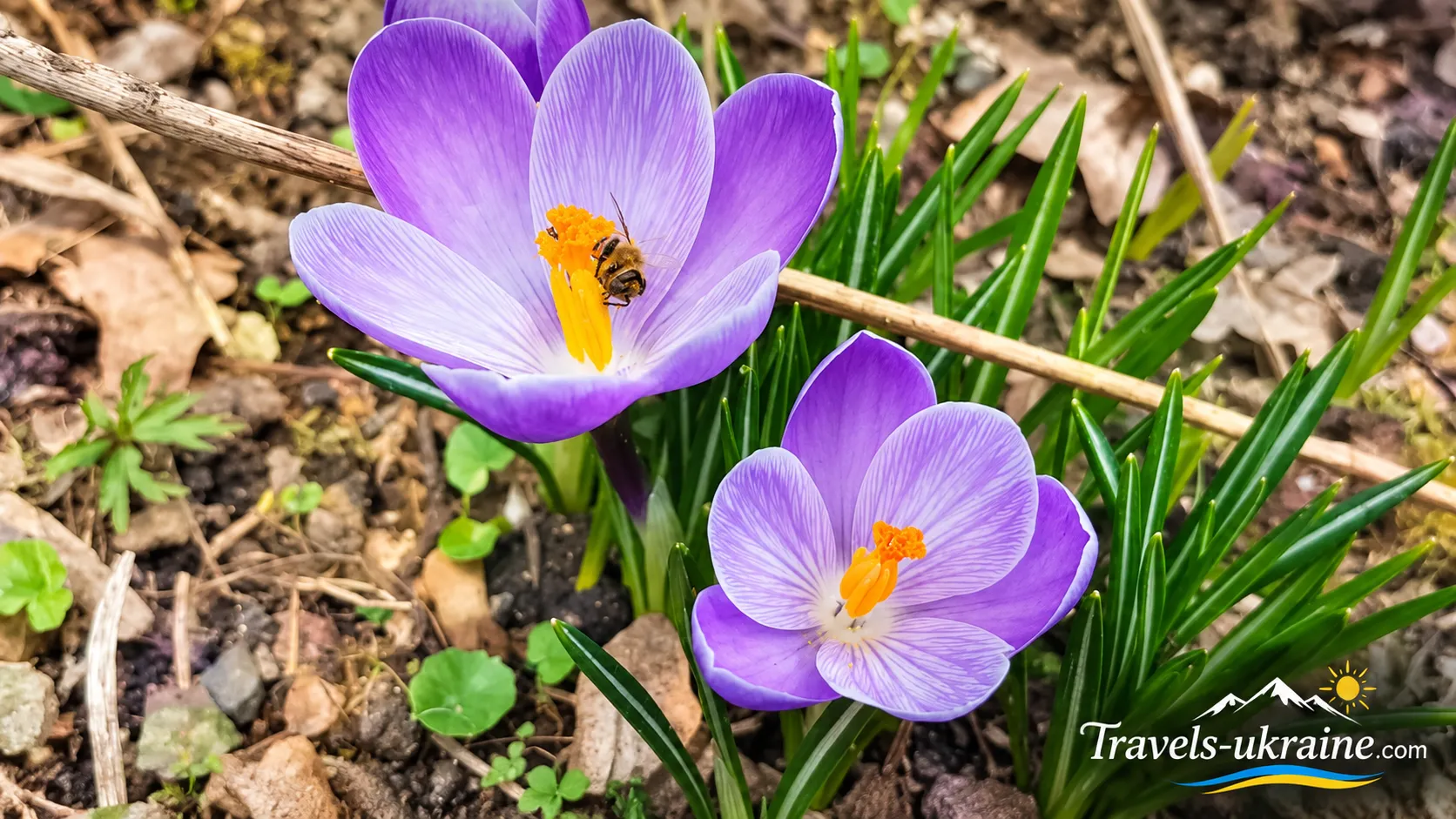
The name “Heuffel's saffron” is easy to misunderstand. Seeing crocuses in Kolochava in spring, you might think they are the same plant used to produce the expensive spice saffron. In fact, these are two different species of the same genus, Crocus, and their purposes are entirely different.
Carpathian crocuses are Heuffel's saffron (Crocus heuffelianus). It is a wild species native to the Carpathians and the Balkans. It is easy to recognize by its large purple flowers, which appear in early spring, sometimes literally beside patches of snow. These are the flowers that cover Kolochava's meadows with their characteristic purple carpet.
Which Crocus Actually Produces the Spice Saffron?
Culinary saffron comes from another plant—saffron crocus (Crocus sativus). This cultivated species has been grown for centuries specifically for its long red stigmas. They are collected by hand and dried, and this raw material becomes the aromatic red-orange spice sold in small quantities. The Royal Botanic Gardens, Kew, explicitly state that culinary saffron comes from the stigmas of Crocus sativus. Thus, similar names do not mean the plants are interchangeable: the famous spice is not produced from Heuffel's saffron blooming in the Carpathians.
Are Crocuses and Saffron Different Plants or Not?
In fact, the words “crocus” and “saffron” in this context do not refer to two separate groups of plants. Both flowers belong to the genus Crocus. “Crocus” is more common in everyday language and ornamental gardening, while Ukrainian botanical names use the word “saffron.” Thus, both Heuffel's saffron and saffron crocus are crocuses. But this is roughly like comparing different species within the same genus of trees: they are related, yet their properties and uses can differ considerably.
How Carpathian and Culinary Saffron Differ
Even their natural rhythms differ. Heuffel's saffron blooms in Ukraine in March–April, which is why it has become one of the symbols of early Carpathian spring. Saffron crocus is grown as a cultivated plant for its spice, and its economic value lies specifically in the flower's stigmas.
For Heuffel's saffron, the opposite is true: its main value is natural and conservation-related. In Ukraine, the species is listed in the Red Data Book. It is prohibited to pick the plants, dig up their corms, or trample their mass-growth sites. So the idea of collecting a few “saffrons for the kitchen” in Kolochava is wrong for two reasons. First, this is not the species used to make the spice. Second, wild Carpathian crocuses are protected, and their place is in spring meadows, not in a traveler's basket.
This very confusion makes Heuffel's saffron even more interesting to travelers. Its name connects it with one of the world's most expensive spices, but the true richness of the Carpathian crocus is entirely different: for several weeks each year, it transforms mountain meadows into a purple spring landscape that cannot be preserved in a spice jar.
When Crocuses Bloom in Kolochava and How to Catch the Peak
For the Crocus Valley in Kolochava, choosing the right travel date determines almost everything. Heuffel's saffron blooms only briefly: one week, the meadows may just be beginning to show scattered purple flowers, while a few warm days later visitors may find an entirely different scene. A little more time, and the spring spectacle gradually disappears until the following year.
Ukraine's Red Data Book gives March–April as the flowering period for Heuffel's saffron. Local tourism sources for Kolochava identify the same window: the first flowers may appear as early as the beginning or middle of March, while mass flowering, depending on the particular spring, lasts approximately until the first half of April, sometimes longer. Therefore, there is no single universal date when “the Crocus Valley will definitely be purple.”
Why Crocuses Bloom at Different Times Each Year
The main guide for Heuffel's saffron is not the calendar but snowmelt and soil warming. After a warm winter with little snow, the first flowers may appear earlier. If the snow remains longer, March is cold, and freezing temperatures persist at night, the start of mass flowering is delayed.
That is why photographs from Kolochava taken on the same date in different years can look completely different. For example, local reports in some seasons recorded the first mass flowering as early as mid-March, while in other years the main bloom unfolded closer to the end of the month. Even Kolochava's official tourism pages give different dates for different seasons—and that is normal for a natural phenomenon.
When Is the Best Time to Go for Purple Meadows?
If the main purpose of your trip is to see the mass crocus bloom in Kolochava, I would primarily aim for the second half of March and the beginning of April. But treat this period only as a guide, not as a guaranteed calendar. The best strategy is to check recent photographs and updates from the Stare Selo Museum or Kolochava tourism resources about a week before your planned trip. Check again a day or two before departure. For such a seasonal destination, this is far more reliable than booking a trip months in advance based solely on a calendar date.
It is also important to understand that the idea of «peak bloom» is relative. One meadow may already be filled with flowers, while on a neighboring one they are only beginning to open. Sunshine, remaining snow, moisture, and even slight differences in terrain all influence this.
What to Do If the Crocuses in Kolochava Have Already Finished Blooming
Missing the season in Kolochava does not mean that seeing crocuses in the Carpathians this year is already impossible. In the mountains, spring moves upward gradually. The higher the elevation, the longer the snow remains and the later vegetation awakens. Therefore, after flowering ends in the lower valleys, Heuffel's saffron can still be found on high-altitude mountain meadows and slopes. We will use this feature later when exploring where else to see crocuses in the Carpathians and how to extend the purple-flower season by several weeks.
So the main rule for planning your trip is very simple: do not look for one magical date. Follow the actual spring in Kolochava. Snow, temperature, and sunshine determine when the grounds of Stare Selo turn into the purple Crocus Valley that draws visitors here each spring.
Where Else to See Crocuses in the Carpathians
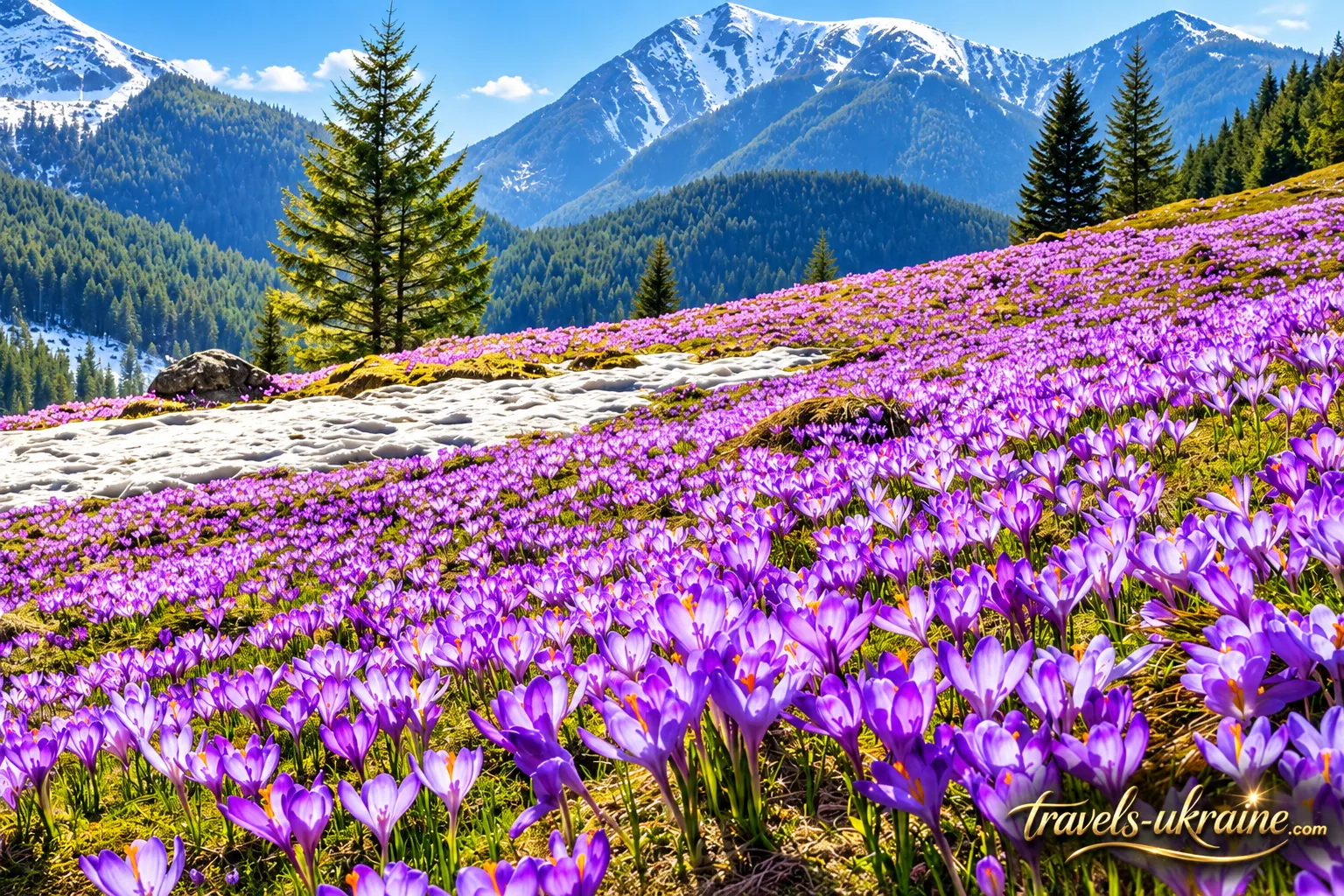
Kolochava is far from the only place where Heuffel's saffron blooms in spring. The species occurs across different elevation zones of the Ukrainian Carpathians, so purple meadows can be found both near settlements and on high mountain pastures. The main difference is timing: when crocuses have already finished blooming in the valleys, spring is only beginning higher in the mountains. This feature makes it possible to “extend” the season to some extent. If you did not make it to Kolochava during peak bloom, that does not mean you have to wait until next year. Look toward higher Carpathian routes, where the snow melts later.
Zakukul Mountain Pasture—Crocuses with a Chornohora Panorama
One of the best-known mass-flowering sites is Zakukul mountain pasture near Mount Kukul. The Carpathian National Nature Park explicitly notes that in spring this pasture becomes a purple-lilac field thanks to the mass flowering of Heuffel's saffron. The experience here is entirely different from Kolochava. Instead of old wooden houses, open mountain meadows surround you, while the Chornohora Range stretches across the horizon. In clear weather, you can admire a panorama of the highest part of the Ukrainian Carpathians, with hundreds of purple flowers filling the foreground in spring.
However, this is a full mountain hike. You must walk to the pasture, so comfortable footwear, suitable clothing, and a weather check are essential. In spring, snow, wet sections, and mud may still remain along the route.
Chornohorytsia Mountain Pasture—Spring Crocuses Above Yaremche
Another confirmed location is Chornohorytsia mountain pasture in the Carpathian National Nature Park. A marked hiking trail leads there from the Yaremche area through forest sections and the Divchi Slozy waterfall. Heuffel's saffron also blooms on the pasture in spring. This is a good option for travelers who want to combine searching for crocuses with a hiking route through the Carpathians rather than traveling specifically to a single flower meadow.
At the same time, do not expect the flowers to form an equally dense carpet every year or along every meter of the route. Crocuses remain wild plants, and their numbers and flowering dates depend on snow, moisture, temperature, and the specific section of the slope.
Synevyr National Nature Park—not Just Kolochava
Many natural populations of Heuffel’s crocus are also protected in Synevyr National Nature Park. According to the park itself, numerous populations grow in Kolочava, Synevyr, Kvasovets, Sukhar, Nehrovets and Vilshana. So in spring, crocuses can be found not only near the “Old Village” Museum. They appear in meadows, clearings and natural areas in different parts of the park. For visitors, this once again shows that the “Crocus Valley” in Kolочava is the best-known tourist spot, but not the only natural place where crocuses grow in the area.
Why crocuses bloom later high in the mountains
Spring does not arrive in the Carpathians all at once. In the valleys, the snow may have disappeared long ago, while substantial snow patches still remain on the high mountain meadows. Heuffel’s crocus often begins to bloom soon after the ground is freed from snow, so the season gradually shifts as the elevation increases. That is why the first crocuses can be seen in Kolочava as early as March, while on high-altitude meadows the purple bloom may continue into April and sometimes reach the beginning of May. This is not a fixed calendar: everything depends on how snowy the winter was and how quickly it warmed up in spring.
There is a simple rule of thumb for visitors: the higher you plan to climb, the later you should look for peak bloom. Before a mountain trip, however, it is better to check not only photos of the crocuses but also the condition of the route—early spring in the valley and early spring at elevations above one thousand metres can be two entirely different seasons. So if you want to see crocuses in the Carpathians without a challenging route, Kolочava remains one of the most convenient options. And if you would like to combine purple flowers with a mountain hike and sweeping panoramas, the high mountain meadows offer a completely different kind of spring journey.
What to see near the Crocus Valley in Kolочava
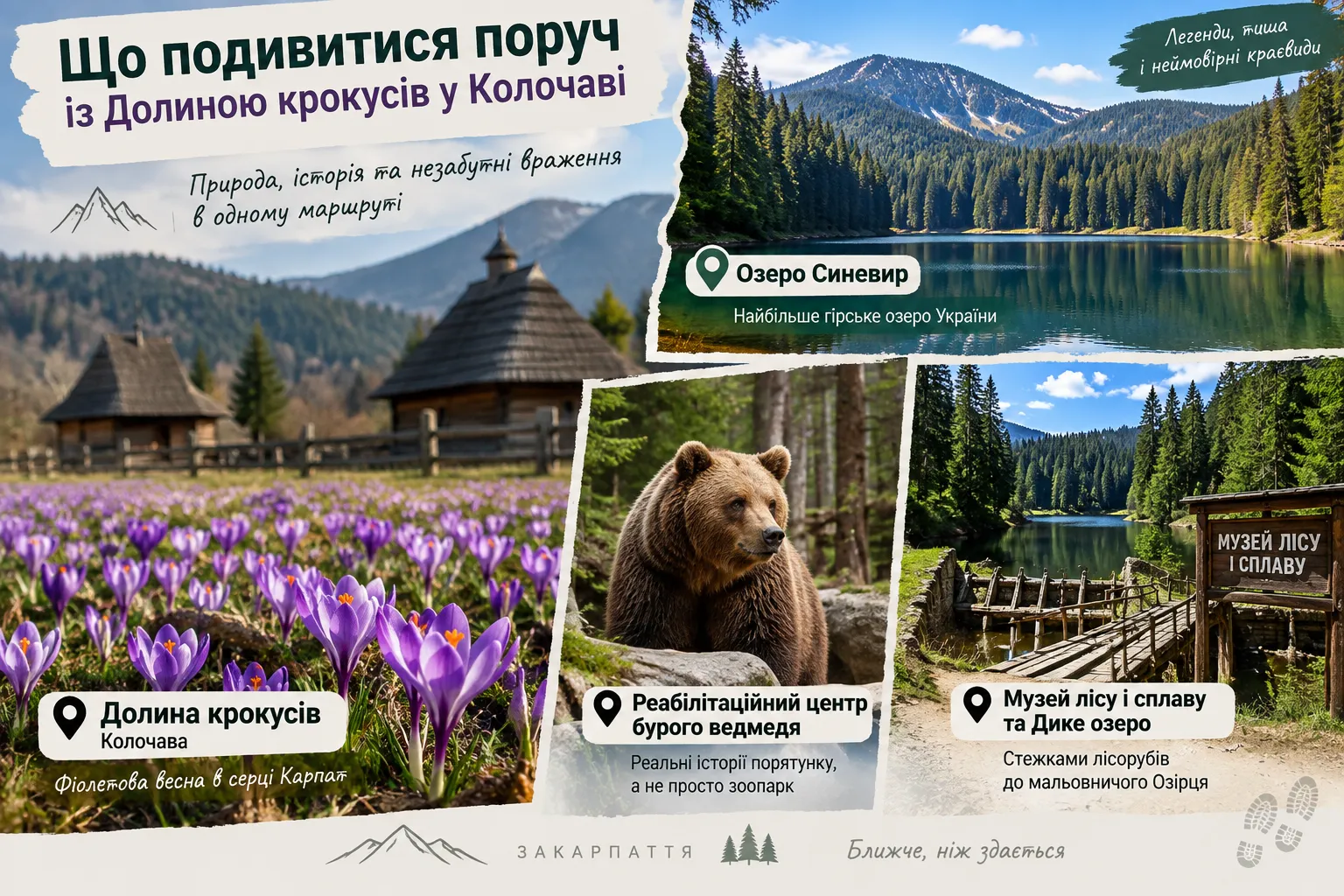
Crocuses in Kolочava can easily be just the first stop on a spring trip through this part of Zakarpattia. Kolочava lies within Synevyr National Nature Park, so nearby you can readily combine the ethnographic “Old Village” with mountain lakes, forests and an introduction to the wild nature of the Carpathians. The most obvious continuation of the route is therefore Lake Synevyr. It is Ukraine’s largest natural mountain lake and the national park’s main tourist attraction. The lake lies among dense spruce forests, so after Kolочava’s purple meadows you encounter a completely different Carpathian landscape.
A road about 1.2 km long leads from the checkpoint to the lake, and walking paths have been arranged around the water. For a leisurely visit to Synevyr, it is better not to plan a ten-minute stop: walking by the water, seeing the lake from different angles and resting a little in the forest is much more enjoyable without rushing. The combination is especially beautiful in spring: crocuses are already blooming below, while snow may still remain on the slopes around Synevyr. In a single day, you can literally see different stages of Carpathian spring.
Brown Bear Rehabilitation Centre
Another worthwhile stop is the Brown Bear Rehabilitation Centre. It has operated within Synevyr National Nature Park since 2011 and was created for animals that suffered abuse or prolonged confinement in unsuitable conditions.
This is important: the centre is not an ordinary zoo. The bears live across a large forest area of about 12 hectares, with enclosures, pools and dens. According to the national park, around three dozen animals rescued from circuses, entertainment venues and other unacceptable conditions are rehabilitated here at any one time. This stop is usually especially interesting for children, but it is educational too: each bear has its own story of rescue, and a visit helps visitors understand why wild animals should not be turned into entertainment.
Forest and Rafting Museum and Dyke Lake
If you would prefer a quieter, more natural walk, consider the Forest and Rafting Museum and the tourist trail to Ozirеts, or Dyke Lake. This offers an introduction to another side of the Carpathians—the history of lumberjacks and raftmen who once floated timber down mountain rivers. In the mid-19th century, a dam was built on the Chorna River to collect water for floating timber. The museum at the historic dam was damaged by floods and is now being restored, while the surviving exhibits can be seen at the visitor centre of Synevyr National Nature Park.
The official «Forest and Rafting Museum—Ozirets (Dyke Lake)» nature trail begins at this location. It is approximately 4 km long, has an easy difficulty level and takes about 1.5–2 hours. At the end, hikers are rewarded with a small forest lake at an elevation of about one thousand metres above sea level. In this way, a trip to the crocuses can easily become a full day in the Carpathians: see the purple bloom among Kolочava’s old houses in the morning, visit the bears, and finish the day at Synevyr or on the quieter forest trail to Dyke Lake. All these places reveal completely different sides of the same region.
Frequently asked questions about the Crocus Valley in Kolочava
Where is the Crocus Valley located?
The best-known Crocus Valley in Kolочava is located on the grounds of the «Old Village Kolочava» museum complex in the village of Kolочava, Khust Raion, Zakarpattia Oblast. The museum’s address is 24 Druzhby Street. In spring, Heuffel’s crocus blooms profusely among the old wooden homesteads and museum exhibits.
When do crocuses bloom in Kolочava?
The first flowers usually appear in March, while peak bloom most often falls in the second half of March and may last until early April. The exact timing changes each year depending on snow, temperature and how quickly spring arrives, so it is best to check the museum’s latest updates before travelling.
How much does admission to the Crocus Valley cost?
The crocuses grow on the grounds of the «Old Village Kolочava» museum complex, so access is included with the museum ticket. Prices may change, so check them on the museum’s official page before travelling.
What are the opening hours of the «Old Village» Museum?
The «Old Village Kolочava» museum complex is open daily from 09:30 to 18:00. During peak crocus season, the site is particularly busy on weekends, so for a more peaceful walk it is better to arrive in the morning or on a weekday.
How much time is needed to visit the Crocus Valley?
Plan approximately 1.5–2 hours for a full visit. This is enough to see the blooming meadows, explore the «Old Village», visit the «Kolочava Narrow-Gauge Railway» and see the other museum exhibits without rushing.
Is it worth visiting the crocuses with children?
Yes. It is a convenient family destination, as the crocuses can be seen without a challenging mountain climb. Besides the flowers, children are usually interested in the old Carpathian houses, outbuildings and the «Kolочava Narrow-Gauge Railway» exhibit. At the same time, children should be told in advance that they must not enter the blooming meadows or pick the crocuses.
Can visitors take photos among the crocuses?
You may photograph the crocuses, but do not enter dense stands or lie among the flowers for a photo. Heuffel’s crocus is listed in the Red Book of Ukraine, and its habitats must not be trampled. The best photographs can be taken from the paths or the edge of the meadow, using the museum’s old wooden buildings as a backdrop.
Can visitors pick crocuses in Kolочava?
No. Picking Heuffel’s crocus, trampling its habitats and digging up its corms are prohibited. It is best to leave the flower in the meadow and take only photographs with you.
Can the crocuses of Kolочava be used to make the spice saffron?
No. Kolочava is home to Heuffel’s crocus (Crocus heuffelianus), while the culinary spice is obtained from an entirely different species—saffron crocus (Crocus sativus). The dried red stigmas of its flowers are used as the spice. Carpathian Heuffel’s crocus is not used to produce it.
Is the Crocus Valley in Kolочava worth visiting?
The Crocus Valley in Kolочava is one of those spring destinations where nature itself determines the best time to travel. A few warm days can turn ordinary meadows beside old Carpathian houses into a purple sea of Heuffel’s crocuses, while just a few weeks later, all that remains of the spectacle is photographs until the following spring.
Kolочava’s main advantage is that you do not need to tackle a challenging mountain route to see the crocuses. Peak bloom can be enjoyed right on the grounds of the «Old Village» open-air museum, combining the natural attraction with traditional architecture, the history of the Verkhovyna region and museum exhibits.
At the same time, Carpathian crocuses are not merely a beautiful backdrop for spring photographs. Heuffel’s crocus is a protected wild species, so the best way to preserve this beauty is to admire the flowers without stepping into the thickets or picking them. A violet meadow is far more valuable when it remains alive rather than being turned into a short-lived bouquet.
If the season in Kolochava has already ended, there is no need to postpone your spring trip for a year. Snow melts later higher in the Carpathians, so crocuses in the mountain meadows can still be found when they have already finished blooming in the valleys. This makes it possible to follow Carpathian spring literally—from Kolochava to the high-altitude meadows.
And if you add Lake Synevyr, the Brown Bear Rehabilitation Center, and other sites in Synevyr National Nature Park to your trip, an ordinary journey to “see the crocuses” can easily become a complete spring route through Zakarpattia.

No Comment
You can post first response comment.