
 English
 Українська
 Български
 Hrvatski
 Čeština
 Dansk
Dansk Nederlands
 Eesti
Eesti Suomi
Suomi Français
 Deutsch
 Ελληνικα
 Magyar
 Íslenska
 Italiano
 Latviešu
 Lietuvos
 Polski
 Português
 Română
 Русский
 Српски
 Slovenčina
 Slovenščina
 Español
 Svenska
 Türkçe
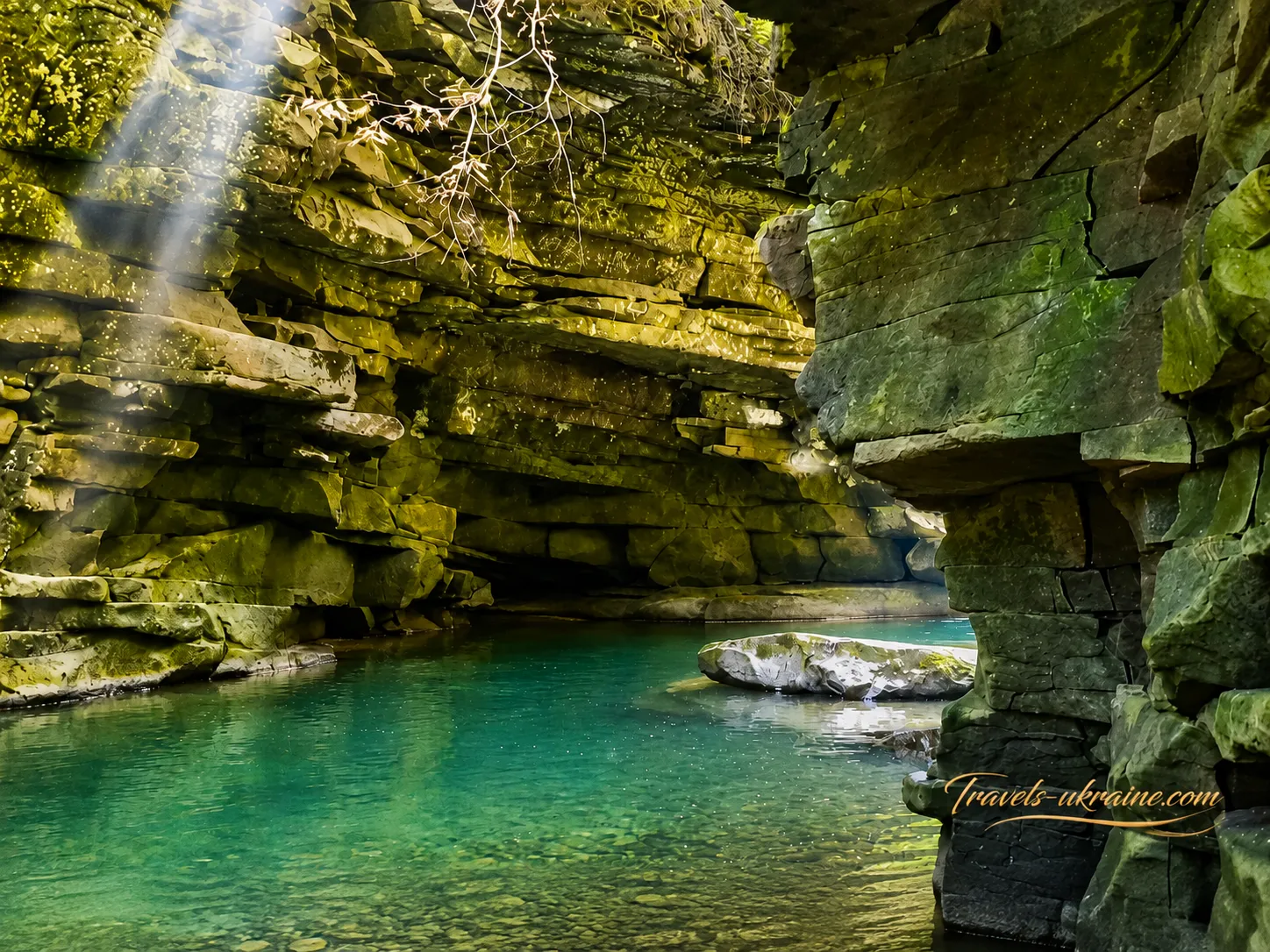
There are places in the Carpathians that impress with the breadth of their panoramas, and others where nature works quite differently—as if it compresses the space around the traveler and makes them look more closely at every detail. Chemehiv Canyon in Mykulychyn is one of those places. Instead of a distant horizon, there are stone walls; instead of an open mountain meadow, a narrow mountain gorge; and water, carving its way between the rocks, takes center stage in the landscape.
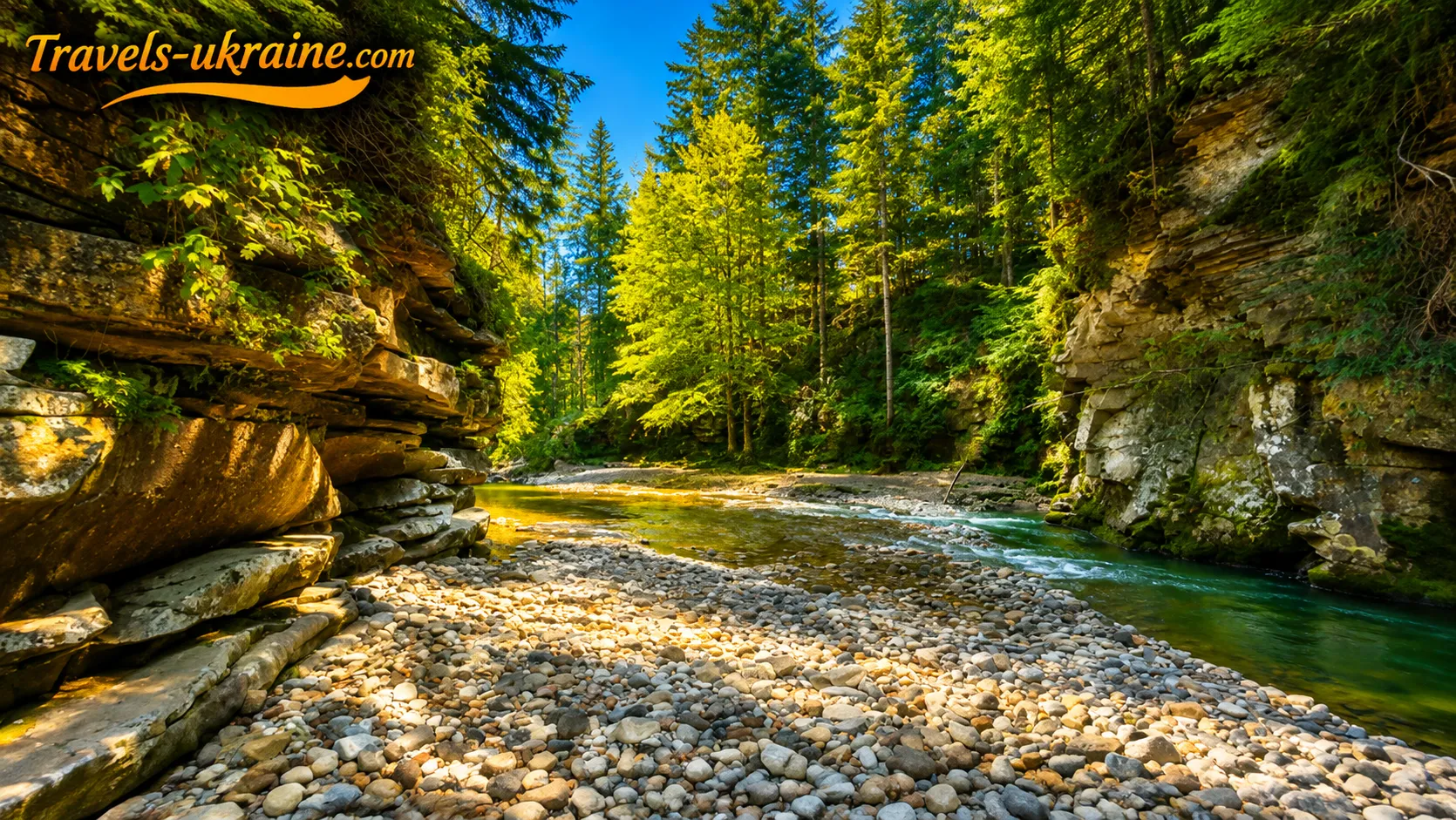
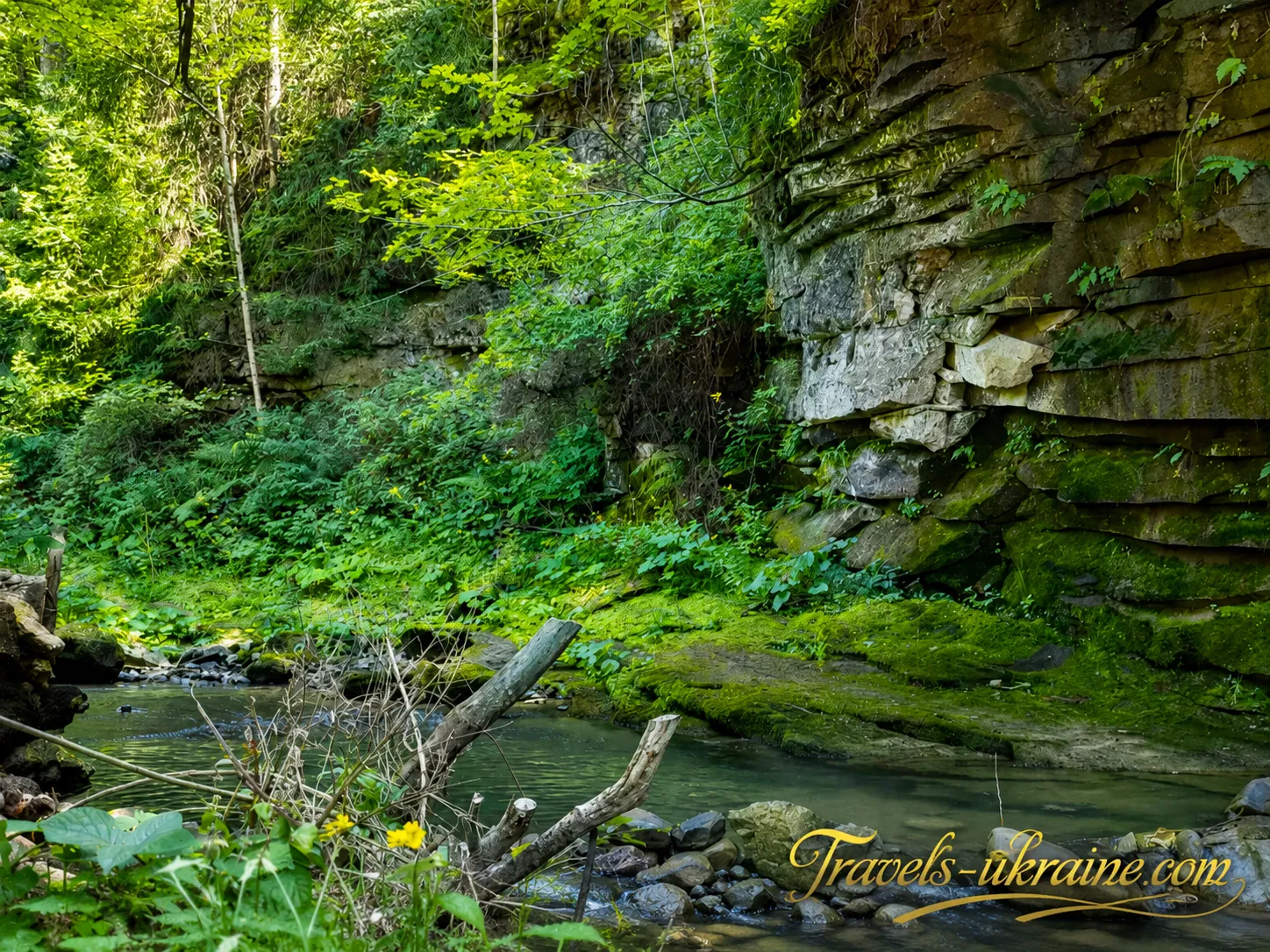
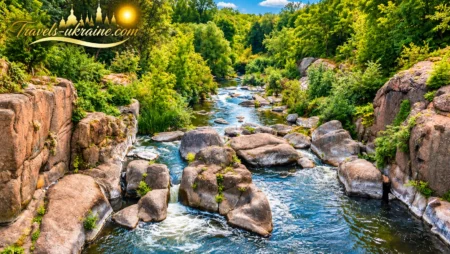
Chemehiv Canyon formed in the valley of the Prutets-Chemehivskyi River near Mykulychyn. The water flows between layers of rock, curves around large boulders, and forms small pools, while the rock walls are covered in places with moss, tree roots, and dense Carpathian vegetation. It is this combination of stone, water, and forest that creates a landscape behind the evocative names found in travel descriptions, such as «Carpathian tropics», «Carpathian jungle», or even «Carpathian Amazon».
Of course, no one promised real tropics in the foothills of the Carpathians—you will have to leave the palm tree for your photo at home. But in the warmer months, when the rocks are covered in rich greenery and the water takes on greenish-emerald hues, scenic Chemehiv Canyon truly looks unusual, even alongside many of the famous natural sites of the Ukrainian Carpathians.
Why Scenic Chemehiv Canyon Deserves a Trip of Its Own
The appeal of this place lies not in a single viewpoint or isolated rock. The canyon in the village of Mykulychyn is best experienced as a short journey through nature, where the scenery changes literally every few dozen meters. In one place, the river is squeezed between rocky banks; elsewhere, a calmer pool opens up; farther on, rock ledges overhang the water, while sunlight filters through the tree canopies and reflects off the stream.
That is why Chemehiv Canyon in the Carpathians appeals not only to those looking for beautiful places to take photographs. Visitors come for walks through the wilderness, the cool air beside mountain water, the unusual terrain, and the chance to exchange busy resort routes for a completely different Carpathian landscape for a few hours.
Moreover, the gorge itself is only one part of this fascinating area. During a trip here, tourists often combine Chemehiv Canyon with the Blue Lagoon, nearby waterfalls, forest roads, and other natural attractions. This makes it easy to turn the outing from a brief stop for a few photos into a full day of enjoying nature in the Carpathians.
The History of Chemehiv Canyon: How the Stone Gorge in Mykulychyn Was Formed
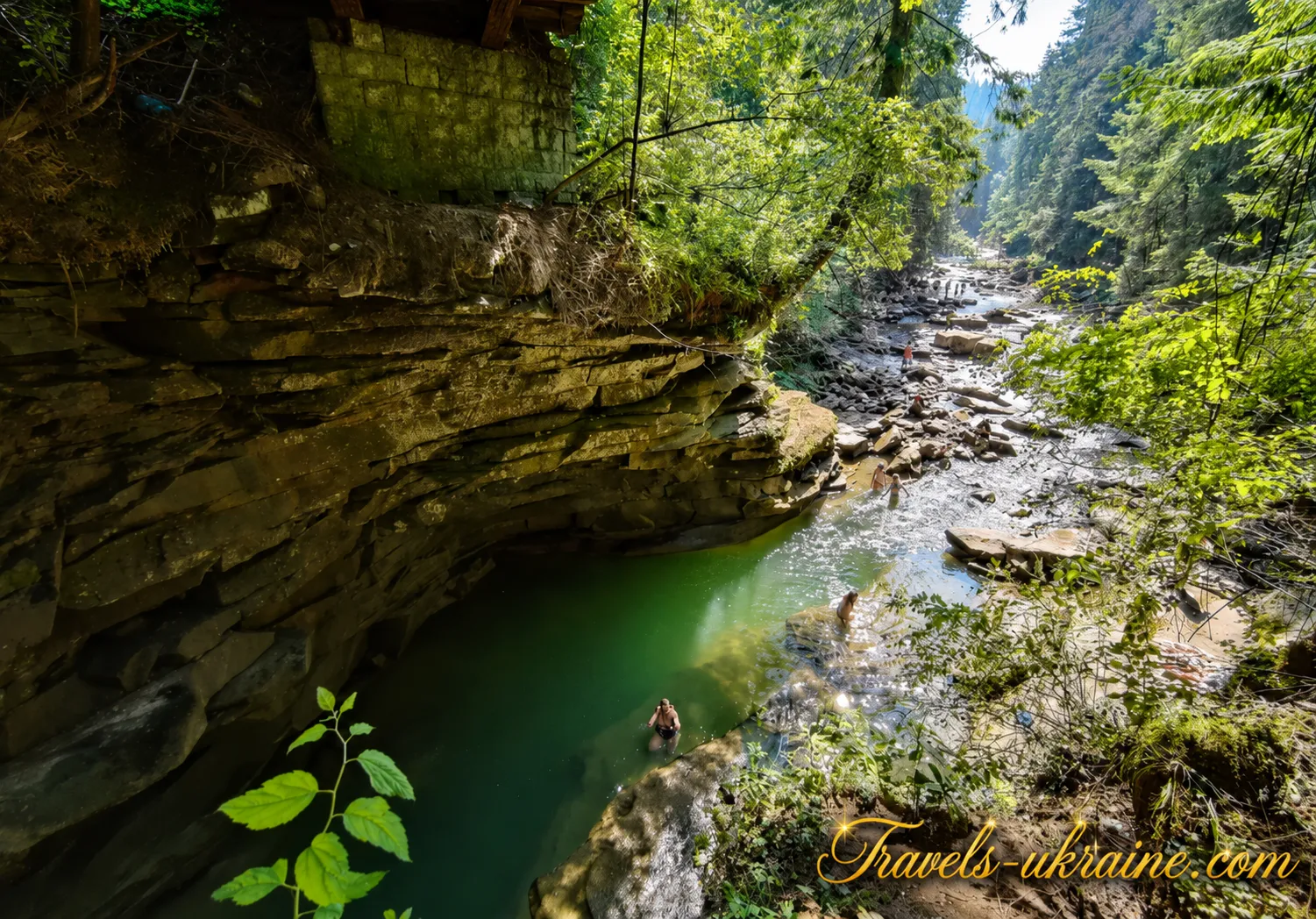
The history of Chemehiv Canyon began long before roads were built here, tourist lodges appeared, and the first travelers began looking for unusual places to photograph. This corner of the Carpathians has no founding date, grand opening, or architect’s name. Its principal creator was nature itself—above all, the water that gradually reshaped the rocky bed of the Prutets-Chemehivskyi and formed the characteristic narrow gorge.
The mountain stream constantly carries sediment, erodes weaker sections of rock, polishes stones, and follows natural cracks in the rock mass. These processes happen very slowly but continuously. The effect of the water is especially noticeable during floods, when the speed and force of the current increase sharply. That is why today the canyon in Mykulychyn has uneven rock walls, stone ledges, narrowed sections of riverbed, small natural basins, and areas where the water literally carves a path between huge boulders.
The exact geological age of the modern form of Chemehiv Canyon is not specified in official descriptions, so claims such as «the canyon is several million years old» should be treated with caution. It is far more accurate to say that this stone gorge in the Ukrainian Carpathians is the result of long-term natural processes—erosion, weathering, flowing water, and the gradual breakdown of mountain rock.
That is why the rocks of Chemehiv Canyon should not be viewed as a static backdrop. The gorge continues to change today: water undercuts the banks, frost widens cracks in the stone, plant roots take hold on the ledges, and after floods, individual sections of the riverbed may look somewhat different. The Carpathian landscape here is literally alive.
Mykulychyn and Chemehiv Canyon in the Historical Context of the Carpathian Foothills
Although there is virtually no documentary chronicle of Chemehiv Canyon in Mykulychyn itself, the surrounding area has a much longer human history. The first known written mention of Mykulychyn dates to 1412. Over the following centuries, the settlement developed in the mountain valley of the Prut, where the lives of local residents were closely tied to forests, mountain meadows, rivers, and routes across the Carpathians.
Mykulychyn is also known in the context of the opryshky movement, which existed in the Carpathians for several centuries. The mountainous terrain, dense forests, secluded valleys, and numerous natural shelters provided an environment where the opryshky could hide and move between settlements. Historical sources mention opryshky leaders associated with Mykulychyn, but there is no documentary evidence that Chemehiv Canyon was used by specific bands or directly connected with Oleksa Dovbush.
This clarification is important because search queries such as «Chemehiv Canyon Dovbush» or «the canyon from the Dovbush film» may create the impression that confirmed historical sites directly connected with the legendary opryshok have survived here. In reality, it is important to distinguish between the history of the opryshky movement in the Carpathians and the much more recent cinematic history of the location. We will return to that separately.
Why the Mountain Gorge Remained Outside Mainstream Tourist Routes for So Long
Unlike major waterfalls, famous peaks, or historical landmarks, small natural gorges long remained simply part of the ordinary local landscape. For residents of nearby villages, such streams, rocks, forest roads, and natural areas were not separate «tourist attractions»—they were part of the environment where they worked, went into the forest, grazed livestock, or traveled from one part of the mountain region to another.
The situation changed with the development of tourism in the Yaremche region. Travelers began looking beyond the best-known attractions to less obvious interesting tourist places: forest paths, small waterfalls, natural lagoons, rocky outcrops, and wild valleys carved by mountain streams. Against this backdrop, the lagoon in Mykulychyn gradually evolved from a little-known natural area into a tourist destination in its own right.
The gorge’s appearance also helped spread its popularity. Its narrow riverbed, dense forest, moss-covered rocks, and clear mountain water look striking in photographs and videos, so the canyon began appearing frequently in travel publications and social media. This is how it became known to people who had previously visited Mykulychyn mainly as a convenient base for trips to Yaremche, Tatariv, Vorokhta, or farther into the mountains.
From Natural Gorge to Mykulychyn Tourist Attraction
Today, Mykulychyn and Chemehiv Canyon are increasingly mentioned together. For the village, this location has become another reason not merely to pass by on the way to better-known Carpathian resorts, but to stop and explore the surrounding area. Much of the site’s appeal is preserved precisely because there is no excessive urban development within the gorge itself.
There is no need to invent medieval mysteries or embellish the past with romantic stories. The true history of Chemehiv Canyon in the Carpathian foothills is fascinating simply because it is unfolding right now. Water is reshaping the stone, vegetation is gradually taking over new sections of rock, and a place once known mainly to local residents and experienced travelers is becoming one of Ukraine’s most recognizable natural attractions.
And while we are accustomed to measuring the history of settlements in centuries, the history of the canyon is better read directly in its terrain: in the layers of stone, water-polished surfaces, cracks in the rocks, and the bed of the Prutets-Chemehivskyi. These natural details best explain the origins of the unusual scenic Carpathian gorge we know today as Chemehiv Canyon.
Natural Features of Chemehiv Canyon
When viewed only in photographs, the canyon’s water attracts the most attention. Yet once there, you quickly realize that the true character of this place is created by the combination of several natural elements: a narrow rocky riverbed, exposed layers of rock, dense forest, moisture, and vegetation that in places literally takes over the rock walls. This is precisely what makes Mykulychyn Canyon so different from open Carpathian mountain meadows and panoramic mountain routes.
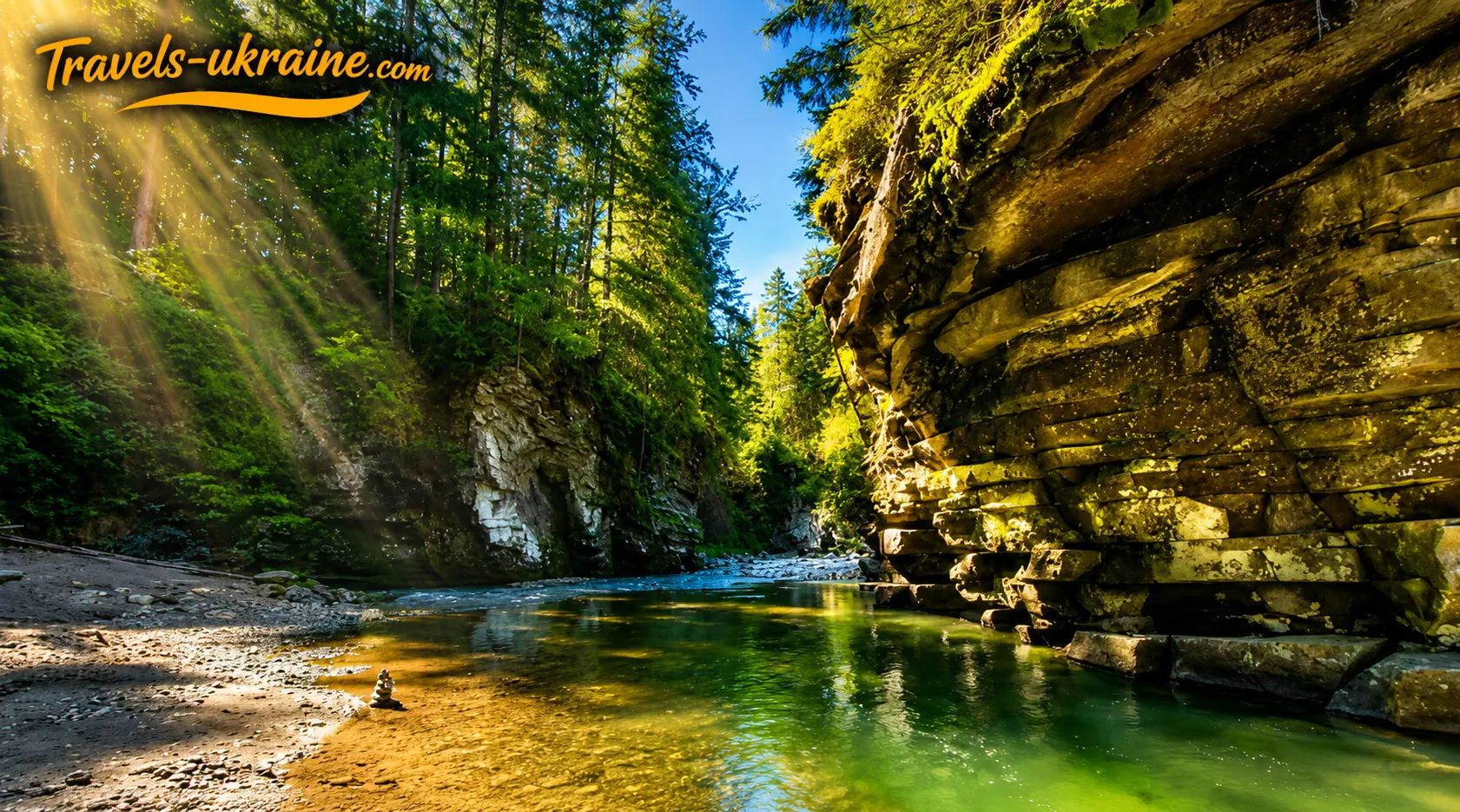
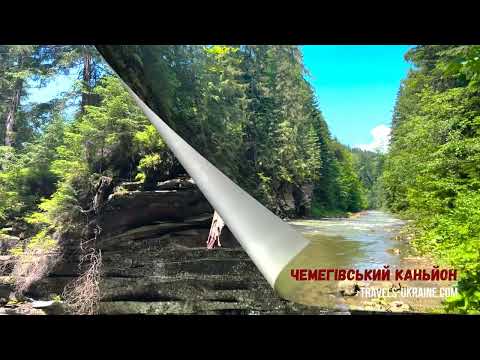
The Prutets-Chemehivskyi carved its way through the rocky terrain, creating a long natural gorge in the middle of the forest. Along different sections, the riverbed widens and then narrows again between the rocks. In some places, the water flows calmly between stones; in others, it speeds up over small drops and rapids. Because of this variety, one part of the route may resemble an ordinary mountain river, while just a few minutes later a true stone canyon with vertical and sloping walls opens before the traveler.
The Rocks of Chemehiv Canyon and Its Geological Outcrops
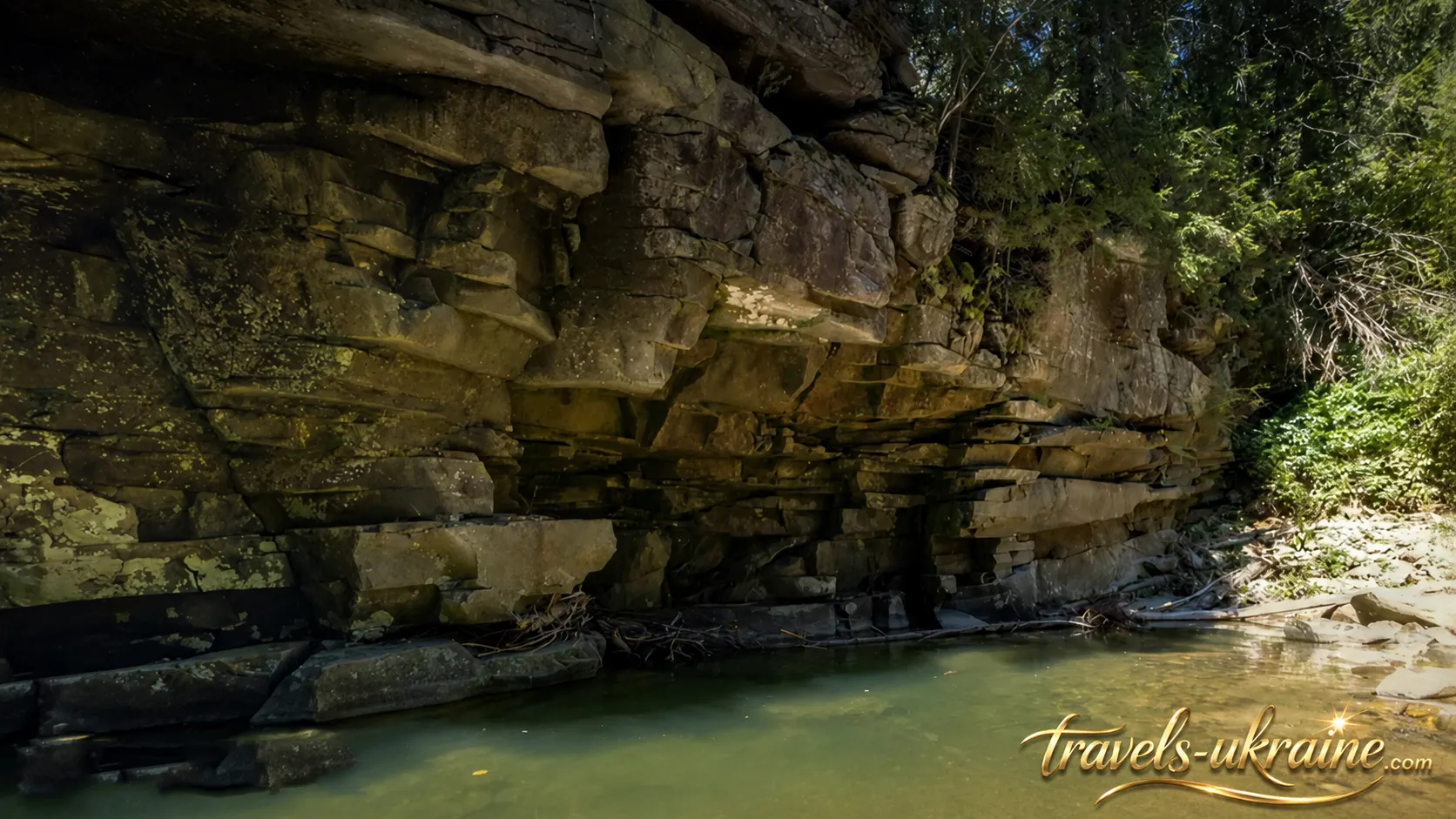
One of the area’s most fascinating features is the canyon’s rock walls. Water has exposed some of the bedrock, making its layered structure clearly visible on the gorge walls. These open sections are known as geological outcrops: instead of soil and vegetation, the mountain’s rocky foundation is visible directly before you.
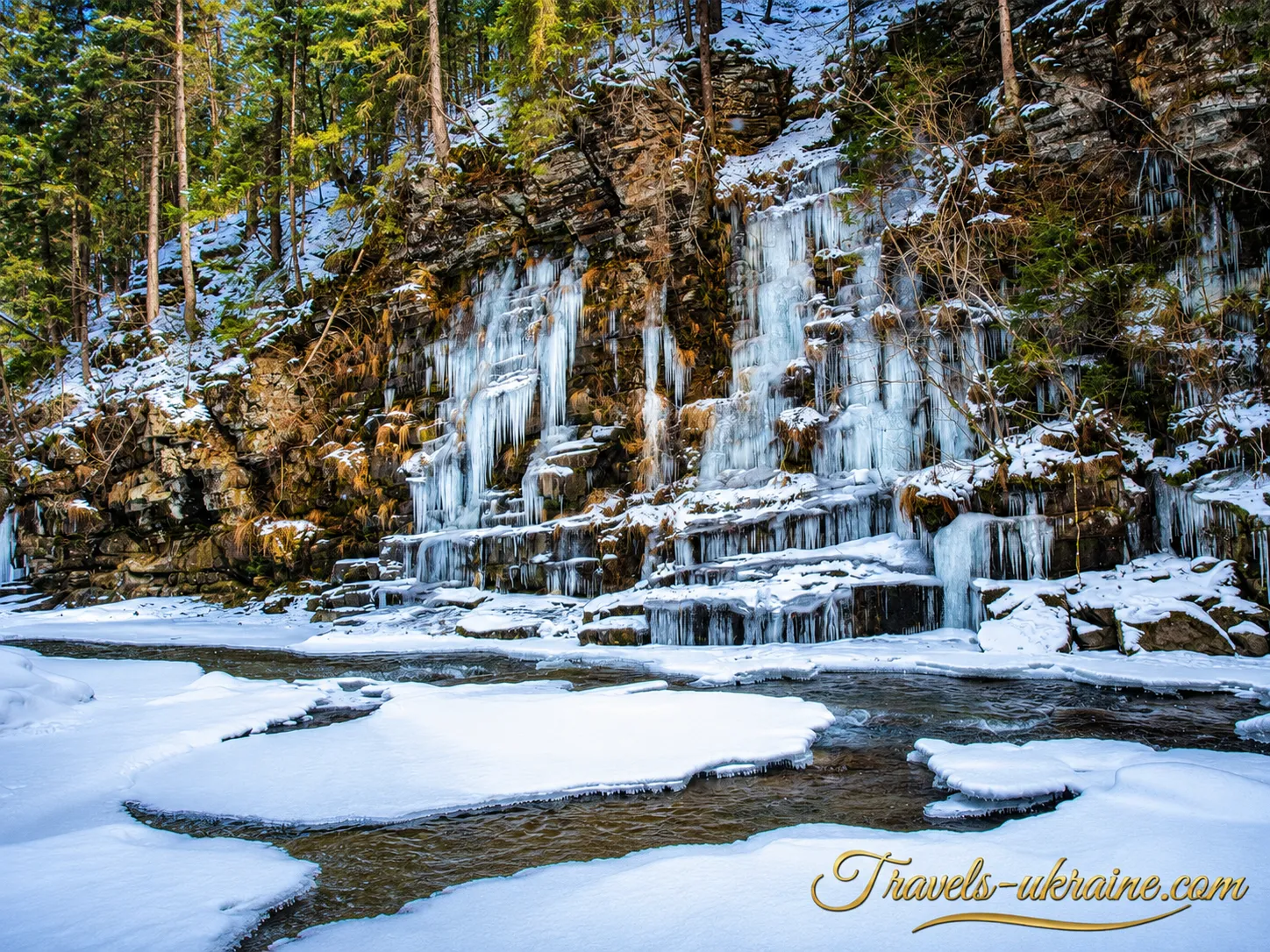
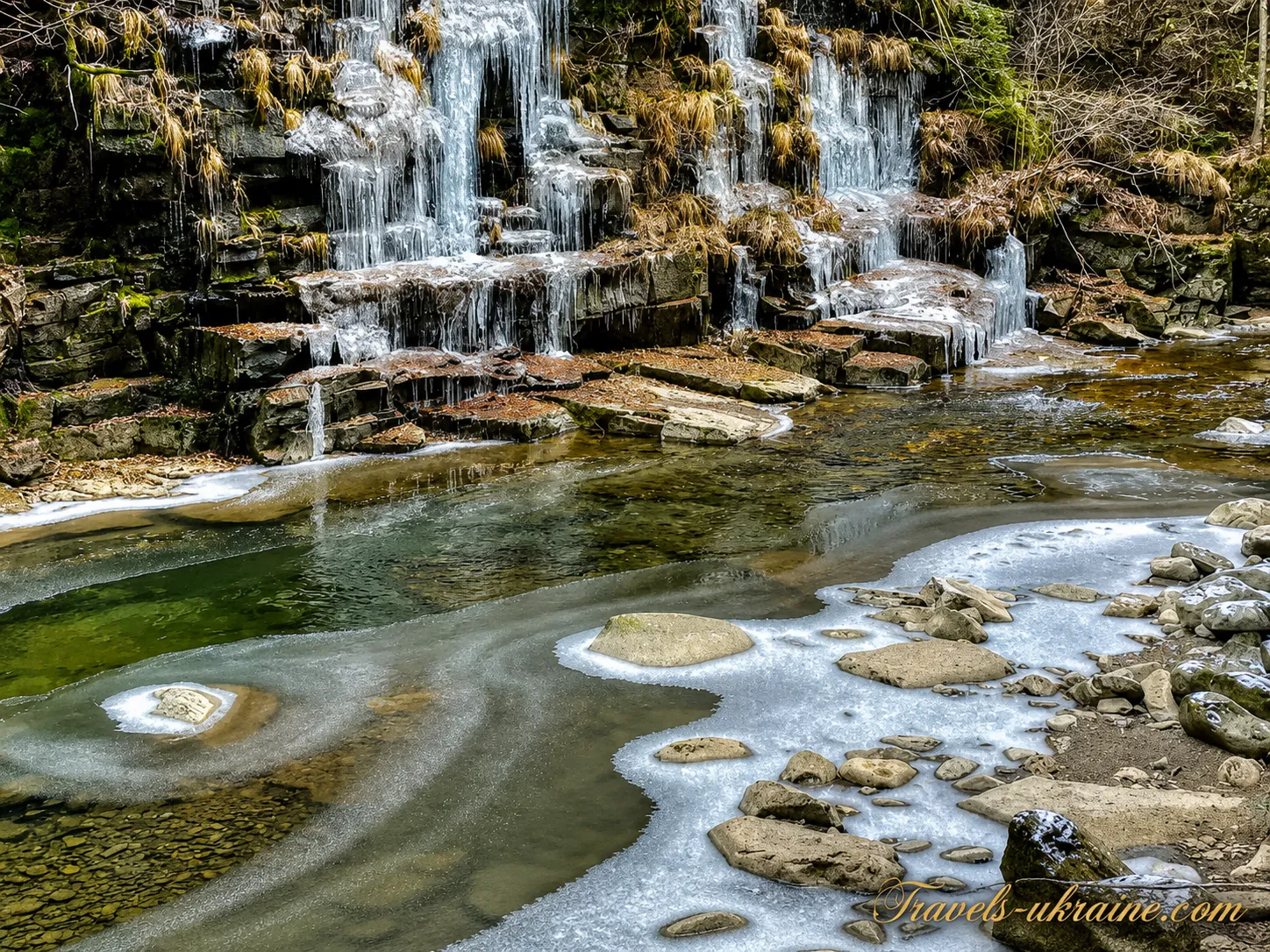
Flysch formations are characteristic of the Mykulychyn area and the Prut Valley—sequences of sedimentary rocks in which harder and softer layers alternate. The differing resistance of the rocks to erosion helps create uneven terrain: some strata withstand the action of water better, while others are gradually washed away and weathered. As a result, ledges, steps, narrow passages, and natural stone shelves emerge, making the mountain gorge particularly striking.
These walls are interesting to examine even for someone with no background in geology. In some places, it seems as though enormous slabs of stone were deliberately stacked one on top of another. In reality, this is a kind of natural chronicle of the Carpathians: instead of pages, there are layers of rock; instead of ink, water, time, and constant weathering.
The Blue Lagoon of Chemehiv Canyon and the Emerald Waters of the Carpathians
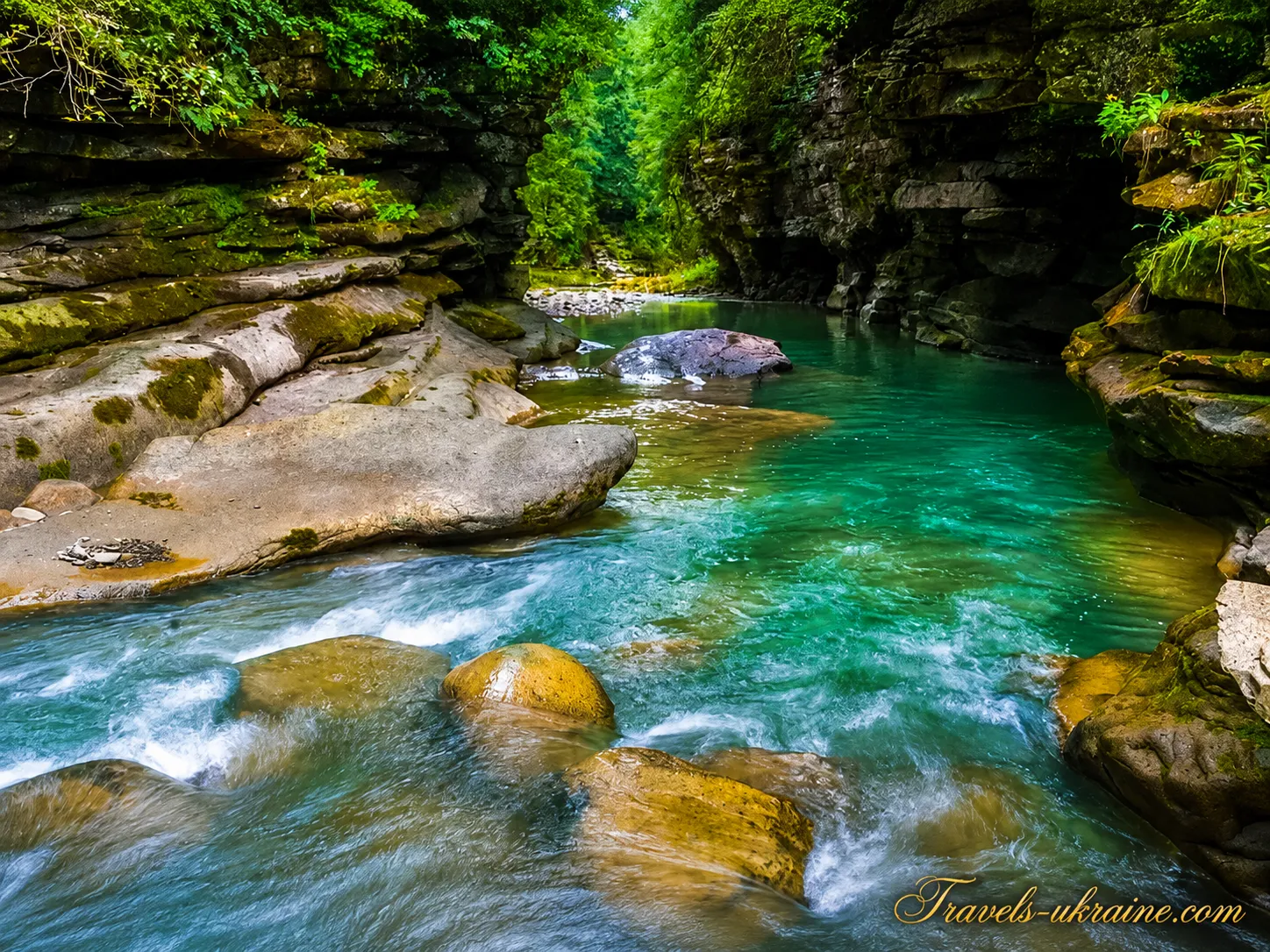
Among the route’s most photographed features are small natural pools that tourists often call the Blue Lagoon. The name sounds almost seaside-like, although this is, of course, not a real marine lagoon but a depression in the bed of a mountain stream. In calmer sections, water collects between rocky banks and forms natural basins. In favorable light, they may take on greenish, turquoise, or emerald hues. This looks especially striking where dense greenery overhangs the water and dark rocks contrast with its sunlit surface.
However, you should not come here expecting to see a pool with permanently bright-blue water. Its appearance depends on the weather, lighting, river level, the condition of the riverbed, and the season. After heavy rainfall, the current may become fuller and muddier, while during a dry, sunny period, individual pools can look considerably clearer. So the famous emerald water in the Carpathians is primarily a natural optical effect created by specific conditions, not a guaranteed color on every day of the year.
Why the water in Chemehiv Canyon is constantly changing its appearance
In a narrow gorge, light behaves quite differently than it does on an open river. For part of the day, the water lies in shadow; then sunlight breaks through the trees, while green leaves and dark rock alter the overall perception of color. Even two photos taken from the same spot in the morning and afternoon may look as though they were taken at entirely different bodies of water.
This is one reason photographers love Chemehiv Canyon with its blue lagoon so much. You do not necessarily need to look for a complex composition here: a cliff, water, and a few rays of sunlight between the trees—and nature has already done most of the work. The only problem is that after the tenth shot, the phrase «one more photo and we’ll go» starts to lose any connection with reality.
Carpathian tropics and jungles in the Carpathians: where these names came from
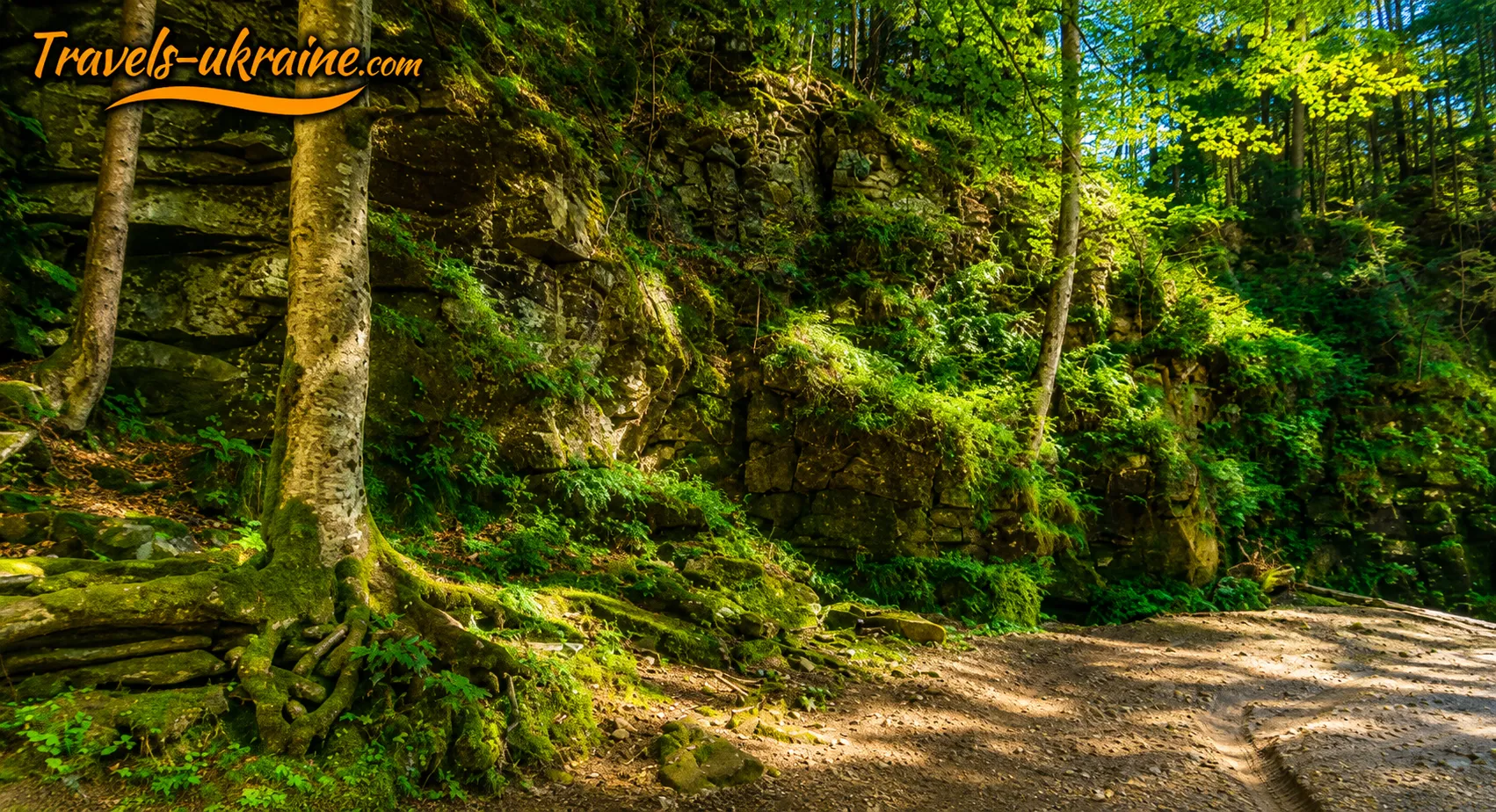
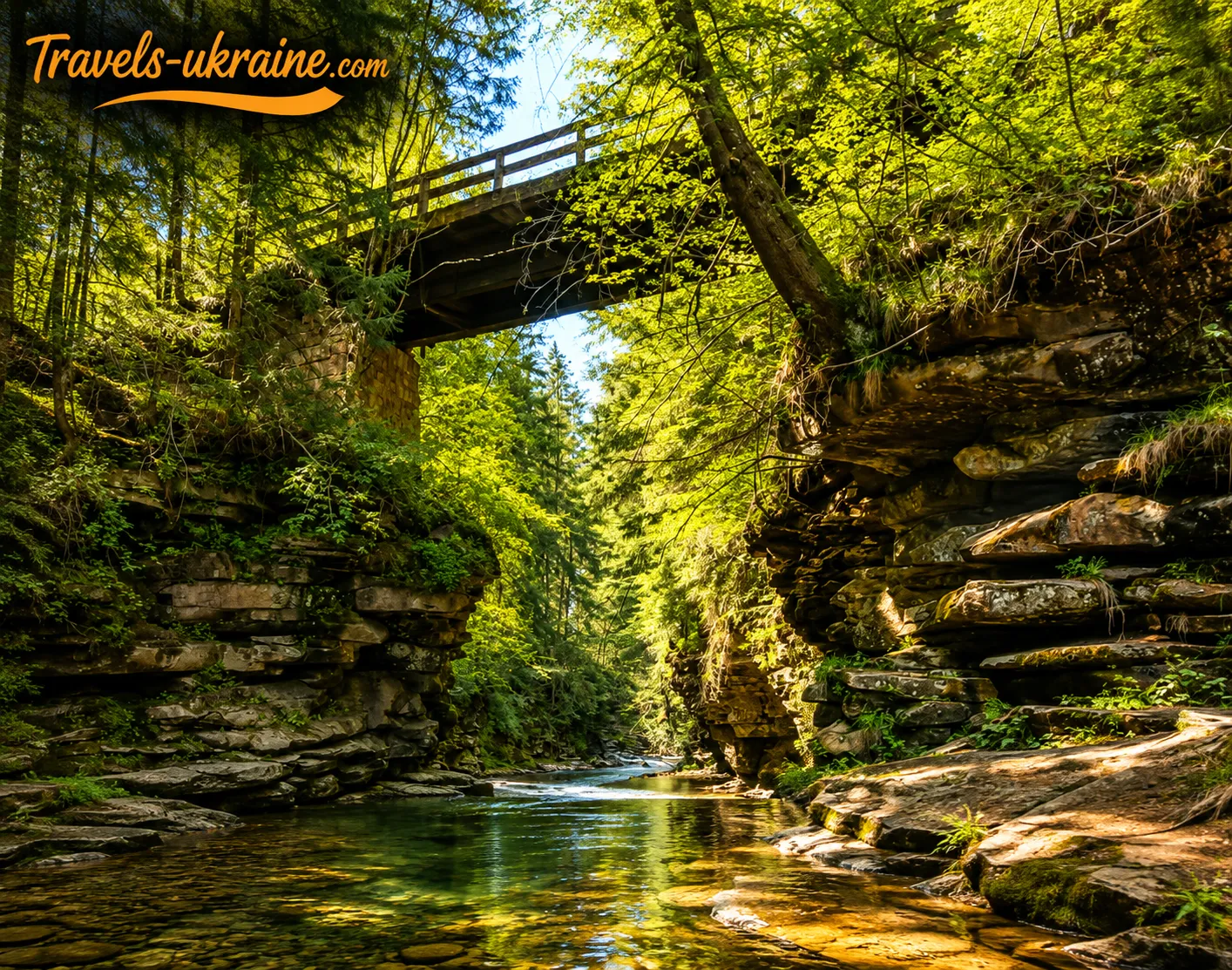
Another distinctive feature of the canyon is the striking combination of rock and vegetation. Trees grow almost directly above the gorge, roots make their way between the stones, and shaded, damp surfaces become covered with moss and other forest vegetation. As a result, some sections of the route look so green in summer that Chemehiv Canyon has acquired the evocative tourist names «the jungle in the Carpathians» and «the tropical canyon of the Carpathians».
From a biological perspective, of course, there are no tropics here. This is an ordinary temperate mountain forest typical of the Carpathians; it simply appears much denser and more dramatic in a narrow, damp gorge. The cliffs restrict the space, trees overhang the water, and the high humidity makes the greenery contrast especially vividly with the rocky surfaces.
Therefore, the search term «jungle in the Ukrainian Carpathians» should be understood as a tourist comparison. It conveys the atmosphere of the place quite accurately, but not its natural zone. Coconut-milk umbrellas are not handed out here either—but there is more than enough genuine Carpathian greenery without any decorations.
The damp microclimate of the rocky gorge in Mykulychyn
Inside the picturesque Carpathian gorge, it often feels cool even when the open areas are fairly warm. High banks and trees partly block the direct sunlight, cold mountain water flows constantly nearby, and shaded surfaces retain moisture for longer. As a result, the temperature right beside the riverbed may subjectively feel lower than on the sunny road several dozen meters above.
Moisture is a major factor in the canyon’s distinctive appearance. The stones become darker, mosses turn a richer green, and small streams and post-rain water leave wet streaks on the rocks. Colors are especially vivid after rain, but there is a downside: the stones and soil become slippery. What looks wonderful in a photograph may prove to be a small natural test of attentiveness underfoot.
Wild Carpathian nature without parkland décor
The main value of Chemehiv Canyon in Ivano-Frankivsk Oblast lies precisely in its natural character. There is no need to create artificial cliffs, decorative ponds, or plant greenery according to a designer’s plan. The narrow riverbed, old trees, stone walls, water, and uneven terrain already form a complete natural landscape.
At the same time, calling Chemehiv Canyon a natural monument in the legal sense would be incorrect without separate confirmation of its official protected status. Instead, as an object of Ivano-Frankivsk Oblast’s natural heritage, the canyon is featured on the region’s official tourism portal. The practical conclusion for travelers is simple: regardless of its formal status, this area should be treated with the same care as any valuable natural destination.
It is the combination of geological outcrops, mountain water, shaded cliffs, and dense vegetation that makes Chemehiv Canyon distinctive. It does not try to compete with Hoverla in height or with the great Carpathian waterfalls in scale. Its advantage lies elsewhere: nature has gathered many details into a small area, so within one short stretch of the route you can see a rocky gorge, geological outcrops, forest above the water, and small natural pools.
Chemehiv Canyon: a brief guide for travelers
Before traveling to Chemehiv Canyon, it is useful to understand what kind of destination it is. This is not a developed tourist complex with a ticket office, level paths, and viewpoints beside every cliff, but a natural mountain area where conditions depend on the weather, water level, and route you choose. Most of the journey does not require special physical preparation, although uneven, wet, and slippery sections occur directly beside the gorge.
Key information about Chemehiv Canyon
- Type of destination: a natural canyon, mountain gorge, river valley, and place for walks in nature.
- Location: outskirts of the village of Mykulychyn, Yaremche urban community, Ivano-Frankivsk Oblast.
- Main natural feature: the rocky bed of the Prutets-Chemehivskyi River and the water-carved rocky sections of the gorge.
- Difficulty: mostly easy or moderate, although some descents to the water require caution.
- Physical preparation: special hiking preparation is not required for an ordinary walk.
- Best way to enjoy it: a walk, time in nature, photography, or a short family or combined tourist route.
Overall, the route to Chemehiv Canyon is not a difficult high-altitude hike. Much of the way through the valley follows roads and relatively gentle terrain. This is one reason the area suits not only experienced hikers but also people who simply want to spend a few hours in nature without a many-hour climb to a summit.
At the same time, an «easy route» does not mean you can walk everywhere in city shoes without watching your step. Directly beside the rocky gorge, conditions change: there are steeper descents, wet soil, tree roots, uneven stones, and slippery surfaces. The difficulty increases noticeably after rain.
For most adult travelers in dry weather, the route is quite accessible. With small children, older people, or travelers who have balance or musculoskeletal problems, descents directly to the water should be approached much more cautiously.
How much does a visit to Chemehiv Canyon cost?
The picturesque canyon of Ivano-Frankivsk Oblast is also attractive because, for an independent visit, the main expenses usually come down to transportation, food, and, if necessary, parking or local transport services. No separate standard tourist ticket is required to view the natural gorge.
Therefore, you can keep the trip budget to a minimum by arriving in your own vehicle or by public transport and walking the route. Another option is to join an organized excursion, use a transfer, take a jeep tour, or combine the canyon with several more distant destinations. In that case, the cost will depend not on the canyon itself but on the service and itinerary you choose.
Who will enjoy a visit to Chemehiv Canyon in the Carpathians?
Mykulychyn’s natural attraction is best suited to travelers who love nature and destinations without excessive tourist development. Photographers, couples, groups of friends, families with school-age children, and anyone who wants to add a short walk among cliffs and mountain water to their trip will all find it interesting.
At the same time, this is not a conventional park with accessible, barrier-free paths. People with significantly reduced mobility may find it difficult to reach the most picturesque sections of the gorge, as the natural terrain has not been leveled specifically for tourists. That is part of the character of the place: the wild nature of the Carpathians remains wild here and requires at least a minimum of attentiveness and respect for the mountains. So, for a first visit, all you need is comfortable footwear, a good mood, a few hours of free time, and good weather. It is better to leave haste in the car, though: a Carpathian canyon is one of those places where the most interesting moments begin precisely when you stop counting the minutes.
Events near Cheme liv Canyon: Hutsul traditions of Mykulychyn
Cheme liv Canyon is first and foremost a natural destination, not a festival venue. There is no permanent stage, calendar of weekly entertainment, or separate annual festival dedicated to the gorge itself. That is more of an advantage: among the cliffs and mountain water, nature itself remains the main event. However, a trip to the canyon can be successfully combined with the cultural life of Mykulychyn and the Yaremche region, where Hutsul traditions remain more than just part of a museum display.
Over the years, Mykulychyn and its surroundings have hosted ethnographic celebrations, workshops, folk ensemble performances, and events connected with highland pasture culture. Their dates and formats may change, so you should plan a trip specifically around a particular event only after checking the organizers’ current program.
Mykulychyn highland pasture celebrations and the traditions of Hutsul shepherds
One of the most interesting examples of cultural events held in Mykulychyn is «Polonynskyi Klych» at the Gorgany highland pasture. The celebration was dedicated to the traditions of summer mountain husbandry and introduced visitors to highland pasture life, including cheese-making, the work of shepherd leaders, folk music, and Hutsul customs.
Events like these help explain something that tourists visiting the Ukrainian Carpathians solely for the scenery do not always notice. Historically, a highland pasture was not simply a beautiful meadow high in the mountains for the Hutsuls. It was a seasonal farming environment where livestock grazed, milk was processed, traditional cheeses were made, and a distinctive way of life with its own rules and customs took shape.
So if you happen to attend a highland pasture or ethnographic celebration during your stay in Mykulychyn, it can be a wonderful addition to your canyon trip. In the first half of the day, you can walk among cliffs and mountain water, then see a completely different side of the region: living Hutsul culture.
Folk music, crafts, and the Hutsul culture of the Yaremche region
The region’s cultural events often combine several elements: performances by folk ensembles, traditional trio music, craft workshops, traditional dress, Hutsul cuisine, and demonstrations of traditional crafts. This format makes it easiest to see that Hutsulshchyna is not a tourist-oriented stylization, but a distinct cultural space with its own musical, culinary, and craft traditions.
It is especially interesting to observe the traditional crafts. Woodcarving, leatherwork, jewelry making, embroidery, cheese making, and playing folk instruments did not develop here by chance. Most of them are directly connected with the available materials, the way people made a living, and the conditions of life in the mountains.
Where to check current events before travelling to Mykulychyn
The most reliable approach is to follow announcements from the Yaremche City Territorial Community, tourism information resources for Ivano-Frankivsk Oblast, local cultural institutions, and the event organizers themselves. Social media can also be useful, but it is best to verify the date, location, and programme against the official announcement.
This is especially true of events held on mountain meadows. Mountain weather can disrupt the programme far more convincingly than any presenter with a microphone, so the location or time may occasionally change.
When the Chemehiv Canyon is more interesting than any festival
There is another option: come when nothing particularly large-scale is happening in Mykulychyn at all. For nature-based recreation in the Chemehiv Canyon, this may even be the best scenario. Fewer tourists mean a better chance of hearing the sound of the Prutets-Chemehivskyi, calmly examining the rocks, and finding a good spot by the water without having to queue with everyone who wants a photo on the same stone.
The Chemehiv Canyon does not need a special event to be interesting. Spring high water, lush summer greenery, morning mist, or an autumn forest create a different picture here every time. In a sense, nature puts on its own programme every day—only it does not print a poster.
So the best approach is simple: come to Mykulychyn and the Chemehiv Canyon primarily for the Carpathians, and if your trip happens to coincide with a Hutsul celebration, fair, or workshop, treat it as a pleasant bonus. That is how nature tourism combines best with discovering the culture of the region.
What to see and do in the Chemehiv Canyon
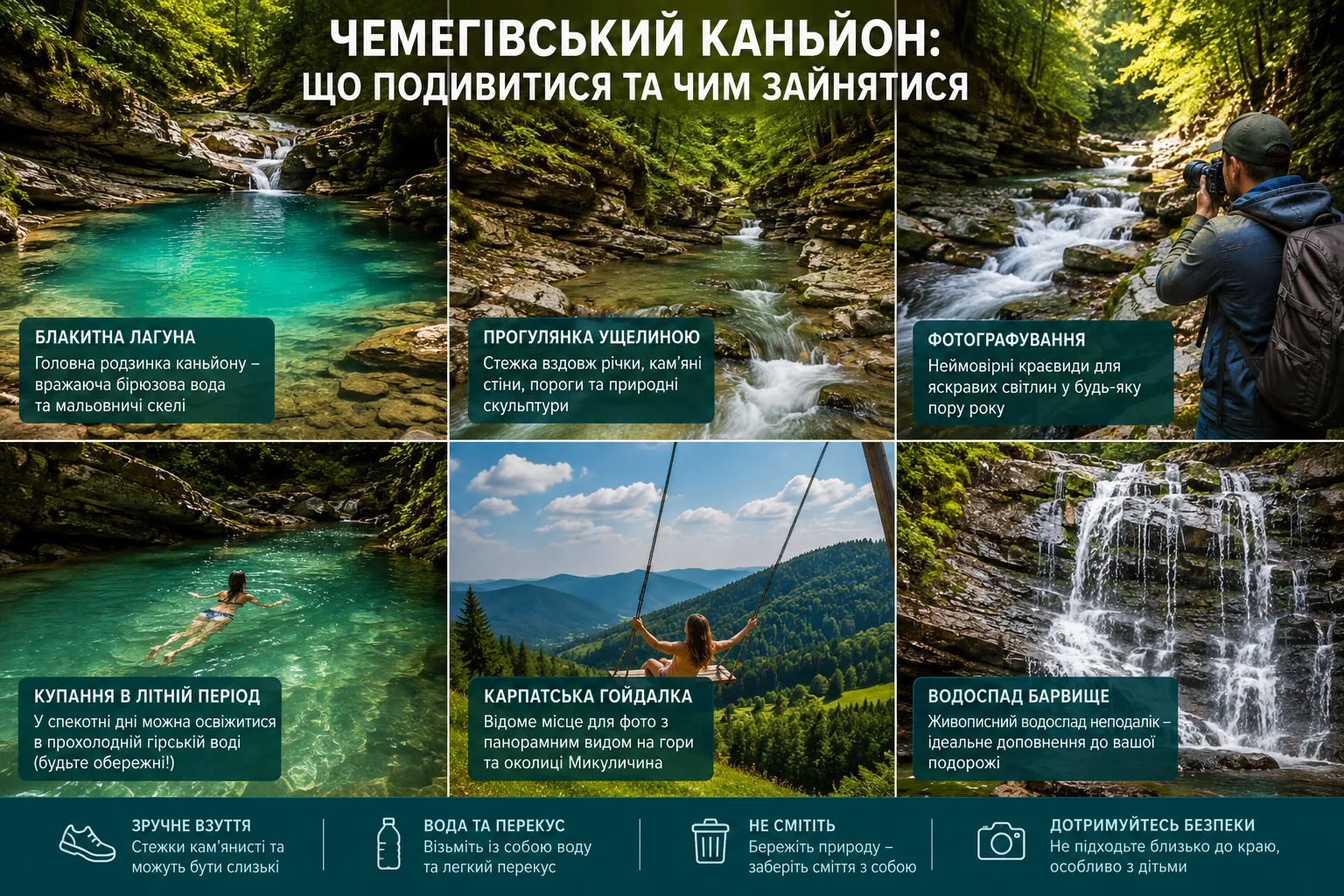
The Chemehiv Canyon in the Carpathian tropics is one of those places where you do not need a long list of activities to spend several enjoyable hours. The main activity is simple: walk along the Prutets-Chemehivskyi, watch the rocky gorge change, descend to safe areas by the water, photograph the cliffs, and gradually discover the natural sites hidden in the river valley.
You can plan the trip in different ways. Some visitors are satisfied with seeing the most striking part of the canyon and returning to Mykulychyn, while others continue towards the Blue Lagoon, Barvyshche Waterfall, and Carpathian Swing. The second option gives you a better feel for the area and turns a short walk into a small Carpathian adventure.
Of course, the best way to get to know the canyon is not to rush. Narrow rocky passages, stone banks, and forest reveal themselves gradually, so the route is most enjoyable during an unhurried walk. In some places, you can approach the riverbed, examine surfaces polished by the water, and see how the river cuts its way between huge boulders.
The spots where the canyon cliffs draw close together, leaving only a narrow corridor above the water, are particularly impressive. Less direct sunlight reaches these places through the trees, so even in the summer heat, the river often offers pleasant coolness.
The Blue Lagoon in Mykulychyn—the Chemehiv Canyon’s best-known pool
One of the main reasons tourists search for where the Blue Lagoon in the Carpathians is located is the photographs of this unusual body of water among the rocks. The Chemehiv Canyon Lagoon is a natural pool in the bed of a mountain stream, where water collects between rocky banks and, in certain light, takes on greenish-turquoise hues.
The contrast is the most striking feature: dark layers of rock, dense greenery above the gorge, and bright water below. When the sun enters the canyon at the right angle, the pool can genuinely resemble a small natural lagoon somewhere much farther south than the Carpathians.
In warm weather, tourists sometimes enter the water and swim in the natural pools, but swimming in the Chemehiv Canyon should not be compared with relaxing on an equipped beach. The mountain stream remains cool even in summer, the bottom is uneven and rocky, and after rain the current can become considerably stronger.
Barvyshche Waterfall near the Chemehiv Canyon
If you still have time and energy to continue walking after exploring the main part of the gorge, you can add Barvyshche Waterfall to the route. It is another natural site in the Prutets-Chemehivskyi valley, often visited together with the canyon and the Blue Lagoon.
Barvyshche Waterfall is not one of the enormous Carpathian waterfalls where water plunges from a height of dozens of metres. Its appeal lies elsewhere: a small cascade fits naturally into the rocky riverbed and is surrounded by forest. Here, it is more interesting to look at the overall composition of water, rocks, and greenery than to focus on the height.
After rainfall, the waterfall looks fuller and more dynamic, but reaching it also becomes more difficult. During dry periods, the flow may be more modest. Such seasonal changes are perfectly natural for small Carpathian waterfalls.
The Carpathian Swing in Mykulychyn
Another popular landmark in this part of Mykulychyn is the Carpathian Swing, also known as the Hutsul Swing. It stands along a route used by tourists on their way to the valley’s natural attractions, making it easy to include in the same walk as the canyon.
Unlike the gorge itself, the swing’s main attraction is the more open view. After shaded cliffs and forest, it is pleasant to reach a more spacious spot and look out over the surrounding slopes. For many tourists, it is also a traditional photo stop before continuing along the route.
However, it is not worth travelling to this part of the Carpathians solely for a few seconds on a swing. It is much more enjoyable to treat it as one stop along a complete route: Carpathian Swing—Chemehiv Canyon—Blue Lagoon—Barvyshche Waterfall.
A cycling trip through the Prutets-Chemehivskyi valley
The area is interesting not only for hikers. The Carpathian National Nature Park describes several cycling routes from Mykulychyn that head towards the Prutets-Chemehivskyi. One of them, the «Old Railway» route, is more than 15 km long and passes through places where a narrow-gauge railway once existed.
This is a good option for those who want to see more of the surrounding area rather than limit themselves to a short walk. The route includes remnants of old engineering structures, forest roads, and places to rest. The rockiest part of the canyon itself is more conveniently explored on foot, with the bicycle left in a safe place.
Not every activity in the Carpathians has to be measured in kilometres. Sometimes it is worth finding a safe spot by the water and simply doing nothing for a few minutes. In the canyon, you can clearly hear how the sound of the stream changes with the width of the riverbed: the water roars over rapids, almost calms in pools, and echoes noticeably between the high cliffs. These pauses are often more memorable than dozens of hurried photographs. It is an excellent form of eco-recreation: no attractions, loud music, or need to keep rushing somewhere.
How to plan a several-hour route through the Chemehiv Canyon
For a first introduction to the area, you can plan a simple route with several logical stops. Start along the road through the Prutets-Chemehivskyi valley, stop at the Carpathian Swing in the village of Mykulychyn, then continue to the canyon’s main rocky section, descend to a safe viewpoint by the water, and, if you have enough time, continue to the lagoon and Barvyshche Waterfall.
- For a short walk: the canyon and several of the most convenient viewpoints.
- For a leisurely trip: the Chemehiv Canyon + Blue Lagoon.
- For a half-day route: Carpathian Swing + canyon + lagoon + Barvyshche Waterfall.
- For an active day: combine a walk with a cycling route or other natural sites around Mykulychyn.
The main thing is not to try to see everything as quickly as possible. The canyon and Mykulychyn’s beautiful places are interesting precisely because of their details: water between the rocks, shade beneath the trees, layers of stone, and a constantly changing landscape. If you walk through it only for a single photograph by the lagoon, you may accidentally miss half of what makes the journey here worthwhile.
What to see near the Chemehiv Canyon: interesting tourist attractions
The Chemehiv Canyon can easily be the main purpose of a trip to Mykulychyn, but there is no need to limit yourself to the gorge. The village and its immediate surroundings offer enough natural, historical, and cultural sites to create a full-day tourist route—or, if you wish, to stay in this part of the Carpathians for several days.
Mykulychyn’s advantage lies in its location. It is a convenient base for trips to waterfalls, mountain trails, and nearby Yaremche, while the village itself offers a wooden sacred-architecture landmark and an introduction to Hutsul culture. That is why the question «what to see near the Chemehiv Canyon» has far more answers than may seem at first glance.
Discovering tourist-friendly Mykulychyn: what is worth seeing
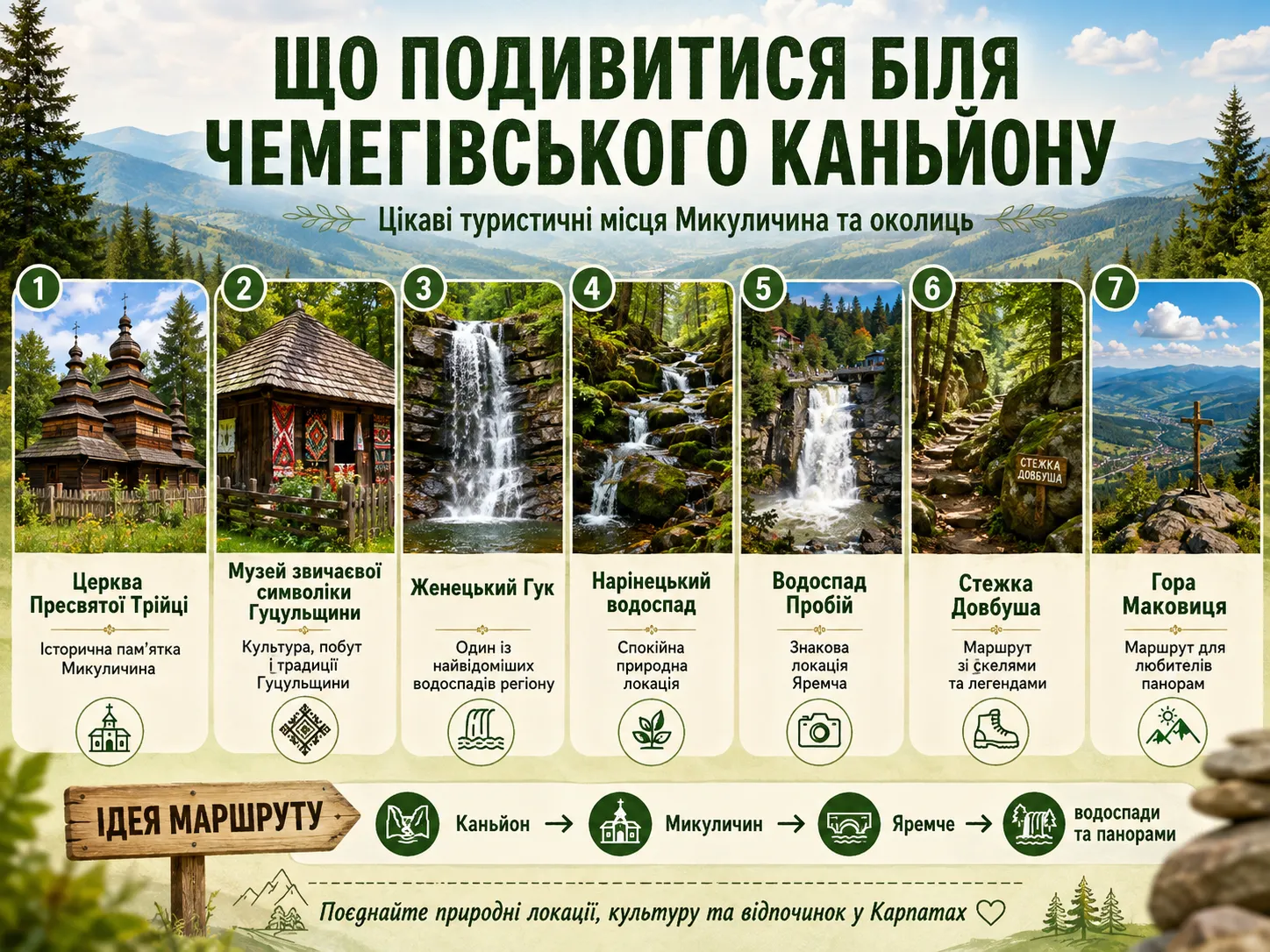
After the canyon’s wild nature, it is worth seeing a completely different side of Mykulychyn. One of the village’s most valuable architectural landmarks is the wooden Church of the Holy Trinity, built in the 19th century in the traditions of Hutsul sacred architecture.
Construction of the church began in 1866 and was completed in 1868. The church has the status of a nationally significant architectural monument. Its interior retains murals and an iconostasis associated with the work of Ukrainian artist, poet, and playwright Kornylo Ustiyanovych. This is a worthwhile stop for anyone who wants their tourist route through Mykulychyn to include more than waterfalls and mountains. Spending a few dozen minutes at the old wooden church offers a completely different perspective on the area and shows how the Carpathians’ natural environment was combined with traditional architecture.
Another interesting site directly in the village is the Museum of Hutsul Customs and Symbols. This private museum opened in 2012 in a building styled as a traditional Hutsul khata-hrazhda homestead. The exhibition helps visitors better understand the region’s culture: it features household objects, traditional clothing, embroidery, woodcarving, and symbols used in Hutsul decorative art. The cheesemaking workshops are a particular highlight.
Zenetskyi Huk—a famous waterfall near Mykulychyn
Among the natural sites that best complement a holiday in Mykulychyn, the Zenetskyi Huk Waterfall deserves special attention. It is located in the Zenets tract between Mykulychyn and Tatariv, within the Carpathian National Nature Park.
Here, the water drops from approximately a 15-meter height, while the waterfall itself lies at an elevation of about 900 meters above sea level. A maintained hiking trail leads to it and is approximately 4.75 km one way. According to the classification of the Carpathian National Nature Park, the trail is rated easy.
Zhenetskyi Huk pairs well thematically with Chemegivsky Canyon, but the experience of these places is different. In the canyon, the focus is on the intimate gorge, the rocks, and the water literally right beside you. Near Huk, attention is drawn to the powerful vertical flow, whose roar can be heard before the waterfall fully emerges among the trees.
Narineckyi Waterfall between Mykulychyn and Tatariv
Those who prefer less well-known natural attractions should take a look at Narineckyi Waterfall. It is located between Mykulychyn and Tatariv on a small mountain stream and is about eight meters high. In scale, this waterfall is smaller than Zhenetskyi Huk, but it is ideal for travelers who enjoy building their route around a series of small natural discoveries. There is no need to expect a spectacular waterfall here—the appeal of the place lies precisely in its intimate character and the typically Carpathian combination of stone, forest, and moving water.
It can be considered an additional stop during a trip toward Tatariv or Zhenetske tract, especially if you have already seen the region’s main tourist attractions.
Yaremche area: Probiy Waterfall, Dovbush Trail, and Makovytsia Mountain
If you have a few hours left in Mykulychyn after visiting Chemegivsky Canyon, Yaremche is a logical continuation of the route. Its best-known natural attraction is Probiy Waterfall on the Prut River. It is completely different from the tranquil pools of Chemegivsky Gorge. Here, the Prut runs through a rocky, canyon-like section and forcefully overcomes a natural drop. The waterfall is especially easy to see from the bridge over the river.
A souvenir market and the famous Hutsulshchyna restaurant-museum are located nearby, so this part of Yaremche is easy to include even in a route with little time to spare. If the canyon offers a chance to experience the wilder side of the Carpathians, the Probiy area reveals their popular tourist face, while the town itself is enchanting.
For travelers interested in the opryshky theme after learning about the history of Chemegivsky Canyon, the Dovbush Trail in Yaremche is a good continuation. The route passes through forested slopes and rock formations and is connected with local memories of the opryshky movement. Here you can see Dovbush Rocks, the large Dovbush Stone, themed sculptures, and the forest terrain characteristic of this part of the Carpathians.
The trail has another practical advantage: it can be combined with Probiy Waterfall and a walk around Yaremche. In this way, after a morning visit to the canyon in Mykulychyn, the second half of the day can become a short thematic route through the Carpathian region.
If, after the narrow Chemegivsky Gorge, you want the opposite kind of landscape—open spaces and mountain panoramas—plan a separate ascent of Makovytsia Mountain near Yaremche. The Carpathian National Nature Park route is approximately 4 km one way and takes around four hours. The trail passes through beech-fir and spruce forests, reaches open areas, and offers views from the summit of the surrounding ridges and famous Carpathian peaks.
It is best not to try to fit Makovytsia into the same day as a long list of other attractions. This is a full-fledged hike, so it is more practical to leave it for the following morning. That way, the trip will be varied: on the first day—Chemegivsky Canyon and interesting places in Mykulychyn; on the second—an ascent into the mountains.
Chemegivsky Canyon in the film «Dovbush»: when the Carpathians became a natural film set
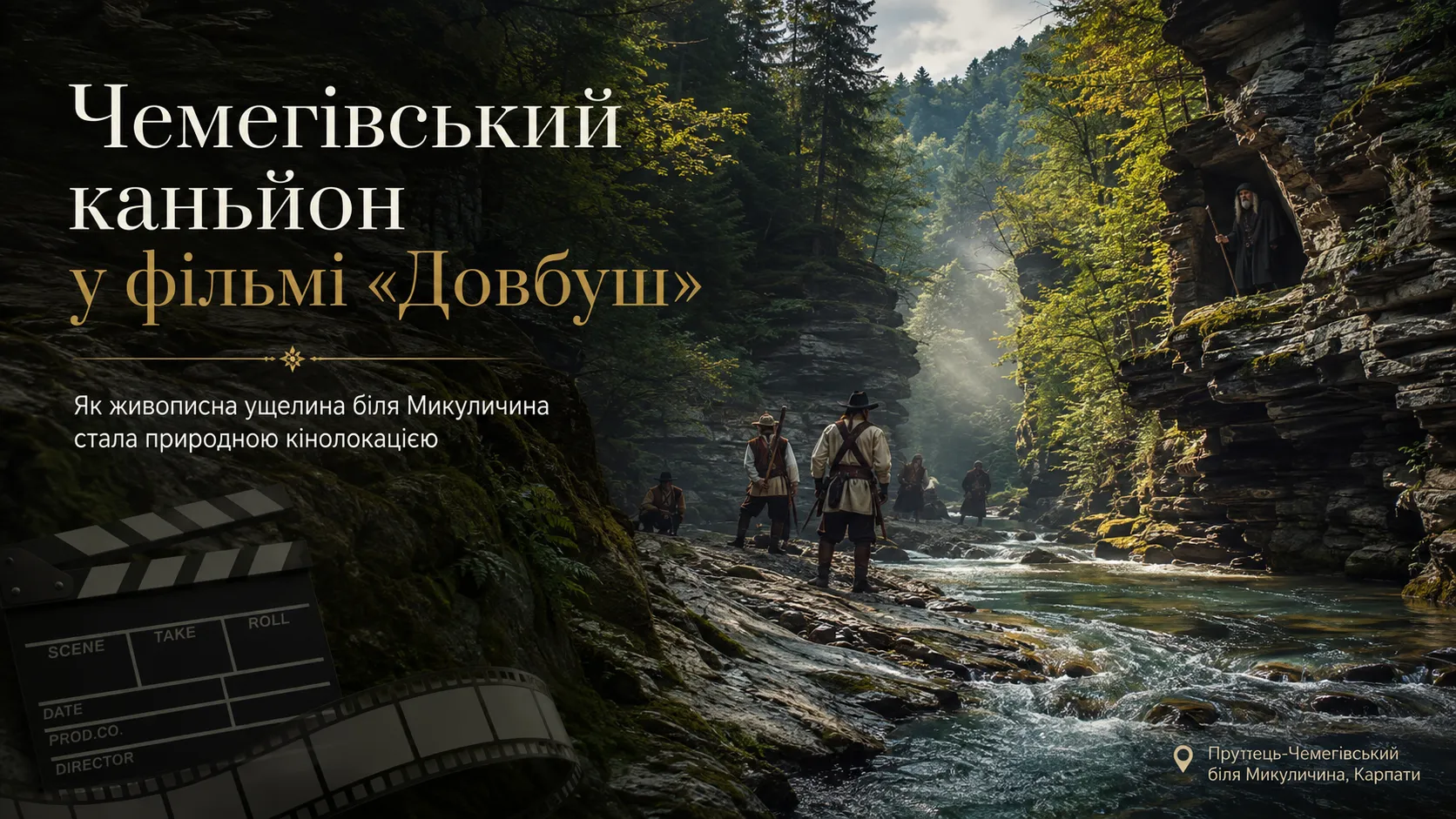
Chemegivsky Canyon is of interest not only to travelers and photographers. Its wild rocks, dense Carpathian forest, and the bed of the Prutets-Chemegivsky attracted the attention of the creators of the large-scale Ukrainian adventure-historical film «Dovbush», directed by Oles Sanin and released nationwide in 2023. Some of the film’s location scenes were shot around Mykulychyn, and the picturesque Chemegivsky Gorge is now also named among the specific filming locations.
For a film about the opryshky, the Carpathians had to look like more than just a beautiful backdrop. The landscape needed to make viewers forget the modern world for at least a few minutes and believe they were looking at an eighteenth-century mountain world. That is exactly the impression created by Chemegivsky Canyon on the Prutets-Chemegivsky River: a narrow stone corridor, overhanging trees, moss-covered rocks, water flowing between huge boulders, and almost no modern development directly in the frame.
Here, the natural landscape already looks like a ready-made set: layers of stone form striking walls, the Prutets-Chemegivsky cuts through the narrow gorge, and dense forest conceals the horizon. Remove a few modern details from view, and it becomes difficult to determine which century the action takes place in. This natural quality was especially important for «Dovbush.» The film was not made as a fairy tale against an imaginary backdrop, but as a large-scale historical movie.
In collections of the film’s filming locations, Chemegivsky Canyon is associated with the scene after Oleksa’s escape, when the hero encounters the mysterious hermit Israel in the midst of the Carpathian wilderness. In the frame, the rocks, water, and dense forest create the feeling of a place far from human settlements, where a chance encounter could go unnoticed by the outside world.
For tourists, this adds an entirely different dimension to the walk. You can not only look at the canyon’s rocks, but also recognize the natural setting that filmmakers used to create the world of the Carpathian opryshky. Visiting the canyon after watching the film is especially interesting: some angles then appear not merely as beautiful scenery, but as part of a major Ukrainian film project.
The Carpathians in «Dovbush» are not a backdrop but a fully fledged character
In Oles Sanin’s film, the Carpathians play a much more important role than that of ordinary picturesque scenery. Mountain forests, rocks, tracts, and narrow passages help explain the world of the opryshky. The challenging terrain allowed small detachments to move quickly, find shelter, and use their knowledge of the area as an advantage. Chemegivsky Canyon in Mykulychyn conveys this feeling particularly well. Even today, it is easy to understand how differently space is perceived among the mountains. Beyond the next bend in the gorge, you cannot see what lies ahead, the sound of water drowns out many other noises, and dense forest conceals the surrounding slopes.
That is why places like this work better in film than the most expensive artificial set. A set is dismantled when filming ends, but the stone gorge of the Prutets-Chemegivsky remains in place—and every traveler can see it without a camera, lighting equipment, or film crew.
How ambitious was the Ukrainian film «Dovbush»?
«Dovbush» became one of the most ambitious Ukrainian film projects of its time. Stunt performers, pyrotechnicians, reenactors, hundreds of extras, and a large production team were involved in making the film. Filming locations were spread across various regions of Ukraine, while costumes, weapons, props, and elaborate sets were created to recreate the eighteenth century.
The film tells a fictional story of Oleksa and Ivan Dovbush against the backdrop of the Carpathian opryshky’s struggle against the Polish nobility. At the same time, the creators emphasized that before filming they worked with historians, ethnographers, museum professionals, reenactors, and archival materials, seeking to recreate the environment of the period as convincingly as possible.
The film’s nationwide release began on August 24, 2023—the Independence Day of Ukraine. For a story about freedom, resistance, and a Carpathian leader, the date proved more than symbolic.
Chemegivsky Canyon after «Dovbush»: a filming location you can visit
The best thing about this story is that the «Dovbush» filming location in Mykulychyn is not hidden behind the gates of a film studio. Chemegivsky Canyon remains a real natural attraction that you can reach on foot, walk along the Prutets-Chemegivsky, and see with your own eyes the landscape that appeared on screen.
And this creates a fairly rare feeling. Usually, once a historical film ends, viewers leave its world in the movie theater. With «Dovbush,» part of that world can literally be found on a map: you can travel to Mykulychyn and walk through the same Carpathian landscape chosen by the film crew.
So if, after watching «Dovbush,» some of its mountain landscapes seemed too beautiful to be real, Chemegivsky Canyon offers a simple way to check. And perhaps this is one of those rare cases when the real Carpathians do not lose out to the cinematic image at all.
Chemegivsky Canyon: frequently asked questions from tourists
Where is Chemegivsky Canyon located?
Chemegivsky Canyon is located on the eastern outskirts of the village of Mykulychyn in Ivano-Frankivsk Oblast. The stone gorge formed along the Prutets-Chemegivsky River, a right-bank tributary of the Prut. The canyon extends a considerable distance through a forested valley, so the name «Chemegivsky Canyon» refers not to one particular rock or body of water, but to an entire natural area along the river.
How do you get to Chemegivsky Canyon from Mykulychyn?
Local roads and hiking routes from Mykulychyn lead to the Prutets-Chemegivsky valley. The path is marked with green signs and forms part of the tourist route «Mykulychyn village—Mount Rokyta.» Part of the way can be covered by car, bicycle, or on foot, although the condition of secondary roads depends on the weather.
Do you have to pay to enter Chemegivsky Canyon?
The official tourist description of Chemegivsky Canyon does not mention a separate fee or entrance ticket for viewing the natural attraction. However, additional costs may apply for parking, transfers, guided tours, jeep tours, or other tourist services. Conditions on site may change, so it is worth checking the latest information before your trip.
How much time is needed to visit Chemegivsky Canyon?
For an unhurried exploration of the main accessible sections, allow approximately 2–3 hours. If you plan to combine Chemegivsky Canyon with Blue Lagoon, the Carpathian Swing, Barvyshche Waterfall, and a longer walk through the Prutets-Chemegivsky valley, it is better to set aside half a day for the route.
When is the best time to visit Chemegivsky Canyon?
For a first trip, the most convenient period is from late spring to early autumn. In summer, the canyon is especially green; in spring, the mountain stream may have a higher water level; and in autumn, the gorge is attractive for its forest colors. Much more important than the specific month is checking the weather: after heavy rainfall, the water level rises and the rocks and trails become slippery.
Can you swim in Chemehiv Canyon and the Blue Lagoon?
The State Emergency Service advises against swimming in mountain waters. The Prutets-Chemehivskyi has cold water, an uneven rocky bed, and a current whose strength depends on the weather and the river’s water level. It is especially dangerous to enter the water after heavy rainfall, jump from cliffs, or dive in places of unknown depth. The Blue Lagoon is safer to admire from the shore.
Is Chemehiv Canyon suitable for a trip with children?
In dry weather, families can walk part of the route, but children must be supervised by adults at all times. Slippery rocks, uneven banks, and steeper descents can be found near the river. With young children, it is better to stick to easily accessible sections and not try to descend to every natural pool or rocky outcrop.
Was the film «Dovbush» really shot in the Chemihivskyi Canyon?
Yes. Official materials about the production of the adventure historical film «Dovbush,» directed by Oles Sanin, confirm that filming took place in the vicinity of Mykulychyn, while materials about specific filming locations list the Chemihivskyi Canyon among them. The gorge is associated with the scene after Oleksa’s escape, in which the hero meets the hermit Izrael. The film was released nationwide in Ukraine in 2023.
What can you see near Chemehiv Canyon?
In the Prutets-Chemehivskyi valley, you can complement your route with the Blue Lagoon, Barvyshche Waterfall, and Carpathian Swing. In Mykulychyn itself, it is worth seeing the Church of the Holy Trinity and the Museum of Traditional Hutsul Symbols. For a broader trip around the Yaremche area, you can add Zhenetskyi Huk, Probiy Waterfall, Dovbush Trail, and Makovytsia Mountain.
What should you bring to Chemehiv Canyon?
For a regular walk, you will need comfortable hiking shoes with good tread, drinking water, a small supply of food, a charged phone, an offline map, and a basic first-aid kit. If the forecast is changeable, bring a raincoat or lightweight waterproof jacket, and for a longer route, a power bank. Before setting out, it is advisable to tell your family or friends where you are going and when you plan to return.
Chemehiv Canyon in Mykulychyn: Is It Worth Seeing the Carpathian Jungle for Yourself?
Chemehiv Canyon is one of those places in the Ukrainian Carpathians that do not need flashy attractions, observation towers, or dozens of entertainment areas to make an impression. Nature itself did the main work long ago: the Prutets-Chemehivskyi carved a path between rocky banks, the water polished the cliffs, and dense forest covered the gorge with a green canopy.
It is this combination of water, rock, and vegetation that created the unusual landscape behind comparisons to the «Carpathian jungle,» «Carpathian tropics,» and even the «Carpathian Amazon.» You should not expect to find palm trees or parrots here, of course, but the cool mountain water, moss-covered rocks, and surrounding greenery look entirely convincing without any tropical props.
A trip here is also appealing because the canyon is easy to combine with other places in Mykulychyn and the Yaremche area. The Blue Lagoon, Barvyshche Waterfall, and Carpathian Swing, along with Zhenetskyi Huk, Yaremche, Probiy Waterfall, Dovbush Trail, and Makovytsia Mountain, make it possible to plan a route for one full day or several days of leisurely relaxation in the Carpathians.
Ukrainian cinema also adds a special character to this area. After the Chemihivskyi Canyon became one of the locations associated with the filming of «Dovbush,» a walk along the Prutets-Chemihivskyi gained another fascinating dimension. Now, among the rocks, you can not only look for a beautiful view but also imagine why this wild Carpathian landscape appealed to the creators of such an expansive historical film. Still, the main reason to come here is not cinematic. The picturesque canyon is worth visiting for the very feeling of the Carpathians—the sound of mountain water, the coolness of the gorge, the scent of the damp forest, and those moments when you simply want to put your phone away and spend a few minutes taking no photographs at all.
So if the road takes you to Mykulychyn one day, set aside a few hours in your itinerary for Chemehiv Canyon. This short journey along the Prutets-Chemehivskyi may become the Carpathian memory that makes you want to return. And if, after your walk, it seems that your photographs do not capture even half of what you saw, that is perfectly fine. Sometimes it simply means that the place is truly worth the journey.

No Comment
You can post first response comment.