
 English
 Українська
 Български
 Hrvatski
 Čeština
 Dansk
Dansk Nederlands
 Eesti
Eesti Suomi
Suomi Français
 Deutsch
 Ελληνικα
 Magyar
 Íslenska
 Italiano
 Latviešu
 Lietuvos
 Polski
 Português
 Română
 Русский
 Српски
 Slovenčina
 Slovenščina
 Español
 Svenska
 Türkçe
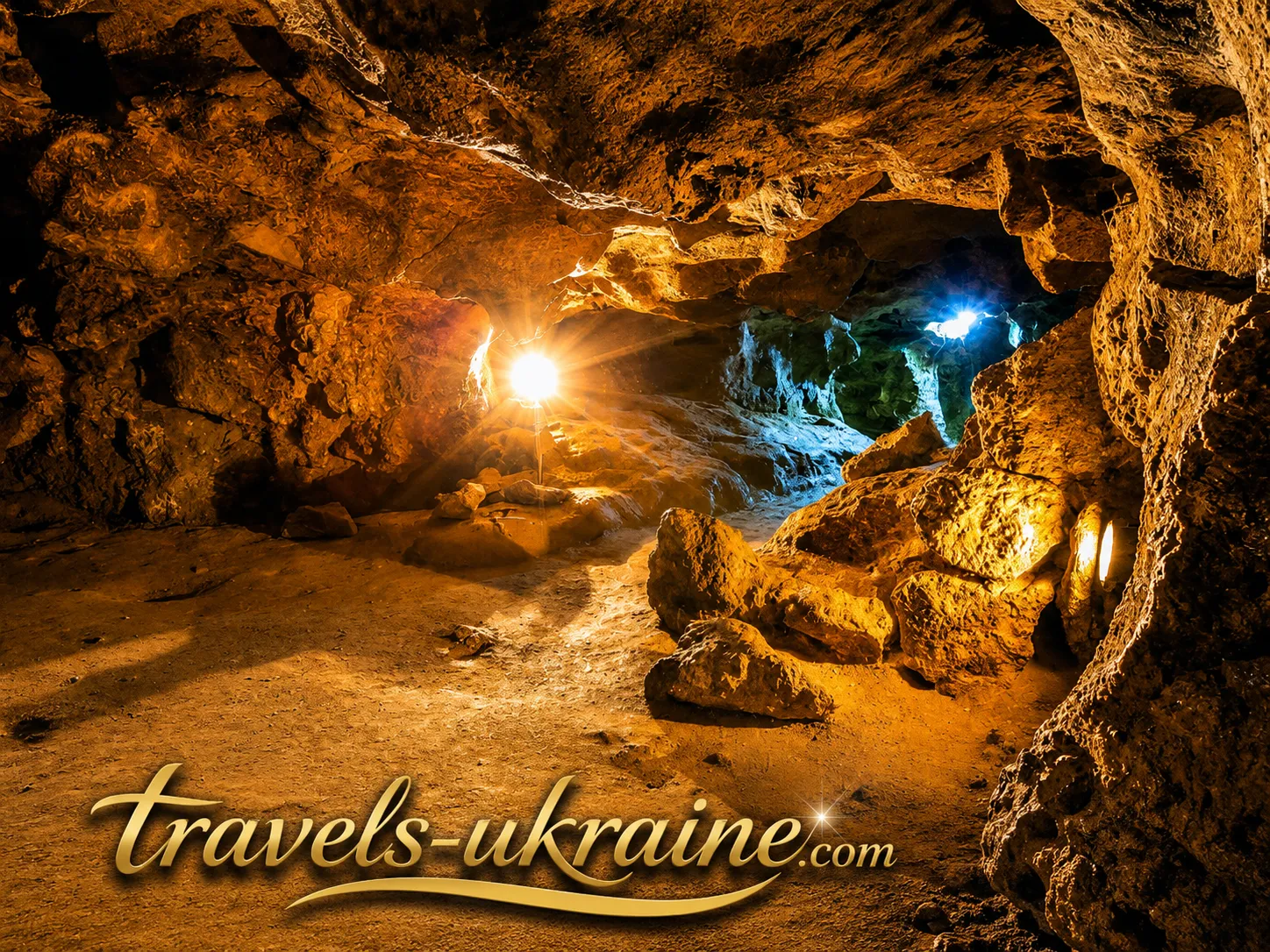
Some tourist destinations impress with their landscapes, towering cliffs, or historic architecture. Others affect you in an entirely different way: they take away your daylight, quiet your unnecessary thoughts, and leave you with only your footsteps, your breathing, a flashlight, and the feeling that you have entered another dimension. Mlynky Cave is exactly this kind of place—one of Podillia’s most fascinating underground destinations, hidden near the village of Zalisia in the Chortkiv area of Ternopil Region.
For many travelers, the Mlynky Gypsum Cave becomes more than just an excursion—it becomes a genuine adventure. There is no ordinary walk along a smooth path with handrails and decorative lighting. Instead, there are natural, narrow underground passages, cave chambers, gypsum walls, crystals, silence, and a route revealed only to those ready to get their clothes a little dirty, stay alert, and trust their guide.
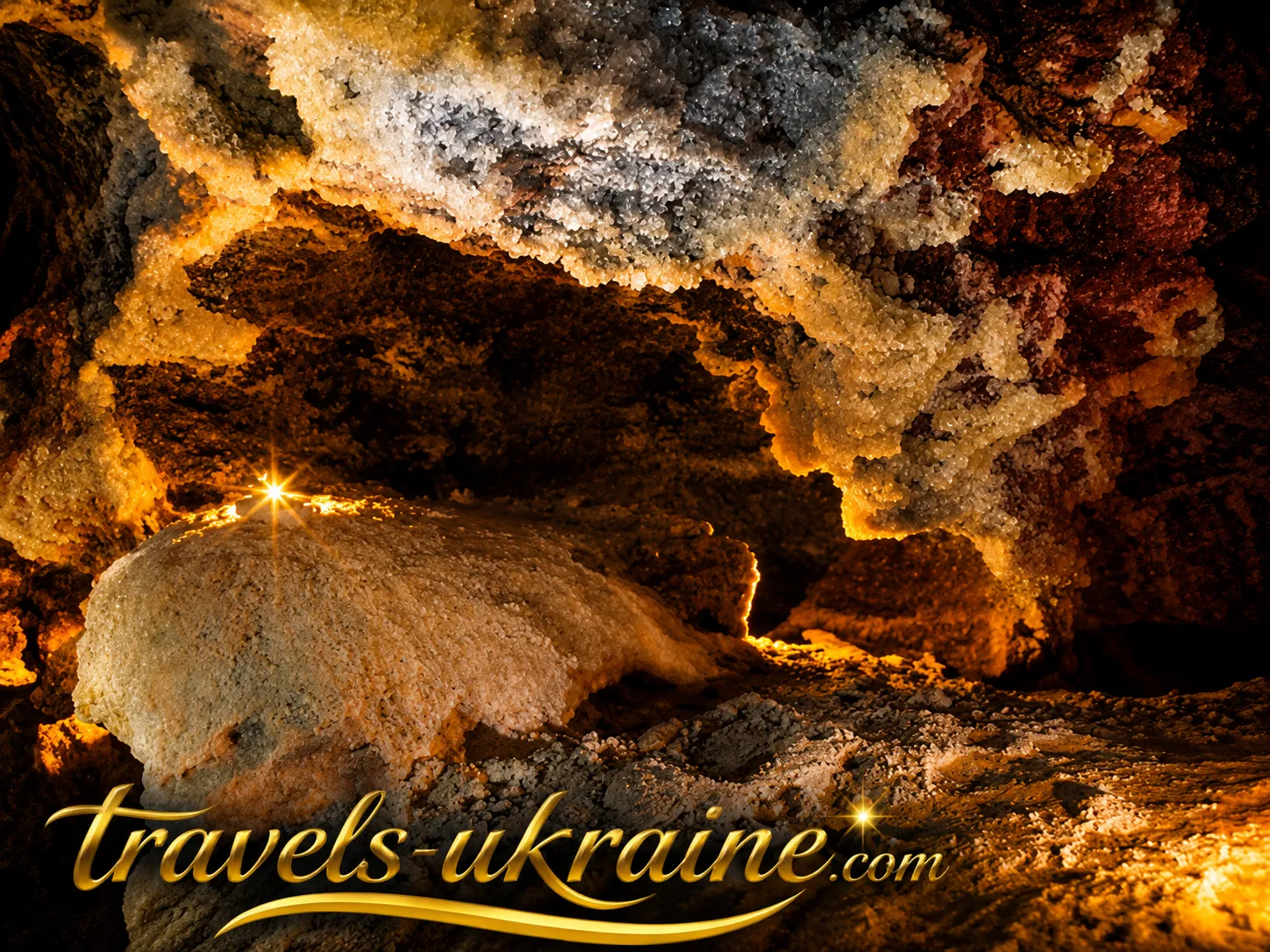
Mlynky’s main feature is its authenticity. There is no theatrical staging here: nature created the scenery, while people have merely learned to carefully guide travelers through the gypsum labyrinths. Along the route, you see not simply a “cave,” but a system of passages, transitions, and chambers where time seems to have stopped. A flashlight picks out textured walls, crystalline patterns, passageways, and strange shapes from the darkness—features that easily spark the imagination.
That is why an excursion to Mlynky Cave differs from a classic tourist walk. It is more like a light caving adventure, in which the tourist does not simply listen to a story but takes part in the route: bending down, passing through narrow sections, placing their feet carefully, studying the terrain, and gradually growing accustomed to the underground silence. For some, it is their first experience of cave tourism; for others, it is a reason to return, because Mlynky has many routes and reveals itself differently every time.
Who Will Enjoy a Caving Adventure in Mlynky Cave
Mlynky Cave in Ternopil Region will appeal to those looking not for ordinary recreation, but for an emotion: a little adrenaline, a little silence, a touch of childlike wonder, and plenty of new impressions. It is a great option for travelers who have already seen castles, parks, and observation decks but want to experience another side of Ukraine—underground, natural, ancient, and mysterious.
This destination is best suited to active tourists, groups of friends, couples, adult travelers, properly organized school or university groups, and anyone interested in geology, nature, cave tourism, ecotourism, and unusual tourist routes in Podillia. At the same time, it is important to understand that this is not a walk in a city park. An underground excursion requires comfortable clothing, proper footwear, attentiveness, and the guidance of an experienced leader.
So let’s set off together into an underground world where darkness has a voice of its own, silence feels deeper than any landscape, and gypsum labyrinths reveal an entirely different Ukraine to the traveler—mysterious, natural, and unforgettable. Mlynky Cave near the village of Zalisia is not merely a geological natural monument of national importance, but a journey into a space where every turn can become the most vivid memory of the route.
The Discovery and Early Exploration of Mlynky Cave
Mlynky Cave has a history woven from geology, human curiosity, and an accidental discovery. Today, it is known as one of Ukraine’s most fascinating gypsum caves. Once, however, the area was simply an ordinary rural outskirts near the village of Zalisia in the Chortkiv area, where people worked the land, used natural resources, and had no idea that a vast underground labyrinth lay hidden nearby.
The name "Mlynky" is connected with the area where a water mill once stood. Later, the name became associated with a hamlet that was incorporated into the village of Zalisia, and eventually with the cave itself. That is why search queries often feature different variations: Mlynky Zalisia or Mlynky Cave in Chortkiv. They all lead to the same place—a gypsum cave in Ternopil Region that has become an important tourist destination in Podillia.
How the Mlynky Gypsum Cave in the Chortkiv Area Was Discovered
The first information about Mlynky Cave appeared on June 25, 1960, in the newspaper «Nove zhyttia». The article was written by M. Bil, a schoolteacher from the village of Uhryn, one of those rare local historians able to spot a sensation where others see merely two dark openings in a mountainside. In fact, he was the one who gave the cave its name. And it must be admitted: the name took hold so naturally that it seemed less invented than drawn straight from the earth itself, along with the smell of gypsum, the coolness of the underground passages, and humanity’s first curiosity about this mysterious labyrinth.
Imagine the moment: a rural outskirts, a hillside, no tourist signs, ticket booths, helmets with headlamps, or grand plaques declaring a «geological natural monument.» Just a dark entrance into the unknown and a teacher who decided not to walk past it. You could say Mlynky was lucky with its discoverer: instead of «Forget it, it’s dark in there,» there was a newspaper article—and with it began the story of one of the most fascinating gypsum caves in Ternopil Region.
It would be too simplistic to tell the history of Mlynky Cave solely through the year of its discovery. Its true history is far older: gypsum formations developed millions of years ago, when the territory of present-day Podillia looked entirely different. In the distant geological past, shallow basins existed here, where mineral deposits gradually accumulated. Over time, these became the foundation for gypsum strata, while water, fractures, and natural processes created underground passages, chambers, and transitions.
Mlynky Cave is therefore not simply a landmark that people happened to find one day. It is the result of a long natural process in which time worked slowly but with extraordinary precision. The underground passages, gypsum crystals, uneven walls, and natural formations remind us that this is not an artificial tunnel, but a complex geological system. It is this natural character that makes Mlynky so valuable to tourists, researchers, and everyone interested in cave tourism.
The Speleological Club, Researchers, and the Development of Tours to Mlynky Cave
After the first explorations, the cave began attracting the attention of speleologists. This was a decisive stage for Mlynky: without the study and mapping of its passages, it might have remained a dangerous and little-known underground cavity. Thanks to the work of researchers and speleological clubs, the cave became accessible to tourists through controlled routes.
Chortkiv speleologists and the «Krystal» speleological club played a particularly important role in popularizing Mlynky. They not only explored the underground passages but also gradually established a culture of responsible visitation. That is why an excursion to a gypsum cave is not wandering through the darkness alone, but an organized underground journey with a guide who knows the route, dangerous sections, the cave’s features, and the rules of conduct underground.
Over time, Mlynky became known among active-recreation enthusiasts, school and university groups, weekend travelers, and supporters of cave tourism. The cave attracts visitors not through decoration, but through its genuine character: you need to move, bend down, sometimes pass through narrow spaces, and listen carefully to instructions. This lively interaction with the surroundings has made Mlynky Cave in Ternopil Region one of Ukraine’s most recognizable underground destinations.
Mlynky Today: A Natural Landmark of Podillia
Today, Mlynky Cave is not only a place for adventure but also a geological natural monument of national importance. This status highlights its natural value and, at the same time, serves as a reminder that the cave must be treated with care. Its gypsum walls, crystals, chambers, and passages are not decorations to be touched without consequences. Everything in the cave forms slowly and is damaged quickly.
For travelers, Mlynky’s history matters as more than background information. It helps them see the route differently. When you know that you are not facing simply a dark corridor, but an underground world formed over millions of years and discovered by people only in the last century, every step feels more meaningful. That is how Mlynky Cave in Podillia transforms from another point on the map into a place with memory, character, and an atmosphere of its own.
The Gypsum Cave in Zalisia: Natural Features
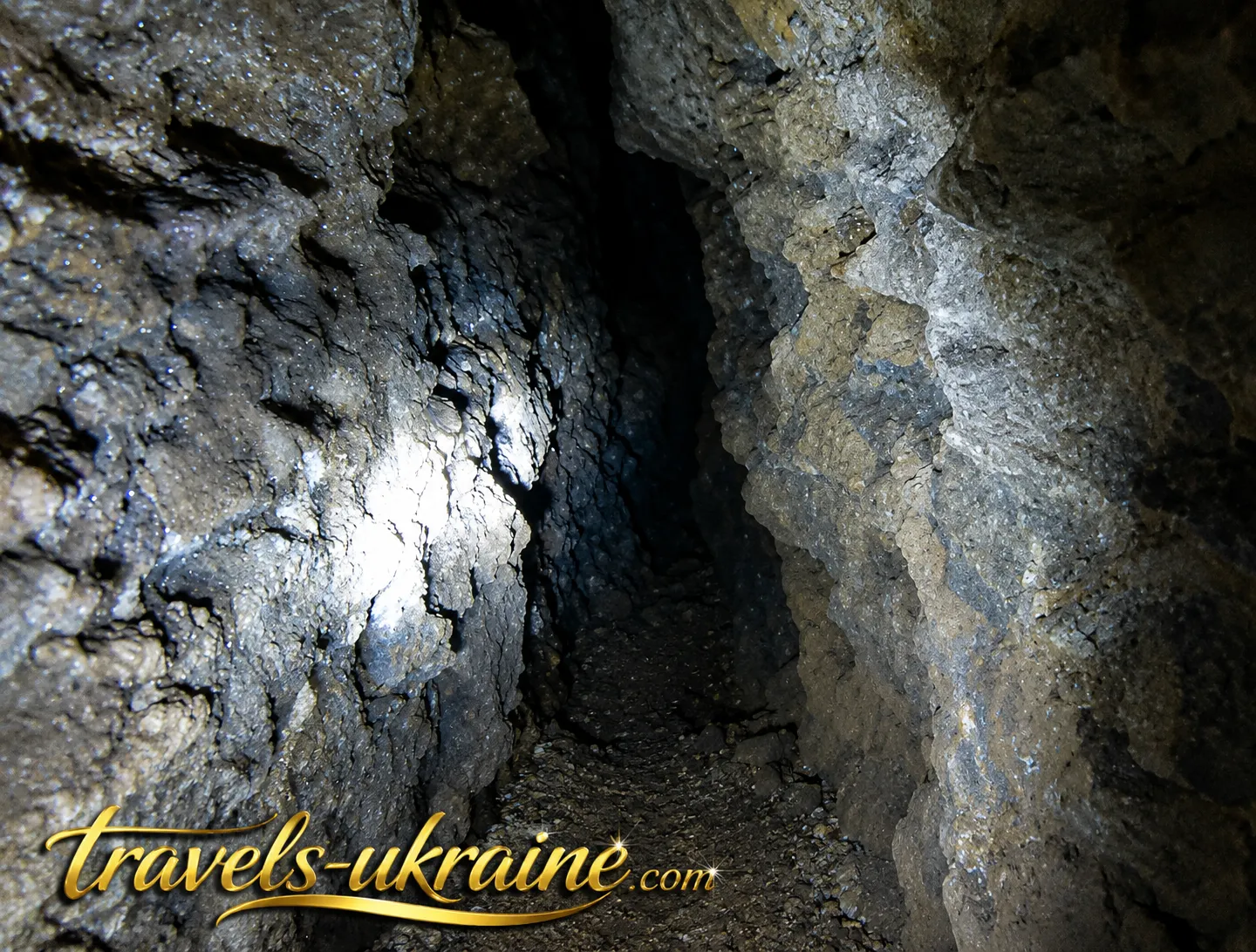
Mlynky Cave in Ternopil Region is a maze cave. This means its underground passages do not resemble one straight gallery where tourists walk from entrance to exit like along a hotel corridor. Here, the space branches, turns, narrows, widens, and sometimes seems to play tricks on travelers: just when a wall appears to stand before you, the guide points out a passage that, without experience, could be mistaken for a shadow or a crack. That is why an underground excursion should always take place with a guide, not according to the principle of “I’ll just take a quick look.” In a cave, such confidence quickly turns into a very bad idea.
The cave’s total length is 53,160 m—and believe me, that is more than enough for even someone with a very confident expression and the words “I remembered the way” to get lost. In Mlynky, that confidence quickly fades: one turn, a second, a third—and suddenly all the passages look alike, the flashlight seems to be shining in the same direction, and the internal navigator quietly packs its bags and goes on vacation. That is why the underground world of Mlynky is not a place for solo experiments, but an underground labyrinth that should be explored only with an experienced guide.
What Makes the Gypsum Cave in Ternopil Region Special
The entrance to Mlynky Cave lies at an elevation of approximately 270 m above sea level. The gypsum layer here is about 20 m thick, and this natural stratum contains the complex underground labyrinth. The cave extends along the Mlynky Valley from southeast to northwest, gradually penetrating the gypsum massif toward the north. Put simply, nature did not lay out a neat tourist corridor “from the entrance to the souvenir shop”; it created a genuine underground puzzle where it is better not to test your navigation skills without a guide.
Mlynky is considered a benchmark of gypsum karst. Structurally, it is a subhorizontal labyrinth-type cavity: the cave does not descend sharply like a mine, but branches into a system of passages, galleries, and chambers. Most of the long galleries and spacious sections formed along fractures with a strike direction of approximately 10–20°, while shorter transitions connect them in the perpendicular direction. This is why Mlynky’s underground passages resemble not a single road but an entire network of natural “streets,” lanes, and unexpected turns, where a phone navigator, if it had a sense of humor, would simply say: “Stick with the guide.”
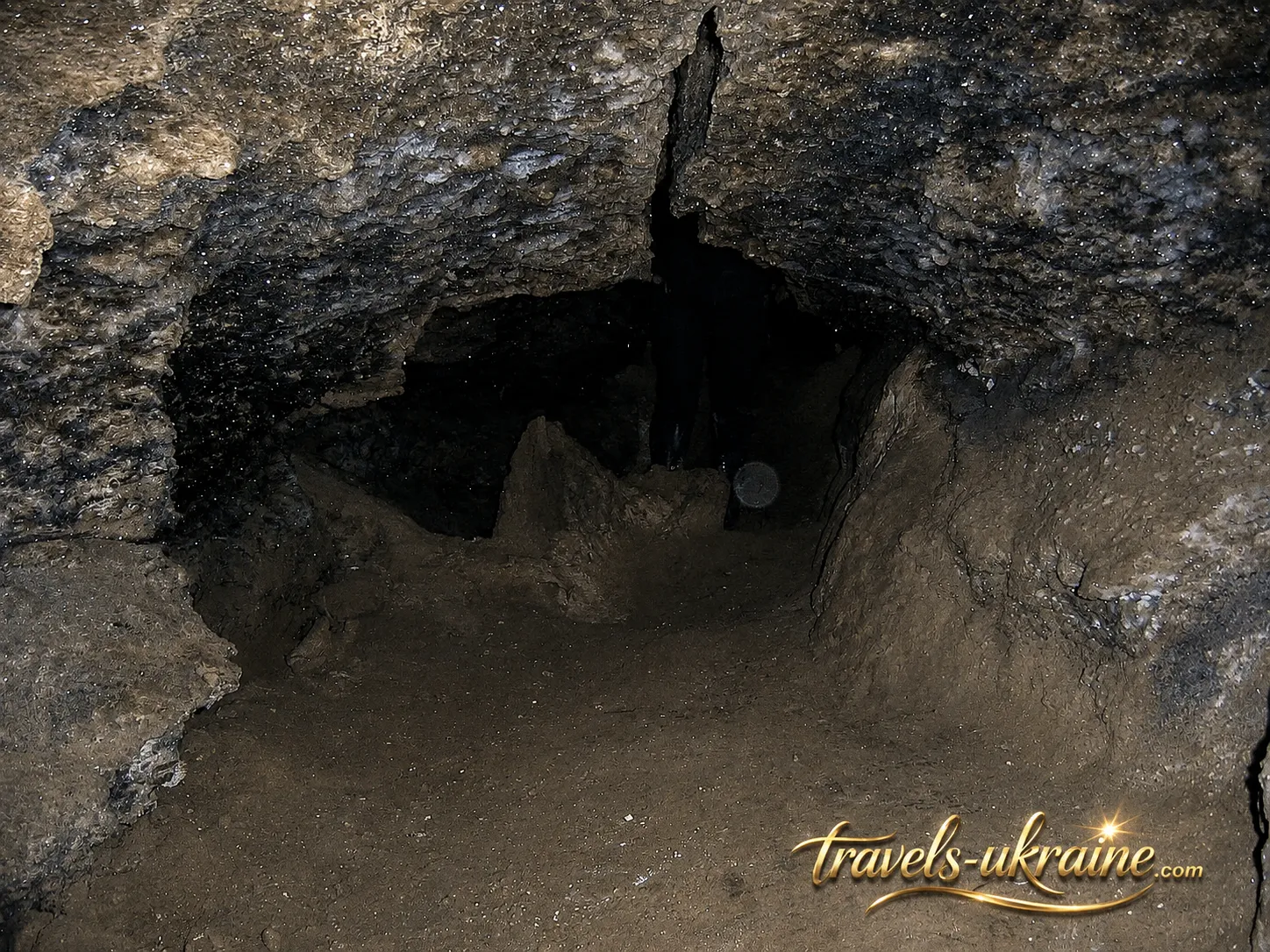
The height of the passages ranges from 0.5 to 20 m. This explains perfectly why, during a caving trip to Mlynky Cave, a tourist can take on several different roles within just a few minutes: first walking almost crouched, then carefully squeezing through a narrow passage, and later suddenly finding themselves in a chamber where they can stand upright and solemnly remember that humans are, after all, bipedal creatures. In some places, the passages run through nearly the entire thickness of the gypsum, while some chambers were formed by collapses. In the ceilings of such sections, marl and limestone layers lying above are exposed, adding even greater geological character to the cave.
Despite the nearly 100 percent humidity, the cave’s temperature is relatively stable at around 9.6 °C. On paper, that sounds almost comfortable, but in practice, after a few minutes underground, it becomes clear that a light jacket or warm sweater is a good idea. Mlynky Cave is not fond of tourists who say, “I’m only going in for a minute; a T-shirt will be fine.” It quickly reminds you that the underground world has its own climate, its own rules, and a very convincing chill.
Gypsum Crystals, Cave Chambers, and Mlynky’s Underground Passages
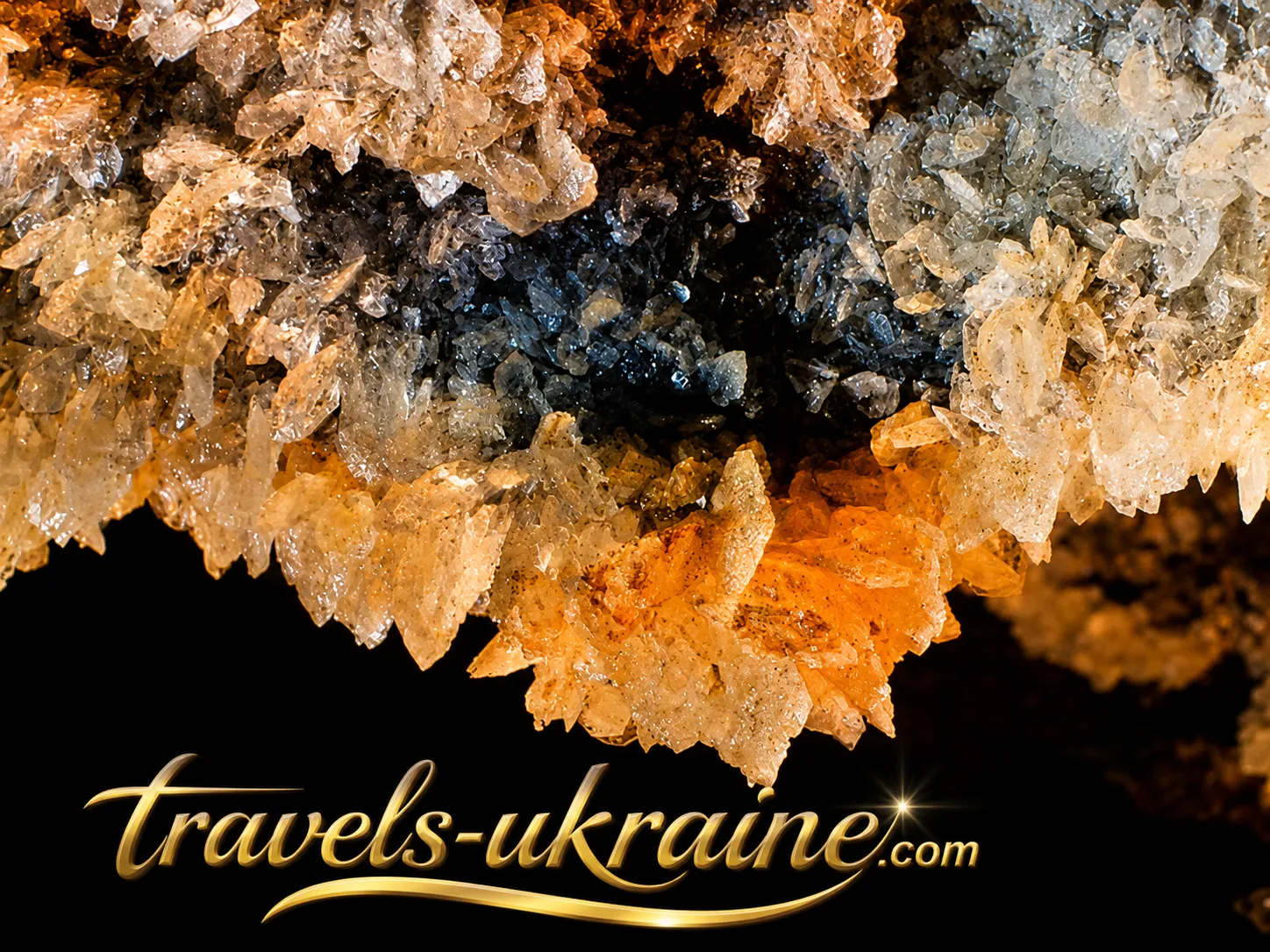
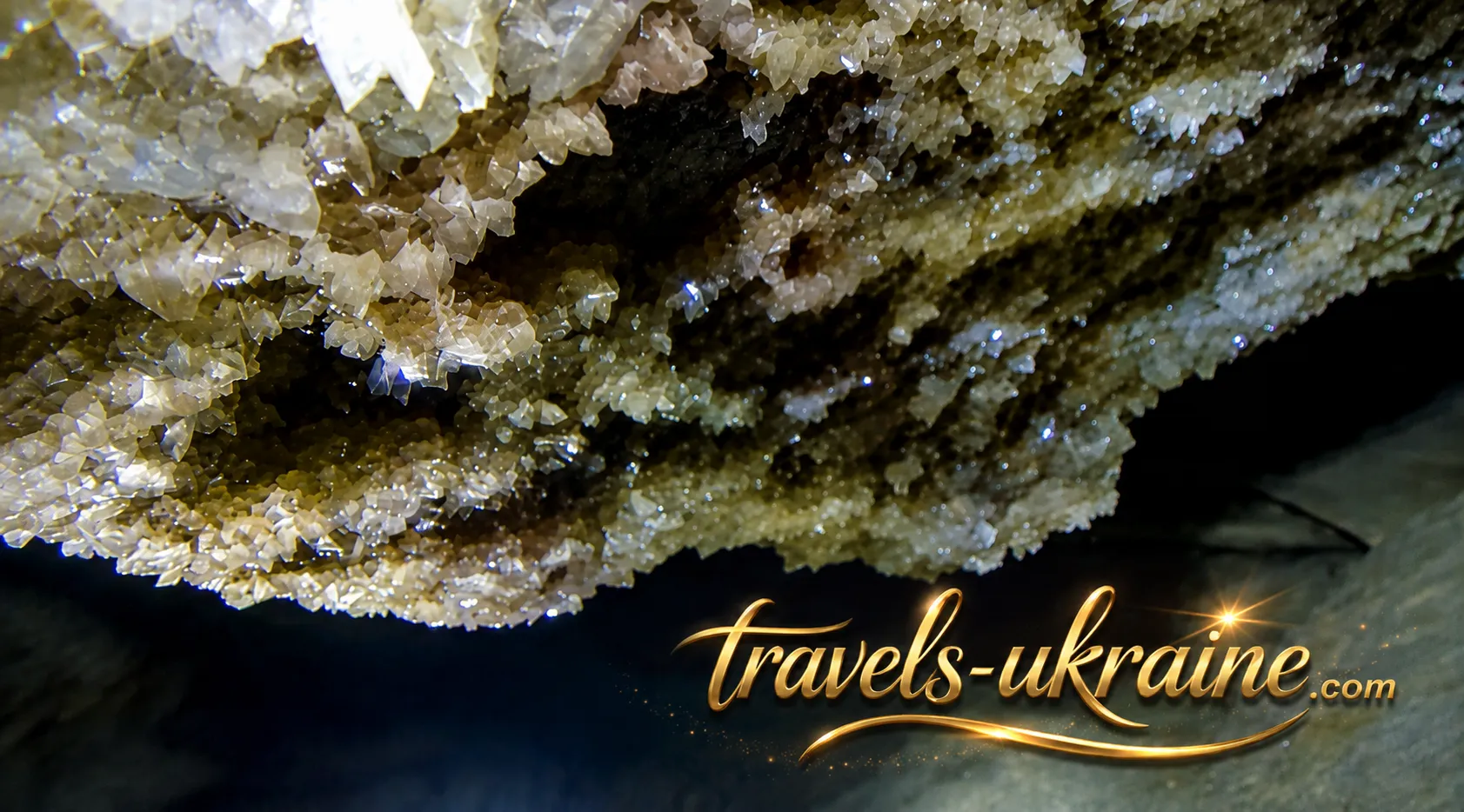
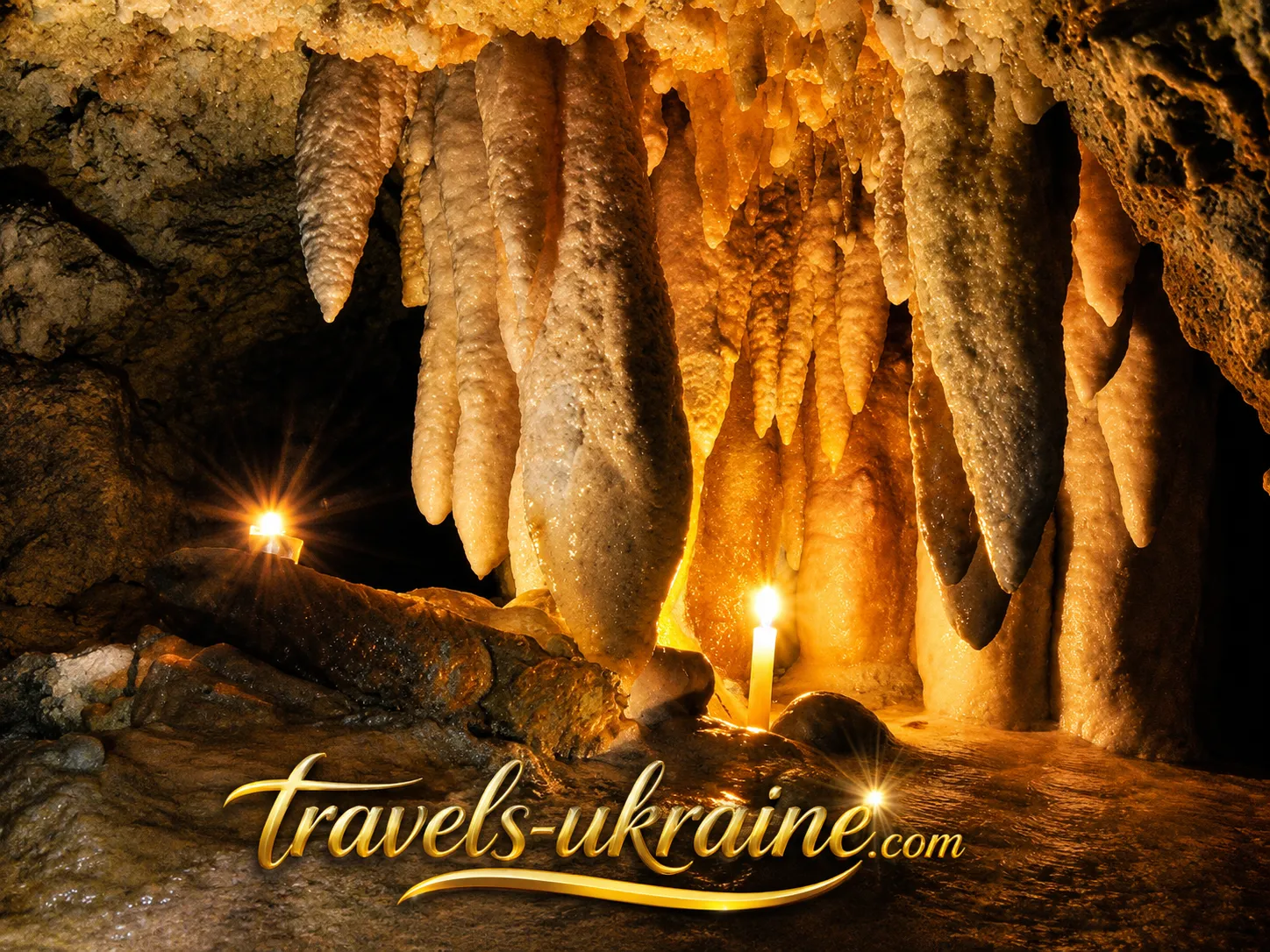
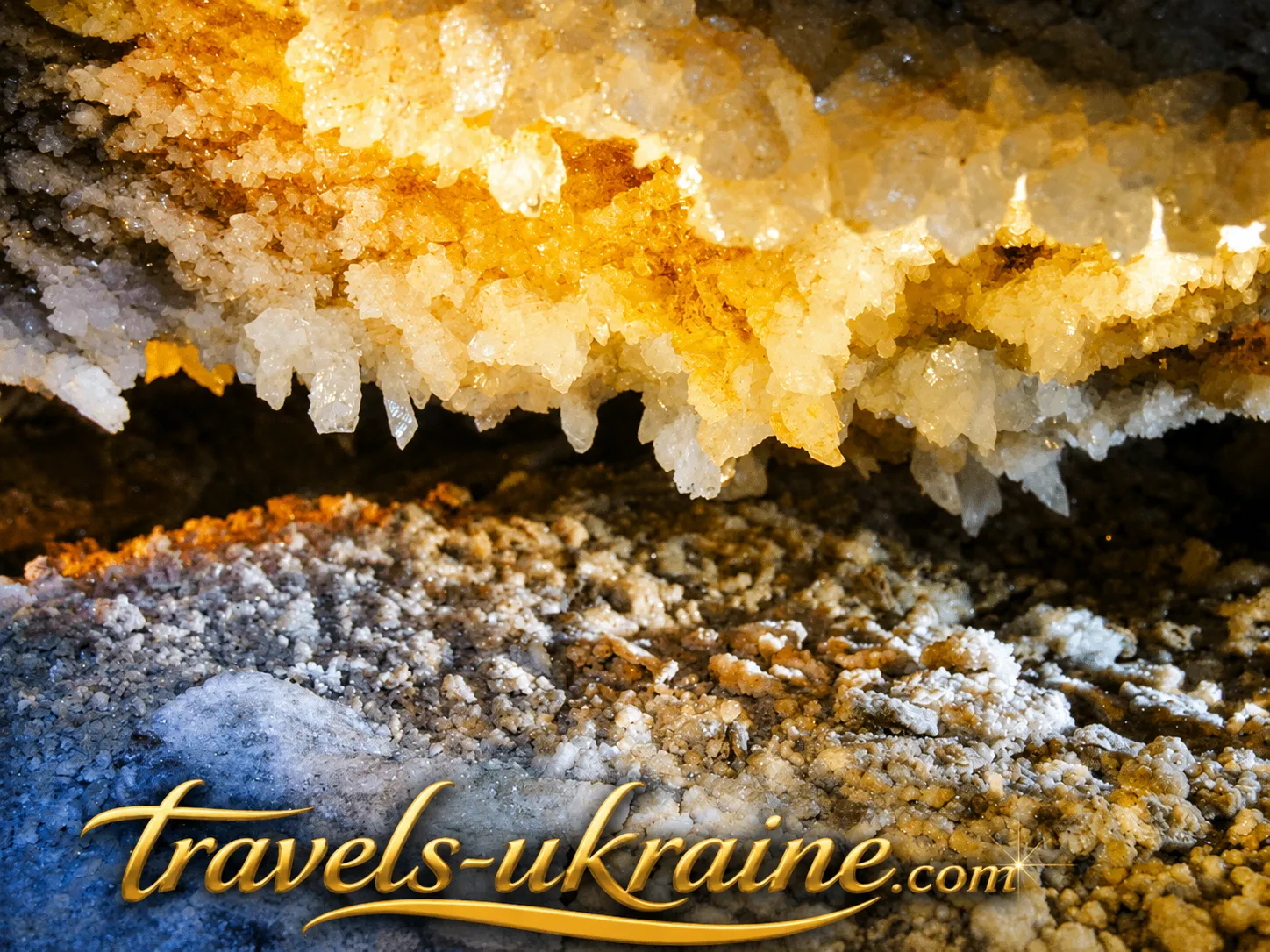
One of the cave’s most beautiful details is its gypsum crystals. They do not always look like the glittering souvenirs sold at a fair, and that is precisely where their charm lies. In their natural underground environment, the crystals can vary in color, size, and structure. Some are delicate, fragile, matte, transparent, or barely noticeable. At times they resemble tiny stars; at others, a whitish frost that somehow failed to melt in the darkness. But they should not be touched: what nature took a very long time to create can be damaged by a human hand in a single second.
Mlynky’s cave chambers do not have the formal grandeur of palace interiors, but they possess an architecture of their own. It is architecture without an architect, shaped by water, pressure, the dissolution of rock, and time. In one place, the space may feel intimate and quiet; elsewhere, it opens up enough for a group to stop, catch its breath, and listen to the guide’s story. Then the passages, turns, narrow sections, and that familiar moment begin again, when someone in the group inevitably asks, “How did you even remember the way?” And, incidentally, that is a very good question.
Mlynky’s underground passages are the main reason the cave feels alive. They do not repeat mechanically, follow a straight route, or let visitors relax completely. In some places you need to bend down, in others walk sideways, and elsewhere place your feet carefully—or simply stop and look around. This interaction with the space is what makes caving in the cave so special: you are not merely looking at a landmark; you are physically making your way through it.
What to Look Out for During a Tour of the Gypsum Cave
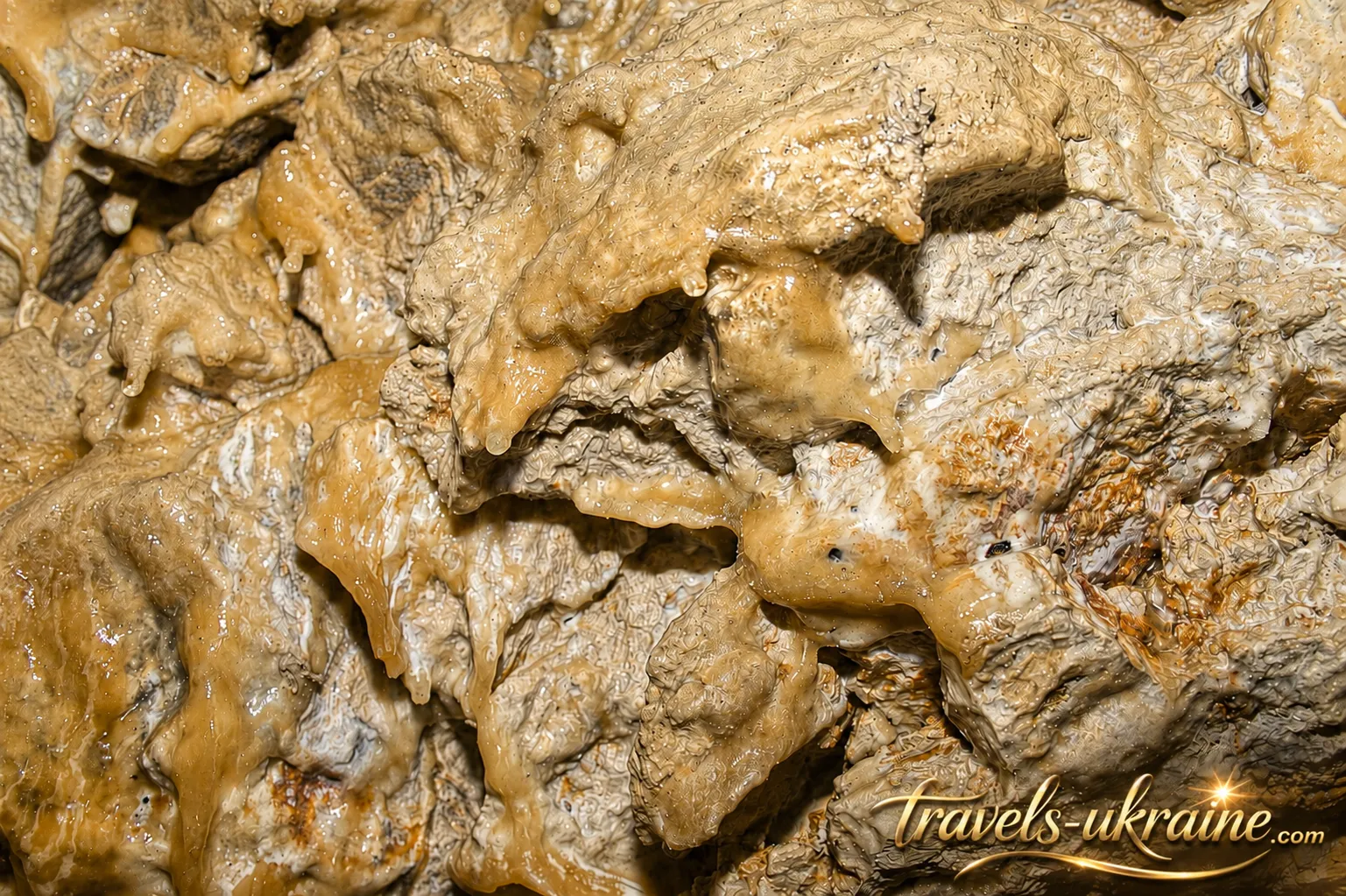
To make your tour more than just an adventure and turn it into a genuinely fascinating journey, remember to look beyond your feet in Mlynky. Of course, you absolutely must watch where you step—the cave has little patience for overconfidence. But it is just as important to notice the details: the color of the gypsum, the shape of the walls, the direction of the cracks, changes in the space, and the sensations of humidity and silence. These small things create the full picture of an underground world whose main decoration is made up of helictites, groups of stalactites, and occasional stalagmites.
This underground gem of Ternopil region, near the village of Zalisia, is a place where natural features do not lie on the surface, either literally or figuratively. You have to see them while moving, feel them in the darkness, hear them in the silence, and understand them through your own route. That is why a cave tour leaves you with more than photographs: it creates a clear inner feeling that Ukraine has far more depth than can be seen from the road.
Photo and Video Gallery
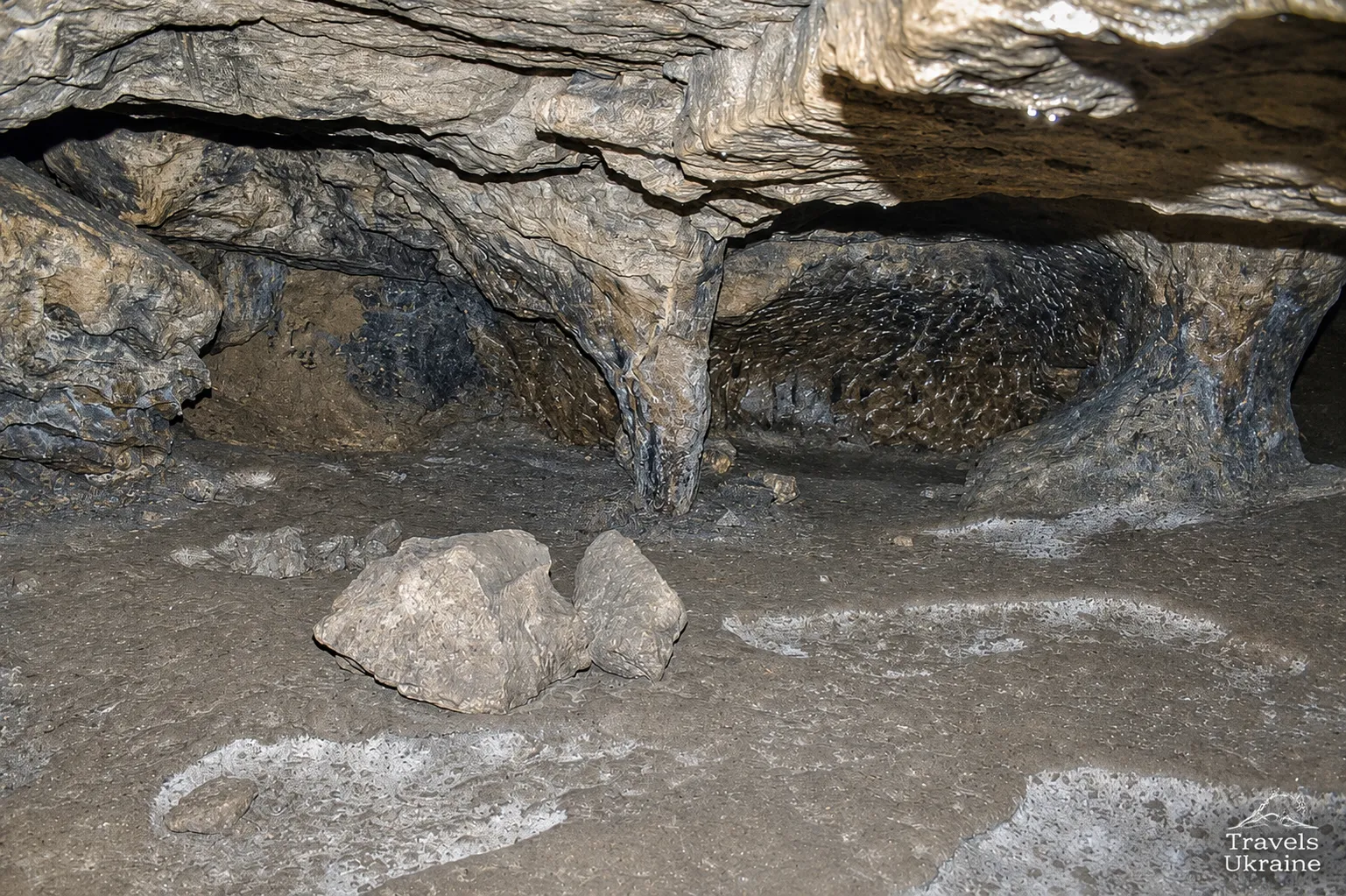
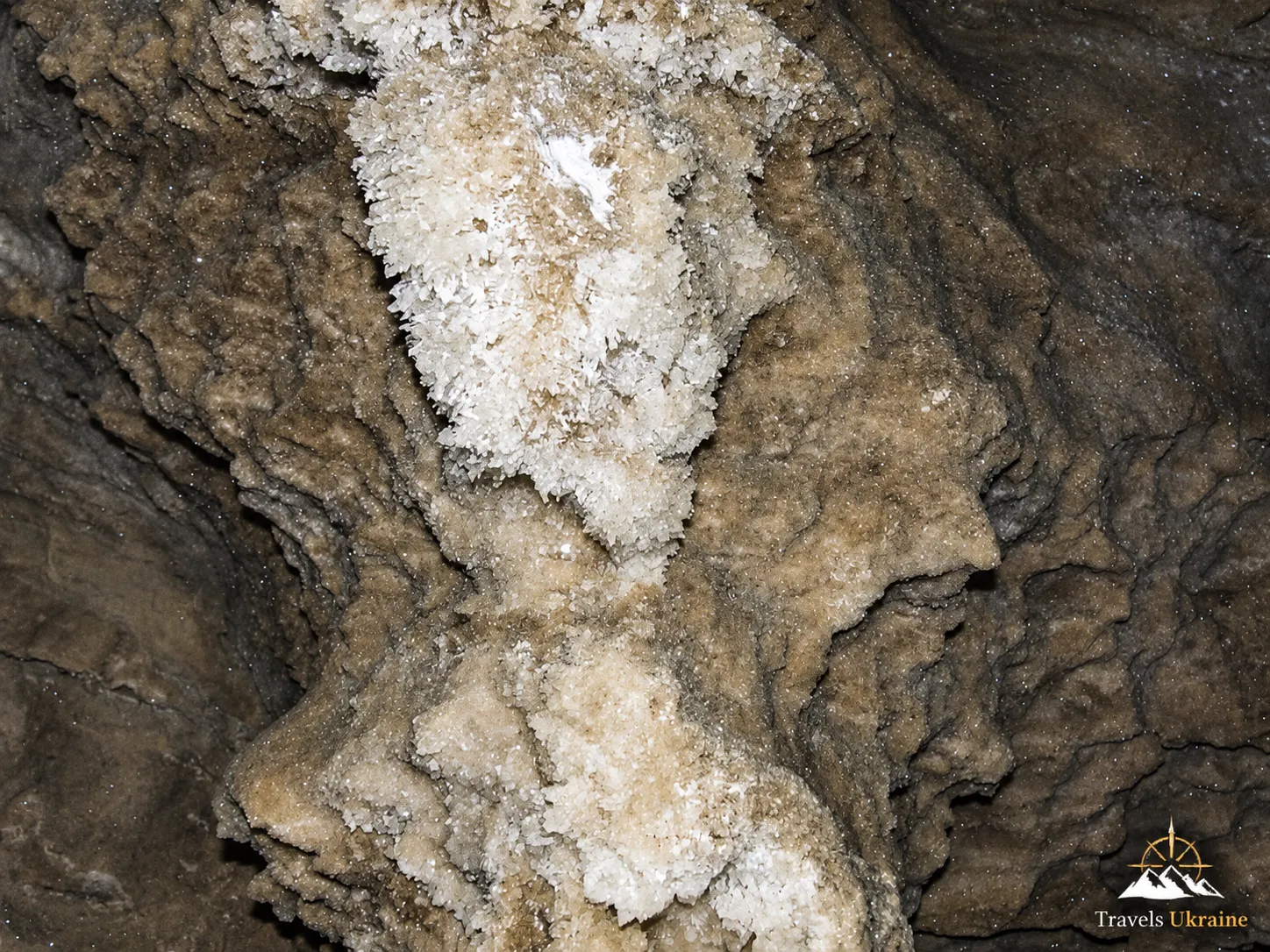
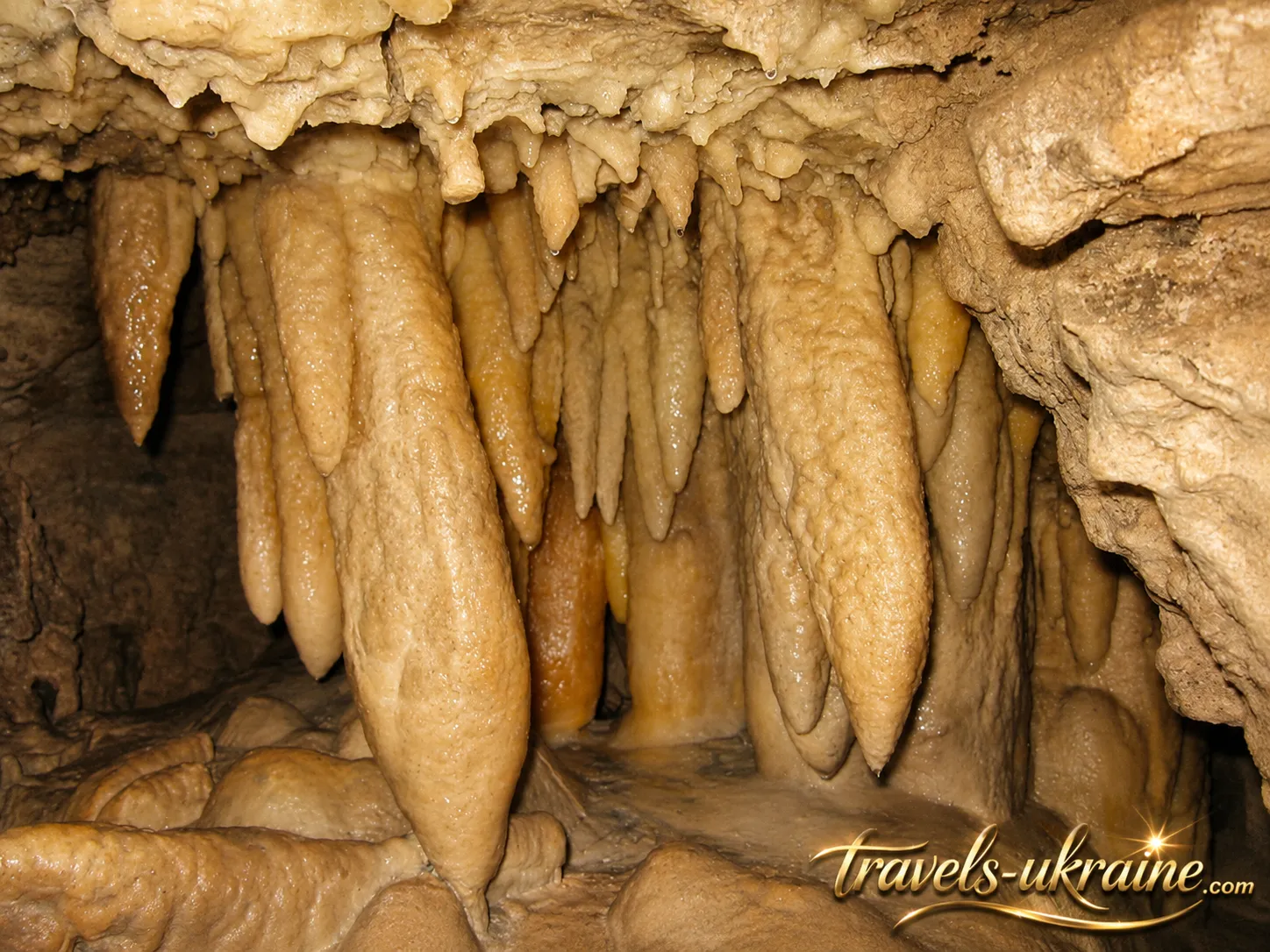
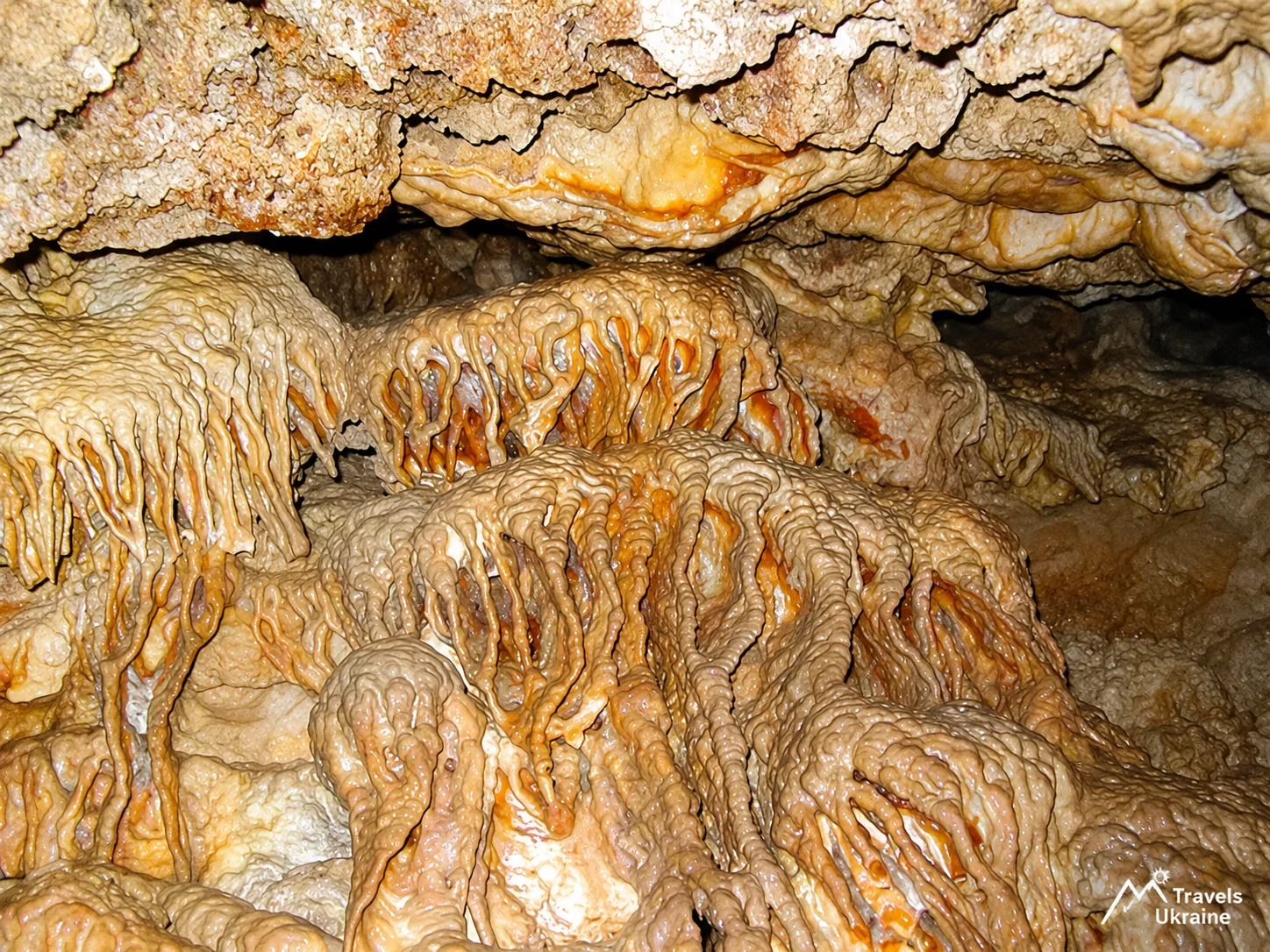
Mlynky Cave: A Quick Guide for Tourists
Mlynky in Ternopil region is an active tourist destination for those who want to see a genuine underground world rather than simply walk along a lit path and tick off “visited a cave.” Here you will find a labyrinth-style gypsum cave, natural passages, narrow routes, chambers, crystals, cool air, humidity, and a route governed by one simple rule: listen to your guide, do not try to be a hero, and do not attempt to prove to the cave that you know the way better.
For your first introduction to Mlynky, it is best to choose a standard cave tour with an experienced guide. It allows you to experience the atmosphere underground, see the characteristic gypsum passages, and understand why this destination is so popular with caving enthusiasts. More challenging routes should be planned only after gaining basic experience or with a group that is physically prepared for a more demanding underground journey.
The duration of the tour depends on the chosen route, the group’s preparation, and the organizer. For a first visit, it is usually best to allow several hours with extra time for the journey to the site, the briefing, equipment fitting, the route itself, and time after leaving the cave. Do not squeeze Mlynky “between coffee and another castle” in a packed schedule. The cave does not like haste, and a wet overall after the route likes it even less.
In terms of difficulty, a gypsum cave is not extreme for a well-prepared tourist, but it is not an easy stroll along a park path either. There may be low passages, uneven floors, slippery sections, narrow spots, and a need to move carefully. For this reason, people with a severe fear of confined spaces or serious musculoskeletal or respiratory problems should assess their abilities in advance and discuss the route with the organizers.
Accessibility, Equipment, and the Budget for a Trip to Mlynky
A visit to Mlynky Cave should be planned in advance and undertaken only with a guide. The route usually requires a helmet, a flashlight, comfortable clothing you do not mind getting dirty, closed-toe shoes with good grip, and a warm layer. The temperature underground remains consistently cool and the humidity is high, so a light jacket or sweater may prove much more useful than the heroic declaration, “I don’t get cold.”
The cost of the trip depends on the tour format, the number of people in the group, equipment rental, transportation, and additional stops along the route. If you are traveling by car, the main expenses are fuel, an organized tour of Mlynky Cave, equipment if needed, and food. If you are planning to travel from Ternopil, Chortkiv, or another city by public transport, check the timetable separately and allow extra time, because a cave is not a shopping center where you can simply “drop in for an hour.”
The main thing to understand before your trip is that a geological natural monument is not an attraction for a random dash in and out, but a full underground journey. It offers plenty of emotions, but requires respect for the route, attentiveness, and proper preparation. If you approach the visit sensibly, this cave in the village of Zalisia may become one of the brightest memories of your trip through Ternopil region.
Interesting Facts About Mlynky Cave
Mlynky Cave is one of those places where facts sound almost like legends, while legends are born right during the tour. All it takes is switching off your unnecessary thoughts, turning on your flashlight, and taking a few steps into the darkness to understand that the underground world has a character of its own. It does not hurry or advertise itself with huge banners, but it can impress you so deeply that, after returning to the surface, daylight seems like a tourist attraction in its own right.
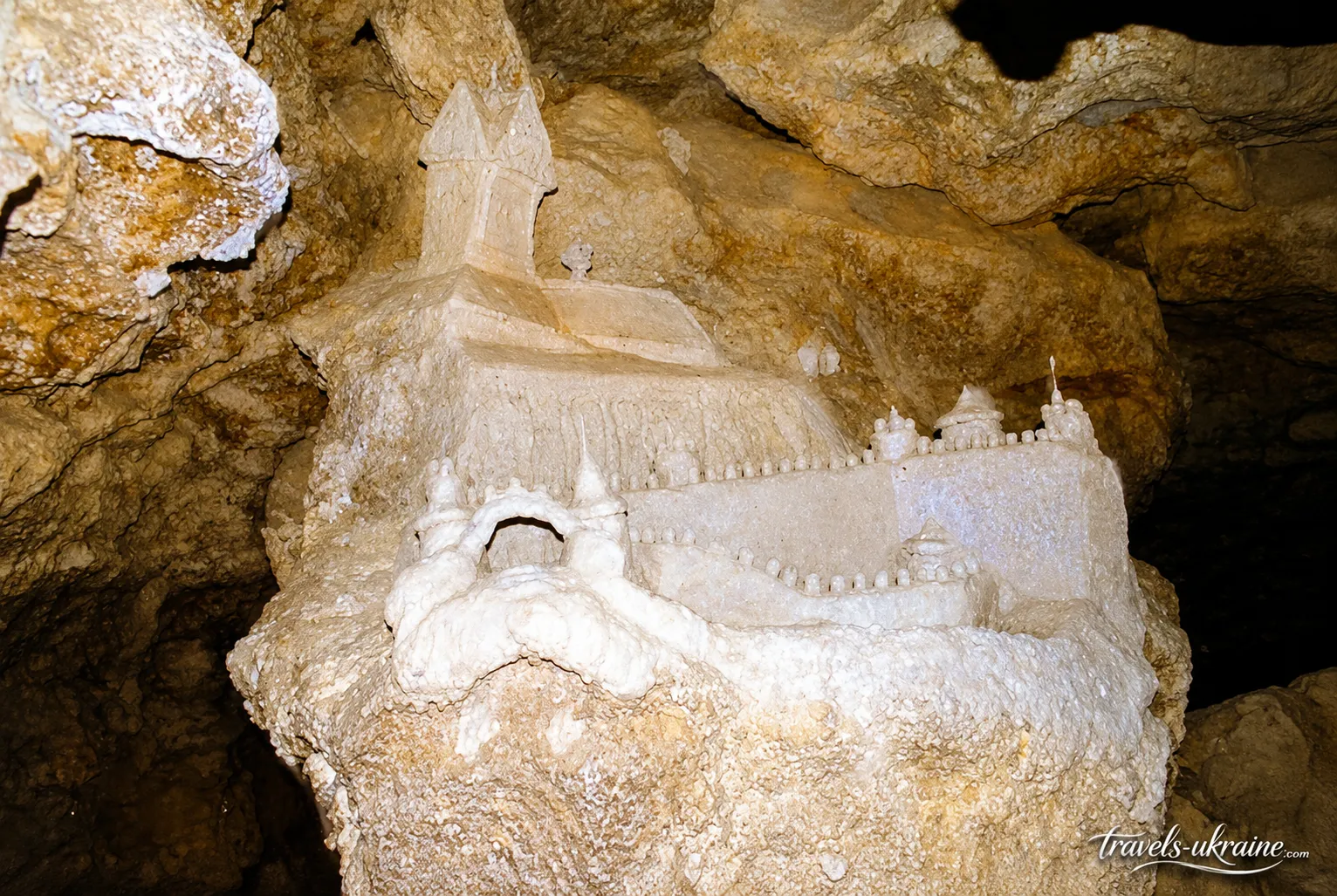
This mysterious labyrinth does not need grand legends about underground castles, gold, or secret passages. Its true legendary quality lies in the atmosphere itself. Walk through a few narrow passages, hear the sound of your footsteps disappear into the darkness, and see your flashlight pick out a crystalline glimmer on the wall—and your imagination begins to work better than any tour guide. To one person, a wall resembles a wave; to another, frozen fabric; to someone else, the profile of a fantastical creature. And some simply want to check that the group is really heading back, rather than visiting the center of the Earth.
That is how small tourist legends are born in Mlynky: about a passage that “was definitely wider when we came in,” a stone that “looked very suspicious,” a turn after which everyone suddenly begins to appreciate daylight, and a guide who looks calmer in the cave than Google Maps does in the city’s central square. This is not official folklore, but these lively stories are exactly what make a journey through Mlynky Cave personal for every tourist.
Fact One: Mlynky Is One of Ukraine’s Best-Known Gypsum Caves
Mlynky Gypsum Cave is known far beyond Ternopil region. It is one of Ukraine’s most fascinating destinations for caving tourism, combining considerable length, a labyrinthine structure, natural gypsum crystals, and the feeling of a genuine underground adventure. There is none of the familiar museum “sterility,” where everything is illuminated, fenced off, and labeled. Mlynky is more like a living book written by nature over millions of years, which tourists read with a flashlight, their knees, their elbows, and a very careful eye on the ground.
The special quality of this cave is that it does not reveal itself all at once. At first, the tourist sees darkness; then becomes accustomed to the narrow passages; then starts noticing the texture of the walls, crystalline patterns, unusual gypsum formations, changes in height, and unexpected transitions. Somewhere in the middle of the route comes the key realization: the underground fairytale of Ternopil region is not simply a question of “where to go for the weekend,” but a full encounter with the underground nature of Podillia.
Fact Two: Gypsum Crystals Grow More Slowly Than a Tourist Gets Ready to Leave
One of Mlynky’s most beautiful features is its gypsum crystals. They may be white, yellowish, dark, reddish, matte, or so reflective under a flashlight that they resemble tiny underground frost crystals. They are not decoration or “natural wallpaper,” but highly vulnerable mineral formations that develop extremely slowly. That is why the rule is simple: look, photograph, and admire them—but do not touch them with your hands.
The tourist joke fits perfectly here: if a crystal took hundreds or thousands of years to grow, it certainly was not waiting for the exact moment when someone decided to test whether it was “real” with a finger. Everything in the cave is real. The cool air is real, the humidity is real, and the consequences of carelessness are real too. So the best souvenir from Mlynky is not a broken-off piece of gypsum, but a clear conscience, vivid photographs, and a story you can tell your friends without adding, “Just don’t tell anyone.”
Fact Three: Bats Live in the Cave, but It Is Not a Horror Movie
Bats can be encountered in Mlynky’s underground world. To some people, that sounds like the beginning of a horror film, but in reality bats are an important part of the cave ecosystem, not characters waiting around a corner with dramatic music for tourists to appear. They are not interested in your hairstyle, backpack, or weekend plans. The best thing a visitor can do is avoid making noise near their roosting areas, refrain from shining a light directly into their eyes, and not try to get a “closer look.”
The underground is their natural habitat, while tourists are guests here. And, as with any visit, it is best to behave in a way that does not make the hosts regret letting you in. Attentiveness and respect for wildlife make an underground tour not only interesting, but also environmentally responsible.
Fact Four: Mlynky Continues to Be Explored
Another interesting feature of the cave is that it is not regarded as a completely “closed case.” Mlynky has been studied for decades, and speleologists continue to treat it as a complex natural system that requires attention, research, and protection. For ordinary tourists, this adds a special feeling: you are entering not a long-completed set, but an underground space that still holds mysteries. That is why Mlynky Cave is interesting not only as a place for recreation, but also as a living geological monument. It shows that nature does not operate on a tourist schedule: it does not open at 10:00, close for lunch, or create beauty “for the season.” It forms it slowly, silently, and with complete conviction.
Mlynky’s interesting facts make one thing clear: this cave does not try to be “convenient” in the usual tourist sense. It is different—natural, quiet, damp, cool, and a little mischievous. That is exactly why people love it. The gypsum labyrinths of Podillia have more than walls and labyrinths, underground chambers, and they possess a mood of their own—one you cannot carry to the surface in a backpack, but can easily preserve in your memory.
Events, Caving Trips, and Tourist Tours to Mlynky Cave
When it comes to events near Mlynky Cave, it is worth saying honestly from the outset: this is not the kind of place where a stage is set up every week, balloons are sold, and a festival with a grand name like “The Night of the Gypsum Dragon” is announced. Mlynky has a different character. Here, the main event is the excursion into the underground passages itself—the moment you enter the darkness, the first narrow passage, the first group laugh after an awkward crouch, and the first serious realization that underground, jokes are jokes, but you really need to listen carefully to the guide.
Mlynky Cave does not operate in the format of mass celebrations, but rather as a destination for caving trips, educational excursions, tourist routes, group tours, and research work. That is precisely what makes it special. You do not have to wait for a specific date on the calendar to have an unforgettable experience. All you need to do is organize the trip properly, arrange a guide, prepare your clothing, and arrive ready not merely to “take a look,” but to truly immerse yourself in the underground world.
The advantage of the cave is that underground there is no traditional tourist season in the sense of “beautiful in summer, everything is lost in winter.” Temperatures at Mlynky remain relatively stable throughout the year, so a caving trip can be planned in different seasons. There is one nuance, however: in winter and autumn, warm clothing for after leaving the cave becomes more important, while in spring and rainy weather, you need to pay closer attention to the road, footwear, and moisture.
For a first introduction, then, the best choice is a standard excursion into a gypsum cave. It lets you experience the atmosphere of Mlynky without unnecessary risk and understand whether this type of recreation is right for you. Those who have already visited caves or are in good physical shape may find more challenging routes interesting, but only with the guides’ approval. Underground, there is no point competing for the title of “the bravest tourist in the group”: the cave will win anyway when it comes to experience, age, and the length of its passages.
Caving Tours to Mlynky Cave: the Main Event for Tourists
The most popular way to visit is a caving tour of Mlynky gypsum cave or an organized guided excursion. For tourists, this is the main event, because the route here is nothing like a classic museum walk. The cave has no glossy waiting hall, level path, or sign saying “caution, excessively beautiful.” Instead, there are helmets, headlamps, natural passages, gypsum walls, narrow openings, and the feeling that you have entered a place where nature carried out repairs for millions of years and apparently still has not finished.
Such trips are often organized by tourist clubs, caving clubs, schools, student groups, groups of friends, or travelers who want to add something truly unusual to their route through Ternopil Oblast. Mlynky is especially popular on weekends, when people want to escape the noise of the city not merely “into nature,” but literally underground. And it must be admitted: this is one of the most original ways to enjoy nature, because here nature is not only around you, but above you, below you, and on every side.
Educational Trips and Caving Adventures for Groups
Mlynky is well suited to educational trips when they are organized responsibly. For older schoolchildren, students, hiking clubs, and local-history groups, it is not just entertainment but a practical lesson in geography, geology, ecology, and common sense. Underground, it quickly becomes clear that the words “karst,” “gypsum,” “labyrinth cave,” and “safety procedures” are not dry textbook terms, but things directly related to your knees, shoulders, and the cleanliness of your trousers.
During such trips, tourists can see what a natural monument looks like, learn why gypsum crystals must not be broken, how underground passages form, why the cave maintains a stable, cool temperature, and why even a very intelligent person is better off not experimenting with the route without a guide. Mlynky explains complex things simply: one narrow passage can sometimes teach respect for nature better than ten lectures in a warm office.
Caving Clubs, Research, and Life Beyond the Tourist Route
Cavers play a special role in the life of Mlynky. Thanks to the people who research, document, protect, and promote the cave, ordinary tourists can safely see part of this underground world. For caving clubs, Mlynky is not merely a tourist spot on a map, but a place of long-term work, responsibility, and constant attention. While a tourist is enjoying a cup of hot tea after the route, researchers are thinking about the condition of the passages, new sections, ecology, safety, and how to make visiting the cave sensible rather than destructive.
Such caving events rarely look like a classic festival. There is no red carpet, but there are coveralls, helmets, maps, ropes, headlamps, and people who can talk about the cave for hours with such enthusiasm that it sounds less like an underground world and more like the best series of the season. This community supports the culture of cave tourism in Ternopil Oblast and helps tourists see Mlynky not as a “dark hole in the ground,” but as a valuable geological natural monument.
So, if you are looking for a classic festival in Mlynky with a poster, stage, and food court, you may be slightly disappointed. But if you regard the underground journey through Ternopil Oblast itself as the main event, everything falls into place. The cave does not need a loud program, because its program has already been written by nature: entering the darkness, gypsum labyrinths, narrow passages, group laughter, respect for the guide, and the deeply satisfying feeling of seeing the sky again after the route.
What to Visit Near Mlynky Cave
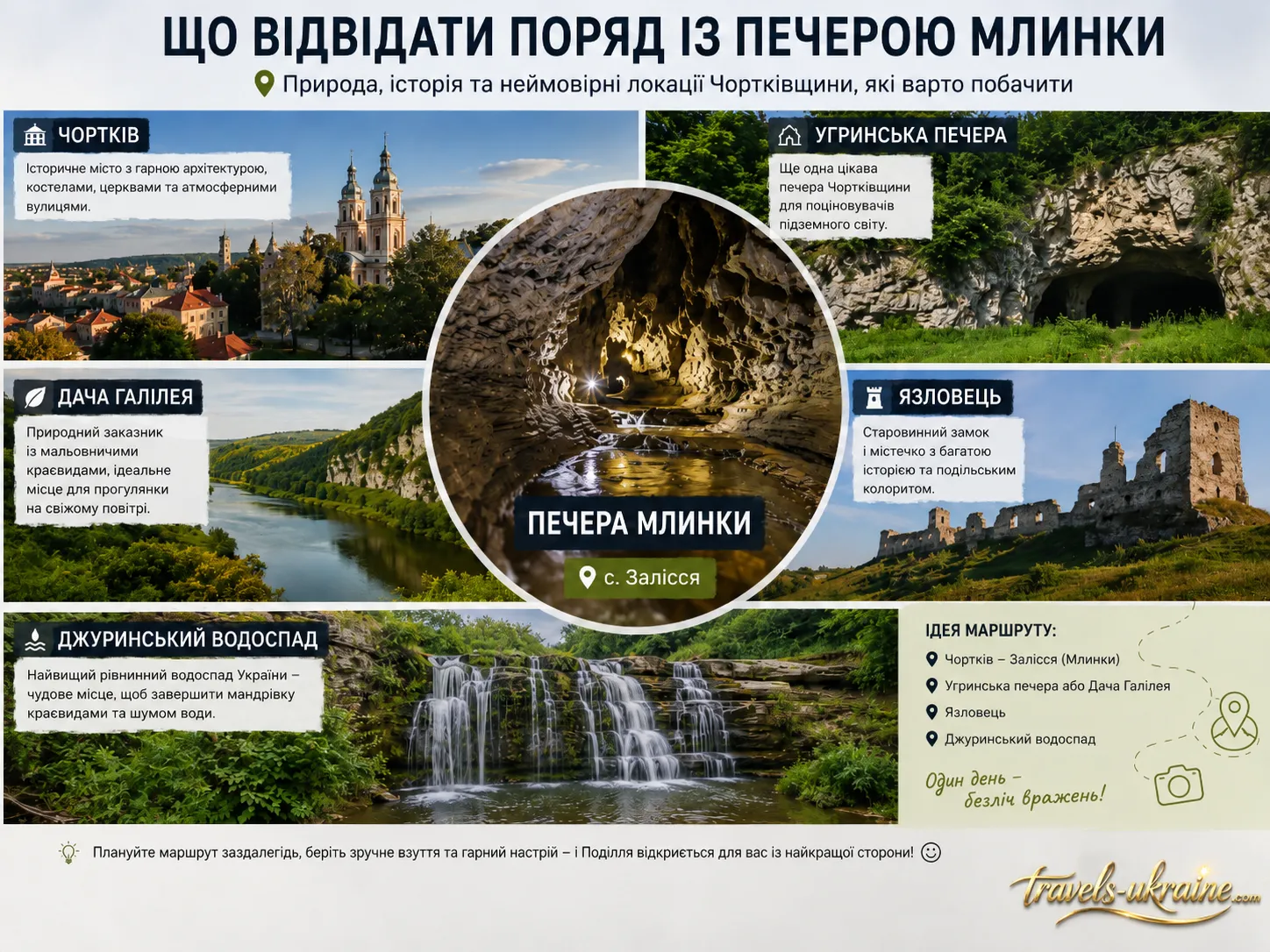
Mlynky Cave in Chortkiv Raion is ideal not only for a standalone underground excursion, but also as part of a full tourist route. If you are traveling to Ternopil Oblast for the sake of a gypsum cave, there is no need to hurry back immediately after emerging onto the surface. Especially since after Mlynky, tourists usually have two wishes: to drink something hot and to look at the sky so attentively that it seems they are seeing it for the first time.
There are several interesting directions for continuing the journey around the cave: Chortkiv with its historic architecture, Podillia’s natural sites, other caves, ancient castles, panoramas, and waterfalls. This route is well suited to a one- or two-day trip, especially if you want to combine cave tourism in Ternopil Oblast, history, nature, and a peaceful getaway without unnecessary bustle.
Chortkiv: a Convenient City Base for Planning a Trip to Mlynky Cave
Chortkiv is the most convenient urban reference point for a trip to Mlynky. That is why tourists often search for the location as Mlynky Chortkiv, although the cave itself is not in the city but near the village of Zаліssia. Chortkiv is worth using as a base for the route: it is easier to find your way, arrange transport, stop for coffee, get something to eat, or add a historical element to the trip.
In Chortkiv, you can walk through the central part of the city, see its historic buildings, Catholic and Orthodox churches, remnants of its defensive past, and experience the atmosphere of southern Podillia. The city does not shout about itself at every turn, but it has character: somewhat old-fashioned, somewhat provincial and calm, and perfectly suited to follow an underground adventure. After a cave where the main road was a narrow passage through gypsum, even an ordinary Chortkiv street feels like a broad avenue of freedom.
Zаліssia Village and the Area Around Mlynky: a Peaceful Start to an Underground Journey
Mlynky and Zаліssia are not merely a geographical reference, but part of the atmosphere of the trip. Zаліssia village and the area around the cave create the very contrast that makes the journey memorable: above ground, quiet Podillian landscapes, country roads, hills, and fields; underground, a complex labyrinth, crystals, and cool air. It is this transition from an ordinary rural landscape to an underground world that makes Mlynky Cave so unexpected.
Before or after the excursion, it is worth setting aside some time for the surrounding area: take a walk, look around, take a few photos, change out of your route footwear at a relaxed pace, and do not immediately try to jump into the car with a look that says, “I’m clean, honestly.” Mlynky is an honest cave: if the route was a good one, your clothes usually tell the story too.
Uhryn Cave: Another Underground Destination in Chortkiv Raion
If the darkness at Mlynky did not scare you off but instead made you want to understand the underground world of Podillia better, consider Uhryn Cave near the village of Uhryn. This is another cave destination in Chortkiv Raion that can be included in a broader route for those interested in geology, karst formations, and cave tourism in Ukraine.
However, the same rule applies here as at Mlynky: caves are not places for improvisation. If you plan to visit underground sites, check in advance whether an excursion is available, whether the route is accessible, and whether you need a guide and equipment. After Mlynky, this rule usually requires little explanation: underground, romance quickly becomes practical.
Dacha Hali leya: Chortkiv Raion Nature for a Peaceful Getaway
For those who want more light, fresh air, and greenery after an underground journey, the Dacha Hali leya nature reserve may be an interesting destination. It is one of the natural sites in Chortkiv Raion worth considering as a calmer continuation of the route. After gypsum passages, narrow crossings, and the coolness of the cave, a walk through the forest feels especially pleasant.
This contrast works beautifully in a trip: first an underground journey, then the surface, fresh air, trees, and the reassuring realization that there are finally not twenty meters of gypsum above your head. That does not mean the cave is frightening, but after Mlynky even an ordinary leaf on a tree looks like a small celebration of vertical space.
Yazlovets and Castle Routes in Ternopil Oblast
If you would like to add some history to your route, consider Yazlovets—one of those Podillian places where the past is felt not through a museum display, but through old walls, the terrain, and the silence. Combining Mlynky with castle sites in Ternopil Oblast works well for a two-day trip: one day for the cave, the second for historic sites, panoramas, and leisurely stops along the way.
After the gypsum labyrinths, old castle ruins are perceived differently. In the cave, nature is the chief architect; in castles, it is people, history, and time. If Mlynky shows what water does to gypsum over millions of years, castle walls remind us that people also knew how to build things that would make tourists, centuries later, walk around, take photos, and say, “Now that was something worth building.”
Dzhuryn Waterfall: a Spectacular Finale to a Route After Mlynky Cave
One of the most impressive natural sites often added to routes through Ternopil Oblast is Dzhuryn Waterfall near the village of Nyrkiv. It is one of the region’s best-known waterfalls and combines well with a trip through Podillia if you have enough time and are not planning to travel “on the run.” After the silence of the cave, the sound of rushing water feels almost like a natural reset.
This route creates a striking contrast: first darkness, gypsum, narrow passages, and underground chambers, then open sky, water, rocks, and space. In short, it is an ideal option for anyone who wants to see the different faces of Ternopil Oblast in a single trip: ecotourism, natural monuments, historic sites, and landscapes that make the map of Ukraine look far more interesting.
Route Ideas: How to Combine Mlynky Cave with Other Destinations
To keep the trip comfortable, it is best not to overload the day. A caving trip to Mlynky Cave takes energy, even when the route does not seem particularly difficult. After such an excursion, not everyone is ready to rush off to three more destinations, especially when their clothes are wet, their shoes are covered in clay, and their body is already dreaming of tea and a proper chair. It is therefore better to plan the route with plenty of time to spare.
- Half-day route: Chortkiv — Zалісся — Mlynky Cave — return to Chortkiv.
- One-day route: Mlynky Cave — a walk around Chortkiv — a leisurely dinner or a short stop in the surrounding area.
- Active route: Mlynky — Uhryn Cave or natural sites in the Chortkiv area, planned in advance.
- Two-day trip: Mlynky Cave — Chortkiv — Yazlovets — Dzhuryn Waterfall — other sites in Podillia.
- Photography route: Zалісся, an underground tour, panoramas of the Chortkiv area, a waterfall or castle ruins.
So, Mlynky, a labyrinth-type cave, can be either the main destination of a trip or a strong part of a longer route through Ternopil region. It works best when combined with Chortkiv, natural sites in Chortkiv district, castle locations and Podillia’s waterfalls. The main thing is not to turn the journey into a tourism marathon. After the cave, you will want to slow down and let the impressions settle. The underground world does not like a rush — even when you have long since made it back to the surface.
Rules of conduct in Mlynky Cave: underground tour etiquette
The Mlynky cave complex is not just a tourist attraction, but an underground natural world with its own rules. You cannot behave here as if you had walked into a shopping centre where the main danger is losing your parking spot. In Mlynky, attentiveness, discipline and respect for the guide, the group and the cave itself matter. Underground, even minor carelessness can create unnecessary problems, so these rules exist not for show but to ensure safety and preserve this unique gypsum landmark.
The most important rule is simple: a tour of Mlynky should only take place with an experienced guide. In a labyrinthine cave, there is no point testing your “inner compass”, especially if, even above ground, you sometimes cannot find the exit in a supermarket on your first attempt. Mlynky has more than 53 km of passages, so exploring it alone is not bravery but an avoidable risk that proper route planning can eliminate.
During a cave tour, the guide is not just someone who “talks about things along the way”. In the cave, the guide is responsible for the route, the group’s pace, safe sections, stops and the tourists’ conduct. If the guide tells you not to move aside, not to enter a certain passage or to wait for the group, it is not because they want to ruin anyone’s adventurous mood. It is because they know the cave far better than a tourist who has only just seen the entrance and has already imagined becoming Speleologist of the Year.
In Mlynky, it is important to stay with the group, neither rushing ahead nor falling behind. The cave does not appreciate chaos: one tourist runs off to photograph a “beautiful wall”, another decides to inspect a narrow passage, and a third stops to tie a shoelace — and the guide has to work not as a guide but as the conductor of an underground orchestra. The best approach is to move calmly, follow instructions and remember that discipline underground does not spoil the adventure; it makes it safe.
Do not touch the gypsum crystals or cave walls unnecessarily
Gypsum crystals in the cave are one of Mlynky’s most beautiful features, but also one of its most fragile. They took a very long time to form and can be damaged in a second. So the rule is simple: look — yes, take photos — yes, admire them — absolutely, break them or touch them with your hands — no. The cave is not a souvenir shop, and gypsum crystals are not waiting for a tourist to take them home to a shelf.
Do not scratch the walls, leave inscriptions, chip off pieces of rock or “check” whether the gypsum is real. It is real. And the cave is real. Unfortunately, traces of human stupidity on natural walls also remain real for a very long time. The best way to show respect for a gypsum cave is to leave it exactly as you found it.
Keep quiet and respect the underground silence
Silence is one of the most powerful parts of the Mlynky experience. Underground, sounds behave differently: voices bounce off the walls, footsteps become more noticeable, and loud laughter can race through the passages as if the cave itself had decided to join the conversation. So speak quietly during the route, do not shout and do not turn the tour into an underground marketplace.
It is especially important to stay quiet in places where bats may be present. They are not an attraction, they do not pose for photos and they certainly do not need a flashlight shining directly into their eyes. The cave is their natural space, while tourists are guests. And if you have come as a guest, it is better not to behave as though you were invited to take down the doors, rearrange the furniture and loudly discuss the renovation.
The rules of conduct in Mlynky Cave are very simple: listen to the guide, do not harm nature, do not disturb the group and do not switch into “I know everything myself” mode. Follow these principles and your caving adventure will be not only exciting but safe. The cave itself will remain as it should be: dark, mysterious, clean, alive and ready to impress the next travellers.
Safety in Mlynky Cave: advice before your underground adventure
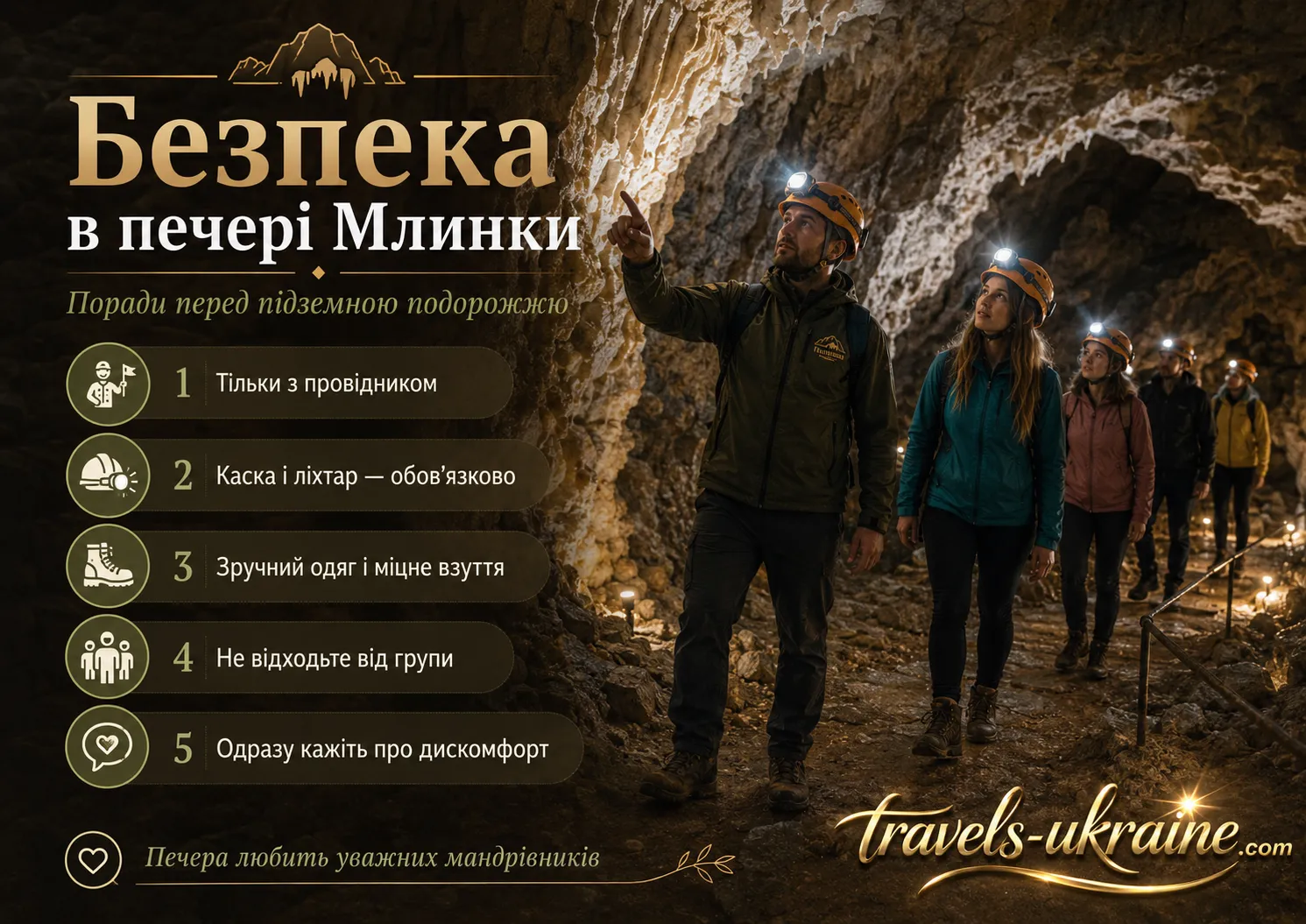
Mlynky Cave offers powerful impressions, but underground, romance must always go hand in hand with safety. There is humidity, uneven ground, low passages, narrow sections and a labyrinthine system, so the main rule is simple: do not rush and listen to the guide. The cave quickly teaches you that courage is good, but a helmet, flashlight and common sense are much more useful.
A cave tour is perfectly suitable for active travellers without specialist caving training, but it requires attentiveness. This is not a stroll along a path or a museum with an even floor. You will need to move through natural passages, sometimes bend down, pass through narrow spaces and watch your step carefully. That is why it is worth preparing for the route in advance, and visiting Mlynky should only be done with an experienced guide who knows the route and its challenging sections.
For a caving adventure in Mlynky gypsum cave, you need comfortable, closed clothing that you do not mind getting dirty, sturdy footwear with good grip, a helmet and a proper flashlight. Do not rely solely on your phone: in the cave, it is better suited to taking photos after the guide’s permission than to serving as your only source of light. After the route, it is a good idea to have a change of clothes, dry socks and a bag for dirty clothing.
Physical fitness and well-being
Mlynky Cave is not extreme for a prepared traveller, but it does require basic physical fitness. If you have serious back, knee, breathing or heart problems, or a strong fear of enclosed spaces, it is best to discuss this with the organisers in advance. You should also not enter the cave after drinking alcohol, getting severely sleep-deprived or feeling unwell. An underground route calls for a clear head, attentiveness and normal reactions.
Do not rush through narrow, low or slippery sections. The cave does not award medals for passing through a passage fastest, but one careless movement can easily give you a bruise and a very sincere respect for your helmet. If you feel uncomfortable, frightened or tired, tell the guide immediately. Often, all it takes is placing your foot correctly, turning your body or simply taking a break.
- Go only with a guide and stay with the group.
- Wear comfortable, closed clothing that you do not mind getting dirty.
- Bring sturdy footwear, a warm layer and a change of clothes for after the route.
- Use a proper flashlight, not just your phone.
- Do not rush through narrow, low or slippery sections.
- Report any discomfort or feeling unwell immediately.
Safety in Mlynky Cave is not about complicated prohibitions but ordinary travel wisdom: prepare properly, listen to the guide, do not overestimate yourself and respect the underground world. Then the underground tour will give you exactly what brings people here: darkness, silence and the pleasant feeling of victory after returning to the surface.
Frequently asked questions about Mlynky Cave in Ternopil region
Where is Mlynky Cave located?
Mlynky Cave is located in Ternopil region, in Chortkiv district, near the village of Zалісся. The easiest landmark is Chortkiv, so tourists often search for it as “Mlynky Cave in Chortkiv” or “Mlynky Chortkiv”, although the site itself is not in the city but near the village.
Can you enter Mlynky Cave without a guide?
No, you should not enter Mlynky gypsum cave on your own. It has a large number of passages, turns and narrow sections where it is easy to lose your bearings. A visit should only be planned with an experienced guide or an organised group. The cave is not the place for a “quick look and I’ll be back” experiment — you still have to find your way back.
How long does a tour of Mlynky Cave last?
The duration of a tour of Mlynky Cave depends on the route, the group’s fitness and the organiser. For a first visit, allow several hours with some extra time for the journey, briefing, equipment selection, the underground route itself and time after leaving the cave. It is better not to schedule Mlynky “between coffee and three other attractions”, because an underground adventure appreciates a relaxed pace.
What should you wear for a caving adventure in Mlynky Cave?
For a caving adventure in Mlynky Cave, you need comfortable, closed clothing that you do not mind getting dirty, a warm layer and sturdy footwear with good grip. The cave is cool and damp, with gypsum dust and narrow passages, so white trainers and a “nice outfit for photos” are better left for a walk around Chortkiv. It is advisable to bring a change of clothes and a bag for dirty clothing.
What is the temperature inside Mlynky Cave?
The cave maintains a cool, damp microclimate. The temperature stays at approximately 9–10 °C, so it can feel noticeably chilly inside even during the warmer months. A light sweater, fleece or jacket is a good choice. The cave quickly proves that “I don’t get cold” is a brave statement, but not always a practical one.
Can you visit Mlynky Cave with children?
The cave can be interesting for teenagers and physically prepared children, but it all depends on their age, fitness, the route and the organiser’s requirements. Before the trip, clarify the restrictions, difficulty and duration of the tour. A child must listen to the guide, stay with the group and be able to cope with darkness, narrow passages and enclosed spaces.
Can you take photos in Mlynky Cave?
You may take photos in the cave if the guide allows it and the photography does not interfere with the group or the safety of the route. It is best to take photos during stops, stay on the route, avoid touching the gypsum crystals and do not shine light directly into people’s or bats’ eyes. A great shot is good, but it is even better when nobody gets stuck or falls afterwards, leaving the guide silently counting to ten.
How difficult is the route in Mlynky gypsum cave?
The difficulty depends on the route you choose. For an active traveller, the basic underground tour is usually accessible, but it is not a walk along a level path. Mlynky has low passages, narrow sections, damp surfaces and areas where you need to move carefully. If you have back, knee, breathing or heart problems, or severe claustrophobia, it is best to consult the organisers in advance.
When is the best time to visit Mlynky Cave?
Mlynky Cave in Ternopil region is interesting in every season, as the microclimate underground remains relatively stable. It is best to plan your excursion in advance and choose a day when you are not in a hurry. In summer, the cave offers pleasant coolness, while in autumn and winter, it is especially important to bring warm clothing for after you return to the surface.
What can you see near Mlynky Cave?
Near Mlynky Cave, you can plan a walk around Chortkiv, visit the village of Zalisia, explore the natural attractions of Chortkiv district, see Uhryn Cave or Yazlivets, or add Dzhuryn Waterfall to a longer itinerary. It is best not to overpack your day: after an underground excursion, you will want to change clothes, have some tea, and briefly feel like someone who has just returned from another world.
Mlynky Cave: a conclusion to an underground journey through Ternopil region
Mlynky Cave is not the kind of place you can “quickly look around” between two stops on an itinerary. It requires time, attention, and a willingness to accept its rules: darkness, cool air, narrow passages, gypsum dust, silence, and respect for your guide. But that is exactly why Mlynky stays with you. There is no artificial theatricality here; instead, there is a genuine underground world that does not try to please everyone, but simply and honestly reveals its natural power.
The gypsum cave near Zalisia is one of those tourist destinations in Ukraine that make you realize a journey can be not only beautiful but also deep in the literal sense. It is an underground gem of Ternopil region, where every turn, every wall, every crystal, and every moment of silence create a feeling of true adventure. The cave does not offer easy, “check-the-box” impressions — it leaves a memory that keeps returning to your mind long after you emerge into the daylight.
So, Mlynky is worth visiting for anyone who wants to see a different Ukraine — not only one of castles, cities, or panoramas, but an underground, natural, and mysterious one. It is fascinating for fans of active tourism, caving, geology, unusual routes, and places unlike standard tourist stops. An excursion to Mlynky is an opportunity to walk through the gypsum labyrinths of Podillia, see crystals, experience true darkness, and understand why underground routes make such a powerful impression on travelers.
Yes, after the route your clothes may be less than perfect, your shoes may have a new story to tell, and your knees may gently hint that they did some work today. But that is part of Mlynky’s charm. This is not a glossy excursion but a living adventure in which the traveler does not simply watch, but takes part in the route. And when you see daylight, air, and sky again after leaving the cave, ordinary things suddenly seem especially precious.
So if you are looking for an unusual place to visit in Ukraine, want to see something special in Ternopil region, walk through mysterious passages, experience underground silence, and return with a story genuinely worth telling, Mlynky Cave is certainly worth your attention. This place does not simply showcase the beauty of Podillia — it reveals it from within.

No Comment
You can post first response comment.