
 English
 Українська
 Български
 Hrvatski
 Čeština
 Dansk
Dansk Nederlands
 Eesti
Eesti Suomi
Suomi Français
 Deutsch
 Ελληνικα
 Magyar
 Íslenska
 Italiano
 Latviešu
 Lietuvos
 Polski
 Português
 Română
 Русский
 Српски
 Slovenčina
 Slovenščina
 Español
 Svenska
 Türkçe
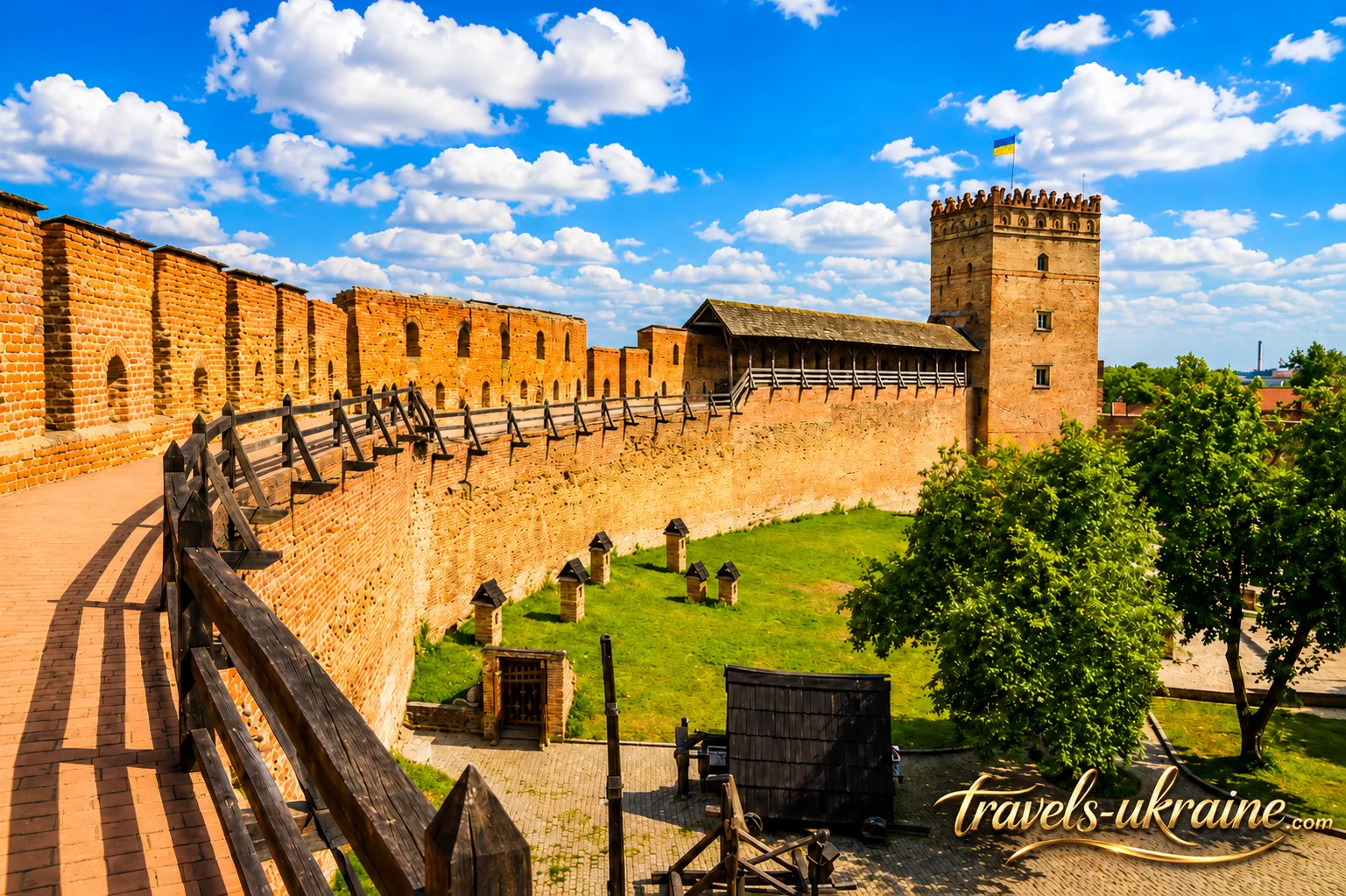
Lutsk Castle is the best place to begin discovering Lutsk. Its high walls, towers, cobbled courtyard, and atmosphere of an ancient princely city create the feeling that time has not disappeared here but has simply become part of the stone. For tourists, it is not merely a beautiful place for a walk or photos, but a true key to understanding Volhynia: its strength, European connections, medieval culture, and urban memory.
Today, Lubart’s Castle, also known as the Upper Castle, Lutsk Castle, or the Castle of the Three Princes, is considered one of Ukraine’s best-known defensive structures. This is not a monument that feels like a «museum set»: it has a character of its own. You can walk through the castle courtyard, examine the old bricks, look up at the towers, and imagine princely councils, embassies, city legends, and the voices of people who lived in Lutsk many centuries ago.
Lutsk Castle attracts all kinds of travelers. Some come for the history, wanting to learn who built Lubart’s Castle and why it became a symbol of princely Volhynia. Others are looking for a beautiful panorama, an interesting walk through the Old Town, or an answer to a simple tourist question: what to see in Lutsk in 1 day. Almost everyone who sees this medieval castle in Lutsk for the first time quickly understands that it is not merely one of the city’s attractions, but its historic center of gravity.
Why Tourists Should Visit Lutsk Castle
Lutsk Castle is worth visiting because it combines several experiences at once: architecture, history, a city route, museums, viewpoints, and the distinctive atmosphere of old Volhynia. It is a convenient place both for a short walk and a full tour. If you plan to combine Lutsk Castle with a walk through the Old Town, it makes sense to start your day here: interesting places in Lutsk are nearby, and the castle helps explain how the city developed around the princely residence.
The special value of this place is that Lutsk Castle presents Volhynia not only as a region of picturesque landscapes, but also as a land with deep state, cultural, and defensive traditions. The Upper Castle in Lutsk is associated with Prince Lubart, Lithuanian princes, medieval diplomacy, and the development of urban life. A walk here can therefore easily become more than a brief sightseeing visit—it can turn into a fascinating journey through several historical eras.
Even without extensive historical knowledge, the castle’s architecture makes an immediate impression. Powerful walls, towering structures, an enclosed courtyard, ancient passages, and the silhouette above the Old Town create the feeling of a genuine medieval fortress.
In this article, we will explore what Lutsk Castle is famous for, when it was built, which towers are worth seeing, what can be found inside, how to plan a tour, what to visit nearby, and why Lubart’s Castle is one of Volhynia’s main attractions. This will not be a dry list of dates, but a practical travel guide for those who want to experience Lutsk attentively, beautifully, and without rushing.
A Brief History of Lutsk Castle
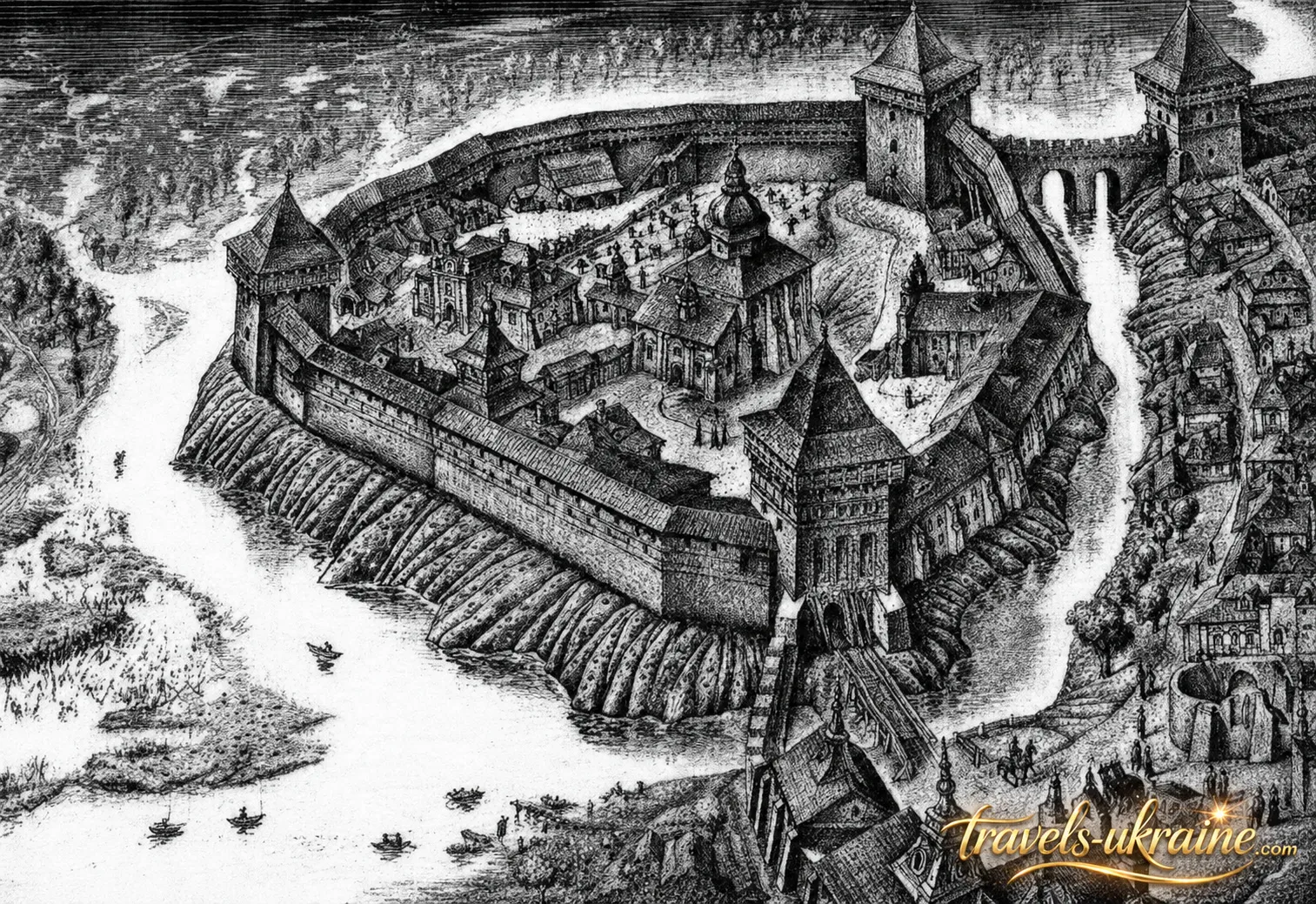
The history of Lutsk Castle did not begin on a single date, but through the long development of a city that stood for centuries at the crossroads of trade routes, princely power, and defensive interests. Ancient fortifications existed here even before the stone stronghold appeared, as Lutsk had a favorable natural position: rivers, marshy areas, and elevated ground helped protect the settlement from attacks. Yet it was in the 14th century that the castle in Lutsk acquired the historical importance that makes it known today as one of Ukraine’s most significant landmarks, recognized as Lutsk’s oldest structure and the main site of the «Old Lutsk» Historical and Cultural Reserve.
When tourists ask when Lutsk Castle was built, they usually mean the stone Upper Castle. Its construction is associated with Prince Dmytro Lubart, the ruler who made Lutsk his residence and transformed the city into a powerful political center. That is why the answer to who built Lubart’s Castle is usually brief: Prince Lubart. In reality, however, the story is more complex and fascinating, as the castle was expanded gradually, changed under successive rulers, and reflected the needs of different eras.
Prince Lubart did more than strengthen Lutsk Castle—he laid the foundation for the magnificent structure we see today. Between 1340 and 1383, a stone castle complex took shape in Lutsk to protect the prince’s residence, the city, and important administrative institutions. For medieval Volhynia, this was not merely a military project but also a political statement: Lutsk was becoming a city capable of receiving rulers, conducting diplomacy, and controlling a large region.
During this period, Lutsk Castle in Volhynia represented a land of strength and an independent princely tradition. Its walls, towers, and gates demonstrated not only defensive readiness but also the city’s status. The medieval castle was a place where matters of power, security, trade, and international relations were decided. So when walking through the courtyard today, remember that these walls saw not only soldiers, but also envoys, officials, clergy, craftsmen, and townspeople for whom the castle was the center of life.
The Castle of the Three Princes: Lubart, Vytautas, and Švitrigaila
One of the landmark’s most intriguing names is the Castle of the Three Princes. It reminds us that the castle in the city of Lutsk was not completed in a single year or by one ruler. Its historical character developed through several stages and is most closely associated with Prince Lubart, Grand Duke of Lithuania Vytautas, and Prince Švitrigaila. Each left a mark on the castle’s fate: one strengthened its defenses, another elevated Lutsk’s political importance, and another continued its expansion and adapted the stronghold to new realities.
Under Vytautas, the historic castle in Lutsk became not only a fortress but also a center of high politics. The best-known event of this period was the congress of European monarchs in 1429. Rulers, envoys, and representatives of influential states met in Lutsk to discuss important matters concerning Central and Eastern Europe. For tourists, this detail is especially telling: the history and interesting facts of Lubart’s Castle in Lutsk are not merely local—they are European in scale.
Why the 1429 Congress Matters for Understanding Lutsk Castle
The 1429 congress shows that the Upper Castle of Lutsk was not a provincial defensive structure but a residence suitable for receiving the highest-ranking guests. They did not come merely to inspect the fortifications—negotiations were held here, power was demonstrated, alliances were sought, and issues affecting the region’s political map were decided. That is why Lutsk’s castle heritage is so significant: it brings together Ukrainian, Lithuanian, Polish, and broader European history.
- 14th century — the stone Upper Castle was formed under Prince Dmytro Lubart.
- Early 15th century — Lutsk’s role grew under Grand Duke Vytautas.
- 1429 — a congress of European monarchs made Lutsk an important diplomatic center.
- Late Middle Ages — additions, changes to the defensive system, and the continued shaping of the castle’s appearance.
From Defensive Stronghold to Lutsk’s Tourist Gem
Over time, Lutsk Castle’s military importance changed. New methods of warfare, the development of artillery, and political changes gradually reduced the role of medieval walls as the city’s primary defense. From the late 16th century onward, the castle no longer had the same defensive importance as before, but it did not lose its symbolic power. It remained part of the urban landscape, administrative memory, and cultural identity of Volhynia.
Today, the history of Lubart’s Castle can be read in its architecture, the names of its towers, the layout of the courtyard, its museum exhibitions, and even the atmosphere of the Old Town itself. For modern travelers, this place answers several questions at once: why it became a symbol of the city, how princely Volhynia was connected with Europe, and why visiting Lubart’s Castle in Lutsk is worthwhile not only for beautiful photos but also for a deeper understanding of Ukrainian history.
This layered history is what makes Lutsk Castle especially interesting for tourists. There is no sense of dead antiquity here; instead, every stone seems to suggest a new story, and every tower reminds us that this is not simply a beautiful place for a walk, but the living memory of a city. Today, Lutsk Castle is a prominent architectural and historical landmark of national importance, a source of pride for Lutsk and all of Volhynia, open to everyone: tourists, families with children, researchers of the past, and travelers who want to experience the genuine atmosphere of a medieval city.
Lutsk Castle Architecture: Towers, Walls, and Medieval Character
Lutsk Castle’s architecture is one of the main reasons this historical landmark makes such a strong impression on tourists. The Upper Castle does not look like a random collection of old walls: it has a clear composition, internal logic, and distinctive silhouette that is easy to recognize in photographs, on postcards, and along Volhynia’s tourist routes. When you enter the courtyard, you immediately sense that the space was designed for defense, controlling access, surveying the surrounding area, and supporting life in the princely residence.
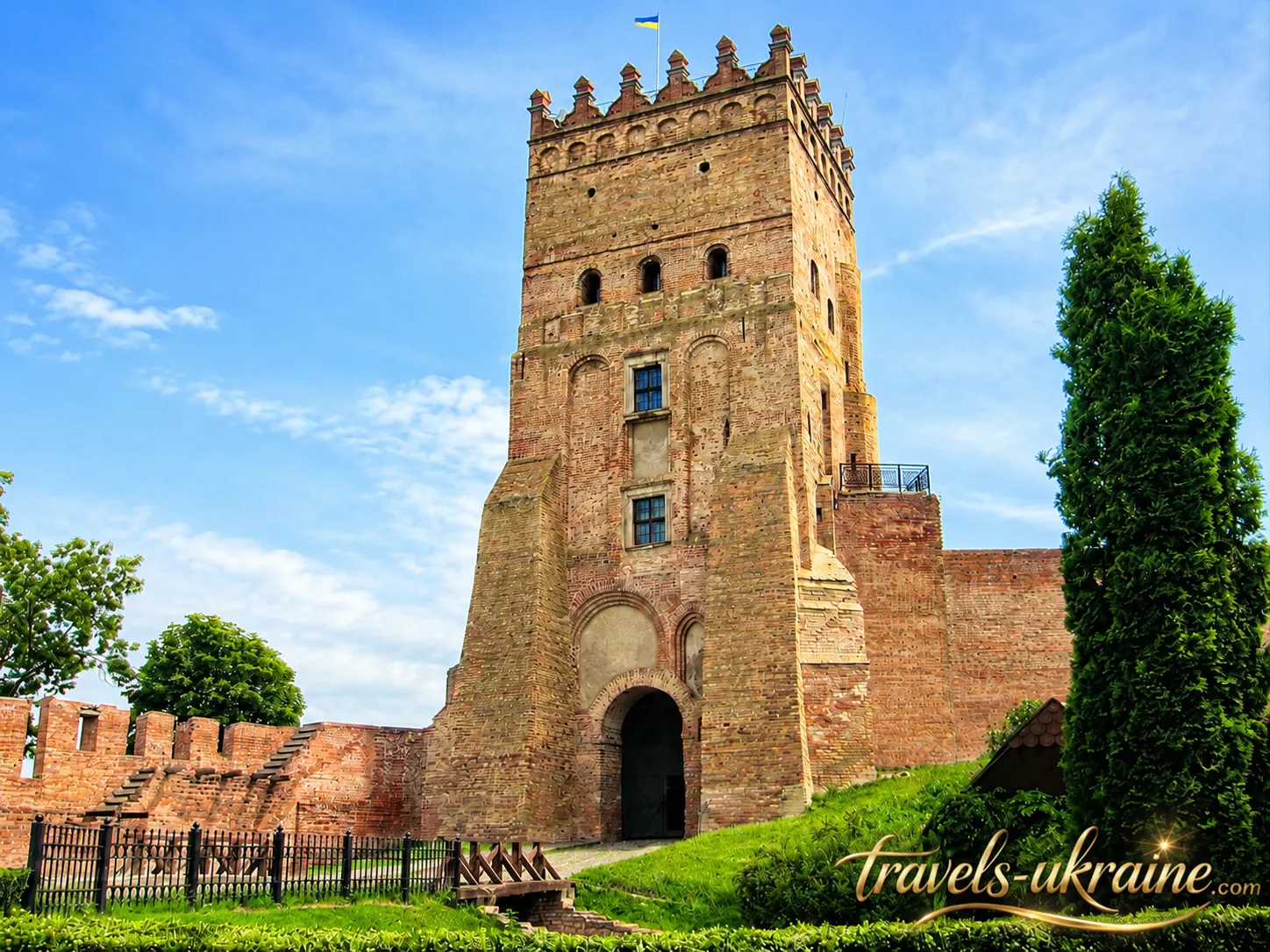
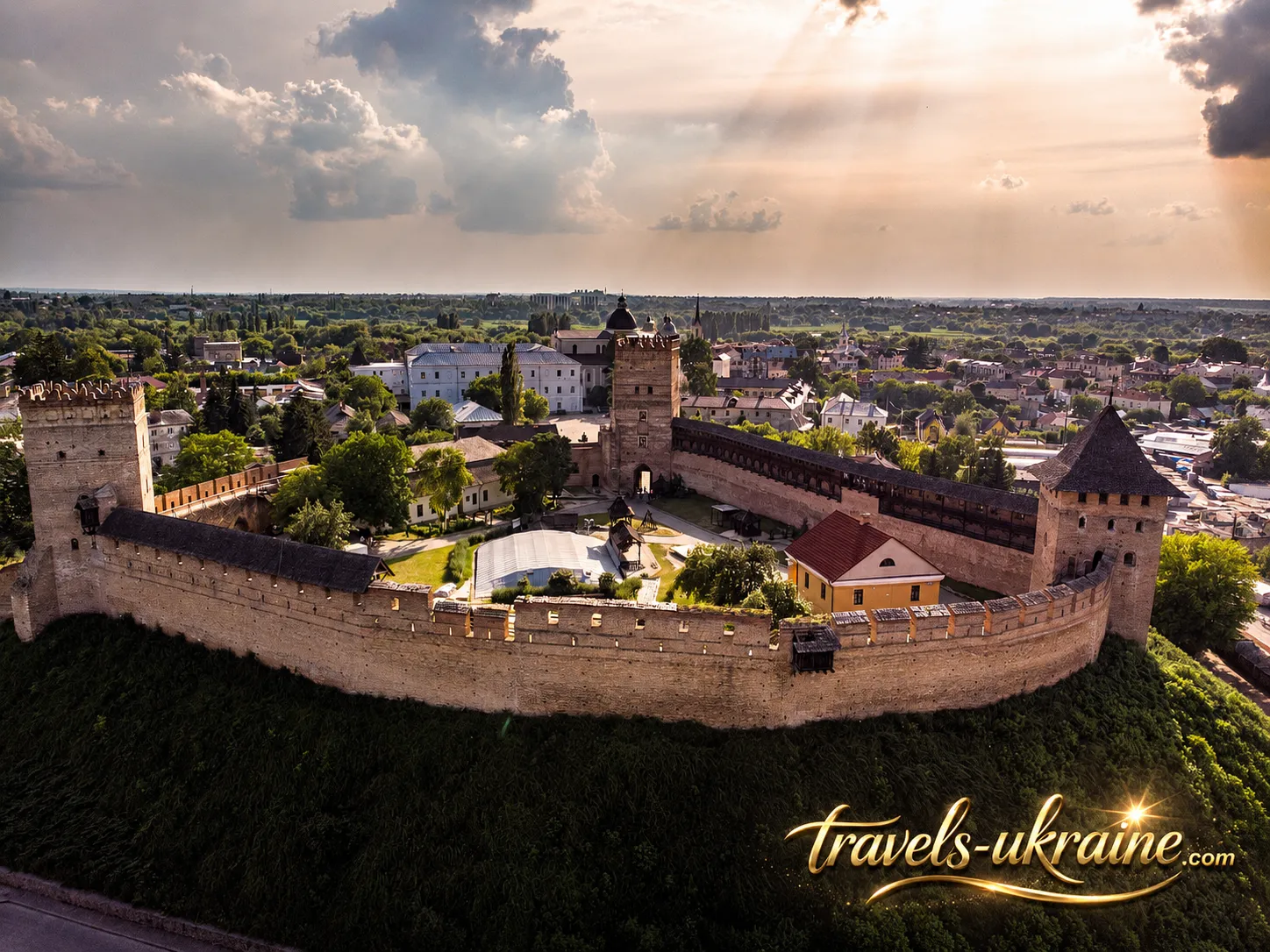
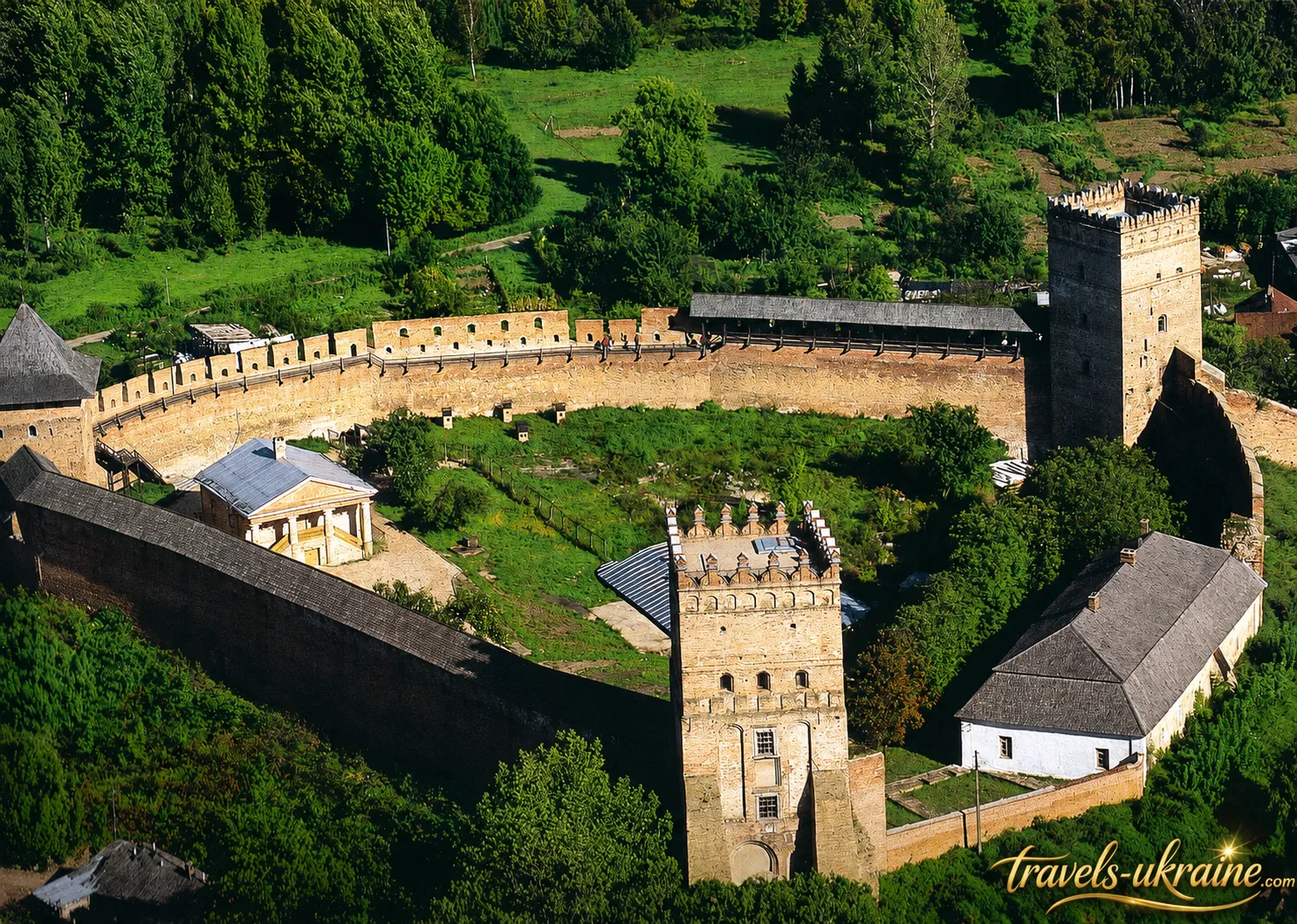
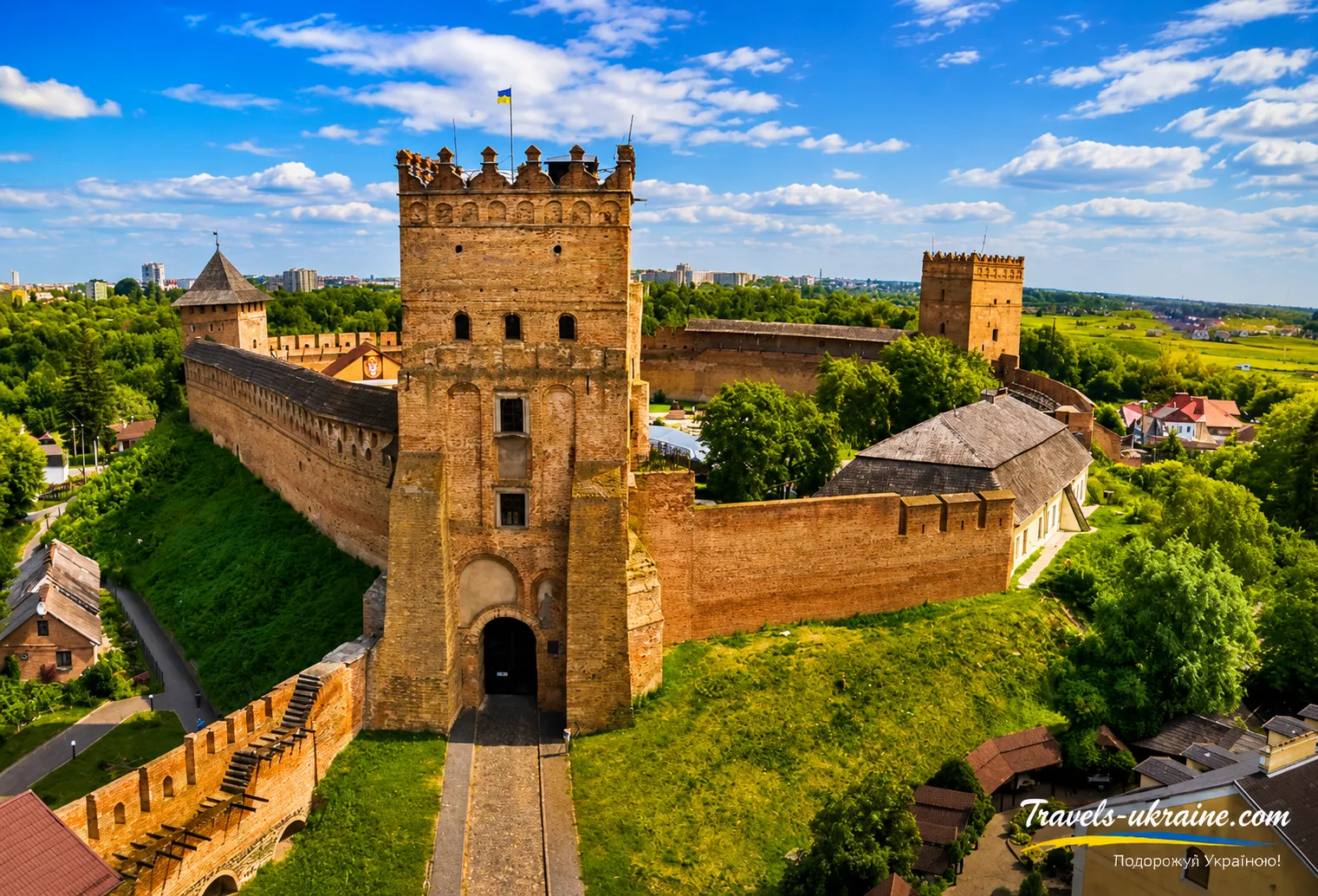
In plan, Lubart’s Castle resembles an almost equilateral triangle with slightly bulging sides—a kind of medieval geometry without unnecessary decoration, yet with a highly convincing character. Its three corners contain three towers: the Entrance Tower, Styrova Tower, and Vladycha Tower, each approximately 100 meters from the others. If today’s tourist sees this shape as a picturesque composition for photographs, in the past it had a much more serious purpose: controlling approaches, maintaining the defense, and making it unmistakably clear to unwanted guests that Lutsk was a city with a strong character.
The Upper Castle’s walls rise about 12 meters above the rampart, while their thickness reaches up to 3 meters in places. The upper part of the walls is thinner—approximately 0.8 meters—but calling it “light” would be bold: up to 5 million bricks were used to build the castle overall. This is a case where medieval builders did not write loud advertising slogans about reliability—they simply built so solidly that six centuries later we still stand beneath these walls, look up, and quietly agree: they took construction seriously.
Over the many centuries of its existence, the castle courtyard’s floor level rose by approximately 3.8 meters. This is not a minor detail but a telling one: Lutsk castle courtyard literally accumulated history beneath people’s feet. Each generation added, repaired, or adapted something to new needs, and as a result the castle space became like a great stone book whose pages are not turned but walked through step by step.
The walls and towers are built using Gothic masonry, and brick dimensions varied by construction period: approximately 28–30 cm long, 12.5–15 cm wide, and 7.5–9.5 cm thick. For an attentive tourist, this is an excellent opportunity to view the historic castle in Lutsk not merely as a beautiful landmark but as a living chronicle of construction. The brick here is not just a material but a kind of signature of the era: somewhat uneven, austere in places, yet entirely authentic.
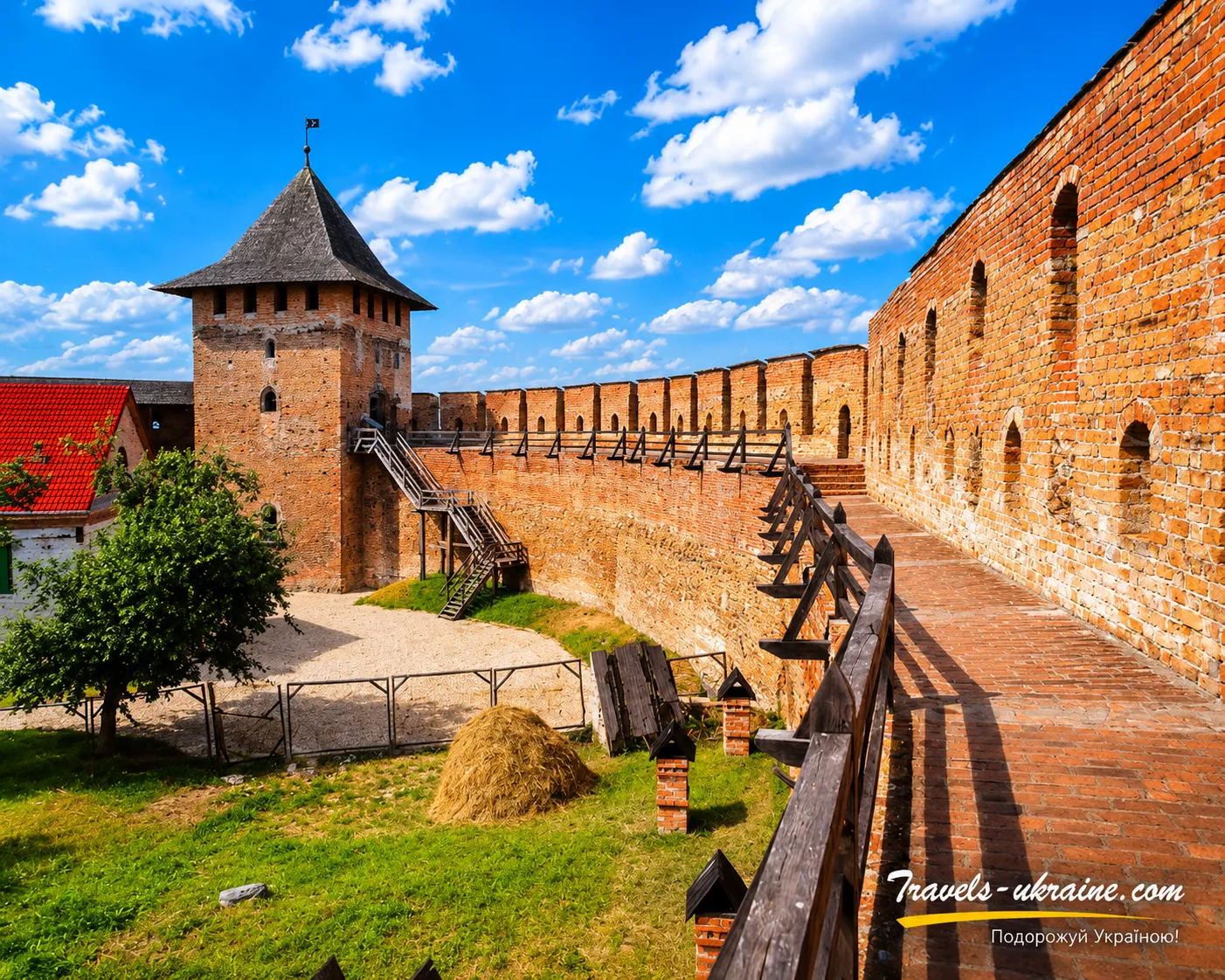
The walls still preserve fighting galleries with loopholes, while in places the ramparts are covered by a shingle roof that gives the structure an ancient, almost fairytale appearance. Near the Entrance and Vladycha Towers, oriels with machicolations—special openings for firing at the area directly below the foot of the wall—rest on corbels. Today, these details fascinate tourists and delight photographers, but once they served a far less romantic purpose: reminding enemies that getting too close to the castle was, to put it mildly, a bad idea.
Why the castle walls make such a powerful impression
The walls of Lutsk Upper Castle do more than enclose the courtyard—they define the scale of the entire landmark. Their height, the rhythm of the brickwork, the passages between the towers, and the sense of enclosed space allow visitors to see how medieval defensive architecture worked. Beauty is not the only thing that matters here; practicality does too: the walls had to withstand attacks, protect the people inside, and provide a view of the surrounding area.
That is why the towers of Lutsk Castle and its defensive walls are worth taking in slowly. The brickwork reveals different periods, the forms reflect a drive for strength, and the overall silhouette captures the character of a princely city. Unlike many romanticized ruins, this medieval castle has retained a sense of wholeness. It needs no overactive imagination to make an impression: simply walk a few steps across the courtyard, look up at the towers, and feel how formidable this structure must have been in its time.
Lutsk Castle Courtyard: A Space Where History Comes Alive
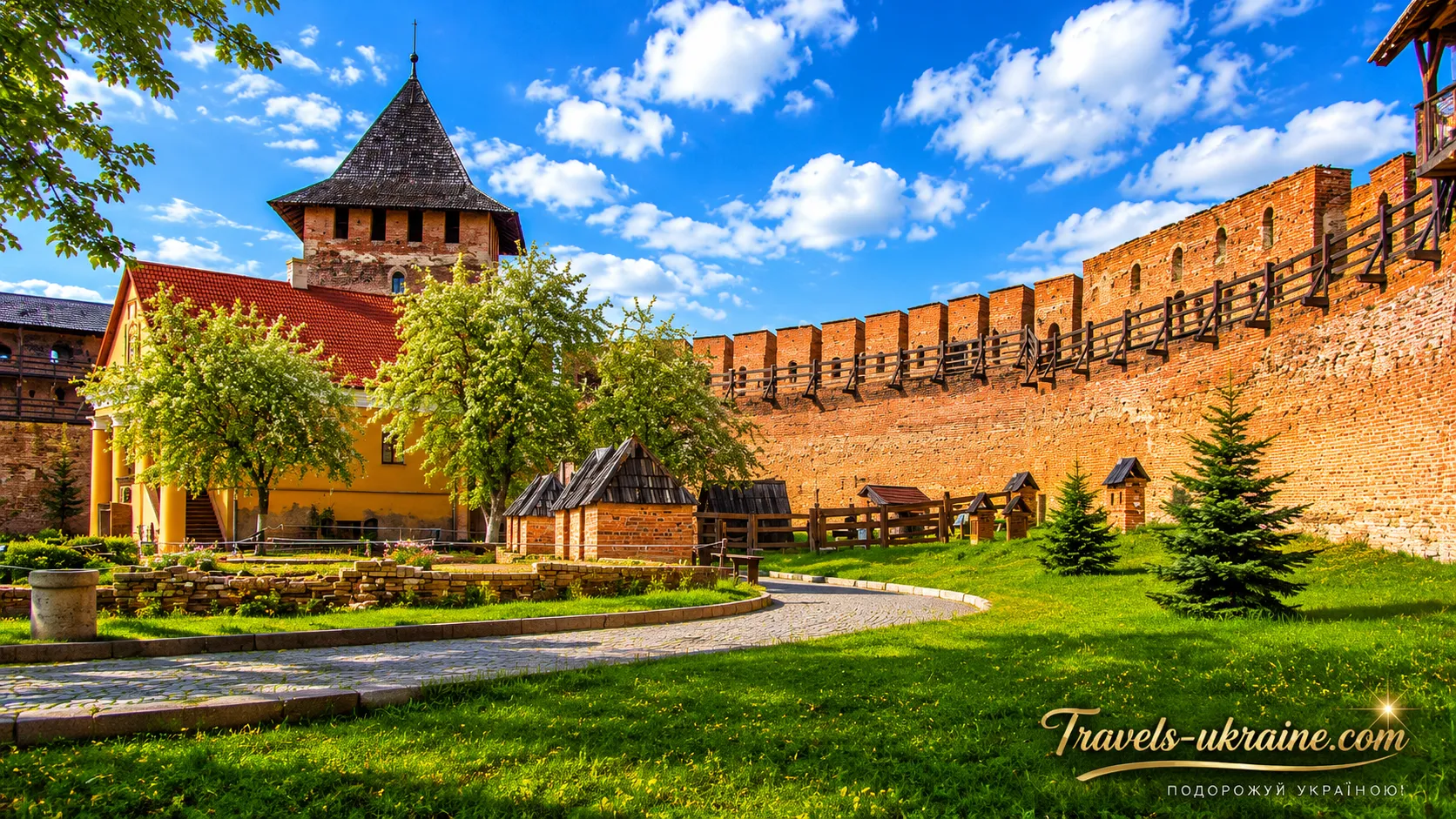
Lutsk Castle Courtyard is made special by its intimate atmosphere. There is no sense of a chaotic tourist site here: the space is enclosed by walls, making visitors feel as though they have stepped into a separate historical world. Within the complex, you can see places connected with princely, religious, judicial, and museum history. Important sites include the remains of the Church of St. John the Theologian, traces of the princely palace, the building of the noble courts, and the county treasury.
For those searching for photos of the inside of Lutsk Castle, the courtyard is one of the best spots. Wide shots with the walls, details of the old brickwork, and photographs against the towers all look beautiful here. The castle’s mood changes with the seasons: Lutsk Castle in summer has a warm, open character, Lutsk Castle in autumn looks especially atmospheric in the soft light and rich colors, while Lutsk Castle in winter takes on a restrained, almost fairytale severity.
Lutsk Castle Viewing Platform: A Panorama of the Old Town
Lutsk Castle viewing platform is one of those places where the fortress’s connection with the city can be felt most clearly. From above, it is easier to understand why a powerful defensive center arose here: the Old Town, ancient streets, church spires, and surrounding landscape come together as one historical picture.
The castle’s architectural power lies not only in its age but also in the way it still helps us read the city. Through its walls, towers, courtyard, and viewpoints, this historical and architectural landmark in Lutsk shows how a medieval defensive structure can become an open space for the modern traveler. Here, you can do more than look at a landmark: you can follow its routes, see its details up close, appreciate its scale, and understand why Lubart’s Castle is one of Volhynia’s main landmarks.
Okolny Castle: A Hidden Part of the Ancient Defensive System
Although Okolny Castle in Lutsk formally ceased to exist, like a truly seasoned resident of the Old Town, it simply did not hurry to disappear completely. According to research, around 55% of its ancient structure—including fragments of towers, walls, and eighteenth-century outer-castle buildings—still exists today, but in a different role: as parts of ordinary Lutsk houses. There is a special irony in this piece of history: a tourist may walk past a residential wall, look at its windows, doors, or courtyard, and never suspect that what stands before them is not simply urban development but a fragment of a former defensive system that once looked far more imposing and probably had a much stricter character.
It is equally fascinating that the street layout of the former Okolny district has also survived. The old buildings and courtyards that once stood within this part of the castle have mostly disappeared, leaving behind only a few structures and plenty of room for the imagination. Yet the urban pattern proved remarkably stubborn: the streets seem to remember where they led centuries ago, even if modern pedestrians now use them for entirely different purposes—not to reach princely institutions or defensive walls, but, say, to get coffee, go home, or take a walk through the Old Town.
In 2006, restoration work was carried out on part of the walls of Okolny Castle, stretching from the Entrance Tower of the Upper Castle to a sixteenth-century building that has survived to this day. This fragment is especially important because it shows that Lutsk’s castle heritage does not end where the familiar tourist route around the three towers does. It is hidden deeper—in walls, the layout of neighborhoods, old passageways, and quiet corners of the city. Okolny Castle seems to have learned to live undercover in modern Lutsk, occasionally reminding us with quiet confidence: “I haven’t disappeared. I’ve just changed my address a little.”
Photo and Video Gallery
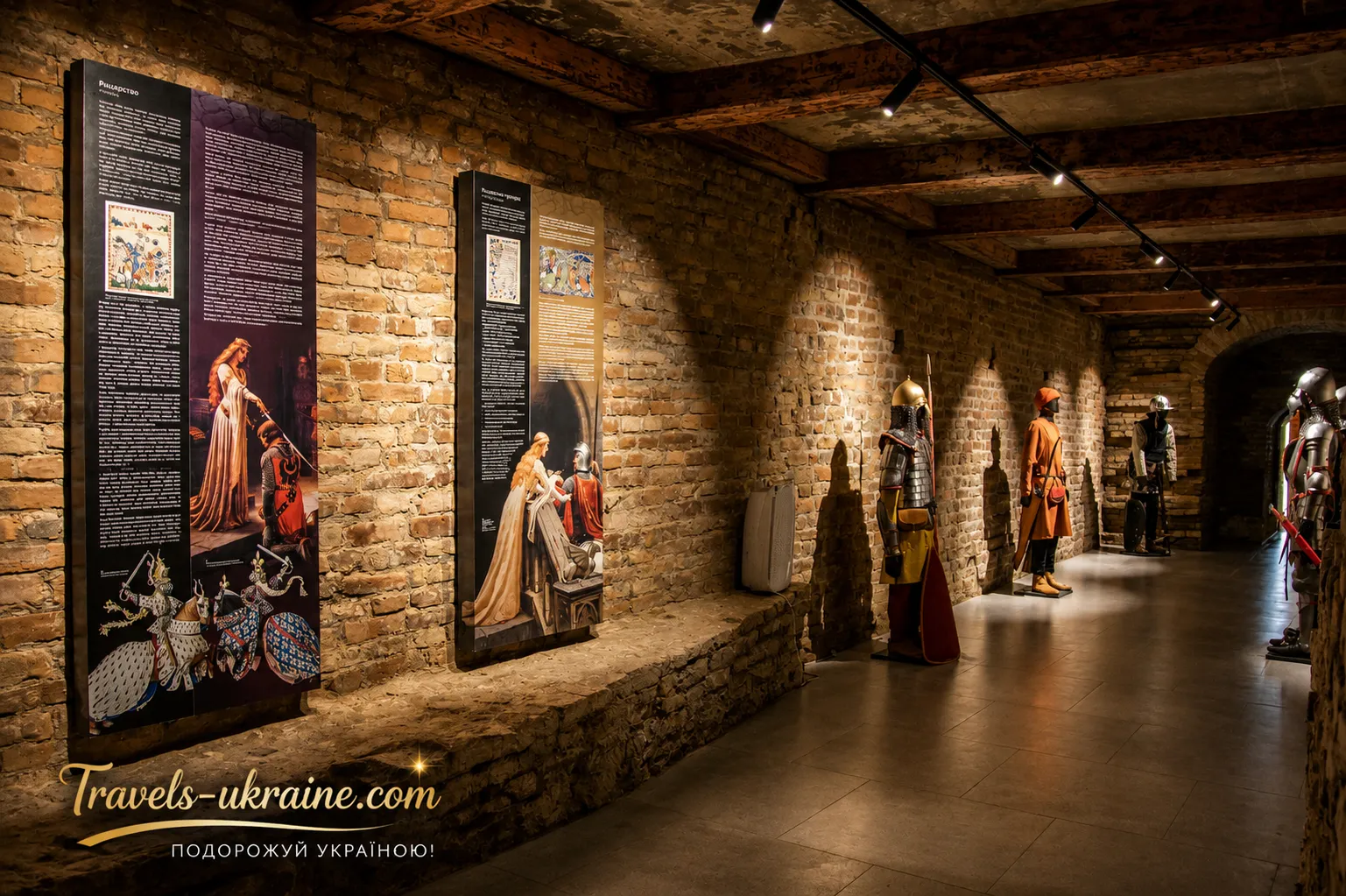
Fascinating Lutsk Castle Legends: Living Stories of the Old Walls
Lutsk Castle has legends no less impressive, where history quietly gives way to mystery. At first glance, it may seem that there is little left to surprise us about a stone fortress that has stood for so many centuries. Towers, a gate, a courtyard, a touch of medieval severity—everything seems clear enough. But look a little closer, and the princely residence begins to behave like a seasoned storyteller: it does not reveal everything at once, but gradually offers up one detail after another. It may recall princes, diplomats, ancient inscriptions on the walls, or Okolny Castle, which supposedly vanished but somehow still stubbornly lives on in Lutsk’s houses.
Medieval Lutsk Castle is one of the most mysterious and impressive castles in Ukraine. It does not merely stand in the center of Lutsk’s Old Town like a beautiful historical backdrop for tourist photos. It seems to keep a watchful silence, preserving ancient stories, half-forgotten tales, and that special atmosphere which cannot be created artificially. Every wall, passage, and tower here awakens the imagination: it feels as though, in another moment, a princely messenger might emerge from behind the wall, the castle gate might creak, or the shadow of someone who knew this castle in an entirely different age might pass by.
Along with its grandeur, Lutsk Castle is associated with numerous myths and legends. This is only natural: a structure that has survived so many centuries could hardly remain without secrets. A castle without legends is almost like an old book without bookmarks: everything may be in place, but it lacks the living touch of the human imagination. That is why the legends of Lutsk Castle fascinate visitors, guides, historians, and travelers who want not only to see stone and brick but also to sense the hidden mood of this place.
One tale is connected with the castle’s founder, Prince Lubart. According to legend, he searched for a long time for a place to build a mighty fortress. Then, one day, while walking through the picturesque meadows around Lutsk, the prince saw a white raven. This unusual vision was taken as a sign from above: this was the very place where a castle should rise, one that would become the city’s stronghold and a symbol of princely power. Historians may greet the story with a cautious smile, of course, but it works wonderfully as part of the tourist experience. Sometimes a city needs not only a date in a chronicle but also a beautiful legend explaining why this particular place feels special.
Another popular tale concerns a mysterious underground passage that supposedly connected Lubart’s Castle with other historic buildings in Lutsk. According to legend, the passage may have been used for the secret movement of important people, escape in times of danger, or communication between key points in the old city. It sounds wonderfully appealing, of course: dungeons, shadows, rustling in the darkness, conspiracies, torches, and someone inevitably whispering, “Just don’t tell anyone.” Stories like these are exactly what make the dungeons of Lutsk Castle one of the subjects that most strongly fires tourists’ imaginations.
Some tales claim that people heard strange sounds, footsteps, or rustling in these underground passages—things that were difficult to explain. Is there scientific evidence for this? No. Does that stop the legend from living on? Also no. Folk imagination rarely asks the archives for permission: if a place has old walls, underground spaces, and several centuries of history behind it, legends find their own way in. And in this sense, this historic castle structure in Lutsk is ideal ground for mysterious stories.
At the same time, it is important to understand that most of these myths and legends are folk tales passed down from generation to generation. They do not always have documentary confirmation, but they convey people’s emotional connection with the castle wonderfully well. These stories contain less dry scholarship and more mood, local color, and that gentle shiver of curiosity that makes a tourist look more closely at the walls, towers, and dark passageways. Legends do not replace history, but they give it a human voice.
That is why the princely Lutsk Castle remains a wonderfully appealing tourist destination in Lutsk. People come here not only for facts, dates, and architecture, but also for the feeling of touching the past. The castle preserves countless real historical events, but alongside them live stories—sometimes naive, sometimes mysterious, sometimes almost theatrical. There is nothing wrong with that. On the contrary, it is precisely the combination of real history and a veil of legend that makes the castle one of Ukraine’s most fascinating cultural heritage sites.
Events and Festivals at Lutsk Castle: When Medieval Walls Come Alive
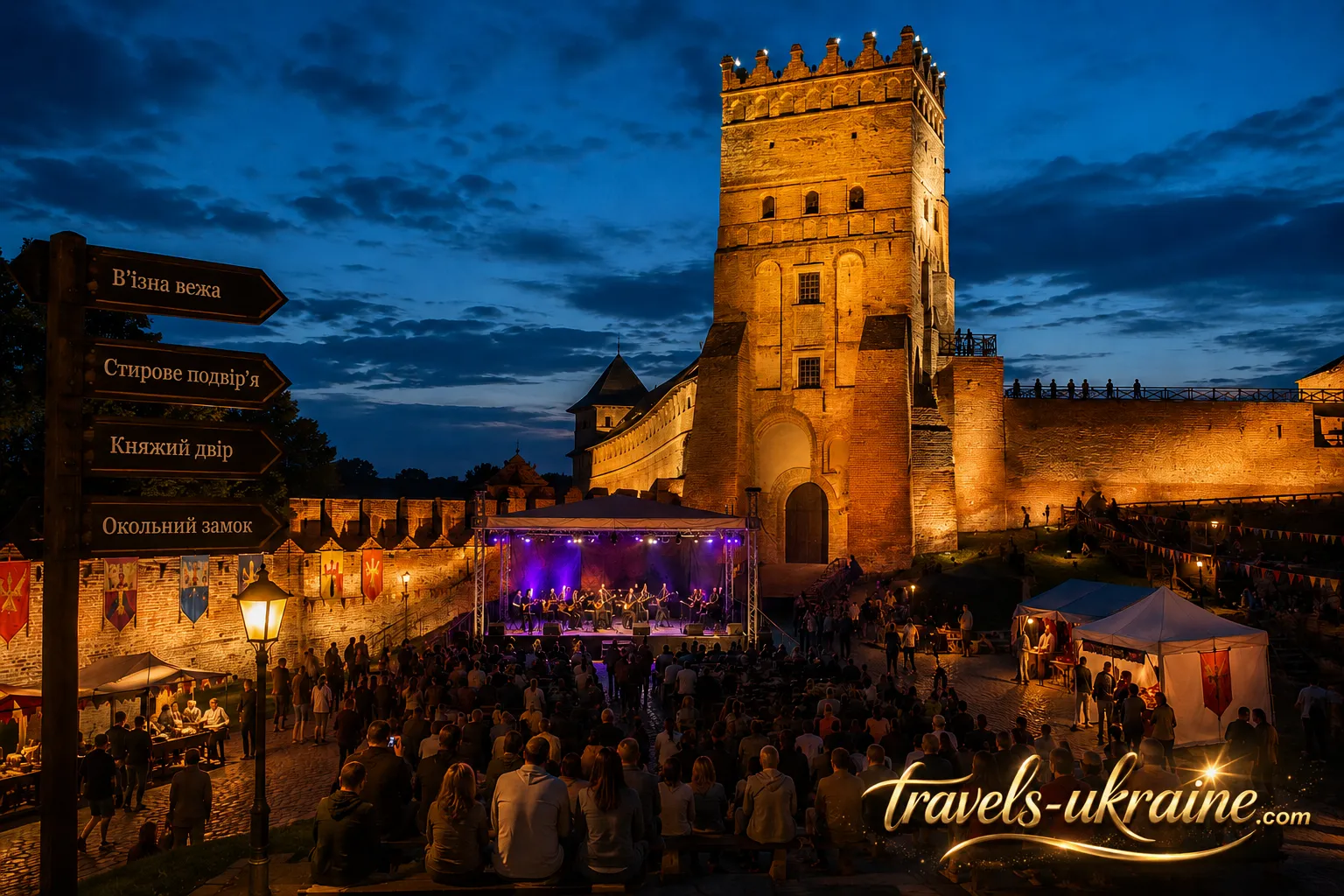
Lutsk Castle complex is more than a place for a quiet stroll, a historical tour, and beautiful photos. From time to time, its old walls seem to awaken: music fills the courtyard, stages appear, audiences gather, and festivals, concerts, exhibitions, knightly tournaments, and themed events take place. Then the former Lubart defensive complex ceases to be merely a magnificent architectural landmark—it becomes a living cultural space where the past and present meet without excessive formality, but with a wonderfully vivid effect.
It is during events that you can best feel that the castle-residence in Lutsk has not become a silent museum exhibit. It continues to be part of city life. Ancient melodies, modern music, theatrical performances, children’s laughter, tourists’ conversations, and that special hum of a crowd can all be heard here—the kind that arises only when people have gathered not simply to “see a location,” but to experience an event within it. Medieval walls have probably witnessed louder times, of course, but at least there is no siege now—and that is already a major plus.
A Night at Lutsk Castle: An Atmospheric Event Among the Old Walls
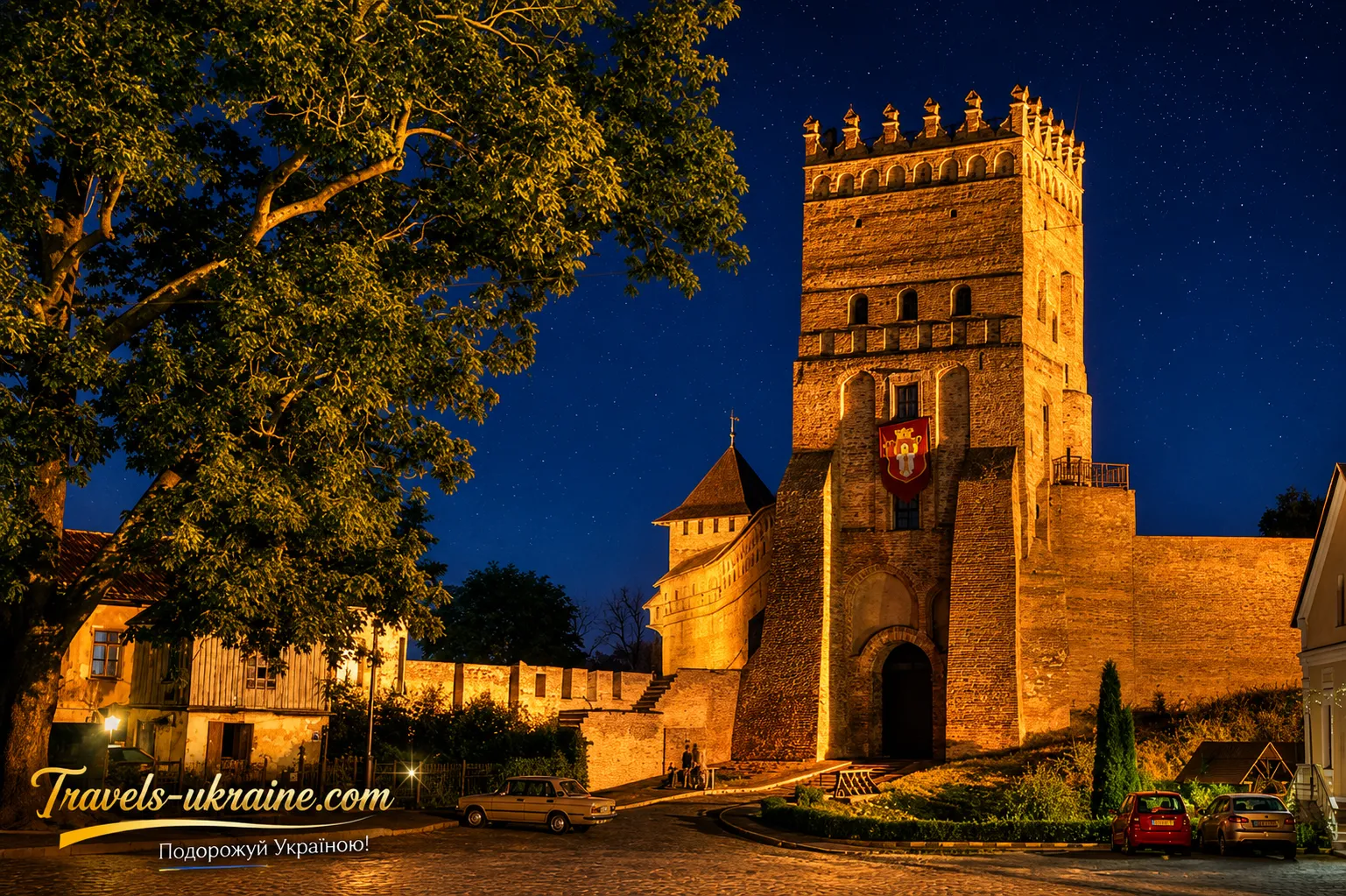
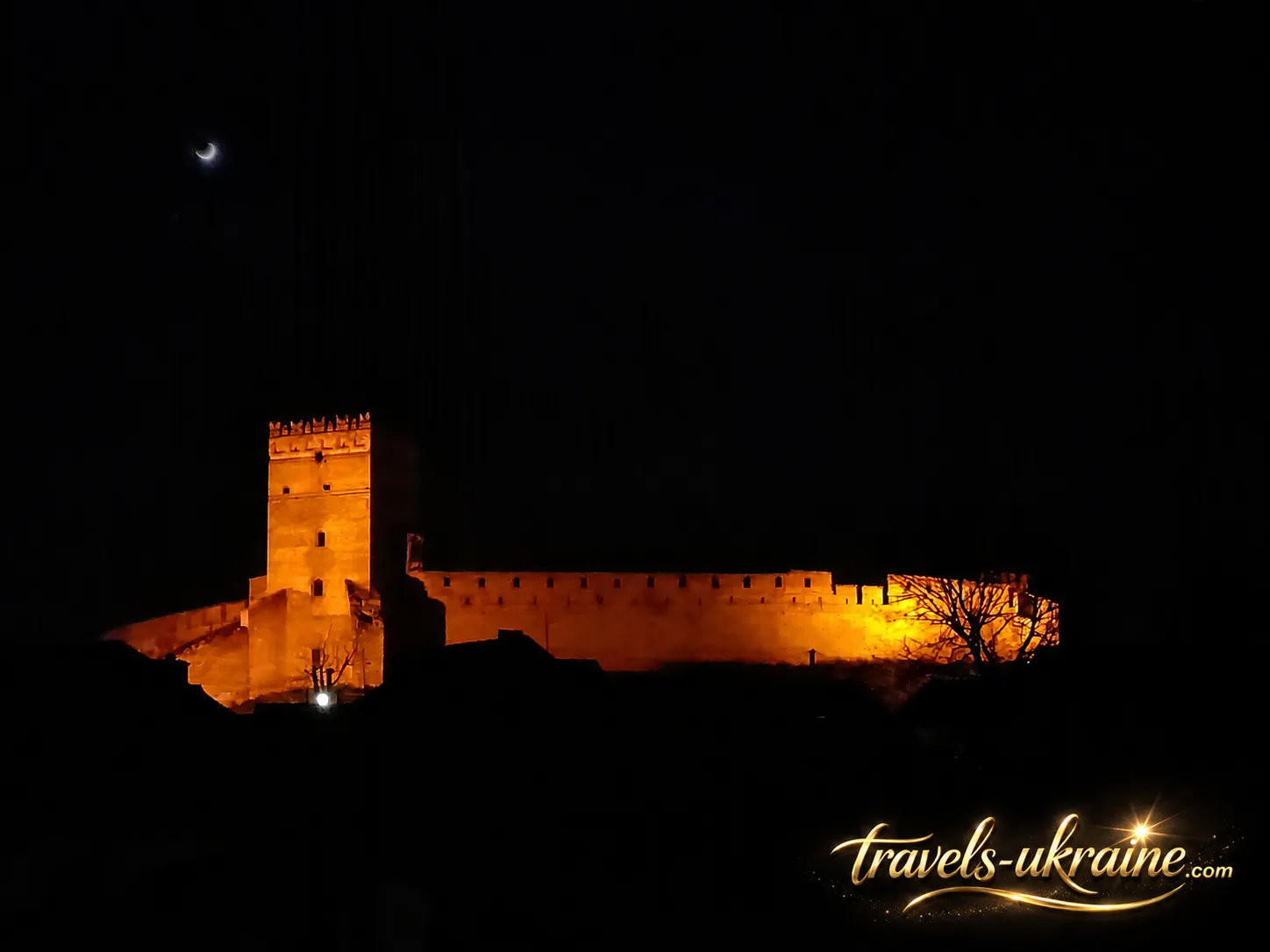
One of the best-known cultural events associated with the castle is the art festival «A Night at Lutsk Castle». The name alone sounds as if tourists are being invited not merely to attend an event but to catch a glimpse of the secret life of the old fortress after sunset. And there is a certain magic to it: evening light, illuminated walls, music, performances, the historic courtyard, and the feeling that Lutsk Castle tells entirely different stories at night than it does during the day.
Such events are especially valuable for travelers who want to see Lutsk Castle at night not merely as a beautiful silhouette in a photograph, but as a place with its own atmosphere. In the evening, the fortress changes: the brick seems warmer, the shadows deeper, and the towers even more imposing. And if during the day the castle ensemble impresses with its architecture, during evening events it begins to function as a stage where history itself takes the leading role. All one has to do is avoid getting in the way—watch, listen, and occasionally remember that this is not happening in a theatrical set, but in a real medieval castle.
Festivals, concerts, and knightly tournaments at Lubart’s Castle
Lubart’s Castle-Fortress is well suited to historical reenactments, art festivals, concerts, and themed celebrations. Its courtyard has a natural theatrical quality: the high walls create a sense of enclosed space, the towers add a dramatic silhouette, and the atmosphere itself needs no artificial decoration. Even an ordinary performance looks a little more ceremonial here, because the backdrop is not a banner or a plastic structure, but several centuries of history. Try giving a lackluster performance after that—the castle seems likely to silently judge you.
Tourists are especially interested in events with a historical atmosphere: knightly tournaments at Lutsk Castle, reenactments, performances in period-style costumes, craft fairs, musical evenings, and theatrical programs. For children, this can be the most engaging way to become acquainted with the past—not through a dry date, but through swords, towers, legends, costumes, and live action. For adults, it is an opportunity to experience the defensive fortress in Lutsk not only through a tourist’s eyes, but also through the atmosphere of a celebration.
- The Floral Art Festival brings contemporary cultural life to the castle and makes it appealing to a wider audience.
- The "Sword of Lutsk Castle" Festival is especially atmospheric in the evening, when the walls and towers create a striking visual effect.
- Knightly tournaments highlight the medieval character of Lutsk Castle particularly well.
- The Art Jazz Cooperation Jazz Fest helps unite the historic setting with contemporary art and culture.
- Themed tours allow visitors to see the castle not merely as a landmark, but as a place filled with living stories.
It is worth noting that this is far from a complete list of the festivals, concerts, and spectacular shows held within the walls of medieval Lutsk Castle. So when planning your trip, be sure to check the events calendar—everyone will find something special here, regardless of their tastes, age, or interests. Lutsk Castle is not only a majestic historical landmark, but also a place where the past comes alive through music, lights, knightly tournaments, theatrical performances, and an unforgettable festive atmosphere.
Why you should check the event schedule before visiting Lutsk Castle
If you are planning to visit the castle in Lutsk, be sure to check the current event schedule. This is not merely a formality. One day, you may find yourself taking a peaceful walk in almost complete silence; the next, you may arrive for a festival, concert, or major city celebration. Both options are good—they simply offer completely different experiences. Silence lets you examine the walls carefully and feel the history, while an event adds energy, light, and the pleasant sense that the city is alive around its main landmark.
This is especially important for those planning a Lutsk tourist route for the weekend or arranging a one-day getaway. If a major event is taking place at the castle, allow extra time, and check the entry conditions, tickets, opening hours, and any possible restrictions on access to certain areas in advance. The castle is certainly large and patient, but a tourist’s day is usually shorter than it seems in the morning. So it is better to know ahead of time whether you are coming for a peaceful tour or an event where the Old Town will buzz like a beehive.
What to see at Lutsk Castle: a tourist route
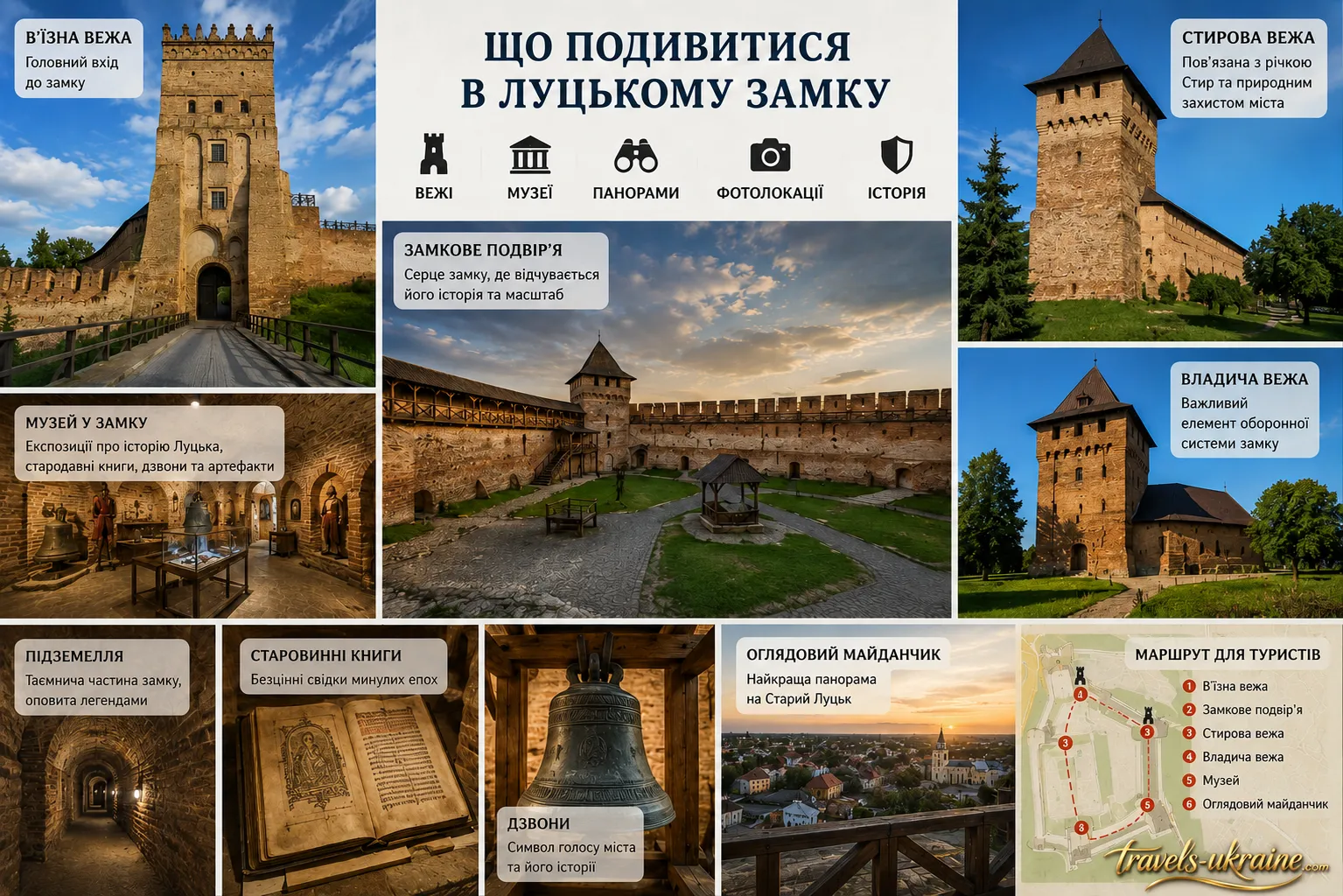
In the heart of historic Lutsk, amid quiet stone streets and echoes of bygone eras, rises a symbol of the past, defensive power, and princely grandeur—Lutsk Castle-Fortress. This monumental structure has long been a true architectural gem of Volhynia, captivating visitors with its beauty, strength, and distinctive atmosphere. Over the centuries, the castle has preserved its power and refined beauty, holding more than 600 years of history in its stone. It still stands on a high hill as a silent witness to times gone by, reminding today’s generation of the glory, struggles, and cultural heritage of our people.
The history of Lutsk Castle is full of events, legends, and dramatic twists that reflect the complex fate of this picturesque fortress. Its walls have witnessed military threats, political intrigues, diplomatic meetings, periods of prosperity, and times of hardship. Here, memories of medieval Volhynia, princely grandeur, and the spirit of the ancient city intertwine. Today, Lutsk Castle no longer serves a military purpose as it once did, but its significance has not diminished. On the contrary, in our time it is a true treasure trove of history and culture—a place worth preserving, respecting, and discovering again and again.
So, if you are planning to visit Lutsk Castle for the first time, the main thing is not to rush. The advice sounds simple, but it is what most often saves tourists from the classic mistake: entering, photographing the Entrance Tower, quickly crossing the courtyard, and deciding, “Well, it’s just a castle.” In reality, the castle does not reveal itself in five minutes. You have to read it slowly: through its towers, old brickwork, museum exhibitions, courtyard silence, viewpoints, and the small details that do not shout for attention but leave the strongest impression.
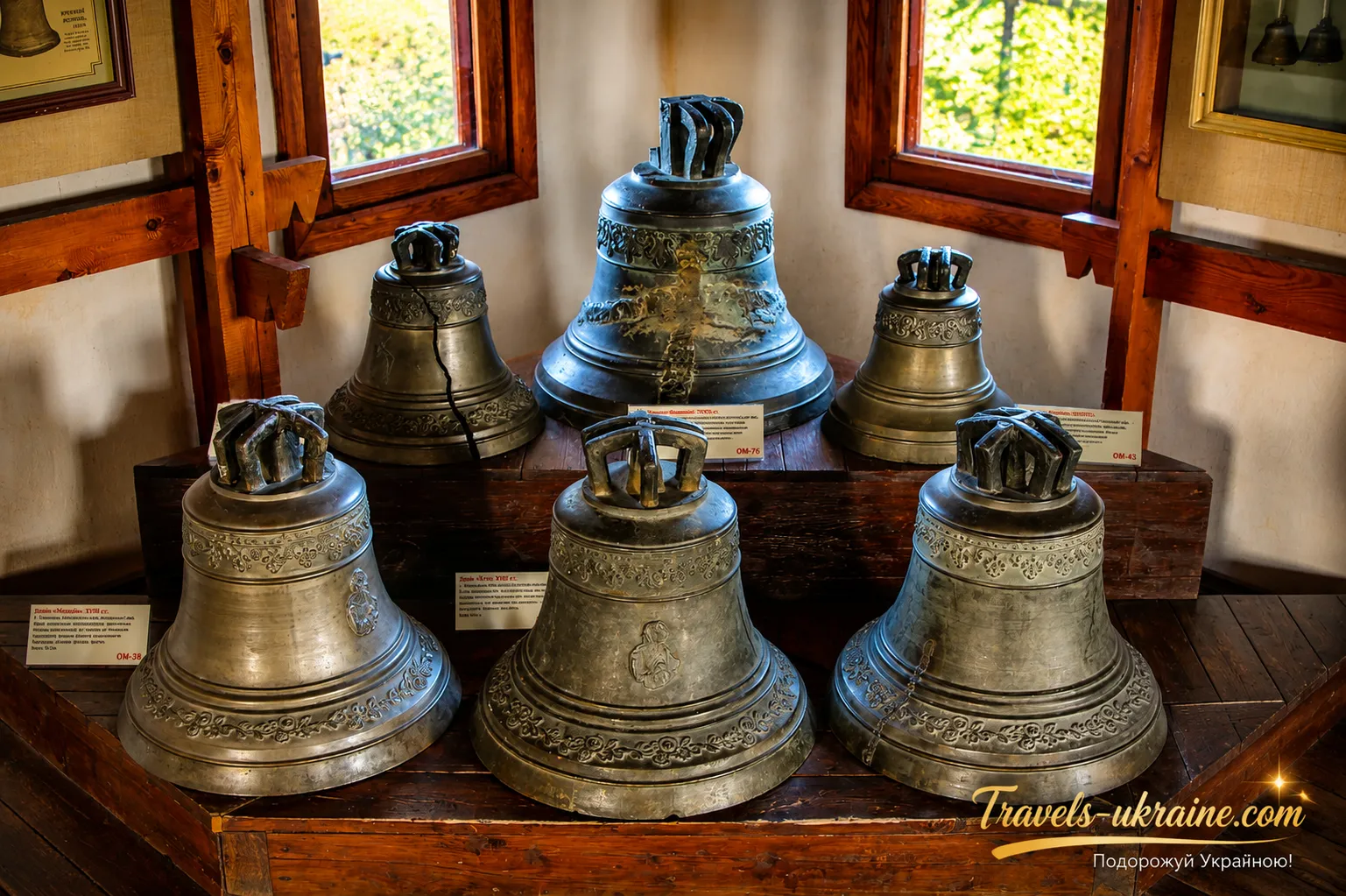
For a tourist, what to see at Lutsk Castle in one tour is not a single question but an entire route. You can explore the three towers, walk along the walls, note the remains of ancient structures, visit the museum at Lutsk Castle, view exhibitions related to old books and bells, and climb to a viewpoint if it is open on the day of your visit. And all of this takes place in an area where every step has a historical backdrop. The castle does not, of course, grab visitors by the sleeve and say, “Look more closely!”—but its walls make the suggestion very clearly.
On the grounds, it is worth paying attention to the remains of the church, traces of ancient structures, museum objects, and the overall layout of the site. This helps you see the castle not only as a defensive structure, but as a place where life once existed: administrative, religious, princely, and urban. There were more than just walls and soldiers here. Decisions were made, guests welcomed, documents kept, prayers said, work done, arguments had, and, presumably, complaints about the weather made from time to time—because in this respect, people from different eras are remarkably alike.
The dungeons of Lutsk Castle: the mysterious part of the route
The dungeons of Lutsk Castle are one of the subjects that especially stir the tourist imagination. Say “dungeons,” and your mind immediately conjures torches, secret passages, rustling in the darkness, and someone very mysterious who, naturally, knows more than they say. In reality, everything may be much calmer, but that does not make it any less interesting. Underground spaces always give a castle a special atmosphere, showing it not only vertically, through its towers, but also in depth—through its hidden layers of history.
If tours or routes connected with the underground sections are available during your visit, they are worth taking. It is a great way to see the castle in Lutsk from a different perspective. But even if the dungeons are inaccessible, the subject remains important for understanding the castle: it connects architecture, legends, defense, and the city’s memory. This historic castle is fascinating not only for what can be seen immediately, but also for what is hidden from first sight.
After exploring the site fully, it becomes clear that what tourists can see at Lutsk Castle is far more than the standard answer of “three towers and a courtyard.” There is architecture, museums, panoramas, legends, underground stories, children’s routes, photo spots, and the feeling of a genuine Old Town. That is why the question of whether Lutsk Castle is worth visiting is almost rhetorical. It is. But rather than “dropping by for a minute,” it is better to give yourself time to see how this princely stronghold gradually reveals its stories.
What to see near Lubart’s Castle: interesting nearby tourist attractions
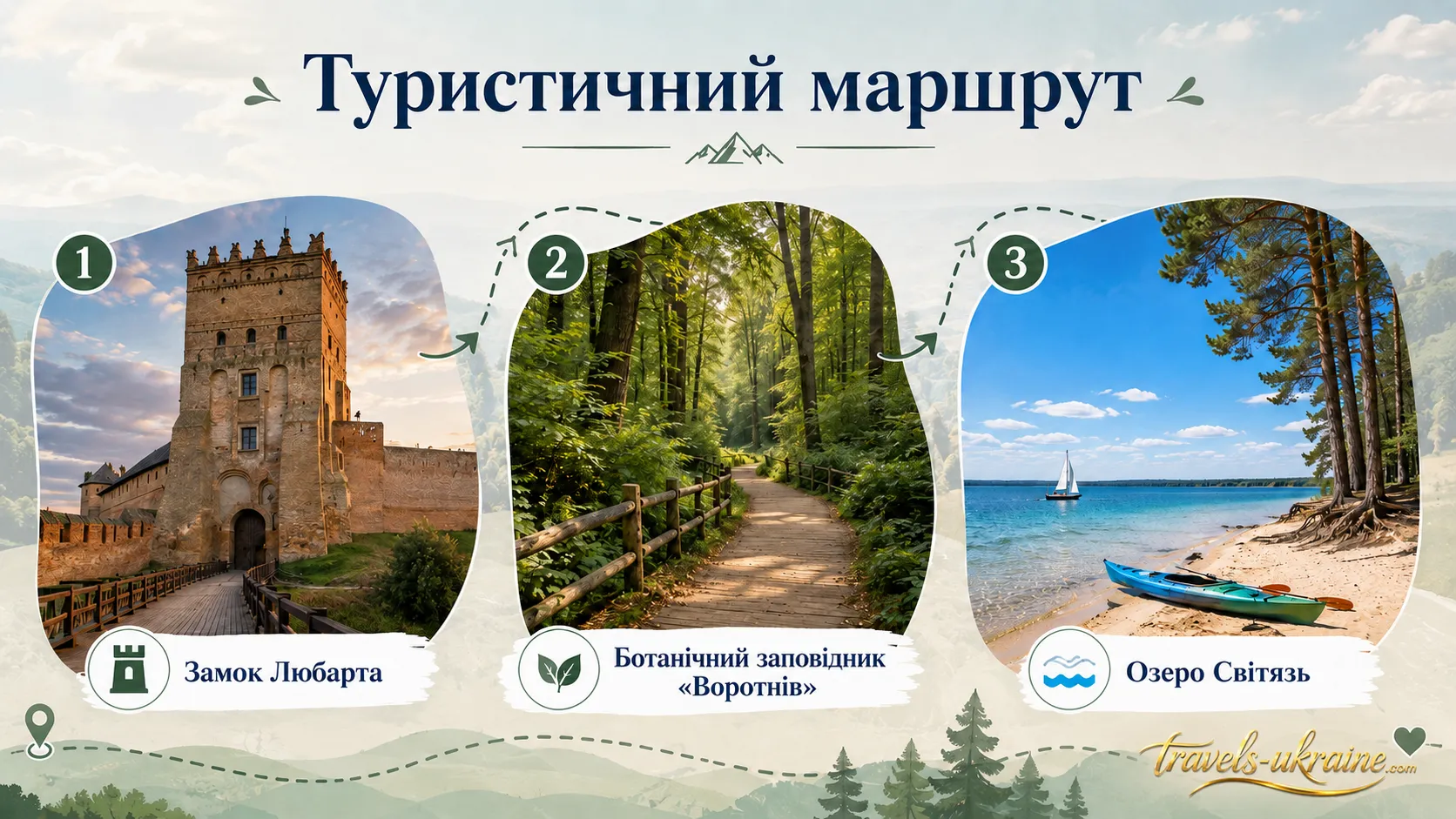
What to see near Lubart’s Castle is exactly the right question, because Lutsk Castle and the Old Town are best experienced not separately, but as one tourist route. The castle sets the main tone for the walk, but there are plenty of places around it that help you discover Lutsk and Volhynia more deeply: churches, old streets, dungeons, museums, atmospheric courtyards, historic buildings, and places where history behaves not like a museum exhibit, but like a very stubborn resident of the city.
After visiting the castle, there is no need to hurry straight to another district. Old Lutsk deserves at least a few hours of attentive exploration. Everything is quite compact here, so you can follow the route on foot, without complicated logistics or a heroic feat in the style of “we saw everything, but can no longer feel our legs.” That is why searches for interesting places in Lutsk so often lead precisely to the area around Lutsk Castle.
Lutsk Old Town is a space where Lubart’s Castle has a natural continuation. It is important not only to walk from one point to another, but also to look closely at the urban environment itself: the narrow streets, old façades, changes in elevation, unexpected views of the towers, and quiet corners that do not always appear in tourist brochures. After the grandeur of the castle walls, the old part of the city feels more intimate, but no less interesting. It does not shout about itself; rather, it hints, “Don’t hurry—there is plenty to tell here too.”
It is especially pleasant to explore this district after a castle tour. You already have the historical context, understand the role of the Upper Castle, remember the Roundabout Castle, and suddenly the ordinary streets begin to look completely different. They become not merely a way to a café or the next attraction, but part of an ancient urban organism. This is the moment when Lutsk Castle and the Old Town turn from a set of keywords into a genuine travel experience.
Vorotniv Botanical Reserve: a green break after Lutsk Castle
If, after the castle walls, towers, and historic architecture, you feel like changing pace and immersing yourself in nature, consider the Vorotniv Botanical Reserve near Lutsk. It is an excellent option for those who want a little silence, greenery, and a leisurely walk away from city noise after the castle’s stone grandeur. The location is within 20 kilometers of Lutsk, so in a short time you can find yourself among forests, fresh air, natural trails, and a calm that feels almost like a gift after a busy tourist route.
Vorotniv is a great addition to a trip to Lutsk: first, a princely castle, medieval walls, history, and legends; then nature, trees, silence, and a chance simply to exhale. It is suitable for a leisurely walk, a short rest after a tour, a family outing, or a brief route for those who enjoy combining Ukraine’s architectural landmarks with natural attractions. Even the most beautiful castles sometimes need a touch of greenery—and the Vorotniv Botanical Reserve fits the bill perfectly.
Lake Svityaz: a waterside escape after exploring Lutsk
If you have set yourself the simple but very worthwhile goal of taking a weekend getaway or finally escaping the daily rush for a short vacation, say, for a week, then Lake Svityaz is worth considering. This is a place for anyone who wants more than just a change of scenery—for a real reset: to see clear water, breathe fresh air, hear the silence of the forest, and forget for a few days that deadlines, traffic jams, and endless phone notifications exist somewhere out there.
Svityaz is an ideal choice for travelers who enjoy an active yet peaceful vacation. You can go fishing, swim, try diving, take to the water on a sailboat, or paddle leisurely in a kayak. Or you can conquer nothing, compete with no one, and simply sit by the water, watch the waves, and honestly admit to yourself: sometimes the best plan is having no plan.
Lake Svityaz can easily become a wonderful alternative to a seaside vacation—and for some people, even surpass it. There is no sea salt on your skin, but there is crystal-clear water, the scent of pine, soft sand, room to walk, and a sense of calm that is not always easy to find at crowded resorts. After exploring Lutsk, its castle, old streets, and historic landmarks, a trip to Svityaz feels like a very natural continuation of the route: first, culture and architecture, then water, forest, and a complete recharge.
Rules and Etiquette at Lutsk Castle: How to Visit This Landmark Respectfully
Lutsk Castle is open to tourists, walkers, guided tours, photography, and a living encounter with history. But it is important to remember that this is not simply a beautiful weekend destination; it is a monument of architecture and history of national significance. Its walls have survived princes, wars, reconstructions, changes of state, and tourists who desperately want to take “one more photo with this brick.” So the best way to visit Lubart’s medieval castle is not only to see it, but also to behave in a way that leaves it just as majestic for the travelers who come after you.
Etiquette at the castle is not complicated. It is based on a simple idea: everything you see around you is not a prop that can be touched, scratched, signed, moved, or “tested for strength just a little.” A historic castle deserves peace, even if it welcomes hundreds of guests every day. And there is a certain fair irony in that: medieval walls once withstood sieges, but modern marker graffiti, carelessness, and the urge to climb “up there where the view is beautiful” can cause no less damage than ancient enemies with battering rams.
If you really want to leave a mark after your visit, take a photo, write a kind review, share your route, or recommend Lutsk Castle to your friends instead. That is far more useful than scratching a brick older than most government offices, roads, and tourist habits combined. The castle walls already have enough stories. They certainly do not need a modern autograph carved with an apartment key.
Be especially considerate in the museum halls. If photography is allowed, wonderful—but it is best not to use flash where it could damage exhibits or disturb other visitors. If photography is prohibited, it is better to accept that calmly. There are plenty of places in the world for photos, while ancient books, bells, artifacts, and historic objects have slightly different priorities in life than appearing on every social network before lunch.
If you have chosen a tour of Lubart’s Castle, give the guide a chance to tell the story properly. Do not interrupt unnecessarily, do not wander far from the group, and do not conduct a parallel tour for your friends when a professional is already working nearby. A good guide helps you notice what an independent tourist can easily miss: the history of Prince Lubart, the significance of the Entrance, Styrova, and Vladycha Towers, the features of Gothic masonry, the remains of ancient structures, legends, and the hidden layers of Old Lutsk.
Questions are encouraged—they always make a tour more engaging. But it is best to ask them at an appropriate moment, without talking over the guide or turning the route into a personal interrogation on the theme of “are you sure it really happened that way?” History is complicated, and not everything fits into a single sentence. That is why a Lutsk Castle tour is often more interesting than exploring on your own: it provides not only facts, but also context.
- Follow staff instructions—they are responsible both for order and for preserving the landmark.
- Do not go behind the barriers—even if it seems that “the best shot” is waiting there.
- Do not touch the exhibits unless the rules of that particular exhibition allow it.
- Keep noise to a minimum in the museum spaces—other visitors came for the atmosphere too, not for your playlist.
- Do not leave litter in the courtyard, near the walls, or in the Old Town.
The best tourist etiquette is not a strict list of prohibitions, but a healthy respect for the place. Lubart’s Castle does not require visitors to walk solemnly or whisper at every step. It asks only for the obvious: do not cause damage, do not spoil anything, do not disturb others, and do not behave as though several centuries of history exist solely for your photo. Keep that in mind, and the walk will be enjoyable both for you and for those who come after you.
Ultimately, the rules for visiting Lutsk Castle are very simple: look carefully, take beautiful photos, listen with interest, treat the walls with respect, and leave behind only good impressions. The castle has survived many eras, but its future depends not only on restorers, historians, and museum professionals. It also depends on every tourist who passes through the Entrance Tower today and decides who to be: a considerate guest or the kind of person who makes everyone want to put up another “do not enter” sign.
Frequently Asked Questions About Lutsk Castle: Tickets, Hours, Routes, and Tips for Tourists
Where is Lutsk Castle located?
Lutsk Castle, also known as Lubart’s Castle, is located in Lutsk’s Old Town on Cathedral Street. This is the historic center of the city, so the castle is easy to combine with a walk to Saints Peter and Paul Cathedral, Lutsk’s underground passages, the Lutheran church, museums, and old streets. In short: look for the towers above the rooftops—the medieval navigation system in Lutsk is remarkably convincing.
How do you get to Lubart’s Castle in Lutsk?
You can reach Lubart’s Castle in Lutsk on foot from the city center, by public transport, taxi, or car. The most enjoyable option for tourists is a walk through the Old Town: this lets you gradually take in Lutsk’s atmosphere and see modern streets give way to the world of ancient history. If you are driving, it is best to check parking options in advance, as spaces may be limited in the historic center.
What are Lutsk Castle’s opening hours?
Lutsk Castle’s opening hours may change depending on the season, holidays, events, maintenance work, or individual museum routes. Before your trip, check the current hours on the reserve’s official website or on Lutsk tourism websites. This is especially important if you plan to climb the towers, take a tour, visit the museums, or attend an evening event on the castle grounds.
How much does a ticket to Lutsk Castle cost?
The price of a ticket to Lutsk Castle depends on the type of visit: basic admission, individual museum exhibitions, sightseeing routes, tower access, or a guided tour may all have different prices. Separate terms may sometimes apply to children, students, eligible groups, or organized groups. It is best to confirm the current price before your visit, so you do not meet the ticket office in the spirit of “we thought it would be different.”
How much time is needed to visit Lutsk Castle?
Allow approximately 40–60 minutes for a quick look around Lutsk Castle, but for a full experience, it is better to have 1.5–2 hours. If you plan to take a tour of Lubart’s Castle, visit the museum exhibitions and viewing platform, and walk through the Old Town, set aside half a day. The castle does not appreciate haste: its most interesting details reveal themselves to those who do not race across the courtyard in “hurry up, there are ten more locations” mode.
What can you see at Lutsk Castle in one tour?
During one tour of Lutsk Castle, you should see the Entrance, Styrova, and Vladycha Towers, the castle courtyard, defensive walls, remains of ancient structures, museum exhibitions, old inscriptions on the walls, and panoramic viewpoints, if available. The subjects of Prince Lubart, the Castle of the Three Princes, the Okolny Castle, underground passages, bells, and ancient books also deserve special attention. Together, these details create a complete picture of the castle—not merely a “pretty fortress for photos.”
Is Lutsk Castle suitable for children?
Lutsk Castle for children is an excellent choice if you present the visit as a small adventure. Children enjoy looking for the three towers, passing through the ancient gate, examining the arrow slits, listening to legends, and imagining what the medieval city looked like. At the same time, adults should keep an eye on children near stairs, walls, viewing areas, and museum exhibits, because this is a genuine historic landmark with cobblestones, uneven surfaces, and old passageways.
Where can you take the best photos of Lutsk Castle?
The best photos of Lutsk Castle can be taken near the Entrance Tower, in the castle courtyard, along the walls, beside sections of old masonry, from viewing points, and from angles overlooking the Old Town. In the morning and toward evening, the light is softer, making the brick look warmer and the shadows deeper. Lutsk Castle in winter, autumn, and summer has a different mood in each season, so photography enthusiasts should return at different times of year.
What can you see near Lubart’s Castle?
Near Lubart’s Castle, you can explore Lutsk’s Old Town, Saints Peter and Paul Cathedral, Lutsk’s underground passages, the Lutheran church, the House with Chimeras, museums, and atmospheric old streets. If you have more time, you can extend the route beyond the city to the Vorotniv Botanical Reserve or Lake Svityaz. This makes for a wonderfully varied trip: first medieval architecture, then nature, water, and relaxation.
Is Lutsk Castle worth visiting?
Yes, visiting Lutsk Castle is absolutely worthwhile. It is one of Volyn’s principal landmarks, a monument of architecture and history of national significance, a symbol of Old Lutsk, and one of Ukraine’s most fascinating medieval fortresses. It has everything needed for a memorable travel experience: towers, walls, legends, museums, panoramic views, ancient inscriptions, the history of princes, and the feeling of a real city with a deep memory.
Conclusion: Why Lutsk Castle Is Worth Visiting at Least Once
Lutsk’s Galicia–Volhynia castle heritage is more than just a beautiful fortress in the city center or another mark on Volyn’s tourist map. It is a place where history takes the shape of brick, carries the voice of ancient walls, and reflects the character of a princely city. Here, it is easy to understand why Lubart’s Castle became a symbol of Lutsk: it does not try to impress with artificial grandeur, need unnecessary embellishment, or call for lengthy explanations. Simply pass through the Entrance Tower, step into the castle courtyard, look up at the walls—and everything becomes clear without grand words.
The castle complex has a rare ability to appeal to very different travelers. History lovers will find Grand Duke Lubart, Vytautas, Švitrigaila, references to European diplomacy, and medieval Volhynia. Photographers will find striking angles, panoramic views, the texture of old brick, and the distinctive light on the towers. Families with children will discover a real adventure featuring the gate, arrow slits, museums, legends, and stories of the underground. And those who simply want to spend a beautiful day in Lutsk will enjoy an atmospheric walk through the Old Town, where every street seems to continue the castle’s story.
Lutsk Castle — a landmark that brings together the city’s history, architecture, and atmosphere
The main strength of this site lies in its many layers. Upper Castle in Lutsk is at once a princely residence, a defensive structure, a museum space, an event venue, and one of the best-known Architectural and Historical Monuments of National Significance. It speaks several languages at once: the language of medieval power, urban memory, legends, tourist routes, and the small details you notice only when you stop rushing.
That is why it is worth visiting Lubart’s Castle in Lutsk not just “for the sake of checking it off,” but with plenty of time to spare. A leisurely approach works best here: first explore the towers, then walk through the courtyard, visit the museum, pay attention to the inscriptions on the walls, listen to the legends, and imagine the Roundabout Castle, which supposedly disappeared but still stubbornly lives on in the city’s buildings. Lutsk Castle is not a place to rush through. It has stood for so many centuries that it has every moral right to teach visitors to slow down a little.
Is Lutsk Castle worth visiting?
The answer is simple: yes, Lutsk Castle is worth visiting. Come for the towers, walls, old brick, museum exhibitions, panoramic views, legends, the atmosphere of the Old Town, and that special feeling when the past stops being abstract. Here, history does not seem distant. It stands before you—tall, somewhat austere, beautiful, weathered by time, and remarkably alive.
And perhaps that is the true magic of Lubart’s Castle. It has not merely survived—it continues to serve the city. It draws tourists, inspires photographers, amazes children, captivates researchers, hosts festivals, recalls princely Volhynia, and at the same time remains part of modern Lutsk. This is not a frozen backdrop from the past, but a place that still has a voice. All you need to do is come, walk through the gate, and give yourself time to hear it.
So, if you are planning a trip through Volyn, putting together a travel itinerary through Ukraine, or simply looking for a place where beauty, history, a leisurely walk, and powerful impressions come together, Lutsk Castle should be near the top of your list. It deserves more than a brief visit—it deserves your full attention. Some landmarks are enough to see once. Others make you want to return in a different season, with different people, in a different frame of mind, already understanding that these walls conceal far more than meets the eye.
No Comment
You can post first response comment.