
 English
 Українська
 Latviešu
 Lietuvos
 Русский
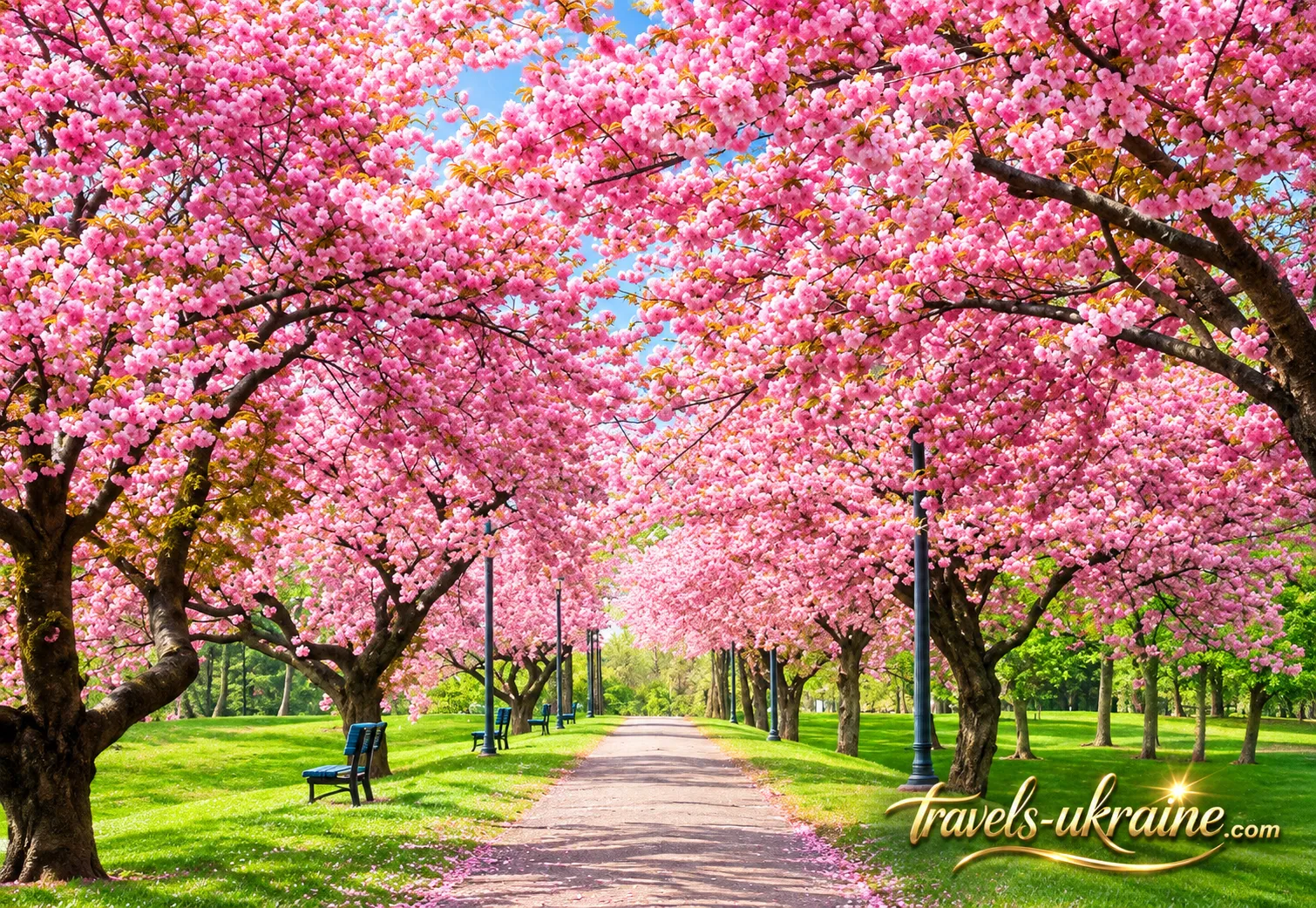
Today, it is hard to imagine springtime Uzhhorod without cherry blossoms. At the end of April, pink crowns appear along old streets, near embankments, administrative buildings, and residential neighborhoods, transforming the city for several weeks into one of Zakarpattia’s best-known spring destinations. Yet the cherry blossom is not a native tree here, and its history in Uzhhorod is far more recent than the castle, cathedrals, or old streets of the city.
The most widely documented version links the arrival of cherry blossoms in Uzhhorod to 1923. According to the city’s official tourism portal, the first trees were brought from Vienna. At that time, Zakarpattia was part of Czechoslovakia, and Uzhhorod was experiencing one of the largest periods of redevelopment in its history. The cherry blossoms thus appeared alongside the new Uzhhorod.
After the First World War, the city took on a new administrative role and began to expand rapidly. One of the main projects was the Malyi Galagov district—a modern quarter of government institutions, residential buildings, and orderly streets, designed in 1921–1923 and actively built up until the end of the 1930s. Before that, the area had been marshy and regularly suffered from flooding by the Uzh River. Before construction began, the land was drained, roads were laid, an embankment was developed, and a new urban landscaping system was created. It was during this period that cherry trees began to be planted widely along the streets of the new district. Alongside the architecture of Czechoslovak modernism came trees that eventually became almost as recognizable an element of the cityscape as Malyi Galagov itself.
Cherry trees took particularly well to the damp soils in this part of the city. Over the years, they spread farther, and the old trees on Dovzhenka and Rakotsi Streets and in the surrounding neighborhoods became the foundation of the cherry-blossom tradition now associated with Uzhhorod.
From Urban Landscaping to a Tourist Symbol
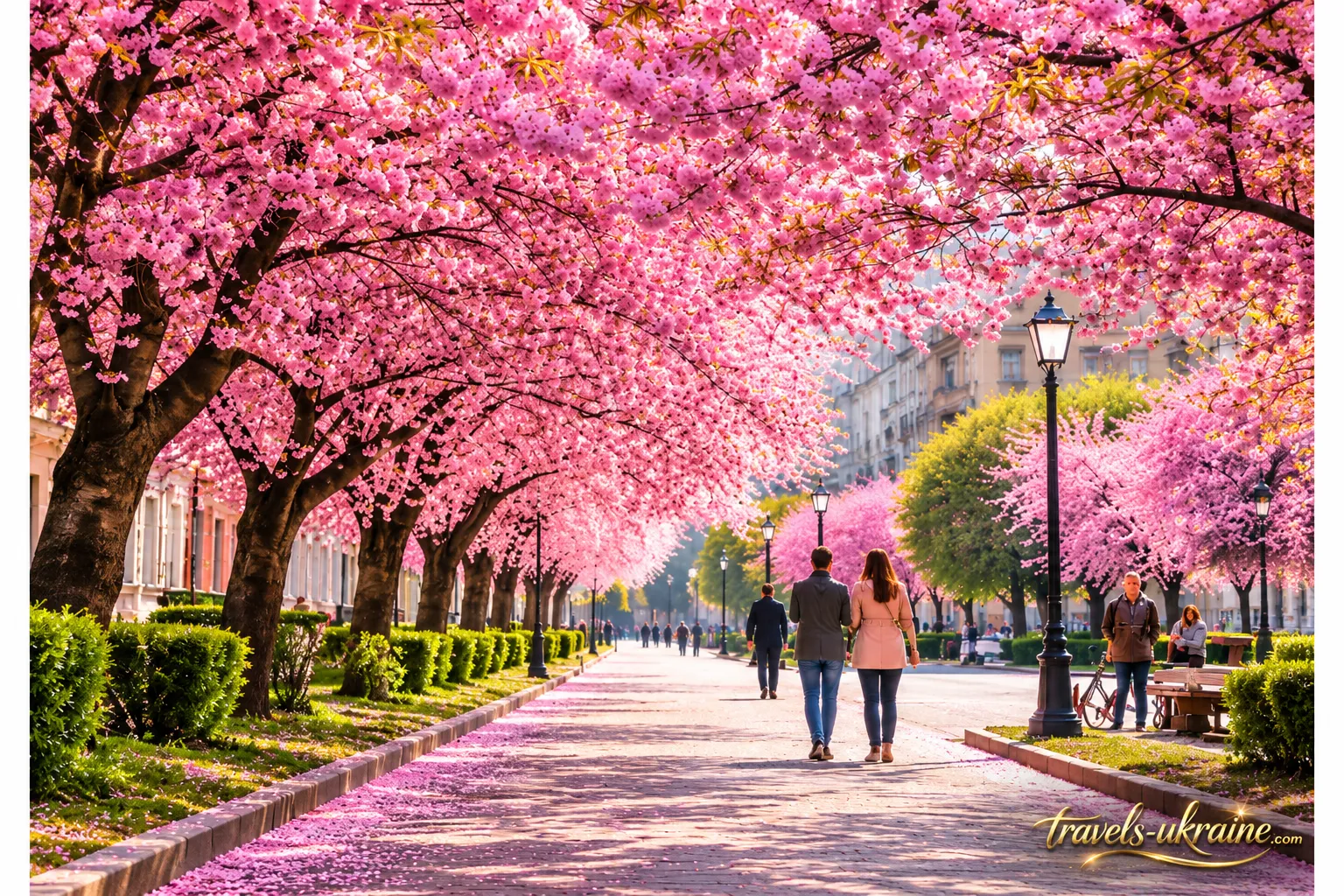
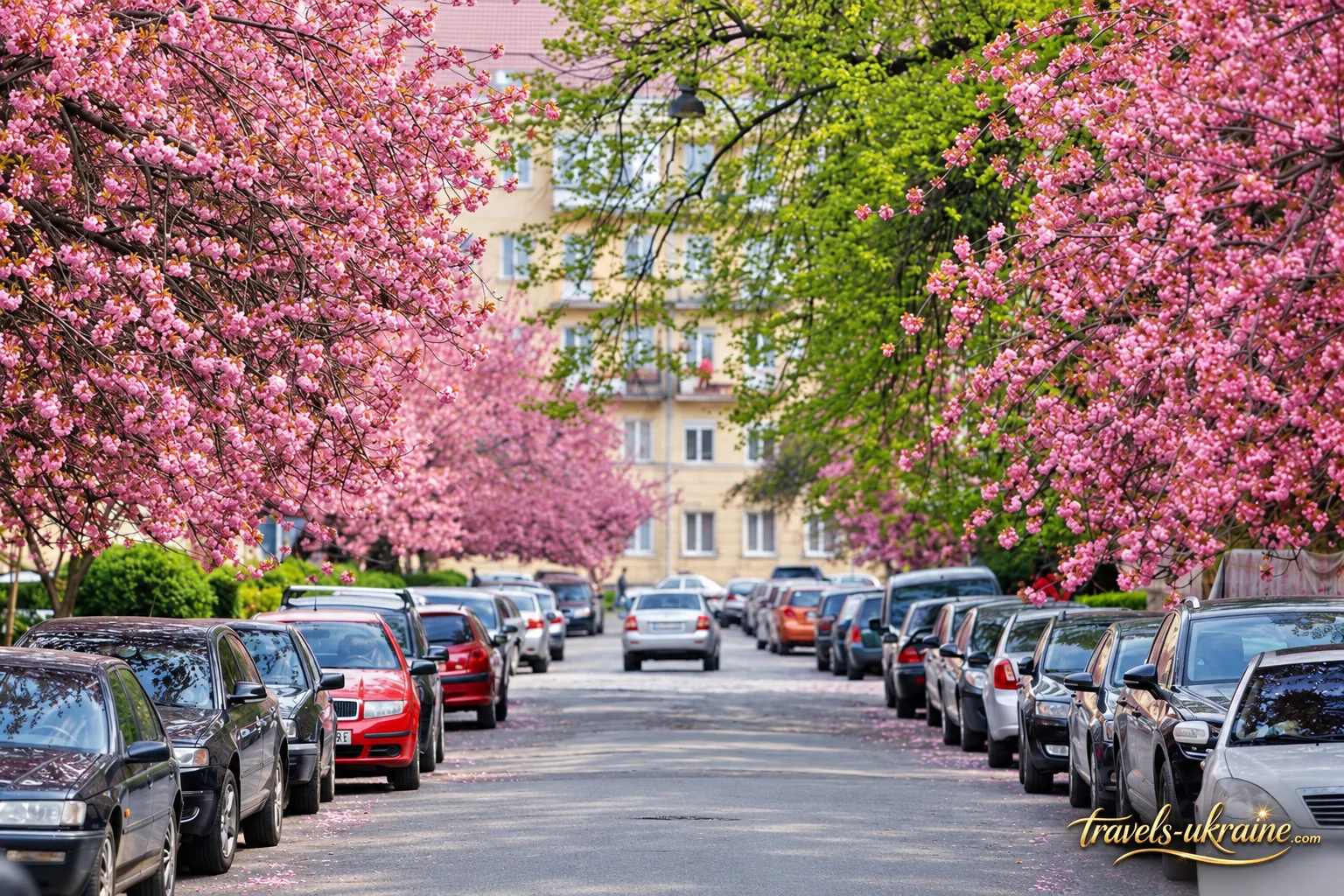
At first, no one created cherry-tree avenues as a tourist attraction. They were simply ornamental trees in an urban environment. But each spring they became harder to overlook: pink crowns covered entire streets, and the brief period of mass blooming created a landscape that sharply distinguished Uzhhorod from most other Ukrainian cities. Gradually, the cherry blossom season in Uzhhorod became a tourist season in its own right. People began planning trips specifically for the second half of April, photographing old streets beneath pink crowns, and creating their own routes from one cherry-tree avenue to another.
The city continues to plant new trees today. In 2020, new cherry-tree avenues appeared along the Kyiv and Slovianska embankments, and the overall geography of the bloom had long since extended beyond historic Malyi Galagov. Cherry trees can be found in various parts of Uzhhorod, although the old central streets remain the most atmospheric at the peak of the season.
Thus, a tree that a century ago was merely part of the city’s new landscaping gradually became one of Uzhhorod’s unofficial symbols. What makes this history especially interesting is that no one officially designated the cherry blossom as a symbol—the role was given to it by spring itself, by the city, and by the thousands of people who return here every year for several weeks of pink blooms.
Over time, a beautiful legend also arose around the arrival of cherry blossoms in Uzhhorod—a tale of Japanese diplomats and stolen saplings. It took root so well that tourists are still told the story today. But which parts are legend and which are confirmed facts? We will explore that next, along with what is actually meant by “cherry blossom” and why its brief flowering captivates people so deeply.
What Is a Cherry Blossom, and Why Does Its Bloom Captivate People?

The word «sakura» is often understood as the name of one particular tree, but that is a somewhat simplified view. The term refers to a whole group of ornamental cherries in the genus Prunus, grown primarily for their exceptionally abundant spring bloom. They include many natural forms, hybrids, and cultivated varieties with white, pale pink, or deep pink flowers.
One of the best-known ornamental cherry species is Prunus serrulata, the Japanese cherry, which botanical sources classify as a member of the rose family. But when we speak of «sakura» as a cultural phenomenon or an element of urban landscaping, we do not necessarily mean just one botanical species: different cities may plant different ornamental varieties and hybrids.
Sakura Blooms for Beauty, Not for Fruit
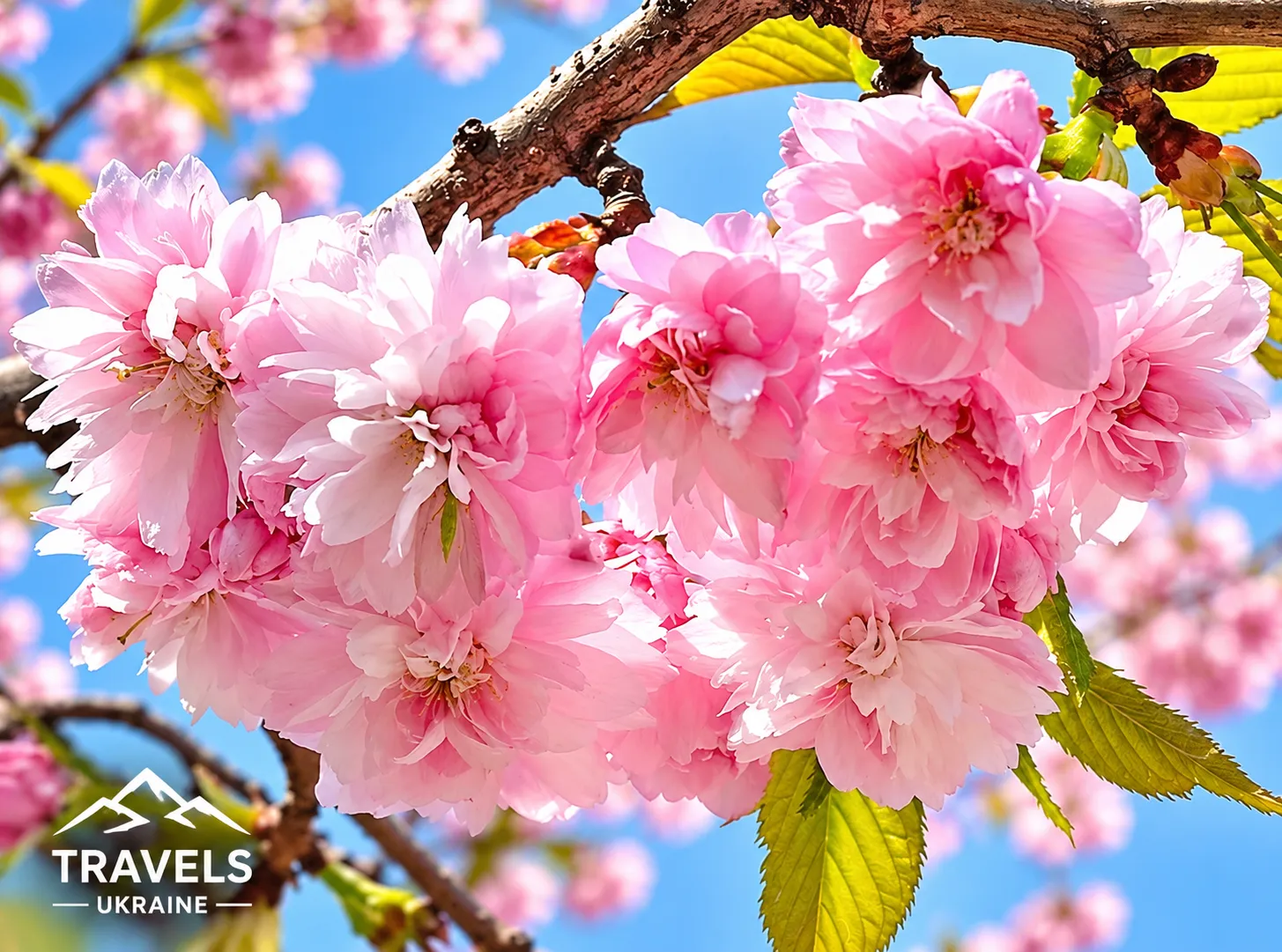
The main value of an ornamental cherry tree lies precisely in its flowers. Unlike the ordinary fruit cherry, grown primarily for its berries, ornamental varieties were selected over decades for the shape of their crowns, the density of their blooms, and the color and number of their petals.
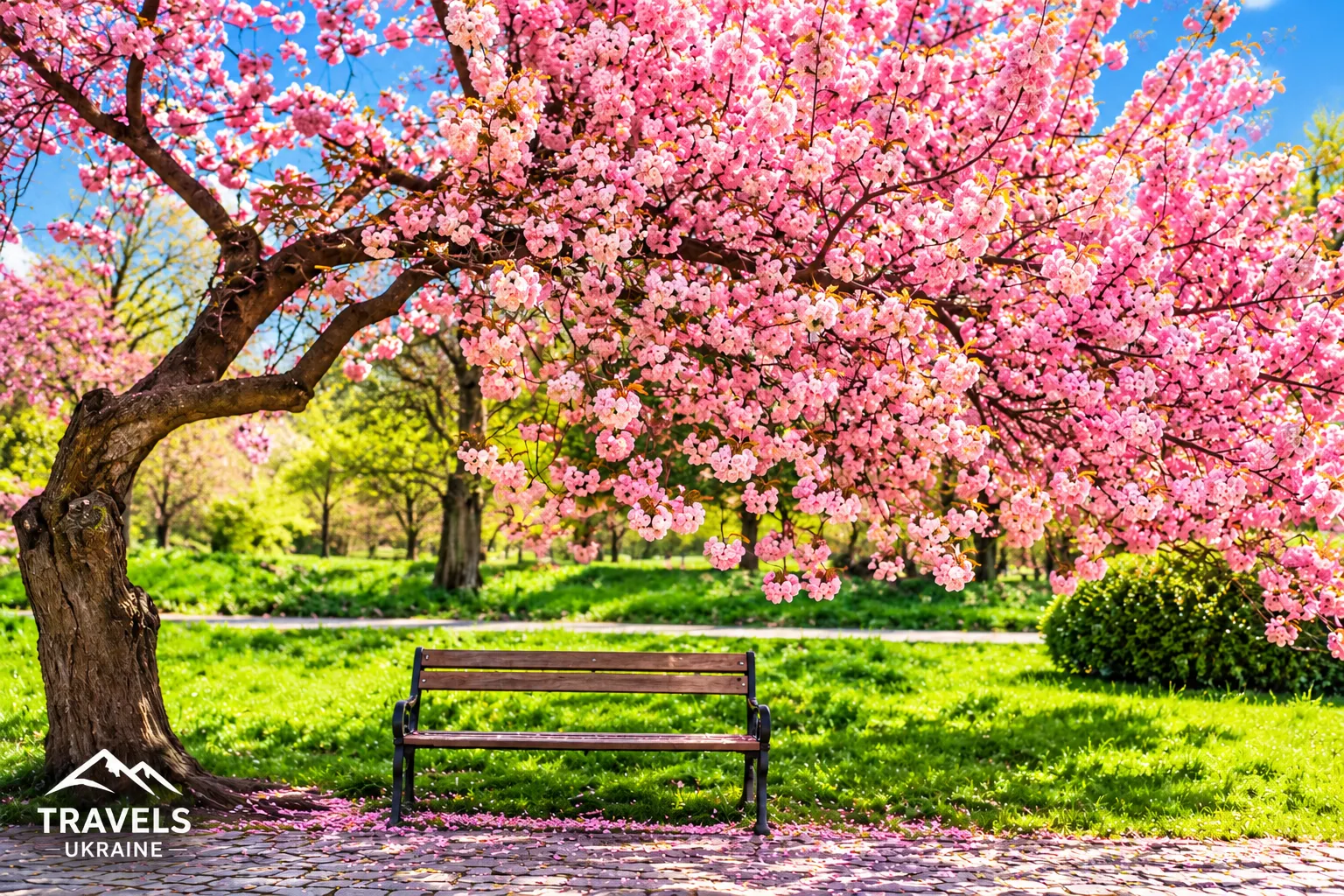
Some ornamental cherries can produce small fruits, but these are not the main purpose of growing them. That is why, in spring, the tree seems to devote all its attention to one brief performance: before dense foliage appears, the branches become covered with so many flowers that from a distance the wood itself is almost invisible.
And the performance does not last long. A single wave of peak bloom may continue for only a few days, while the entire decorative period depends heavily on temperature, rain, and wind. It is precisely this brevity that creates the effect that makes people try not to miss sakura «this year.»
Hanami: When Admiring Flowers Became a Tradition
In Japan, observing the spring bloom developed into a distinct cultural tradition—hanami, literally «flower viewing.» People meet in parks, stroll beneath flowering trees, have picnics, and simply spend time watching this brief spring season.
In Japanese culture, sakura is closely associated with a sense of transience. A flower is very beautiful, but it does not last long: yesterday the tree was almost bare, today it is completely pink, and in a few days the wind is already covering the ground with petals. This fleetingness made the bloom a symbol of a moment worth noticing and experiencing now rather than putting off until later.
Perhaps that is why the tradition takes root so easily far beyond Japan. In Uzhhorod, people have effectively created their own version of hanami: they come to the flowering streets not because a new attraction has opened there, but simply to stroll, photograph the trees, and spend time amid the springtime city.
Why Flowering Trees Really Can Improve Your Mood
The emotional effect of flowering sakura is not merely attractive tourist phrasing. Research into the effects of urban green spaces shows that observing nature may promote psychological relaxation. In one small Japanese study, participants who spent time near flowering cherry trees showed lower levels of tension and anxiety than when viewing an ordinary urban environment; the researchers also recorded changes in blood pressure.
Still, this should not be taken to mean that sakura has some special «healing effect.» The study was small, and the positive impact was probably related more broadly to observing green, flowering natural surroundings. But the tourist experience is entirely understandable: a slow walk along a beautiful street, without rushing, really can be far more pleasant than another hour among cars and concrete façades.

When Do Cherry Blossoms Bloom in Uzhhorod, and How Can You Catch the Peak?
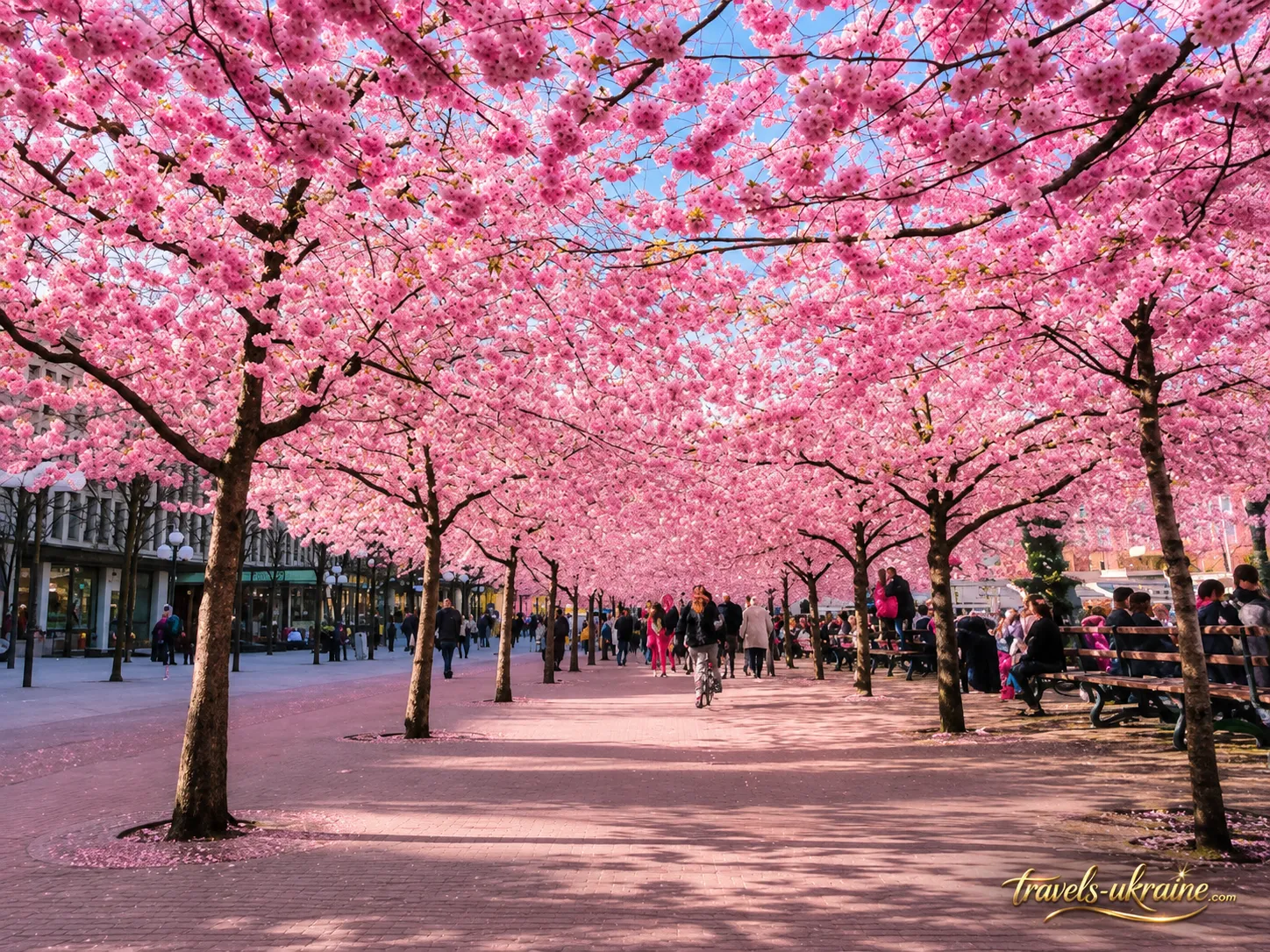
When it comes to the cherry blossom season in Uzhhorod, choosing the right travel date matters more than any list of attractions. You can visit the same streets just one week apart and see two completely different cities: first, the trees are only beginning to be covered with pink flowers; then come several days of peak bloom; and soon afterward, petals are already lying on the sidewalks, giving way to green leaves.
According to Uzhhorod’s official tourism portal, the main cherry blossom season traditionally falls in the second half of April, and the city remains «pink» for approximately two weeks. But these dates should not be treated as a fixed calendar. Spring arrives differently each year, so the peak can shift noticeably.
Why Do Cherry Trees Bloom on Different Dates Each Year?
The main factor is temperature. After a warm winter and rapid warming, trees wake earlier, while a cool March and early April can delay the opening of the buds. Even the location of an individual tree matters: on a sunny street, one cherry tree may already be fully pink, while several blocks away another is only preparing to open its buds.
In addition, Uzhhorod is home to trees of different ages and different ornamental forms of sakura, so they do not bloom at exactly the same time. This is why the season stretches out: one street may already be past its peak while trees on another are just beginning to develop color. A good example is the spring of 2026. Because of a sharp warm-up at the end of March, the first trees opened significantly earlier than usual, and by April 6, the beginning of mass blooming was being recorded in Uzhhorod. The peak was expected at the end of that same week. In other words, the usual rule of «traveling after mid-April» could easily have left a tourist arriving after the brightest wave this time.
How Long Does the Bloom Last, and How Can You Catch Uzhhorod’s Peak?
The most spectacular period for any individual tree is quite short. That is why the term «peak cherry blossom» refers not to the entire season but to the moment when most flowers have opened and the petals have not yet begun to fall en masse. Across Uzhhorod as a whole, you can enjoy the cherry blossoms for longer—approximately several weeks—as the trees open gradually. But if you want to see the dense pink crowns that almost completely conceal the branches, it is best to arrive during the narrow window of mass bloom.
Weather also affects how long this period lasts. Calm, cool days help the flowers remain in bloom longer, while strong wind, heavy rain, or a sharp rise in temperature can turn pink crowns into a «rain of petals» much faster. So the best strategy is not to plan your trip based solely on last year’s date. If sakura is the main purpose of your journey, start following current photographs and reports from Uzhhorod approximately a week before departure.
Local tourism resources, city pages, and recent posts are especially useful because they show the trees’ actual condition: still in bud, beginning to bloom, in full bloom, or already shedding petals. Check the situation again two or three days before your trip. If you can adjust your dates, leave yourself at least a few days of flexibility. For a seasonal natural phenomenon, this flexibility is far more valuable than a ticket bought six months in advance for the «traditionally correct» date of April 20.
What If You Arrive a Little Earlier or Later?
Even if you do not arrive exactly at the peak, the trip will not necessarily be a failure. At the beginning of the season, it is interesting to watch the pink buds gradually open, while after the peak the city enters another beautiful phase—petals spill across the embankments and sidewalks, creating a distinctive pink carpet. In addition, because the trees differ in age and location, you can almost always find cherry trees in another stage of bloom somewhere in the city. If one popular avenue is already shedding its petals, another street may look significantly better.
So, if you are wondering when it is best to travel to Uzhhorod for the cherry blossoms, the answer is this: generally aim for April, especially the middle and second half of the month, but always check the trees’ actual condition before setting out. In this case, a few fresh photographs from Uzhhorod may prove more useful than any calendar.
Where to See Cherry Blossoms in Uzhhorod: The Most Beautiful Streets and a Route
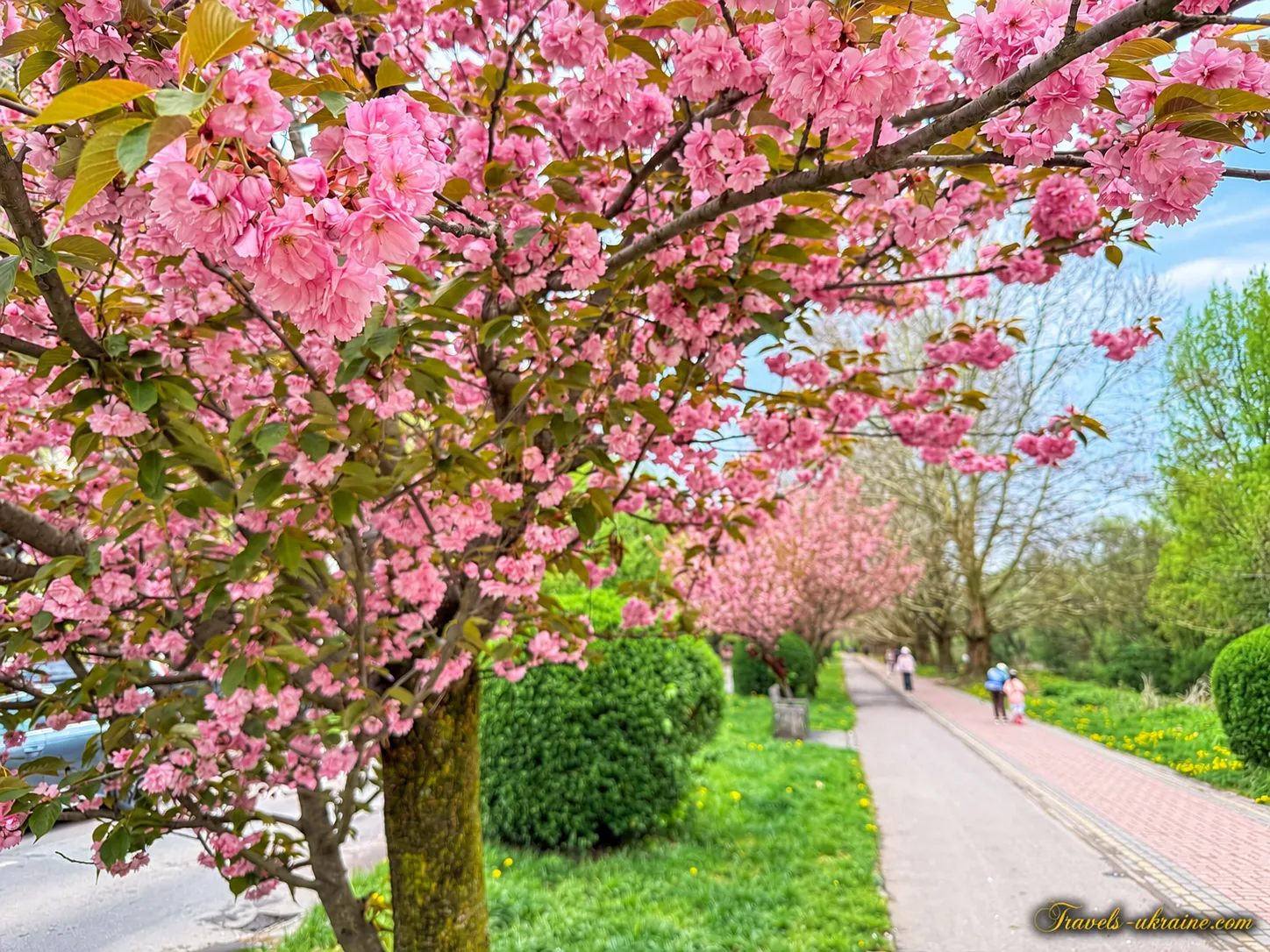
Cherry blossoms in Uzhhorod are not concentrated in a single park or on one specially created avenue. The pink trees are scattered throughout different parts of the city: old cherry trees grow among the architecture of Malу Galagov, newer avenues stretch along the embankments, and individual groups of trees can be found on Mytna Street, Druhetiv Street, Svobody Avenue, and other streets. That is why the best way to discover cherry-blossom Uzhhorod is not to look for one «main tree,» but to take a short walking route through the city. The official tourism portal has even created a separate cherry blossom map that can be used to plan your own walk. A complete tour of the main marked locations takes approximately 3–5 hours, but for a first visit it is perfectly sufficient to choose several of the most impressive areas.
Dovzhenko Street — the classic cherry-blossom Uzhhorod
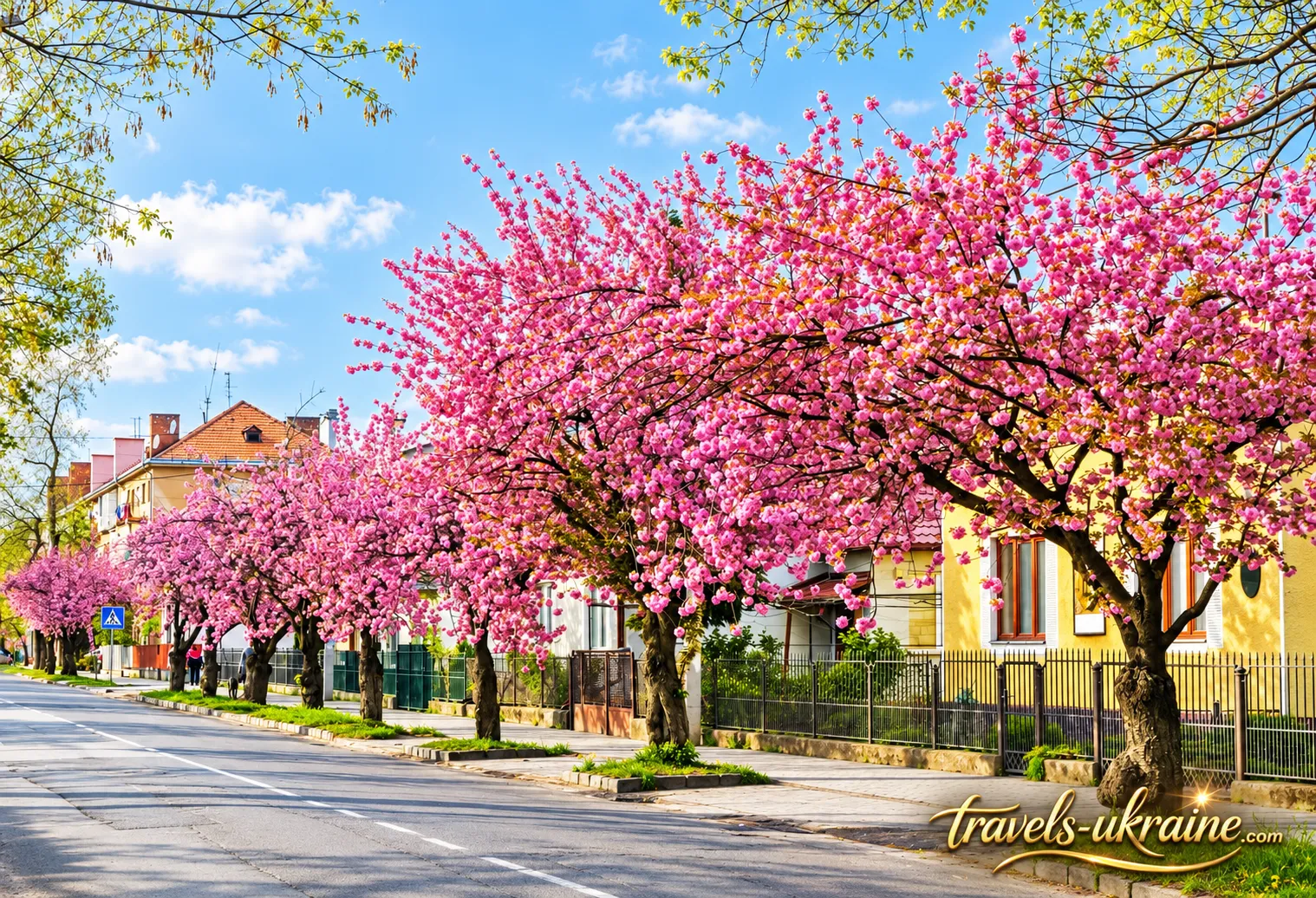
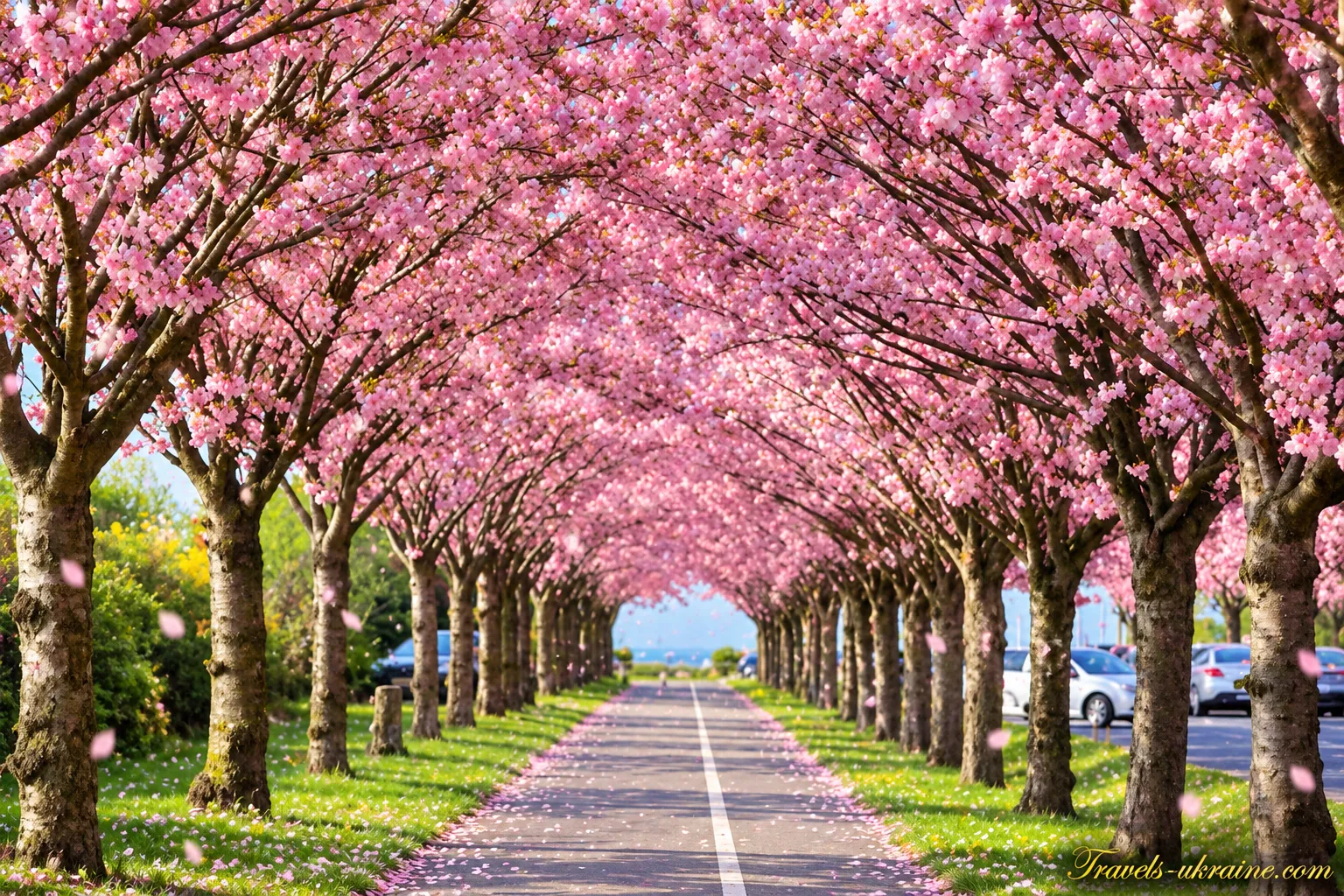
If I had to choose just one place, I would start with Dovzhenko Street. Some of the city’s oldest and most abundantly flowering cherry trees grow here. During peak bloom, their crowns almost meet above the street, creating a distinctive pink corridor. The surrounding architecture adds a special atmosphere. This is part of the historic Malyi Galagov district, developed during the Czechoslovak period. So alongside the cherry blossoms, your photos will feature not random modern high-rises, but restrained interwar architecture, old façades, fences, and quiet urban courtyards.
This is where you can best sense the Uzhhorod from which the city’s cherry-blossom story began. The official tourism portal calls Dovzhenko Street and the surrounding streets the place where the oldest and most abundant trees have been preserved.
Rakoczi Street and Malyi Galagov
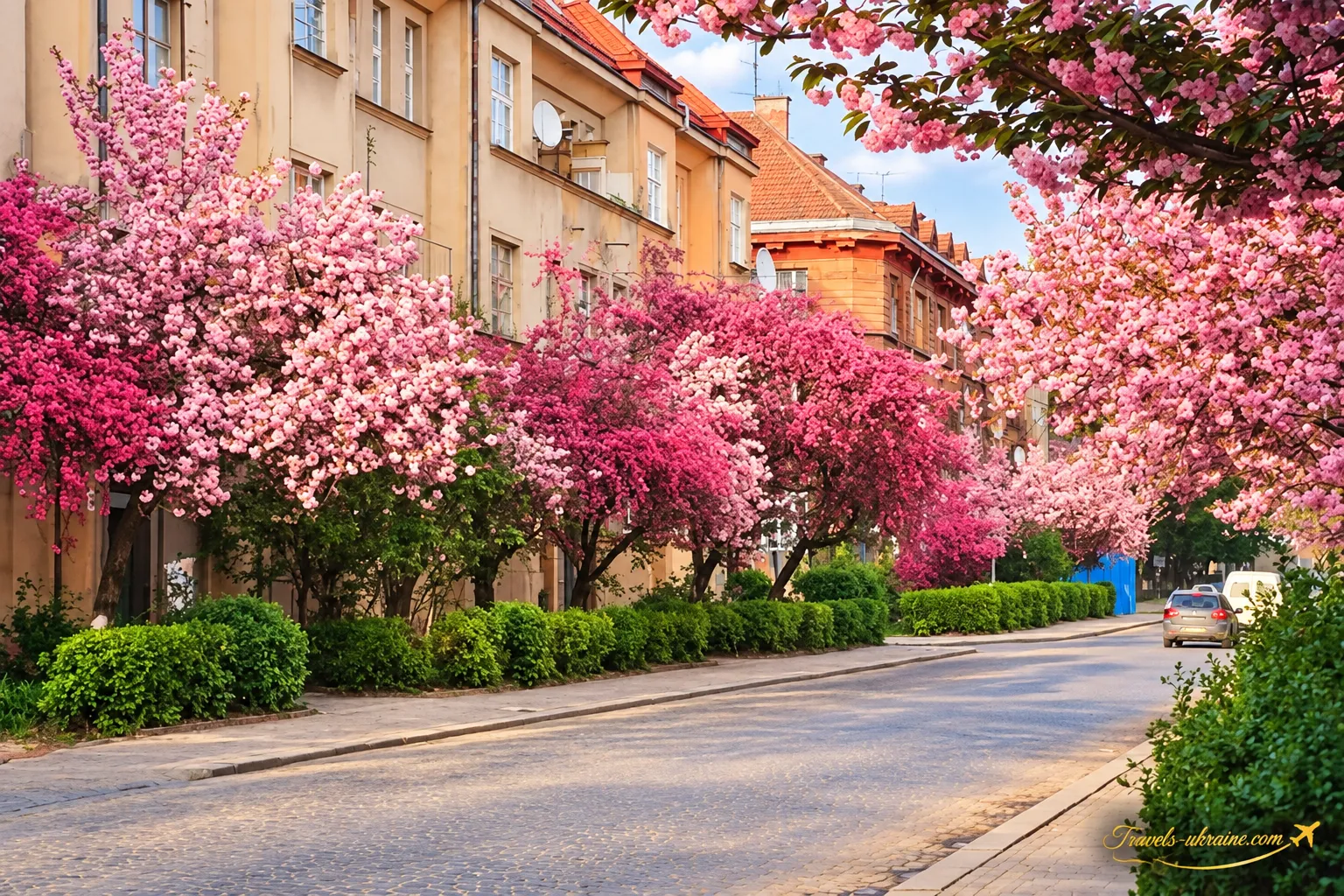
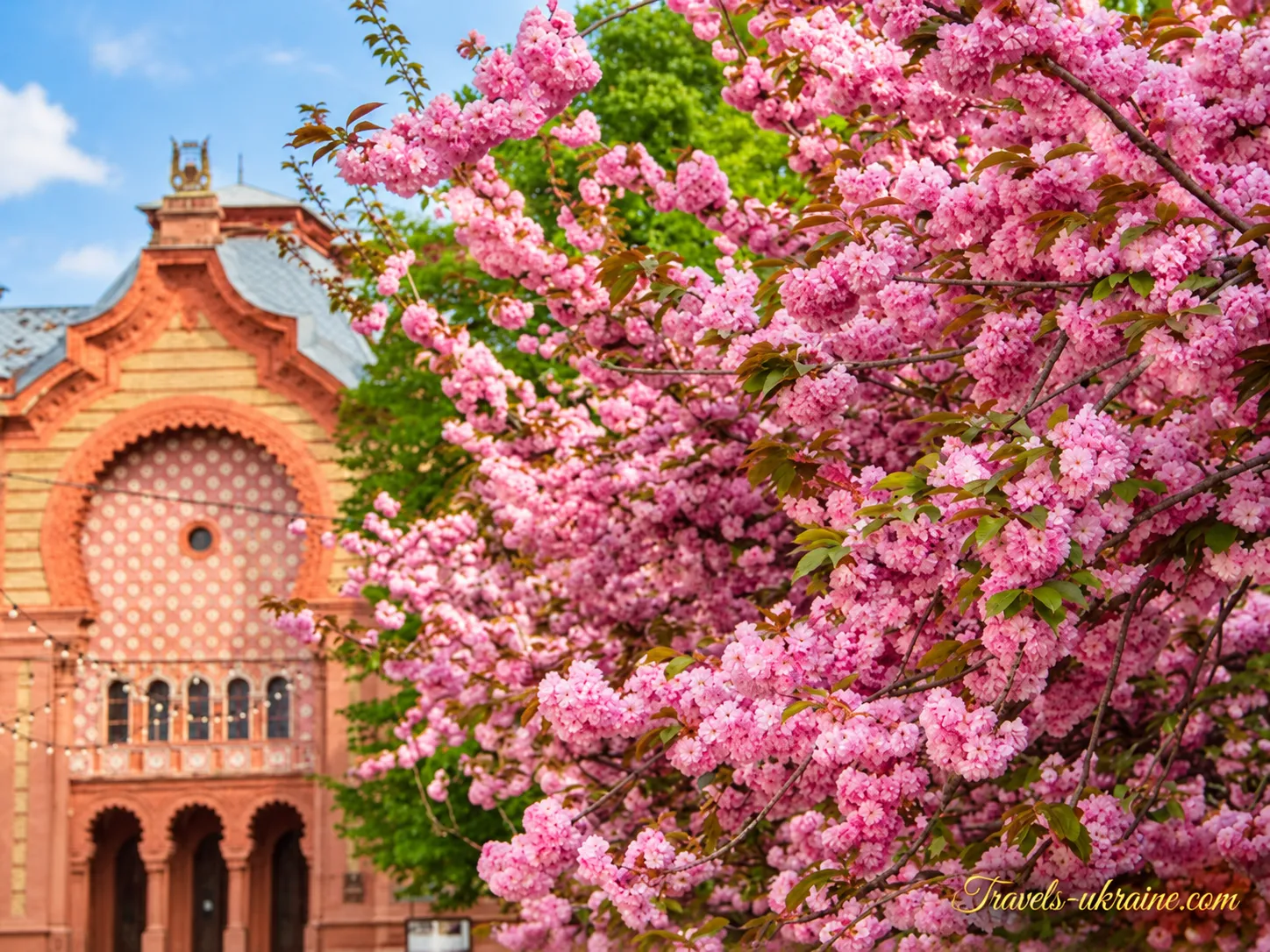
From Dovzhenko Street, it makes sense to continue your walk along Rakoczi Street and through the Malyi Galagov district. In spring, the entire area changes: pink trees appear among government buildings, residential houses, and the quiet streets of interwar Uzhhorod. This part of the route is interesting because the cherry blossoms are not separated from the city—they are literally integrated into its architecture. You can admire unusual doors, façades, and Constructivist details while moving from one flowering tree to the next.
If you enjoy not only photographing flowers but also simply walking around a city, I would rank Malyi Galagov during cherry-blossom season among Uzhhorod’s best locations.
Kyiv and Slovianska Embankments — a long walk along the Uzh
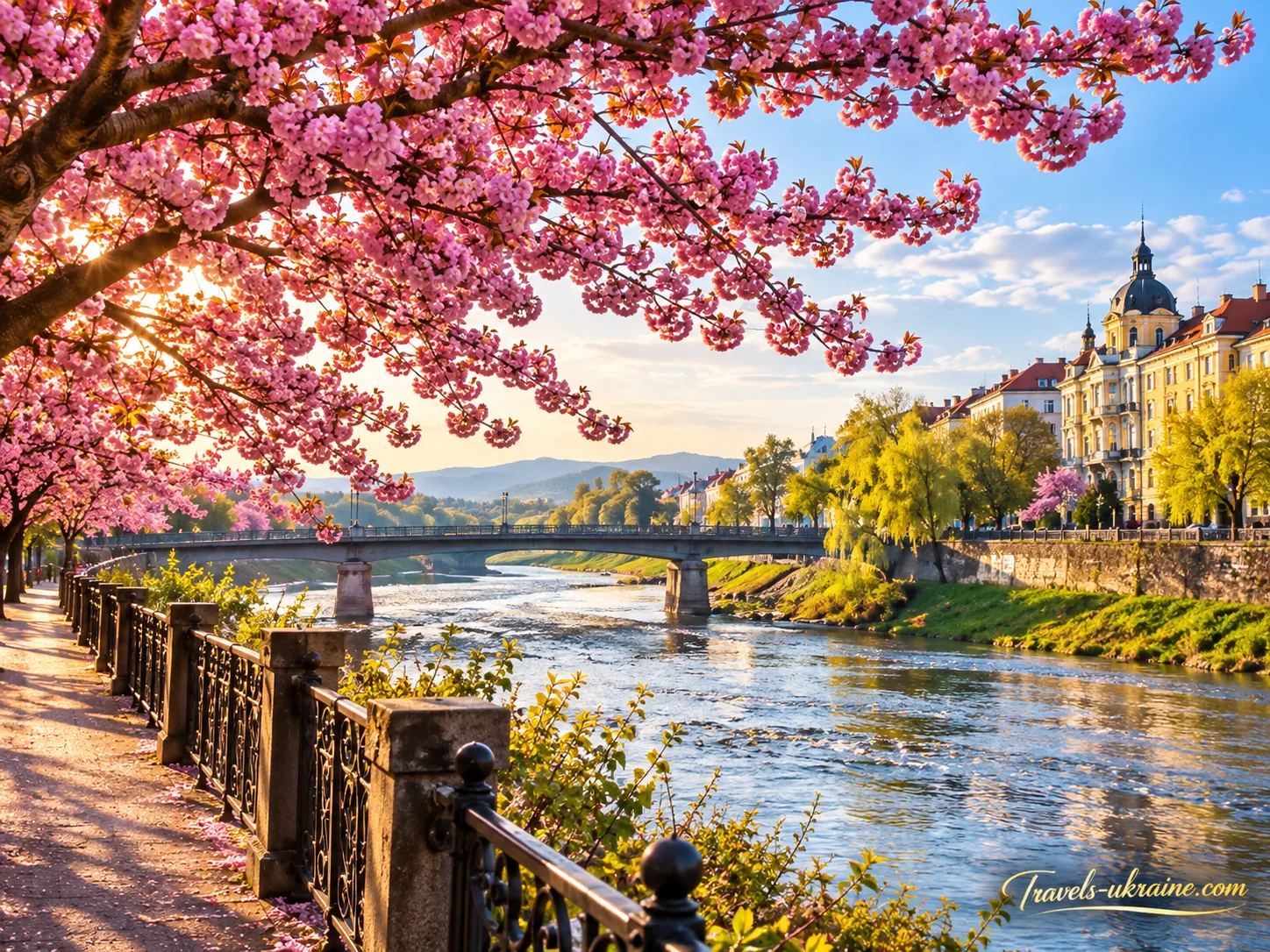
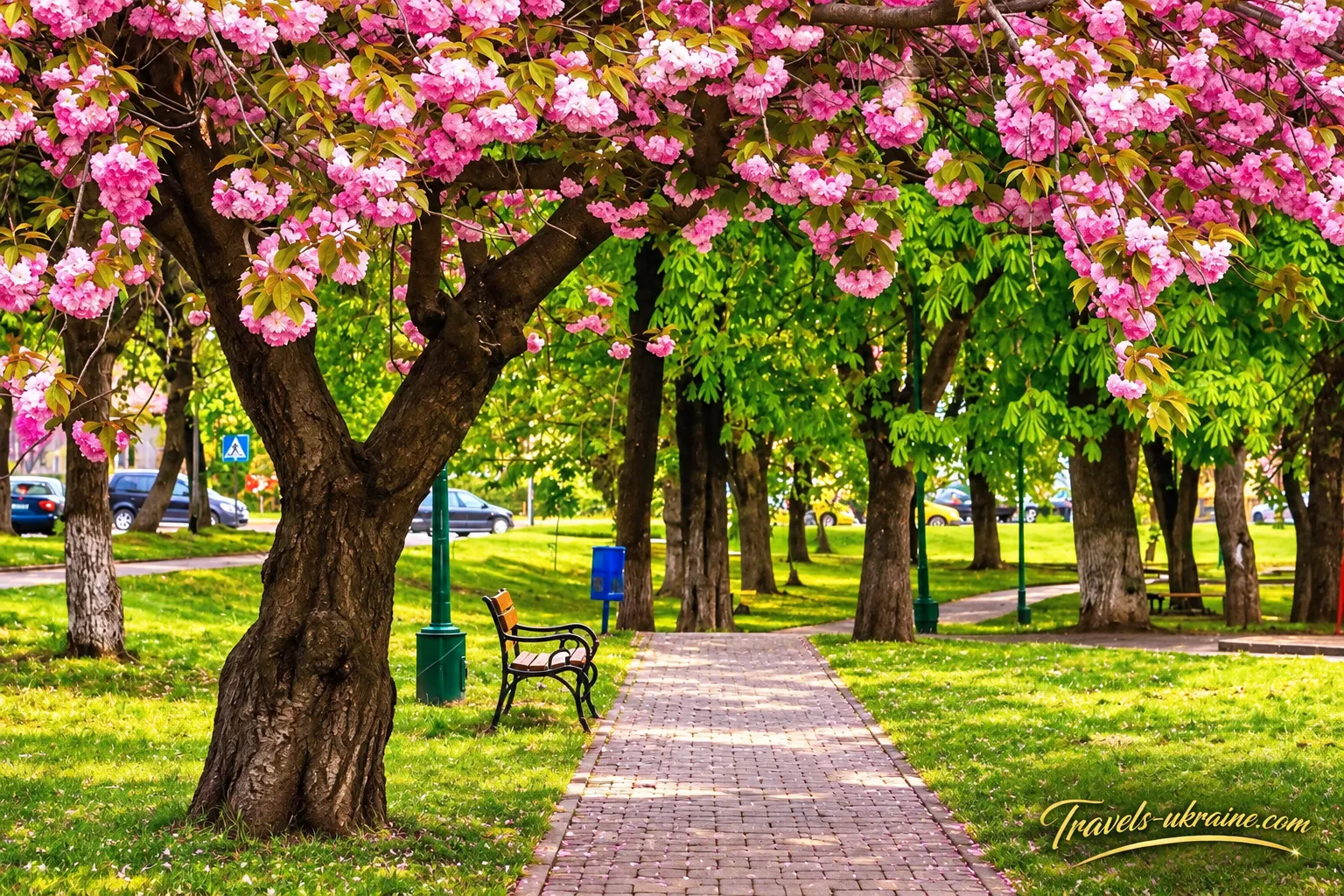
The cherry trees along the Kyiv and Slovianska Embankments have a different character. The new avenues were planted in 2020, so these are not the century-old trees found in the old part of the city. Instead, the embankments offer more space and are ideal for an unhurried walk by the river. They are especially pleasant in the afternoon: pink trees on one side, the Uzh on the other, and a route that can continue along the water without constant traffic and narrow pavements. The city’s official tourism portal identifies the embankment as the site of one of Uzhhorod’s largest cherry-tree avenues.
Druhetiv and Mytna Streets — cherry blossoms away from the main tourist crowds
Two more well-known cherry-blossom spots are Druhetiv and Mytna Streets. They are among the streets of old Uzhhorod with the highest concentration of cherry trees. These locations are especially interesting if the most popular areas around Dovzhenko Street are already crowded with photographers. The blossoms here can be just as impressive, while the atmosphere is often quieter. In addition, trees in different parts of the city do not bloom at exactly the same time, so at the beginning or end of the season it is worth checking several districts.
Svobody Avenue and other cherry-blossom spots
Svobody AvenueSvobody Avenue and other districts of Uzhhorod, and new plantings continue to appear. That is why the modern cherry blossom map is much broader than the traditional tourist route through Malyi Galagov. If you have only a few hours, there is no point trying to visit absolutely every tree. It is much more enjoyable to choose two or three outstanding locations and leave time for coffee, the embankment, and the old town.
The best cherry-blossom route in Uzhhorod
- Dovzhenko Street — old cherry trees and classic photographs;
- Rakoczi Street and Malyi Galagov — cherry blossoms among interwar architecture;
- the historic centre — a short break for a walk and coffee;
- the Uzh embankments — a more spacious route along the river;
- if time permits — Mytna or Druhetiv, depending on the current state of the bloom.
This route should not be treated as a rigid plan. During cherry-blossom season, the most interesting discoveries sometimes happen between planned stops: you turn onto a neighbouring street and find a tree with no crowds of photographers, even though it is blooming just as beautifully as the famous avenue.
For those who want to take the most comprehensive route possible, the official Uzhhorod tourism portal offers a tree map and interactive cherry blossom map. They mark trees and avenues near the city’s main tourist routes. A complete tour of these locations takes approximately 3–5 hours.
What to see in Uzhhorod during cherry-blossom season
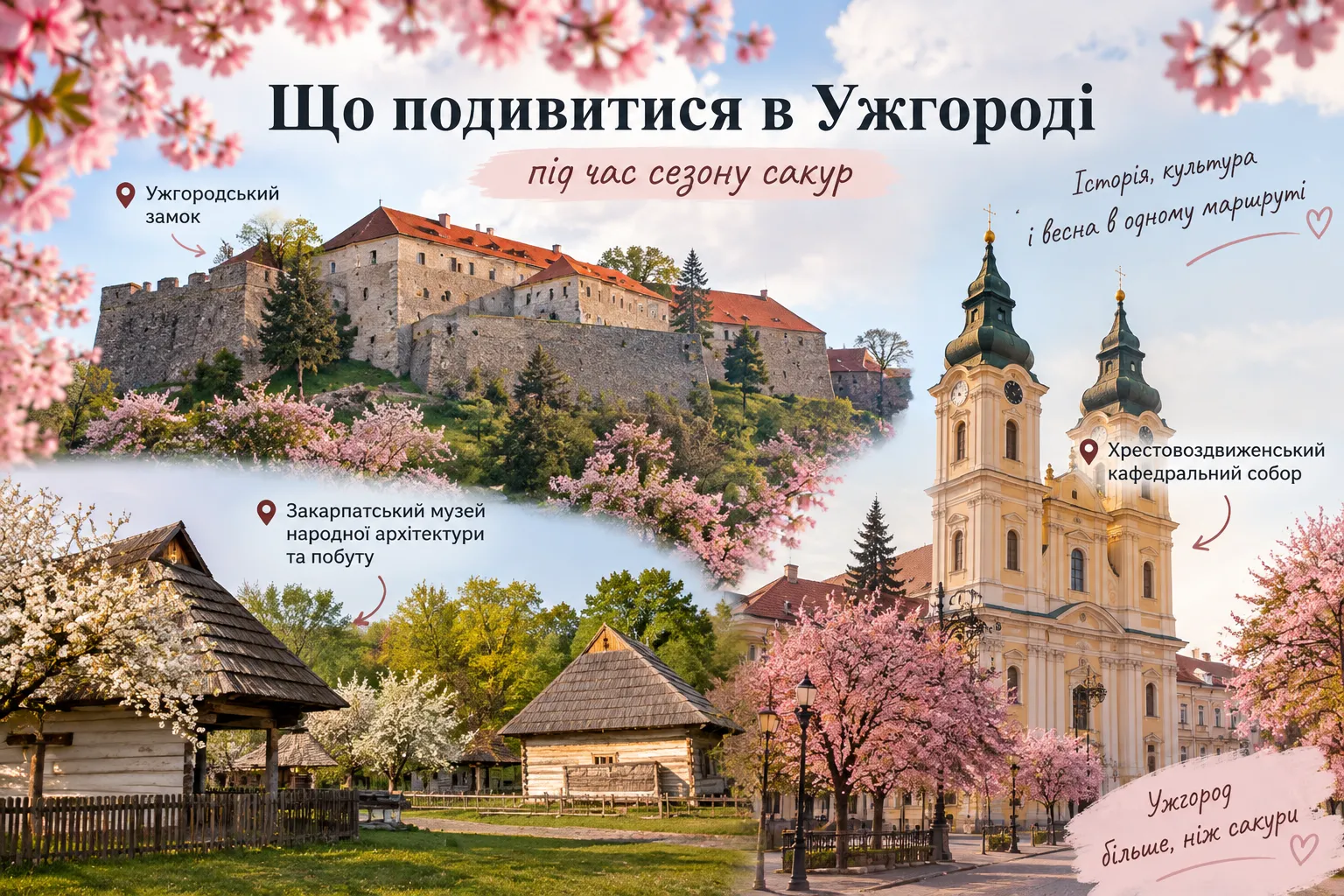
It would be a shame to come to Uzhhorod just for a few photographs beneath pink trees. Cherry-blossom season combines perfectly with a walk through the old town: from the flowering streets of Malyi Galagov, you can gradually make your way to the historic centre, the cathedrals, and Castle Hill. As a result, the cherry blossoms become not a separate photo spot, but a beautiful part of an entire day in Uzhhorod.
Uzhhorod Castle — fortress, palace, and museum
One of your main stops should be Uzhhorod Castle. It is more than just old walls on a hill: inside, you will find bastions, the Druhet Palace, an inner courtyard, the ruins of a medieval church, and the Transcarpathian Regional Museum of Local Lore, which operates in the palace itself. The castle is also conveniently located close to the city centre. After visiting the cherry-blossom streets, you can gradually walk up Kapitulna Street, spend approximately one and a half to two hours here, and then continue your route on foot.
Transcarpathian Museum of Folk Architecture and Life
Located practically beside the castle walls is the Transcarpathian Museum of Folk Architecture and Life—an open-air museum containing traditional homes and farm buildings from different parts of Transcarpathia. After walking through modern streets lined with cherry blossoms, you can enter another world within just a few minutes: wooden houses, old homesteads, traditional clothing, household objects, and the architecture of the Boykos, Hutsuls, Dolynians, and other ethnic groups of the region.
The combination of the castle and the open-air museum is especially effective: first you see an aristocratic residence and military fortress, and then how ordinary residents of Transcarpathia lived over the centuries. And you do not even need to travel to another part of the city.
Holy Cross Cathedral and old Kapitulna Street
Another logical stop is the Greek Catholic Cathedral of the Exaltation of the Holy Cross. Its two tall towers form one of the most recognisable silhouettes of historic Uzhhorod, while Kapitulna Street itself is well suited to an unhurried walk between the castle and the centre. The church’s history is also connected with the Druhet family: in the XVII century, Janos Druhet invited the Jesuits to Uzhhorod and helped establish the church complex, which later passed to the Greek Catholic diocese.
In spring, the contrast is particularly striking: just a few minutes earlier, you were photographing pink cherry blossoms among the modernist buildings of Malyi Galagov, and now you find yourself among old stone streets, Baroque architecture, and castle walls.
Frequently asked questions about cherry blossoms in Uzhhorod
When do cherry blossoms bloom in Uzhhorod?
Traditionally, the main cherry-blossom period in Uzhhorod falls in April, often in the middle and second half of the month. However, the exact timing depends on the temperatures of a particular spring: after an early warm spell, peak bloom may begin significantly sooner. It is therefore best to check current photographs and updates from the city before your trip.
How long does the cherry blossom season last?
Across the city, the cherry-blossom season usually lasts approximately several weeks, as different trees do not open fully at exactly the same time. The peak bloom of an individual tree is much shorter. Strong winds, heavy rain, or a sudden rise in temperature can accelerate petal fall.
Where are the most cherry trees in Uzhhorod?
Among the best-known cherry-blossom locations are Dovzhenko, Rakoczi, and Druhetiv Streets, the Malyi Galagov district, and the Kyiv and Slovianska Embankments. Some of the oldest and most abundantly flowering trees grow on Dovzhenko Street and the neighbouring streets.
How much time is needed for a cherry-blossom route in Uzhhorod?
Approximately 1.5–2 hours is enough for several of the main cherry-blossom streets. If you want to visit most of the locations marked on the city’s official tree map, the Uzhhorod tourism portal recommends allowing approximately 3–5 hours.
Do you have to pay to see the cherry blossoms in Uzhhorod?
No. Cherry trees grow directly on city streets, embankments, and in public spaces, so there is no separate charge to see them. Admission tickets are needed only if you combine your cherry-blossom walk with visits to museums, the castle, or other paid tourist attractions.
When is the best time to photograph cherry blossoms in Uzhhorod?
For less crowded photographs, it is best to come early in the morning on a weekday. The last hour before sunset is also ideal for warm, gentle light. On the most popular streets, weekends during peak bloom can be very crowded.
Is it worth visiting the cherry blossoms with children?
Yes. Most cherry-blossom routes follow ordinary city streets and embankments, so there are no difficult sections. The Uzh embankments are especially convenient for a family walk, as they offer more open space. Just explain to children that tree branches must not be broken or pulled down for photographs.
Is it worth going if peak bloom has already passed?
Yes, if you are prepared for less abundant flowering. Cherry trees in different parts of Uzhhorod do not bloom fully at the same time, so after peak bloom has ended on one street, you may find trees still flowering beautifully in another district. Mass bloom is also followed by a beautiful period of falling pink petals.
How can you find out whether the cherry blossoms are blooming in Uzhhorod now?
Before your trip, check the official Uzhhorod tourism portal, current city updates, and recent photographs from the main cherry-blossom streets. To find specific trees, you can use the official tree map and interactive Uzhhorod cherry blossom map.
Uzhhorod in spring: a city you will want to return to
Cherry blossom season in Uzhhorod is not about a single avenue or a few trees where you have to take a quick photo. For several weeks each spring, pink canopies become part of the city itself: they appear amid the architecture of Malyi Galagov, along the embankments, on old streets, and in ordinary urban neighborhoods. The most fascinating thing is the combination. You can start the morning among the cherry trees on Dovzhenko and Rákóczi, walk along the Uzh Embankment, and within a few hours find yourself by the walls of Uzhhorod Castle, in the old cathedral quarter, or among traditional Zakarpattian houses at the open-air museum. That is why a trip to see the cherry blossoms can easily become a full introduction to Uzhhorod and an engaging tourist route through Zakarpattia.
There is just one challenge: cherry blossoms do not follow the tourist calendar. Peak bloom depends on the spring weather and can shift by several weeks. That is why, before your trip, it is better to check the current condition of the trees rather than rely solely on dates from previous years. Perhaps it is precisely this brief season that makes the cherry blossoms so special. The pink streets last for only a short time: just a few days ago, there were buds on the branches; then the city was covered in pink bloom; and soon the petals are already carpeting the sidewalks.
If you are wondering when to see Uzhhorod at its most atmospheric, cherry blossom season is one of the best times to visit. The key is to choose the right date, not limit yourself to a single popular avenue, and allow yourself to simply wander through the city without rushing. That is how a few pink trees become more than just a beautiful photo—they become a vivid spring memory of Uzhhorod.





No Comment
You can post first response comment.